
2027 How to Become a Substance Abuse Counselor in North Carolina

Co-Founder and Chief Data Scientist
If you want to become a substance abuse counselor in North Carolina, the main decision is not simply which school to attend. You need to understand which credential fits your career goal, how much education and supervised experience you will need, what the North Carolina Substance Abuse Professional Practice Board expects, and whether the salary and day-to-day work match the life you want. This guide explains the path from entry-level preparation to advanced counseling roles, including education options, certification steps, legal duties, salary expectations, job market conditions, continuing education, burnout risks, and practical ways to choose the right training route.
Quick answer: How do you become a substance abuse counselor in North Carolina?
To become a substance abuse counselor in North Carolina, you generally start with a high school diploma or GED for entry-level intern roles, complete addiction-specific education, gain supervised clinical experience, apply through the North Carolina Substance Abuse Professional Practice Board, pass the required exam, and maintain your credential through continuing education. A bachelor’s degree can improve entry-level opportunities, while a master’s degree is commonly needed for more advanced clinical roles such as Licensed Clinical Addiction Specialist.
Key Things You Should Know About Becoming a Substance Abuse Counselor in North Carolina
- North Carolina needs more addiction treatment professionals. The North Carolina Department of Health and Human Services has reported a need for over 1,000 additional professionals in the field, creating openings for new counselors as treatment demand grows.
- Pay is meaningful but varies by role and setting. The Bureau of Labor Statistics (2023) places the average salary for substance abuse counselors in North Carolina at approximately $47,000 per year, with some counselors earning upwards of $60,000 in metropolitan areas.
- Long-term demand is strong. Employment for substance abuse counselors in North Carolina is projected to grow 23% from 2021 to 2031, supported by opioid-related treatment needs and broader recognition of mental health care.
- North Carolina may offer a workable cost-of-living balance. Cities such as Charlotte and Raleigh have a cost of living index about 5-10% lower than the national average, which can make a counselor’s salary go further than in some higher-cost states.
- The Licensed Clinical Addiction Specialist credential can expand your options. LCAS typically requires a master’s degree, supervised experience, and a state exam, and it can qualify counselors for more advanced clinical and leadership responsibilities.
- How can you become a substance abuse counselor in North Carolina?
- What is the minimum educational requirement to become a substance abuse counselor in North Carolina?
- What does a substance abuse counselor do?
- What is the certification and licensing process for a substance abuse counselor in North Carolina?
- What legal and ethical considerations must a substance abuse counselor consider in North Carolina?
- How much can you earn as a substance abuse counselor in North Carolina?
- What is the job market like for a substance abuse counselor in North Carolina?
- What innovative, evidence-based practices are emerging in substance abuse counseling in North Carolina?
- How can cross-disciplinary training enhance your practice in North Carolina?
- How Can Advanced Education Impact Your Counseling Effectiveness in North Carolina?
- How Can Integrating Forensic Expertise Enhance Your Substance Abuse Counseling Practice in North Carolina?
- Can substance abuse counselors transition into behavior analysis roles in North Carolina?
- How can integrating family-focused practices improve counseling outcomes in North Carolina?
- What financial support options are available for aspiring substance abuse counselors in North Carolina?
- How can collaboration with criminal justice professionals enhance substance abuse counseling outcomes in North Carolina?
- What career and advancement opportunities are available for a substance abuse counselor in North Carolina?
- What professional development and continuing education opportunities are available for substance abuse counselors in North Carolina?
- What challenges should you consider as a substance abuse counselor in North Carolina?
- How can substance abuse counselors manage burnout and maintain well-being in North Carolina?
How can you become a substance abuse counselor in North Carolina?
The path to substance abuse counseling in North Carolina is credential-based. Your exact route depends on whether you want an entry-level support role, a certified addiction counseling position, or a more advanced clinical role that requires graduate education.
- Choose the right education level. A high school diploma or GED can support entry-level intern registration, but many employers prefer a bachelor’s degree in psychology, counseling, social work, human services, or a related field. Advanced clinical work often requires a master’s degree.
- Take addiction-specific coursework. Your training should cover addiction theory, treatment planning, counseling ethics, assessment, relapse prevention, co-occurring disorders, and documentation.
- Complete supervised practice. North Carolina credentials require hands-on experience, including supervised work in clinical or treatment settings.
- Apply through the state board. The North Carolina Substance Abuse Professional Practice Board reviews applications, education, experience, ethics documentation, and fees.
- Pass the required exam. Certification is not complete until you meet the examination requirement for the credential you are pursuing.
- Build a focused resume. Employers will look for addiction treatment training, supervised experience, documentation skills, crisis response ability, and familiarity with ethical and confidentiality standards.
- Apply strategically. Treatment centers, hospitals, community agencies, residential programs, correctional settings, and outpatient clinics may all hire addiction counseling professionals.
| Path | When it makes sense | Typical education focus | Career direction |
| Entry-level intern or support role | You want to enter the field quickly and build supervised experience | High school diploma or GED plus required training | Intern, aide, recovery support, case support |
| Bachelor’s-prepared counselor pathway | You want stronger job prospects and a broader human services background | Psychology, social work, counseling, addiction studies, or human services | Substance abuse counseling, case management, program support |
| Master’s-level clinical pathway | You want advanced clinical responsibilities or LCAS preparation | Clinical counseling, mental health counseling, social work, or related graduate study | Clinical addiction practice, supervision, leadership, specialized treatment |
North Carolina schools such as the University of North Carolina at Chapel Hill, North Carolina State University, and the University of North Carolina at Greensboro may be relevant starting points for students comparing counseling, psychology, social work, or addiction-focused preparation. If you are also comparing requirements across states, Research.com’s guide to licensed counselor roles in Alabama can help you see how pathways differ by jurisdiction.
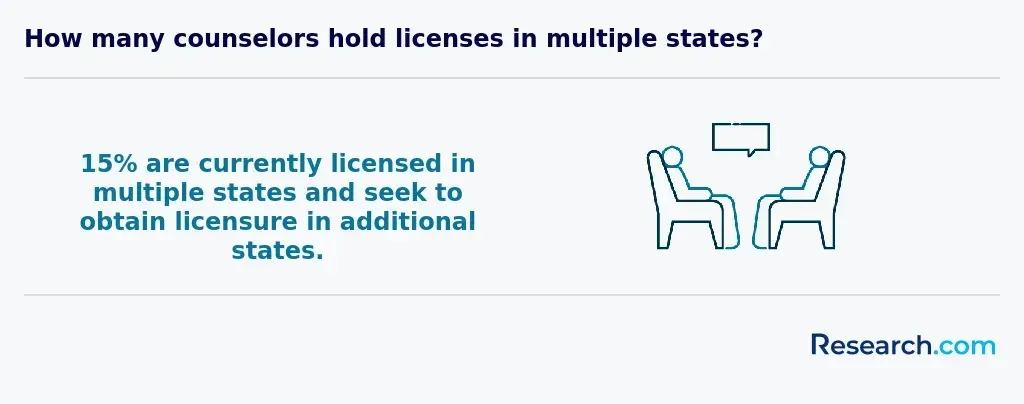
Multistate practice is becoming more relevant as counselors consider telehealth, relocation, and interstate career options. Currently, 15% of counselors are licensed in multiple states and seek to obtain licensure in additional states, as shown below.
What is the minimum educational requirement to become a substance abuse counselor in North Carolina?
The minimum education depends on the credential and job level. A high school diploma or GED can qualify someone to begin in an entry-level path such as Substance Abuse Counselor Intern, but a bachelor’s degree is often a better foundation for employment and advancement. A master’s degree is commonly expected for advanced clinical positions, including roles tied to LCAS preparation.
- Minimum starting point: A high school diploma or GED can open the door to certain intern-level roles.
- Recommended undergraduate preparation: A bachelor’s degree in psychology, social work, counseling, human services, or a related discipline can improve competitiveness.
- Advanced clinical preparation: A master’s degree in clinical counseling or a related field is often needed for higher-level practice.
- Core topics: Addiction theory, counseling ethics, treatment methods, assessment, case documentation, relapse prevention, and client education are central to the work.
- Program length: A bachelor’s degree generally takes about four years, while a master’s program usually adds two to three years.
- Cost range: Bachelor’s degree tuition can range from $20,000 to $50,000, while master’s programs often cost between $30,000 and $60,000.
- Practical training: Supervised internships or clinical placements matter because employers and credentialing boards need evidence that you can apply counseling concepts with real clients.
- Accreditation: Choose accredited programs so your coursework is more likely to be accepted for credentialing, employment, graduate study, and financial aid eligibility.
| Education level | Best for | Time commitment stated in this guide | Cost range stated in this guide |
| High school diploma or GED | Entry-level intern preparation | Varies by training route | Varies by provider |
| Bachelor’s degree | Students who want stronger entry-level options and graduate school readiness | About four years | $20,000 to $50,000 |
| Master’s degree | Future advanced clinicians, supervisors, and LCAS-focused candidates | Additional two to three years | $30,000 to $60,000 |
The University of North Carolina at Greensboro is one example of a North Carolina institution with clinical mental health counseling preparation that can support students interested in substance abuse work. Students who want to compare broader counseling pathways can also review Research.com’s overview of counseling career growth.
What does a substance abuse counselor do?
A substance abuse counselor helps people understand, manage, and recover from substance use disorders. The role combines assessment, counseling, education, treatment planning, relapse prevention, documentation, and coordination with other professionals.
- Evaluate clients to understand substance use patterns, co-occurring concerns, safety risks, and treatment needs.
- Create individualized treatment plans based on the client’s goals, history, supports, and level of care.
- Lead individual counseling sessions and group counseling sessions focused on recovery skills, motivation, coping strategies, and relapse prevention.
- Teach clients and families about addiction, recovery, triggers, support systems, and treatment expectations.
- Track progress, update care plans, and document services according to agency and legal standards.
- Coordinate with physicians, mental health clinicians, social workers, probation officers, family members, and community resources when appropriate.
Skills that matter most
- Empathy: Clients are often dealing with shame, loss, trauma, legal stress, or family conflict. A judgmental approach can shut down progress quickly.
- Clear communication: Counselors must explain treatment plans, boundaries, risks, and recovery strategies in language clients can use.
- Clinical judgment: The work often involves relapse risk, crisis concerns, co-occurring mental health issues, and complex family dynamics.
- Patience: Recovery is rarely linear, and counselors must support clients through setbacks without losing focus.
- Organization: Accurate notes, treatment plans, referrals, and compliance documentation are essential.
-
: "
“I graduated from the University of North Carolina at Greensboro, and the work reminds me daily that recovery is not only about stopping substance use. It is also about helping people rebuild trust, routines, relationships, and hope.”
"
What is the certification and licensing process for a substance abuse counselor in North Carolina?
North Carolina’s substance abuse counseling credentials are overseen by the North Carolina Substance Abuse Professional Practice Board. The board sets requirements for education, supervised experience, ethics, examination, and credential renewal.
A common route is the Certified Substance Abuse Counselor credential. Applicants must complete a minimum of 270 hours of board-approved education, including training in substance abuse topics, HIV/AIDS education, and professional ethics. Candidates also complete 300 hours of supervised practicum experience in a clinical setting.
Applicants must complete a criminal background check and submit fingerprints. Prior convictions are reviewed individually, but applicants who are currently serving an active sentence, including probation, are ineligible for registration.
The application packet includes a resume, Ethics Agreement, job description, and a non-refundable registration fee of $125. Candidates must also complete a three-hour ethics training course. After the education and supervised practice requirements are met, candidates take the required certification examination. The examination fee is $125.
| Requirement | What applicants should verify |
| Board-approved education | At least 270 hours, including required topic areas |
| Supervised practicum | 300 hours in a relevant clinical setting |
| Ethics training | Three-hour ethics training course |
| Application fee | Non-refundable registration fee of $125 |
| Exam fee | $125 |
| Background check | Fingerprint submission and review of criminal history |
Common application mistakes to avoid
- Submitting coursework that has not been confirmed as board-approved.
- Counting supervised hours incorrectly or failing to document them clearly.
- Leaving out the resume, Ethics Agreement, job description, fee, or ethics course documentation.
- Assuming an online program automatically satisfies North Carolina credentialing requirements.
- Waiting until the end of a degree program to check whether the coursework fits the credential you want.
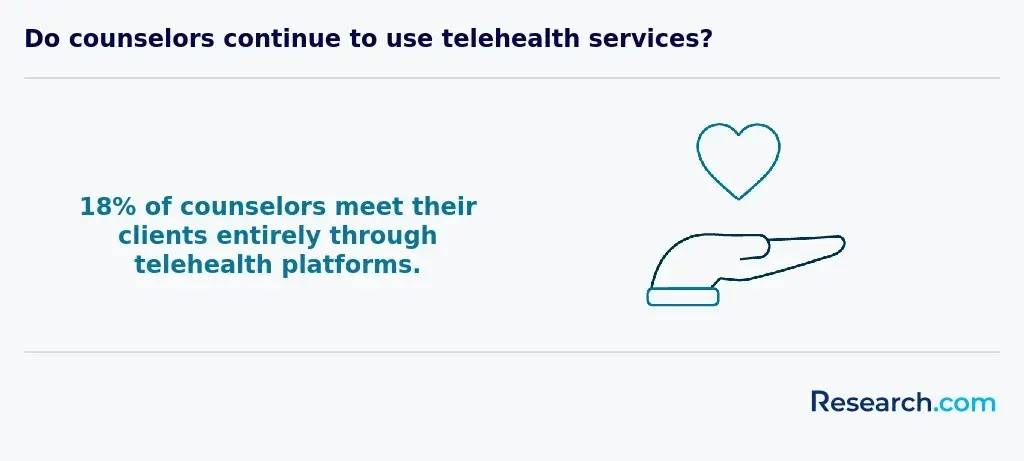
Telehealth is also changing how counselors work. This matters for credential planning because 18% of counselors meet their clients entirely through telehealth platforms.
Before applying, speak with supervisors, credentialed counselors, and the state board if you are unsure how your education or experience will be evaluated. If you are comparing licensure mobility or alternate state pathways, Research.com’s guide to South Dakota LPC careers may provide useful context.
What legal and ethical considerations must a substance abuse counselor consider in North Carolina?
Substance abuse counselors in North Carolina handle sensitive information and work with clients who may face medical, legal, family, employment, and safety consequences. Ethical practice is not optional; it protects clients, employers, and counselors.
- Mandatory reporting: Counselors are mandated reporters and must report suspected child abuse or neglect according to applicable law.
- State board compliance: Counselors must follow North Carolina Substance Abuse Professional Practice Board rules on qualifications, professional conduct, supervision, and credential maintenance.
- Confidentiality: Counselors must follow HIPAA and 42 CFR Part 2 requirements that protect substance use treatment records and client privacy.
- Boundaries: Dual relationships can damage trust and create ethical violations. Counselors must avoid relationships that blur professional and personal roles.
- Documentation: Treatment plans, progress notes, releases of information, referrals, and discharge plans should be accurate, timely, and compliant.
- Client rights: Clients must understand informed consent, confidentiality limits, treatment options, and how their information may be shared.
If you are considering broader clinical licensure beyond addiction counseling, review Research.com’s guide on how to become a licensed counselor in North Carolina.
How much can you earn as a substance abuse counselor in North Carolina?
Substance abuse counselors in North Carolina earn an average salary of approximately $47,000 per year, with a median salary around $45,000. The national average is around $50,000 for substance abuse counselors. North Carolina salaries may be lower than the national figure, but the state’s moderate cost of living can improve the practical value of that income.
| Salary factor | How it can affect earnings |
| Credential level | Advanced credentials such as LCAS can support access to higher-responsibility roles. |
| Education | Master’s-level preparation may qualify counselors for more clinical and supervisory positions. |
| Location | Metropolitan areas such as Charlotte, Raleigh, and Greensboro may offer more openings and stronger pay potential. |
| Work setting | Hospitals, residential treatment centers, outpatient agencies, government programs, and private organizations may have different pay structures. |
| Experience | Supervision, program management, specialty training, and years in the field can influence compensation. |
Higher-paying career directions
- Clinical Director
- Substance Abuse Program Manager
- Licensed Professional Counselor specializing in addiction
North Carolina locations to compare
- Charlotte: The state’s largest city has a broad healthcare and behavioral health market.
- Raleigh: The capital region includes universities, healthcare systems, and public-sector opportunities.
- Greensboro: Demand for mental health and addiction services can create opportunities for qualified counselors.
Salary should be part of the decision, but not the only factor. Candidates should compare debt, credentialing costs, work setting, caseload expectations, supervision quality, and the emotional demands of the role. For broader clinical counseling routes, see Research.com’s guide to North Carolina LPC careers.
What is the job market like for a substance abuse counselor in North Carolina?
The job market for substance abuse counselors in North Carolina is favorable, but it is not equally easy for every applicant. The North Carolina Department of Commerce projects demand for substance abuse counselors to grow by 18% over the next decade, significantly higher than the national average. The strongest candidates usually combine relevant education, documented supervised experience, credential readiness, and comfort working with co-occurring mental health and social service needs.
- Compensation: The average salary for a substance abuse counselor in North Carolina ranges from $40,000 to $55,000 annually, depending on experience and location.
- Benefits: Employers may offer health insurance, retirement plans, and continuing education support, though packages vary widely.
- Competition: Urban areas such as Charlotte and Raleigh can attract more applicants, so advanced degrees and specialized credentials can help.
- Growth options: Counselors can move into supervision, trauma-informed care, family-based treatment, program coordination, or clinical leadership.
- Location trade-offs: Rural areas may have fewer resources but strong community need; urban areas may offer more employers but more competition.
Substance use patterns also help explain why addiction treatment remains a public concern. Among adults aged 18 and older in the United States, 18.7% reported marijuana use in the past year, 3.6% reported opioid use, 3.5% reported prescription pain medication use, 2.4% reported prescription sedative use, 2.0% reported cocaine use, 1.9% reported prescription stimulant use, 1.0% reported methamphetamine use, 1.0% reported LSD use, and 0.4% reported heroin use.
These figures show why treatment systems need counselors who understand prevention, assessment, recovery planning, relapse risk, and referral coordination.
What innovative, evidence-based practices are emerging in substance abuse counseling in North Carolina?
North Carolina substance abuse counselors are increasingly expected to use evidence-based approaches rather than relying only on supportive conversation. Commonly used practices include cognitive behavioral therapy, motivational interviewing, trauma-informed care, medication-assisted treatment coordination, relapse prevention planning, and integrated support for co-occurring mental health concerns.
Telehealth has also become part of modern addiction treatment. It can reduce access barriers for clients who live far from providers, lack transportation, or need flexible scheduling. At the same time, counselors must understand privacy rules, crisis planning, documentation standards, and whether telehealth is clinically appropriate for a particular client.
Because clients often need help beyond addiction treatment alone, counselors may benefit from understanding adjacent roles in social work, therapy, and psychology. Research.com’s comparison of social worker vs psychologist responsibilities can help clarify how different professionals contribute to care.
How can cross-disciplinary training enhance your practice in North Carolina?
Substance use rarely exists in isolation. Clients may also be dealing with family conflict, trauma, unemployment, housing instability, chronic illness, domestic violence, or court involvement. Cross-disciplinary training helps counselors recognize these broader issues and collaborate more effectively.
- Family counseling knowledge can improve relapse prevention and communication planning.
- Trauma-informed training can help counselors avoid approaches that unintentionally retraumatize clients.
- Criminal justice knowledge can support clients navigating probation, diversion, reentry, or court-ordered treatment.
- Behavioral health training can strengthen work with co-occurring anxiety, depression, or other mental health concerns.
If you want to understand how marriage and family counseling overlaps with addiction work, review Research.com’s guide to marriage counselor education requirements in North Carolina.
How Can Advanced Education Impact Your Counseling Effectiveness in North Carolina?
Advanced education can deepen clinical judgment, improve assessment skills, and prepare counselors for complex cases involving co-occurring disorders, trauma, family systems, ethics, and treatment planning. A graduate degree may also improve eligibility for advanced credentials and supervisory or leadership roles.
A master’s-level program can be especially useful if you want to move beyond entry-level addiction counseling into clinical mental health work, program leadership, or integrated care. Students comparing flexible graduate options can explore Research.com’s ranking of the best online master's in mental health counseling degree program.
How Can Integrating Forensic Expertise Enhance Your Substance Abuse Counseling Practice in North Carolina?
Some clients in substance abuse counseling also have legal involvement, such as probation, diversion programs, custody issues, impaired driving cases, or reentry after incarceration. Forensic knowledge can help counselors understand risk assessment, documentation standards, referral coordination, and collaboration with courts or justice agencies.
This does not mean a substance abuse counselor becomes a forensic scientist. Rather, it means the counselor understands how clinical treatment and legal systems can intersect. Counselors interested in that broader field can review Research.com’s guide on how to become a forensic scientist in North Carolina.
Can substance abuse counselors transition into behavior analysis roles in North Carolina?
Substance abuse counselors already use behavior change principles, including triggers, reinforcement, coping skills, and relapse prevention. That background can be useful for professionals who later consider behavior analysis. However, behavior analysis has its own scope of practice, coursework, supervision, and examination expectations.
A transition usually requires additional specialized preparation rather than a simple job change. If that path interests you, compare requirements carefully using Research.com’s guide on how to become a behavior analyst in North Carolina.
How can integrating family-focused practices improve counseling outcomes in North Carolina?
Family systems can either support recovery or make it more difficult. Counselors who understand family patterns may be better equipped to help clients rebuild trust, identify enabling dynamics, create safety plans, improve communication, and strengthen sober support.
Family-focused practice is especially useful when a client’s substance use has affected parenting, marriage, finances, housing, or caregiving responsibilities. Counselors who want a deeper family therapy perspective can review Research.com’s guide on how to become an MFT in North Carolina.
What financial support options are available for aspiring substance abuse counselors in North Carolina?
Education and credentialing costs can be a barrier, so students should compare more than tuition. Program length, transfer credit policies, supervised placement support, fees, commuting costs, exam costs, and whether the program meets board requirements all affect the total investment.
- Ask each school’s financial aid office about scholarships, grants, work-study options, and tuition payment plans.
- Check whether employers offer tuition reimbursement or continuing education support.
- Compare community college, public university, online, and graduate pathways before committing.
- Confirm whether transfer credits will reduce both cost and completion time.
- Look for supervised placement support, because arranging hours independently can delay credential progress.
If your priority is entering the counseling workforce as efficiently as possible, Research.com’s guide to the quickest way to become a counselor in North Carolina can help you compare accelerated routes.
How can collaboration with criminal justice professionals enhance substance abuse counseling outcomes in North Carolina?
Many clients with substance use disorders interact with the criminal justice system. Collaboration with probation officers, court programs, reentry services, forensic evaluators, and public health agencies can improve treatment coordination when information sharing is lawful and clinically appropriate.
Effective collaboration can help counselors align treatment plans with court expectations, reduce missed referrals, support relapse prevention, and identify risks that may affect the client’s recovery. Counselors interested in the psychology side of criminal justice can explore Research.com’s guide on how to become a criminal psychologist in North Carolina.
How can collaboration with educational institutions enhance substance abuse counseling results in North Carolina?
Schools, colleges, and universities can be important partners in early identification, prevention, referral, and recovery support. Substance abuse counselors who coordinate with school-based mental health teams can help address concerns before they become more severe.
Collaboration may involve referral pathways, family communication, crisis planning, prevention education, or coordinated support for students returning from treatment. Counselors who want to understand related school-based roles can review Research.com’s guide to North Carolina school psychologist certification requirements.
What career and advancement opportunities are available for a substance abuse counselor in North Carolina?
Substance abuse counseling can lead to several career levels. The best path depends on your education, credential, experience, and interest in direct care, supervision, program administration, policy, or related mental health fields.
| Career stage | Possible roles | What usually helps you advance |
| Entry level | Addiction Counselor Aide, Case Manager, Recovery Support Specialist | Relevant coursework, supervised experience, strong documentation habits |
| Mid level | Clinical Supervisor, Program Coordinator | Master’s degree, credentialing, leadership skills, treatment planning experience |
| Senior level | Director of Substance Abuse Services, Policy Advisor | Extensive experience, advanced education, program management, policy knowledge |
| Related paths | Mental Health Counselor, Social Worker | Additional licensure, broader clinical training, population-specific expertise |
The U.S. Bureau of Labor Statistics projects 22% growth in employment for substance abuse counselors from 2018 to 2028. The median annual wage for counselors in this field was reported at approximately $44,630. These figures support the field’s long-term demand, but individual outcomes depend on location, credentials, employer type, and experience.
What professional development and continuing education opportunities are available for substance abuse counselors in North Carolina?
- North Carolina substance abuse counselors must complete 40 hours of continuing education every two years to keep their licensure current.
- The North Carolina Substance Abuse Professional Practice Board provides credentialing standards, continuing education guidance, and approval requirements.
- The North Carolina Association for the Treatment of Opioid Dependence offers events that may help counselors stay current on treatment methods and opioid-related care.
- The North Carolina Division of Mental Health, Developmental Disabilities, and Substance Abuse Services provides training resources, including webinars and in-person learning opportunities.
- NAADAC offers online continuing education courses on topics such as ethics, treatment skills, and advanced clinical practices.
- Universities and colleges in North Carolina may offer professional development courses or certificate programs connected to substance abuse counseling.
- Professional organizations and coalitions can help counselors build referral networks, learn from peers, and stay aware of practice changes.
- Journals such as the Journal of Substance Abuse Treatment can help counselors follow emerging research and evidence-based approaches.
- Peer supervision and mentorship can strengthen decision-making, reduce isolation, and support ethical practice.
What challenges should you consider as a substance abuse counselor in North Carolina?
Substance abuse counseling can be meaningful, but it is demanding work. Before choosing this career, consider whether you can handle complex client needs, inconsistent progress, documentation pressure, and the emotional weight of addiction treatment.
- Client resistance: Some clients enter treatment because of family pressure, employment concerns, court orders, or crisis events. Motivation can change from week to week.
- Relapse risk: Relapse can be part of the recovery process. Studies indicate that over 85% of individuals may experience a relapse within a year of treatment, so counselors need strong relapse prevention and re-engagement skills.
- Limited resources: Some areas may lack enough treatment beds, psychiatric providers, transportation, peer support, or affordable follow-up care.
- Emotional strain: Counselors may hear trauma histories, witness setbacks, and manage crises, which can affect their own well-being.
- Stigma: Addiction is still misunderstood in many communities, so counselors often serve as educators and advocates.
- Administrative burden: Ethical documentation, insurance requirements, court reports, and treatment planning can take substantial time.
| Common mistake | Better approach |
| Choosing a program without checking board requirements | Confirm credential fit before enrolling. |
| Looking only at tuition | Compare fees, transfer credits, commute, supervision access, and exam costs. |
| Assuming every online program qualifies for North Carolina credentials | Ask the board or program for written confirmation of alignment. |
| Ignoring burnout risk | Plan for supervision, boundaries, peer support, and manageable caseloads. |
| Relying only on rankings or school reputation | Prioritize accreditation, placement support, credential alignment, and outcomes. |
Public concern about substance use remains high. In 2018, 43 percent of adults viewed prescription pain relievers such as Oxycontin, Percocet, and Vicodin as a severe issue in their communities. Other drugs such as cocaine or methamphetamines were identified as a pressing concern by 42 percent. Heroin use was viewed as a serious problem by 37 percent of adults, alcohol use by 34 percent, and marijuana use by 26 percent.
These perceptions show why counselors need clinical skills as well as community education, advocacy, and collaboration abilities.
How can substance abuse counselors manage burnout and maintain well-being in North Carolina?
Burnout prevention should be part of your career plan from the start. Substance abuse counselors can manage stress more effectively by setting work boundaries, using clinical supervision, consulting with peers, taking time away from crisis-heavy caseloads when possible, and building routines that support sleep, exercise, family life, and mental health.
- Use supervision to process difficult cases rather than carrying them alone.
- Keep boundaries around after-hours communication whenever the job allows it.
- Watch for warning signs such as cynicism, emotional exhaustion, sleep disruption, and reduced empathy.
- Seek training in trauma-informed care and crisis response to feel more prepared for high-intensity work.
- Consider whether another counseling specialty might better fit your long-term goals.
If you want to compare addiction counseling with broader mental health practice, Research.com’s guide on how to become a mental health counselor in North Carolina may help you evaluate alternative routes.
What do substance abuse counselors say about their careers in North Carolina?
-
: "
“The best part of the job is seeing clients reconnect with their families and regain stability. North Carolina’s community programs and treatment providers give counselors practical resources to support recovery.” Jim
"
-
: "
“This work has taught me how important cultural awareness is. Clients bring different histories, values, and support systems, and counseling is more effective when those differences are respected.” Maria
"
-
: "
“I value the collaboration among professionals here. Sharing strategies with other providers helps us serve clients better and reminds me that addiction treatment is a team effort.” Duncan
"
Questions to ask before choosing a substance abuse counseling program in North Carolina
- Does the program’s coursework align with the North Carolina Substance Abuse Professional Practice Board credential I want?
- Is the school accredited by a recognized accrediting body?
- Will the program help me find supervised practicum or internship placements?
- How many credits can I transfer, and how will that affect cost and completion time?
- Does the curriculum include ethics, HIV/AIDS education, addiction theory, assessment, and treatment planning?
- What are the total costs, including tuition, fees, books, travel, technology, exam fees, and application fees?
- Does the program prepare me for entry-level work, advanced clinical practice, or both?
- Can I speak with current students, alumni, or field placement coordinators before enrolling?
- If the program is online, how are clinical hours handled in North Carolina?
Key Insights
- North Carolina offers a structured credentialing path for substance abuse counselors, but the right route depends on whether you want entry-level work, certified addiction counseling, or advanced clinical practice.
- A high school diploma or GED can support some starting roles, but a bachelor’s degree improves employment options, and a master’s degree is often important for advanced credentials such as LCAS.
- Credential planning should begin before enrollment. Confirm that your coursework, supervised experience, ethics training, and practicum hours match state board requirements.
- Salary potential in North Carolina is approximately $47,000 per year on average, with higher earnings possible in metropolitan areas and leadership roles.
- The work is personally meaningful but emotionally demanding. Burnout prevention, supervision, boundaries, and continuing education are essential for long-term success.
- Do not choose a program based only on cost or convenience. Accreditation, credential alignment, supervised placement support, and total cost are more important than tuition alone.
Related Articles for Nearby States
- 2027 How to Become a Substance Abuse Counselor in South Carolina
- 2027 How to Become a Substance Abuse Counselor in Virginia
- 2027 How to Become a Substance Abuse Counselor in Georgia
- 2027 How to Become a Substance Abuse Counselor in Tennessee
- 2027 How to Become a Substance Abuse Counselor in West Virginia
- 2027 How to Become a Substance Abuse Counselor in Kentucky
- 2027 How to Become a Substance Abuse Counselor in Florida
- 2027 How to Become a Substance Abuse Counselor in Maryland
- 2027 How to Become a Substance Abuse Counselor in Alabama
- 2027 How to Become a Substance Abuse Counselor in Pennsylvania
References:
- Addiction Counseling Degree. (n.d.). North Carolina Addiction Counseling Schools and State Licensure Information. Addiction Counseling Degree.
- Addiction-Counselor.org. (2018, June 13). North Carolina Education Requirements & Certification for Substance Abuse Counselors. Addiction-Counselor.org.
- Careersofsubstance.org. (n.d.). Counselor / Clinician. Careersofsubstance.org.
- CFCC.edu. (2019, October 4). Certified Alcohol & Drug Counseling (CADC). CFCC.edu.
- Counseling.online.wfu.edu. (2019, November 26). What Is a Substance Abuse Counselor? A Career Path in Clinical Mental Health. WFU.
- Dars.ecu.edu. (n.d.). Licensure & Certification. ECU.
- Humanservicesedu.org. (n.d.). Substance Abuse Counseling Certification in North Carolina. Humanservicesedu.org.
- Intercoast.edu. (2020, October 15). Unexpected Perks of Being a Certified Drug and Alcohol Counselor. Intercoast.edu.
- NCSAPPB.org. (2012, January 31). Requirements. NCSAPPB.org.
Other Things You Should Know About Becoming a Substance Abuse Counselor in North Carolina
In 2027, substance abuse counselors in North Carolina can work in various settings, including rehabilitation centers, hospitals, schools, and private practices. Opportunities also exist in community health agencies and government organizations, focusing on treatment, prevention, and education programs related to substance abuse.


