
2027 How to Become a Certified Medical Assistant (CMA)

Co-Founder and Chief Data Scientist
Becoming a certified medical assistant is one of the faster ways to enter patient-facing healthcare work without earning a bachelor’s degree. The role combines clinical support, administrative coordination, patient communication, and digital recordkeeping, so it appeals to people who want practical healthcare training and steady employment options. Certification is not required in every state, but many employers prefer or expect it because it signals that you have met a recognized standard of knowledge and skill.
This guide explains how to become a certified medical assistant, what training usually includes, how long the process takes, which certifications to compare, what the job pays, and how to decide whether this path fits your goals. It is written for high school graduates, career changers, current medical assistants considering certification, and students comparing short healthcare programs.
Quick answer: How do you become a certified medical assistant?
Most aspiring certified medical assistants complete high school or a GED, enroll in an accredited medical assisting certificate, diploma, or associate degree program, finish supervised clinical training, and pass a national certification exam such as the Certified Medical Assistant credential from the American Association of Medical Assistants. The process usually takes one to two years after high school, although some certificate programs are shorter and associate degree programs often take about two years.
- Medical assistants in the U.S. earn an average annual salary of $43,350, or an average of $20.84 per hour, according to the United States Bureau of Labor Statistics.
- Medical assisting is not limited to one academic background: only 58% of medical assistants majored in medical assisting services, while others studied nursing, healthcare administration, business, or other fields.
- The Certified Medical Assistant credential from the American Association of Medical Assistants is one of the most common credentials, but RMA, NCMA, CCMA, and CMAA certifications are also available.
- Credential rules vary by state, so students should verify local requirements before enrolling in a program or scheduling an exam.
- Employment of medical assistants is projected to grow 12% from 2024 to 2034, with about 112,300 projected openings each year during that period.
- The typical path takes one to two years, depending on whether you choose a certificate, diploma, or associate degree program.
- What does certified medical assistant training include?
- Where do certified medical assistants work?
- How much do certified medical assistants earn?
- Why consider medical assisting as a career?
- How do you become a certified medical assistant?
- What skills do effective medical assistants need?
- What is the job outlook for certified medical assistants?
- How long does it take to become a certified medical assistant?
- What advancement options are available after certification?
- What is the lowest-cost route to certification?
- How can public health education support a CMA career?
- How do CMA, RMA, and CCMA certifications compare?
- Can affordable online medical assistant programs provide solid training?
- How does specialized training help medical assistants advance?
- How can you get your first medical assistant job?
- What legal and ethical duties do certified medical assistants have?
- What technology should medical assistants know?
- Which professional development options can strengthen a CMA career?
- How does location affect medical assistant salary?
- How can a healthcare administration bachelor’s degree support career growth?
What graduates say about becoming certified medical assistants
My medical assisting program gave me the hands-on practice I needed before working with real patients. We practiced blood draws, learned clinical procedures, and worked through realistic care scenarios. Having instructors who answered questions and corrected mistakes early made a major difference. - Mike
Completing the program while managing work and family responsibilities was difficult, but finishing it gave me confidence. The training challenged me, and now I have a healthcare role where I use practical skills and support patients every day. - Maia
The classmates I met during training became a strong support system. We studied together, prepared for clinical rotations together, and helped one another through demanding weeks. That shared experience was one of the most valuable parts of the program. - Devon
What does certified medical assistant training include?
Certified medical assistant training prepares students for both the clinical and administrative sides of outpatient healthcare. In the classroom, students usually study anatomy, physiology, medical terminology, infection control, patient privacy, medical law, documentation, and basic pharmacology. In labs, they practice common clinical tasks before entering a real healthcare setting.
Typical hands-on training includes measuring vital signs, preparing exam rooms, assisting with examinations, collecting specimens, performing basic lab procedures, sterilizing equipment, and learning safe patient interaction. Programs also teach office operations such as appointment scheduling, insurance basics, medical billing, coding, patient records, and electronic health record documentation.
The clinical rotation or externship is often the most important part of training. It lets students apply classroom learning in settings such as physician offices, clinics, hospitals, and outpatient centers while being supervised by healthcare professionals. This experience also helps students confirm whether they prefer direct patient care, administrative work, or a specialty clinic environment.
| Training Area | What You Learn | Why It Matters on the Job |
| Clinical procedures | Vital signs, specimen collection, exam preparation, basic testing, sterilization | Supports physicians and nurses during patient visits and procedures |
| Administrative operations | Scheduling, patient intake, insurance paperwork, billing basics, records management | Keeps clinics organized and reduces delays for patients and providers |
| Communication and patient service | Patient education, professional communication, empathy, confidentiality | Helps patients feel informed, respected, and safe during appointments |
| Digital healthcare tools | Electronic medical records, telehealth support, billing systems, digital monitoring devices | Reflects how modern clinics document care and coordinate services |
Where do certified medical assistants work?
Certified medical assistants are most commonly employed in settings where patients receive routine, preventive, or outpatient care. Their versatility makes them useful in clinics that need employees who can move between front-office duties and clinical support tasks.
In direct patient care roles, medical assistants may welcome patients, update health histories, record blood pressure and temperature, prepare patients for exams, answer basic questions, and help maintain patient comfort. In clinical support roles, they may assist providers during visits, collect blood or other specimens, administer medications under appropriate supervision, and prepare equipment for use.
Medical assistants can also focus heavily on administrative work. In those roles, they may manage appointment calendars, maintain patient files, prepare insurance claims, verify information, and coordinate patient flow through the office.
Common workplaces for certified medical assistants
- Primary care offices
- Specialty practices such as cardiology, dermatology, pediatrics, orthopedics, and women’s health
- Urgent care clinics
- Outpatient care centers
- Hospitals and hospital-based clinics
- Community health centers
- Diagnostic and laboratory settings
How much do certified medical assistants earn?
Certified medical assistant pay varies by location, experience, employer type, specialty, shift schedule, and local demand for healthcare workers. A medical assistant working in a high-cost metro area or a specialty clinic may earn more than someone in a smaller office or lower-cost region, but salary outcomes are never guaranteed.
According to the United States Bureau of Labor Statistics, medical assistants in the U.S. earn an average annual salary of $43,350, or an average of $20.84 per hour. Among the top-paying states for medical assistants, Washington reports an annual mean wage of $53,780, followed by Alaska at $52,530 and California at $50,900.
When comparing salary data, pay attention to whether the source reports average pay, median pay, hourly wages, or certification-specific earnings. For example, Salary.com (2026) reports an average annual salary of $40,000 for CMAs, Payscale (2026) also estimates $40,000, while BLS (2024) lists the median annual salary for medical assistants as $44,200.
Why consider medical assisting as a career?
Medical assisting can be a practical entry point into healthcare because it requires less schooling than many licensed clinical careers while still placing workers close to patient care. The role may fit people who want a healthcare job with a blend of clinical tasks, administrative work, and daily patient interaction.
The career can also be a stepping stone. Some medical assistants later move into specialized assisting, medical billing, patient coordination, healthcare administration, nursing, or other allied health paths. For example, medical assistants interested in nursing may eventually compare pathways and earnings in roles such as surgical nursing, including surgical nurse salary expectations.
Certification can improve a candidate’s competitiveness because many employers prefer applicants who have passed a recognized exam. It can also help demonstrate readiness for roles that require consistent documentation, patient privacy compliance, safe clinical technique, and professional communication. Like students exploring nursing masters programs online, medical assistants should compare credentials carefully and choose the path that aligns with their long-term goals.
Who is medical assisting a good fit for?
- Students who want to enter healthcare without committing to a bachelor’s degree first
- Career changers who want practical, job-focused training
- People who are comfortable working with patients, providers, and office systems
- Workers who want a foundation for future healthcare roles
- Students who can handle a mix of hands-on clinical tasks and detailed paperwork
Who should consider a different path?
- Students who want independent clinical decision-making may need to pursue nursing, physician assistant, or other licensed clinical careers.
- People who dislike direct patient contact may prefer billing, coding, health information, or healthcare administration roles.
- Students seeking the highest healthcare salaries may need longer education pathways.
- Those who want fully remote work should know that many medical assistant roles require in-person patient care.
How do you become a certified medical assistant?
Medical assistants are not required to hold certification or licensure in most states, but state rules and employer expectations vary. Before enrolling, students should check their state board of medicine, state licensing agency, and target employers. This preparation is similar to how nursing students research what to expect in the first year of nursing school before committing to a program.
Some U.S. states do not set formal education requirements for medical assistants. However, employers often prefer candidates who completed structured training and earned a national credential because certification provides evidence of competence and professional commitment.
According to Zippia, 58% of medical assistants majored in medical assisting services, 8% earned degrees in nursing, 6% studied healthcare administration, 5% majored in business, and 23% completed other degrees.
Step-by-step path to becoming a certified medical assistant
- Finish high school or earn a GED. A diploma or GED is usually the minimum requirement for entry into a medical assisting program.
- Choose an accredited medical assisting program. Programs commonly take one to two years and may award a certificate, diploma, or associate degree. Look for accreditation from organizations such as the Commission on Accreditation of Allied Health Education Programs or the Accrediting Bureau of Health Education Schools.
- Complete classroom and lab training. Expect courses in medical terminology, anatomy, clinical procedures, office administration, patient privacy, records, and healthcare communication.
- Finish required clinical rotations. Most programs include practical experience in a clinic, hospital, physician office, or outpatient setting so students can practice under supervision.
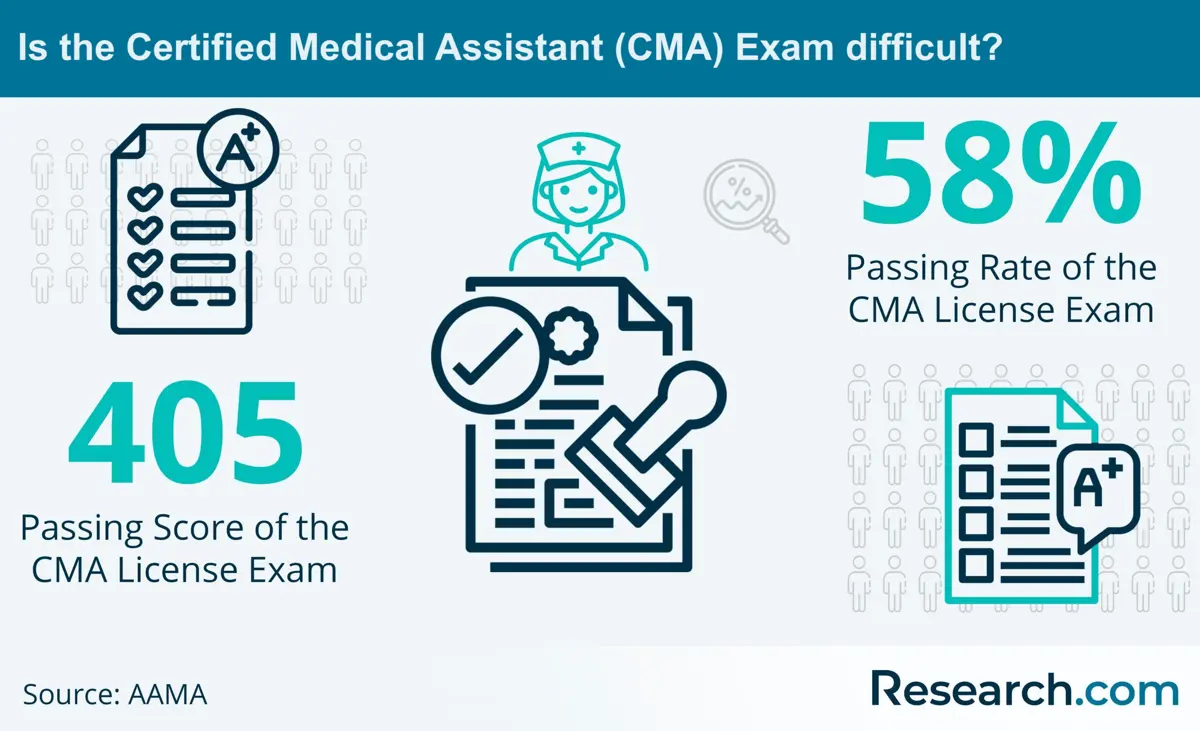
- Apply for a certification exam. One common option is the CMA exam from the American Association of Medical Assistants. The AAMA’s CMA exam had an 80% passing rate as of the 2024 academic year, and the exam fee is $125 for AAMA members and $250 for non-members.
- Pass the exam and document your credential. Certification confirms that you have met the testing organization’s requirements and can help strengthen job applications.
- Verify state-specific rules. Even when national certification is accepted, your state or employer may have additional requirements for certain duties.
Because the certification exam is comprehensive, students should plan dedicated study time for clinical, administrative, legal, and general knowledge areas rather than treating it as a simple formality.
How do you maintain CMA certification?
The AAMA certification is valid for 60 months. To maintain it, a CMA can either retake and pass the AAMA CMA exam or complete continuing education requirements. The continuing education route requires 60 continuing education units, which may include coursework such as an online medical coding course.
- 10 units in general topics
- 10 units in administrative topics
- 10 units in clinical topics
- 30 units in a preferred combination of clinical, general, and administrative topics
Continuing education helps CMAs stay current with documentation standards, patient care expectations, technology, and compliance practices.
Other medical assistant certifications to compare
The CMA credential is not the only nationally recognized path. Medical assistants may choose another certification based on eligibility, career goals, employer preference, and whether they want a general, clinical, or administrative emphasis.
| Credential | Organization | Best Fit |
| Registered Medical Assistant | American Medical Technologists | Students or working medical assistants seeking a broad medical assisting credential with flexible eligibility routes |
| National Certified Medical Assistant | National Center for Competency Testing | Candidates who want a competency-based credential with a stronger emphasis on assisting physicians |
| Certified Clinical Medical Assistant | National Healthcareer Association | Students focused mainly on patient care and clinical duties |
| Certified Medical Administrative Assistant | National Healthcareer Association | Candidates who prefer scheduling, records, billing support, front-office workflow, and administrative responsibilities |
What skills do effective medical assistants need?
Medical assistants need technical accuracy, calm communication, and strong organization. Their work affects patient flow, documentation quality, provider efficiency, and patient experience. Zippia data shows that common skills listed on medical assistant resumes include patients at 20.2%, vital signs at 10%, patient care at 9.3%, phlebotomy at 3.9%, CPR at 3.8%, EKG at 3.7%, and customer service at 3.4%.
Clinical and administrative skills
- Scheduling: Medical assistants coordinate patient appointments, provider availability, billing follow-ups, and schedule changes so the office can operate efficiently.
- Appointment management: They book new visits, arrange follow-up appointments, and help keep provider schedules properly paced.
- CPR readiness: Medical assistants should be prepared to respond appropriately during emergencies, including situations where a patient becomes unconscious or experiences cardiac distress.
- EKG support: In some settings, medical assistants help perform electrocardiograms, which record the heart’s electrical activity and may help identify abnormal rhythms, blocked or restricted arteries, past heart attack indicators, or pacemaker function concerns.
- Phlebotomy: Many medical assistants learn how to draw blood safely so specimens can be sent for testing.
- Medical knowledge: Medical terminology, anatomy, physiology, and common procedures help CMAs communicate accurately with providers and patients.
- Electronic medical records: Medical assistants must enter information correctly, protect patient data, retrieve records efficiently, and document care in secure digital systems.
Professional skills
- Communication: CMAs must listen carefully, explain instructions clearly, and communicate professionally with patients, providers, and coworkers.
- Time management: Busy clinics require medical assistants to prioritize tasks, stay organized, and keep patient visits moving.
- Critical thinking: Medical assistants often respond to changing patient needs, provider requests, and unexpected workflow problems.
- Empathy: Patients may feel anxious, sick, or embarrassed, so a calm and respectful approach matters.
- Ethics: CMAs must protect patient confidentiality, maintain professional boundaries, and follow legal and workplace standards.
The image below summarizes the skills medical assistants most often emphasize when applying for jobs.

What is the job outlook for certified medical assistants?
The employment outlook for medical assistants is strong compared with many occupations. Medical assistants support physicians and other healthcare providers in settings that continue to rely on outpatient care, chronic disease management, preventive care, and efficient patient flow.
The BLS projects 12% employment growth for medical assistants from 2024 to 2034. That projection represents about 112,300 openings each year, on average, across the same decade.
This projected growth is higher than the 3% growth projected for all jobs in the country and slightly higher than the 11% growth projected for healthcare support occupations overall. Still, local hiring conditions vary, so students should compare job postings in their own region before choosing a program.
| Job Role | Projected Job Growth | Median Pay |
| Dental Hygienist | 7% | $87,530 |
| Occupational Therapy Assistant | 23% | $65,450 |
| Health Information Technologist | 16% | $62,990 |
| Physical Therapist Assistant | 19% | $58,740 |
| Licensed Practical Nurse | 5% | $59,730 |
| Medical Records Specialist | 8% | $48,780 |
| Dental Assistant | 7% | $46,540 |
| Phlebotomist | 8% | $41,810 |
| Medical Assistant | 12% | $42,000 |
| Pharmacy Technician | 6% | $40,300 |
How long does it take to become a certified medical assistant?
Most students can become certified medical assistants within one to two years after high school. Certificate programs often take nine to 12 months, while associate degree programs are commonly structured as two-year programs. Some certificate options can be completed in five to six months, while more comprehensive associate degree pathways may extend slightly beyond two years.
The right timeline depends on your schedule, budget, prior credits, program format, clinical requirements, and certification exam preparation time.
| Pathway | Typical Time | Best For | Trade-Off |
| Short certificate program | Five to six months in some cases | Students who want the fastest possible route | May be intensive and may provide less general education |
| Certificate or diploma program | Nine to 12 months | Students seeking job-focused training without a full degree | May offer fewer transfer credits toward future degrees |
| Associate degree | Often two years | Students who want broader education and potential transfer options | Takes longer and may cost more than a certificate |
What advancement options are available after certification?
Certification can be the beginning rather than the endpoint of a healthcare career. After gaining experience, medical assistants can specialize, move into team leadership, transition into office management, or use their background as a bridge into nursing, health information, billing, coding, or healthcare administration.
- Specialized certifications: CMAs can add credentials such as Certified Phlebotomy Technician, EKG Technician Certification, or specialty-focused assisting credentials in areas such as allergy or dermatology.
- Lead or supervisory roles: Experienced CMAs may become lead medical assistants or clinical team leaders, training newer staff, managing schedules, and helping coordinate clinic workflow.
- Healthcare administration: Medical assistants who enjoy operations may pursue roles such as practice manager or healthcare administrator with additional education in management or healthcare administration.
- Nursing pathways: Some CMAs continue their education to become licensed practical nurses or registered nurses, which involves additional education, licensure, and expanded clinical responsibility.
- Adjacent healthcare careers: CMAs may also consider patient navigator, health information technician, medical office manager, or similar roles. Short programs such as 6-month certificate programs that pay well may support some career changes.
What is the lowest-cost route to becoming a certified medical assistant?
The most affordable route is usually an accredited certificate or diploma program at a community college, technical college, or vocational school, especially for in-state students. These programs typically focus on the skills needed for entry-level work and certification eligibility without requiring the broader coursework of an associate degree.
Online and hybrid programs can also reduce costs by limiting commuting, parking, relocation, and campus-related expenses. However, students should verify that any online program includes required hands-on practice or clinical placement support. A lower tuition price is not helpful if the program does not qualify you for your preferred certification exam or local employers.
Students comparing the cheapest medical assistant programs should look beyond tuition. Include exam fees, books, uniforms, background checks, immunizations, technology fees, transportation to clinical sites, and whether credits can transfer into a future degree.
Ways to reduce the cost of medical assistant training
- Start with an accredited community college or public technical college.
- Ask whether the program is eligible for financial aid, grants, or scholarships.
- Compare total cost, not only advertised tuition.
- Check whether local employers offer tuition reimbursement.
- Confirm that the program prepares students for the certification exam you plan to take.
- Ask whether clinical placements are arranged by the school or must be found independently.
Can affordable online medical assistant programs provide solid training?
Affordable online medical assistant programs can be a viable option when they are accredited, transparent about clinical requirements, and aligned with certification eligibility. The strongest online programs combine flexible coursework with in-person labs, externships, or local clinical placements so students can build practical skills safely.
Before enrolling, compare accreditation status, curriculum depth, student support, externship placement policies, and certification exam preparation. Research.com’s guide to affordable online medical assistant programs can help students compare lower-cost options that still prioritize training quality.
| Question to Ask | Why It Matters |
| Is the program accredited by a recognized organization? | Accreditation can affect certification eligibility, employer confidence, and transfer options. |
| How are labs and clinical rotations completed? | Medical assisting requires hands-on practice, not only online lectures. |
| Which certification exams does the program prepare students for? | Different credentials have different eligibility rules and employer recognition. |
| What is included in the total program cost? | Books, uniforms, supplies, exam fees, background checks, and transportation can change affordability. |
| Does the school help with externship placement? | Students may struggle if they must find clinical sites without school support. |
How does specialized training help medical assistants advance?
Specialized training can help certified medical assistants qualify for more focused responsibilities, improve efficiency, and stand out in competitive clinics. Useful areas include EHR documentation, telemedicine support, phlebotomy, EKG, specialty practice procedures, medical billing, coding, and compliance.
For medical assistants who want to strengthen administrative and revenue cycle skills, billing and coding courses online may provide targeted training in claims, coding rules, payer requirements, and documentation accuracy.
How can you get your first medical assistant job?
Your first medical assistant job search should begin before graduation. Use the externship to build references, ask supervisors for feedback, and identify the settings where you perform best. A certificate, diploma, or associate degree can qualify candidates for medical assistant and related entry-level roles, but employers may prefer applicants with certification, strong clinical evaluations, and experience with EHR systems.
Unlike online masters in speech pathology, medical assisting is most often offered through certificate, diploma, and associate degree pathways. Bachelor’s options exist, but they are often completion programs that build on earlier education. Zippia (2025) reports that 24% of medical assistants hold associate degrees, 23% completed diploma programs, 11% have bachelor’s degrees, 9% have a high school diploma, and 33% have other degrees.
What can you do with an associate degree in medical assisting?
- Clinical Medical Assistant (Median Salary: $37,052): Supports providers with patient assessments, vital signs, specimen collection, preparation for lab work, supervised medication administration, and patient education.
- Administrative Medical Assistant (Median Salary: $39,926): Manages front-office operations in health care facilities, including scheduling, records, billing support, insurance processes, phone calls, and patient intake.
- Patient Care Coordinator (Median Salary: $40,194): Helps patients move through care plans by coordinating appointments, referrals, insurance questions, communication, and follow-up steps.
- Medical Office Receptionist (Median Salary: $38,739): Greets patients, checks them in, answers calls, schedules visits, verifies insurance information, and maintains an organized reception area.
- Specialty Medical Assistant (Median Salary: $37,190): Works in a focused field such as dermatology, cardiology, pediatrics, or orthopedics and assists with specialty-specific exams, tests, equipment, and procedures.
What can you do with a bachelor’s degree after medical assisting?
- Healthcare Administrator (Median Salary: $61,134): Oversees healthcare facility operations, staffing, budgets, resources, policy implementation, compliance, and performance improvement.
- Medical Sales Representative (Median Salary: $63,941): Promotes medical products, equipment, or pharmaceuticals to healthcare organizations and professionals through relationship building, product education, and sales support.
- Healthcare Educator (Median Salary: $70,149): Designs and delivers health education programs on prevention, wellness, medication management, and self-care in community, clinical, or educational settings.
- Healthcare Consultant (Median Salary: $88,367): Helps healthcare organizations analyze systems, improve operations, evaluate data, strengthen compliance, and implement process or technology improvements.
Alternative careers for experienced certified medical assistants
- Health Informatics Specialist (Median Salary: $55,560): Uses healthcare data and technology to support better patient care, EHR systems, privacy compliance, and operational decision-making.
- Pharmaceutical Sales Representative (Median Salary: $72,362): Builds relationships with providers and healthcare organizations while explaining pharmaceutical products, treatment options, and product benefits.
- Medical Billing Specialist (Median Salary: $45,069): Reviews patient records, assigns codes, prepares claims, follows up on unpaid claims, answers billing questions, and supports compliance with billing rules.
How can public health education support a CMA career?
Public health education can broaden a medical assistant’s understanding of prevention, community health, epidemiology, health policy, and population-level care. This background can be useful in community clinics, preventive care initiatives, patient education, vaccination efforts, chronic disease programs, and outreach work.
Medical assistants interested in community-based healthcare can compare public health pathways and costs, including information on online BSPH program cost, before deciding whether a public health degree fits their career plan.
How do CMA, RMA, and CCMA certifications compare?
The CMA, RMA, and CCMA are all recognized medical assistant credentials, but they differ in sponsoring organization, eligibility pathways, and emphasis. Choosing among them should depend on your program, employer preferences in your region, whether you want a generalist or clinical focus, and how quickly you need to qualify for an exam.
The CMA credential, awarded by the American Association of Medical Assistants, is widely recognized and reflects preparation in both clinical and administrative responsibilities. Candidates typically complete an accredited medical assisting program and pass an exam covering topics such as anatomy, medical law, and clinical procedures.
The RMA credential, awarded by American Medical Technologists, is also respected and may offer more flexible eligibility options for candidates with qualifying work experience. It can be a strong choice for medical assistants who want a broad credential accepted in many healthcare settings.
The CCMA credential, offered by the National Healthcareer Association, is more clinically focused. It may suit students who want to emphasize direct patient care tasks such as taking vital signs, assisting with diagnostic tests, and supporting clinical procedures.
| Certification | Primary Focus | Potential Advantage | Best Choice If... |
| CMA | Balanced clinical and administrative medical assisting | Strong employer recognition and broad scope | You want a general credential tied to accredited program completion |
| RMA | General medical assisting with flexible eligibility routes | May fit candidates with qualifying work experience | You need an alternative to the CMA pathway |
| CCMA | Clinical medical assisting | Emphasizes patient care and clinical procedures | You prefer direct clinical work over administrative duties |
Students who want to enter the field quickly may compare accelerated options such as a medical assistant degree online 6 weeks program. These compact programs can move faster than traditional pathways, but students should confirm accreditation, clinical requirements, workload, and certification eligibility before enrolling.
What legal and ethical duties do certified medical assistants have?
Certified medical assistants handle sensitive information and participate in patient care, so legal and ethical responsibilities are central to the job. They must protect patient privacy, follow HIPAA and applicable state privacy rules, document accurately, maintain professional boundaries, and perform only tasks allowed by law and workplace policy.
Medical assistants should also understand informed consent procedures, error reporting protocols, infection control, confidentiality, and the limits of their role. Ongoing training helps reduce risk and supports a culture of accountability. Professionals who later pursue advanced healthcare education, such as a Pharm D degree online accredited, may study these legal frameworks in greater depth.
What technology should medical assistants know?
Healthcare offices increasingly rely on digital tools, and medical assistants are often expected to use them accurately while maintaining patient privacy. Technology does not replace the human side of medical assisting, but it changes how appointments are coordinated, records are updated, visits are documented, and patient information is shared.
- Electronic health record systems: CMAs enter, retrieve, and update patient information while helping maintain accurate and secure records.
- Telemedicine platforms: Medical assistants may schedule virtual visits, prepare patients, troubleshoot basic access issues, and document telehealth encounters.
- Mobile health applications: Some clinics use apps for appointment reminders, care instructions, follow-up communication, or patient engagement.
- Automated billing and coding software: Administrative medical assistants may use digital systems to support claims, coding, billing workflows, and insurance documentation.
- Digital diagnostic and monitoring devices: Medical assistants may work with tools such as portable ECG equipment and digital blood pressure monitors during routine exams and monitoring.
Which professional development options can strengthen a CMA career?
Professional development helps medical assistants stay current and prepare for advancement. Useful options include continuing education courses, specialty workshops, webinars, employer training, certification renewal coursework, and membership in professional associations.
Networking can also matter. Professional groups, conferences, and workplace mentorship can expose CMAs to openings in leadership, specialty practices, health information, public health, and adjacent healthcare jobs, including some pathways commonly explored by students comparing biology major jobs.
How does location affect medical assistant salary?
Medical assistant pay can change substantially by state, metro area, employer type, and local cost of living. Higher wages in one state do not automatically mean stronger purchasing power if housing, transportation, and taxes are also higher. Students should compare local job postings, benefits, commuting costs, and advancement options before relocating for pay alone.
For a state-by-state view, review Research.com’s guide to medical assistant salary data and compare it with job listings in the areas where you plan to work.
How can a healthcare administration bachelor’s degree support career growth?
A bachelor’s degree in healthcare administration can help experienced CMAs move from task-based clinical support into supervisory, operational, or administrative roles. Coursework in budgeting, leadership, healthcare systems, compliance, quality improvement, and operations can prepare medical assistants for roles such as lead medical assistant, office manager, practice manager, or healthcare administrator.
For CMAs who want a cost-conscious path to management education, comparing the most affordable online bachelors degree healthcare administration options can help identify programs that support long-term advancement without unnecessary expense.
Common mistakes to avoid when becoming a certified medical assistant
| Mistake | Why It Can Hurt You | Better Approach |
| Choosing a program without checking accreditation | It may affect certification eligibility, employer acceptance, or transfer credit. | Verify accreditation before applying or paying fees. |
| Comparing tuition only | Books, supplies, uniforms, background checks, exam fees, and commuting can raise the real cost. | Ask for a full cost breakdown in writing. |
| Assuming online means fully remote | Medical assisting requires hands-on clinical practice in most programs. | Confirm lab, externship, and clinical placement requirements. |
| Ignoring state and employer requirements | Some duties and hiring preferences vary by location. | Check your state rules and review local job postings. |
| Choosing the fastest program without checking outcomes | Accelerated programs can be demanding and may not fit every student. | Compare certification eligibility, support services, and clinical preparation. |
| Assuming certification guarantees a specific salary | Pay depends on location, experience, employer, and setting. | Use salary data as a planning tool, not a promise. |
Questions to ask before enrolling in a medical assistant program
- Is the program accredited by CAAHEP, ABHES, or another recognized accreditor?
- Which certification exams will I be eligible to take after graduation?
- Does the school arrange clinical rotations or externships?
- What is the total cost, including supplies, fees, books, uniforms, background checks, and exam fees?
- What percentage of students complete the program and pass certification exams?
- Are classes online, hybrid, or in person, and what attendance requirements apply?
- Can credits transfer into an associate or bachelor’s degree later?
- What local employers hire graduates from this program?
- Does the program include EHR, telehealth, phlebotomy, EKG, and administrative training?
- What career services are available before and after graduation?
Is it worth it to become a certified medical assistant?
Becoming a certified medical assistant can be worth it for students who want a relatively short, practical route into healthcare and are comfortable with both patient care and administrative duties. The career offers projected employment growth, multiple workplace options, and a foundation for future healthcare advancement.
The trade-off is that medical assisting is not the highest-paying healthcare path, and certification requires time, tuition, exam preparation, and continuing education. Still, for many students, the shorter timeline makes it a reasonable healthcare certificate program option compared with careers that require a bachelor’s or graduate degree.
Can you get a medical assistant job with only a certificate?
Yes. Many medical assistants qualify for entry-level jobs with a certificate or diploma, especially when the program includes clinical training and prepares students for certification. Community colleges, vocational schools, and technical institutes commonly offer these programs. Similar schools may also be useful for students researching how to become certified dialysis technician or other healthcare careers that do not require a bachelor’s degree.
Certificate holders may apply for many of the same entry-level roles as associate degree graduates, but some employers may prefer an associate degree because it typically includes broader coursework and may provide stronger transfer options for future education.
Key Insights
- Certification is not mandatory in every state, but it can improve employability because many healthcare employers prefer nationally credentialed medical assistants.
- The usual path is high school or GED, accredited training, clinical rotation, certification exam, and ongoing credential maintenance.
- Most students finish in one to two years, with shorter certificates available and associate degrees commonly taking about two years.
- The CMA, RMA, and CCMA are not identical; compare eligibility rules, employer recognition, and whether you want a generalist or clinical focus.
- Medical assistants earn an average annual salary of $43,350, or $20.84 per hour, but pay depends heavily on location, employer, experience, and setting.
- The BLS projects 12% employment growth from 2024 to 2034, with about 112,300 projected annual openings, making medical assisting a strong entry-level healthcare option.
- Do not choose a program based only on speed or tuition. Accreditation, clinical placement, exam eligibility, total cost, and local employer recognition matter more.
- Medical assisting can lead to advancement in specialty clinics, lead roles, billing and coding, health information, healthcare administration, nursing pathways, and public health-related work.
References:
- AAMA. About the Exam. AAMA
- BLS (2024, April 23). 31-9092 Medical Assistants. BLS
- BLS (2024, October 25). Medical Assistants. BLS
- Franklin University. How Long Does It Take to Become a Medical Assistant? Franklin University
- Gold, K. & Harmes, K. (2024, April). Medical assistants identify strategies and barriers to clinic efficiency. The Journal of Family Practice, 71(3), E1-E7. DOI
- Katz, E. (2024, July 8). Researchers identify most effective practices of medical assistants, as well as barriers. University of Michigan
- Payscale (2024. Salary for Certification: Certified Medical Assistant (CMA). Payscale
- Salary.com (2024). Certified Medical Assistant Salary in the United States. Salary.com
- Zippia (2024, April 27). MEDICAL ASSISTANT EDUCATION REQUIREMENTS. Zippia
- Zippia (2024, December 12). MEDICAL ASSISTANT SKILLS FOR YOUR RESUME AND CAREER. Zippia
Other Things You Should Know About Becoming a Certified Medical Assistant
Certified Medical Assistants must complete 60 continuing education units every 5 years to renew the AAMA CMA credential. At least 10 of those units must be earned each year, and the certification is maintained through the American Association of Medical Assistants.
To maintain CMA certification in 2027, you must complete 60 recertification points within a 60-month cycle, including specific points in administrative, clinical, and general categories, as per the American Association of Medical Assistants (AAMA) requirements.


