2027 Substitute Teaching License & Requirements in Massachusetts

Co-Founder and Chief Data Scientist
Becoming a substitute teacher in Massachusetts is usually a district-by-district hiring process, not a single statewide license application for every short-term classroom assignment. That flexibility can be appealing if you want school-based work, classroom experience, part-time income, or a pathway toward a full teaching role. It can also be confusing because requirements, pay, training, benefits, and assignment systems vary widely by district.
This guide explains how substitute teaching works in Massachusetts, what qualifications districts commonly ask for, how assignments are offered, what long-term substitutes may need, how pay is typically structured, and how to decide whether this role fits your education and career goals. It is written for career changers, education majors, retirees, recent graduates, paraprofessionals, and anyone considering classroom work before committing to teacher licensure.
Quick answer: becoming a substitute teacher in Massachusetts
- Massachusetts does not use one universal process for every substitute teacher role. Most candidates apply directly to school districts, which set local hiring standards, training expectations, and assignment procedures.
- A high school diploma or GED may be the minimum baseline in some districts, while others prefer or require college coursework, a bachelor’s degree, educator licensure, or subject-area experience, especially for long-term assignments.
- Background checks, fingerprinting, proof of work authorization, district onboarding, and classroom management preparation are common parts of the hiring process.
- Demand is generally stronger in districts facing staffing gaps, including urban districts, Gateway Cities, rural areas, and hard-to-staff subject areas such as special education, math, science, and ESL/bilingual education.
- Reported pay commonly falls between $22.18 and $25.00 per hour, or about $45,000 to $49,700 annually when converted to full-year equivalents, but actual earnings depend heavily on district rates, number of days worked, assignment length, and eligibility for long-term substitute pay.
- Requirements to become a substitute teacher in Massachusetts
- Types of substitute teaching roles and permits in Massachusetts
- How substitute teachers renew permits or educator licenses
- How districts offer substitute teaching assignments
- Using substitute teaching to move into a full-time teaching job
- Substitute teacher pay in Massachusetts
- Job outlook and demand by region
- Professional development options for substitutes
- Legal rights and workplace protections
- Private school opportunities for substitute teachers
- Ethical standards for substitute teachers
- How substitutes receive feedback
- Benefits and incentives for substitute teachers
- Common challenges and mistakes to avoid
- Stress management strategies for substitute teachersCommon challengesAdditional guidanceReferences
What are the requirements to become a substitute teacher in Massachusetts?
The most important thing to understand is that substitute teacher hiring in Massachusetts is largely handled by individual school districts. State rules and student-safety requirements still matter, but a candidate usually does not begin by applying for one statewide substitute license. Instead, you review district job postings, submit an application, complete required screening, and follow that district’s onboarding process.
- Education: A high school diploma or GED may satisfy the baseline requirement in some districts. Other districts may prefer applicants with college credits, a bachelor’s degree, prior school experience, or an active educator license, particularly for long-term or specialized assignments.
- Minimum age: Candidates generally must be at least 18 years old, which aligns with employment requirements and the level of responsibility involved in supervising students.
- Authorization to work: Applicants must show legal eligibility to work in the United States as part of the standard hiring process.
- Background screening: Substitute teachers must complete criminal background checks and fingerprinting through the Massachusetts Department of Criminal Justice Information Services process used for school employees.
- District application: Candidates apply to specific districts, not to every Massachusetts school at once. Applications may include transcripts, references, interviews, CORI checks, fingerprinting documentation, and prior employment verification.
- Training or orientation: Some districts require substitutes to complete an orientation, online modules, classroom management training, policy review, or a short assessment before they can accept jobs.
- Extended private occupational school assignments: For assignments longer than ten consecutive days in private occupational schools, written approval from the Department is required to confirm that the candidate is appropriate for the extended role.
| Requirement area | What it means for applicants | Why it matters |
| Education level | Check each district’s posting because minimum expectations may range from a high school diploma or GED to a bachelor’s degree or educator license. | District standards affect where you can apply and whether you qualify for higher-paying long-term assignments. |
| Background checks | Expect fingerprinting and criminal history review before working with students. | Schools must meet student safety and employment compliance obligations. |
| Training | Districts may require orientation before granting access to the substitute assignment system. | Training helps substitutes understand emergency procedures, behavior expectations, and local policies. |
| Application strategy | Apply to multiple districts if you want steadier work. | Substitute work is not guaranteed daily, and demand varies by school, grade level, and season. |
If you are interested in education but not sure classroom teaching is the right long-term path, it may also help to compare careers with an education degree beyond classroom teaching.
What are the different types of substitute teaching permits in Massachusetts?
Massachusetts substitute teaching roles are often described by assignment length and district need. The terminology may differ by employer, so applicants should confirm whether a posting is for daily substitute work, a long-term classroom placement, an emergency staffing role, or a role that requires educator licensure.
- Short-Term Substitute License: This category is commonly associated with assignments of up to 20 consecutive school days in one classroom. It is generally intended for candidates who meet basic suitability standards and may have at least a bachelor’s degree but do not necessarily hold a full educator license.
- Long-Term Substitute License: This option applies to assignments lasting more than 20 consecutive days. Districts commonly expect stronger qualifications for these roles, such as a valid professional or initial educator license or enrollment in a teacher preparation program.
- Daily Substitute License: Daily substitutes fill short, non-continuous absences. This role is often the most flexible option for people testing the field, working part time, or accepting assignments around another schedule.
- Emergency Substitute Permit: When districts cannot find enough qualified substitutes, emergency staffing options may allow candidates without traditional educator credentials to cover classrooms temporarily under district oversight.
| Substitute role | Best fit | Main trade-off |
| Daily substitute | People who want flexible, occasional work and exposure to different schools or grade levels. | Income and schedule can be inconsistent. |
| Short-term substitute | Candidates who can cover a classroom for a limited stretch and follow existing lesson plans. | You may need to adjust quickly without deep familiarity with students. |
| Long-term substitute | Aspiring teachers, licensed educators, or candidates seeking stronger classroom experience. | Expect more planning, grading, family communication, and accountability. |
| Emergency substitute | Applicants willing to help districts during staffing shortages. | Training and support quality may vary, so candidates should ask what preparation is provided. |
The chart below shows staffing shortages across major teaching areas, including special education, general elementary education, and ESL/bilingual education. For substitute teachers, these shortages matter because districts with persistent vacancies often need more reliable daily and long-term coverage.
How do substitute teachers renew their teaching permit in Massachusetts?
Renewal depends on what credential you hold. A day-to-day substitute who works only through district hiring systems may not have the same renewal duties as a licensed educator serving in long-term substitute roles. If you hold an Initial, Temporary, or Professional educator license, follow the Massachusetts Department of Elementary and Secondary Education renewal process for that license type.
- Confirm your license category: Renewal rules differ for Initial, Temporary, and Professional licenses. A Professional License, often relevant for experienced educators and some long-term substitutes, must be renewed every five years.
- Track Professional Development Points: Professional License renewal requires 150 PDPs, including required learning in content, pedagogy, special education strategies, and ESL or bilingual education.
- Maintain a professional development plan: Keep records of completed professional learning and obtain administrator endorsement when required before filing your renewal.
- Use the DESE online system: Submit renewal materials through the Massachusetts Department of Elementary and Secondary Education Educator Licensure and Renewal system, including documentation such as PDP records and an endorsed plan.
- Account for multiple licenses: If you hold more than one license area, each additional area requires 30 PDPs, with at least 15 in the content area for that specialty.
- Ask your district before the deadline: District licensure coordinators can clarify local professional development opportunities, documentation expectations, and renewal timing.
If your long-term goal is leadership, college teaching, policy, or administration, reviewing options such as online doctorate programs in higher education can help you see where advanced education pathways may lead.
How do substitute teachers receive assignments in Massachusetts districts?
After approval, substitutes are usually added to a district assignment system or call list. The process can be highly structured in large districts and more informal in small districts. Your ability to get steady work often depends on how quickly you respond, how many schools you are willing to serve, and whether administrators view you as reliable.
- Online assignment platforms: Many districts use systems such as Frontline, formerly AESOP, so substitutes can view, accept, or decline open jobs online or by phone.
- Direct calls from schools: Some districts still rely on administrative staff to contact substitutes, especially for last-minute absences or smaller school systems.
- Preferred substitute lists: Schools may give earlier access to substitutes who have strong performance records, subject expertise, licensure, or prior experience in the building.
- No guarantee of daily work: Even approved substitutes may not receive assignments every day. Availability depends on absences, school calendars, budget decisions, and district staffing levels.
- Annual reactivation: Districts may ask substitutes to confirm availability each year, often through “reasonable assurance” communication near the end of the school year.
- Regional variation: Large urban districts are more likely to use formal systems and standardized training, while smaller districts may rely more heavily on local relationships and direct communication.
- Training before access: Districts such as Boston may require online training, assessments, or onboarding steps before substitutes can accept assignments.
| How to get more assignments | Why it helps |
| Keep your availability updated in the district system. | Schools are more likely to contact substitutes who appear ready to work. |
| Accept jobs at multiple schools or grade levels. | A wider availability range increases the number of open assignments you can see. |
| Arrive early and leave clear notes for the regular teacher. | Professional follow-through can move you onto preferred lists. |
| Build skill in high-need settings such as special education or ESL support. | Districts often struggle to fill specialized absences. |
| Respond quickly to morning openings. | Many substitute jobs are filled on short notice. |
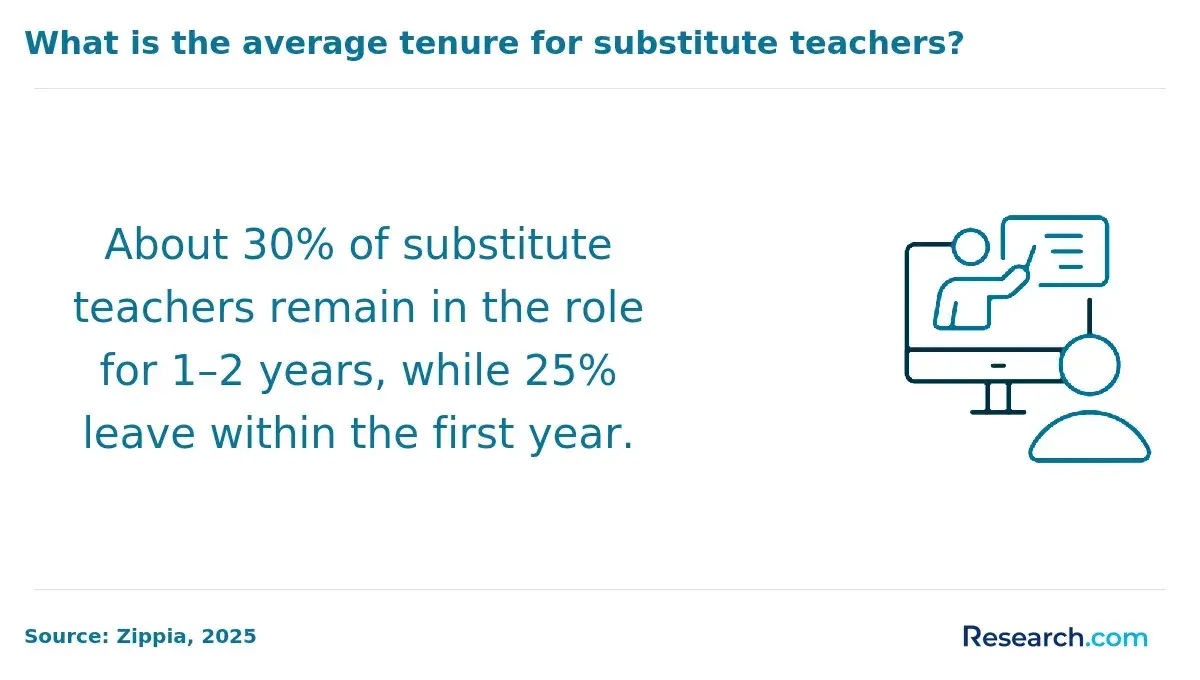
The following image connects assignment availability with how long substitutes tend to remain in these roles.
Can substitute teaching lead to a full-time teaching job in Massachusetts?
Yes, substitute teaching can help you move toward a full-time teaching job in Massachusetts, but it does not replace licensure. It is best viewed as a way to gain school experience, build references, understand grade levels, and decide whether teaching is a strong fit before entering or completing a formal licensure pathway.
- Classroom experience: Substitute work helps you practice classroom routines, behavior management, lesson delivery, and communication with school staff.
- Professional relationships: Principals, department chairs, and teachers may become references if you consistently perform well.
- District insight: Working in different schools helps you compare school cultures before applying for permanent roles.
- Required background checks: Candidates for full-time employment must still complete the background screening and fingerprinting required by Massachusetts regulations.
- Educator licensure: A permanent public school teaching role generally requires the appropriate Massachusetts teaching license.
- MTEL exams: Candidates pursuing licensure must pass the Massachusetts Tests for Educator Licensure, commonly called the MTEL.
- Additional endorsements and preparation: Full-time teachers may need approved preparation program completion and endorsements such as Sheltered English Immersion.
| If your goal is... | Use substitute teaching to... | Next step to verify |
| Daily flexible work | Serve multiple schools and build a reliable schedule. | Ask each district about daily rates, call systems, and minimum availability. |
| Long-term substitute assignments | Show you can manage a classroom over time. | Confirm whether the role requires a license, bachelor’s degree, or teacher preparation enrollment. |
| Full-time public school teaching | Gain references and clarify your preferred grade or subject. | Review Massachusetts licensure, MTEL, and endorsement requirements. |
| Private school teaching | Demonstrate classroom readiness and professional judgment. | Check each private school’s hiring expectations because they may differ from public school licensure rules. |
How much do substitute teachers make in Massachusetts?
Reported substitute teacher pay in Massachusetts commonly ranges from $22.18 to $25.00 per hour, which is often described as roughly $45,000 to $49,700 annually when converted to a full-year equivalent. Some salary estimates reach $56,981 annually when longer assignments, district pay differences, or additional compensation are considered. Actual take-home income can be much lower or higher depending on how often you work and whether you qualify for long-term substitute rates.
- Credentials: A teaching license, advanced education, or specialized endorsement such as SEI can improve eligibility for higher-paying long-term roles.
- District location: Boston and Cambridge may offer higher average pay than some other areas, reflecting local budgets, staffing demand, and cost of living.
- Assignment length: Daily substitutes usually earn a set daily or hourly rate, while long-term substitutes may receive higher rates and sometimes limited benefits.
- Local demand: Districts facing shortages or high-cost labor markets may raise rates to attract substitutes.
- Education background: Candidates comparing credentials can review types of education degrees to understand how different programs may support teaching-related career paths.
| Pay factor | How it can affect earnings | Question to ask before accepting work |
| Daily versus long-term assignment | Long-term roles may pay more but require more planning and responsibility. | When does the district’s long-term rate begin? |
| Licensure or endorsement | Licensed substitutes may qualify for specialized or extended roles. | Does a Massachusetts educator license change the pay scale? |
| District pay policy | Rates vary by district, even for similar work. | Is pay hourly, daily, or based on assignment type? |
| Number of days worked | Annual income depends on assignment availability and your schedule. | How many days do active substitutes typically work? |
| Benefits eligibility | Some benefits may apply only after meeting regular-hour or long-term thresholds. | Do substitutes working at least 20 hours per week qualify for any benefits? |
What is the job outlook for substitute teachers in Massachusetts?
The outlook for substitute teachers in Massachusetts is shaped by teacher absences, vacancies, burnout, retirement patterns, enrollment changes, and shortages in specific subject areas. Demand is not evenly distributed. Candidates who are willing to work in multiple schools, cover high-need grades, or accept specialized assignments may find more consistent opportunities.
- Boston and other urban districts: Urban districts often have significant staffing needs. Boston reported around 900 open teaching roles in 2023, and substitutes are especially important in subjects such as math, science, and special education.
- Gateway Cities: Worcester, Springfield, Lowell, and Brockton may rely heavily on substitutes because of turnover, hard-to-fill roles, and limited local hiring pools.
- Western and rural Massachusetts: Smaller districts may have fewer applicants nearby, making dependable substitutes important when teachers are absent.
- Growing suburban districts: Areas with enrollment growth may need substitutes during hiring cycles or when new roles remain unfilled.
- Absenteeism and burnout: Nearly half of districts in the Northeast report understaffing connected to teacher absenteeism and burnout, which supports continued demand for reliable substitutes throughout the school year.
If you want stronger qualifications for early-grade roles, compare career options with an online bachelor’s degree in early childhood education.
The chart below shows that California was the largest employer of short-term substitute teachers in 2023, followed by Texas and New York. The drop from California to North Carolina shows that substitute employment can vary sharply by state, population, and school system size.
For Massachusetts candidates, the lesson is practical: statewide demand matters, but local district conditions matter more. Apply where vacancies, enrollment, and substitute shortages create actual openings.
What professional development opportunities support career growth for substitute teachers in Massachusetts?
Professional development can make substitute teaching easier and more valuable, especially if you want long-term assignments or future licensure. Useful training usually focuses on classroom management, student behavior, emergency procedures, inclusive teaching, special education basics, trauma-informed practices, and communication with regular teachers.
- District orientation: Covers local policies, school safety procedures, attendance systems, substitute expectations, and technology tools.
- Classroom management workshops: Helps substitutes maintain routines, redirect behavior, and keep students engaged without overstepping district policy.
- Mentorship: Experienced teachers or building administrators may offer feedback after assignments, especially for substitutes placed repeatedly in the same school.
- Licensure preparation: Aspiring teachers can use substitute experience while preparing for MTEL exams, educator preparation requirements, and endorsements.
- Specialized training: Learning about special education, ESL, and inclusive practices can improve confidence in high-need classrooms.
For a broader view of educator credentials, review teaching certification types and requirements in Massachusetts.
What legal rights and protections do substitute teachers have in Massachusetts?
Substitute teachers are school employees while working an assignment, but their rights and benefits depend on district policies, assignment type, hours worked, and whether they are hired directly or through a staffing provider. Before accepting work, read the district’s handbook or employment agreement carefully.
- Clear employment terms: Substitutes should know their pay rate, expected hours, cancellation policy, reporting procedures, and whom to contact for problems.
- Safe workplace expectations: District policies should explain harassment prevention, student behavior reporting, emergency procedures, and workplace safety protocols.
- Liability and incident reporting: Substitutes should ask how the district handles injuries, student incidents, allegations, and documentation.
- Dispute procedures: Human resources should be able to explain how substitutes report payroll issues, unsafe conditions, discrimination, or other concerns.
- Policy access: Review district handbooks before your first assignment so you understand attendance, confidentiality, technology, discipline, and mandated reporting rules.
For a role-specific overview, see how to become a substitute teacher in Massachusetts. If you have a legal concern about your own employment situation, district human resources or a qualified legal professional can provide guidance based on your facts.
Can substitute teaching pave the way to private school education roles in Massachusetts?
Substitute teaching can help candidates pursue private school roles because it provides classroom experience, references, and evidence that you can supervise students responsibly. However, private schools may use different hiring standards from public districts. Some emphasize subject expertise, school mission fit, religious or independent school experience, or prior work with specific student populations.
- Use substitute work as proof of readiness: Keep records of grade levels, subjects, and long-term assignments you have completed.
- Build references: Ask administrators or lead teachers who know your work whether they can serve as references.
- Study the school’s mission: Private schools often hire for community fit as well as instructional ability.
- Fill credential gaps: Additional coursework, professional development, or certification may help if you lack formal teacher preparation.
For a more focused route, read how to become a private school teacher in Massachusetts.
What ethical standards do substitute teachers adhere to in Massachusetts?
Substitute teachers are expected to follow the same professional conduct principles that protect students, families, and schools. Even a one-day assignment involves access to student information, classroom authority, and responsibility for student safety.
- Student confidentiality: Do not share grades, accommodations, behavior details, family information, or student records with unauthorized people.
- Safe and inclusive classrooms: Treat students fairly and intervene according to policy when bullying, discrimination, or unsafe behavior occurs.
- Policy compliance: Follow school rules on attendance, emergency drills, technology use, classroom supervision, and discipline.
- Conflicts of interest: Gifts valued at $50 or more connected to the role are prohibited, and smaller gifts may need disclosure depending on the situation.
- Professional boundaries: Avoid personal relationships or communication with students, families, or staff that could compromise objectivity or safety.
- Fair grading and assessment: If asked to grade work, use the teacher’s instructions and objective criteria rather than personal preference.
- Mandatory reporting: Suspected abuse or neglect must be reported promptly as required by Massachusetts law.
- Professional behavior during short assignments: Temporary work still requires punctuality, discretion, respectful communication, and accurate documentation.
- Ethics training: Required training helps substitutes understand legal duties, student privacy, and district conduct standards.
- Massachusetts professional expectations: Substitute educators should align their conduct with the Professional Standards for Teachers and local district policies.
What mechanisms ensure effective performance feedback for substitute teachers in Massachusetts?
Feedback systems differ by district, but substitutes should actively seek input if they want more assignments or a transition into teaching. Many schools track whether substitutes arrive on time, follow lesson plans, manage the classroom appropriately, communicate clearly, and handle unexpected situations professionally.
- Post-assignment notes: Regular teachers may report whether lesson plans were followed and whether the classroom was left organized.
- Administrator observation: Principals or assistant principals may provide informal or formal feedback, especially during long-term placements.
- Preferred substitute status: Strong performance can lead to more frequent calls from particular schools.
- Mentor conversations: Some substitutes benefit from talking with experienced teachers about classroom management and student engagement.
- Self-reflection: Keep a private log of what worked, what was difficult, and what questions to ask before future assignments.
If substitute work confirms that you want a permanent classroom role, explore how to become a teacher online in Massachusetts.
What are the benefits received by substitute teachers in Massachusetts?
Benefits for substitute teachers are not uniform across Massachusetts. Some substitutes receive only hourly or daily pay, while others may qualify for limited benefits based on regular hours, long-term assignments, union agreements, municipal policies, or retirement system rules.
- Schedule flexibility: Substitutes can often choose assignments that fit around caregiving, school, retirement, freelance work, or another part-time job.
- Higher long-term rates: Some districts increase compensation for substitutes who remain in one assignment for an extended period, with bonuses or rate changes often beginning after 30 or 90 days.
- Possible health insurance eligibility: Under Massachusetts law, substitute teachers regularly working at least 20 hours per week may qualify for municipal group health insurance, though district policies vary and some districts limit day-to-day substitute hours.
- Retirement credit: Substitute teachers may earn creditable service days toward the Massachusetts Teachers’ Retirement System, which can matter for those working consistently or planning a longer education career.
- Professional learning access: Some districts allow substitutes to attend training that improves classroom skills and supports future hiring.
- Reasonable assurance of reemployment: Districts may provide reasonable assurance for substitutes who meet performance standards and remain eligible for the next school year.
| Potential benefit | Most likely for | What to verify |
| Flexible schedule | Daily substitutes | Whether the district requires minimum monthly availability. |
| Higher long-term pay | Substitutes covering extended absences | The day when the long-term rate begins and whether it is retroactive. |
| Health insurance consideration | Substitutes regularly working at least 20 hours per week | District eligibility rules and hour-counting policies. |
| Retirement service credit | Consistent or long-term substitutes | How days are reported to the Massachusetts Teachers’ Retirement System. |
| Professional development | Substitutes pursuing long-term or full-time roles | Whether substitutes may attend district training at no cost. |
If you are comparing degree paths toward certification, see what are the easiest teaching degrees for context on program options and trade-offs.
What are the common challenges for substitute teachers in Massachusetts?
Substitute teaching can be meaningful, but it is not always easy. The role often combines uncertain scheduling, limited preparation time, unfamiliar classrooms, and uneven support. Knowing the common challenges before you start can help you choose districts more carefully and avoid preventable frustration.
- Unpredictable work: Assignments may change daily, making income and personal planning difficult.
- Shortage pressure: Districts with substitute shortages may need coverage quickly, which can place substitutes in classrooms with little notice.
- Limited onboarding: Some substitutes report that orientation is not enough to prepare them for behavior management, special education needs, or school-specific procedures.
- Outdated scheduling methods: Districts that rely on spreadsheets, phone calls, or manual coordination may create confusion or missed opportunities.
- Classroom management difficulty: Students may test boundaries when the regular teacher is absent, especially if lesson plans are incomplete.
- Limited benefits: Many day-to-day substitute roles do not include paid leave, health insurance, or consistent retirement contributions.
- District-by-district variation: Pay, expectations, training, and support can differ substantially across Massachusetts.
- Administrative rules: Qualification standards and approval requirements for assignments beyond ten days can limit who is eligible for extended substitute work.
| Common mistake | Why it causes problems | Better approach |
| Applying to only one district | One district may not have enough openings to provide steady income. | Apply to several districts within a reasonable commute. |
| Looking only at the daily pay rate | Higher pay may come with fewer assignments, less support, or longer travel. | Compare pay, assignment volume, training, commute, and benefits together. |
| Assuming all substitute roles are the same | Daily, short-term, emergency, and long-term assignments can involve very different responsibilities. | Ask what planning, grading, meetings, and communication are expected. |
| Ignoring licensure requirements for full-time teaching | Substitute experience alone usually does not qualify someone for a permanent public teaching role. | Map out MTEL, preparation program, endorsement, and license requirements early. |
| Skipping policy review | Discipline, confidentiality, technology, and emergency rules vary by district. | Read the substitute handbook before accepting your first assignment. |
What strategies can help manage work-related stress for substitute teachers in Massachusetts?
Substitute teachers often walk into unfamiliar classrooms with limited context. Stress management is therefore partly personal and partly professional: you need routines that keep you calm and systems that help you manage students safely.
- Prepare a substitute toolkit: Bring backup activities, pencils, seating chart templates, a timer, and a simple note form for the regular teacher.
- Arrive early when possible: Use the extra time to review lesson plans, emergency procedures, attendance systems, and nearby staff contacts.
- Set expectations immediately: Start class with clear instructions, a calm tone, and the teacher’s posted routines when available.
- Ask for help early: Contact the office or neighboring teacher before a minor issue becomes a major disruption.
- Choose assignments strategically: If certain grade levels or schools consistently create unsustainable stress, adjust your availability.
- Build a support network: Other substitutes can share practical advice about district systems, school cultures, and classroom management.
- Use professional development: Training in classroom management, resilience, special education, and de-escalation can reduce anxiety and improve performance.
If you are weighing substitute teaching against a permanent teaching career, review how many years of college it takes to become a teacher in Massachusetts so you can compare the short-term role with the full licensure pathway.
Is substitute teaching in Massachusetts worth it?
Substitute teaching is worth considering if you want flexible school-based work, need classroom experience before applying to a teacher preparation program, or want to build connections in Massachusetts districts. It may be less suitable if you need guaranteed full-time income, predictable benefits, or a clearly defined career ladder without additional licensure steps.
| Substitute teaching may be a good fit if... | You may want another path if... |
| You want to test teaching before committing to a degree or license. | You need a stable paycheck every week. |
| You can handle changing schools, grade levels, and routines. | You prefer predictable responsibilities and long-term planning. |
| You are building references for future education roles. | You want benefits that are guaranteed from the start. |
| You are comfortable learning district systems quickly. | You are not comfortable managing student behavior without extensive preparation. |
| You want flexible part-time or semi-retired work. | You want a permanent public teaching role but are not prepared to complete licensure requirements. |
Key insights
- Massachusetts substitute teaching is mainly a district hiring process, so always check local postings instead of assuming one statewide requirement applies everywhere.
- Daily substitute work offers the most flexibility, while long-term substitute assignments usually involve more responsibility and may require stronger credentials.
- Background checks, fingerprinting, work authorization, and district onboarding are standard parts of becoming eligible to work with students.
- Pay can be competitive, with reported rates between $22.18 and $25.00 per hour and full-year equivalents around $45,000 to $49,700, but actual income depends on how often you work.
- Substitute teaching can strengthen a future teaching application, but full-time public school teaching generally requires Massachusetts educator licensure, MTEL exams, and any required endorsements.
- The best candidates compare districts by pay, assignment volume, training, commute, benefits eligibility, and support—not just the headline daily rate.
- To reduce stress, prepare classroom routines, ask for help early, keep clear notes, and seek training in classroom management and student support.
Related Articles for Nearby States
- 2027 Substitute Teaching License & Requirements in Rhode Island
- 2027 Substitute Teaching License & Requirements in Connecticut
- 2027 Substitute Teaching License & Requirements in New Hampshire
- 2027 Substitute Teaching License & Requirements in New York
- 2027 Substitute Teaching License & Requirements in Vermont
- 2027 Substitute Teaching License & Requirements in New Jersey
- 2027 Substitute Teaching License & Requirements in Maine
- 2027 Substitute Teaching License & Requirements in Pennsylvania
- 2027 Substitute Teaching License & Requirements in Delaware
- 2027 Substitute Teaching License & Requirements in Maryland
References:
- All Education Schools. (n.d.). Massachusetts teacher certification guide. https://www.alleducationschools.com/teacher-certification/massachusetts/
- Massachusetts Department of Elementary and Secondary Education. (n.d.). Seeking employment in MA — licensure requirements. Office of Educator Licensure. https://www.doe.mass.edu/licensure/faq-glossary/seeking-employment.html
- Massachusetts Teachers Association. (n.d.). License renewal. https://www.massteacher.org/employment-and-licensure/license-renewal
- Massachusetts Teachers Association. (n.d.). Licensure. https://massteacher.org/employment-and-licensure/licensure
- Mass.gov. (n.d.). SE 400.00 substitute teachers. https://www.mass.gov/info-details/se-40000-substitute-teachers
- Renew a Teaching License. (n.d.). Renew a teaching license in MA with approved online PDPs. https://renewateachinglicense.com/state-requirements/state-requirements-to-renew-a-teaching-license-in-ma/
- Teaching Certification. (n.d.). Massachusetts teacher certification renewal. https://teaching-certification.com/teaching/massachusetts-teacher-certification-renewal/
Other Things to Know About Substitute Teaching License and Requirements in Massachusetts
In Massachusetts, to become a substitute teacher in 2027, you typically need at least a high school diploma. However, individual school districts may have specific preferences or additional requirements, such as a college degree or relevant experience. It's recommended to check with the specific district you are interested in for its requirements.
In 2027, Massachusetts offers different types of substitute teaching licenses, such as temporary and long-term substitute permits. Temporary permits often require fewer qualifications, while long-term permits may need a bachelor's degree and completion of specific training modules set by the state Department of Education.
The Massachusetts Department of Elementary and Secondary Education, or DESE, approves substitute teaching licenses in 2027. DESE sets the licensing rules, reviews applications, and issues the educator license needed to work as a substitute in public schools across the state.