2027 Types of Applied Behavior Analysis (ABA) Certification Online

Co-Founder and Chief Data Scientist
Choosing an ABA certification is really a career-level decision: it determines what services you can provide, how much supervision you need, what degree you must earn, and which jobs you can realistically pursue. As of January 2, 2025, there are 276,183 professionals with Behavior Analyst Certification Board (BACB) credentials, showing how widely applied behavior analysis is used in schools, clinics, healthcare organizations, autism services, behavioral health programs, and related therapy settings.
This guide explains the main types of ABA certification online, how they differ, what each credential may cost, how long each path can take, and which option fits different career goals. It is designed for students, career changers, RBTs considering advancement, psychology majors, educators, and healthcare professionals who want a practical way to compare ABA credential pathways before committing time and money.
Quick Answer: Which ABA Certification Should You Choose?
- Choose the RBT if you want the fastest entry point into ABA and are comfortable working under close supervision.
- Choose the BCaBA if you have or are pursuing a bachelor’s degree and want more responsibility while still practicing under a BCBA.
- Choose the BCBA if your goal is independent practice, program design, supervision, or long-term advancement in behavior analysis.
- Choose the BCBA-D if you already hold doctoral-level training and want a designation that signals advanced scholarship, research preparation, or academic expertise. It does not add practice privileges beyond the BCBA.
- What ABA certification options are available for 2027?
- How do ABA certification requirements compare by education and fieldwork?
- What has changed in ABA certification and online training in 2027?
- Should you choose an online ABA program or an in-person course?
- How long does online ABA certification take?
- How much do online ABA certification programs cost?
- How can you pay for ABA certification?
- What continuing education options are available after certification?
- Why combine counseling training with ABA certification?
- How does ABA certification fit with advanced psychology training?
- Do you need ABA certification to work as a behavior analyst?
- How do you evaluate the quality and accreditation of an online ABA program?Certification requirements reminder
- How can ABA support specialization in child and adolescent psychology?
- What jobs can you pursue with each ABA certification level?
- How can ABA certification support long-term career growth?
- What challenges should online ABA students expect?
- Which ABA certification best matches your career goals?
- Can ABA certification and an accelerated psychology bachelor’s degree improve career options?
- Can ABA certification create opportunities in forensic psychology?Psychology degree optionCredential decision guide
What ABA certification options are available for 2027?
The BACB credentials are structured by responsibility level. The lower levels focus on direct implementation and supervised support, while the advanced levels involve assessment, intervention design, supervision, research, leadership, and independent practice.
| Credential | Best For | Typical Practice Level | Key Requirement |
| Registered Behavior Technician (RBT) | Entry-level ABA staff and direct therapy support roles | Works under BCBA or BCaBA supervision | High school diploma, 40-hour training, competency assessment, and RBT exam |
| Board Certified Assistant Behavior Analyst (BCaBA) | Bachelor’s-level professionals who want more responsibility | Conducts ABA work under BCBA supervision | Bachelor’s degree, approved coursework, supervised experience, and BCaBA exam |
| Board Certified Behavior Analyst (BCBA) | Professionals seeking independent ABA practice and supervisory roles | Designs, supervises, and evaluates ABA programs independently | Master’s degree, verified coursework, supervised experience, and BCBA exam |
| Board Certified Behavior Analyst–Doctoral (BCBA-D) | Doctoral-level professionals in research, academia, or senior leadership | Same practice privileges as BCBA, with doctoral designation | PhD or PsyD in a behavior analysis-related field plus BCBA requirements |
Registered Behavior Technician (RBT)
The RBT is the most accessible ABA credential and is often the starting point for people who want to test whether behavior analysis is the right career path. RBTs help carry out behavior intervention plans, collect data, and work directly with clients while being supervised by a BCBA or BCaBA.
- Requirements: Candidates need a high school diploma, 40 hours of training, a competency assessment, and a passing score on the RBT exam.
- Credential count: As of 2025, there are 196,579 certified RBTs, making this the largest ABA credential group.
- Best fit: This route works well for new ABA workers, paraprofessionals, therapy aides, and students exploring behavioral health careers.
Board Certified Assistant Behavior Analyst (BCaBA)
The BCaBA is a bachelor’s-level credential for professionals who want to move beyond technician duties but are not yet ready for a master’s-level BCBA pathway. BCaBAs may help with assessments, treatment implementation, case management, and RBT supervision, but they continue to work under BCBA oversight.
- Requirements: Candidates need a bachelor’s degree in behavior analysis or a related field, BACB-approved coursework, supervised experience, and a passing BCaBA exam score.
- Credential count: There are 5,479 certified BCaBAs as of 2025, indicating a smaller and more specialized group than RBTs.
- Best fit: This option can make sense for bachelor’s-level professionals who want a stronger ABA role before pursuing graduate school.
Board Certified Behavior Analyst (BCBA)
The BCBA is the primary credential for independent behavior analysts. BCBAs assess client needs, design behavior intervention plans, supervise RBTs and BCaBAs, analyze outcomes, and coordinate care with families, schools, clinicians, and agencies.
- Requirements: Candidates need a master’s degree in ABA, psychology, or education, verified coursework, supervised fieldwork, and a passing BCBA exam score.
- Credential count: As of 2025, 74,125 individuals hold BCBA certification.
- Best fit: This is usually the right path for professionals who want independent clinical responsibility, supervisory authority, and stronger advancement potential.
Board Certified Behavior Analyst–Doctoral (BCBA-D)
The BCBA-D is not a separate license to do more clinical work than a BCBA. Instead, it is a doctoral designation for BCBAs who have completed qualifying doctoral study. It can be valuable for faculty positions, research leadership, senior clinical roles, or organizational leadership.
- Requirements: Candidates typically need a PhD or PsyD in a behavior analysis-related area and must satisfy BCBA requirements.
- Practice scope: The designation does not create additional practice privileges beyond the BCBA.
- Best fit: This path is most relevant for professionals interested in scholarship, teaching, advanced leadership, or research-intensive roles.
How do ABA certification requirements compare by education and fieldwork?
ABA credentials build on one another. The RBT requires the least formal education, while the BCBA and BCBA-D require graduate-level preparation. If your long-term goal is independent practice, plan early for the degree, coursework, and supervised fieldwork requirements tied to the BCBA.
| Certification | Education Level | Experience or Supervision | Decision Point |
| RBT | High school diploma | Competency assessment and supervised service delivery | Fastest way to begin working in ABA |
| BCaBA | Bachelor’s degree | Supervised experience under BCBA oversight | Useful for bachelor’s-level advancement without immediate graduate study |
| BCBA | Master’s degree | Extensive supervised fieldwork | Best match for independent practice and supervisory roles |
| BCBA-D | Doctoral degree | BCBA-level requirements plus doctoral preparation | Most relevant for research, teaching, and senior leadership |
The RBT route is the quickest because it requires only a high school diploma and targeted training. The BCaBA requires a bachelor’s degree and may be a logical next step for students completing an online applied behavior analysis degree. The BCBA requires graduate study and is commonly pursued through an online master’s in applied behavior analysis. The BCBA-D requires doctoral-level preparation but does not expand practice privileges beyond the BCBA.
Educational attainment also matters in the broader behavior analyst workforce. According to Zippia, 54% of behavior analysts hold a bachelor’s degree, 33% hold a master’s degree, and 6% have an associate degree. For candidates who want higher-responsibility roles, this reinforces the importance of planning for graduate education rather than stopping at entry-level ABA work.
What has changed in ABA certification and online training in 2027?
ABA training continues to adapt as employers expect stronger data skills, ethical decision-making, telehealth readiness, and supervised practice experience. Candidates comparing online programs should look beyond convenience and ask whether the curriculum prepares them for the actual conditions of ABA work.
Coursework is becoming more practice-oriented
Many online ABA programs now give more attention to data analysis, ethics, case-based decision-making, and technology-supported services. This reflects the growing role of technology in ABA practice and the need for professionals who can use data responsibly while tailoring interventions to client needs.
Online access has expanded, but quality still varies
More institutions now offer online behavioral science and ABA-related options, including behavioral science degree online programs. This can help working adults, parents, rural students, and career changers complete coursework without relocating. However, accessibility should not be confused with quality. Students still need to verify accreditation, fieldwork support, faculty expertise, and exam preparation.
Supervision remains the make-or-break factor
Online coursework can teach principles and methods, but ABA competency depends heavily on supervised application. Before enrolling, ask exactly how the program helps students secure, document, and complete fieldwork. A program with weak supervision support can delay certification even if the courses are convenient.
Should you choose an online ABA program or an in-person course?
Online and campus-based ABA programs can both prepare students for certification, but they work best for different learners. The right choice depends on your schedule, local fieldwork options, budget, learning style, and need for face-to-face support.
| Factor | Online ABA Program | In-Person ABA Program |
| Schedule | Often better for working adults and students who need asynchronous coursework | Better for students who prefer fixed class times and campus routines |
| Cost | May reduce commuting, housing, and relocation expenses; tuition rates for online programs are often lower | May involve additional transportation, campus fees, or housing costs |
| Fieldwork | Requires careful planning to secure approved local supervision | May offer more built-in local placement relationships |
| Networking | Depends on live sessions, faculty access, cohorts, and mentorship design | Often easier to build relationships through face-to-face interaction |
| Best for | Self-directed learners with reliable supervision options nearby | Learners who want structured support and in-person skill practice |
When an online ABA program makes sense
- You need flexibility: Online courses can make it easier to keep working while completing ABA coursework.
- You want to avoid relocation costs: Studying remotely may reduce travel, housing, and campus-related expenses.
- You already have a fieldwork site: Online study works best when you can complete supervised practice through an employer, clinic, school, or approved local setting.
When in-person training may be better
- You need close academic structure: Campus programs can provide more predictable contact with instructors and peers.
- You do not have supervision arranged: Local program partnerships may make fieldwork easier to secure.
- You learn best through live demonstration: Some students benefit from in-person modeling, immediate feedback, and on-site labs.
Professionals who want to move beyond direct ABA service into health systems, behavioral health administration, or academic leadership may also consider a doctor of behavioral health pathway after gaining substantial field experience.
How long does online ABA certification take?
The timeline depends on the certification level, whether you study full time or part time, how quickly you complete fieldwork, and whether you already hold the required degree. Coursework alone is not the full timeline for BCaBA, BCBA, or BCBA-D candidates; supervised experience and exam preparation also matter.
| Certification | Estimated Timeline | What Usually Determines the Pace |
| RBT | One to three months | Training schedule, competency assessment timing, and exam readiness |
| BCaBA | One to two years | Bachelor’s coursework progress and supervised experience completion |
| BCBA | Two to three years | Master’s program length, fieldwork hours, and exam preparation |
| BCBA-D | Four to six years | Doctoral degree progress, research requirements, and advanced professional preparation |
How much do online ABA certification programs cost?
ABA certification costs vary widely because some credentials require short training while others require full undergraduate, master’s, or doctoral study. When comparing programs, include tuition, books, technology fees, application fees, exam fees, supervision costs, travel for fieldwork, and any lost income from reducing work hours.
| Path | Estimated Tuition or Training Cost | Important Cost Notes |
| RBT Training | $100 to $500 | Usually covers training and competency assessment-related costs |
| BCaBA Programs | $10,000 to $25,000 | Often tied to undergraduate-level coursework |
| BCBA Programs | $30,000 to $60,000 | Typically includes graduate tuition and fieldwork-related preparation |
| BCBA-D Programs | $50,000 to $100,000 | May include dissertation research and postdoctoral supervision expenses |
The BCBA certification cost can also include application and exam fees, which typically range from $245 to $495. Before enrolling, ask the school for a full cost breakdown rather than relying on tuition alone.
How can you pay for ABA certification?
Financial aid options depend on the credential level and whether the program is offered through an accredited institution. Short RBT training may have limited aid options, while bachelor’s, master’s, and doctoral programs may qualify for broader funding sources.
Scholarships
Some universities and behavior analysis programs offer scholarships based on academic achievement, financial need, professional goals, or commitment to serving specific populations. Ask whether scholarships apply to online students and whether awards are renewable.
Employer tuition reimbursement
ABA clinics, school districts, healthcare organizations, and behavioral health providers may help employees pay for certification if the credential supports staffing needs. Confirm whether reimbursement requires continued employment after completion.
Federal student loans and grants
Students enrolled in accredited graduate or doctoral programs may be eligible for federal aid. Completing the FAFSA is usually the first step in determining eligibility.
Installment plans
Some programs allow students to divide tuition into monthly or term-based payments. This can reduce upfront pressure, but students should still compare the total program cost.
If you are also considering counseling or psychology-related roles, reviewing adjacent pathways such as how to prepare for a career in career counseling can help you compare funding options across related helping professions.
What continuing education options are available after certification?
ABA certification is not the end of professional learning. Behavior analysts and technicians need to keep skills current as evidence-based practices, supervision standards, technology tools, ethics expectations, and client needs evolve.
- Workshops and conferences: Useful for ethics, supervision, specialized interventions, and updates in practice standards.
- Webinars and online CE courses: Convenient for working professionals who need flexible continuing education.
- Advanced graduate coursework: Helpful for RBTs, BCaBAs, or BCBAs planning to move into higher credential levels.
- Mentorship and peer consultation: Valuable for case review, professional judgment, and leadership development.
Professionals planning to move from technician or assistant roles into independent practice may compare BCBA online master’s programs to find a graduate option that supports both certification preparation and long-term career growth.
Why combine counseling training with ABA certification?
ABA and counseling are distinct fields, but they often intersect in schools, clinics, family support programs, developmental services, and behavioral health settings. Counseling training can strengthen communication, rapport-building, cultural responsiveness, and collaboration with clients and families.
This combination may be especially useful for professionals who work with clients facing emotional, social, academic, or family-related challenges in addition to behavior goals. ABA certification can support structured intervention planning, while counseling skills can improve client engagement and interdisciplinary teamwork. If this direction appeals to you, reviewing the steps to become a counselor can clarify the additional education and licensure expectations involved.
How does ABA certification fit with advanced psychology training?
ABA certification can complement advanced psychology preparation by adding a behavior-change framework, measurement skills, and intervention planning tools. Psychology training may add broader assessment knowledge, clinical theory, developmental context, and diagnostic understanding, depending on the program and career track.
Professionals interested in combining ABA with higher-level clinical or assessment-focused training may explore options such as PsyD online programs. This type of path requires careful planning because psychology licensure, ABA certification, supervised practice, and state requirements may differ.
Do you need ABA certification to work as a behavior analyst?
Certification requirements depend on the role, employer, funding source, and state rules. Some positions may use behavior analysis principles without requiring BACB certification, but advanced behavior analyst roles commonly prefer or require certification, especially when the job involves assessment, treatment planning, supervision, or payer-recognized ABA services.
Why certification matters
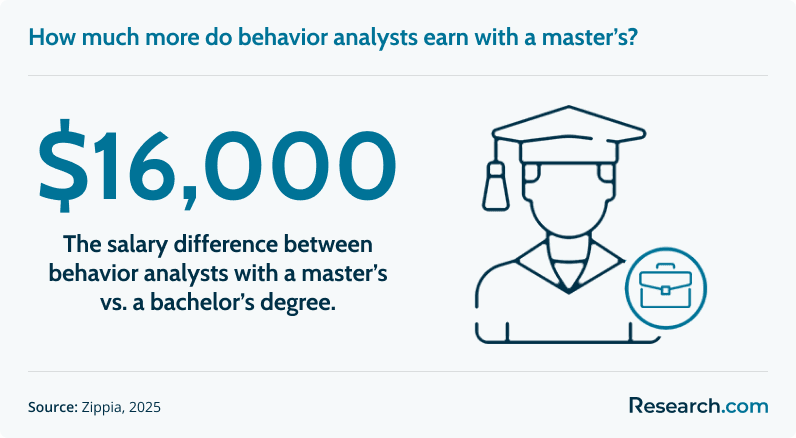
- Stronger earning potential: Certified ABAs with a master’s degree earn, on average, $16,000 more per year than those with only a bachelor’s degree.
- More role options: Certification can support opportunities in schools, hospitals, clinics, research settings, and behavioral health organizations.
- Professional credibility: BACB certification signals that a candidate has met defined education, training, supervision, and examination standards.
Before assuming certification is optional, check your state’s behavior analyst licensing rules, employer requirements, insurance billing expectations, and the level of responsibility attached to the role you want.
How do you evaluate the quality and accreditation of an online ABA program?
A strong online ABA program should be transparent about accreditation, curriculum alignment, fieldwork support, faculty qualifications, student outcomes, and exam preparation. Do not choose a program only because it is inexpensive, fast, or fully online.
| What to Check | Questions to Ask | Why It Matters |
| Institutional accreditation | Is the college or university accredited by a recognized accreditor? | Accreditation can affect financial aid eligibility, transfer credits, and employer recognition. |
| BACB alignment | Does the curriculum meet current BACB coursework expectations for the credential you want? | Misaligned coursework can delay certification eligibility. |
| Supervised fieldwork support | Does the program help students find qualified supervisors or approved field sites? | Fieldwork is often the biggest barrier for online students. |
| Faculty expertise | Are instructors experienced in ABA practice, supervision, research, or specialty areas? | Faculty quality affects mentorship, exam preparation, and applied learning. |
| Outcomes transparency | Does the program publish exam pass rates, completion rates, or placement support details? | Clear outcomes help students compare programs realistically. |
Independent program comparisons, such as guides to applied behavior analysis schools, can help you build a shortlist. Still, rankings should be only one input. Always confirm the program’s current requirements directly with the school and the relevant certification body.
How can ABA support specialization in child and adolescent psychology?
ABA is widely used in services for children and adolescents, especially when treatment goals involve communication, skill acquisition, adaptive behavior, classroom behavior, or family-supported intervention. Pairing ABA preparation with child and adolescent psychology training can help professionals understand developmental stages, family systems, mental health concerns, and educational context more deeply.
Students interested in this combination may compare child and adolescent psychology master’s programs online. This route may be useful for professionals who want a broader foundation for youth-focused roles, but students should verify whether the psychology program supports licensure, ABA certification, both, or neither.
What jobs can you pursue with each ABA certification level?
Career options expand as certification level rises. RBTs usually provide direct services under supervision, BCaBAs take on more delegated responsibilities, and BCBAs lead assessment, treatment planning, supervision, and program evaluation. BCBA-D professionals often pursue the same practice roles as BCBAs, plus research, teaching, or leadership opportunities.
| Credential | Common Roles | Estimated Salary | Demand or Growth Information |
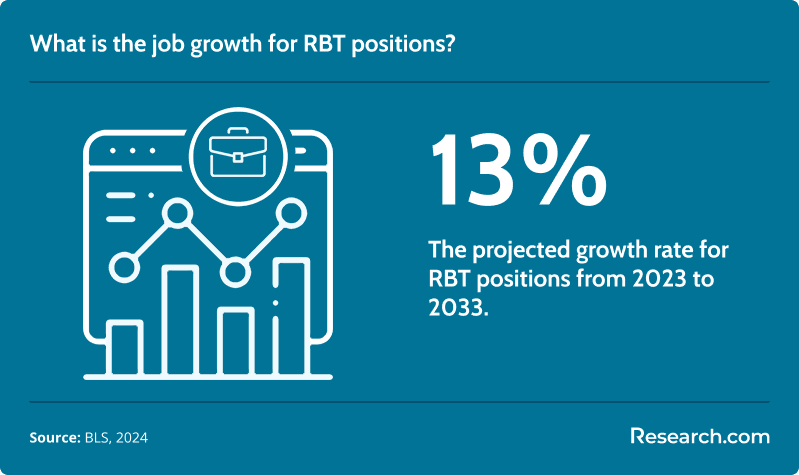
| RBT | Behavior technician, therapy aide, school-based ABA support staff | $35,000 to $50,000 per year | Job growth of 13% from 2023 to 2033, according to the US Bureau of Labor Statistics (BLS) |
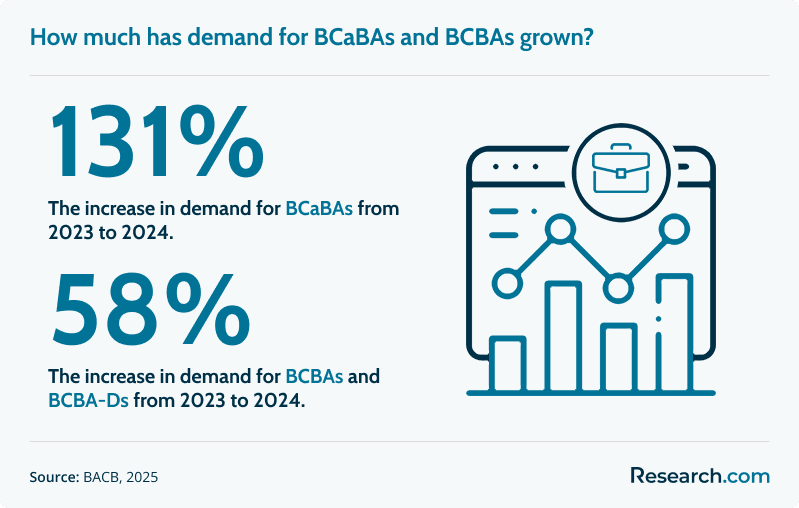
| BCaBA | Assistant behavior analyst, case support specialist, RBT supervisor under BCBA oversight | $50,000–$70,000 per year | Demand for BCaBAs increased by 131% from 2023 to 2024, with California, Florida, Texas, Virginia, and Michigan accounting for 49% of demand |
| BCBA | Behavior analyst, clinical supervisor, ABA program designer, school consultant | $90,931 per year on average, with total compensation reaching $115,057 per year | Demand for BCBAs and BCBA-Ds increased by 58% from 2023 to 2024, with California, Massachusetts, Texas, New Jersey, and Florida accounting for 40% of demand |
| BCBA-D | Doctoral-level behavior analyst, researcher, faculty member, senior clinical leader | Often earns over $120,000 per year, particularly in leadership or research roles | Included in the BCBA and BCBA-D demand increase of 58% from 2023 to 2024 |
Students drawn to youth services may also compare related career paths, including how to become a child counselor, because child-focused counseling and ABA roles may share work settings even when training and licensure requirements differ.
How can ABA certification support long-term career growth?
ABA certification can create a laddered career path. Many professionals start in direct service roles, move into assistant-level responsibilities, complete graduate education, and eventually supervise teams or lead programs as BCBAs.
- From RBT to BCaBA: This step can increase responsibility and help candidates build stronger applied experience while completing undergraduate preparation.
- From BCaBA to BCBA: This is the major transition for professionals who want independent practice and supervisory authority.
- From BCBA to BCBA-D or doctoral study: This pathway may support research, teaching, executive leadership, or specialized clinical work.
- From clinical practice to interdisciplinary leadership: ABA experience can transfer into education, healthcare administration, behavioral health operations, and program development.
Professionals who want to combine behavioral expertise with broader clinical psychology preparation may explore master’s and PsyD programs, but they should compare licensure outcomes, cost, and time commitment carefully before enrolling.
What challenges should online ABA students expect?
Online ABA programs can be effective, but they require more self-direction than many students expect. The most common problems are not usually the video lectures; they are supervision, time management, program transparency, and staying connected to faculty and peers.
| Common Challenge | Why It Becomes a Problem | Better Approach |
| Choosing a program without checking certification alignment | Students may complete courses that do not support their intended credential | Confirm current BACB-related requirements before enrolling |
| Assuming online means easier | ABA still requires rigorous study, data skills, ethics knowledge, and supervised practice | Plan weekly study time and fieldwork time before classes begin |
| Ignoring supervision logistics | Fieldwork delays can extend the path to certification | Ask how the program helps students identify qualified supervisors |
| Comparing tuition only | Fees, books, supervision, exam costs, and travel can change the true price | Request a full program cost estimate |
| Overlooking networking | Online students may have fewer informal professional contacts | Look for live sessions, mentorship, cohort activities, and professional association opportunities |
Some professionals also build interdisciplinary skills through related graduate routes, such as an online MFT degree. This can be useful for family systems knowledge, but it should not be treated as a substitute for ABA certification unless it meets the specific credential or licensure goal you have in mind.
Which ABA certification best matches your career goals?
The best ABA certification depends on the work you want to do, how much education you are willing to complete, and whether you want to remain in supervised support roles or move into independent practice.
| Your Goal | Most Relevant Credential | Why This Credential Fits |
| Enter ABA quickly and gain direct client experience | RBT | It is the shortest route and allows you to work under BCBA or BCaBA supervision. |
| Advance after earning a bachelor’s degree | BCaBA | It adds responsibility while still keeping you within a supervised practice structure. |
| Design interventions and supervise others | BCBA | It is the core credential for independent behavior analyst practice. |
| Teach, research, or lead at a doctoral level | BCBA-D | It signals doctoral preparation but does not add clinical privileges beyond the BCBA. |
- If you are new to ABA: Start with the RBT if you want to understand daily ABA work before committing to a degree path.
- If you already have a bachelor’s degree: Consider the BCaBA if you want more responsibility now but are not ready for graduate school.
- If you want independent practice: Plan for the BCBA because it is the credential most closely tied to assessment, intervention design, and supervision.
- If your goal is academia or research: The BCBA-D may be appropriate after doctoral training, especially if you want to teach, publish, or lead research programs.
People interested in pediatric and developmental services may also want to learn how much child life specialists make, since child life, developmental psychology, and ABA can overlap in healthcare and child-focused environments.
What do practitioners say about online ABA certification?
-
: "
Completing my BCBA preparation online helped me keep working while managing family responsibilities. The mix of flexible coursework and live mentorship made the program feel manageable while I completed supervised fieldwork. Emmy
"
-
: "
I was unsure whether online ABA training would feel interactive enough, but live discussions, applied assignments, and virtual learning tools helped me connect the material to my job right away. Ben
"
-
: "
The online format made certification more realistic for me because I did not have to move or stop working full time. That flexibility helped me focus on building ABA skills while staying employed. Rose
"
Can ABA certification and an accelerated psychology bachelor’s degree improve career options?
Combining ABA preparation with psychology coursework can be useful for students who want a stronger foundation in human behavior, development, learning, and mental health. An accelerated bachelor’s in psychology may help some learners complete undergraduate requirements more quickly while preparing for RBT, BCaBA, graduate ABA study, or related behavioral health roles.
This combination is most useful when the program sequence is intentional. Students should confirm whether credits transfer, whether coursework supports BACB requirements, and whether the accelerated pace leaves enough time for fieldwork, exam preparation, and professional experience.
Can ABA certification create opportunities in forensic psychology?
ABA and forensic psychology are separate specialties, but behavior analysis can add value in settings where professionals study, assess, or respond to behavior in legal, correctional, clinical forensic, or risk-related contexts. ABA skills in data collection, functional assessment, intervention planning, and behavior measurement can complement forensic training when used within the proper professional scope.
Students interested in this interdisciplinary direction may compare programs such as the cheapest forensic psychology master’s programs online. Before enrolling, verify whether the program supports forensic psychology career goals, ABA certification requirements, licensure expectations, or a combination of these outcomes.
Common mistakes to avoid when choosing an ABA certification path
- Picking the fastest option without considering long-term goals: RBT training is quick, but it does not qualify you for independent behavior analyst practice.
- Assuming every online ABA program meets certification requirements: Always verify current coursework and fieldwork alignment before enrolling.
- Looking only at tuition: Exam fees, application fees, supervision costs, books, technology fees, and lost work hours can change the real cost.
- Delaying fieldwork planning: For BCaBA and BCBA candidates, supervised experience can become the main timeline bottleneck.
- Relying only on rankings: Rankings can help you build a shortlist, but accreditation, outcomes, support, and fit matter more.
- Assuming salary outcomes are guaranteed: Pay varies by credential, location, employer, experience, setting, and job responsibilities.
Key Insights
- ABA certification is tiered: RBT is the entry point, BCaBA is the bachelor’s-level assistant credential, BCBA supports independent practice, and BCBA-D identifies doctoral-level preparation without adding practice privileges beyond the BCBA.
- As of 2025, there are 196,579 certified RBTs, 5,479 BCaBAs, and 74,125 BCBAs, showing that the field has the largest workforce concentration at the RBT level and substantial demand for master’s-level BCBAs.
- RBT training may take one to three months and cost $100 to $500, while BCBA and BCBA-D pathways require far more time, graduate education, supervised experience, and financial planning.
- Estimated salaries rise with credential level: RBTs earn $35,000 to $50,000, BCaBAs earn $50,000–$70,000, BCBAs average $90,931 with total compensation reaching $115,057, and BCBA-D professionals often earn over $120,000 in leadership or research roles.
- Online ABA programs can be a strong choice for working adults, but only if they provide credible coursework, transparent costs, strong faculty access, and practical support for supervised fieldwork.
- The smartest certification choice is the one that matches your intended scope of work: direct implementation, assistant-level practice, independent behavior analysis, or doctoral-level research and leadership.
References:
- BACB. (2025). US employment demand for behavior analysts: 2010–2024. BACB.
- BACB. (2025, January 7). BACB CERTIFICANT DATA - Behavior Analyst Certification Board. BACB.
- BLS. (2024, August 29). Psychiatric technicians and aides. BLS.
- Glassdoor. (2025). Salary: Behavior Analyst in United States 2025. glassdoor.com.
- Zippia. (2025, January 8). Behavior Analyst Demographics and Statistics [2025]: Number of behavior analysts in the US. zippia.com.
Other Things You Should Know About the Types of ABA Certification Online
Yes, but only if the program includes supervised fieldwork that meets BACB requirements. For BCBA and BCaBA certification, candidates need verified fieldwork under an approved supervisor, with specific monthly documentation and experience standards set by the Behavior Analyst Certification Board.
Prerequisites for enrolling in a 2027 online ABA certification program typically include a bachelor's degree in psychology or a related field, completion of specific coursework in behavior analysis, and sometimes relevant work experience. Requirements may vary by program, so check specific details with your chosen institution.