
2027 Doctor of Education (EdD) Salary

Co-Founder and Chief Data Scientist
Investing in a doctorate is a major decision, and it’s smart to weigh the costs against the potential financial returns. For many mid-career educators and professionals, the central question is whether the significant commitment of time and money required for a Doctor of Education will lead to a worthwhile salary increase. You need clear, reliable data to determine if this investment aligns with your career ambitions.
With over 10 years of experience, our career planning experts have created this guide to provide a transparent, data-driven look at the earning potential that comes with an EdD.
What are the benefits of pursuing a doctor of education (EdD)?
- Qualify for top-tier leadership positions. An EdD is often a prerequisite for the most senior roles in education and related sectors, such as superintendent or chief learning officer.
- Achieve a significant salary increase. Graduates with a doctoral degree have higher earning potential, with postsecondary education administrators earning a median salary of $103,960 in 2024.[
- Gain enhanced professional credibility and expertise. The rigorous, practice-oriented training of an EdD program positions you as a leader capable of solving complex, real-world problems.
What can I expect from a doctor of education (EdD) program?
You can expect a doctoral program designed for working professionals that focuses on applying research to solve practical challenges in your field. Unlike a research-heavy Ph.D., an EdD is a practitioner's degree. The curriculum is built to develop your leadership capabilities, strategic thinking, and ability to drive organizational change.
Most programs take three to four years to complete and are often structured to accommodate the schedules of full-time employees, with many high-quality online options available. The experience culminates in a dissertation or a capstone project, which typically involves tackling a real problem of practice within your organization or community. This final project is your opportunity to demonstrate your expertise and create a tangible impact.
Where can I work with after completing my doctor of Education (EdD) program?
An EdD opens doors to senior leadership roles across several sectors, moving far beyond the traditional K-12 school system. Graduates are equipped to lead in higher education, corporate environments, and non-profit organizations.
In K-12 education, the most common path is toward becoming a school superintendent, overseeing an entire district's operations and educational standards.[2] Within higher education, EdD holders often work as deans, provosts, or other high-level administrators. In the corporate world, they are strong candidates for roles like chief learning officer or training and development manager, where they shape workforce education strategies.[1] Non-profits and government agencies also seek out EdD graduates for policy and leadership positions.
How much can I make with a doctor of education (EdD) program?
Graduates with a doctoral degree have strong earning potential, with the U.S. Bureau of Labor Statistics reporting that postsecondary education administrators earned a median annual wage of $103,960 in May 2024. However, salaries can vary significantly based on the specific career path, location, and years of experience. While some roles may start lower, top-tier positions like school superintendent can command salaries well over $150,000.
- What is the average salary for someone with a Doctor of Education degree? EdD Salary
- How much can you make with an EdD compared to a master’s degree in education? EdD vs Master's
- Do EdD salaries vary by education sector? Salary by Sector
- What is the lifetime earning potential with a Doctor of Education degree? Earning Potential
- How do EdD salaries compare in higher education vs. K–12 schools? Higher Ed vs K-12
- Do EdD graduates earn more in the public or private sector? Public vs Private Sector
- Which industries outside education hire EdD graduates and what do they pay? Which industries outside education hire EdD graduates and what do they pay?
- Do EdD graduates see faster salary growth compared to those with an MEd or PhD? Do EdD graduates see faster salary growth compared to those with an MEd or PhD?
- Do EdD graduates earn as much as PhD in Education graduates? Do EdD graduates earn as much as PhD in Education graduates?
- What is the job market outlook for EdD graduates? What is the job market outlook for EdD graduates?
- Are additional certifications beneficial for EdD graduates? Are additional certifications beneficial for EdD graduates?
What is the average salary for someone with a Doctor of Education degree?
If you are considering a Doctor of Education degree, the salary question is really an ROI question: will the credential help you move into a role that pays enough to justify the cost, time, and workload? An EdD is usually designed for experienced educators, administrators, training leaders, and organizational learning professionals who want to move from implementation into senior leadership. This guide explains what EdD graduates can earn, which roles tend to pay more, how salaries compare with master’s-level education roles and PhD pathways, and what to evaluate before enrolling in a program.
Quick answer
The average salary for a Doctor of Education graduate in the U.S. is commonly reported in the $88,000 to $100,000 range per year, with many salary surveys and labor sources placing the overall median around $89,000 to $99,000 annually. That average is useful, but it can be misleading if viewed alone. EdD salaries depend heavily on job title, sector, leadership responsibility, location, employer size, and prior experience.
For example, K–12 principals generally fall between $98,000 and $160,000, while superintendents in larger districts can exceed $150,000. In higher education, deans and provosts commonly fall between $103,000 and $169,000, and college presidents can earn well above $277,000, with some salaries surpassing $300,000. Outside schools and universities, corporate learning leaders such as chief learning officers may earn between $120,000 and $200,000.
The practical takeaway is simple: the EdD itself does not guarantee a six-figure salary. The strongest earnings usually come when the degree is paired with substantial leadership experience and a move into district, university, corporate, healthcare, government, or nonprofit leadership.
What an EdD salary really reflects
A Doctor of Education is commonly used as a professional leadership credential rather than a research-only degree. Employers often value it when the role requires systems thinking, organizational change, education policy, assessment, curriculum leadership, faculty or staff development, applied research, and executive decision-making. Northeastern University describes the EdD as a career-focused doctorate for education leaders, which is why salary outcomes are closely tied to how the graduate uses the credential in practice.
Several factors usually matter more than the degree title alone. A superintendent of a large district, a university vice president, or a corporate learning executive will usually out-earn a classroom educator with the same doctorate because the scope of responsibility is different. Location also matters because salary schedules, state funding, local cost of living, and institutional budgets vary widely.
Salary ranges for common EdD career paths
| Role | Typical salary range |
| K–12 Principal | $80,000 – $160,000 |
| School Superintendent | $149,000 – $300,000 |
| Higher Ed Dean/Provost | $103,000 – $169,000 |
| College President | $277,000 – $338,000 |
| Curriculum Director | $74,000 – $152,000 |
| Instructional Coordinator | $74,000 – $120,000 |
| Chief Learning Officer | $120,000 – $200,000 |
| Corporate Training Director | $100,000 – $180,000 |
| Postsecondary Instructor | $84,000 – $110,000 |
Best fit: who is most likely to see a salary benefit from an EdD?
- Experienced educators moving into leadership: Teachers, principals, department chairs, and curriculum leaders may use the EdD to qualify for district-level or institutional leadership roles.
- Administrators seeking senior responsibility: Professionals already working in student affairs, academic affairs, enrollment, institutional effectiveness, or educational operations may find the degree useful for advancement.
- Corporate learning professionals: Training directors, instructional design leaders, and workforce development professionals may use the EdD to compete for executive learning roles.
- Mission-driven leaders: Nonprofit, government, and healthcare education professionals may benefit when the role requires program evaluation, policy implementation, and large-scale training strategy.
When an EdD may not raise your pay much
- If you remain in the same classroom role: Some districts offer salary schedule increases for doctorates, but the largest increases usually come from moving into leadership, not only adding letters after your name.
- If your employer does not reward doctoral credentials: Private employers, nonprofits, and some institutions may care more about experience, measurable results, and management scope.
- If the program is expensive and career goals are unclear: A high-cost EdD can delay ROI if you do not have a realistic plan for promotion or career transition.
How much can you make with an EdD compared to a master’s degree in education?
An EdD can lead to higher pay than a master’s degree in education when it helps you move into roles with broader authority. A master’s degree is often enough for teaching advancement, instructional leadership, counseling, curriculum work, and many principal roles. The EdD becomes more financially meaningful when it supports advancement into superintendent, dean, provost, executive director, chief learning officer, or comparable senior leadership positions.
The salary premium is not automatic, but a move from a master’s-level role into a doctoral-level leadership role can produce a meaningful increase, sometimes described in the 20-40% range depending on the roles being compared. The key comparison is not “master’s degree versus EdD” in isolation. It is “current role versus target leadership role.”
How to think about the master’s-to-EdD pathway
For many professionals, the master’s degree is the platform that makes doctoral study possible. It builds specialized knowledge in teaching, leadership, curriculum, administration, counseling, or policy. The EdD then adds advanced preparation in applied research, organizational leadership, strategy, equity, policy, and systems improvement. If you are still planning the earlier step, review the requirements for a master’s degree in education before comparing doctoral programs.
| Credential | Common career use | Salary impact to evaluate |
| Master’s in Education | Teacher advancement, instructional leadership, principal preparation, curriculum roles, specialized education roles | Often improves eligibility for professional roles and salary schedules, but may not open the highest executive positions alone |
| Doctor of Education | District leadership, university administration, executive learning roles, applied education leadership, policy and systems work | Most valuable when it leads to a promotion, broader management scope, or a move into senior administration |
Do EdD salaries vary by education sector?
Yes. EdD pay can differ substantially by sector because K–12 districts, colleges, universities, corporations, healthcare systems, nonprofits, and government agencies compensate leadership in different ways. Corporate learning and development roles may offer a higher salary ceiling, especially for chief learning officer or senior training leadership positions. Large K–12 districts can also pay very well, particularly for superintendent roles. Higher education offers many administrative pathways, but compensation varies by institution type, budget, size, and role.
Sector comparison for EdD graduates
| Sector | Common EdD roles | What to consider |
| K–12 public education | Principal, superintendent, curriculum director, instructional coordinator | Often has structured pay scales, public accountability, board oversight, and strong benefits in some systems |
| Higher education | Dean, provost, student affairs leader, academic administrator, postsecondary instructor | May offer multiple leadership tracks, but advancement can be competitive and institution-specific |
| Corporate learning and development | Chief learning officer, training director, workforce development leader | Can offer higher base pay and bonuses, but may be more tied to business performance and organizational change |
| Healthcare, nonprofit, and government | Education program director, policy leader, training executive, program evaluator | Can reward applied research and leadership skills, though budgets and pay structures vary widely |
Look beyond base salary
When comparing offers, evaluate total compensation rather than salary alone. Public education and public higher education roles may include strong benefits, pension plans, predictable salary structures, and job stability. Private-sector roles may offer higher pay potential and performance incentives but can involve greater volatility. If you want to pursue the degree while continuing to work, compare flexible formats carefully; some professionals look at the shortest online EdD programs when speed is a major priority.
What is the lifetime earning potential with a Doctor of Education degree?
The lifetime value of an EdD depends on whether it changes your career trajectory. Over a 20 to 30-year career, the difference between staying in a mid-level education role and moving into senior leadership can be substantial and may exceed a million dollars in cumulative earnings in some cases. However, that outcome depends on promotions, employer type, geography, cost of attendance, debt, and how quickly the graduate moves into higher-paying work.
How to evaluate EdD ROI before enrolling
A practical ROI calculation should include more than projected salary. Start with total program cost, including tuition, fees, books, technology costs, travel or residency expenses, and any income you may lose if you reduce work hours. Then compare that cost with realistic salary changes for the specific roles you plan to pursue. If cost is a major concern, compare affordable online EdD programs to reduce debt and shorten the time needed to recover your investment.
| ROI factor | Why it matters | Question to ask |
| Total program cost | A lower-cost program can make the degree pay off sooner | What will I pay after employer assistance, scholarships, and transfer credits? |
| Career target | The degree has more value when tied to a specific leadership path | Which roles will this EdD realistically help me pursue? |
| Time to promotion | Delayed advancement can reduce financial return | How soon could I qualify for a higher-paying role after graduation? |
| Employer recognition | Some employers reward doctorates more clearly than others | Does my district, institution, or industry pay more for doctoral-level credentials? |
| Debt level | Loan payments can reduce the net benefit of a higher salary | Can I complete the program without taking on unsustainable debt? |
How do EdD salaries compare in higher education vs. K–12 schools?
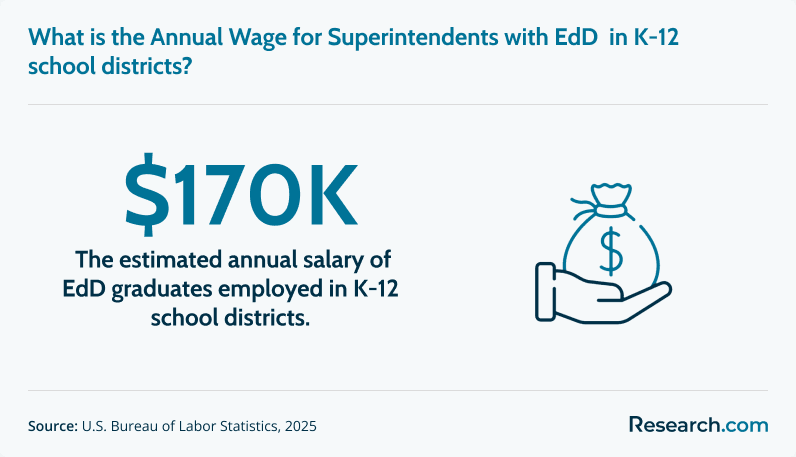
K–12 and higher education can both lead to strong EdD salaries, but the opportunity structure is different. In K–12 systems, the top district role can be highly compensated. A superintendent in a large, well-funded district can earn more than many university administrators, with an average salary range of $146,046 to $215,726. However, each district usually has only one superintendent, so competition for those roles can be intense.
Higher education offers a broader set of administrative positions. Universities and colleges may employ multiple deans, vice presidents, provosts, directors, and student service leaders. Postsecondary education administrators have a median salary of $103,960, with the top 10 percent earning more than $212,420. For professionals who prefer campus-based leadership, academic operations, student affairs, or institutional strategy, higher education may offer more varied pathways than K–12 administration.
K–12 vs. higher education: salary is only one part of the decision
| Comparison point | K–12 leadership | Higher education leadership |
| Top earning roles | Superintendent and senior district administrators | Dean, provost, vice president, president, senior administrator |
| Work environment | Highly visible, community-facing, board-driven, often politically sensitive | Institutional, committee-based, faculty-facing, and often more bureaucratic |
| Advancement pattern | Often moves from teacher to principal to district leadership | May move through academic affairs, student affairs, enrollment, operations, or faculty leadership |
| Best fit | Professionals who want direct impact on school systems and local communities | Professionals interested in college operations, student success, academic programs, and institutional strategy |
Higher education administrators shape university operations in areas such as academic planning, student services, compliance, enrollment, and institutional improvement. Before choosing a path, compare the work culture as carefully as the paycheck.
ROI thinking is not unique to education. Professionals in other fields face similar trade-offs when deciding whether graduate education is worth the cost; for example, nurses comparing leadership pathways often ask whether moving from a BSN to an MSN is worth it. The same logic applies to an EdD: the degree is most valuable when it clearly connects to higher responsibility and stronger long-term earning potential.
Postsecondary education administrators help colleges and universities manage academic affairs, student support, enrollment, institutional services, and executive operations. The chart below provides additional context on median annual wages for this sector.
Do EdD graduates earn more in the public or private sector?
Private-sector EdD roles often have a higher compensation ceiling, especially in corporate learning, workforce development, education technology, consulting, and executive training. Public-sector roles, including public school districts and state universities, may offer more predictable pay structures, stronger job security, pension benefits, and transparent advancement systems. The better financial choice depends on your risk tolerance, benefits needs, and career goals.
Public vs. private sector comparison
| Factor | Public sector | Private sector |
| Salary structure | Often tied to published salary schedules or public compensation rules | Often negotiated and linked to market demand, performance, and business impact |
| Benefits | May include strong retirement plans, health benefits, and job stability | May include bonuses or incentives, but benefits vary widely by employer |
| Career examples | Superintendent, principal, public university administrator, instructional coordinator | Chief learning officer, training director, EdTech leader, consultant |
| Best fit | Professionals who value public service, stability, and structured advancement | Professionals who want higher upside, faster organizational change, and business-facing leadership |
Some roles now sit between sectors. EdTech companies, consulting firms, public-private workforce partnerships, and nonprofit education organizations may combine education expertise with business strategy. Similar cross-disciplinary salary questions appear in other professional fields, such as professionals comparing MSN MBA dual degree jobs that blend clinical, business, and leadership skills.
Which industries outside education hire EdD graduates and what do they pay?
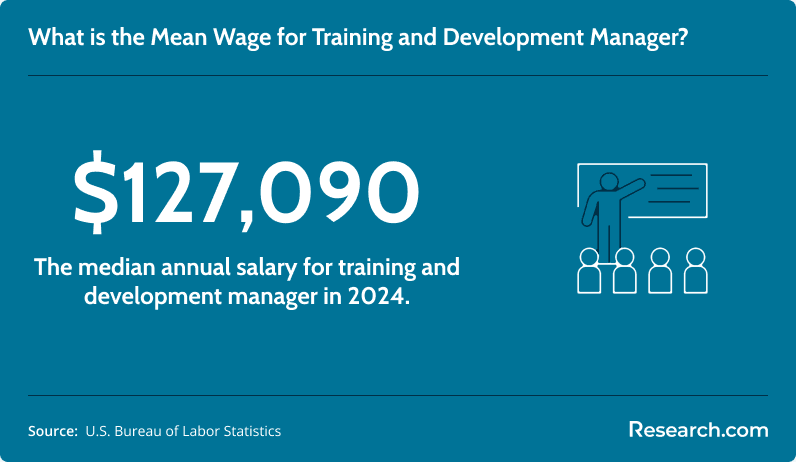
EdD graduates are not limited to schools and colleges. Many organizations need leaders who understand adult learning, program evaluation, instructional design, policy implementation, change management, and workforce development. Corporate learning and development is one of the most common non-school pathways. Training and development managers had a median salary of $127,090 in 2024, and senior learning executives may earn more depending on organization size and responsibility.
EdTech companies may hire EdD graduates for product strategy, implementation, customer success leadership, research, curriculum design, and professional learning. Healthcare organizations may need education leaders to manage staff training, patient education, continuing education, or medical education programs. Government agencies and nonprofits may value EdD graduates for policy, evaluation, community education, and program leadership.
Non-school industries that may value an EdD
| Industry | Possible roles | Why an EdD can help |
| Corporate learning and development | Chief learning officer, training director, learning strategy leader | Connects adult learning, instructional design, leadership, and measurable business outcomes |
| Education technology | Implementation leader, curriculum strategist, product learning specialist | Helps translate educational research and user needs into scalable products and services |
| Healthcare | Medical education leader, staff development director, patient education program leader | Supports training systems, compliance education, and professional development programs |
| Government and nonprofit organizations | Program director, education policy leader, evaluation specialist | Applies research and leadership skills to community programs, policy goals, and public outcomes |
| Consulting | Education consultant, organizational learning advisor, assessment consultant | Uses doctoral-level expertise to solve training, leadership, curriculum, or systems problems for clients |
Corporate learning and instructional design
Corporate learning roles can be attractive for EdD graduates who enjoy adult education, technology-enabled learning, leadership development, and measurable performance improvement. If this path interests you but you are not ready for a doctorate, a lower-cost specialized master’s may be a useful step; compare options such as the most affordable online master’s in instructional design programs before committing to a doctoral route.
Do EdD graduates see faster salary growth compared to those with an MEd or PhD?
EdD graduates may see faster salary growth than professionals with only an MEd when the doctorate helps them move into senior leadership. The common salary accelerator is not the credential by itself; it is the transition from roles such as teacher, coordinator, or principal into district, institutional, or executive leadership. If you are still comparing master’s-level outcomes, review high-paying jobs for professionals with a master’s in education to understand what may be possible before doctoral study.
Compared with a PhD in Education, an EdD can sometimes lead to faster early-career salary movement for experienced practitioners because many students are already employed in education or training leadership while completing the degree. PhD programs are typically more research-focused, and graduates may pursue faculty or research roles where compensation growth follows a different timeline. However, either degree can lead to strong earnings if it leads to the right senior role.
The right comparison is career path to career path. A PhD graduate who becomes a university executive may out-earn many EdD graduates, while an EdD graduate who becomes a superintendent or chief learning officer may out-earn many research-focused academics. In other fields, students also weigh whether a degree creates a direct pipeline into advanced professional roles, such as those asking why major in biology for medical school. For EdD students, the equivalent question is whether the doctorate connects directly to a defined leadership market.
Do EdD graduates earn as much as PhD in Education graduates?
EdD and PhD in Education graduates can earn comparable salaries when they hold comparable roles. The degree type matters less than the job’s scope, employer, budget, and leadership responsibility. A university dean, provost, or president may hold either credential. In those cases, compensation is usually based on the position rather than whether the person holds an EdD or a PhD.
The misconception is that a PhD automatically pays more because it is research-intensive. In reality, an EdD graduate leading a large district or corporate learning function may earn more than a PhD graduate in a traditional faculty role. At the same time, PhD graduates who become senior university administrators, research center directors, or highly successful scholars may have strong earnings as well. In 2024, 466 doctorate recipients specialized in educational leadership and administration, showing continued interest in practitioner-focused leadership preparation.
EdD vs. PhD: choose based on the work you want
| Question | EdD may fit better if... | PhD may fit better if... |
| What type of problems do you want to solve? | You want to improve organizations, programs, systems, and leadership practice | You want to conduct original research and contribute to academic knowledge |
| Where do you want to work? | Districts, colleges, universities, companies, nonprofits, government agencies, or consulting settings | Universities, research organizations, policy institutes, or research-intensive roles |
| What outcome matters most? | Applied leadership, promotion, organizational impact, and practical change | Research expertise, scholarship, teaching at the university level, and academic publication |
| How should salary be evaluated? | Compare the degree against leadership roles you plan to pursue | Compare the degree against faculty, research, and academic administration pathways |
If you are comparing doctoral and post-master’s education credentials, it may also help to review the difference between an EdS and an EdD, since that distinction can clarify whether you need a specialist credential or a full applied doctorate.
What is the job market outlook for EdD graduates?
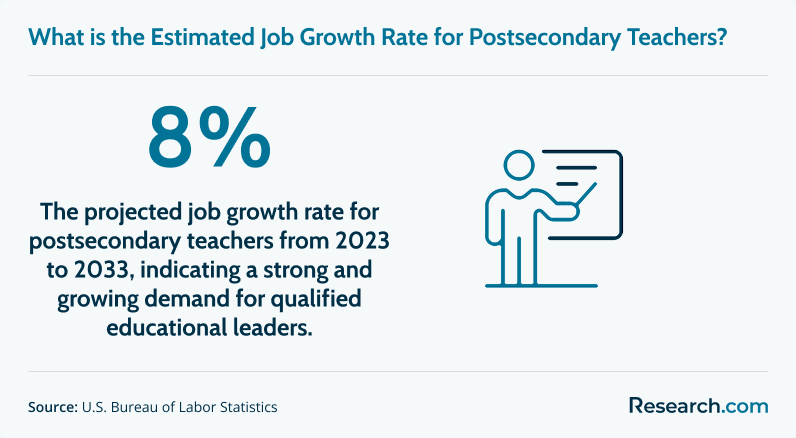
The job market for EdD graduates is shaped by demand for leadership in education, training, healthcare, workforce development, and organizational learning. The U.S. Bureau of Labor Statistics projects growth for several roles connected to EdD pathways, including an 8% growth rate for postsecondary teachers and a 29% growth rate for medical and health services managers between now and 2033. These figures do not mean every EdD graduate will enter those roles, but they do show that education, training, and leadership skills remain relevant across multiple sectors.
Budget pressure, enrollment shifts, technology adoption, accountability requirements, and workforce reskilling are all influencing the market. Some schools and universities face financial constraints, while other employers need leaders who can improve outcomes, manage change, and build effective learning systems. As with healthcare labor-market research, where professionals may ask which state pays gerontology nurse practitioners the highest salaries, EdD candidates should look at location-specific and sector-specific demand rather than relying only on national averages.
Current trends affecting EdD salaries and opportunities
- Technology and AI are changing learning roles: Employers increasingly need leaders who can evaluate educational technology, guide responsible AI use, and train staff effectively.
- Workforce development is expanding outside schools: Companies, healthcare systems, nonprofits, and government agencies need learning leaders who can design training tied to measurable outcomes.
- Accountability remains central: Schools and colleges continue to need leaders who can use data, assessment, and applied research to improve programs.
- Leadership competition is real: The EdD can strengthen a profile, but senior roles still require experience, references, measurable achievements, and strong communication skills.
Are additional certifications beneficial for EdD graduates?
Additional certifications can be useful when they support a specific career target. An EdD demonstrates advanced leadership and applied research preparation, but a focused credential can show technical competence in areas such as instructional design, educational technology, project management, data analysis, human resources, corporate training, or school administration. The right certification depends on the sector you want to enter.
For example, an EdD graduate pursuing corporate learning may benefit from credentials tied to learning strategy, instructional design, or talent development. A school leader may need state-specific administrator or superintendent credentials. A higher education professional may benefit from training in assessment, compliance, analytics, or student success. If you are comparing broader credential options, review certification programs that may lead to higher-paying careers and choose only those that match your target role.
How to choose an EdD program with salary outcomes in mind
- Start with the job, not the degree. Identify the exact roles you want after graduation and check whether job postings prefer or require a doctorate.
- Check accreditation and institutional credibility. Make sure the university is properly accredited and recognized by employers in your sector.
- Compare total cost, not just tuition. Include fees, residencies, travel, books, technology, and the cost of reducing work hours if needed.
- Ask about career outcomes. Request examples of graduate roles, promotion patterns, employer partnerships, and dissertation or capstone projects.
- Look for relevant specialization options. Choose concentrations aligned with your goals, such as educational leadership, higher education, instructional design, organizational leadership, or learning technologies.
- Evaluate flexibility honestly. Online and hybrid formats can help working professionals, but they still require significant time for reading, research, writing, and applied projects.
- Calculate your break-even point. Estimate how much your salary would need to rise and how long it would take to recover your program costs.
Common mistakes to avoid when evaluating EdD salary potential
| Mistake | Why it can hurt ROI | Better approach |
| Assuming the doctorate automatically guarantees a raise | Many employers pay based on role, responsibility, and salary schedule, not only the degree | Confirm how your target employers reward doctoral credentials |
| Choosing a program based only on speed | A faster program is not always the best fit if it lacks relevance, support, or employer recognition | Balance completion time with quality, accreditation, cost, and career alignment |
| Ignoring total program cost | Fees, travel, and debt can reduce the financial benefit of higher pay | Build a full cost estimate before enrolling |
| Using national averages as a personal salary forecast | Average salaries do not reflect your location, sector, experience, or target role | Research salary data for your specific region and job title |
| Choosing a specialization without a career plan | A broad or mismatched concentration may not support your intended promotion | Select a specialization that matches the roles you want to pursue |
| Overlooking licensure or credential rules | Some K–12 leadership roles require state-specific administrator credentials beyond the degree | Check state and employer requirements before applying |
What EdD graduates say about salary and career impact
- David: "I had built my career in corporate training but wanted to move into higher education leadership. The EdD helped me add academic credibility to my professional background. I now manage professional development at a major university, and that transition would have been much harder without the doctorate. Completing the program online allowed me to keep working while changing direction."
- Omar: "The strongest part of my EdD experience was learning alongside professionals from K–12, higher education, and international education settings. Those conversations changed how I thought about leadership and helped me consider nonprofit education roles I had not previously explored. The online discussions and group work made the program feel connected rather than isolated."
- James: "I was unsure whether to choose an EdD or a PhD because I wanted a doctorate but did not want a purely research-focused career. The applied structure of the EdD matched my goal of leading change directly. I was able to keep working as a school administrator while studying, and the degree strengthened my confidence for larger leadership responsibilities."
Key Insights
- The average EdD salary is commonly in the $88,000 to $100,000 range, but role matters more than the average. Superintendents, deans, provosts, college presidents, and corporate learning executives often have much higher earning potential than classroom or mid-level roles.
- An EdD pays off best when it leads to a leadership move. The degree is most financially valuable when it helps you qualify for broader authority, larger teams, bigger budgets, or executive responsibility.
- Master’s vs. EdD salary comparisons should be role-based. Compare your current or master’s-level role with the specific doctoral-level role you want, not just degree titles.
- K–12, higher education, and corporate roles reward the EdD differently. Public education may offer structure and stability, while corporate learning may offer higher upside and more performance-based compensation.
- EdD and PhD earnings can be similar when the jobs are similar. The best choice depends on whether you want applied leadership or research-centered work.
- ROI depends on cost control. Program price, debt, employer assistance, completion time, and promotion timeline can determine whether the degree produces a strong financial return.
- Do not enroll without checking accreditation, licensure, and employer expectations. A credible program aligned with your career target is far more valuable than a generic doctorate with unclear outcomes.
References:
- National Center for Science and Engineering Statistics. (2024). Survey of Earned Doctorates 2024. National Science Foundation.
- Organization for Economic Co-operation and Development. (2024). Education Policy Outlook 2024. OECD Publishing.
- U.S. Bureau of Labor Statistics. (2025). Instructional Coordinators. Occupational Outlook Handbook. U.S. Department of Labor.
- U.S. Bureau of Labor Statistics. (2025). Postsecondary Education Administrators. Occupational Outlook Handbook. U.S. Department of Labor.
- U.S. Bureau of Labor Statistics. (2025). Training and Development Managers. Occupational Outlook Handbook. U.S. Department of Labor.
Other Things You Should Know About Doctor of Education (EdD) Salary
Yes. In 2027, K-12 district leadership roles such as superintendent or assistant superintendent often pay $120,000 to $250,000, while university administration roles like dean or provost can range from about $130,000 to over $300,000, depending on institution size and responsibility.
Yes, geographic location can significantly influence an EdD holder's salary in 2027. Typically, salaries are higher in urban areas with a higher cost of living. For example, EdD holders in metropolitan regions often earn more than those in rural areas. Additionally, regions with high demand for educational leaders may offer better compensation packages.
Yes, the salary for an EdD holder in 2027 can vary depending on the industry or sector. Educational administration, higher education roles, and corporate training positions are sectors that often offer competitive salaries for EdD graduates, with notable variations based on location and experience.
In 2027, states like California, New York, and Massachusetts often offer the highest salaries for EdD holders due to high demand for educational leaders and cost of living adjustments. These states typically pay above the national average for similar roles.


