2027 Fastest Way To Become a Counselor in Louisiana

Co-Founder and Chief Data Scientist
Becoming a counselor in Louisiana is not a shortcut career: full LPC licensure requires graduate education, supervised clinical work, an approved exam, and state board review. But you can move through the process efficiently if you choose the right degree program, apply for provisional licensure on time, secure strong supervision, and avoid delays with transcripts, background checks, and clinical hour documentation.
This guide is for students, career changers, bachelor’s-degree holders, and working behavioral health employees who want the fastest realistic route to counseling work in Louisiana. You will learn what the state requires, which jobs are possible before full licensure, how online and accelerated programs compare, what employers look for, how much counselors earn, and whether a fast-track path is worth the workload.
Quick answer: fastest path to counseling licensure in Louisiana
- The fastest route to become a licensed professional counselor in Louisiana is to complete a qualifying 60-credit graduate counseling degree, apply promptly for Provisional Licensed Professional Counselor (PLPC) status, finish 3,000 supervised post-graduate hours, pass either the NCE or NCMHCE, and submit a complete LPC application to the Louisiana State Board of Licensed Professional Counselors.
- The timeline cannot be compressed below Louisiana’s supervision rules: post-graduate supervised experience must take no less than two years and no more than six years.
- Louisiana’s counselor job outlook is supported by mental health awareness, behavioral health workforce needs, and demand in rural and underserved communities.
- The average salary for counselors in Louisiana is approximately $64,464 annually, though pay depends heavily on license level, specialty, location, employer type, and experience.
- A fast-track plan works best for students who can handle a heavy graduate workload, document clinical hours carefully, and choose programs aligned with Louisiana licensure requirements.
- What is the fastest way to become a licensed counselor in Louisiana?
- What counseling careers can you pursue in Louisiana with only a bachelor’s degree?
- Are there accelerated counseling degree programs in Louisiana?
- Are online counseling programs in Louisiana faster than traditional ones?
- What challenges do fast-track counseling students face?
- How do employers in Louisiana view fast-track counselors?
- Are fast-track and online counseling programs in Louisiana more affordable?
- Is there a demand for counselors in Louisiana?
- What are the advantages of specializing in counseling in Louisiana?
- How much do counselors get paid in Louisiana?
- What are the ethical and continuing education requirements for Louisiana counselors?
- What are the best practices for ongoing professional growth after licensure?
- Is taking the fast route to become a counselor in Louisiana worth it?
- How can I effectively prepare for Louisiana’s counselor licensing exam?
- How can I become a school counselor in Louisiana?
What is the fastest way to become a licensed counselor in Louisiana?
The quickest legitimate path is not about skipping requirements. It is about completing each Louisiana licensing step in the right order with as few administrative setbacks as possible. The Louisiana State Board of Licensed Professional Counselors oversees the LPC pathway, and candidates should plan backward from the degree, PLPC registration, supervised hours, exam, and final LPC application.
In practical terms, the fastest route looks like this:
| Step | What Louisiana candidates need to do | How to avoid delays |
| Complete the required graduate education | Earn a 60-credit graduate degree in mental health counseling or a closely related field from a regionally accredited institution. | Before enrolling, confirm that the curriculum matches Louisiana LPC coursework expectations and includes the required clinical training components. |
| Apply for PLPC status | Register as a Provisional Licensed Professional Counselor after graduation so you can begin counting supervised post-graduate experience. | Request official transcripts early and submit the PLPC application as soon as you are eligible. |
| Complete supervised experience | Accumulate 3,000 hours of supervised post-graduate experience, including at least 1,900 direct client contact hours and at least 100 hours of face-to-face supervision. | Choose a site that offers steady client volume, qualified supervision, and clear documentation procedures. |
| Meet the required timeline | Finish supervised experience in no less than two years and no more than six years. | Create a monthly hour-tracking plan with your supervisor instead of waiting until the end of the process. |
| Complete background checks | Submit required background check materials. | Schedule this early. In-person checks at Louisiana State Police Headquarters may take up to two weeks, while mail submissions can take as long as eight weeks. |
| Pass the required exam | Prepare for and complete either the National Counselor Examination (NCE) or the National Clinical Mental Health Counseling Examination (NCMHCE). | Use NBCC-approved materials, practice tests, and Louisiana Counseling Association resources rather than relying only on general study guides. |
| Apply for LPC licensure | Submit final documentation to the Louisiana board after meeting education, supervision, exam, and application requirements. | Keep copies of supervision logs, approvals, exam records, and board correspondence throughout the process. |
The biggest time-savers are not dramatic. They are administrative: choose a qualifying program, register as a PLPC immediately after graduation, avoid incomplete applications, and work at a site where client-contact hours are consistent. For a broader explanation of counseling timelines, review Research.com’s guide to how fast can you become a licensed therapist.
What counseling careers can you pursue in Louisiana with only a bachelor’s degree?
A bachelor’s degree alone generally does not qualify someone to practice independently as a licensed professional counselor in Louisiana. However, it can open the door to supervised behavioral health, case management, human services, and addiction support roles. These jobs can help you confirm your interest in counseling before committing to graduate school.
Common bachelor’s-level options include:
| Role | Typical setting | How it helps future LPC candidates |
| Entry-level substance abuse counselor or support staff | Rehabilitation centers, recovery programs, community agencies | Builds experience with addiction recovery, group support, relapse prevention environments, and supervised client services. |
| Behavioral health technician or specialist | Hospitals, residential programs, nonprofits, crisis or community behavioral health programs | Provides exposure to treatment teams, documentation, behavioral interventions, safety planning, and client care coordination. |
| Case manager or social work assistant | Social service agencies, mental health nonprofits, community programs | Develops assessment, referral, advocacy, and resource-navigation skills that are useful in clinical training. |
These positions are especially relevant in community agencies and nonprofits serving vulnerable populations. They can strengthen a graduate school application and help you decide whether you want to specialize in mental health counseling, school counseling, substance abuse services, trauma recovery, or another area.
If your goal is full counselor licensure, use bachelor’s-level employment as a stepping stone rather than an endpoint. Comparing the best rated online counseling degree program options can help you identify graduate pathways that fit your schedule, budget, and career goals.
This chart shows top-paying industries for counselors:
Are there accelerated counseling degree programs in Louisiana?
Louisiana counseling master’s programs are not usually “fast” in the way some undergraduate or certificate programs are. Because LPC preparation generally requires a 60-credit graduate curriculum with substantial clinical training, most students should expect a serious multi-year commitment. Still, some programs offer flexible formats, online delivery, summer enrollment, and full-time plans that can help students finish closer to the shorter end of the traditional timeline.
Examples of Louisiana counseling master’s options include:
| School or program | Format and focus | Timeline and clinical details | Cost information stated |
| University of Holy Cross | Fully online CACREP-accredited Master of Science in Counseling with Clinical Mental Health Counseling and School Counseling concentrations. | Designed for completion in as little as three years; includes over 700 hours of clinical experience and two required residencies. | Tuition rates are described as competitive, though specific figures are not publicly detailed. |
| Loyola University New Orleans | 60-credit Master of Science in Counseling offered online and in a campus-based hybrid format. | Standard completion time is approximately three years; students may move faster with heavier course loads and summer terms. The program requires 740 clinical training hours. | Tuition is about $1,039 per credit hour, totaling roughly $62,340. |
| Louisiana State University Health Sciences Center – New Orleans and Louisiana State University (Baton Rouge) | CACREP-accredited counseling master’s programs with rigorous academic and clinical expectations. | Not described as explicitly accelerated, but full-time enrollment and careful course planning may help students finish on the shorter side of the standard range. | No specific tuition figure is stated here. |
When evaluating accelerated counseling degree programs in Louisiana, do not focus only on graduation speed. Ask whether the program is regionally accredited, whether the counseling curriculum aligns with Louisiana LPC requirements, whether clinical placements are available in your area, and whether the pace leaves enough time to develop counseling skills.
Students who already hold a graduate degree or want to add a focused skill area may also compare best online graduate counseling certificate programs, but a certificate alone should not be assumed to meet LPC eligibility rules.
Are online counseling programs in Louisiana faster than traditional ones?
Online counseling programs can be more convenient, but they are not automatically faster. The core licensure requirements still apply: a qualifying graduate curriculum, practicum and internship experience, post-graduate supervision, and a licensing exam. The time advantage comes from flexibility, not from removing clinical or board requirements.
| Factor | Online counseling program | Campus or hybrid program | Decision point |
| Scheduling | Often better for working adults because coursework may be more flexible. | May require commuting and fixed class meeting times. | Online may help if work or family obligations would otherwise slow your progress. |
| Clinical placement | Students may need to secure approved local placements and supervisors. | Programs may have established relationships with nearby sites. | Ask exactly how placement support works before enrolling. |
| Residency requirements | Some programs include required in-person residencies. | Face-to-face learning is built into the format. | Budget for travel if residencies are required. |
| Networking | Requires more intentional effort to connect with faculty, peers, and local employers. | Offers more routine in-person interaction. | Choose online only if you are proactive about building professional relationships. |
| Licensure fit | Can work well if the program meets Louisiana requirements. | Can work well if the program meets Louisiana requirements. | Never assume an online program qualifies for Louisiana LPC licensure without verifying. |
Online study may help you maintain employment while completing coursework, which can reduce financial pressure. However, students still need enough time for clinical skills practice, supervision, documentation, and exam preparation. A program that is too compressed can create problems later if it leaves you underprepared for practicum, internship, or employer expectations.
What challenges do fast-track counseling students face?
Accelerated counseling study can be productive for disciplined students, but it is demanding. Counseling is a skill-based profession, not only an academic subject. Compressing coursework can make it harder to absorb theory, practice clinical judgment, and receive feedback.
- Heavy academic load: Condensed terms often mean more reading, writing, exams, skills demonstrations, and clinical preparation in a shorter window.
- Limited time to practice counseling skills: Students may have fewer opportunities to reflect on feedback before entering practicum and internship settings.
- Pressure on work and family life: Full-time employment, caregiving, and accelerated graduate study can become difficult to sustain at the same time.
- Burnout risk: Continuous coursework, client-facing training, supervision, and exam preparation can lead to fatigue if students do not plan recovery time.
- Smaller professional network: Students moving quickly may spend less time developing relationships with classmates, faculty members, supervisors, and local agencies.
- Licensure documentation problems: Fast-moving students may overlook details such as approved coursework, practicum requirements, supervisor qualifications, or hour tracking.
The best fast-track students usually do three things well: they protect study time, communicate early with supervisors, and maintain organized records from the first semester. If you are already stretched thin, a part-time program may be slower but safer.
How do employers in Louisiana view fast-track counselors?
Louisiana employers generally care less about whether a program was marketed as “accelerated” and more about whether the candidate is licensure-eligible, clinically prepared, ethical, and ready to work with real clients. Because Louisiana requires a 60-credit graduate degree plus supervised experience, employers often use accreditation, field placement quality, supervision history, and references to judge readiness.
Fast-track graduates can be attractive candidates when they show discipline, maturity, and strong documentation. This is especially true for career changers or bachelor’s-level behavioral health workers who already understand client services, case coordination, crisis response, or community-based care.
However, employers may be cautious if a candidate’s training appears thin. Be ready to explain where you completed practicum and internship, what populations you served, what supervision you received, and how you handled ethical and cultural issues. A strong portfolio of supervised experience matters more than the speed of your degree.
Are fast-track and online counseling programs in Louisiana more affordable?
Fast-track and online programs can reduce some costs, but they are not always cheaper. The true price depends on tuition, fees, books, residencies, travel, technology, clinical placement expenses, exam fees, background checks, lost income, and how long you remain enrolled.
- Tuition can vary widely: The University of Louisiana at Monroe’s online Master of Science in Counseling charges around $500 per credit, resulting in an estimated total of $30,000 for a 60-credit curriculum. Public institutions in Louisiana generally price online counseling degrees between $10,000 and $17,000, reflecting substantial savings compared to some national averages.
- Faster completion can reduce indirect costs: Finishing sooner may lower living expenses, campus-related costs, or the number of semesters in which fees are charged.
- Online study can help students keep working: Flexible delivery may allow students to maintain income while completing graduate coursework.
- Commuting and housing costs may drop: Online students can often avoid daily travel and campus housing expenses, although residencies or in-person clinical requirements may still create costs.
- Financial aid and in-state tuition matter: Louisiana residents may benefit from in-state rates at public institutions, and eligible students can still explore federal and state financial aid options.
| Cost question to ask | Why it matters |
| What is the total program cost, not just the per-credit tuition? | Fees, clinical costs, residencies, books, and technology charges can change the real price. |
| Can I complete practicum and internship near where I live? | Travel requirements can add time and expense. |
| Does the program help locate clinical placements? | Students who must find placements alone may face delays. |
| Can I keep working while enrolled? | Lost income can make a cheaper program more expensive in practice. |
| Will transfer credits or prior graduate credits apply? | Accepted credits may reduce time and cost, but policies vary by school. |
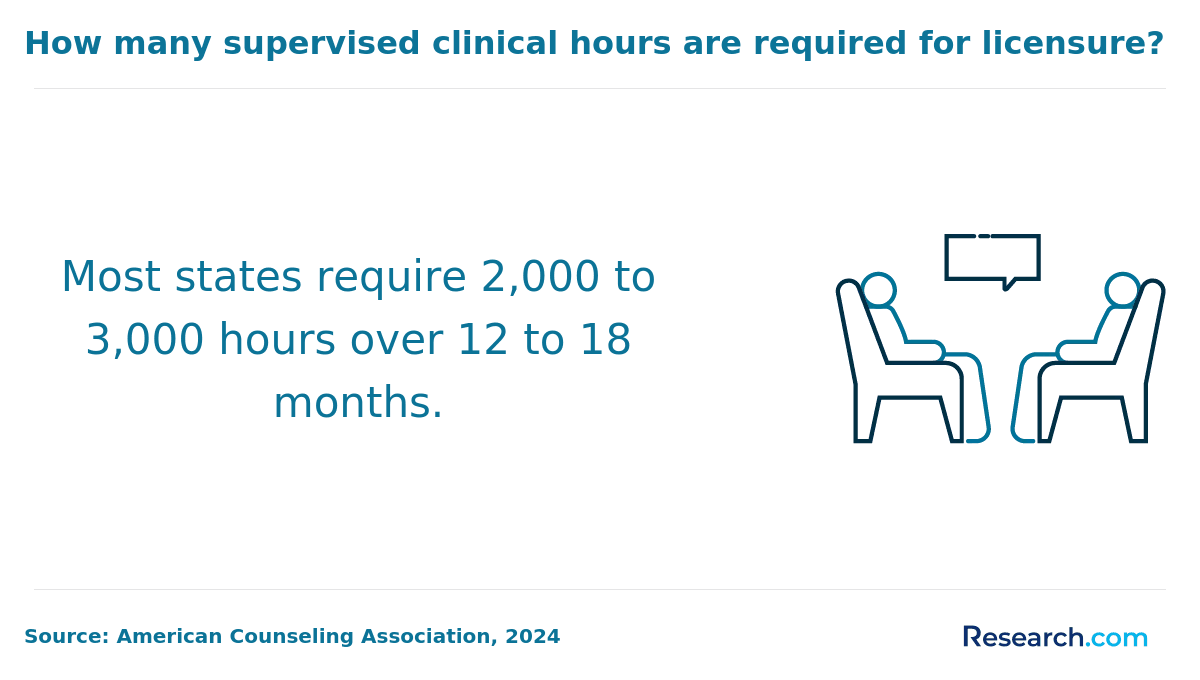
It is also important to understand the supervised clinical hours required for licensure. The image below summarizes what candidates need to complete.
Is there a demand for counselors in Louisiana?
Yes. Louisiana’s need for counselors reflects both national behavioral health trends and state-specific access issues. The U.S. Bureau of Labor Statistics projects a 19% growth rate for substance abuse, behavioral disorder, and mental health counselors nationwide between 2023 and 2033 — far above the average for all occupations.
Within Louisiana, demand is shaped by limited access to mental health services in rural and underserved communities, ongoing substance use concerns, school-based mental health needs, family stressors, and shortages created by both new positions and replacement hiring as experienced professionals leave the workforce.
Demand does not guarantee a specific job or salary, but it does mean prospective counselors should think strategically about specialization, placement sites, and credentials. Students comparing counseling, social work, and therapy pathways may also want to review the difference between LPC and LCSW degrees before selecting a graduate program.
What are the advantages of specializing in counseling in Louisiana?
Specialization can make a counselor more useful to employers and communities because Louisiana’s behavioral health needs are not uniform. A counselor working in a school, rural clinic, addiction recovery program, hospital, private practice, or community agency may need different training and clinical tools.
| Specialization area | Why it may be valuable in Louisiana | Who should consider it |
| Substance abuse counseling | Supports clients and families affected by addiction and recovery needs. | Students interested in treatment centers, rehabilitation programs, community agencies, or integrated behavioral health settings. |
| School counseling | Addresses academic, social, emotional, and crisis-related student needs. | Candidates who want to work with children, adolescents, educators, and families. |
| Trauma-informed counseling | Helps clients affected by crisis, violence, disaster, grief, or chronic stress. | Future counselors drawn to community mental health, crisis services, family services, or clinical practice. |
| Marriage, couple, and family-focused work | Supports relational functioning, parenting concerns, and family systems. | Students interested in family services, private practice, and child welfare-adjacent work. |
Specialization should be chosen based on your intended work setting, local demand, supervision opportunities, and long-term career interests. If addiction counseling is your focus, Research.com’s guide on how to become a substance abuse counselor in Louisiana can help you compare that pathway with LPC preparation.
How much do counselors get paid in Louisiana?
Counselor pay in Louisiana depends on license status, years of experience, specialty, employer, region, and whether the counselor works in an agency, school, hospital, private practice, or other setting. As of 2025, the average annual wage for counselors in the state is approximately $64,464, with most professionals earning between $47,887 and $53,017.
Entry-level licensed professional counselors in Louisiana typically start around $40,000 per year, while those with five to nine years of experience can expect salaries closer to $48,595. Licensed professional counselors in Baton Rouge earn around $50,000 annually, reflecting local salary patterns within the state.
| Counseling area | Salary considerations |
| Mental health counseling | Licensed professional counselors focused on mental health usually earn between $54,600 and $80,000, depending on role, setting, and location. |
| Substance abuse counseling | Pay is often lower to mid-range, although experienced counselors in specialized settings may earn more. |
| School counseling | School counselor salaries in Louisiana are generally comparable to or slightly above mental health counselor salaries, consistent with national patterns. |
| High-demand or underserved regions | Some communities may offer higher compensation to recruit qualified counselors, but candidates should evaluate workload, support, and supervision as well as pay. |
Compared with national figures, counselor salary in Louisiana tends to be somewhat below the U.S. median, partly because of regional cost of living differences and local labor market conditions. Advanced certifications, supervisory roles, specialized clinical expertise, and private practice or healthcare system employment can influence earnings.
If your goal is school-based practice and cost control, comparing affordable online school counseling programs may help you identify programs that fit your budget and licensure goals.
The following overview highlights some of the best-paying counseling jobs in the US:
What are the ethical and continuing education requirements for Louisiana counselors?
Louisiana counselors must practice within professional and state ethical standards. This includes protecting client confidentiality, maintaining appropriate boundaries, documenting services responsibly, using competent treatment methods, and understanding duties related to risk, mandated reporting, and client welfare.
Continuing education is also part of maintaining professional competence after licensure. Counselors should expect to complete ongoing training in areas such as ethics, confidentiality, data protection, cultural responsiveness, clinical best practices, and emerging treatment approaches. Because rules can change, licensees should rely on the Louisiana State Board of Licensed Professional Counselors for current renewal and continuing education details.
For a focused review of state-specific licensing rules, see Research.com’s guide to LPC license requirements in Louisiana.
What are the best practices for ongoing professional growth after licensure?
Licensure is not the endpoint of counselor development. It is the point at which professional responsibility increases. New LPCs should build a growth plan that combines supervision, consultation, continuing education, specialization, and careful career management.
- Seek consultation even after supervision ends: Complex cases, ethical questions, and trauma work benefit from professional discussion.
- Choose continuing education strategically: Prioritize training that matches your client population rather than collecting random credits.
- Join professional networks: Associations, workshops, and peer consultation groups can lead to referrals, mentorship, and job leads.
- Build documentation habits: Strong records protect clients, counselors, and employers.
- Consider advanced credentials carefully: Certifications can be valuable when they align with your specialty, but they should not replace supervised competence.
- Reassess career fit regularly: Agency work, school counseling, private practice, hospitals, and nonprofits each have different workloads and advancement paths.
Counselors considering adjacent helping professions can also review Louisiana social worker educational requirements to understand how social work education differs from counseling preparation.
Is taking the fast route to become a counselor in Louisiana worth it?
A fast route can be worth it if it is still a high-quality route. The advantage is clear: earning PLPC status allows you to begin supervised clinical work, gain experience, build professional contacts, and move toward LPC licensure while earning income. For students committed to the field, that earlier entry can be valuable.
However, “fast” should never mean poorly planned. Counseling requires judgment, emotional stamina, cultural humility, ethical discipline, and supervised practice. If an accelerated schedule causes you to rush through clinical development or choose a weak placement, the short-term time savings may create long-term problems.
| The fast route may be a good fit if... | A slower route may be better if... |
| You can study full time or close to full time without sacrificing clinical quality. | You need to work long hours and cannot consistently complete readings, assignments, and skills practice. |
| You already have experience in behavioral health, education, social services, or case management. | You are new to the field and need more time to build foundational counseling skills. |
| You have access to strong practicum, internship, and post-graduate supervision sites. | You live in an area where placements are difficult to secure and the program offers limited support. |
| You are organized enough to track hours, deadlines, applications, and board requirements. | You are likely to miss documentation details that could delay licensure. |
For many Louisiana candidates, the best approach is not the absolute fastest program. It is the fastest program that still meets licensure standards, supports clinical placement, fits your finances, and prepares you to serve clients safely.
What counselors in Louisiana say about their careers
- I chose an accelerated counseling path because I wanted to begin supervised work as soon as I responsibly could. The demand for mental health services in Louisiana made the decision feel practical, but the real value came from getting into the field and learning under supervision. – Donald
- Serving rural communities in Louisiana has shown me how much access matters. Moving quickly through training helped me start contributing sooner, but I still had to be intentional about supervision, boundaries, and learning the needs of the community. – Patty
- After licensure, professional development became a major part of my career. Workshops, continuing education, and peer consultation helped me grow faster than coursework alone could have. – Jeremie
How can I effectively prepare for Louisiana’s counselor licensing exam?
Louisiana LPC candidates may take either the National Counselor Examination (NCE) or the National Clinical Mental Health Counseling Examination (NCMHCE). The best exam choice depends on board requirements, your training background, and the type of content you are most prepared to handle.
- Confirm the accepted exam with the Louisiana board: Do this before paying for preparation materials or registering.
- Review the exam format: The NCE and NCMHCE test different skills, so your study plan should match the exam you select.
- Create a written study calendar: Include content review, practice questions, weak-area review, and rest days.
- Use official or reputable materials: Prioritize NBCC-approved resources and practice exams over unverified online notes.
- Study ethics and diagnosis carefully: Many candidates underestimate how much judgment-based reasoning matters.
- Join a study group or consult licensed counselors: Experienced professionals can help you understand how exam content connects to real counseling practice.
- Do not wait until supervision is complete: Begin light review earlier so exam preparation does not become a last-minute barrier to licensure.
For a related overview of the Louisiana pathway, you can also read Research.com’s guide to the quickest way to become a counselor in Louisiana.
How can I become a school counselor in Louisiana?
School counseling is a specialized pathway because it connects counseling skills with student development, academic planning, family systems, crisis response, and school operations. Candidates should not assume that every general counseling program automatically leads to school counselor eligibility.
Prospective school counselors should look for programs that include coursework and field experience related to child and adolescent development, educational psychology, school counseling practice, crisis intervention, consultation, and work with families and school personnel. Practical experience in school settings is especially important because the daily work differs from clinical mental health counseling in private practice or community agencies.
Before enrolling, ask whether the program meets Louisiana requirements for school counseling roles, whether placements are available in schools, and whether graduates are prepared for the credential or certification pathway you intend to pursue. For a more detailed state-specific guide, see how to become a school counselor in Louisiana.
Common mistakes to avoid when fast-tracking a counseling career in Louisiana
| Mistake | Why it can hurt you | Better approach |
| Choosing a program because it is fast without checking licensure alignment | You may graduate with credits that do not fully support Louisiana LPC eligibility. | Confirm accreditation, curriculum, practicum, internship, and board alignment before applying. |
| Looking only at tuition | Fees, travel, residencies, unpaid clinical hours, and lost income can change the real cost. | Calculate total cost of attendance and likely income impact. |
| Assuming online means easier | Online programs still require clinical work, supervision, exams, and strong self-discipline. | Choose online only if you can manage independent learning and placement logistics. |
| Waiting to plan supervision | Poor supervision planning can delay the 3,000 required hours. | Identify qualified supervisors and high-volume clinical sites early. |
| Not tracking hours carefully | Missing records can slow LPC approval even if you completed the work. | Maintain organized logs and review them regularly with your supervisor. |
| Relying only on rankings | A highly visible program may not be the best fit for your location, budget, or licensure needs. | Compare outcomes, placement support, faculty access, cost, and Louisiana board alignment. |
Questions to ask before choosing a Louisiana counseling program
- Is the institution regionally accredited?
- Is the counseling program CACREP-accredited or otherwise clearly aligned with Louisiana LPC coursework expectations?
- Does the program require 60 credits?
- How are practicum and internship placements arranged?
- Can I complete clinical training in my area?
- What happens if I cannot find a placement on time?
- How many students does each faculty advisor support?
- Are there required residencies, and what do they cost?
- What is the total estimated cost, including fees and clinical expenses?
- Do graduates commonly pursue PLPC and LPC licensure in Louisiana?
- What exam preparation support is available for the NCE or NCMHCE?
- Can I attend part time if the accelerated pace becomes unrealistic?
Key insights
- The fastest legitimate LPC path in Louisiana requires a 60-credit qualifying graduate degree, PLPC registration, 3,000 supervised post-graduate hours, at least 1,900 direct client contact hours, at least 100 hours of face-to-face supervision, and an approved licensing exam.
- Louisiana’s supervision timeline cannot be rushed below the state’s minimum: candidates must complete supervised experience over no less than two years and no more than six years.
- Bachelor’s-degree holders can work in supervised behavioral health, case management, substance abuse support, and human services roles, but independent counseling practice generally requires graduate education and licensure.
- Online and accelerated programs can save time and reduce some costs, but only if they meet Louisiana licensure requirements and provide reliable clinical placement support.
- Employers value fast-track graduates when their training is accredited, their supervision is strong, and their clinical experience is well documented.
- Do not choose a counseling program based only on speed, tuition, or convenience. The best option is the one that balances licensure fit, clinical quality, affordability, and your ability to complete the workload without burning out.
Related Articles for Nearby States
- 2027 Fastest Way To Become a Counselor in Mississippi
- 2027 Fastest Way To Become a Counselor in Arkansas
- 2027 Fastest Way To Become a Counselor in Texas
- 2027 Fastest Way To Become a Counselor in Alabama
- 2027 Fastest Way To Become a Counselor in Tennessee
- 2027 Fastest Way To Become a Counselor in Missouri
- 2027 Fastest Way To Become a Counselor in Oklahoma
- 2027 Fastest Way To Become a Counselor in Florida
- 2027 Fastest Way to Become a Counselor in Kentucky
- 2027 Fastest Way to Become a Counselor in Georgia
References:
- CounselingPsychology.org. (n.d.). Best online counseling programs in Louisiana. https://www.counselingpsychology.org/counseling/schools/louisiana
- CounselingSchools.com. (n.d.). Become a counselor in Louisiana (LA): State licensing & schools. https://www.counselingschools.com/licenses/louisiana
- EPPP 101. (n.d.). Best counseling psychology programs in Louisiana. https://eppp101.com/best-counseling-psychology-programs-in-louisiana
- Human Services Edu. (n.d.). MSW programs in Louisiana | Earn a Masters of Social Work in LA. https://www.humanservicesedu.org/louisiana-msw
- Louisiana State University. (n.d.). Master of Education in Counseling | SOE. https://www.lsu.edu/chse/education/academics/graduate/counselor-ed/index.php
- Online Counseling Programs. (n.d.). How to become a licensed counselor (LPC) in Louisiana. https://onlinecounselingprograms.com/become-a-counselor/counseling-licensure/how-to-become-a-counselor-in-louisiana
- OnlineMFTPrograms.com. (n.d.). 12+ Louisiana master in counseling programs (CACREP accred.). https://onlinemftprograms.com/cacrep-accredited-counseling-programs/louisiana
- US BLS. (2024). Strong growth projected in mental health-related employment. Bureau of Labor Statistics. https://www.bls.gov/opub/ted/2024/strong-growth-projected-in-mental-health-related-employment.htm
- ZipRecruiter. (2025). Licensed Mental Health Counselor Salary in Louisiana. https://www.ziprecruiter.com/Salaries/Licensed-Mental-Health-Counselor-Salary--in-Louisiana
Other Things You Need to Know About the Fastest Way to Become a Counselor in Louisiana
In 2027, to become a counselor in Louisiana, you need a master's degree in counseling or a related field. This education must include coursework in areas such as human development, counseling theory, and ethics, totaling at least 60 graduate semester hours.
The Louisiana State Board of Licensed Professional Counselors issues LPC licenses in 2027. Applicants must submit transcripts, supervised-practice documentation, and application materials to that board, which also sets the rules for licensure, supervision, and renewal for professional counselors in Louisiana.
In 2027, obtaining a counselor license in Louisiana quickly requires completing 3,000 hours of supervised post-graduate experience, including at least 1,900 hours in direct client contact. The supervision must be under a licensed professional and documented as part of the licensing process.