2027 Best Developmental Psychology Doctorate Programs

Co-Founder and Chief Data Scientist
A developmental psychology doctorate is a major commitment: several years of advanced study, original research, faculty mentorship, and often practical training with children, adolescents, families, schools, healthcare systems, or community organizations. For working professionals, the key question is not simply “Which program is best?” It is whether a PhD or PsyD pathway fits your career goals, schedule, research interests, funding options, and long-term return on investment.
This guide explains what developmental psychology doctorate programs involve, how online and campus formats compare, what they cost, how admissions usually work, and which career paths may follow. It also highlights program-selection criteria that matter more than rankings alone: accreditation, faculty fit, assistantship availability, research alignment, practicum access, dissertation support, and employer recognition.
Quick answer: Is a developmental psychology doctorate worth it?
A developmental psychology doctorate can be worth it if you want to lead research, teach at the university level, design child and adolescent interventions, influence education or health policy, or qualify for advanced psychology roles that require doctoral training. It is usually not the fastest or cheapest route for someone who only wants entry-level counseling, case management, or education support work.
| Choose this doctorate if you want to... | Consider another route if you... |
| Conduct original research on human development, child development, adolescence, aging, cognition, or developmental disorders. | Need the fastest path into the workforce and do not need doctoral-level research training. |
| Teach, publish, or pursue academic leadership in psychology or human development. | Prefer a practice-focused counseling role that may be reachable through a master’s-level pathway. |
| Work in policy, healthcare, education, nonprofit research, or applied developmental science. | Are unwilling to commit four to seven years to coursework, research, dissertation work, and possible practica. |
| Increase eligibility for advanced roles where doctoral training is preferred or required. | Have not yet identified a clear research focus or faculty mentors whose work matches your interests. |
What are the main benefits of a developmental psychology doctorate?
A doctorate in developmental psychology can expand both the depth of your expertise and the range of professional settings available to you. The strongest benefits usually come from specialized research training, credibility in advanced roles, and access to leadership opportunities.
- Broader career options: Graduates may work in research, higher education, healthcare, school systems, government agencies, nonprofits, child development centers, or consulting roles.
- Advanced specialization: Doctoral study allows you to focus on areas such as cognitive development, social-emotional development, developmental disorders, adolescent development, or lifespan development.
- Higher earning potential: A doctorate can improve long-term salary prospects. The original data cited for doctoral education notes that median wages can rise from $56,000 with a master’s degree to $78,000 with a doctorate.
- Research and policy influence: Doctoral graduates are better positioned to design studies, evaluate interventions, publish findings, and inform education, healthcare, or child welfare policy.
- Flexible study formats: Some programs offer online or hybrid coursework, which can help working professionals continue employment while completing doctoral requirements.
- Access to major employment sectors: Hospitals (30%), schools (25%), and government agencies (20%) are among the largest employers of developmental psychologists in 2024.
What can I expect from a developmental psychology doctorate program?
A developmental psychology doctorate studies how people grow, change, learn, adapt, and develop across the lifespan. Programs usually combine theory, statistics, research design, developmental science, ethics, and specialized seminars. Many also require lab work, teaching, field placements, practica, comprehensive exams, and a dissertation based on original research.
Common topics include cognitive development, language development, social and emotional development, family systems, developmental psychopathology, intervention design, neurodevelopment, research methods, and quantitative analysis. Students learn how to evaluate evidence, collect and interpret data, and apply developmental theory to real-world problems.
Online programs may deliver coursework through live video sessions, recorded lectures, digital discussion boards, virtual advising, and online research collaboration. However, online does not always mean fully remote. Many doctoral programs still require in-person residencies, supervised fieldwork, internships, research lab participation, or local practicum placements.
Where can I work with a developmental psychology doctorate?
Developmental psychology doctorate graduates may work wherever organizations need expertise in human development, learning, behavior, mental health, family systems, or developmental risk and resilience.
| Work setting | Possible roles | Best fit for students interested in... |
| Universities and colleges | Professor, researcher, lab director, academic program leader | Teaching, publishing, mentoring students, and leading research projects |
| Hospitals and clinics | Developmental psychologist, assessment specialist, clinical program leader | Developmental disorders, pediatric psychology, neurodevelopment, and intervention |
| Schools and education agencies | School consultant, assessment expert, early childhood specialist, research evaluator | Learning, behavior, school readiness, special education, and student support |
| Government agencies | Policy advisor, program evaluator, child and family services researcher | Public policy, developmental outcomes, welfare systems, and population-level impact |
| Nonprofit organizations | Program director, grant researcher, child mental health evaluator | Community intervention, advocacy, prevention, and underserved populations |
| Private sector and consulting | Human development consultant, training specialist, organizational advisor | Workforce development, family services, youth programs, and applied behavioral research |
How much can I make with a developmental psychology doctorate?
Earnings depend on role, employer, location, licensure status, research experience, and whether you work in academia, healthcare, government, schools, or private consulting. In May 2023, median annual salaries for psychologists varied by industry: government roles reported a median salary of $115,400, hospitals reported $102,660, ambulatory healthcare services reported $98,380, and elementary and secondary schools reported $84,440.
A doctorate may improve access to higher-responsibility roles, but it does not guarantee a specific salary. Before enrolling, compare program cost, funding, time away from full-time work, assistantship availability, and the types of jobs graduates actually obtain.
- Best developmental psychology doctorate programs for 2027
- How long does a developmental psychology doctorate take?
- Online vs. on-campus developmental psychology doctorate programs
- Average cost of a developmental psychology doctorate
- Financial aid options for doctoral students
- Admissions requirements and prerequisites
- Typical doctorate courses in developmental psychology
- Common developmental psychology specializations
- How to choose the right doctoral program
- How developmental psychology connects with other psychology degrees
- Career paths after a developmental psychology doctorate
- How to verify accreditation and program quality
- Diversity and inclusion in developmental psychology programs
- Job market for developmental psychology doctorate graduates
- Practical training in doctoral programs
- Substance use intervention and developmental psychology
- Mentorship and professional networking
- Common challenges in doctoral study
- Can you fast-track a developmental psychology doctorate?
- Accredited online PsyD programs in developmental psychology
- Employer views of online developmental psychology doctorates
- Emerging trends and research areas
- Student support services
- Ethical research practices
- Benefits of online psychology degrees
- Interdisciplinary study opportunities
Best Developmental Psychology Doctorate Programs for 2027
How do we rank schools?
Because doctoral study requires a large investment of time and money, program comparisons should be based on transparent, verifiable information rather than reputation alone. Research.com uses data sources such as the IPEDS database, Peterson's database, the College Scorecard database, and The National Center for Education Statistics to evaluate schools and programs. These sources help students compare institutional characteristics, program information, affordability indicators, and educational quality markers. For a fuller explanation, review Research.com’s methodology page.
| School | Program focus | Cost | Credits | Sample courses or areas |
| Liberty University | Online PhD in Developmental Psychology with training in lifespan development, psychological theory, and research methods | $595 per credit | 60 | Cognitive Development, Advanced Research, Social Psychology |
| The New School for Social Research | PhD in Cognitive, Social, and Developmental Psychology with an interdisciplinary research orientation | $2,470 per credit | 60 | Cognitive Psychology, Developmental Psychology, Social Psychology, Research Methods |
| The University of Alabama at Birmingham | Developmental Psychology PhD emphasizing lifespan development, research, and applied experience | $480 per credit | 81 credits | Core psychology courses, research methods, developmental theory |
| UNLV | PhD in Psychological and Brain Sciences with specialization options across psychology areas | $344.25 per credit | 72 | Cognitive Psychology, Developmental Psychology, Clinical Psychology, and more. |
| The University of Pennsylvania | Developmental Psychology program focused on cognitive, social, and emotional growth across the lifespan | ~$37,678 per academic year | 20 credits minimum | Core topics in cognitive development, social development, and research methods |
| UCL | Psychology and Human Development MPhil/PhD with advanced research training | ~$9822 program cost | Not specified; based on research output | Research methods, cognitive development, social psychology |
| Boston University | PhD in Developmental Science with individualized mentorship and interdisciplinary study | $66,670 program cost | 64 credits required for completion. | Core areas include developmental theory, research methods, and applied developmental science. |
| FIU | Ph.D. in Developmental Science focused on cognitive, emotional, and social development | ~$4,101 per semester | 75 | Developmental Theory, Research Methods, Lifespan Development |
| Stanford University | PhD in Psychology with rigorous research training across psychology fields | ~$1,305 per unit | Varies depending on research and coursework | Cognitive psychology, neuroscience, social psychology, and more |
| University of Toronto | PhD in Developmental Psychology and Education focused on child and adolescent development | $6,210 | 12 full-course equivalents | Topics include developmental theories, cognitive development, and research methods |
Graduate perspectives on developmental psychology doctoral study
"My doctorate helped me move from general interest in child development to leading research teams in a hospital setting. The work is demanding, but the training changed how I design studies and evaluate interventions." — Racquel
"The online format made the degree possible while I was working and caring for my family. The biggest benefit was not just flexibility; it was learning how to apply developmental research to early childhood policy." — Jeremy
"Doctoral study was intense, especially during the dissertation stage. It prepared me for academic work, teaching, and publishing in a way a shorter degree could not have done." — Essa
Key Findings
- Employment of psychologists is projected to grow by 6% from 2022 to 2032, with demand linked to schools, hospitals, mental health centers, and growing recognition of how mental health affects learning.
- Doctoral degree holders earn over 20% more in weekly median salary than those with a bachelor's degree.
- Most developmental psychology doctorate programs take four to seven years and include advanced coursework, research training, a dissertation, and possibly internships or practica.
- The average developmental psychology doctorate program cost is around $133,340 when tuition, fees, and living expenses are included.
- Common specialization options include child development, adolescent development, lifespan development, cognitive development, social and emotional development, and developmental disorders.
How long does it take to complete a developmental psychology doctorate program?
A developmental psychology doctorate usually takes four to seven years, depending on the degree structure, enrollment pace, dissertation progress, funding model, and whether the program includes clinical or field-based requirements. This is different from the path to become a psychiatrist, which can take up to eight years after completing a bachelor's degree.
| Program stage | Typical timing | What students usually do |
| Foundational coursework | First two to three years | Study developmental theory, statistics, research methods, child psychology, cognition, social development, and ethics. |
| Research development | Often begins in the second or third year | Join labs, refine research questions, collect data, present findings, and prepare for dissertation work. |
| Comprehensive exams or milestones | Varies by program | Demonstrate mastery of theory, methods, and specialization areas before advancing to candidacy. |
| Dissertation | Final years | Design, conduct, write, and defend original research in developmental psychology. |
| Internship or practicum | Required in some programs | Complete supervised applied experience in schools, clinics, community agencies, hospitals, or research settings. |
In 2020, 753 doctoral degrees in developmental and child psychology were awarded by private not-for-profit institutions in the United States. Students pursuing child psychologist requirements should pay special attention to whether a program’s curriculum, practicum structure, and accreditation status align with the roles they want after graduation.

How does an online developmental psychology doctorate program compare to an on-campus program?
Online and on-campus developmental psychology doctorates can both be rigorous, but they differ in delivery, networking, research access, and practical training logistics. In 2022, primarily online colleges awarded 5,976 doctoral degrees, accounting for 2.9% of all doctoral degrees that year.
| Factor | Online doctorate | On-campus doctorate |
| Schedule flexibility | Often better for working professionals, especially when courses are asynchronous or hybrid. | May require regular campus attendance, lab meetings, seminars, and in-person teaching or research duties. |
| Course delivery | Uses recorded lectures, live video meetings, digital readings, online exams, and discussion platforms. | Relies more on in-person seminars, labs, face-to-face advising, and campus-based research meetings. |
| Research access | Can be strong, but students must confirm how remote research supervision, data access, and lab participation work. | Often provides easier access to faculty labs, research teams, campus facilities, and informal collaboration. |
| Networking | May include virtual cohorts, online conferences, faculty meetings, and professional communities. | Usually offers more daily contact with peers, faculty, visiting scholars, and campus events. |
| Practicum or internship | May require local placements approved by the program. | May use established regional placements through the university’s existing network. |
| Best fit | Students who need geographic flexibility and can stay self-directed. | Students who want immersive campus research culture and frequent in-person mentorship. |
The best format is the one that supports your research goals, funding needs, supervision style, and practical training requirements. Online flexibility is valuable, but accreditation, faculty fit, and placement quality matter more than convenience alone.
What is the average cost of a developmental psychology doctorate program?
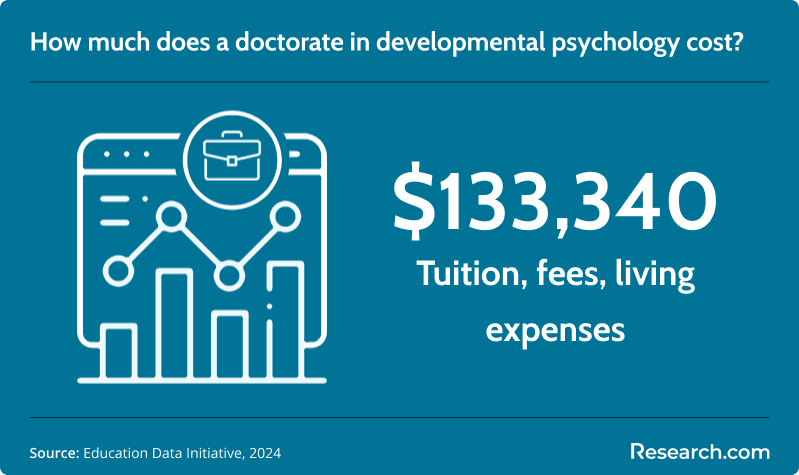
The average developmental psychology doctorate program costs about $133,340, including tuition, fees, and living expenses. Actual cost can vary widely by school, residency status, funding package, online or campus format, local cost of living, and how long the dissertation takes.
| Cost category | Typical amount stated | What to check before enrolling |
| Tuition | $20,000 to $50,000 per year | Whether tuition is charged by credit, term, academic year, or dissertation status. |
| Fees | $2,000 to $5,000 annually | Technology, student services, lab, research, graduation, and online learning fees. |
| Living expenses | $15,000 to $25,000 per year | Housing, food, transportation, health insurance, and relocation costs. |
| Books and materials | $1,000 to $2,000 annually | Textbooks, assessment materials, software, statistics tools, and research supplies. |
Do not compare programs by tuition alone. A higher-tuition program with full assistantship funding may cost less out of pocket than a lower-tuition program with limited aid. Ask for a full cost-of-attendance estimate, average funding duration, stipend information, assistantship workload, and whether funding continues during dissertation years.
What are the financial aid options for students enrolling in a developmental psychology doctorate program?
Doctoral students may use several funding sources, but availability differs sharply by school and program type. Research-focused PhD programs may offer assistantships or fellowships, while some professional or online programs rely more heavily on loans, employer support, or scholarships.
| Funding option | How it works | What to verify |
| Federal loans | Eligible students may borrow through federal loan programs with structured repayment options. | Annual borrowing limits, interest rates, repayment plans, and total projected debt. |
| Scholarships | Schools, professional organizations, and nonprofit groups may offer awards for psychology students. | Eligibility, renewal rules, deadlines, and whether awards are one-time or recurring. |
| Grants | Need-based grants may be available through federal or state sources and do not require repayment. | Start with the U.S. Department of Education website for possible grants. |
| Teaching or research assistantships | Students work part-time for the university in exchange for a stipend and, in many cases, tuition support. | Workload, tuition coverage, stipend amount, health insurance, and renewal requirements. |
| Employer tuition assistance | Some employers help pay for job-related graduate education. | Reimbursement caps, grade requirements, service commitments, and approved programs. |
Before accepting an offer, compare the full funding package with the program’s expected time to completion. A doctorate that takes longer than planned can increase living expenses, loan reliance, and opportunity cost.
What are the prerequisites for enrolling in developmental psychology doctorate program?
Admissions requirements vary, but most developmental psychology doctorate programs look for evidence that applicants can succeed in advanced research, writing, statistics, and independent scholarly work.
| Requirement | What programs commonly expect | How to strengthen your application |
| Bachelor's or master's degree | Most programs require at least a bachelor's degree; some prefer or require a master's in psychology or a related field. | Students from related education or counseling backgrounds, including those exploring the most affordable online school counseling degrees, may need additional psychology or research coursework. Applicants with one of the affordable online master's programs in psychology may be better prepared for doctoral-level study. |
| GPA and GRE scores | A strong GPA, usually 3.0 or higher, and competitive GRE scores are often required. | Confirm whether GRE scores are required, optional, or waived, because policies vary by institution. |
| Letters of recommendation | Applicants often submit 2-3 letters from professors, supervisors, or research mentors. | Choose recommenders who can discuss your research skills, writing ability, maturity, and readiness for doctoral work. |
| Relevant experience | Research, internships, lab work, clinical exposure, education experience, or child development work can be valuable. | Prioritize experience that connects directly to your intended specialization and faculty research interests. |
| Personal statement | Programs usually ask for career goals, research interests, and reasons for pursuing doctoral study. | Name specific faculty, research questions, populations, and methods that match the program. |
Many applicants apply to both developmental and clinical psychology PhD programs to broaden their options, but the fit should be intentional. Clinical programs are often highly competitive and may have different licensure and practicum expectations.
What courses are typically in a developmental psychology doctorate program?
Coursework gives students the theoretical, methodological, and ethical foundation needed for advanced developmental research. Exact requirements differ by institution, but many programs include a mix of core psychology, developmental science, statistics, research design, and specialization seminars.
| Course area | What students learn | Why it matters |
| Developmental theories | Major frameworks explaining human growth, learning, identity, attachment, cognition, and social development. | Provides the conceptual foundation for research questions and applied interventions. |
| Cognitive development | How attention, memory, language, reasoning, executive function, and problem-solving change over time. | Supports work in education, neurodevelopment, assessment, and child learning research. |
| Social and emotional development | Peer relationships, family systems, emotion regulation, temperament, identity, and social behavior. | Helps explain developmental risk, resilience, mental health, and adjustment. |
| Research methods | Experimental, longitudinal, observational, survey, and mixed-methods approaches. | Prepares students to design reliable studies and evaluate developmental evidence. |
| Statistics and quantitative analysis | Data modeling, measurement, inference, and interpretation of developmental research data. | Essential for dissertation research, publications, grants, and program evaluation. |
| Developmental disorders | Developmental delays, autism, ADHD, learning disabilities, and related assessment or intervention issues. | Useful for students interested in clinical, school, healthcare, or intervention research settings. |
| Ethics and professional practice | Responsible research conduct, consent, confidentiality, data management, and work with vulnerable populations. | Critical for research involving children, families, schools, and clinical populations. |
What types of specializations are available in developmental psychology doctorate program?
Specializations help doctoral students connect coursework, research, practicum experiences, and dissertation topics to a specific career direction. The best specialization is the one supported by faculty expertise, active research labs, and relevant placement opportunities.
| Specialization | Focus | Good fit for students who want to... |
| Child development | Psychological growth from infancy through adolescence. | Study early learning, attachment, family systems, school readiness, or developmental risk. Students with interests in special education may also compare affordable online master's in special education options. |
| Adolescent development | Teen identity, peer relationships, risk behavior, mental health, and transitions to adulthood. | Work with schools, youth programs, public policy, or adolescent health research. |
| Lifespan development | Development from birth through old age. | Study aging, adult development, family life cycles, or developmental change across stages. |
| Cognitive development | Changes in thinking, memory, reasoning, attention, and problem-solving. | Pursue research in learning, language, educational psychology, or neurodevelopment. |
| Social and emotional development | Relationships, emotion regulation, personality, attachment, and social behavior. | Focus on resilience, family systems, trauma, peer influence, or social adjustment. |
| Developmental disorders | Conditions that emerge in childhood or adolescence, such as autism or ADHD. | Work in assessment, intervention research, healthcare, schools, or specialized clinical settings. |
Students interested in justice, legal systems, or behavioral assessment may also compare affordable online master's programs in forensic psychology as a related but distinct graduate pathway.
How to choose the best developmental psychology doctorate program?
The best developmental psychology doctorate program is not automatically the highest-ranked or most famous one. It is the program that matches your research agenda, funding needs, learning format, supervision style, and career goals.
| Selection factor | Why it matters | Questions to ask |
| Accreditation and recognition | Accreditation can affect educational quality, licensure eligibility, internship access, and employer confidence. | Is the program accredited or approved by a relevant body such as the American Psychological Association or the National Association of School Psychologists? |
| Faculty fit | Doctoral success often depends on close mentorship and research alignment. | Which faculty members study your intended topic, and are they accepting new doctoral students? |
| Specialization options | Your concentration should connect to your dissertation and career path. | Does the program support child development, cognitive development, developmental disorders, lifespan development, or another focus? |
| Program format | Online, hybrid, and campus programs differ in flexibility and research access. | How often must students attend campus, residencies, labs, or practicum sites? Students comparing online psychology doctorates may also review a doctorate in organizational psychology online for format differences. |
| Funding | Assistantships, stipends, and tuition support can dramatically change total cost. | How many years of funding are guaranteed, and what happens during dissertation completion? |
| Practical training | Applied experience can shape employability and licensure-related preparation. | Where do students complete practica, internships, field placements, or research assistantships? |
| Graduate outcomes | Placement data shows whether the program leads to the careers you want. | Where have recent graduates worked, published, or completed postdoctoral training? |
How does developmental psychology connect with other psychology degrees?
Developmental psychology overlaps with several psychology and human services fields. Clinical psychology uses developmental knowledge to understand diagnosis and treatment across life stages. Educational psychology applies developmental science to learning, instruction, school readiness, and student support. Forensic psychology may use developmental perspectives when examining juvenile behavior, risk, rehabilitation, or legal decision-making.
The degree type also matters. A PhD usually emphasizes research and scholarship, while a PsyD is often more practice-oriented. Students deciding between these pathways should compare training models, dissertation expectations, licensure relevance, and likely career outcomes. Research.com’s guide to doctor of psychology salary comparisons can help clarify how PsyD and PhD pathways differ.
What career paths are available for graduates of developmental psychology doctorate program?
Graduates may pursue research, academic, leadership, consulting, policy, or applied developmental science roles. Some positions may require licensure, postdoctoral training, or additional supervised experience, depending on duties and state requirements.
| Career path | Typical responsibilities | Where it may lead |
| Director of Research | Lead developmental studies, manage research teams, secure grants, and publish findings. | Universities, hospitals, research institutes, government agencies, or nonprofits. |
| Department Head | Oversee psychology, child development, education, or behavioral science departments. | Academic institutions, schools, hospitals, or community organizations. Students with a degree in elementary education online may find education-focused roles especially relevant. |
| Clinical Director | Manage mental health or developmental services, supervise staff, and evaluate programs. | Clinics, hospitals, pediatric centers, or specialized service agencies. |
| Policy Advisor | Use developmental evidence to shape child welfare, education, family, or mental health policy. | Government agencies, think tanks, advocacy groups, or public policy organizations. |
| Professor or Academic Leader | Teach, mentor students, publish research, serve on committees, and lead academic initiatives. | Colleges, universities, research centers, and interdisciplinary institutes. |
| Consultant | Advise schools, agencies, companies, or nonprofits on developmental outcomes and program design. | Independent consulting, organizational training, education services, or healthcare systems. |
Students interested in population health, prevention, and community-level intervention can also compare related public health pathways, including the cheapest online public health degree options.
How can I verify the accreditation and educational quality of my developmental psychology doctorate program?
Start by confirming institutional accreditation, then review any program-level accreditation or professional recognition relevant to your intended career. Accreditation is especially important if you plan to seek licensure, complete supervised practice, apply for internships, or work in schools or clinical settings.
- Check the institution’s accreditor through official accreditation databases or the school’s accreditation page.
- Confirm whether the psychology program has programmatic accreditation or approval relevant to your career goals.
- Ask whether the curriculum meets licensure-related educational requirements in your state if you plan to practice clinically.
- Review faculty credentials, publications, funded research, lab activity, and student mentorship load.
- Request graduate outcomes, internship placement information, dissertation completion rates, and average time to degree.
- Compare related graduate pathways, such as 1 year masters in psychology online options, to understand how doctoral quality indicators differ from master’s-level programs.
How do developmental psychology doctorate programs promote diversity and inclusion?
Strong doctoral programs prepare students to study development across cultures, family structures, languages, socioeconomic contexts, and lived experiences. Diversity and inclusion should appear in more than a single course; they should shape research design, mentoring, clinical or field training, recruitment, and community partnerships.
- Curriculum: Courses should address cultural development, structural inequality, family diversity, disability, identity, and ethical research with diverse populations.
- Research methods: Students should learn how sampling, measurement, language, and cultural assumptions affect developmental findings.
- Mentorship: Programs should support historically underrepresented students through advising, peer networks, funding access, and inclusive lab cultures.
- Interdisciplinary training: Related fields such as family therapy can deepen understanding of family systems. Students interested in this area may review MFT graduate programs online.
What is the job market for graduates with a developmental psychology doctorate program?
The job market for developmental psychology doctorate graduates depends on specialization, research record, licensure status, teaching experience, and sector. Overall employment of psychologists, including graduates of online PhD forensic psychology programs, is projected to increase by 6% from 2022 to 2032, faster than the average for all occupations.
Demand is connected to schools, hospitals, mental health centers, and social service agencies. School psychologists are expected to remain important as awareness grows around the relationship between mental health and learning. Developmental expertise is also useful for students facing educational, behavioral, or developmental challenges that affect school success.
Education level can also influence earnings. According to the U.S. Bureau of Labor Statistics, in 2020, individuals with a doctorate earned over 20% more in weekly median salary than those with a bachelor's degree.
How are practical training opportunities integrated into developmental psychology doctorate programs?
Practical training may appear through research assistantships, teaching assistantships, field placements, internships, practica, community partnerships, lab-based projects, or applied program evaluation. The structure depends on whether the degree is research-focused, practice-focused, online, hybrid, or campus-based.
Students should ask where training takes place, who supervises it, how placements are evaluated, and whether online students receive equivalent support. Those comparing flexible formats can also explore a doctorate degree in psychology online to understand how programs combine remote coursework with practical requirements.
How do developmental psychology doctorate programs integrate substance use intervention strategies?
Some developmental psychology programs include coursework or research on adolescent risk behavior, prevention science, family factors, trauma, developmental pathways to substance misuse, and early intervention. These topics are especially relevant for students interested in youth mental health, public health, school-based prevention, or clinical research.
Programs may use case studies, supervised placements, intervention research, and interdisciplinary training to connect developmental theory with prevention and treatment. Students seeking a more direct counseling credential in this area may compare an addiction counselor degree with doctoral-level developmental psychology training.
How do developmental psychology doctorate programs cultivate mentorship and professional networking opportunities?
Mentorship is one of the most important factors in doctoral success. Strong programs connect students with faculty advisors, research labs, peer cohorts, conference opportunities, professional associations, alumni, and applied training sites.
- Faculty mentorship: Advisors guide research design, publishing, dissertation planning, and academic development.
- Lab communities: Research groups help students build technical skills, collaborate on studies, and prepare conference presentations.
- Professional networks: Conferences, internships, and partnerships expose students to employers and researchers outside the university.
- Related applied training: Students interested in behavioral intervention may also compare an online masters degree in applied behavior analysis to strengthen applied skills.
What challenges might students face during developmental psychology doctorate programs?
Doctoral study is rewarding but difficult. Students often manage heavy reading loads, statistics courses, research uncertainty, teaching duties, funding pressure, dissertation delays, and competing work or family responsibilities.
| Common challenge | Why it happens | Better strategy |
| Underestimating the dissertation | Original research often takes longer than coursework. | Choose a feasible topic, clarify data access early, and set regular writing milestones. |
| Choosing a weak faculty fit | A prestigious school may not have mentors in your exact research area. | Apply where at least one active faculty member studies your topic and is accepting students. |
| Funding stress | Assistantships may be limited, competitive, or not guaranteed for all years. | Ask for funding duration, stipend details, tuition coverage, and dissertation-year support in writing. |
| Balancing life and study | Doctoral programs demand sustained time, focus, and emotional energy. | Build a realistic weekly schedule and use advising, peer groups, and mental health resources early. |
| Confusing career paths | Psychology, counseling, social work, and education roles have different requirements. | Compare fields before enrolling; this guide to what is the difference between a social worker and a psychologist degree can help clarify distinctions. |
Is it possible to fast-track your developmental psychology doctorate?
Some programs may offer accelerated formats, transfer credit options, year-round study, or flexible scheduling. However, a developmental psychology doctorate cannot be shortened without limits because doctoral training includes research skill development, dissertation completion, mentorship, and often practical experience.
Fast-tracking may make sense if you already hold relevant graduate credits, have a clear research agenda, can study full time, and have strong faculty support. It may be risky if acceleration reduces research quality, practicum preparation, or accreditation alignment. Students interested in shorter psychology pathways can also compare the quickest psychology degree options before committing to doctoral study.
What distinguishes accredited online PsyD programs in developmental psychology?
Accredited online PsyD programs are generally practice-oriented and should be evaluated by curriculum quality, supervised training, faculty qualifications, practicum structure, student support, and alignment with professional standards. Students should not assume that an online PsyD automatically meets licensure or internship requirements in every state.
Ask whether the program includes in-person residencies, supervised clinical experiences, dissertation or applied research requirements, and state-specific licensure disclosures. For a closer look at program quality indicators, review Research.com’s guide to PsyD online programs APA accredited online.
Do employers value an online developmental psychology doctorate?
Employers are more likely to value an online developmental psychology doctorate when the institution is accredited, the curriculum is rigorous, faculty mentorship is substantive, and the student completed meaningful research or applied training. The format matters less when the program can demonstrate quality and the graduate can show strong skills.
Employers may ask about dissertation work, research methods, publications, practicum experiences, data analysis, teaching, and collaboration. Students worried about credibility should review whether is an online psychology degree respected by employers and prioritize accredited programs with transparent outcomes.
What emerging trends and research areas are shaping developmental psychology now?
Developmental psychology continues to evolve as researchers examine how biology, technology, family life, schools, culture, and inequality shape human development. Current areas of interest include:
- Neurodevelopmental and brain plasticity research: Brain imaging and neuropsychological tools are helping researchers study how early-life stress, education, intervention, and environment relate to development and behavior.
- Digital influence on development: Researchers are examining how digital media, screen time, and online social interaction may affect children’s and adolescents’ cognitive, social, and emotional development.
- Early childhood intervention programs: Studies continue to evaluate supports for autism, ADHD, learning disabilities, and developmental delays, with attention to long-term outcomes.
- Developmental impact of socioeconomic factors: Researchers study how food insecurity, healthcare access, educational opportunity, and family resources shape cognitive and emotional growth.
- Cultural and societal impacts on development: Cross-cultural research helps psychologists understand how families, norms, institutions, and social expectations influence developmental stages.
What student support services are offered in developmental psychology doctorate programs?
Doctoral programs are demanding, so support services can make a meaningful difference in completion, wellbeing, and career preparation. Strong programs make these resources visible before enrollment, not only after students arrive.
- Academic advising: Advisors help students plan coursework, meet milestones, choose electives, and prepare for comprehensive exams.
- Research support: Libraries, databases, labs, methodology workshops, grant-writing support, and publishing guidance support dissertation progress.
- Career services: Graduate career offices may assist with CVs, interviews, academic job searches, postdoctoral applications, and nonacademic career planning.
- Mental health and wellbeing resources: Counseling, stress management, wellness workshops, and crisis support can help students manage doctoral pressure.
- Financial aid advising: Aid offices can explain loans, assistantships, scholarships, grants, and funding deadlines.
- Online learning support: Online students should receive technical help, virtual library access, remote advising, and digital tutoring. Similar support structures appear in other online doctoral fields, such as online DSW programs.
- Peer communities: Cohorts, writing groups, research teams, and student organizations reduce isolation and encourage accountability.
- Professional development: Workshops on teaching, presentation skills, ethics, grant writing, and conference participation help students prepare for long-term careers.
How do developmental psychology doctorate programs ensure ethical research practices?
Ethics training is central because developmental psychologists often study children, families, schools, clinical populations, and other groups requiring careful protections. Programs usually teach Institutional Review Board procedures, informed consent and assent, confidentiality, responsible data management, conflicts of interest, and ethical reporting.
Students should expect to apply ethics through research proposals, case discussions, supervised projects, and dissertation review. These skills are relevant across many psychology careers, especially roles involving assessment, intervention, policy, or research with vulnerable populations.
What are the benefits of pursuing an online degree in psychology?
An online psychology degree can offer flexibility, broader geographic access, and scheduling options for students balancing work, caregiving, or relocation limits. For many learners, an online degree in psychology is a practical way to begin or continue psychology education without moving to campus.
However, online students should still verify accreditation, faculty access, internship or practicum expectations, technology requirements, transfer policies, and total cost. Flexibility is valuable only when the program also provides academic rigor, student support, and clear alignment with the student’s career goals.
What are the opportunities for interdisciplinary study in developmental psychology?
Developmental psychology is naturally interdisciplinary because human growth is shaped by biology, family, school, culture, healthcare, law, technology, and policy. Doctoral students may strengthen their research by drawing from fields outside traditional psychology.
| Interdisciplinary area | How it connects to developmental psychology | Possible applications |
| Forensic psychology | Developmental science can inform understanding of juvenile behavior, rehabilitation, decision-making, and legal involvement. | Students may compare forensic psychology master's programs online when exploring legal and behavioral pathways. |
| Educational psychology | Developmental research explains how children learn, regulate emotions, build skills, and respond to school environments. | School readiness, learning interventions, assessment, and education policy. |
| Public health | Developmental science supports prevention work related to childhood obesity, substance abuse, mental health, and early adversity. | Community programs, prevention research, and population-level intervention. |
| Neuroscience | Brain development research helps explain cognitive, emotional, and behavioral change across the lifespan. | Neurodevelopmental disorders, aging, intervention timing, and brain plasticity. |
| Social work | Social work adds a systems perspective on families, communities, trauma, poverty, and policy. | At-risk youth programs, family services, and child welfare evaluation. |
| Law and policy | Developmental evidence can shape policies for children, adolescents, families, schools, and mental health systems. | Child welfare, juvenile justice, education law, and family policy. |
Common mistakes to avoid when choosing a developmental psychology doctorate
| Mistake | Why it can hurt you | Better decision |
| Choosing based only on ranking | A highly ranked school may not have faculty who study your topic. | Prioritize research fit, funding, mentorship, and graduate outcomes. |
| Ignoring accreditation | Accreditation can affect licensure, internships, employer recognition, and transferability. | Verify institutional and relevant programmatic accreditation before applying. |
| Assuming online means easier | Doctoral work still requires advanced research, writing, statistics, and dissertation completion. | Ask how online students receive research supervision, field placement support, and faculty access. |
| Comparing tuition without funding | Sticker price may not reflect assistantships, stipends, fee waivers, or living costs. | Compare net cost, total debt, funding duration, and time to completion. |
| Overlooking licensure requirements | Not all psychology doctorates prepare students for the same professional credentials. | Check state requirements and ask the program for licensure disclosures if clinical practice is your goal. |
| Starting without a research direction | Unclear interests can slow progress and weaken admissions applications. | Identify populations, methods, faculty mentors, and research questions before applying. |
Questions to ask before applying
- Which faculty members would be a strong research match, and are they accepting doctoral students?
- What is the average time to degree for students in this program?
- How many students receive assistantships, stipends, tuition support, or fellowships?
- What practical training, fieldwork, internship, or practicum experiences are required?
- Do online students complete any campus residencies or in-person requirements?
- Where do graduates work after completing the program?
- What percentage of students complete the dissertation, and what support is available during that stage?
- Does the program meet educational requirements for any license or credential you may need?
- How does the program support diversity, ethical research, and work with vulnerable populations?
- What will the full cost be, including fees, living expenses, materials, and dissertation years?
Key Insights
- A developmental psychology doctorate is best for students who want advanced research, teaching, policy, leadership, or specialized developmental science roles.
- Most programs take four to seven years, so funding, dissertation support, and faculty fit are critical to completion.
- Online programs can be legitimate and rigorous, but students must verify accreditation, practicum logistics, mentorship quality, and employer relevance.
- The average program cost is around $133,340, but net cost depends heavily on assistantships, scholarships, grants, loans, and living expenses.
- Salary outcomes vary by role and sector; May 2023 median salaries ranged from $84,440 in elementary and secondary schools to $115,400 in government roles for psychologists in the cited industries.
- Do not choose a doctorate based on ranking alone. The better decision is the program that aligns with your research interests, career plan, funding needs, and required credentials.
References:
- Doctor of Philosophy in Developmental Psychology & Education. (n.d.). Ontario Institute for Studies in Education. https://www.oise.utoronto.ca/aphd/programs/doctor-philosophy-developmental-psychology-education
- Education pays, 2022. (2024, August). U.S. Bureau of Labor Statistics. Retrieved August 16, 2024, from https://www.bls.gov/careeroutlook/2023/data-on-display/education-pays.htm
- Occupational Outlook Handbook - Psychologists. (2024, August). U.S Bureau of Labor Statistics. Retrieved August 16, 2024, from https://www.bls.gov/ooh/life-physical-and-social-science/psychologists.htm#tab-6
- PhD salaries and lifetime earnings. (2018, February 15). The Graduate School. https://grad.msu.edu/phdcareers/career-support/phdsalaries
- Walden University. (2022, November 8). Earn more with a master’s degree or PhD degree. Walden University. https://www.waldenu.edu/programs/resource/earn-more-with-a-masters-degree-or-phd-degree
Other Things You Should Know About Developmental Psychology Doctorate Programs
In 2027, developmental psychology Ph.D. students can access financial aid options like fellowships, teaching assistantships, and research assistantships. Many universities also offer merit-based scholarships and federal student loans to assist with tuition and living expenses.
Identifying the best doctoral programs involves evaluating several criteria. Key factors include faculty expertise, research opportunities, program reputation, funding availability, graduate placement rates, and specialized facilities. Prospective students should consider these aspects to choose programs that align with their academic and career aspirations.
Yes. Most competitive programs expect at least 1 to 2 years of research experience, usually in a lab, plus a curriculum vitae, a purpose statement, and letters from faculty who can assess research skills. Many also favor applicants with a senior thesis or poster presentation.