2027 Best Doctorate in Forensic Psychology Online?

Co-Founder and Chief Data Scientist
// PREVIEW //
An online doctorate in forensic psychology is a major academic, financial, and career decision. It can prepare experienced psychology, counseling, criminal justice, public safety, or legal professionals to study criminal behavior, conduct forensic assessments, teach, consult, contribute to policy, or pursue advanced clinical work where psychology and the legal system overlap. It is not, however, the right path for every student. Licensure rules, practicum requirements, dissertation expectations, residency obligations, and total program cost can vary widely.
This guide explains what to expect from online doctoral programs in forensic psychology, how PhD and PsyD pathways differ, what programs may cost, how long they usually take, and which career outcomes may be realistic. It also includes a 2027 program list, decision tables, admissions guidance, accreditation considerations, financial aid options, and practical questions to ask before enrolling.
Why consider an online Doctorate in Forensic Psychology degree?
- You want advanced specialization at the intersection of psychology and law. Doctoral coursework commonly covers criminal behavior, psychological evaluation, forensic assessment, legal decision-making, research methods, and expert witness issues.
- You are aiming for senior-level roles. A doctorate can support careers in research, teaching, consulting, leadership, and, when licensure requirements are met, clinical or forensic psychological practice.
- You want stronger earning potential, but need to evaluate ROI carefully. According to 2024 data from Zippia, the estimated average salary for forensic psychologists is $83,000, with salaries reaching up to $127,000 or more in certain locations, industries, and specializations.
// PREVIEW //
Quick answer: Is an online Doctorate in Forensic Psychology worth it?
An online doctorate in forensic psychology can be worth it if you already have a strong foundation in psychology, counseling, criminal justice, law, or a related field and you need doctoral-level training for research, teaching, consulting, leadership, or licensure-oriented work. The degree is most useful when the program is accredited, includes supervised practical training where needed, aligns with your state’s licensing requirements, and has a total cost that makes sense for your expected career path.
It may not be the best choice if you only need entry-level criminal justice employment, want the fastest route into counseling practice, or are considering a program that does not clearly explain accreditation, practicum placement, residency requirements, dissertation support, or career outcomes.
| Choose this degree if... | Consider another path if... |
| You want doctoral-level expertise in forensic assessment, criminal behavior, legal psychology, research, or policy. | You want a shorter, lower-cost route into general mental health counseling or criminal justice work. |
| You can manage independent online study, doctoral writing, research, and possible in-person requirements. | You need daily face-to-face structure, local clinical placement support, or a fully campus-based cohort. |
| Your target role requires or strongly rewards a doctorate. | Your target job only requires a bachelor’s or master’s degree. |
| The program meets accreditation and, if applicable, licensure expectations in your state. | The school cannot confirm whether its coursework and supervised training fit your professional goals. |
What can I expect from an online Doctorate in Forensic Psychology degree?
Online doctorate in forensic psychology programs usually combine advanced psychology coursework with legal, criminal justice, assessment, research, and ethics training. Students may study how psychological science informs court decisions, offender rehabilitation, victim services, correctional systems, crisis response, expert testimony, and public safety policy.
- Degree types vary. Programs commonly lead to either a PhD, which usually emphasizes scholarship and research, or a PsyD, which generally places more emphasis on applied and clinical practice.
- Coursework is interdisciplinary. Students often examine criminal behavior, mental health law, forensic evaluation, research design, risk assessment, trauma, victimology, correctional psychology, and professional ethics.
- Doctoral work is demanding. Expect advanced writing, independent research, faculty mentorship, dissertation or applied doctoral project requirements, and possibly practicums, internships, residencies, or supervised forensic experience.
- Online does not always mean fully remote. Some programs require weekend residencies, workshops, in-person supervision, internships, or local field experiences.
- The degree can support several career directions. Graduates may work in academia, consulting, government, corrections, law enforcement support, research, policy, or licensed practice when all state requirements are satisfied.
Where can I work with an online Doctorate in Forensic Psychology degree?
Graduates may work in settings where psychological expertise is applied to legal questions, criminal behavior, public safety, or justice-involved populations. The exact roles available depend on licensure status, professional experience, specialization, and whether the doctorate is research-focused or practice-focused.
- Courts and legal settings: forensic assessment, expert consultation, competency-related work, mitigation support, jury consulting, or trial consulting.
- Mental health and correctional settings: evaluation, treatment planning, risk assessment, rehabilitation programming, or crisis intervention.
- Government and public safety agencies: research, behavioral consultation, training, threat assessment, or policy development.
- Colleges and universities: teaching, research, doctoral supervision, or program leadership.
- Private practice or consulting: forensic evaluation, expert witness work, organizational consultation, or specialized assessment, depending on licensure and state rules.
How much can I make with an online Doctorate in Forensic Psychology degree?
Salary depends on job title, licensure, location, employer type, years of experience, and specialization. A doctorate may improve access to senior, academic, research, clinical, or consulting roles, but it does not guarantee a specific income.
According to the U.S. Bureau of Labor Statistics (BLS), the median annual salary for psychologists, including forensic psychologists, is $117,750 in 2023. The top 10% of earners, which usually include those with more professional experience and advanced academic credentials, can bring home $157,420.
Zippia reports that forensic psychologists typically yield an average annual salary of $83,065. Zippia’s 2024 data also shows geographic variation: forensic psychologists in Santa Rosa, California earn an average salary of $127,409, while those in Houston Texas have an average salary of $77,739.
Experience level also matters. Junior level forensic psychologists earn an average of $67,000 per year, while those in more senior positions can pocket an average of $101,000 per year.
| Salary factor | What the cited data shows |
| Forensic psychologist average salary | Zippia reports an average annual salary of $83,065. |
| Psychologists overall | BLS reports $117,750 in 2023 for psychologists, including forensic psychologists. |
| Top earners | BLS reports $157,420 for the top 10% of earners. |
| Location example | Zippia reports $127,409 in Santa Rosa, California and $77,739 in Houston Texas. |
| Experience level | Zippia reports $67,000 for junior level roles and $101,000 for senior positions. |
- 2027 best online doctorate in forensic psychology programs
- How long does an online Doctorate in Forensic Psychology take?
- Online vs. on-campus Doctorate in Forensic Psychology: which is better?
- What does an online Doctorate in Forensic Psychology cost?
- What financial aid can forensic psychology doctoral students use?
- What are the admissions requirements?
- What courses will you take?
- What forensic psychology specializations are available?
- How should you choose the right online doctorate program?
- What career paths can graduates pursue?
- What is the job market for forensic psychology doctorate graduates?
- Are online Doctorate in Forensic Psychology programs as prestigious as campus programs?
- What are the challenges of online doctoral study?
- How does forensic psychology compare with other psychology doctorates?
- Can an online Doctorate in Forensic Psychology meet licensure requirements?
- How do programs address substance abuse and addiction counseling?
- How do student support services affect online doctoral success?
- How does accreditation affect forensic psychology careers?
- How can online programs build practical experience and networking?
- How can counseling techniques strengthen forensic psychology practice?
- What technical requirements and digital skills do online students need?
- What trends are shaping online forensic psychology education?
- How do programs train students for remote forensic assessment?
- What ethical issues matter in online forensic psychology training?
- Are online forensic psychology degrees legitimate and respected?
- How do legal and regulatory changes influence training?
- How do faculty expertise and mentorship affect doctoral training?
- What certifications can strengthen a forensic psychology career?
- How can you assess ROI before enrolling?
- What accreditation criteria should you review?
2027 List of Best Online Doctorate in Forensic Psychology Programs
How do we rank schools?
Choosing an online doctorate in forensic psychology should start with program fit, accreditation, cost, faculty expertise, and career alignment—not rankings alone. To identify options for this guide, our team reviewed data from sources such as the College Scorecard database, the IPEDS database, the National Center for Education Statistics (NCES), and Peterson’s database, including its Distance Learning Licensed Data Set. You can also review the Research.com ranking methodology for more detail on how schools are evaluated.
| School | Program | Best fit | Key requirement to notice |
| Fielding Graduate University | PhD in Clinical Psychology with Forensic Psychology concentration | Students seeking clinical psychology training with a forensic concentration | 500 cumulative hours of direct and indirect forensic experience with supervision |
| Capitol Technology University | PhD in Forensic Cyberpsychology | Experienced professionals interested in cybercrime, online behavior, and digital forensic issues | Research-focused online doctorate with a cyberpsychology emphasis |
| Alliant International University | PhD in Psychology, Public Policy and Law | Master’s or juris doctor holders working in public or private health and safety | Online format with two weekend residencies |
| University of Arizona Global Campus | PsyD with Criminology and Justice Studies specialization | Students interested in applied psychology, corrections, and justice systems | Applied doctoral project or dissertation and three non-credit in-residence workshops |
| Walden University | PhD in Forensic Psychology | Students seeking teaching, research, consulting, or criminal justice-focused forensic psychology roles | Four PhD residencies, dissertation, and doctoral writing assessment |
1. Fielding Graduate University
Fielding Graduate University offers a Doctor of Philosophy (PhD) in Clinical Psychology with a Forensic Psychology concentration. Students may earn a master’s degree during the program and can select concentrations such as forensic psychology or social justice and diversity. The curriculum is designed to build competencies and entry-level knowledge for health psychologist generalists. Coursework uses a mix of online, virtual, and in-person activities, and the forensic psychology concentration includes 500 cumulative hours of supervised direct and indirect forensic experience.
- Program Length: Five to six years
- Tracks/concentrations: PhD in Clinical Psychology Forensic Psychology concentration
- Cost per Credit: Fielding provides a tuition estimate of $10,180 per term
- Required Credits to Graduate: Minimum of 179 semester credits
- Accreditation: American Psychological Association (APA), WASC Senior College and University Commission (WSCUC)
2. Capitol Technology University
Capitol Technology University offers a fully online PhD in Forensic Cyberpsychology for professionals interested in cybercrime, online behavior, and digital risk. The program teaches students to apply psychological and criminological theories to cybercrime prevention, intervention, and analysis. Topics include Internet psychology, digital convergence, artificial intelligence, offender profiling, cyber deviancy, online victimology, and related areas. Course instructors include experts in cyberpsychology, and students may have opportunities for research collaborations with the Department of Defense (DoD), the National Security Agency (NSA), and other related agencies and organizations.
- Program Length: Approximately two to three years minimum
- Tracks/concentrations: PhD in Forensic Cyberpsychology
- Cost per Credit: $950 per credit
- Required Credits to Graduate: Minimum of 60 credit hours
- Accreditation: Middle States Commission on Higher Education (MSCHE)
3. Alliant International University
Alliant International University offers an online Doctor of Philosophy in Psychology, Public Policy and Law with two weekend residencies. The program is intended for juris doctor or master’s degree holders who work in public or private health and safety. Students build advanced knowledge in violence, legal systems, and psychological practice as they prepare for consulting and expert-oriented roles. Enrollees select from five concentrations at admission, and the program uses eight-week terms with three start dates throughout the year.
- Program Length: Approximately two to three years
- Tracks/concentrations:
- Conflict Resolution and Peace Studies
- Criminal Behavior
- Forensic Victimology
- Professional Protection & Security Management
- Trial Consulting
- Cost per Credit: $815 per credit unit
- Required Credits to Graduate: 60 credit units
- Accreditation: WASC Senior College and University Commission (WSCUC)
4. University of Arizona Global Campus
The University of Arizona Global Campus offers an online Doctor of Psychology (PsyD) with a specialization in Criminology and Justice Studies. The program focuses on criminal justice, corrections, criminal behavior, and the use of psychological principles to address practical crime and justice challenges. Students complete an applied doctoral project or dissertation and three non-credit in-residence workshops.
- Program Length: Approximately four years
- Tracks/concentrations: PsyD Criminology and Justice Studies specialization
- Cost per Credit: $812
- Required Credits to Graduate: 62 credits
- Accreditation: WASC Senior College and University Commission (WSCUC)
5. Walden University
Walden University offers an online PhD in Forensic Psychology for students interested in serving the criminal justice system through teaching, research, consulting, or related work. The program includes one track for students with a master’s in forensic psychology and another for students with a master’s in a different field. Students may choose the General Program or a Self-Designed specialization. Requirements include four PhD residencies, a dissertation, and a doctoral writing assessment.
- Program Length: Can be completed in as little as three years and a maximum of eight years
- Tracks/concentrations:
- Specialization in Criminal Justice
- Specialization in Crisis Leadership Management
- Specialization in Crisis Response
- Specialization in Legal Issues in Forensic Psychology
- Specialization in Victimology
- Cost per Credit: $620 per quarter hour
- Required Credits to Graduate: 80 quarter credits
- Accreditation: The Higher Learning Commission (HLC)
Key findings about online doctorate in forensic psychology programs
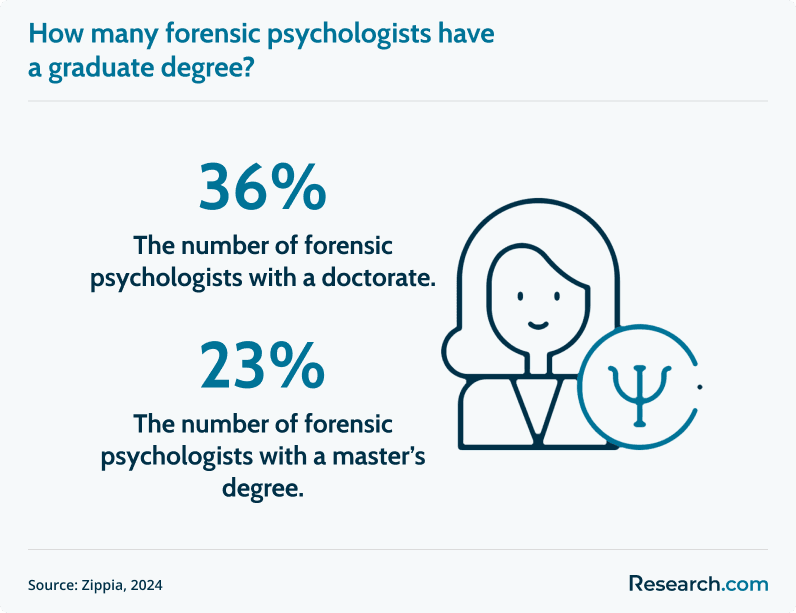
- According to data from Zippia, 36% of forensic psychologists have a doctorate.
- Employment projections show that there are approximately 11,300 new jobs for forensic psychologists over the next decade.
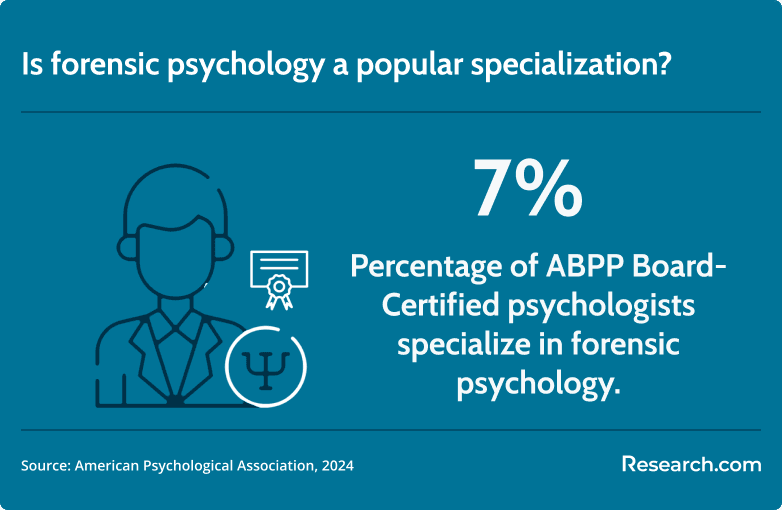
- The APA reports that only 7% of ABPP Board-Certified psychologists specialize in forensic psychology.
- An online doctorate in forensic psychology typically takes two to five years to complete, depending on the program requirements and enrollment status.
- Forensic psychologists with a master’s degree earn an average salary of $74,570, while those with a doctorate have an average salary of $93,229.
How long does it take to complete an online Doctorate in Forensic Psychology program?
Most online doctorate in forensic psychology programs take about two to five years based on the programs reviewed for this guide. The timeline depends on the degree type, transfer credits, whether you enter with a master’s degree, enrollment status, research progress, practicum or internship requirements, and dissertation or doctoral project completion.
Programs in this field may require 60 to 180 credits. Students entering with a relevant master’s degree may need fewer credits than those who need additional foundational coursework. Part-time enrollment often extends the timeline, while accelerated or post-master’s structures may shorten it.
Data from Statista shows that in 2021, the median number of years it takes to complete a doctorate in the U.S. was 8.7 years since finishing a bachelor’s degree and 7.3 years after starting graduate school. If speed matters, ask each school how long similar students typically take to finish the dissertation, practicum, internship, or applied doctoral project.
Students comparing broader psychology doctoral options can also review affordable online doctorate in psychology pathways.
How does an online Doctorate in Forensic Psychology compare to an on-campus program?
Online and on-campus doctoral programs may cover similar academic content, but the learning experience, networking format, field placement process, and support structure can differ significantly. The better choice depends on your schedule, location, licensure goals, and need for in-person mentoring.
| Factor | Online doctorate | On-campus doctorate |
| Flexibility | Often better for working professionals who need to balance employment, family, and coursework. | Usually follows a more fixed schedule with in-person class meetings. |
| Faculty and peer interaction | Delivered through virtual meetings, discussion boards, residencies, and remote advising. | Provides regular face-to-face access to faculty, classmates, labs, and campus events. |
| Practical training | May require students to secure local practicum, internship, or forensic experience sites. | May offer established local partnerships and more direct campus-based placement support. |
| Best for | Self-directed students with strong time management and local professional networks. | Students who want immersion, in-person structure, and campus-based research communities. |
| Main risk | Assuming “online” means no residency, supervision, or fieldwork requirements. | Higher relocation, commuting, or schedule constraints. |
Online graduate education has become more accepted among adult learners and employers. An online survey conducted by Champlain College found that 72% of adults believe online education is a more reputable way to get a degree than five years ago, and 84% of adults think employers are more accepting of online degrees.
Graduate education also continues to expand. According to the National Center for Education Statistics, there was a 17% increase in A.Y. 2021-2022 in the number of graduate degrees conferred by postsecondary institutions in the U.S. since A.Y. 2011-2012. These included 203,900 doctor’s degrees and 880,200 master’s degrees.
Psychology remains a common graduate field. Data from Statista shows that there were 6,363 doctoral degrees in psychology awarded in A.Y. 2020-2021 in the United States.
What is the average cost of an online Doctorate in Forensic Psychology program?
Based on the programs reviewed for this guide, an online doctorate in forensic psychology may cost $40,000 to $120,000. Total price varies by tuition rate, number of credits, program length, residency requirements, dissertation fees, technology fees, books, travel, and whether you need additional coursework before doctoral study.
Some programs charge by credit, with rates often ranging from $500 to $1,000 per credit hour. Doctoral programs commonly require 60 to 120 credits, although some require more. For example, Capitol Tech lists a technology fee ($40 per credit hour), lab fees ($25 to $500), an application fee ($100), and a nonrefundable graduation fee ($150).
| Cost item | Why it matters |
| Tuition | The largest cost; compare total credits, not only the per-credit rate. |
| Residency or workshop travel | Online programs may still require travel for weekend residencies or in-person workshops. |
| Technology and lab fees | These can add to the total cost even when tuition appears affordable. |
| Dissertation or project continuation fees | Students who need extra time may pay additional terms or continuation fees. |
| Practicum or internship expenses | Placement-related travel, supervision, background checks, and documentation may create added costs. |
Students seeking lower-cost routes should compare tuition, transfer credit policies, residency expenses, and completion timelines. Research.com’s guide to affordable online colleges for psychology can help you benchmark broader psychology options.
When judging value, compare the total cost with career outcomes rather than assuming every doctorate pays off equally. A return-on-investment analysis from FREOPP notes that some graduate programs that provide better ROI than other degrees. Zippia data also shows a salary difference by education level: forensic psychologists with a master’s degree earn an average salary of $74,570, while those with a doctorate have an average salary of $93,229.
What are the financial aid options for students enrolling in an online Doctorate in Forensic Psychology program?
Doctoral students should build a funding plan before enrolling. Start with aid that does not require repayment, then consider employer support and federal loans before private loans.
- Federal Student Aid: Eligible doctoral students may use Direct Unsubsidized Loans and Grad PLUS Loans. The Free Application for Federal Student Aid (FAFSA) is required to determine eligibility.
- Scholarships: Psychology students may find graduate scholarships, grants, and awards through professional organizations, including the American Psychological Association (APA), as well as universities and private foundations.
- Fellowships: Some schools offer competitive fellowships that may include tuition assistance and a stipend in exchange for research, teaching, or service responsibilities.
- Employer Tuition Assistance: Working professionals should ask employers about tuition reimbursement, professional development funds, public safety education benefits, or workforce development support.
- Grants: Some grants fund specific research projects, especially those tied to forensic psychology, criminal justice reform, trauma, child welfare, or mental health.
- Private Loans: Banks and credit unions may offer private education loans, but these often have higher interest rates and fewer repayment protections than federal loans.
Apply early and compare eligibility rules carefully. If you are still deciding between a master’s and a doctorate, you may want to compare costs for an online forensic psychology masters before committing to a doctoral program.
Debt should be part of your decision. Education Data Initiative reports that the average debt among PhD holders is $89,526. It also reports that 91.2% of all student loan debt in 2024 was federal and 8.84% was from private lenders.
What are the prerequisites for enrolling in an online Doctorate in Forensic Psychology program?
Admissions requirements vary, but competitive applicants usually show readiness for doctoral research, advanced writing, ethical practice, and independent study. Many programs expect a graduate background in psychology or a closely related field.
- Master’s Degree: Many programs require a campus-based or online masters degree in psychology, forensic psychology, counseling, criminal justice, social work, or another relevant discipline. Zippia reports that 23% of forensic psychologists have a master’s degree.
- Minimum GPA: Programs often ask for a GPA around 3.0 to 3.5 on a 4.0 scale, although more selective programs may expect stronger academic records.
- Professional Experience: Relevant experience in psychology, corrections, law enforcement, victim services, behavioral health, or criminal justice can strengthen an application. Applicants entering from earlier credentials, including an online criminal justice associates degree, may need additional undergraduate and graduate preparation before doctoral admission.
- GRE Scores: Some schools still request GRE results, while others waive the exam and use a holistic review process.
- Letters of Recommendation: Most programs request two to three letters from academic or professional references who can speak to your readiness for doctoral work.
- Personal Statement: A strong statement should explain your research interests, career goals, forensic psychology focus, and fit with the program’s faculty and curriculum.
- Interview: Some schools conduct virtual or in-person interviews to assess academic preparation, communication skills, professionalism, and program fit.
| Application component | What admissions committees look for |
| Transcripts | Evidence that you can handle graduate-level psychology, statistics, research, and writing. |
| Resume or CV | Relevant work, research, clinical, legal, public safety, or human services experience. |
| Statement of purpose | A clear match between your goals and the program’s specialization, faculty, and training model. |
| Recommendations | Third-party confirmation of your judgment, ethics, writing ability, and doctoral readiness. |
| Interview | Professional maturity, realistic expectations, and communication skills. |
What courses are typically in an online Doctorate in Forensic Psychology program?
Doctoral coursework usually combines psychological science, law, criminal behavior, assessment, ethics, research, and applied forensic practice. Course names vary by school, but common topics include the following:
- Law and Mental Health: Examines how mental health conditions, psychological principles, and legal standards interact in courts, corrections, and public policy.
- Forensic Assessment: Covers methods used to evaluate individuals involved in legal matters, including risk assessment, competency-related questions, and structured forensic evaluations.
- Criminal Behavior: Explores psychological, social, developmental, and environmental explanations for criminal conduct. Related behavioral frameworks may also appear in a doctorate in behavioral health program.
- Psychology in the Legal System: Reviews the functions of psychologists in legal contexts, including consultation, expert testimony, witness evaluation, and ethical boundaries.
- Advanced Topics in Forensic Psychology: May include juvenile offending, trauma, correctional treatment, victimology, terrorism, cybercrime, or forensic work with specialized populations.
Before enrolling, ask whether the program includes statistics, research design, dissertation preparation, assessment training, supervised fieldwork, and licensure-aligned clinical components if those are relevant to your goals.
What types of specializations are available in online Doctorate in Forensic Psychology programs?
Specializations help you align doctoral study with the type of work you want to do after graduation. The best choice depends on whether you plan to pursue research, clinical work, consulting, teaching, corrections, public safety, victim services, or legal system support.
- General Forensic Psychology: Provides broad preparation in legal psychology, criminal behavior, assessment, ethics, and research.
- Criminal Justice: Focuses on correctional systems, offender rehabilitation, juvenile justice, criminal behavior, and justice policy. Students who want deeper justice-system training may compare doctoral study with an accredited criminal justice degree online accredited pathway.
- Legal Issues in Forensic Psychology: Emphasizes expert testimony, jury selection, courtroom consultation, witness evaluation, and psychologist roles in litigation.
- Police Psychology: Covers law enforcement stress, officer wellness, candidate assessment, crisis response, and police training.
- Victimology: Examines trauma, victim advocacy, victim services, and the psychological impact of crime. Students may also study the psychological impact of restorative justice.
- Terrorism and Homeland Security: Studies behavioral threat assessment, radicalization, terrorism psychology, and the role of psychologists in national security contexts.
The American Psychological Association reports that only 7% of psychologists certified by the American Board of Professional Psychology (ABPP) specialize in forensic psychology, which makes specialization an important differentiator but not a substitute for licensure, supervised training, and experience.
How to choose the best online Doctorate in Forensic Psychology program?
The best online doctorate is the one that fits your career goal, budget, licensing needs, research interests, and learning style. Do not choose based on title alone. A “forensic psychology” program may be research-focused, clinical, justice-oriented, policy-oriented, or cyber-focused.
| What to check | Questions to ask before applying |
| Accreditation | Is the institution regionally accredited? Is the psychology program APA-accredited if I need that for licensure or career goals? |
| Licensure alignment | Does the program meet the education, practicum, internship, and supervision requirements in my state? |
| Curriculum | Does it include forensic assessment, ethics, research, criminal behavior, legal psychology, and my intended specialization? |
| Practical training | Who finds practicum or internship sites? Are placements available in my state or region? |
| Faculty | Do faculty members publish, practice, consult, or conduct research in my area of interest? |
| Residencies | How many in-person sessions are required, where are they held, and what do they cost? |
| Total cost | What is the full program cost including fees, travel, books, continuation terms, and lost work time? |
| Student outcomes | What are completion rates, licensure exam outcomes if applicable, job placements, and alumni career paths? |
Common mistakes include focusing only on tuition, assuming all online psychology doctorates support licensure, ignoring dissertation support, skipping accreditation verification, and enrolling before confirming whether field placements are available where you live.
What career paths are available for graduates of online Doctorate in Forensic Psychology programs?
Career options depend on training model, specialization, licensure, and prior experience. Some roles involve direct psychological assessment or treatment, while others focus on research, teaching, consulting, legal support, or public policy.
- Forensic Psychologist: Licensed professionals may conduct psychological evaluations, risk assessments, competency-related assessments, and other forensic services. Growing concerns around cybercrime have also increased interest in programs connected to cybersecurity schools online.
- Professor or Researcher: Graduates may teach psychology, criminal justice, or forensic psychology courses and conduct research in colleges, universities, research centers, or think tanks.
- Legal or Trial Consultant: Some professionals advise attorneys, courts, agencies, or organizations on psychological issues, jury behavior, violence risk, victimology, or expert testimony.
- Policy or Program Specialist: Graduates may work with government agencies, nonprofits, correctional systems, or advocacy organizations to design, evaluate, or improve programs.
- Law Enforcement or Public Safety Consultant: Some apply psychological expertise to crisis response, threat assessment, police training, offender behavior, or organizational wellness. Advanced credentials may help prepare professionals for leadership-oriented or good paying criminal justice jobs.
Zippia reports that employers often value communication, creative thinking, and critical thinking. It also identifies common job-specific skills among forensic psychologists, including psychological evaluations (11.96%), mental illness (11.04%), risk assessments (11.02%), and forensic evaluations (10.49%).
What is the job market for graduates with an online Doctorate in Forensic Psychology degree?
The job market is specialized rather than broad. Demand exists in courts, corrections, public safety, universities, private consulting, behavioral health, and research, but many roles require licensure, supervised experience, or a strong record of forensic expertise.
Zippia projects employment of forensic psychologists to grow 6% until 2028, resulting in about 11,802 new jobs from 2018 up to 2028. For psychologists overall, including professionals with a doctorate in organizational psychology, BLS projects 7% employment growth from 2023 to 2033.
Zippia data also identifies the following states as having the most jobs for forensic psychologists:
- California - 608 jobs
- Illinois - 270 jobs
- Maryland - 171 jobs
- North Carolina - 161 jobs
- Pennsylvania - 150 jobs
- Virginia - 126 jobs
- Washington - 124 jobs
- New Jersey - 106 jobs
- Massachusetts - 98 jobs
- Wisconsin - 90 jobs
What are the career outcomes for graduates of an online Doctorate in Forensic Psychology program?
Graduates may move into forensic assessment, academic research, correctional program development, trial consulting, victim services, public safety consulting, expert testimony support, or leadership roles in justice-related organizations. Students who want broader psychology preparation before doctoral study may compare this route with an online masters in psychology.
The strongest outcomes usually come from matching the program to a specific goal. For example, aspiring licensed psychologists should prioritize licensure-aligned clinical training, while future professors should prioritize faculty mentorship, research methods, publications, and dissertation fit.
Are online Doctorate in Forensic Psychology programs as prestigious as traditional on-campus programs?
An online doctorate can be respected when it comes from an accredited institution, has rigorous admissions and faculty standards, includes appropriate research or practicum components, and aligns with the student’s professional goals. Employers and licensing boards generally focus less on the delivery format and more on accreditation, program quality, supervised training, competencies, and experience.
Prestige still varies by institution, program reputation, faculty expertise, alumni outcomes, and accreditation status. Students comparing applied psychology doctorates may also review online PsyD program options, especially if clinical practice is central to their career plan.
What are the challenges of online learning in the doctorate in forensic psychology?
Online doctoral study is flexible, but it is not easier. Students must manage advanced coursework, research deadlines, writing expectations, technology requirements, field placement coordination, and professional responsibilities with less daily structure than a campus program.
- Self-discipline: You need a consistent study schedule and the ability to work without frequent in-person reminders.
- Time management: Doctoral coursework, dissertation milestones, residencies, and fieldwork can compete with work and family obligations.
- Active engagement: Online students must initiate faculty contact, join discussions, seek feedback, and use digital research tools effectively.
- Limited face-to-face interaction: Students who learn best through in-person discussion, labs, or cohort activities may prefer campus-based study.
- Practical experience logistics: Some online programs require students to locate local placements. This can be challenging in forensic, correctional, or clinical settings. Students considering related applied pathways, such as a behavioral science degree online, should also review fieldwork expectations.
How does a doctorate in forensic psychology compare to other psychology doctorates?
A forensic psychology doctorate is different from a general PhD in psychology or a broad PsyD because it focuses on legal systems, criminal behavior, forensic assessment, correctional populations, public safety, and the role of psychological science in courts and justice settings.
| Doctorate type | Primary focus | Often best for |
| PhD in Forensic Psychology | Research, scholarship, consulting, teaching, and forensic psychology theory | Students interested in academia, research, policy, consulting, or advanced forensic specialization |
| PsyD with forensic focus | Applied and clinical psychology with forensic or justice-related training | Students seeking practice-oriented roles, especially where licensure alignment is built into the program |
| PhD in Psychology | Psychological research and academic inquiry across a broader field | Students focused on research, teaching, or specialized psychological science |
| PsyD in Psychology | Clinical practice and applied psychology | Students seeking direct clinical service roles, subject to licensure requirements |
When comparing psychology doctorates, consider training model, accreditation, supervised experience, licensure eligibility, dissertation expectations, and career outcomes. Research.com’s comparison of doctor of psychology salary considerations may help students weigh PsyD and PhD options.
Can an online Doctorate in Forensic Psychology meet licensure requirements?
Some online doctorates may support licensure preparation, but students must verify this before enrolling. Licensure requirements differ by state and may include specific coursework, supervised practicum hours, internship requirements, postdoctoral supervision, exams, and program accreditation standards. A doctorate that is useful for research or consulting may not automatically qualify a graduate for clinical psychology licensure.
Before applying, contact your state psychology licensing board and ask the program for written confirmation of whether its curriculum and supervised training meet your state’s requirements. Students who are still building graduate preparation may also compare accelerated master's psychology programs before selecting a doctoral route.
How do online forensic psychology programs integrate training in substance abuse and addiction counseling?
Forensic psychology programs may address substance use because addiction frequently intersects with criminal behavior, competency questions, corrections, rehabilitation, family court, and risk assessment. Coursework may cover co-occurring disorders, assessment methods, treatment planning, relapse risk, ethical documentation, and legal implications.
Students who want a stronger clinical or counseling focus should review whether the doctorate includes addiction-specific coursework, supervised substance abuse training, or elective options. Research.com’s guide to addiction counseling courses can help students compare related preparation.
How do student support services enhance success in online forensic psychology programs?
Support services can determine whether an online doctoral student progresses smoothly or stalls during coursework, practicum planning, dissertation development, or professional transition. Strong programs provide academic advising, dissertation coaching, library access, writing support, technical support, career counseling, mental health resources, and clear escalation paths when students encounter problems.
Students who are comparing broader mental health education options may also review affordable online counseling degree programs to understand how support models differ across related fields.
How does accreditation impact career opportunities in forensic psychology?
Accreditation affects employer confidence, transferability, federal financial aid eligibility, licensure review, internship access, and professional credibility. For licensure-oriented students, institutional accreditation alone may not be enough; specialized psychology accreditation may also matter depending on the role and state requirements.
Students should verify accreditation directly through the accreditor and the institution. If your goal is to become a licensed forensic psychologist, confirm whether the program’s accreditation and training model fit your state board’s expectations.
How can online programs enhance your practical experience and professional networking?
High-quality online programs create applied learning through supervised placements, virtual case simulations, research collaborations, residency workshops, professional webinars, alumni events, faculty mentoring, and conference preparation. These opportunities matter because forensic psychology is built on applied judgment, ethical reasoning, communication, and credibility—not coursework alone.
Ask whether the school helps identify practicum or internship sites, how it supervises remote students, and whether alumni work in courts, corrections, public safety, universities, or consulting. Students interested in strengthening therapeutic skills alongside forensic training may also explore a family therapist degree online.
How can integrating counseling techniques enhance forensic psychology practice?
Counseling skills can improve forensic psychology practice by strengthening interviewing, rapport-building, crisis intervention, trauma-informed communication, and treatment planning. These skills are especially useful when working with victims, justice-involved clients, families, correctional populations, or individuals with complex mental health needs.
However, forensic and therapeutic roles have different ethical boundaries. Students should learn how to separate evaluation, treatment, confidentiality, and court-related duties. Those seeking counseling-specific training can compare standards in online CACREP counseling programs.
What technical requirements and digital skills are essential for success in an online forensic psychology program?
Online doctoral students need more than basic computer access. They must be able to participate in live classes, manage digital research, protect confidential information, collaborate remotely, and complete advanced writing and data analysis tasks.
- Reliable high-speed internet and an updated computer
- Comfort with learning management systems, video conferencing, and digital collaboration tools
- Ability to use academic databases, digital libraries, citation managers, and secure file storage
- Basic competence with statistics, research software, and document formatting tools
- Awareness of data security, privacy, and professional communication standards
Students comparing other online behavioral or clinical credentials may also review cost-focused options such as the cheapest BCBA accredited programs online.
What are the emerging trends in online forensic psychology education?
Online forensic psychology education is being shaped by digital assessment methods, cybercrime, telehealth-informed practice, data privacy, virtual simulations, AI-related risks, and interdisciplinary collaboration among psychology, law, cybersecurity, public safety, and behavioral health. Programs are also paying more attention to ethical remote assessment, digital evidence, online victimization, and technology-facilitated offending.
Students should look for programs that revise curricula as legal, technological, and professional expectations change. Those still exploring psychology subfields can compare broader psychology career paths.
How do online forensic psychology programs ensure effective remote forensic assessments?
Programs that train students in remote forensic assessment should emphasize secure platforms, informed consent, standardized procedures, confidentiality, data integrity, documentation, test limitations, and the ethical differences between remote and in-person evaluation. Students may use simulations, case studies, structured interviews, and supervised practice to understand when remote assessment is appropriate and when it is not.
Remote assessment training is valuable, but it does not replace state rules, agency policies, court expectations, or supervised clinical competence. Students interested in faster entry into counseling-related work should compare this long doctoral path with guidance on how to become a counselor fast.
What are the key ethical considerations in online forensic psychology programs?
Forensic psychology requires careful ethical judgment because the work can affect legal rights, public safety, treatment access, sentencing, custody, and institutional decisions. Online training should cover confidentiality, informed consent, dual roles, bias, cultural competence, documentation, remote assessment limits, data security, and the difference between clinical care and forensic evaluation.
Students who want related helping-profession options can compare forensic psychology with careers with a human services degree, which may involve advocacy, case management, and community support rather than doctoral-level forensic evaluation.
Are online forensic psychology degrees legitimate and respected?
Online forensic psychology degrees can be legitimate and respected when they come from accredited institutions, use qualified faculty, maintain rigorous doctoral standards, provide appropriate practical training, and clearly explain licensure relevance. The online format itself is not the main issue; accreditation, outcomes, training quality, and professional fit matter more.
Before enrolling, confirm institutional accreditation, program reputation, faculty credentials, residency requirements, fieldwork policies, and whether the degree title fits your intended career. Students can also review what online psychology degree accreditation to look for when comparing schools.
How do evolving legal and regulatory requirements influence online forensic psychology training?
Forensic psychology programs must respond to changes in privacy expectations, telehealth standards, remote assessment policies, court procedures, informed consent practices, and state licensing rules. Students should expect training in confidentiality, data protection, digital documentation, ethical testimony, professional boundaries, and jurisdiction-specific requirements.
If your career plan includes counseling-related credentials, compare psychology board requirements with certification for counseling, because counseling and psychology licensure follow different regulatory systems.
How do faculty expertise and mentorship impact your online forensic psychology training?
Faculty mentorship is especially important in an online doctorate because students need guidance on research design, dissertation development, forensic ethics, publication strategy, specialization choices, and professional networking. Strong mentors can help students connect coursework with applied forensic problems and avoid overly broad or unfocused dissertation topics.
Before applying, review faculty publications, practice backgrounds, research areas, dissertation supervision experience, and availability for remote students. Students comparing broader doctoral psychology options can also review online doctor of psychology programs.
What additional certifications can enhance your forensic psychology career?
Additional credentials can strengthen a forensic psychology career when they match your role and are recognized by employers, courts, agencies, or licensing boards. Useful areas may include forensic interviewing, crisis intervention, trauma-informed care, risk assessment, psychological testing, victim advocacy, correctional mental health, or substance abuse counseling.
Certifications should complement, not replace, licensure and supervised experience. Students who want to expand clinical qualifications should understand the credentials needed to be a therapist before choosing add-on training.
How can you assess the return on investment of your online forensic psychology degree?
To assess ROI, compare the full cost of attendance with the career outcomes that are realistic for your background, location, licensure path, and specialization. Do not rely only on advertised salaries. Ask for graduation rates, average completion time, internship support, licensure outcomes where applicable, alumni job titles, dissertation completion support, and employer partnerships.
| ROI question | Why it matters |
| What is the total cost, including fees and residencies? | A low tuition rate can become expensive once travel, continuation fees, and technology costs are added. |
| How long do students actually take to finish? | Extra terms can increase debt and delay career advancement. |
| Does the program support licensure in my state? | A non-licensure doctorate may not qualify you for clinical psychologist roles. |
| What do graduates do after completion? | Alumni outcomes show whether the program aligns with your target career. |
| Will my employer value or fund the degree? | Employer tuition support or promotion pathways can improve ROI. |
Students who want a faster applied psychology doctorate may also compare fast-track PsyD programs, but speed should never replace accreditation, field training, and licensure alignment.
What accreditation criteria should you consider when evaluating online forensic psychology programs?
Accreditation is one of the most important filters when comparing online forensic psychology doctorates. At minimum, confirm institutional accreditation from a recognized accrediting agency. If your goal involves clinical psychology licensure, also determine whether specialized psychology accreditation is required or strongly preferred in your state.
- Verify the school’s institutional accreditation through official accreditor sources.
- Ask whether the psychology program itself has specialized accreditation when relevant.
- Confirm whether coursework, practicum, internship, and supervision meet your state’s licensing standards.
- Review whether field placements are approved, supervised, and documented appropriately.
- Check whether counseling-related components meet separate standards, such as CACREP accreditation, when counseling licensure is part of your plan.
Common mistakes to avoid before enrolling
- Assuming every online doctorate leads to licensure. Some programs are designed for research, consulting, policy, or teaching rather than clinical psychology licensure.
- Comparing only tuition rates. Total cost includes credits, fees, residencies, travel, books, technology, fieldwork expenses, and extra dissertation terms.
- Ignoring accreditation details. Institutional accreditation and specialized program accreditation are not the same.
- Choosing a specialization too early without a career plan. Match your concentration to actual job requirements in your state or target sector.
- Underestimating dissertation time. Doctoral completion often depends on research progress, writing support, and faculty availability.
- Not asking who arranges field placements. Online students may be responsible for finding acceptable local practicum or internship sites.
- Relying only on rankings. A highly ranked program is not useful if it does not meet your licensure, schedule, cost, or specialization needs.
Key Insights
- An online doctorate in forensic psychology is best for students who need advanced training in psychology, law, criminal behavior, assessment, research, or justice-system consulting.
- PhD programs usually lean toward research and scholarship, while PsyD pathways generally emphasize applied and clinical practice; the right choice depends on your target role.
- Online programs can be respected, but accreditation, supervised training, faculty expertise, and state licensure alignment matter more than delivery format.
- Costs can range from $40,000 to $120,000, so students should compare total program cost, not just per-credit tuition.
- Salary outcomes vary by licensure, location, employer, specialization, and experience. Zippia reports an average annual salary of $83,065 for forensic psychologists, while doctoral-level earnings may be higher depending on role and market.
- Before enrolling, ask the school for written information on accreditation, residency requirements, field placements, dissertation support, licensure alignment, student outcomes, and full cost of attendance.
References:
- Capitol Technology University (n.d.). Doctorate Tuition Rates 2024-2025. https://mycapitol.captechu.edu/ICS/College_Offices/Business_Office/Doctorate_Tuition_Rates_2024-2025.jnz
- Champlain University (November 2023). Data Reveals New Insights on Online Higher Education Post-Pandemic. https://online.champlain.edu/blog/data-reveals-new-insights-online-higher-education-post-pandemic
- Hanson, M. (July 2024). Student Loan Debt Statistics. Education Data Initiative. https://educationdata.org/student-loan-debt-statistics
- Hanson, M. (September 2024). Average Graduate Student Loan Debt. Education Data Initiative. https://educationdata.org/average-graduate-student-loan-debt
- Korhonen, V. (July 2024). Doctoral degrees earned in the United States 2020/21, by field of research. Statista. https://www.statista.com/statistics/185353/number-of-doctoral-degrees-by-field-of-research
- Korhonen, V. (August 2024). Median years to complete a doctorate U.S. 1995-2021. Statista. https://www.statista.com/statistics/240170/years-needed-to-complete-a-doctorate-in-the-us
- Page, C. et al. (March 2024). Datapoint: The most and least common specialty areas for licensed psychologists. American Psychological Association. https://www.apa.org/monitor/2024/03/top-psychology-specialties
- U.S. Bureau of Labor Statistics (August 2024). Psychologists. https://www.bls.gov/ooh/life-physical-and-social-science/psychologists.htm
- Zippia (n.d.). Job outlook for forensic psychologists in the United States. https://www.zippia.com/forensic-psychologist-jobs/trends
- Zippia (June 2024). Forensic Psychologist Salary. https://www.zippia.com/salaries/forensic-psychologist
- Zippia Team (April 2024). Forensic Psychologist Education Requirements. Zippia. https://www.zippia.com/forensic-psychologist-jobs/education
- Zippia Team (June 2024). Forensic Psychologist Skills for Your Resume and Career. Zippia. https://www.zippia.com/forensic-psychologist-jobs/skills
Other Things You Need to Know About Online Doctorate in Forensic Psychology Degrees
Yes, most online doctorate programs in forensic psychology require a dissertation or doctoral research project, usually completed in the final 1 to 2 years. Programs often expect an original study, committee approval, and a final oral defense before graduation.
In 2027, top-ranked universities offering online doctorates in forensic psychology include John Jay College of Criminal Justice, Palo Alto University, and the University of Arizona Global Campus. These programs are recognized for their rigorous curriculum and expert faculty in the field.