2027 What Can You Do With a Master’s in Forensic Psychology?

Co-Founder and Chief Data Scientist
A master’s in forensic psychology is for people who want to apply psychological knowledge in courts, corrections, law enforcement, victim services, juvenile justice, and other legal settings. The decision is not simply whether the subject is interesting. You also need to know what jobs the degree can realistically lead to, whether it supports licensure in your state, how much programs cost, and whether a doctorate may be necessary for your long-term goals.
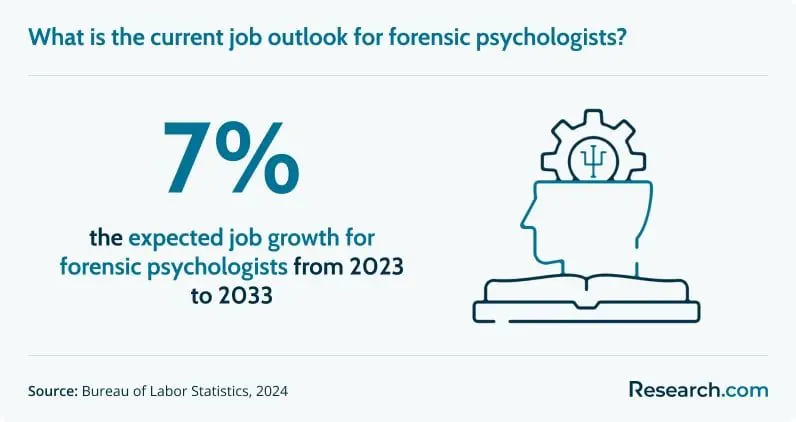
Currently, around 7,336 forensic psychologists are employed in the United States, and employment for psychologists is projected to grow by 7 percent from 2023 to 2033, faster than the average for all occupations. That demand can create opportunities, but outcomes depend heavily on location, credentials, field experience, and whether your intended role requires state licensure.
This guide explains what to expect from a master’s in forensic psychology, how online and campus programs compare, what programs may cost, which careers are realistic with a master’s degree, and how to choose a program without overpaying or choosing a path that does not match your goals.
Quick Answer: Is a Master’s in Forensic Psychology Worth It?
A master’s in forensic psychology can be worth it if you want roles in corrections, victim advocacy, court services, forensic case management, research support, or justice-related mental health programs. It is also useful preparation for doctoral study in psychology or related fields. However, a master’s degree alone may not qualify you to work independently as a licensed psychologist in many states, so students who want clinical authority, private practice, or advanced forensic evaluation roles should carefully review doctoral and licensing requirements before enrolling.
Key Things You Should Know About a Master's in Forensic Psychology
- Employment demand is growing, but roles differ by credential. The demand for psychologists is projected to grow by 7% from 2023 to 2033. Forensic psychology graduates may find opportunities in mental health courts, juvenile justice, corrections, law enforcement support, and victim services, but independent psychologist roles often require additional education and licensure.
- Salary depends on job title, location, and scope of practice. Forensic psychologists with a Master’s degree earn an average annual salary of $58,000. Some professionals in large cities such as Los Angeles and New York can earn upwards of $70,000 annually, but those figures should not be treated as guaranteed outcomes.
- Program costs require careful comparison. Master’s in forensic psychology programs generally cost between $20,000 to $70,000. Public universities may be less expensive than private institutions, and scholarships, assistantships, employer support, or federal aid can reduce out-of-pocket costs.
- The most useful programs combine psychology, law, research, and fieldwork. Strong programs build skills in assessment, ethics, research methods, criminal law, abnormal psychology, interviewing, and written reporting for legal or correctional settings.
- The degree is versatile but not unlimited. Graduates may pursue work as forensic case managers, probation-related professionals, victim advocates, court liaisons, research assistants, or mental health evaluators. Students who want to diagnose independently, testify as licensed psychologists, or run a clinical practice should investigate doctoral pathways.
What Is a Master’s in Forensic Psychology?
A master’s in forensic psychology is a graduate degree that studies how psychological theory, assessment, human behavior, trauma, mental illness, and decision-making apply within legal and criminal justice systems. It sits between psychology, law, criminology, public policy, and mental health practice.
Students learn how courts and correctional systems use psychological information, how mental health affects competency and rehabilitation, how victimization changes behavior, and how evidence-based assessment can support decisions involving risk, treatment, custody, sentencing, or intervention. The degree may be offered as an MA, MS, or specialized legal and forensic psychology program, depending on the institution.
What are the benefits of enrolling in a master's in forensic psychology programs?
The main benefit of a master’s in forensic psychology is specialized preparation for work at the intersection of behavioral science and the justice system. Instead of studying psychology in a broad clinical context only, students focus on how assessment, ethics, research, trauma, and mental health services function in legal environments.
Many programs also include internships, field placements, practicum experiences, or research projects. These experiences matter because forensic psychology employers often value practical exposure to courts, correctional facilities, mental health agencies, victim services, or justice-focused nonprofits. The degree can also help students test whether they want to continue into doctoral training before committing to a longer and more expensive path.
| Potential Benefit | Why It Matters | Best Fit For |
| Specialized legal-psychology training | Builds knowledge of how mental health, behavior, and law interact | Students interested in courts, corrections, policy, or justice services |
| Fieldwork or internship exposure | Helps students apply classroom concepts in real settings | Career changers and students without justice-system experience |
| Preparation for applied roles | Supports entry into case management, advocacy, research, or correctional work | Students seeking employment after the master’s degree |
| Foundation for doctoral study | Can strengthen academic preparation for PhD, PsyD, or law-related study | Students aiming for licensed psychologist or advanced forensic roles |
What can I expect from a master's in forensic psychology programs?
Students can expect graduate-level coursework in psychological assessment, psychopathology, criminal behavior, legal systems, ethics, research methods, and forensic interviewing. Programs often ask students to analyze case material, write professional reports, examine legal standards, and understand the limits of psychological conclusions in court or correctional settings.
Many programs require a thesis, capstone, externship, clinical fieldwork, or non-clinical fieldwork. A thesis is usually better for students considering doctoral programs or research careers, while fieldwork is often more useful for students who want immediate applied employment after graduation.
Where can I work after graduating from a master's in forensic psychology programs?
Graduates may work in public agencies, nonprofit organizations, correctional systems, court-connected services, law enforcement support units, victim advocacy programs, juvenile justice programs, legal offices, research centers, and behavioral health organizations. The exact job title depends on state rules, employer requirements, supervision structure, and whether the role involves clinical assessment or treatment.
Common settings include mental health courts, detention centers, probation and parole offices, correctional facilities, crisis programs, victim services organizations, policy offices, and research teams. Some graduates also work in consulting or academic support roles, especially when they have strong research and data analysis skills.
How much can I make with a master's in forensic psychology programs?
Pay varies widely because “forensic psychology” can describe different roles with different credential requirements. On average, forensic psychologists with a master’s degree earn around $58,000 annually. Salaries can range from approximately $50,000 to over $70,000 depending on role, location, employer, specialization, and experience. In large metropolitan areas like New York or Los Angeles, salaries may be higher because of demand and cost of living.
Students should compare salary information by job title rather than relying only on the broad label “forensic psychologist.” A correctional treatment specialist, victim advocate, research assistant, court liaison, and licensed psychologist may have very different pay ranges, responsibilities, and advancement paths.
- List of Master's in Forensic Psychology Programs for 2027
- How long does it take to complete a master's in forensic psychology program?
- How does an online master's in forensic psychology program compare to an on-campus program?
- What is the average cost of a master's in forensic psychology program?
- What are the financial aid options for students enrolling in a master's in forensic psychology program?
- What are the prerequisites for enrolling in a master's in forensic psychology program?
- What courses are typically in a master's in forensic psychology program?
- What types of specializations are available in a master's in forensic psychology program?
- What are the accreditation and licensing requirements for a master's in forensic psychology program?
- Is an Accelerated Path Available for Forensic Psychology Education?
- What are the emerging trends in forensic psychology?
- Should I pursue a doctoral degree after earning a master's in forensic psychology?
- Could further academic advancement improve your career prospects in forensic psychology?
- How can forensic psychology complement child psychology careers?
- How to choose the best master's in forensic psychology program?
- Can supplementary certifications boost my forensic psychology career?
- What essential skills are crucial to excel in forensic psychology?
- What career paths are available for graduates of master's in forensic psychology programs?
- What is the job market for graduates with a master's in forensic psychology program?
- Is a Master’s in Forensic Psychology a Good Investment?
List of Master's in Forensic Psychology Programs for 2027
The programs below show how different a forensic psychology master’s degree can look in practice. Some emphasize research and doctoral preparation, while others focus more directly on field placements, legal systems, and applied forensic mental health work.
1. City University of New York – MA in Forensic Psychology
CUNY’s John Jay College of Criminal Justice offers an MA in Forensic Psychology built around the application of psychological science to criminal and civil justice settings. The 42-credit curriculum gives students grounding in psychological development, psychopathology, personality assessment, psychotherapy methods, research, and the relationship between psychology and law.
The program is designed for students who may continue into doctoral study or pursue work in mental health courts, detention centers, parole or probation offices, legal settings, advocacy, research, case management, or court liaison roles. Students complete one of three experiential options: clinical fieldwork, non-clinical fieldwork, or a thesis.
- Program Length: 2 years
- Tracks/Concentrations: Thesis Track, Externship Track, Dual Track
- Cost per Credit: $5,545.00 per semester for in-state students; $855.00 per credit for out-of-state students
- Required Credits to Graduate: 42 credits
- Accreditation: Middle States Commission on Higher Education (MSCHE)
2. University of Denver – MA in Forensic Psychology
The University of Denver’s Master of Arts in Forensic Psychology is offered through the Graduate School of Professional Psychology and has operated since 1999. The 90-credit program combines clinical psychology training with forensic coursework and applied field experiences.
Students study forensic assessment, trial consulting, intimate partner violence interventions, and services for adults, juveniles, and victims. The program includes two-year-long field placements, making it most appropriate for students who want a highly applied graduate experience connected to corrections, law enforcement, victim assistance, legal consulting, or further study.
- Program Length: 3 years
- Tracks/Concentrations: N/A
- Cost per Credit: $1,356.00
- Required Credits to Graduate: 90 credits
- Accreditation: Higher Learning Commission (HLC)
3. University of North Dakota – Master's in Forensic Psychology (MS or MA)
The University of North Dakota offers a Master of Science in Forensic Psychology with a strong research orientation. The program prepares students to apply psychological theory and research skills to courts, prisons, police departments, and other justice-related settings.
Students complete coursework such as Psychology and Law and Forensic Assessment, along with a required thesis and supervised fieldwork. The program may be a strong fit for students considering law school, doctoral study, forensic science, forensic psychology research, or applied work after graduation.
- Program Length: 2 years
- Tracks/Concentrations: N/A
- Cost per Credit: $498.45 per credit for in-state residents; $633.03 per credit for Minnesota residents; $747.68 for US non-residents
- Required Credits to Graduate: 30 credits
- Accreditation: Higher Learning Commission (HLC)
4. Marymount University – MA in Forensic and Legal Psychology
Marymount University’s MA in Forensic and Legal Psychology integrates psychology, criminal justice, legal systems, public policy, and national security-related issues. Its metro D.C. location may be valuable for students interested in internships or professional exposure connected to federal agencies, policy organizations, law enforcement, or legal reform work.
The program emphasizes practical preparation, ethical judgment, critical thinking, and interdisciplinary problem-solving. Students interested in wrongful convictions, intelligence analysis, criminal investigation, public policy, or national security may find the program’s location and professional network especially relevant.
- Program Length: 2 years
- Tracks/Concentrations: N/A
- Cost per Credit: $1,340.00
- Required Credits to Graduate: 39 credits
- Accreditation: Southern Association of Colleges and Schools Commission on Colleges (SACSCOC)
5. University of California, Irvine – Master of Legal and Forensic Psychology
The University of California, Irvine offers a Master of Legal and Forensic Psychology through collaboration between the Department of Psychological Science and the Department of Criminology, Law, and Society. The program focuses on how psychological principles and legal frameworks can be used to evaluate and improve justice systems.
Because the program is primarily online, it may appeal to working professionals who need flexibility. Coursework addresses topics such as memory and the law, forensic assessment, and legal reasoning, while emphasizing research, evidence-based practice, policy, and interdisciplinary analysis.
- Program Length: 2 years
- Tracks/Concentrations: N/A
- Cost per Credit: $16,200.00 program fee
- Required Credits to Graduate: 52 credits
- Accreditation: Western Association of Schools and Colleges, Senior College and University Commission (WSCUC)
How long does it take to complete a master's in forensic psychology program?
Most full-time students complete a master’s in forensic psychology in about two years, but the timeline depends on credit requirements, internship expectations, thesis requirements, and whether the student enrolls full time or part time. The overall length of a master’s degree can also vary by school structure and academic calendar.
Students who choose part-time study may need additional time, while accelerated or transfer-friendly programs may shorten the path. Field placements can also affect scheduling because students must coordinate with agencies, supervisors, and work obligations.
A master’s degree generally gets students into the workforce faster than a doctorate. However, students comparing this path with how to become a clinical psychologist should know that clinical psychologist licensure usually requires further education beyond the master’s level.
| Study Path | Typical Fit | Main Trade-Off |
| Full-time master’s program | Students who can prioritize school and fieldwork | Faster completion but heavier weekly workload |
| Part-time master’s program | Working adults or students with caregiving responsibilities | More manageable schedule but longer time to finish |
| Thesis track | Students considering doctoral programs or research roles | Stronger research preparation but more independent academic work |
| Fieldwork or externship track | Students seeking applied roles after graduation | Better practical exposure but may require schedule flexibility |
How does an online master's in forensic psychology program compare to an on-campus program?
Online and on-campus forensic psychology programs often cover similar topics, but the student experience can be very different. The better choice depends on your schedule, learning style, access to local field placements, and need for in-person networking.
| Factor | Online Program | On-Campus Program |
| Flexibility | Usually easier to combine with work or family obligations | Requires attendance at scheduled class times and campus activities |
| Fieldwork | May allow placements near the student’s location | May offer established relationships with local agencies |
| Networking | Relies on virtual meetings, online discussion, and intentional outreach | Often provides more face-to-face contact with faculty, peers, and local professionals |
| Cost and access | Can reduce relocation or commuting costs | May involve campus fees, commuting, or relocation expenses |
| Best for | Self-directed students and working professionals | Students who want structured in-person learning and local professional immersion |
Before choosing an online program, confirm that it is properly accredited, that field placements are available where you live, and that the curriculum supports your career goals. An online format can be credible and effective, but it should not be chosen only because it is convenient.
What is the average cost of a master's in forensic psychology program?
Tuition for a Master’s in Forensic Psychology often ranges from $30,000 to $60,000, though the broader program-cost range discussed for the field is $20,000 to $70,000. Costs vary by school type, residency status, credit load, delivery format, required fees, and whether fieldwork creates travel or scheduling expenses.
Examples show the range clearly. John Jay College of Criminal Justice (CUNY) may cost around $20,000 per year for in-state students, while out-of-state students can pay more. The University of Denver's program costs about $40,000 for the entire program, and the University of California, Irvine’s program is estimated to cost between $45,000 and $55,000.
According to EducationData.org, the average cost of a master's degree across all fields is approximately $30,000. Students should compare that benchmark with each forensic psychology program’s total cost of attendance, not tuition alone.
| Cost Item | Why Students Overlook It | What to Ask the School |
| Tuition and mandatory fees | Advertised tuition may not include full program charges | What is the total cost to graduate? |
| Books and assessment materials | Specialized psychology courses may require additional resources | Are estimated course material costs available? |
| Field placement expenses | Travel, background checks, or scheduling changes can add cost | Are placements local, remote, or arranged by the student? |
| Lost income or reduced work hours | Internships may conflict with full-time employment | How many weekly hours are required for fieldwork? |
| Future doctoral study | A master’s may not be the final degree for some career goals | How many graduates continue into doctoral programs? |
What are the financial aid options for students enrolling in a master's in forensic psychology program?
Graduate students in forensic psychology may use several forms of financial aid, including federal loans, scholarships, grants, assistantships, fellowships, work-study opportunities, and employer tuition support. Since financial aid plays a major role for many students, it is important to compare net cost rather than sticker price.
- Federal student loans. Graduate students may use Direct Unsubsidized Loans and can borrow up to $20,500 annually. Repayment options may vary based on federal rules and borrower circumstances.
- Scholarships and grants. Some awards are based on academic merit, financial need, professional goals, or membership in psychology-related organizations. Students comparing justice-related fields may also review adjacent program options such as online forensic accounting degree programs when evaluating career alternatives.
- Employer tuition assistance. Students already working in corrections, courts, law enforcement, human services, or behavioral health should ask whether their employer supports graduate study.
- Assistantships and fellowships. Some universities offer teaching, research, or administrative roles that may include tuition support or stipends.
Financial aid is common among graduate students, with 73% of graduate students in the US relying on some form of aid. Apply early, ask each program about institutional awards, and compare the total debt you may need to take on against likely earnings in your target role.
What are the prerequisites for enrolling in a master's in forensic psychology program?
Admissions requirements vary, but most programs want evidence that applicants can handle graduate psychology coursework and understand the legal or human-services context of the field.
- Bachelor’s degree. Many programs prefer applicants with undergraduate study in psychology, criminal justice, sociology, forensic science, or a related field. Students from forensic science degree backgrounds may qualify if they have enough behavioral science preparation.
- Minimum GPA. Many programs expect a minimum undergraduate GPA, often 3.0 or higher, though competitive programs may use stricter review.
- Recommendation letters. Schools usually ask for two or three letters from faculty, supervisors, or professionals who can speak to the applicant’s readiness.
- Statement of purpose. Applicants commonly submit an essay explaining their goals, relevant experience, and reasons for choosing forensic psychology.
- GRE scores or work experience. Some programs may request standardized test scores, professional experience, or prerequisite coursework.
If your undergraduate degree is not in psychology, ask whether the program requires prerequisite courses in statistics, research methods, abnormal psychology, or developmental psychology before enrollment.
What courses are typically in a master's in forensic psychology program?
Most forensic psychology master’s programs combine core psychology training with legal and criminal justice applications. The strongest curricula help students understand both psychological science and the limits of using that science in legal decision-making.
- Foundations of forensic psychology. Introduces the history, scope, terminology, and major applications of psychology in legal systems. Students exploring related behavioral fields may also compare curricula with a behavioral psychology degree online.
- Psychopathology and criminal behavior. Examines mental disorders, behavioral patterns, and risk factors that may appear in forensic settings.
- Forensic assessment techniques. Covers interviewing, testing, evaluation methods, and report writing for court or correctional contexts.
- Ethics and professional practice. Focuses on confidentiality, informed consent, cultural competence, dual relationships, bias, and the difference between therapeutic and forensic roles.
- Research methods and statistics. Trains students to evaluate evidence, interpret data, and prepare for thesis work or doctoral study.
What types of specializations are available in a master's in forensic psychology program?
Specializations help students focus their training on a specific population, setting, or professional function. Not every program offers formal concentrations, but many allow electives, placements, thesis topics, or capstone projects in specialized areas.
- Forensic assessment and evaluation. Focuses on psychological evaluations used in legal contexts, such as competency or risk-related questions.
- Victimology. Studies the psychological effects of crime, trauma, crisis response, and victim support systems.
- Juvenile forensic psychology. Emphasizes youth development, juvenile courts, rehabilitation, family systems, and prevention.
- Correctional psychology. Prepares students to understand mental health treatment, rehabilitation, reentry, and behavioral management in correctional environments.
- Police psychology. Addresses law enforcement stress, crisis negotiation, screening, training, and organizational consultation.
Specialization can influence job fit and earning potential, but pay still depends on employer, location, licensure, experience, and scope of responsibility.
| City | Average Annual Salary |
| Oakland, CA | $126,994 |
| Fremont, CA | $126,641 |
| San Jose, CA | $126,435 |
| San Francisco, CA | $127,242 |
| Stockton, CA | $125,886 |
| Source: Zippia, 2025 |
What are the accreditation and licensing requirements for a master's in forensic psychology program?
Accreditation should be one of the first things you verify. A master’s program should be offered by an institution accredited by a recognized accreditor because accreditation affects credit transfer, eligibility for federal financial aid, employer confidence, and future graduate study.
Licensing is more complicated. A master’s in forensic psychology may support some supervised mental health or justice-system roles, but it may not meet requirements for independent practice as a psychologist. State rules vary, and many psychologist licenses require doctoral education. Before enrolling, ask the program exactly which licenses, certifications, or supervised credentials its curriculum is designed to support in the state where you plan to work. Students seeking flexible accredited options can also compare broader psychology pathways such as an online master's of psychology.
Is an Accelerated Path Available for Forensic Psychology Education?
Some students can shorten their graduate timeline through transfer credits, heavier course loads, year-round study, or accelerated formats. These options can be useful for motivated students with relevant academic preparation, but they are not always the best choice if the program compresses fieldwork, reduces faculty access, or creates an unsustainable schedule.
Students who want a faster foundation before graduate study may also explore a fast-track psychology degree online. The key is to make sure speed does not come at the expense of accreditation, supervised experience, or long-term licensure planning.
What are the emerging trends in forensic psychology?
Forensic psychology is being shaped by stronger demand for evidence-based assessment, interdisciplinary collaboration, technology-supported research, and more attention to trauma, risk, rehabilitation, and behavioral health in justice settings. Professionals increasingly need to interpret data carefully, understand ethical limits, and communicate psychological findings to non-psychologists.
Technology and analytics may support behavioral assessment, research synthesis, and crime analysis, but they do not replace professional judgment, validated methods, or ethical review. Some professionals also build adjacent expertise in behavior analysis through credentials related to the online BCBA pathway, especially when their work involves behavioral intervention, disability services, or structured treatment environments.
Should I pursue a doctoral degree after earning a master's in forensic psychology?
A doctorate may be necessary if your goal is to become a licensed psychologist, conduct advanced forensic evaluations, teach at a higher level, lead independent clinical work, or build a career centered on research. A master’s degree can be a strong stepping stone, but it may not be the terminal credential for the career you want.
Students considering a doctorate should compare PhD and PsyD pathways, assistantship opportunities, clinical training requirements, internship expectations, and total debt. Cost-conscious students may want to review affordable PsyD programs while also confirming whether any program meets licensing expectations in their state.
Could further academic advancement improve your career prospects in forensic psychology?
Further academic study can improve career prospects when it directly matches the role you want. Doctoral training can develop advanced research ability, deeper assessment competence, specialized intervention skills, and eligibility for higher-level licensure. It can also open doors in academia, forensic evaluation, leadership, policy, and independent practice.
Students who are drawn to research-heavy or advanced clinical pathways may compare online PhD in psychology programs with campus-based doctoral options. The right choice depends on accreditation, funding, faculty expertise, practicum access, internship requirements, and state licensing rules.
How can forensic psychology complement child psychology careers?
Forensic psychology can complement child psychology when children are involved in legal, custody, abuse, trauma, delinquency, victimization, or child welfare cases. Professionals with both developmental and forensic knowledge may be better prepared to understand how age, trauma, family systems, mental health, and legal procedures interact.
This combination can be relevant in juvenile justice, child advocacy centers, custody-related services, child protection, trauma programs, and court-connected evaluations. Students comparing related career paths may review information on child psychology careers and salary to understand how developmental expertise may influence options.
How to choose the best master's in forensic psychology program?
The best program is not simply the highest-ranked or most recognizable. It is the program that matches your career goal, budget, location, learning format, fieldwork needs, and licensing plan.
- Verify accreditation first. Confirm institutional accreditation and ask whether the program meets any professional or state-specific requirements relevant to your goals.
- Match the curriculum to your target role. A research-focused program may be ideal for doctoral preparation, while a fieldwork-heavy program may be better for applied justice-system roles.
- Review faculty expertise. Look for faculty with experience in forensic assessment, law and psychology, corrections, victimology, juvenile justice, or the specialization you want.
- Ask about field placements. Find out whether the school places students, whether placements are guaranteed, and what agencies commonly host students.
- Compare total cost, not tuition alone. Include fees, travel, fieldwork expenses, reduced work hours, and possible doctoral education later.
- Look at graduate outcomes. Ask what job titles graduates obtain, how many enter doctoral programs, and whether alumni work in your preferred region.
| Question to Ask | Why It Matters |
| Does this program prepare students for the specific job I want? | Forensic psychology roles vary widely, and not all programs prepare for the same outcomes. |
| Will this degree meet licensing or certification requirements in my state? | State rules can determine whether you can practice independently or only under supervision. |
| What field placements are available? | Applied experience can strongly affect employability and professional confidence. |
| What is the total cost to graduate? | Program price affects return on investment and future debt burden. |
| What do graduates do after completing the program? | Actual outcomes are more useful than broad career claims. |
Can supplementary certifications boost my forensic psychology career?
Additional certifications can be useful when they add a clearly relevant skill, such as behavioral assessment, trauma-informed care, crisis intervention, victim advocacy, substance use support, or applied behavior analysis. They are most valuable when they support a specific job requirement rather than simply adding letters after your name.
For example, students interested in behavioral intervention may compare forensic psychology with masters in ABA therapy options. However, certifications should be evaluated for cost, recognition, continuing education requirements, and whether employers in your region actually request them.
What essential skills are crucial to excel in forensic psychology?
Forensic psychology requires more than an interest in crime or human behavior. Professionals must communicate clearly, write defensible reports, understand ethical boundaries, interpret research, and work with people under stress, trauma, or legal pressure.
- Analytical reasoning. Professionals must evaluate complex behavioral information without overreaching beyond the evidence.
- Clear writing. Reports may be read by attorneys, judges, correctional staff, treatment teams, or agency leaders.
- Ethical judgment. Forensic settings create risks involving confidentiality, dual roles, bias, coercion, and informed consent.
- Research literacy. Strong practitioners understand study design, statistics, assessment limits, and evidence quality.
- Interdisciplinary communication. Forensic psychology often requires collaboration with legal, medical, social service, and law enforcement professionals.
- Cultural competence. Assessments and interventions must account for culture, language, trauma history, disability, and systemic factors.
Students aiming for advanced clinical preparation may also compare master’s pathways with PsyD programs online to understand how doctoral training may deepen assessment and intervention skills.
What career paths are available for graduates of master's in forensic psychology programs?
Graduates can pursue multiple roles, but job titles and responsibilities vary by state, employer, and licensure. A master’s degree is often useful for supervised, administrative, research, advocacy, and justice-system roles.
- Forensic case manager. Coordinates services for individuals involved in the legal or correctional system.
- Correctional treatment specialist. Helps plan rehabilitation, treatment, and reentry support for people in correctional settings.
- Victim advocate. Supports victims through crisis response, resource referral, and navigation of legal processes.
- Court liaison. Helps connect courts, treatment providers, correctional systems, and community programs.
- Research assistant or analyst. Supports studies involving criminal behavior, justice policy, mental health, or legal decision-making.
- Juvenile justice specialist. Works with youth, families, courts, and agencies to support intervention and rehabilitation.
- Police or agency consultant. May assist with training, stress management, community relations, or behavioral insight, depending on qualifications.
Students interested in youth-focused work may also compare outcomes in related fields, including information on master's in child and adolescent psychology salary.
What is the job market for graduates with a master's in forensic psychology program?
The job market is supported by the growing use of psychological expertise in legal, correctional, and community-based justice systems. According to the Bureau of Labor Statistics, overall employment for psychologists is projected to grow 7% from 2023 to 2033, faster than the average for all occupations.
Still, graduates should expect competition for roles that use the title “forensic psychologist,” especially when those roles require doctoral training or licensure. Master’s graduates may have stronger prospects when they target job titles that match their credential level, build internship experience, develop strong writing and assessment skills, and network with courts, correctional systems, victim services, and mental health agencies.
Some students also compare forensic psychology with adjacent investigative or justice-related fields. For example, the forensic accounting salary may appeal to students who are more interested in financial investigation than behavioral assessment.
What Graduates Have to Say About Their Master's in Forensic Psychology
My master’s program gave me a clearer understanding of how psychological research and practical assessment can support work in the justice system. Because I was already employed in a correctional facility, the online format helped me keep working while building stronger skills in victimology, ethics, and applied forensic practice.
- Emilie
I entered the program hoping to work at the connection point between mental health and the legal system. The degree helped me expand my professional network, move from case management into advocacy for mental health programs in correctional settings, and understand how policy and treatment decisions affect people inside the system.
- Denise
The program helped me grow as a probation officer because it strengthened my understanding of ethics, cultural competence, and behavioral assessment. Being able to interact with classmates and faculty online made graduate school possible while I continued working full time.
- Clarence
Is a Master’s in Forensic Psychology a Good Investment?
A master’s in forensic psychology is a good investment when the degree leads to a role you can realistically obtain, at a cost you can manage, in a state where the credential supports your professional goals. It is a weaker investment if you assume the degree automatically qualifies you as a licensed forensic psychologist without checking state requirements.
To evaluate return on investment, compare tuition, fees, fieldwork expenses, and possible lost income against realistic salaries for your target job titles. Forensic psychologists with a master’s degree earn an average annual salary of $58,000, while other salary references for forensic psychologists with master’s degree cite an average salary of $65,000 to $80,000 annually. Because salary figures vary, use them as starting points and then research actual job postings in your region.
Students who are primarily trying to reduce education costs may compare forensic psychology master’s programs with broader cheap online psychology degrees, especially if they are still deciding between forensic, clinical, counseling, behavioral, or child-focused psychology paths.
Common Mistakes to Avoid
- Assuming the degree guarantees licensure. Many independent psychologist roles require doctoral education and state licensure.
- Choosing based only on tuition. A low-cost program may become expensive if fieldwork is hard to arrange, credits do not transfer, or the curriculum does not match your goal.
- Ignoring accreditation. Lack of recognized accreditation can affect financial aid, employment, transfer credit, and further study.
- Relying only on rankings. Rankings may not reflect field placement quality, faculty fit, licensure alignment, or local employer reputation.
- Overlooking job titles. Search for actual postings such as victim advocate, court liaison, correctional treatment specialist, and forensic case manager, not just “forensic psychologist.”
- Assuming online is always easier. Online programs still require graduate-level research, writing, deadlines, and often fieldwork.
- Forgetting long-term education costs. If your career goal requires a doctorate, include that future cost in your decision.
References:
- Hanson, M. (3 Feb 2025). Financial aid statistics. educationdata.org
- US Bureau of Labor Statistics. Psychologists. bls.gov
Key Insights
- A master’s in forensic psychology is best for applied justice-system roles and doctoral preparation. It can support careers in corrections, victim advocacy, court services, research, juvenile justice, and case management, but it may not be enough for independent psychologist licensure.
- Licensure rules should drive your decision. Before enrolling, confirm whether the program meets the requirements for your intended role in the state where you plan to work.
- Cost varies widely. Programs generally cost between $20,000 to $70,000, so compare total cost, financial aid, fieldwork expenses, and likely debt before committing.
- Practical experience is a major differentiator. Internships, externships, thesis work, and agency partnerships can make a program more valuable than coursework alone.
- Salary outcomes are not uniform. Forensic psychologists with a Master’s degree earn an average annual salary of $58,000, but earnings vary by city, employer, experience, specialization, and whether the role requires advanced licensure.
- A doctorate may be necessary for advanced clinical and forensic evaluation work. Students who want independent practice, expert-level assessment, university teaching, or high-level research should plan beyond the master’s degree.
Other Things You Should Know About a Master's in Forensic Psychology Programs
Yes. To qualify for licensure as a psychologist, most states require about 1,500 to 4,000 supervised postdegree hours, plus the Examination for Professional Practice in Psychology (EPPP). A master’s in forensic psychology alone does not meet psychologist licensure requirements.
Yes, the FBI hires forensic psychologists for roles such as criminal profilers, victim specialists, and behavioral analysts, often valuing their expertise in understanding criminal behavior and assisting investigations.
In 2027, a Master's in Forensic Psychology can qualify you for roles like criminal profiler, jury consultant, or law enforcement advisor, allowing direct collaboration with law enforcement agencies. This work often involves evaluating criminal behavior and creating psychological profiles to assist investigations.