2027 How to Become an Art Teacher in Alabama: Requirements & Certification

Co-Founder and Chief Data Scientist
Becoming an art teacher in Alabama is a licensing decision as much as a career decision. You need the right degree, a state-approved teacher preparation pathway, required exams, a background check, supervised teaching experience, and an understanding of how Alabama’s arts standards shape classroom instruction. Alabama employs nearly 1,000 postsecondary art, drama, and music teachers, with an annual mean wage of around $70,000, while K-12 art teacher pay is usually discussed separately and varies by district, experience, and school setting. This guide explains the practical route to certification, how to compare degree options, what to expect from student teaching, where salaries tend to differ, and how to prepare for a sustainable teaching career in Alabama’s schools.
Quick Answer: How Do You Become an Art Teacher in Alabama?
- To teach art in Alabama public schools, you generally need a bachelor’s degree in art education or a closely related field, completion of a state-approved educator preparation program, passing scores on required exams, a background check, and a Class B Professional Educator Certificate.
- As of 2023, salary estimates for Alabama art teachers are commonly reported at about $52,000 per year, while postsecondary art teachers make around $69,820 annually. Actual pay depends on district salary schedules, years of experience, credentials, and location.
- The employment outlook cited for Alabama art teachers points to about 5% growth over the next decade, supported by continued interest in arts education and creative skill development.
- Alabama’s relatively low cost of living can make teaching salaries go further. Housing costs in cities such as Birmingham and Huntsville are described as about 15-20% lower than the national average.
- How can you become an art teacher in Alabama?
- What are the educational requirements for becoming an art teacher in Alabama?
- What is the certification and licensing process for an art teacher in Alabama?
- How important is teaching experience and what are the internship opportunities for art teachers in Alabama?
- What are the standards and curriculum requirements for teaching art in Alabama?
- What is the job market like and what are the salary expectations for art teachers in Alabama?
- What professional development and continuing education opportunities are available for art teachers in Alabama?
- What are effective classroom management strategies and teaching methods for art teachers in Alabama?
- What should you do first after choosing this career path?
- What are the career advancement opportunities and specializations for art teachers in Alabama?
- What future trends are influencing art education and career opportunities in Alabama?
- Can art teachers expand into related education roles?
- Could alternative education degree programs simplify the path to art teaching in Alabama?
- What resources and support are available for new art teachers in Alabama?
- How does Alabama support new educators introducing art into elementary education?
- What challenges do art teachers in Alabama face and how can they overcome them?
- How can interdisciplinary collaboration enhance art teaching outcomes in Alabama?
- Can additional certifications support inclusive art education in Alabama?
- What distinguishes private school art teaching careers in Alabama?
- How can technology integration enhance art teaching outcomes in Alabama?
- How can historical context enrich art curricula in Alabama?
- How does early childhood art education shape creative development in Alabama?
How can you become an art teacher in Alabama?
The most direct route to becoming an Alabama art teacher is to complete a state-recognized art education pathway and earn teacher certification. According to Alabama’s 2022 teacher workforce recruitment and retention evaluation, the state had 47,464 teachers in 2021, reflecting a 2.6% increase since 2014. At the same time, Alabama has faced concerns about fewer education graduates and teachers assigned outside their certified fields, which makes properly prepared candidates important to school staffing.
For most candidates, the process looks like this:
| Step | What You Need to Do | Why It Matters |
| 1. Choose the right degree | Earn a bachelor’s degree in art education or a closely related field through an accredited institution. | Your degree must support Alabama teacher certification requirements. |
| 2. Complete teacher preparation | Finish a state-approved educator preparation program with pedagogy coursework and supervised teaching. | Alabama expects future teachers to demonstrate both content knowledge and classroom readiness. |
| 3. Pass required exams | Complete the required Alabama testing sequence, including Praxis assessments tied to art education. | Exam scores help verify that you meet state expectations for teaching knowledge and subject competency. |
| 4. Clear the background check | Submit fingerprints and complete the required criminal background review. | Schools must confirm candidate eligibility before placing teachers with students. |
| 5. Apply for certification | Submit documentation to the Alabama State Department of Education through the required process. | Certification is the credential that allows you to teach in Alabama public schools. |
| 6. Build your hiring materials | Prepare a resume, lesson samples, and an art portfolio that shows both your creative work and your teaching approach. | Districts want evidence that you can manage a classroom, teach standards, and model artistic practice. |
| 7. Keep your license current | Complete required professional development and renew your certificate on schedule. | Ongoing learning is part of maintaining certification and staying effective in the classroom. |
A strong portfolio should do more than display finished artwork. Include examples of process work, media variety, age-appropriate lesson ideas, assessment samples, and a short statement explaining how you help students develop creative confidence. If you are also comparing teaching pathways outside Alabama, Research.com’s guide to the steps to become a teacher in South Carolina can help you understand how requirements differ by state.
What are the educational requirements for becoming an art teacher in Alabama?
Alabama art teachers need preparation in two areas: visual art and education. A studio-only degree may strengthen your artistic skill, but public school teaching usually requires an approved educator preparation component. Likewise, a general education degree without enough art content may not meet subject-area expectations for art certification.
The standard starting point is a bachelor’s degree in art education or a program that combines art coursework with teacher preparation. Many candidates complete courses in studio art, drawing, painting, design, art history, assessment, classroom management, child development, instructional methods, and student teaching. A typical program may require around 54 credit hours in art-related courses and 29 credit hours focused on educational theory and practice.
Some teachers later pursue graduate study to qualify for advanced roles, deepen their curriculum knowledge, or move into leadership. Candidates comparing graduate education options may find programs such as affordable online elementary education masters useful if they want broader preparation in instructional design, elementary pedagogy, or school-based leadership.
| Education Path | Best For | Important Caution |
| Bachelor’s in art education | First-time college students who know they want to teach art in K-12 schools. | Confirm that the program is approved for Alabama teacher certification. |
| Bachelor’s in studio art plus teacher preparation | Students who already have strong art training but need education coursework and field experience. | A studio art degree alone may not be enough for public school certification. |
| Master’s in education or art education | Certified teachers seeking advancement, specialization, or stronger teaching credentials. | Graduate study does not replace initial certification unless the program is designed as a licensure pathway. |
| Alternative certification route | Career changers with a bachelor’s degree who need a structured path into teaching. | Requirements vary, so candidates should confirm eligibility directly with the state or approved program provider. |
Accreditation matters. Before enrolling, verify that the institution and educator preparation program are recognized for Alabama certification purposes. Well-known Alabama institutions such as the University of Alabama, Auburn University, and the University of North Alabama offer pathways that students commonly consider, but applicants should still check the current approval status, testing expectations, field placement requirements, and certification outcomes before committing.
What is the certification and licensing process for an art teacher in Alabama?
Alabama’s public school certification process is designed to confirm that art teachers understand their subject, know how to teach diverse learners, and meet professional conduct requirements. The usual credential for beginning public school teachers is the Class B Professional Educator Certificate.
- Candidates generally need a bachelor’s degree in art education or a related field from an accredited institution to qualify for a Class B Professional Educator Certificate.
- A state-approved educator preparation program is required and normally includes art education coursework, pedagogy, field experience, and student teaching. Programs often encompass at least 120 credit hours.
- After completing academic and preparation requirements, candidates must pass the AECTP exams, including Praxis Subject Assessments connected to art education.
- Fingerprinting and background checks are required through the Alabama State Department of Education. This step helps protect students and confirms professional eligibility.
- Certification applications are submitted through the ALSDE’s online system, along with education records, test results, and background check documentation.
- The certification application fee is currently set at $30. Praxis exam costs may add $90 to $150, depending on the specific tests required.
- Certified art teachers must complete ongoing professional development to keep their credential active, including 50 hours of professional development every five years.
Because certification rules can change, do not rely only on a college brochure, job posting, or informal advice. Check requirements with the Alabama State Department of Education, your educator preparation office, and the district where you hope to work.
How important is teaching experience and what are the internship opportunities for art teachers in Alabama?
Teaching experience is not optional preparation; it is where future art teachers learn how creative instruction works with real students, real schedules, limited materials, and different ability levels. Alabama’s certification process includes student teaching so candidates can demonstrate classroom readiness before becoming the teacher of record.
Student teaching typically lasts a full semester and places the candidate under the supervision of a certified mentor teacher. In this setting, you learn how to design lessons, explain artistic techniques, manage materials, assess student work, adapt instruction, and handle classroom routines.
Common experience requirements and opportunities include:
- A minimum of 12 weeks of student teaching in a K-12 setting.
- Participation in seminars, workshops, or professional development connected to teaching practice.
- Art-related extracurricular experience, such as helping with art clubs, exhibitions, school murals, community events, or summer programs.
To make student teaching more valuable, ask your mentor to observe specific skills: how you introduce a project, how you redirect off-task behavior, how you support students who say they “cannot draw,” and how you assess creative work fairly. Keep copies of lesson plans, rubrics, student work samples when permitted, and reflections for your employment portfolio.
If you need more experience before applying for full-time jobs, consider volunteering with local arts programs, assisting in after-school activities, working at summer art camps, supporting museum education events, or teaching beginner workshops. These experiences are not always substitutes for required student teaching, but they can make you a stronger candidate.
What are the standards and curriculum requirements for teaching art in Alabama?
Alabama art teachers are expected to align instruction with the Alabama Course of Study for Arts Education. These standards guide K-12 teaching across arts disciplines and help ensure that students are not only making artwork but also learning how to analyze, interpret, connect, and communicate through creative practice.
The curriculum framework includes five major disciplines: dance, media arts, music, theatre, and visual arts. Visual art teachers should understand where their subject fits within this broader arts education structure, especially when planning interdisciplinary projects or schoolwide arts initiatives.
| Curriculum Area | What Art Teachers Should Emphasize | Classroom Example |
| Artistic creation | Students learn to generate ideas, experiment with materials, and develop finished work. | Students create a mixed-media self-portrait after exploring identity, composition, and symbolism. |
| Art analysis | Students describe, interpret, and evaluate artwork using appropriate vocabulary. | Students compare two artworks and explain how color, line, and scale affect meaning. |
| Art history and context | Students connect art to culture, time period, place, and community. | Students study local artists or regional traditions before developing work connected to Alabama culture. |
| Media and technique | Students practice safe, purposeful use of tools, materials, and digital platforms. | Students build a digital portfolio that documents sketches, revisions, and final images. |
| Reflection and critique | Students learn to discuss creative choices and revise based on feedback. | Students participate in peer critique using a structured rubric and respectful discussion norms. |
Effective teachers translate state standards into lessons that fit student age, available resources, and community context. For example, an elementary lesson may focus on shape, pattern, and storytelling, while a high school lesson may require research, process documentation, critique, and a more advanced technical outcome.
Teachers who want to combine art with broader elementary teaching preparation can compare options such as the top affordable online elementary education programs, especially if they are interested in early grades, integrated arts, or general classroom instruction.
What is the job market like and what are the salary expectations for art teachers in Alabama?
Art teacher salaries in Alabama depend heavily on the type of school, district salary schedule, degree level, experience, and whether the role is K-12 or postsecondary. Current salary discussions often place elementary and high school art teachers in Alabama around $50,000 per year, with some estimates citing about $52,000 per year. Urban areas such as Birmingham or Huntsville may exceed $55,000, while more rural areas may be closer to $45,000. Postsecondary art teachers can earn more than $69,800, as reported by the U.S. Bureau of Labor Statistics.
| Role or Setting | Salary Figure Cited | What Can Affect Pay |
| K-12 art teacher statewide estimate | Around $50,000 per year or about $52,000 per year | District, years of service, degree level, and contract terms. |
| Urban districts such as Birmingham or Huntsville | Often exceeding $55,000 | Local salary schedules, cost of living, and competition for teachers. |
| Rural school districts | Closer to $45,000 | District funding, staffing needs, and local salary scales. |
| Postsecondary art teachers | More than $69,800; around $69,820 annually in cited data | Institution type, terminal degree, publication or exhibition record, and full-time versus adjunct status. |
The job market is generally described as stable, with demand connected to school staffing needs and continuing recognition of arts education. However, art positions can be more limited than core academic positions in some districts. Candidates may improve their prospects by being willing to teach across grade levels, support extracurricular arts programming, integrate digital media, or add endorsements that broaden their usefulness to a school.
Benefits can also affect total compensation. Public school teachers often consider health insurance, retirement plans, paid time off, and professional development support when evaluating offers. A lower salary in one district may still be attractive if the benefits, commute, mentoring, class size, or materials budget are stronger.
What professional development and continuing education opportunities are available for art teachers in Alabama?
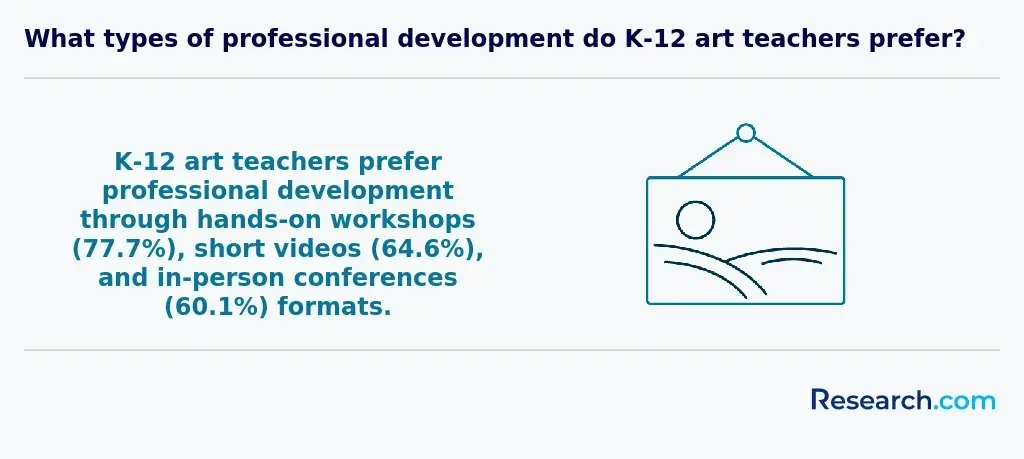
Professional development is essential for Alabama art teachers because certification renewal, instructional quality, curriculum changes, classroom technology, and student needs all evolve over time. Nationally, over 30% of K-12 art teachers report that their district’s professional development opportunities are satisfactory, and Alabama educators can also turn to state, local, university, and arts-organization resources.
Alabama art teachers must complete a minimum of 50 clock hours of professional development every five years to maintain certification. Rather than treating those hours as a checklist, use them strategically. Choose training that improves your weakest area, supports your school’s goals, or helps you move toward advancement.
| Professional Development Option | Useful For | How to Use It Well |
| Alabama State Council on the Arts programs | Arts integration, community partnerships, and funding awareness. | Look for workshops or grant-related opportunities that can directly support student projects. |
| Alabama Alliance for Arts Education | Curriculum planning, advocacy, and arts education collaboration. | Use events to connect with teachers outside your district and exchange lesson strategies. |
| Alabama Center for the Arts workshops | Art educator training and updated teaching practices. | Select sessions that add techniques you can apply immediately in the classroom. |
| Alabama Art Education Association | Networking, lesson sharing, and professional identity. | Attend conferences or local events to build a support network before you need one. |
| Online courses and webinars | Flexible learning for teachers balancing full-time work. | Prioritize courses that provide documentation for renewal and practical classroom tools. |
| Collaborative learning communities | Peer feedback, shared resources, and problem-solving. | Bring student work samples, rubrics, or lesson challenges for focused discussion. |
Professional development can also help art teachers move into broader school leadership, curriculum support, or instructional coaching. Educators exploring long-term options beyond classroom teaching can review related careers in education management.
What are effective classroom management strategies and teaching methods for art teachers in Alabama?
Art classrooms require strong management because students often use shared supplies, move around the room, work with messy materials, and complete open-ended projects. Good classroom management protects creativity rather than limiting it. Students need freedom to explore, but they also need routines that keep the room safe, productive, and respectful.
| Common Art Room Challenge | Better Strategy | Why It Works |
| Students misuse supplies | Teach material procedures before the project begins and model cleanup expectations. | Students are less likely to waste materials when routines are explicit. |
| Noise rises during studio work | Use a clear attention signal, voice-level expectations, and timed work checkpoints. | Students can collaborate without losing instructional focus. |
| Some students finish too early | Provide extension tasks such as artist statements, revision prompts, or sketchbook challenges. | Early finishers stay engaged without distracting others. |
| Students say they are “bad at art” | Emphasize process, experimentation, and growth rather than only polished outcomes. | Confidence improves when students see art as skill-building, not fixed talent. |
| Behavior issues interrupt demonstrations | Pause, use nonverbal redirection, and reteach expectations before continuing. | Instruction is more effective when the class is ready to listen. |
| Wide skill gaps appear in one class | Differentiate by offering choice in medium, complexity, reference materials, or final format. | Students can meet standards while working at an appropriate challenge level. |
Strong art teaching also depends on lesson design. Effective lessons include a clear objective, a short demonstration, visual references, student choice, structured work time, feedback, and reflection. Rubrics should evaluate creativity, technique, effort, process, and understanding of the standard rather than simply rewarding students who already have advanced drawing skills.
Teachers who want deeper research and resource skills may explore an online master's in LIS, especially if they are interested in digital collections, media literacy, or school library collaboration.
What are the first steps to take after deciding to become an art teacher in Alabama?
Start by confirming which certification route fits your current education level. A high school student, a college freshman, a studio artist with a bachelor’s degree, and a certified teacher adding another subject may all need different next steps. For a broader overview of Alabama teacher requirements, review Research.com’s guide on how to become a teacher in Alabama.
- Check whether you need an initial bachelor’s program, a post-baccalaureate pathway, or an alternative certification option.
- Confirm that your chosen program is approved for Alabama teacher preparation.
- Ask which Praxis or AECTP exams are required and when students usually take them.
- Review student teaching placement expectations, including grade levels and semester timing.
- Estimate total costs, including tuition, fees, exam costs, background check costs, supplies, and transportation to field placements.
- Begin building an art and teaching portfolio before your final semester.
- Talk to current Alabama art teachers about district hiring cycles, materials budgets, and classroom realities.
What are the career advancement opportunities and specializations for art teachers in Alabama?
Art teaching can remain a classroom career for decades, but it can also lead to specialized instruction, leadership, curriculum work, community arts programming, or higher education. The best advancement path depends on whether you want more creative specialization, more influence over programs, or a move into administration.
| Advancement Path | What It Can Look Like | When It Makes Sense |
| Medium or subject specialization | Digital art, ceramics, photography, art history, media arts, or advanced studio courses. | You want to deepen your creative niche and attract students to stronger arts electives. |
| Department leadership | Art department chair, fine arts lead, or school arts coordinator. | You enjoy mentoring colleagues, coordinating exhibits, and shaping program direction. |
| Curriculum coordination | District-level curriculum planning, standards alignment, assessment design, or arts integration. | You want broader influence beyond a single classroom. |
| Additional endorsements | Special education, gifted education, elementary education, or another teaching field. | You want greater flexibility, stronger inclusive teaching skills, or more job options. |
| Administrative leadership | Assistant principal, principal, program director, or arts administrator. | You are prepared to pursue additional leadership credentials and manage staff, budgets, and policy. |
| Postsecondary teaching | Community college, university, or adjunct teaching in art or art education. | You have advanced credentials, a strong portfolio, and interest in teaching older students. |
Specialization can also strengthen employability. Schools increasingly value teachers who can support digital portfolios, media arts, interdisciplinary projects, exhibitions, and inclusive instruction. Advancement is usually gradual: build strong classroom results first, document your work, then pursue credentials or leadership roles that match your goals.
What future trends are influencing art education and career opportunities in Alabama?
Digital tools are changing what students create and how teachers assess creative growth. Alabama art teachers may increasingly use digital portfolios, media arts assignments, online critique tools, virtual museum resources, and multimedia projects. This does not replace traditional drawing, painting, sculpture, or ceramics; it expands the ways students can communicate visually.
Students interested in digital art may also connect classroom skills to creative industries such as design, illustration, media production, and animation career pathways. For teachers, this means stronger technology confidence can make lessons more relevant and help students see how art connects to future work.
Can art teachers expand their horizons by exploring complementary educational roles?
Art teachers build transferable skills in visual communication, student engagement, project-based learning, curation, and community programming. Those skills can support roles in curriculum development, museum education, instructional design, community arts coordination, and school library collaboration. Educators interested in information access, media resources, and student research support can compare this path with guidance on how to become a librarian in Alabama.
Expanding into a complementary role makes the most sense when you want to stay connected to education but do not want your entire career defined by a single classroom assignment. It can also help teachers who enjoy organizing resources, designing learning experiences, or connecting schools with community arts organizations.
Could alternative education degree programs simplify the path to art teaching in Alabama?
Alternative or flexible education programs may help career changers, working adults, or degree holders who need a more practical route into teaching. However, “faster” should never mean “unclear.” Any pathway you choose must still satisfy Alabama’s certification expectations, including approved preparation, exams, background checks, and supervised teaching where required.
Before selecting an accelerated option, ask whether the program leads to Alabama certification, how student teaching is arranged, what exams are required, and whether graduates are eligible for the certificate you need. Candidates comparing simplified education pathways can review the list of easiest education degrees, but certification fit should matter more than convenience alone.
What resources and support are available for new art teachers in Alabama?
New art teachers need more than lesson ideas. They need mentors, standards guidance, supply solutions, classroom management support, professional networks, and funding strategies. The following resources can help early-career teachers avoid isolation and build stronger programs.
- The Alabama Art Education Association can connect new teachers with professional development, networking opportunities, events, and experienced educators.
- The Alabama State Department of Education provides curriculum standards, certification information, and state-level guidance for public school educators.
- Local school districts may offer mentoring or induction programs that pair beginning teachers with veteran educators.
- The National Art Education Association offers webinars, online communities, lesson resources, and a wider professional network for art educators.
- Online teacher communities, including art education groups on social platforms, can help with quick advice on supplies, project planning, and classroom routines.
- The Alabama Arts Council may be useful for teachers looking for grants, partnerships, or support for arts programming.
- Universities and colleges sometimes host educator workshops, summer institutes, or continuing education opportunities.
- Art supply stores and education resource centers may provide teacher discounts, demonstrations, or product training.
- Local galleries, museums, artists, and community arts organizations can support guest talks, exhibits, field trips, and collaborative projects.
How does Alabama support new educators introducing art into elementary education?
Elementary art instruction requires a different approach from secondary art teaching. Younger students need lessons built around exploration, motor development, visual vocabulary, storytelling, and confidence. Teachers who want to understand the broader elementary pathway can review Research.com’s guide on how to become an elementary school teacher in Alabama.
Support often comes through district mentoring, professional learning communities, induction programs, and standards-based planning resources. These structures help new teachers translate arts standards into short, age-appropriate lessons that fit elementary schedules and developmental needs.
New elementary art teachers should also learn how to advocate for materials. Simple systems such as supply inventories, donation lists, reusable media centers, and rotating stations can help stretch limited budgets while keeping lessons meaningful.
What challenges do art teachers in Alabama face and how can they overcome them?
Art teachers in Alabama may face limited budgets, shared classrooms, large class sizes, uneven access to materials, pressure to prioritize tested subjects, and the challenge of proving the academic value of art. These problems are real, but they are easier to manage with planning and advocacy.
| Challenge | Practical Response |
| Small supply budget | Plan reusable projects, request community donations, apply for grants, and prioritize versatile materials. |
| Limited instructional time | Use focused lessons with clear demonstrations, repeatable routines, and realistic project scope. |
| Low recognition of art’s value | Display student work, connect projects to literacy or history, and share standards-based outcomes with administrators. |
| Wide range of student ability | Offer choice, scaffold techniques, and grade based on growth, process, and criteria rather than raw talent. |
| Classroom behavior issues | Teach procedures explicitly, use consistent transitions, and document repeated concerns when support is needed. |
Art teachers can also learn from other subject-area educators who manage writing, discussion, assessment, and standards alignment. For example, strategies used by those learning how to become an english teacher in Alabama may transfer to critique writing, artist statements, and classroom discussion.
How can interdisciplinary collaboration enhance art teaching outcomes in Alabama?
Interdisciplinary collaboration helps art teachers show that creative work supports analysis, communication, problem-solving, and content knowledge. A visual arts project can connect to geometry, scientific observation, Alabama history, literature, music, or digital media.
For example, art and math teachers might collaborate on symmetry, scale, pattern, or perspective. Teachers interested in cross-subject planning can compare strategies used in guides such as how to be a middle school math teacher in Alabama. The goal is not to turn art into another subject, but to help students see how creative thinking works across disciplines.
Can additional certifications support inclusive art education in Alabama?
Additional credentials can help art teachers serve a wider range of learners. A certification or endorsement connected to special education, for instance, can strengthen skills in differentiation, accommodations, behavior supports, and accessible assessment. Teachers who want this preparation can explore the pathway for special education teacher certification in Alabama.
Inclusive art teaching means offering multiple ways to participate. Students may demonstrate understanding through drawing, collage, digital media, verbal explanation, adaptive tools, or collaborative work. The strongest classrooms preserve high expectations while removing unnecessary barriers.
What distinguishes private school art teaching careers in Alabama?
Private school art teaching can differ from public school teaching in certification expectations, curriculum flexibility, class size, resources, and hiring practices. Some private schools may value state certification, while others may weigh portfolio strength, teaching experience, faith-based fit, or specialized artistic expertise more heavily.
Private schools may give art teachers more room to design custom projects or integrate school-specific themes. However, teachers should still ask careful questions about salary, benefits, contract length, planning time, budget, evaluation methods, and expectations for extracurricular duties. Candidates interested in this setting can review guidance on how to become a private school teacher in Alabama.
How can technology integration enhance art teaching outcomes in Alabama?
Technology can help art teachers document process, expand media choices, provide feedback, and connect students to wider audiences. Digital portfolios, virtual galleries, animation tools, design software, tablet drawing, and multimedia critique platforms can make student growth easier to track.
Technology is most effective when it supports artistic goals rather than distracting from them. A strong digital lesson should still teach composition, visual meaning, technique, revision, and reflection. Teachers exploring arts technology across disciplines may find useful parallels in how to become a music teacher in Alabama, especially when combining audio, visual design, and performance-based learning.
How can historical context enrich art curricula in Alabama?
Art becomes more meaningful when students understand the people, places, events, and cultures behind creative work. Alabama art teachers can connect visual art to local history, regional traditions, civil rights history, architecture, folk art, museum collections, and global movements.
Historical context helps students move beyond copying a style. They learn to ask why an artwork was made, who made it, what materials were available, what audience it addressed, and how meaning changes over time. Educators who want stronger cross-curricular methods can explore strategies used by those preparing to become a history teacher in Alabama.
How does early childhood art education shape creative development in Alabama?
Early childhood art education supports fine motor skills, sensory exploration, visual literacy, language development, problem-solving, and self-expression. Young children benefit from art experiences that emphasize process over perfect products: mixing colors, exploring textures, building shapes, telling stories through images, and describing what they made.
Teachers working with young learners should use short instructions, safe materials, predictable routines, and open-ended prompts. Art in early childhood is not just decoration for the refrigerator; it is part of how children learn to observe, choose, experiment, and communicate. Educators interested in early learning can review Research.com’s guide on how to become a kindergarten teacher in Alabama.
What do graduates say about becoming an art teacher in Alabama?
- For Alicia, teaching art in Alabama has been personally meaningful because community support and student creativity make the work feel purposeful. She values watching students develop confidence and use art to express ideas they may not communicate in other subjects. Alicia
- Rafah points to Alabama’s cultural variety as a strength in the art classroom. She sees that diversity as a way to help students explore identity, voice, and creative interpretation. Rafah
- Brett describes the profession as both collaborative and innovative. Sharing resources with other educators and connecting art to the wider curriculum have helped him grow as a teacher. Brett
Common Mistakes to Avoid Before Becoming an Art Teacher in Alabama
- Choosing a program without checking certification alignment: A strong art program is not automatically a teacher certification program. Verify approval before enrolling.
- Looking only at tuition: Add exam fees, application fees, supplies, transportation, background checks, and unpaid student teaching time to your cost estimate.
- Assuming online coursework is enough: Teacher preparation usually requires supervised field experience, so confirm how placements work.
- Waiting too long to build a portfolio: Hiring teams may want to see your own artwork, student-centered lesson plans, and evidence of classroom practice.
- Ignoring rural and smaller districts: Competition can vary by location, and some candidates find strong early-career opportunities outside major cities.
- Assuming salary estimates are guaranteed: Actual pay comes from district schedules, credentials, years of experience, and contract terms.
- Treating art as separate from school priorities: Teachers who connect art to literacy, history, technology, and student engagement often advocate more effectively for their programs.
Questions to Ask Before Choosing an Alabama Art Education Program
- Is this program approved for Alabama teacher certification in art?
- What certificate will I be eligible for after completion?
- Which Praxis or AECTP exams are required, and when do students typically take them?
- How many hours or weeks of field experience and student teaching are included?
- Where are student teaching placements located, and can working adults complete them?
- What are the total estimated costs beyond tuition?
- What percentage of graduates pass required exams and secure teaching jobs?
- Does the program help students create teaching portfolios and prepare for district interviews?
- Are there opportunities to specialize in digital art, media arts, ceramics, art history, or elementary art?
- How does the program support transfer students, career changers, or candidates with a prior bachelor’s degree?
Related Articles for Nearby States
- 2027 How to Become an Art Teacher in Mississippi: Requirements & Certification
- 2027 How to Become an Art Teacher in Tennessee: Requirements & Certification
- 2027 How to Become an Art Teacher in Georgia: Requirements & Certification
- 2027 How to Become an Art Teacher in Florida: Requirements & Certification
- 2027 How to Become an Art Teacher in Louisiana: Requirements & Certification
- 2027 How to Become an Art Teacher in Arkansas: Requirements & Certification
- 2027 How to Become an Art Teacher in Kentucky: Requirements & Certification
- 2027 How to Become an Art Teacher in South Carolina: Requirements & Certification
- 2027 How to Become an Art Teacher in North Carolina: Requirements & Certification
- 2027 How to Become an Art Teacher in Missouri: Requirements & Certification
References:
- The Art of Education University. (2024). The state of art education 2024. TheArtofEducation.edu. Retrieved September 19, 2024.
- Glassdoor. (2024, June 6). How much does an art teacher make in Alabama? Glassdoor.com. Retrieved September 19, 2024.
- Mackey, E. G., & Martin, A. (2022). Improving classroom instruction with Alabama’s Teacher Growth Program (ATGP). Alabama State Department of Education. Retrieved September 19, 2024.
- U.S. BLS. (2024, April 3). Occupational employment and wages, May 2023: 25-1121 Art, drama, and music teachers, postsecondary. U.S Bureau of Labor Statistics. Retrieved September 19, 2024.
Key Insights
- Alabama’s route to public school art teaching usually requires a bachelor’s degree, state-approved educator preparation, required exams, a background check, student teaching, and a Class B Professional Educator Certificate.
- Certification fit matters more than program convenience. Before enrolling, confirm that your degree or alternative pathway is approved for Alabama teacher licensure.
- Salary figures vary by source and setting. Alabama K-12 art teacher estimates are commonly discussed around $50,000 to about $52,000 per year, while postsecondary art teachers are reported around $69,820 annually.
- The Alabama State Department of Education reports that as of 2023, there are approximately 1,200 certified art teachers in the state, indicating an established professional community for arts educators.
- Over 80% of art education graduates are reported to find employment within a year of graduation, but individual outcomes depend on location, openings, credentials, interview quality, and willingness to teach across grade levels.
- Alabama requires prospective art teachers to pass the Praxis II Art Content Knowledge exam, and the 2023 pass rate was approximately 75%, so candidates should budget study time as well as exam fees.
- Continuing education is not optional. Alabama art teachers must complete 50 hours of professional development every five years, and nearly 60% of art teachers participated in workshops or courses in 2023.
- The strongest candidates combine artistic skill with classroom management, standards-based lesson design, technology confidence, inclusive teaching strategies, and a portfolio that shows how they help students grow creatively.
Other Things You Should Know About Becoming an Art Teacher in Alabama
The Alabama State Department of Education oversees the certification process for art teachers. They set the requirements, evaluate applications, and issue certifications, ensuring that prospective art teachers meet all necessary criteria before teaching in Alabama public schools.
Alabama art teachers must pass the Praxis Subject Assessments for Art, usually Praxis Art: Content Knowledge (5134), to meet state certification requirements. The Alabama State Department of Education uses Praxis scores as part of the teacher licensure process, along with an approved education program and background clearance.
To maintain art teacher certification in Alabama, educators must complete 50 hours of professional development or continuing education every five years. This includes workshops, seminars, or college courses approved by the Alabama State Department of Education to ensure ongoing professional growth.