2027 Online Digital Photography Degrees With Commercial Photography Focus

Co-Founder and Chief Data Scientist
Choosing an online digital photography degree is really a career-investment decision: will the program help you build a portfolio that clients and employers trust? The U.S. Bureau of Labor Statistics reported a $42,520 median annual wage for photographers in May 2024, but commercial work often depends on specialization, business skill, and portfolio quality.
This guide is for students comparing online photography degrees, certificates, and career paths. You'll learn how programs work, what they cost, how accreditation matters, and how to choose a degree that fits your commercial photography goals.
Key Things You Should Know
- For 2026 applicants, the best online commercial photography degree is usually one that combines visual technique, lighting, editing, portfolio development, and business coursework rather than photography theory alone.
- College Board's 2024-25 figures show average published tuition and fees of $4,050 at public two-year colleges, $11,610 for in-state public four-year colleges, and $43,350 at private nonprofit four-year colleges, so total cost varies sharply by school type and transfer credit.
- BLS data published in 2024 reported a $42,520 median annual wage for photographers and projected slower-than-average employment growth, which means students should evaluate portfolio outcomes, internship access, and business preparation before enrolling.
What is an online digital photography degree with a commercial photography focus?
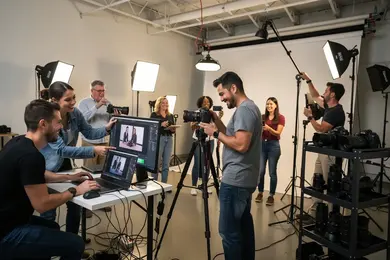
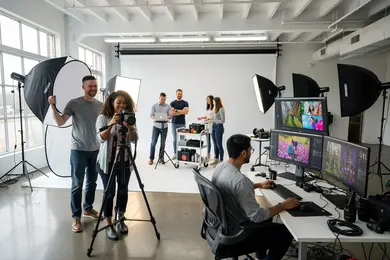
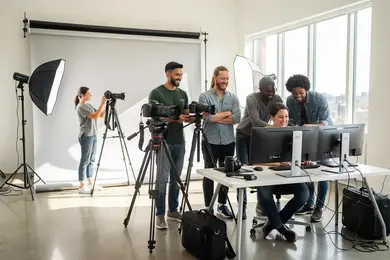
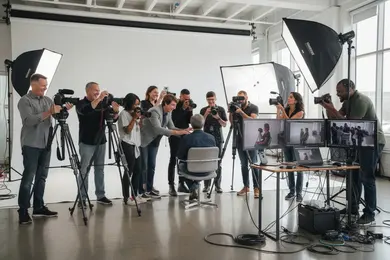
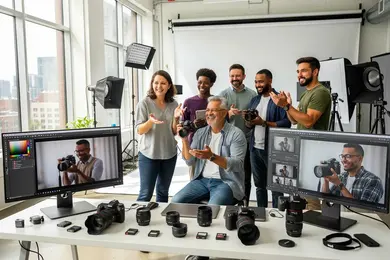
An online digital photography degree with a commercial photography focus is a college program that teaches students how to create images for business, advertising, media, retail, real estate, events, and brand communication. "Digital photography" refers to image capture, editing, color management, asset organization, and output using digital cameras and software. "Commercial photography" narrows that training toward client-facing work where images serve a business purpose.
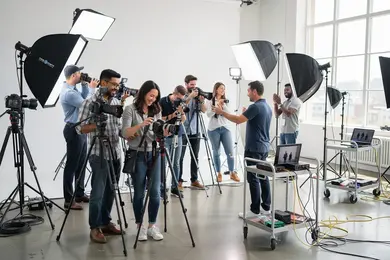
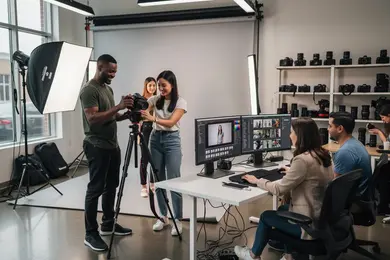
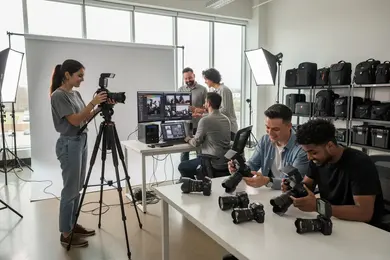
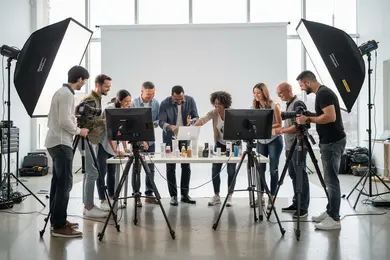
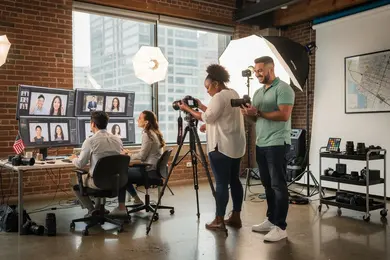
These programs are usually delivered through online lectures, critiques, assignments, portfolio reviews, and software-based labs. Students may shoot independently at home, in rented studios, outdoors, or at local client sites, then submit work for instructor and peer feedback. A strong program should teach not only how to make technically polished images, but also how to price work, manage usage rights, communicate with clients, and present a professional portfolio.
This degree is most useful for students who want structured training, faculty critique, a credential, and a guided portfolio-building process. It may be less useful for experienced photographers who already have a strong portfolio, steady clients, and only need targeted training in software, lighting, or business operations.
Commercial photography programs often emphasize these work settings and deliverables because they reflect how images are purchased in the market:
- Product and e-commerce photography for online stores, catalogs, and marketplaces
- Advertising and brand photography for campaigns, websites, and social media
- Food, fashion, portrait, and lifestyle photography for commercial clients
- Architectural and real estate photography for property marketing
- Corporate headshots, editorial assignments, and event coverage for organizations
How do online commercial photography degrees compare with on-campus programs?
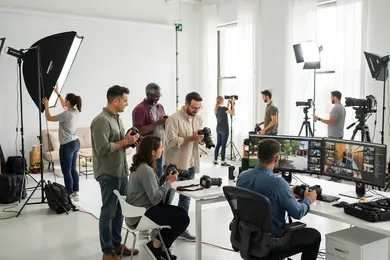
Online commercial photography degrees can be a strong fit for students who need flexibility, but they are not automatically easier or cheaper than campus programs. The main trade-off is that online students gain schedule control while taking more responsibility for equipment access, shooting locations, self-direction, and networking.
The comparison below highlights the practical differences that matter most when deciding whether to study photography online or on campus.
| Factor | Online commercial photography degree | On-campus commercial photography program | Best fit |
| Schedule | Often asynchronous or hybrid, with uploaded assignments and virtual critiques | More fixed class times, studio sessions, and in-person critique blocks | Online works better for working adults and students outside major art-school markets |
| Studio access | Students may need to create a home setup or rent local studio time | Students may use school studios, lighting labs, and equipment checkout rooms | Campus works better if you need frequent access to specialized gear |
| Critique and feedback | Usually delivered through discussion boards, video calls, annotated submissions, and portfolio reviews | Often delivered live in studio classrooms with immediate group discussion | Either can work if critiques are frequent, detailed, and instructor-led |
| Networking | Depends on virtual events, alumni access, local internships, and student initiative | May offer easier access to local galleries, studios, visiting artists, and campus events | Campus may help students who rely heavily on in-person community |
| Cost structure | May reduce relocation and commuting costs, but equipment costs still matter | May include campus fees, commuting, housing, and supplies | Online can be more affordable when tuition is reasonable and transfer credits apply |
Choose online if you are disciplined, can build or access a shooting setup, and want to keep working while studying. Choose campus if you need supervised studio time, a highly tactile learning environment, or direct access to school-owned equipment. A hybrid program can be a useful middle ground when it combines online coursework with short residencies, local internships, or in-person portfolio reviews.
What types of digital photography degrees prepare you for commercial photography careers?
Commercial photography careers do not require one single degree title. Students can enter through associate, bachelor's, certificate, or broader visual arts programs, but the best choice depends on how much time, money, and career mobility they want.
The table below compares common academic paths and when each option makes sense.
| Program type | Typical credential | What it usually covers | When it makes sense |
| Digital photography certificate | Undergraduate or professional certificate | Camera technique, editing, lighting, and portfolio basics | Best for learners who already have a degree or want targeted skills without a long program |
| Associate degree in photography | AA, AS, or AAS | Foundational photography, digital imaging, general education, and introductory business skills | Best for budget-conscious students who may transfer later or pursue entry-level freelance work |
| Bachelor's degree in photography | BA, BFA, or BS | Advanced studio practice, visual communication, art direction, portfolio development, and electives | Best for students seeking deeper critique, broader creative training, or future management and teaching options |
| Visual communication or media arts degree | BA, BFA, or BS | Photography plus design, branding, video, web media, and storytelling | Best for students who want broader creative-media flexibility beyond still photography |
| Business or marketing degree with photography electives | AA, BA, or BS | Client strategy, entrepreneurship, branding, and selected imaging courses | Best for students planning to run a studio, agency, or content-production business |
A bachelor's degree can provide more portfolio depth and critique, but it is not always the highest-ROI path for every photographer. If your goal is rapid freelance entry, an associate degree or certificate plus a strong portfolio may be enough. If your goal is art direction, brand content strategy, higher education, or leadership in a creative department, a bachelor's program may offer better long-term flexibility.
Students comparing creative technology paths should also distinguish photography from interactive design. For example, game design schools online may fit students who want to build visual worlds, game assets, or interactive media, while commercial photography programs are better for students who want to produce client-ready still images and visual campaigns.
How can you tell if an online digital photography program is properly accredited?
Accreditation is one of the most important checks before enrolling because it affects federal financial aid eligibility, transfer credit, employer confidence, and graduate-school options. For online photography degrees, the first priority is institutional accreditation, not whether the photography major itself has a special art-school label.
A properly accredited U.S. college should be recognized by an accrediting agency accepted by the U.S. Department of Education or the Council for Higher Education Accreditation. Specialized art and design accreditation, such as recognition from the National Association of Schools of Art and Design, can add credibility, but it is usually not a substitute for institutional accreditation.
Use these steps before submitting an application or deposit:
- Search the school's name in the U.S. Department of Education's accreditation database and confirm the accreditor, campus, and institutional status.
- Check whether the online program is offered by the same accredited institution listed in the database, especially if the school uses a separate online division or partner platform.
- Ask whether credits transfer into photography, visual communication, or fine arts bachelor's programs if you are starting with a certificate or associate degree.
- Confirm that enrolled students can use federal financial aid if they qualify, because non-accredited training providers may not be eligible.
- Review consumer disclosures, graduation rates, student complaint history, and portfolio or employment support before assuming accreditation alone means strong outcomes.
Common red flags include vague claims such as "internationally recognized," pressure to enroll immediately, no clear accreditor name, or a school that describes itself as "licensed" but not accredited. Licensing to operate and academic accreditation are not the same thing.
What courses and skills are typically included in commercial-focused digital photography curricula?
A commercial-focused digital photography curriculum should build technical control, creative judgment, business readiness, and a portfolio that matches real client needs. The best programs move beyond camera basics and require students to solve practical visual problems, such as photographing reflective products, directing a portrait session, or creating a cohesive brand campaign.
Most programs organize coursework around several skill clusters. These areas matter because commercial clients judge both image quality and reliability.
- Camera and exposure control, including aperture, shutter speed, ISO, lenses, file formats, and capture workflow
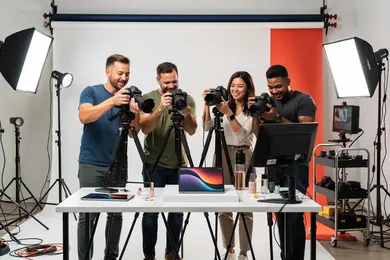
- Lighting for studio, location, product, portrait, food, fashion, and architectural subjects
- Digital editing, retouching, color correction, compositing, file management, and print or web output
- Visual storytelling, composition, art direction, branding, and campaign development
- Business practices, including estimates, contracts, licensing, copyright, invoicing, client communication, and marketing
- Portfolio development through critiques, capstone projects, personal branding, and professional presentation
Technology is changing what students should expect from these programs. Generative AI, automated masking, AI noise reduction, synthetic backgrounds, and image-recognition tools are now part of many photography workflows, but they do not replace the need for lighting judgment, client communication, ethical disclosure, and copyright awareness. Students who are more interested in building AI systems than using AI-assisted creative tools may want to compare photography programs with AI degrees.
Before enrolling, ask to see recent student portfolios and sample assignments. A strong curriculum should show evidence of instructor critique, commercial-style briefs, and final work that could plausibly be shown to clients, agencies, or employers.
What are the admission requirements for online commercial photography degree programs?
Admission requirements vary by credential level and school selectivity. Many online photography certificates and associate programs are open-access or test-optional, while bachelor's programs may require transcripts, a portfolio, a personal statement, or transfer-credit evaluation.
Students should prepare the following materials early because photography admissions can involve both academic and creative review:
- Official high school, GED, college, or military transcripts, depending on the program level
- A portfolio of original images if required, usually showing technical control, composition, and creative direction
- A statement of purpose explaining commercial interests such as product, portrait, real estate, fashion, food, or brand photography
- Proof of English proficiency for applicants whose prior education was not in English
- Technology readiness, including access to a digital camera, computer, image-editing software, reliable internet, and file-storage workflow
- Transfer-credit documents, including syllabi or course descriptions when seeking credit for previous art, media, or general education courses
Some online schools offer rolling admissions or frequent start dates, which can be useful if you do not want to wait for a traditional semester. If start-date flexibility is a major priority, compare programs with online colleges with weekly start dates, but make sure the photography courses you need are actually offered in the term you plan to begin.
Avoid applying only to the fastest program. Commercial photography requires repeated practice, critique, and portfolio revision, so an accelerated format works best for students who already have time for intensive shooting assignments each week.
How long do online digital photography degrees take and what do they cost?
Program length depends on credential level, transfer credit, course load, and whether the school uses semesters, quarters, or accelerated terms. Cost depends on tuition, fees, camera equipment, lighting gear, software, printing, storage, and travel for local shoots or internships.
College Board's 2024-25 pricing data gives a useful baseline for comparing published tuition and fees by institution type, although actual online program costs may differ by school and residency status.
- $4,050 average published tuition and fees at public two-year colleges
- $11,610 average published in-state tuition and fees at public four-year colleges
- $43,350 average published tuition and fees at private nonprofit four-year colleges
These figures do not include every photography-specific cost. A student with existing camera gear may spend less upfront than a beginner who needs a camera body, lenses, tripod, lighting kit, calibrated monitor, backup storage, and software subscriptions.
The table below summarizes common time frames and cost considerations so you can compare options more realistically.
| Credential | Typical full-time length | Common cost drivers | Cost-control strategy |
| Certificate | Several months to one year | Course fees, software, camera access, and portfolio materials | Use it for targeted upskilling rather than paying for courses you already know |
| Associate degree | About two years | Tuition, general education courses, equipment, and transfer planning | Start at a public community college and confirm transfer pathways before enrolling |
| Bachelor's degree | About four years, less with transfer credit | Upper-level studio courses, portfolio reviews, electives, fees, and supplies | Maximize transfer credits and compare total program cost, not just per-credit tuition |
| Degree completion program | Often one to three years | Remaining credits, residency requirements, portfolio courses, and technology fees | Request a written degree audit before committing |
Financial aid can change affordability significantly. The maximum Federal Pell Grant for the 2024-25 award year was $7,395, but eligibility depends on federal aid rules, enrollment status, cost of attendance, and the student's aid index. Students should complete the FAFSA, ask about scholarships for art and design students, and compare net price after grants rather than relying on advertised tuition alone.
What careers can you pursue with an online commercial photography degree?
An online commercial photography degree can prepare students for freelance, studio, agency, retail, media, and in-house content roles. The credential alone is rarely enough; employers and clients usually look closely at the portfolio, reliability, technical execution, turnaround time, and ability to match a brand brief.
The following career paths are common for graduates who combine photography training with business and digital-content skills.
| Career path | Typical work | Portfolio evidence that matters |
| Commercial photographer | Creates images for advertising, branding, products, people, and campaigns | Polished client-style projects, lighting control, consistent editing, and usage-ready deliverables |
| Product or e-commerce photographer | Photographs products for websites, catalogs, marketplaces, and retail content | Clean product sets, color accuracy, reflective-object control, and high-volume workflow examples |
| Portrait or corporate photographer | Produces headshots, executive portraits, team images, and environmental portraits | Strong posing, lighting, retouching, and client-direction samples |
| Real estate or architectural photographer | Photographs residential, commercial, hospitality, or interior spaces | Interior lighting balance, perspective control, exterior shots, and fast delivery workflow |
| Photo editor or digital imaging specialist | Retouches, manages, color-corrects, and prepares images for publication or commerce | Before-and-after edits, compositing skill, metadata organization, and production consistency |
| Content producer | Creates still images, short-form video, and branded visual assets for organizations | Cross-platform campaign samples, basic video ability, social content, and brand consistency |
Students who want the strongest career flexibility should build a portfolio around a specific market instead of trying to show every type of photography. A focused product, portrait, real estate, or brand-content portfolio is easier for clients to understand than a broad collection with no commercial direction.
Entry-level paths may include assisting established photographers, working in a studio, editing images for a retailer, producing social media content, or taking small freelance jobs while building references. Advancement often comes from stronger specialization, repeat clients, licensing income, production management, or moving into art direction and creative leadership.
What salary ranges and job outlook can commercial photographers expect in the U.S.?
Commercial photography pay varies widely because many photographers are self-employed, part-time, project-based, or paid by assignment rather than salary. Location, specialization, client type, licensing terms, production scale, and business skill can matter as much as the degree itself.
The most useful national benchmark is the BLS photographer category. BLS data published in 2024 reported a $42,520 median annual wage for photographers in May 2024. This figure is a midpoint across many photography roles, not a forecast for a specific graduate or a measure of high-end advertising, corporate, or specialized commercial work.
BLS projections published in 2024 for the 2023-33 period showed photographer employment growing more slowly than the average for all occupations. For students, that means a degree should be evaluated as a portfolio-and-business-building investment, not simply as a ticket to a job title.
The table below shows how pay context can differ by work model and market position.
| Work model | Income pattern | What influences earning potential |
| Staff photographer | More predictable pay, benefits may be available | Employer size, location, role scope, editing skills, and content-production ability |
| Freelance commercial photographer | Variable project income | Client base, pricing, usage licensing, niche demand, referrals, and production efficiency |
| Studio owner | Business revenue minus operating costs | Marketing, equipment investment, assistants, studio rent, repeat clients, and pricing discipline |
| Digital imaging specialist | May be hourly, salaried, or contract-based | Retouching skill, color management, speed, software fluency, and industry specialization |
If you are comparing photography with more data-heavy career paths, salary benchmarks can look very different. For example, a guide to sports analytics salary can help you compare creative portfolio careers with roles built around statistics, data tools, and quantitative decision-making.
AI and automation are also affecting the field. Automated editing can speed up routine tasks, and generative tools can reduce demand for some simple stock-style images. At the same time, clients still need photographers who can direct real shoots, manage people and products, solve lighting problems, and deliver legally usable original images.
How should students choose the best online commercial photography program for their goals?
The best online commercial photography program is the one that fits your target market, budget, learning style, and portfolio needs. A school with a strong brand but weak critique, limited commercial coursework, or unclear transfer policies may be a poor fit even if it looks attractive at first.
Use the following process to compare programs before enrolling:
- Define your target commercial niche, such as product, portrait, real estate, food, fashion, hospitality, or brand content.
- Review required courses and confirm that the curriculum includes lighting, editing, portfolio development, and business practices.
- Check institutional accreditation and verify that the online program is covered by the accredited school.
- Ask for recent student portfolios, capstone examples, and information about critique frequency.
- Calculate total cost, including tuition, fees, software, camera gear, lighting, storage, printing, and any travel or studio rental needs.
- Request a transfer-credit review in writing if you have previous college credits or military training.
- Ask how the program supports internships, client projects, alumni networking, career services, and portfolio reviews.
- Compare full-time and part-time pacing, then choose a schedule that leaves enough time for shooting, editing, and revision.
Common mistakes include choosing the cheapest program without checking accreditation, assuming online study means less work, buying expensive gear before understanding course requirements, or selecting a general art degree when you need commercial business training. Another mistake is judging a program only by its course list; photography education depends heavily on critique quality and portfolio outcomes.
Before committing, ask admissions or the department these questions:
- How often will instructors provide individualized critique on images and portfolios?
- Are commercial lighting, product photography, client communication, and copyright covered in required courses?
- What equipment is required at the start, and what can be rented, borrowed, or purchased later?
- Can online students participate in internships, exhibitions, portfolio reviews, or alumni events?
- What percentage of credits must be completed at the institution, and how are transfer credits evaluated?
- Who teaches the commercial photography courses, and do they have current professional experience?
Students should choose this path if they want structured feedback, a marketable portfolio, and business-ready creative training. They should consider a shorter certificate, workshops, or self-directed learning if they already have strong clients and only need a specific technical upgrade.
Other Things You Should Know About Digital Photography
Most programs require a digital portfolio of 10 to 20 images, plus a short artist statement and, in some cases, a resume or transcript. Schools often ask for varied work showing exposure, composition, and editing skills rather than expensive gear or studio experience.
Usually, students keep copyright to original work, but policies vary. Read the school's student work, portfolio, and promotional-use policies so you know whether the institution can display your images and how credit will be handled.
Photoshop and Lightroom complement each other. In a digital photography degree with a commercial focus, both are crucial. Photoshop handles detailed editing, while Lightroom excels at organizing and processing multiple images, enhancing workflow efficiency. Most programs recommend proficiency in both to ensure broad capabilities in commercial photography settings.
Some students take small paid projects, assistant roles, or editing work while studying. Keep expectations realistic, use written agreements, and avoid accepting assignments beyond your technical ability or insurance coverage.
References
- Online Photography Degree | Associate Degree (AOS) https://www.sessions.edu/online-degrees/digital-photography/
- Professional Diploma in Creative and Commercial Photography https://www.griffith.ie/faculties/professional-academy/courses/professional-diploma-in-creative-and-commercial-photography
- How Much Do Photographers Make | Full Frame Insurance https://www.fullframeinsurance.com/blog/how-much-do-photographers-make
- What Can You Do With A Photography Degree? - What Career Live https://www.whatcareerlive.co.uk/what-can-you-do-with-a-photography-degree/
- How to Choose the Right Photography Program https://nossi.edu/how-to-choose-the-right-photography-program/
- Which fields can I work in post pursuing an online photography course? https://www.careers360.com/question-can-you-name-some-popular-digital-photography-experts-across-the-globe
- Courses https://www.baph.co.uk/courses
- Best Online Photography Degrees https://www.onlineu.com/degrees/photography
- 5 Key Factors to Consider When Choosing a Photography Course | Vogue College of Fashion https://www.voguecollege.com/articles/madrid/5-key-factors-to-consider-when-choosing-a-photography-course/
- What can you do with a Photography degree? https://www.falmouth.ac.uk/study/undergraduate/what-can-you-do-photography-degree