
2027 How to Become a Teacher in South Carolina – What Degree Do You Need to Be a Teacher?

Co-Founder and Chief Data Scientist
Becoming a teacher in South Carolina is a structured process, but the best route depends on your background, the grade level or subject you want to teach, and whether you already have a bachelor’s degree. The state continues to face recruitment and retention pressures: a recent SC Teacher report placed South Carolina teacher retention at about 83% to 87% for the one-year average and approximately 82% to 85% for the three-year average. For aspiring educators, that means schools need committed teachers, especially in shortage areas, but candidates still need to choose the right preparation program, pass required exams, and complete state certification steps.
This guide explains how to become a teacher in South Carolina, including degree options, teacher preparation requirements, licensure steps, timelines, salaries, high-demand specializations, online versus campus-based programs, alternative certification routes, and financial aid considerations. It is designed for first-time college students, career changers, out-of-state educators, substitute teachers, and current teachers planning their next career move.
Quick answer: How do you become a teacher in South Carolina?
To become a certified teacher in South Carolina, most candidates must earn a bachelor’s degree, complete a state-approved teacher preparation program, pass the required Praxis exams, clear a criminal background check, and apply for certification through the South Carolina Department of Education. The traditional route usually takes about 4 years. Candidates who already hold a bachelor’s degree in another field may qualify for alternative pathways that can take about one to two years.
Key benefits of becoming a teacher in South Carolina
- Educator departures and retirements in South Carolina have declined for the third consecutive year in 2024-2025, reaching their lowest levels in years compared to over 9,700 the previous year.
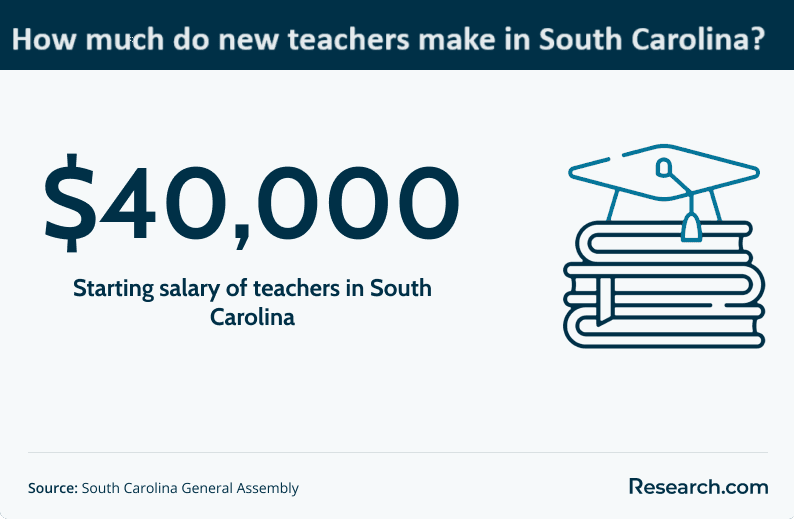
- The minimum starting salary for teachers in South Carolina is $40,000.
- International teachers constituted approximately 4% of all new hires in South Carolina.
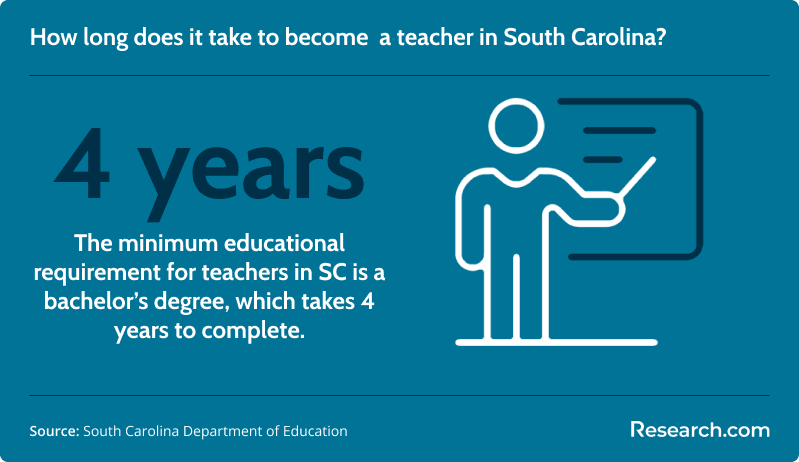
- The minimum education requirement to become a teacher in SC is a bachelor's degree, which can take about 4 years to complete.
- South Carolina offers license reciprocity, giving licensed teachers from other states a pathway to apply for a South Carolina teaching license.
- Special education has the highest number of vacant teaching positions in SC, with 209 openings.
- Top education programs in South Carolina for 2027
- State of the education industry in South Carolina
- Teacher salaries in South Carolina
- Education requirements for South Carolina teachers
- Teacher licensure application and renewal in South Carolina
- Timeline to become a teacher in South Carolina
- How to choose a teaching program in South Carolina
- Online versus traditional education programs in South Carolina
- Alternative pathways to teaching in South Carolina
- Teaching specializations in South Carolina
- Advancement options for experienced South Carolina teachers
- Benefits of online science education programs in South Carolina
- Special education teacher certification in South Carolina
- Career paths for licensed teachers in South Carolina
- School librarians in South Carolina education
- Kindergarten teacher requirements in South Carolina
- Private school teaching requirements in South Carolina
- Employment outcomes for South Carolina teaching graduates
- Current teacher certification requirements in South Carolina
- Substitute teacher requirements in South Carolina
- Average cost of teaching programs in South Carolina
- Financial aid for South Carolina teaching students
- Benefits of entering high-demand teaching fields
- Online master’s degrees for South Carolina teachers
- How South Carolina can respond to teacher shortages
Top Education Programs in South Carolina for 2027
How these programs were selected
South Carolina has several education programs that prepare students for classroom teaching, licensure exams, field placements, and long-term professional growth. Because a teaching degree can require a major financial and time commitment, students should compare programs using verified information rather than reputation alone.
Research.com reviews data from trusted sources, including the IPEDS database, Peterson's database, the College Scorecard database, and the National Center for Education Statistics. These sources help evaluate education programs using consistent data points. You can review the Research.com ranking process on the methodology page.
| School and program | Best fit | Program length | Required credits | Cost per credit | Accreditation |
| Clemson University — Bachelor of Arts in Elementary Education | Students preparing to teach elementary school | 4 years | 122 | $451 | Council for the Accreditation of Educator Preparation (CAEP) |
| University of South Carolina — Master of Arts in Teaching (MAT) in Elementary Education | Career changers with a non-education bachelor’s degree | 12 months | 36 | $798 | CAEP |
| College of Charleston — Bachelor of Science in Early Childhood Education | Students interested in birth through grade three instruction | 4 years | 122 | $451 | National Council for Accreditation of Teacher Education (NCATE) |
| Winthrop University — Bachelor of Science in Elementary Education | Future K-6 teachers seeking strong classroom preparation | 4 years | 120 | $451 | CAEP |
| Coastal Carolina University — Bachelor of Arts in Middle Level Education | Students planning to teach grades 5-8 | 4 years | 122 | N/A | CAEP |
Clemson University: BA in Elementary Education
Clemson University’s elementary education degree is designed for students who want a traditional undergraduate route into elementary teaching. The program emphasizes pedagogy, classroom management, subject-area instruction, and field-based learning. Students considering elementary classrooms should compare this option with other early childhood education pathways if they are more interested in younger learners.
University of South Carolina: MAT in Elementary Education
The University of South Carolina’s MAT in Elementary Education is aimed at students who already completed a bachelor’s degree outside education and want a graduate-level route toward South Carolina teaching licensure. Because it is a 12-month program with 36 credits, it may appeal to career changers who want a faster route than earning a second bachelor’s degree.
College of Charleston: BS in Early Childhood Education
The College of Charleston program focuses on early learning, child development, literacy, and teaching children from birth through grade three. Students comparing this program should pay close attention to field experience requirements and whether early childhood is the right developmental stage for their teaching goals.
Winthrop University: BS in Elementary Education
Winthrop University’s elementary education program prepares candidates for K-6 classrooms. Its curriculum includes instructional design, classroom management, and special education preparation, which can be valuable for teachers working with diverse learners in elementary settings.
Coastal Carolina University: BA in Middle Level Education
Coastal Carolina University’s middle level education program prepares future teachers for grades 5-8. This path is a strong fit for students who enjoy working with pre-adolescent and adolescent learners and want to combine classroom teaching with subject-specific preparation. Students interested in developmental learning can also review related child development programs and courses.
What South Carolina Education Graduates Say About Their Degree
My education degree taught me far more than how to write lesson plans. I learned how to design lessons that keep students curious, engaged, and willing to ask questions. My final-year internship made the career feel real, and working directly with students confirmed that teaching was the right path for me. -Olivia
The relationships I built during my program mattered as much as the coursework. A few classmates and I formed a study group, and that support helped us through difficult assignments, fieldwork, and exam preparation. We now teach in different schools, but we still exchange advice and encouragement. -Bill
I did not expect social-emotional learning to be such a major part of my education degree. It helped me understand that good teaching is not only about academic progress. Creating a classroom where students feel safe, respected, and included is just as important. -Chelsea
What is the state of the education industry in South Carolina?
South Carolina’s education sector continues to need qualified teachers across grade levels, districts, and subject areas. The demand is not evenly distributed: some districts and specialties have more openings than others, and rural communities may face greater staffing challenges than larger or more affluent areas.
Teacher demand in South Carolina
South Carolina’s student population and public school staffing needs continue to shape demand for educators. According to a recent report by the South Carolina Department of Education, the number of teachers exceeded 46,000 for the 2025-2026 school year, an increase of about 1,000 teachers from the previous year.
The state also faces shortages in specific subject areas, including special education and mathematics. This pattern is consistent with broader national concerns about the shortage of teachers in specific subject areas. For students asking what they can do with an education major, the strongest opportunities often appear in schools and communities with the greatest staffing need. You can explore broader career options in this guide to jobs for education majors.
| Market factor | What it means for aspiring teachers | Decision tip |
| Shortages by subject | Some fields, such as special education and mathematics, may offer more hiring opportunities. | Choose a specialization only if it matches your strengths and long-term interest, not just current vacancies. |
| Regional variation | Rural districts may have different staffing needs than urban or suburban districts. | Compare district hiring patterns before choosing a field placement or student teaching site. |
| Retention pressure | Schools need teachers who can stay, grow, and handle classroom realities. | Look for programs with strong mentoring, classroom management training, and supervised fieldwork. |
How much do teachers make in South Carolina?
Teacher pay in South Carolina varies by district, experience level, education level, role, and local salary schedules. In general, teachers in urban or more affluent areas may earn more than those in rural or economically challenged regions. The South Carolina General Assembly approved an increase in the minimum starting salary for teachers to $40,000, a $4,000 raise from the previous year.
Salary can also rise as teachers gain experience, complete advanced degrees, or earn additional certifications. Some educators pursue graduate study or specialty credentials to qualify for leadership roles, additional responsibilities, or higher placement on a district salary schedule. Teachers considering salary growth should review district pay scales directly and compare them with state-level efforts to improve compensation, including strategies used to support salary increases for teachers.
| Salary factor | How it can affect pay | What to check before applying |
| District | Compensation can differ by local budget and region. | Review the district salary schedule, not just statewide figures. |
| Years of experience | Many districts use step-based salary schedules. | Ask how prior teaching experience is credited. |
| Degree level | Advanced degrees may affect placement on salary schedules. | Confirm whether a master’s degree changes pay in your target district. |
| Certification area | High-demand fields may improve employment prospects. | Ask whether the district offers incentives for shortage areas. |
What are the educational requirements for becoming a teacher in South Carolina?
The standard route to becoming a teacher in South Carolina includes academic preparation, supervised classroom experience, licensure testing, and state certification. The process is designed to confirm that teachers know their subject, understand how students learn, and can manage real classroom responsibilities.
Bachelor’s degree
A bachelor’s degree is the baseline education degree requirement for most teaching candidates. Many students major in elementary education, early childhood education, secondary education, special education, or a subject field such as English, mathematics, science, or history, depending on the grade level and license area they want to pursue.
State-approved teacher preparation program
South Carolina teacher candidates must complete a state-approved educator preparation program. These programs combine coursework in instructional methods, assessment, classroom management, child development, and diversity with field observations and student teaching. The student teaching component is especially important because it gives candidates supervised experience before they become the teacher of record.
Praxis exams
South Carolina requires teachers to pass the Praxis exams aligned with the subject and grade level they plan to teach. The exact tests depend on the certification area. These exams evaluate content knowledge and professional teaching skills.
Teacher certification
After completing education, preparation, and testing requirements, candidates apply for certification through the South Carolina Department of Education. Certification requirements vary by role, subject, and grade level. South Carolina also provides multiple routes, including traditional preparation, alternative certification, and reciprocity for eligible out-of-state educators.
Continuing education
Certification is not the end of professional preparation. South Carolina teachers must continue learning through professional development and renewal activities. Ongoing training helps educators stay current with instructional strategies, classroom technology, assessment practices, student support needs, and state requirements.
What is the teacher licensure application and renewal process in South Carolina?
Teacher licensure is the formal process that allows a qualified educator to teach in South Carolina public schools. Certification verifies that the candidate has completed the required education, training, testing, and background review.
Initial licensure application steps
- Complete the required degree and preparation program. Most candidates need a bachelor’s degree and a state-approved teacher preparation program in the appropriate field.
- Pass the required Praxis exams. Candidates must take the Praxis assessments that match their intended grade level and subject area.
- Complete a criminal background check. South Carolina requires a background review, including fingerprint submission, to help protect student safety.
- Submit the certification application. Applicants send documentation such as transcripts, test scores, and other eligibility materials to the South Carolina Department of Education.
- Receive the initial teaching license. Once approved, the candidate receives authorization to teach in South Carolina public schools.
Licensure renewal requirements
South Carolina teachers must maintain their credentials by completing required renewal steps. Renewal generally depends on professional development, documentation, and continued eligibility.
- Submit a renewal application. Teachers provide documentation of completed professional development and other required renewal materials.
- Pay the renewal fee. The fee varies by license type and renewal period.
- Complete any required background check. Some renewal situations may require another background review.
- Verify teaching experience when required. Certain licenses may require documented teaching experience for renewal.
Reciprocity for out-of-state teachers
South Carolina offers license reciprocity for educators already licensed in another state. Reciprocity can simplify the process, but it does not always eliminate state-specific requirements. Applicants should expect to provide proof of current certification, transcripts, teaching experience, test scores when applicable, professional development records, and background check materials.
Out-of-state and international teacher considerations
International teachers are part of South Carolina’s educator workforce. A recent report from the Center for Educator Recruitment, Retention, and Advancement found that international teachers in South Carolina constituted approximately 4% of all new hires, up from the previous year’s 1% and compared with the 5% recorded several years earlier.
Out-of-state teachers may need to submit evidence of prior teaching experience and official transcripts. International teachers may also need a foreign credential evaluation, proof of English language proficiency, and successful completion of required exams. Requirements can vary, so candidates should confirm details directly with the South Carolina Department of Education before applying.
| Applicant type | Likely route | Main documents to prepare |
| First-time undergraduate student | Bachelor’s degree plus approved teacher preparation | Transcripts, Praxis scores, student teaching documentation, background check |
| Career changer with a bachelor’s degree | Alternative certification or MAT route | Prior degree transcripts, program admission materials, Praxis scores, background check |
| Out-of-state licensed teacher | Reciprocity review | Valid certificate, transcripts, experience verification, test records, background check |
| International teacher | Credential and eligibility review | Credential evaluation, English proficiency evidence when required, exams, background check |
How long does it take to become a teacher in South Carolina?
The traditional route usually takes at least four years because candidates must complete a bachelor’s degree in education or a related certification field. Students who pursue a master's degree in education for advancement, specialization, or leadership preparation should plan for an additional two years, although some combined bachelor’s and master’s pathways may shorten the overall timeline.
Licensure testing can add time if a candidate needs extra preparation or must retake an exam. Some educator preparation programs integrate Praxis preparation into coursework, while others expect students to prepare independently.
Career changers who already hold a bachelor’s degree may qualify for alternative pathways that take about one to two years. These options often combine intensive coursework, classroom-based practice, mentoring, and certification requirements.
Students who need flexibility can compare campus-based programs with the best online education programs, especially if they are working, caregiving, or changing careers while preparing for licensure.
| Pathway | Typical timeline | Best for | Important caution |
| Traditional bachelor’s degree | About 4 years | First-time college students planning to become licensed teachers | Make sure the program is approved for South Carolina certification. |
| Master’s degree after bachelor’s | Two years to complete | Teachers seeking advancement, higher qualifications, or leadership roles | Confirm whether the degree affects pay or licensure in your district. |
| Alternative certification | About one to two years | Career changers with a bachelor’s degree in another field | Requirements vary, and candidates may need intensive mentoring and coursework. |
| Online or hybrid education program | Varies by program | Students needing schedule flexibility | Field placements and student teaching still usually happen in person. |
How do you choose the best teaching program in South Carolina?
The best teaching program is the one that leads to the certification area you want, fits your schedule and budget, provides strong field experience, and meets South Carolina licensure requirements. Do not choose only by school name or convenience.
Questions to ask before enrolling
- Does the program match your intended license? Confirm whether it prepares you for early childhood, elementary, middle level, secondary, special education, or another certification area.
- Is the program properly accredited or state-approved? Look for recognized accreditation such as CAEP and verify that the program supports South Carolina certification.
- How are field placements arranged? Ask whether the school places students in local classrooms and how student teaching is supervised.
- What are the Praxis pass expectations? Ask whether the curriculum includes exam preparation and what support is available if you do not pass on the first attempt.
- What is the full cost? Compare tuition, fees, books, technology charges, transportation, housing, and lost work time.
- Can you transfer credits? Transfer policies can change both cost and graduation timeline.
- Does the program fit your schedule? Working adults may need evening, online, hybrid, or part-time options.
- What support is available after graduation? Career services, licensure advising, and school district partnerships can make the job search easier.
Common mistakes when choosing a teaching program
| Mistake | Why it can hurt you | Better approach |
| Choosing only by lowest tuition | A cheaper program may cost more if credits do not transfer or licensure support is weak. | Compare total cost, completion timeline, and certification outcomes. |
| Ignoring accreditation or approval | You may finish coursework that does not meet certification requirements. | Verify state approval before enrolling. |
| Assuming online means fully remote | Student teaching and fieldwork typically require in-person classroom experience. | Ask where and how field placements are completed. |
| Picking a specialization only because it is in demand | Teaching in a field that does not fit your skills can lead to burnout. | Balance labor market demand with subject interest and teaching strengths. |
| Relying only on rankings | A highly ranked school may not be the best fit for your license area or schedule. | Use rankings as one factor, not the only factor. |
How do online education programs compare to traditional ones in South Carolina?
Online education programs can be a practical option for aspiring teachers who need flexibility, especially working adults and career changers. Traditional campus programs may offer more face-to-face interaction, structured schedules, and easier access to local field placements. Both formats can be valid if the program is accredited, state-approved, and aligned with South Carolina certification requirements.
Students searching for the easiest education degree should be cautious. A program may feel more manageable because it is flexible, but teacher preparation still requires exams, fieldwork, classroom performance, and licensure documentation. The right question is not “Which degree is easiest?” but “Which approved program gives me the best chance to finish, pass exams, and become an effective teacher?”
| Format | Advantages | Limitations | Best fit |
| Online | Flexible scheduling, reduced commuting, easier to combine with work or family responsibilities | Less in-person interaction; field placements still need coordination | Working adults, rural students, career changers |
| Campus-based | Direct access to faculty, peers, campus resources, and local school partnerships | Less schedule flexibility; commuting and housing may increase cost | First-time college students and learners who prefer structured in-person support |
| Hybrid | Mixes online convenience with periodic in-person engagement | May still require travel on specific days | Students who want flexibility but value face-to-face instruction |
What alternative pathways exist to become a teacher in South Carolina?
Alternative certification routes serve candidates who already have a bachelor’s degree in a non-education field and want to move into teaching without completing another full undergraduate degree. These routes can be especially useful for professionals entering shortage areas or bringing subject-matter expertise from another career.
One recognized route is the Program of Alternative Certification for Educators (PACE). PACE allows eligible candidates to teach in public schools while completing requirements toward full certification. Participants typically gain classroom experience while receiving structured support and mentoring.
Career changers should compare program costs, time commitments, teaching obligations, testing requirements, and subject eligibility. Research.com’s guide to the types of teaching certificates in South Carolina can help candidates understand different credential routes before committing to a program.
Alternative certification can help South Carolina expand its teacher pipeline, especially in mathematics, science, and special education. However, it is not a shortcut around professional preparation. Candidates still need to prove they can teach effectively, manage a classroom, and meet state standards.
What are the different specializations for teaching in South Carolina?
Teaching specializations determine the students you serve, the subjects you teach, the Praxis exams you take, and the jobs you can pursue. Choosing the right specialization is one of the most important decisions in your teacher preparation plan.
| Specialization | Who you teach | Good fit if you... |
| Early Childhood Education (ECE) | Children from birth to kindergarten | Enjoy play-based learning, early literacy, and child development. |
| Elementary Education | Kindergarten to grade 5 | Want to teach multiple subjects and build foundational academic skills. |
| Special Education | Students with disabilities across eligible settings | Are patient, organized, collaborative, and interested in individualized instruction. |
| Mathematics | Usually middle and high school students | Like problem-solving and can explain abstract ideas clearly. |
| Science | Students studying biology, chemistry, physics, earth science, or related fields | Enjoy inquiry-based learning, labs, and helping students understand the natural world. |
| English Language Learners (ELL) | Students developing English language proficiency | Want to support language development, academic access, and cultural inclusion. |
| Social Studies | Middle and high school learners | Enjoy history, civics, geography, discussion, and critical reading. |
| Art, Music, and Physical Education | Students across grade levels | Want to develop creativity, performance, wellness, or physical development. |
| Career and Technical Education (CTE) | Students preparing for technical careers or further training | Have industry knowledge and want to connect classroom learning with workforce skills. |
The chart below shows that special education has the most vacant positions among South Carolina teaching fields, followed by mathematics and early childhood and elementary education.
How can experienced teachers advance into leadership and specialized roles in South Carolina?
Experienced South Carolina teachers can move beyond classroom teaching by adding endorsements, pursuing graduate study, completing leadership training, or building expertise in areas such as STEM, literacy, special education, instructional coaching, or school administration. Advancement is strongest when the credential matches a real district need and the teacher can document classroom effectiveness.
Teachers who want a subject-specific path may benefit from reviewing requirements such as how to become an english teacher in South Carolina. A focused certification can strengthen a teacher’s marketability while helping schools fill specialized roles.
What are the benefits of pursuing an online science education program in South Carolina?
An online bachelor of science education degree can help future science teachers build subject knowledge while maintaining a flexible schedule. This can be useful for students who work, live far from campus, or need to balance coursework with family responsibilities.
Students should still verify that the online program includes the required teacher preparation components, Praxis alignment, and supervised field experiences. Science education is hands-on by nature, so candidates should ask how labs, classroom observations, and student teaching are handled.
How can I achieve special education teacher certification in South Carolina?
Special education certification requires preparation in disability categories, individualized education programs, adaptive instruction, evidence-based interventions, behavior support, assessment, and collaboration with families and school teams. Candidates also need supervised experience in settings that serve students with disabilities.
Because requirements can be detailed and role-specific, candidates should review the full guide to special education teacher certification in South Carolina before choosing a program or certification route.
What career paths are available to licensed teachers in South Carolina?
A South Carolina teaching license can lead to classroom roles and, with experience or additional credentials, positions in leadership, curriculum, technology, consulting, and student support. Teachers should think about career growth early because specialization, graduate study, and district experience can affect advancement options.
| Career path | Main responsibilities | Typical preparation |
| Classroom teacher | Plan lessons, teach students, assess learning, communicate with families, manage classroom routines | Bachelor’s degree, teacher preparation, Praxis exams, certification |
| Instructional coach or lead teacher | Support teachers, model lessons, analyze student data, guide professional learning | Teaching experience and strong instructional record |
| Curriculum developer | Create lessons, align materials with standards, support district curriculum planning | Teaching experience and curriculum design knowledge |
| School administrator | Lead school operations, supervise instruction, support staff, manage school improvement work | Teaching experience plus leadership preparation or advanced credentials |
| Educational technology specialist | Help teachers use digital tools, support technology integration, troubleshoot instructional platforms | Teaching background and technology expertise |
| Educational consultant | Advise schools, lead workshops, review instructional practices, support education initiatives | Deep teaching expertise and specialized knowledge |
| Teacher librarian or media specialist | Manage library resources, support research skills, teach information literacy, collaborate with teachers | Teaching background and library/media preparation |
Licensed teachers may also work outside traditional schools as corporate trainers, nonprofit education coordinators, after-school program leaders, instructional designers, or educational software contributors.
What is the role of school librarians in South Carolina's education ecosystem?
School librarians support student learning by connecting learners and teachers with books, databases, digital tools, research strategies, and information literacy instruction. In South Carolina schools, they can also help classroom teachers integrate technology and strengthen students’ ability to evaluate information.
Teachers interested in a library-focused career path can review How to be a school librarian in South Carolina? to understand the preparation and credential expectations for this specialized role.
What are the specific requirements to become a kindergarten teacher in South Carolina?
Kindergarten teachers in South Carolina need academic preparation in early childhood development, literacy, classroom management, assessment, and age-appropriate instruction. Candidates typically complete a relevant bachelor’s degree, supervised field experience, state-required exams, and certification steps.
Because kindergarten sits at a critical stage between early learning and elementary education, candidates should review the detailed kindergarten teacher requirements in South Carolina before selecting a program.
What are the specialized requirements for private school teaching in South Carolina?
Private schools in South Carolina may use hiring standards that differ from public school certification rules. Some private institutions prioritize subject expertise, teaching experience, faith-based or mission-aligned preparation, or specialized curriculum knowledge. Others may prefer or require state certification.
Because expectations vary by school, applicants should evaluate each employer individually and review private school teacher requirements in South Carolina before assuming that public and private school requirements are the same.
What are the employment outcomes for teaching graduates in South Carolina?
Teaching graduates in South Carolina enter a labor market with ongoing demand, especially in shortage fields and districts with persistent vacancies. Employment outcomes depend on certification area, district need, geographic flexibility, field placement experience, Praxis performance, and the strength of the candidate’s preparation program.
Students considering digital options should compare program approval, field placement support, and licensure alignment. Research.com’s guide on how to become a teacher online in South Carolina explains how online preparation can fit into the state’s certification process.
What are the current teacher certification requirements in South Carolina?
South Carolina maintains multiple certification routes while requiring candidates to meet professional standards. Traditional candidates usually complete an approved teacher preparation program, Praxis exams, a background check, and a certification application. Alternative-route candidates may use prior bachelor’s-level study plus supplemental coursework, assessments, and mentored teaching.
Because requirements can differ by subject, grade level, and applicant background, candidates should review the full guide to teacher certification requirements in South Carolina before committing to a pathway.
What are the requirements for becoming a substitute teacher in South Carolina?
Substitute teaching requirements are not the same as full teacher certification requirements. South Carolina substitute teachers generally need to meet district eligibility rules, complete required training when applicable, and pass background checks. Some districts may require a bachelor’s degree or enrollment in a teacher preparation program.
Because policies can vary by district, applicants should review local requirements and consult this guide to South Carolina substitute teacher requirements.
What is the average cost of teaching programs in South Carolina?
The cost of a teaching program in South Carolina depends on the institution, degree level, residency status, delivery format, fees, and living expenses. Public colleges and universities often cost less than private institutions for in-state students, while out-of-state students typically pay much higher tuition.
Program type also matters. Bachelor’s degrees, master’s degrees, and alternative certification programs can have very different cost structures. Students should avoid comparing tuition alone and instead calculate the total cost of attendance.
For example, a semester at College of Charleston, a public university in Charleston, SC, costs $12,518 for state residents and $36,398 for out-of-state students or non-residents. This estimate covers tuition and fees based on an anticipated enrollment of 12 hours per semester. When books and supplies, technology and library fees, housing and food, transportation, and other personal miscellaneous fees are included, the total estimated cost could reach up to over $33,000 for in-state students and over $58,000 for out-of-state students.
| Cost category | Why it matters | Question to ask |
| Tuition and fees | This is usually the largest direct education cost. | Is the published rate per credit, per semester, or per year? |
| Residency status | Out-of-state tuition can be much higher than in-state tuition. | Can you qualify for in-state tuition? |
| Books and supplies | Education programs may require textbooks, assessment tools, and classroom materials. | Are digital materials included in fees? |
| Housing and food | Campus programs may require relocation or higher living costs. | Can you live at home or choose an online/hybrid program? |
| Transportation | Fieldwork and student teaching may require travel. | Where are placements located? |
| Testing and licensure | Praxis exams and certification steps can add expenses. | Are exam preparation or fee supports available? |
What are the financial aid options for students pursuing teaching programs in South Carolina?
Financial aid can reduce the upfront cost of a teaching degree, but students should compare eligibility rules, renewal requirements, service obligations, and deadlines. Aid can come from federal, state, institutional, and private sources.
- Federal grants. Pell Grants and TEACH Grants can help eligible students pursuing education careers.
- State grants. South Carolina offers state grant and scholarship options for qualifying students.
- Institutional scholarships. Many colleges and universities provide scholarships for education majors or students entering shortage fields.
How to lower the cost of becoming a teacher
- Complete the FAFSA as early as possible.
- Ask each school about scholarships for education majors.
- Compare in-state and out-of-state tuition carefully.
- Ask whether transfer credits can reduce your total credits required.
- Consider online or hybrid options if they reduce commuting or housing costs.
- Check whether any grant or scholarship requires teaching service after graduation.
What are the benefits of specializing in high-demand teaching fields in South Carolina?
Specializing in a high-demand field such as special education, mathematics, or elementary education can improve a candidate’s job prospects in districts with open positions. It may also allow teachers to serve students and schools with the greatest need.
However, demand should not be the only factor. Teachers are more likely to persist when their specialization fits their strengths, interests, and temperament. Candidates interested in elementary classrooms can start with Research.com’s guide on how to become an elementary school teacher in South Carolina.
Can an online master’s degree accelerate career advancement for South Carolina teachers?
An online master’s degree can help South Carolina teachers deepen instructional expertise, prepare for leadership, or move into specialized roles such as curriculum design, coaching, administration, or consulting. The online format may be especially useful for working teachers who need to study without leaving their classrooms.
Before enrolling, teachers should confirm whether the degree is recognized by their district, whether it supports certification or endorsement goals, and whether it fits their long-term career plan. Compare options in Research.com’s guide to the best online master's in education programs.
How South Carolina can address its teacher shortage
South Carolina’s teacher shortage is connected to recruitment, retention, compensation, working conditions, and vacancies in key areas such as special education and mathematics. No single policy will solve the issue. A stronger response requires better entry routes, better early-career support, and clearer advancement pathways.
- Expand recruitment pathways. Alternative certification, online options, and accelerated programs can help career changers enter the profession. A flexible bachelor of education online degree may help students who cannot attend a traditional campus program full time.
- Strengthen teacher retention. New teachers need mentoring, manageable workloads, practical classroom support, and supportive school leadership. Mentorship can be especially important during the first years of teaching.
- Improve professional development. Teachers are more likely to stay when they can grow. Training in technology integration, classroom management, literacy, special education, and leadership can help educators build sustainable careers.
- Create advancement options. Roles such as instructional coach, curriculum developer, teacher leader, and administrator can give experienced teachers reasons to remain in education.
- Focus on shortage areas without lowering quality. South Carolina can recruit more teachers into high-need fields while still requiring strong preparation, supervised practice, and professional standards.
Related Articles for Nearby States
- 2027 How to Become a Teacher in Georgia – What Degree Do You Need to Be a Teacher
- 2027 How to Become a Teacher in North Carolina – What Degree Do You Need to Be a Teacher?
- 2027 How to Become a Teacher in Florida – What Degree Do You Need to Be a Teacher
- 2027 How to Become a Teacher in Tennessee – What Degree Do You Need to Be a Teacher
- 2027 How to Become a Teacher in Alabama – What Degree Do You Need to Be a Teacher?
- 2027 How to Become a Teacher in Virginia – What Degree Do You Need to Be a Teacher
- 2027 How to Become a Teacher in Kentucky – What Degree Do You Need to Be a Teacher?
- 2027 How to Become a Teacher in Mississippi – What Degree Do You Need to Be a Teacher?
- 2027 How to Become a Teacher in West Virginia – What Degree Do You Need to Be a Teacher?
- 2027 How to Become a Teacher in Louisiana – What Degree Do You Need to Be a Teacher?
References:
- Ash, A. M. (2025, September 24). Teachers Who Collaborate, Learn at Work Are More Satisfied. Gallup. https://news.gallup.com/poll/695492/teachers-collaborate-learn-work-satisfied.aspx
- EDUCAUSE. (2025). Findings From The 2025 Teaching and Learning Workforce Report. https://events.educause.edu/-/media/files/events/webinar/2025/web2513/slides.pdf
- Kurtz, H. & Baker, L. (2025, March 4). What Teacher Morale Looks Like in Every State. EdWeek. https://www.edweek.org/the-state-of-teaching/teaching-learning/what-teacher-morale-looks-like-in-every-state/2025/03
- National Student Clearinghouse Research Center. (2026, January 15). Final Fall Enrollment Trends. https://nscresearchcenter.org/final-fall-enrollment-trends
- Steiner, E. D., Levine, P. R., Doan, S., & Woo, A. (2025). Teacher WellBeing, Pay, and Intentions to Leave in 2025. RAND. https://www.rand.org/pubs/research_reports/RRA1108-16.html
Key Insights
- Most South Carolina teachers qualify through a bachelor’s degree, a state-approved teacher preparation program, Praxis exams, a background check, and certification through the South Carolina Department of Education.
- The traditional path usually takes about 4 years, while alternative pathways for bachelor’s degree holders in other fields may take about one to two years.
- The minimum starting salary for teachers in South Carolina is $40,000, but actual pay varies by district, experience, education level, and certification area.
- Special education is the highest-vacancy field listed, with 209 vacant positions, followed by mathematics and early childhood and elementary education.
- Online programs can be useful for flexibility, but candidates must verify accreditation, state approval, field placement arrangements, and licensure alignment before enrolling.
- Do not choose a teaching program based only on tuition or convenience. Accreditation, Praxis support, student teaching quality, transfer policies, and total cost matter just as much.
- Career changers should investigate alternative certification, including PACE, but should expect rigorous coursework, exams, mentoring, and classroom accountability.
- Teachers who want long-term growth can pursue graduate study, endorsements, instructional coaching, curriculum roles, school administration, media specialist positions, or consulting.
Other Things You Should Know About Becoming a Teacher in South Carolina
The South Carolina State Board of Education issues teacher certificates through the South Carolina Department of Education. Applicants submit materials to the Office of Educator Services, which reviews transcripts, test scores, and other required documents before recommending certification approval.
Aspiring teachers in South Carolina must pass the Praxis Core Academic Skills for Educators tests, covering Reading, Writing, and Mathematics, along with relevant Praxis Subject Assessments. These exams assess fundamental skills and subject knowledge necessary for teaching and are prerequisites for certification.
South Carolina teachers must complete 120 renewal credits or six credit hours of coursework every five years to renew their professional educator certificate. This ensures teachers stay updated with educational standards and practices. Renewal credits can include college courses, workshops, or district-approved activities.


