
2027 How to Become an Elementary School Teacher in Alabama: Requirements & Certification

Co-Founder and Chief Data Scientist
Becoming an elementary school teacher in Alabama requires more than earning a degree and enjoying work with children. You need to choose a state-approved preparation route, complete supervised classroom experience, pass required exams, apply for certification, and keep that certificate active through renewal. For 2026 planning, the decision also involves cost, online versus campus study, alternative certification options, job location, and long-term career growth.
This guide explains the Alabama elementary teacher pathway from start to finish. You will learn what education is required, how licensure works, how traditional and alternative routes compare, whether online programs can qualify, what costs to expect, and how to evaluate whether this career fits your goals. It also covers job outlook, salary data, specializations, rural versus urban teaching, and practical mistakes to avoid before enrolling in a program.
Quick Answer: How do you become an elementary school teacher in Alabama?
To become an elementary school teacher in Alabama, you generally need at least a bachelor’s degree in elementary education or a related field, completion of a state-approved educator preparation program, passing scores on required Alabama certification exams such as the Praxis series where applicable, and approval for an Alabama teaching certificate. If you already hold a bachelor’s degree, an alternative certification route may shorten the transition into teaching. Alabama teachers must renew their licenses every five years and complete 50 hours of professional development for renewal.
Key Things You Should Know About Becoming an Elementary School Teacher in Alabama
- The licensure process for an elementary school teacher in Alabama often takes about 12 to 18 months after a candidate has the necessary academic background, although the timeline depends on prior coursework, field experience, and exam completion.
- During the 2022-2023 academic year, Alabama issued over 5,000 new teaching licenses for elementary education, showing continued need for qualified educators.
- The initial Alabama teaching license application fee is $30, and the renewal fee is $50. Candidates should also budget for exams and background checks, which may bring added credentialing costs to around $300.
- Elementary teacher candidates must typically hold a bachelor’s degree in education or a related area, complete a state-approved teacher preparation program, and pass the required Praxis series of exams.
- Alabama teaching certificates must be renewed every five years, and renewal requires 50 hours of professional development to help educators stay aligned with current classroom practices and state expectations.
- Educational requirements for Alabama elementary teachers
- Licensure application and renewal process
- Traditional versus alternative teacher certification routes
- How long the process usually takes
- Whether online programs qualify for Alabama licensure
- Online versus campus elementary education programs
- Typical costs for elementary education programs
- How to compare Alabama elementary education programs
- Elementary education specializations to consider
- Career paths for elementary education graduates
- Other teaching careers in Alabama
- Special education as a career-expanding option
- How elementary teacher pay compares with other paths
- State policy changes and classroom expectations
- Stress management and teacher resilience
- Interdisciplinary collaboration in elementary schools
- Moving from elementary education into early childhood education
- Public versus private elementary teaching careers
- Low-cost routes to an Alabama teaching credential
- Additional endorsements and career flexibility
- Teaching certificate requirements for elementary educators
- Parent and community engagement in classroom success
- Alabama elementary teacher job market
- Teaching in rural versus urban Alabama schools
- Why continuing education matters for Alabama teachers
- Professional development options for elementary teachers
What are the educational requirements for elementary school teachers in Alabama?
Alabama public elementary teachers must meet state certification standards before they can serve as teachers of record. The usual pathway starts with a bachelor’s degree, continues through an approved educator preparation program, and ends with testing and certification approval by the state.
The core education requirements are:
- Bachelor’s degree: Most candidates complete a bachelor’s degree in elementary education. Related degrees may be acceptable when paired with an approved preparation pathway, but candidates should confirm eligibility before enrolling.
- State-approved educator preparation program: Alabama requires teacher candidates to complete approved professional preparation. These programs usually include coursework in child development, instructional planning, assessment, literacy, math instruction, classroom management, and teaching diverse learners.
- Clinical field experience: Student teaching or supervised classroom practice is essential because it shows that you can apply instructional methods with real students, not just complete academic coursework.
- Required certification exams: Candidates must pass required assessments through Alabama’s certification process, including Praxis exams where applicable.
- Application for certification: After completing the required degree, preparation program, fieldwork, and exams, candidates apply for the appropriate Alabama educator certificate, commonly the Class B Professional Educator Certificate for bachelor’s-level preparation.
| Requirement | Why it matters | What to verify before enrolling |
| Bachelor’s degree | Establishes the academic foundation for teaching in Alabama elementary classrooms | Whether the major or pathway aligns with Alabama elementary certification |
| Approved teacher preparation | Provides pedagogy, classroom management, assessment, and supervised teaching practice | Whether the program is state-approved for Alabama licensure |
| Student teaching | Demonstrates readiness to manage instruction with children in real classrooms | Where placements occur and whether they fit your location and schedule |
| Certification exams | Confirms required knowledge and teaching competency | Which exams are required and when you should take them |
| State application | Officially authorizes teaching in Alabama public schools | Fees, background check steps, documents, and processing timelines |
The practical takeaway is simple: do not choose a program based only on tuition or convenience. Choose one that clearly leads to Alabama elementary certification.
What is the licensure application and renewal process for elementary school teachers in Alabama?
The Alabama licensure process is structured, but the right sequence matters. Missing an exam, enrolling in a non-approved program, or delaying background check requirements can extend your timeline.
Initial licensure steps
- Complete the required degree and preparation program. Most candidates finish a bachelor’s degree in elementary education or a related field plus an approved educator preparation program.
- Finish student teaching or clinical practice. Your preparation program should document that you completed the required supervised teaching experience.
- Pass required assessments. Alabama requires candidates to meet testing requirements through the state certification process, including applicable Praxis exams.
- Prepare documentation. You may need transcripts, institutional recommendation forms, test scores, background check clearance, and identity documents.
- Apply through the Alabama State Department of Education. The initial teaching license application fee is $30.
Renewal requirements
Alabama requires teacher license renewal every five years. The renewal fee is $50, and teachers must complete 50 hours of professional development. These requirements are designed to keep educators current with instructional practice, curriculum expectations, classroom technology, assessment methods, and student support strategies.
| Licensure stage | Typical requirement | Common mistake to avoid |
| Before applying | Complete a qualifying degree, educator preparation, fieldwork, and exams | Assuming any education degree automatically qualifies for Alabama certification |
| Initial application | Submit documentation and pay the $30 application fee | Waiting until graduation to ask what paperwork is needed |
| Credentialing costs | Plan for application, background check, and exam costs that can total around $300 | Budgeting only for tuition and ignoring certification expenses |
| Renewal | Renew every five years with 50 hours of professional development and a $50 renewal fee | Leaving professional development documentation until the renewal deadline |
If affordability is a major concern, compare state-approved options carefully and review affordable online education degree pathways that may fit your budget and certification goals.
What is the difference between traditional and alternative teacher certification programs in Alabama?
Alabama offers more than one route into teaching. The best option depends on whether you are starting college for the first time, already hold a bachelor’s degree, or are changing careers from another field.
Traditional teacher preparation
A traditional route is usually best for students who know early that they want to become teachers and plan to earn an education degree from the start.
- Who it fits: First-time college students or transfer students pursuing elementary education as their main degree.
- Program structure: Coursework, field observations, methods classes, and student teaching are built into the degree plan.
- Typical institutions: Alabama institutions such as the University of Alabama and Auburn University offer traditional teacher preparation options.
- Main advantage: The degree and certification preparation are integrated, which can reduce confusion about requirements.
- Main trade-off: It usually takes longer if you already have a bachelor’s degree in another field.
Alternative teacher certification
An alternative pathway is generally designed for people who already hold a degree outside education or who want to move into teaching after working in another profession.
- Who it fits: Career changers, degree holders, and candidates who need a more flexible route into the classroom.
- Program structure: Candidates may complete certification coursework while meeting state requirements and, in some cases, begin teaching while finishing certification obligations.
- Examples: The Alabama Teacher Education Program (ATEP) and the Alabama Alternate Route to Certification (ARC) are examples of alternative options.
- Main advantage: Alternative routes may be completed faster, often within one to two years.
- Main trade-off: Candidates need to be highly organized because employment, coursework, testing, and mentoring requirements can overlap.
| Pathway | Best for | Typical timeline | Key consideration |
| Traditional certification | Students earning their first teaching-focused bachelor’s degree | Usually tied to a four-year degree plan | Confirm the program is approved for Alabama elementary certification |
| Alternative certification | Career changers or bachelor’s degree holders in non-education fields | Often one to two years for the certification portion | Check whether you can manage teaching responsibilities while completing requirements |
Both routes can lead to the same professional goal: certification to teach elementary students in Alabama. In 2023, Alabama had around 21,130 elementary school teachers, so the pathway you choose should be based on your background, finances, timeline, and readiness for classroom work.
How long does it take to become an elementary school teacher in Alabama?
The full timeline depends on where you start. A first-time college student may spend about five to seven years completing a bachelor’s degree, preparation program, exams, and licensure. A candidate who already holds a bachelor’s degree may complete the certification portion faster, sometimes within the 12 to 18 month range depending on requirements and test timing.
| Stage | Estimated time | What happens during this stage |
| Bachelor’s degree | 4 years | Students complete general education, major coursework, elementary methods, and field-based requirements. |
| Teacher preparation program | 1-2 years | Candidates complete professional education coursework, internships, and student teaching if not already embedded in the degree. |
| Licensure exams | Varies | Exam preparation, scheduling, retesting if needed, and score reporting can affect the timeline. |
| Licensure application | 1-2 months | The state reviews documents, fees, background information, institutional recommendations, and test records. |
If you are comparing timelines across states, be careful not to assume requirements transfer perfectly. For example, a guide to becoming a teacher in South Carolina can be useful for comparison, but Alabama certification decisions should be based on Alabama-specific rules.
Are online education programs accepted for teacher licensure in Alabama?
Online elementary education programs can be accepted for Alabama teacher licensure when they meet the state’s approval, accreditation, fieldwork, and testing requirements. The delivery format is less important than whether the program is properly recognized and aligned with Alabama certification standards.
Before enrolling in an online program, verify the following:
- Accreditation and state approval: Look for institutional accreditation and confirm that the educator preparation program is accepted for Alabama licensure. Programs may also reference CAEP or another recognized educator preparation quality standard.
- Licensure alignment: Ask whether graduates are eligible for Alabama elementary education certification, not just a general education degree.
- Student teaching placement: Online coursework does not remove the need for in-person classroom experience. Confirm where and how student teaching will be arranged.
- Exam preparation: The program should prepare candidates for Alabama’s required certification assessments, including Praxis exams where applicable.
- State authorization: If the program is based outside Alabama, ask whether it is authorized to serve Alabama residents and whether it leads to Alabama licensure.
- Renewal support: Some online programs and providers also offer professional development options that may help with future renewal requirements.
An online program can be a strong option for working adults, parents, rural students, or career changers, but only if it is designed to satisfy Alabama certification requirements.
How does an online elementary education program in Alabama compare to an on-campus program?
Online and campus-based elementary education programs can both prepare candidates for Alabama licensure when they meet state requirements. The better choice depends on your schedule, learning style, budget, access to schools for fieldwork, and need for in-person support.
| Factor | Online program | On-campus program |
| Schedule flexibility | Often better for students balancing work, caregiving, or long commutes | Usually follows fixed class times and campus schedules |
| Learning environment | Requires self-direction, reliable technology, and strong time management | Offers more face-to-face structure and immediate classroom interaction |
| Field experience | Must still include in-person student teaching or clinical placement | May have established placement relationships with nearby school districts |
| Networking | Can include virtual advising and online cohorts, but networking may require extra effort | Often provides easier access to faculty, peers, career fairs, and local school contacts |
| Cost considerations | May reduce commuting and housing costs, and may allow continued employment | May involve housing, transportation, parking, and campus-based fees |
| Best fit | Independent learners who need flexibility and can arrange fieldwork | Students who want structure, campus resources, and frequent in-person support |
The most important question is not “online or campus?” It is “Will this program make me eligible for Alabama elementary teacher certification, and can I realistically complete the field experience?”
What is the average cost of elementary education programs in Alabama?
The cost of becoming an elementary teacher in Alabama depends on degree level, institution type, residency status, delivery format, transfer credits, fees, and whether you need housing. Tuition is only one part of the total cost.
- Tuition: The Educational Specialist (EdS) in Elementary Education at the University of Alabama lists tuition of approximately $440 per credit hour. With 30-33 credit hours required, total tuition can be around $13,200 to $14,520 for that program.
- Room and board: Students who study on campus or relocate may spend between $10,000 to $12,000 annually on living expenses, depending on location and lifestyle.
- Books and materials: Textbooks and required learning materials may range from $500 to $1,000 per year, depending on course requirements.
- Credentialing expenses: Certification-related costs such as applications, exams, and background checks may range from $300 to $500.
| Cost category | Amount stated | How to reduce the cost |
| Program tuition | Approximately $440 per credit hour for the University of Alabama EdS example | Compare public institutions, online options, employer support, and transfer credit policies |
| Total EdS tuition example | About $13,200 to $14,520 for 30-33 credit hours | Confirm the exact credit count before enrolling |
| Room and board | About $10,000 to $12,000 annually | Consider online study, commuting, or lower-cost housing arrangements |
| Textbooks | About $500 to $1,000 per year | Ask about used books, rentals, library access, and open educational resources |
| Credentialing fees | Usually $300 to $500 | Plan early for exam, application, and background check costs |
When comparing programs, estimate return on investment using realistic salary expectations rather than best-case assumptions. In 2023, the highest-paid K12 teachers in the cited comparison were secondary school teachers with an average annual salary of $58,460. If you are also considering leadership-oriented graduate study, compare its purpose and cost with options such as an online master’s degree in organizational leadership.
How to choose the best elementary education program in Alabama?
The best elementary education program is the one that gets you licensed, prepares you well for real classrooms, fits your budget, and supports your job search. A well-known name is helpful, but it should not replace careful verification.
Program selection checklist
- Confirm Alabama certification alignment. Ask whether the program leads to Alabama elementary teacher licensure and what certificate graduates typically pursue.
- Check accreditation and approval. Verify institutional accreditation and educator preparation approval before committing money.
- Review the curriculum. Strong programs should cover literacy, math instruction, classroom management, child development, assessment, technology use, and teaching diverse learners.
- Evaluate field placements. Ask how student teaching sites are assigned, whether rural and urban placements are available, and how mentor teachers are selected.
- Ask about exam pass support. Programs should offer advising, test preparation, and clear timelines for required certification exams.
- Compare total cost. Include tuition, fees, books, transportation, housing, technology, exams, and background checks.
- Look at advising and career services. Strong support can help you stay on track, prepare for interviews, and connect with school districts.
| Question to ask | Why it matters |
| Is this program approved for Alabama elementary teacher certification? | A degree that does not lead to licensure can delay or derail your teaching plans. |
| Where will I complete student teaching? | Field placement logistics affect transportation, work schedules, and readiness for employment. |
| What exams do graduates need to pass? | Testing requirements influence timeline, cost, and preparation strategy. |
| What support exists if I struggle academically or fail an exam? | Retesting and delayed licensure can add cost and time. |
| What is the full program cost, not just tuition? | Fees, books, housing, and credentialing expenses can change affordability. |
| Do graduates find teaching jobs in Alabama districts? | Local employer relationships can make the transition into teaching smoother. |
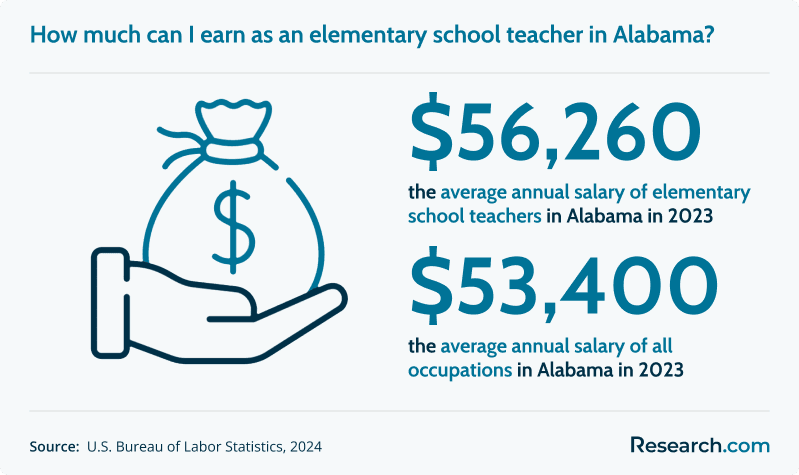
Salary should be part of the decision, but it should not be treated as guaranteed. In 2023, elementary school teachers in Alabama earned about $56,260 on average, with pay varying by district, experience, credentials, and location.
What types of specializations are available within elementary education in Alabama?
Specializations can help elementary teachers serve specific student populations, qualify for additional roles, or build a stronger long-term career path. They are especially useful when they match district needs and your teaching strengths.
- Special education: This focus prepares teachers to support students with disabilities and varied learning needs. Because approximately 14% of students in the U.S. receive special education services, training in inclusive instruction can be valuable in many classrooms.
- Early childhood education: This area focuses on children from birth to age eight and emphasizes developmentally appropriate instruction, early literacy, play-based learning, and family engagement.
- Reading and literacy: Literacy specialization helps teachers diagnose reading difficulties, support foundational reading skills, and strengthen instruction across subjects.
- STEM education: A STEM focus can help elementary teachers design lessons in science, technology, engineering, and mathematics that build problem-solving and early analytical skills.
- ESL: English as a Second Language preparation helps teachers support students who are developing English proficiency while learning grade-level content.
| Specialization | Best for teachers who want to | Career value |
| Special education | Support students with individualized learning needs | Can expand eligibility for specialized teaching roles |
| Early childhood education | Work with younger learners and foundational development | Useful for transitions between preschool and early elementary settings |
| Reading and literacy | Improve reading outcomes and intervention strategies | Valuable for classroom instruction and literacy-focused roles |
| STEM education | Strengthen science, technology, engineering, and math instruction | Supports interdisciplinary lessons and technology-rich classrooms |
| ESL | Teach multilingual learners more effectively | Helpful in increasingly diverse classrooms |
Choose a specialization because it solves a real classroom or career need, not because it simply sounds impressive.
What career paths are available for elementary school teachers in Alabama?
An elementary education background can lead to classroom teaching and, with additional education or credentials, related roles in student support, curriculum, school leadership, and education content development.
- Elementary school teacher: The most direct role is teaching foundational subjects to children in elementary grades, including literacy, mathematics, science, and social studies.
- School librarian: Teachers with additional library science preparation can support reading development, research skills, and information literacy.
- Guidance counselor: With further counseling education, an elementary teacher can move into student academic, behavioral, and social-emotional support.
- Health educator: This path focuses on student wellness, nutrition, safety, and healthy decision-making, often in school or community settings.
- Instructional designer: Teachers with curriculum and technology skills can develop lessons, digital learning materials, and training resources.
- Education writer or editor: Strong communicators may create or revise textbooks, lesson plans, assessments, and other educational content.
In Alabama, elementary education teachers averaged about $56,260 in 2023. Advancement into specialized, leadership, or administrative roles may require graduate education, additional certification, or district-specific experience. If you need a flexible and lower-cost starting point, compare affordable online elementary education programs that align with your certification plans.
Some educators also compare elementary teaching with adjacent K-12 roles. Preschool teacher employment had the highest projected growth rate among the K-12 teaching roles cited here, at 7.7% from 2022 to 2032.
What other teaching careers are available in Alabama?
Elementary education is only one teaching pathway in Alabama. If you prefer older students or a specific subject area, you can compare requirements for roles such as middle school math, special education, ESL, STEM, art, private school teaching, or preschool education. For example, candidates with strong math skills can review how to become a middle school math teacher in Alabama to understand how certification and subject preparation differ from elementary education.
The right teaching path depends on the age group you want to serve, the subjects you enjoy, your tolerance for classroom structure, and the credentialing requirements you are willing to complete.
Can specializing in special education expand my career opportunities in Alabama?
Yes. Special education can broaden an elementary teacher’s career options because it prepares educators to work with students who need individualized supports, accommodations, and specialized instructional strategies. Teachers with this preparation may be better equipped to collaborate on individualized education programs, adapt lessons, manage behavior supports, and create inclusive classrooms.
If you are considering this route, review the steps in becoming a special education teacher in Alabama and compare the added requirements with your current certification plan.
Is elementary teacher compensation competitive compared to other career paths?
Elementary teaching in Alabama offers stable public-sector employment for many educators, but compensation should be evaluated realistically. Consider salary, benefits, retirement, contract length, district pay scales, professional development support, and long-term advancement options. The average Alabama elementary teacher salary cited in this guide is $56,260, while the overall average salary for all occupations in the state is $53,400.
If your decision is strongly salary-driven, compare teaching with other service-oriented fields, including addiction recovery career salary information, before committing to a degree or certification route.
How are state policy changes impacting elementary school teaching in Alabama?
State policy affects what elementary teachers teach, how students are assessed, how schools use technology, and how educators document professional growth. Prospective teachers should monitor Alabama curriculum standards, reading and literacy expectations, technology requirements, accountability measures, and certification rules.
Policy changes may also influence opportunities in specialized teaching areas. If you have creative or subject-specific interests, compare elementary education with related pathways such as becoming an art teacher in Alabama.
How can I manage stress and sustain resilience as an elementary teacher in Alabama?
Elementary teaching can be deeply meaningful, but it is also demanding. Teachers manage academic instruction, classroom behavior, family communication, student needs, paperwork, assessments, and district expectations. Resilience should be treated as a professional skill, not an afterthought.
- Build a weekly planning routine that protects time for lesson preparation and grading.
- Use mentor teachers, grade-level teams, and instructional coaches instead of solving every problem alone.
- Document behavior and academic concerns early so support teams can intervene.
- Set communication boundaries with families while remaining responsive and professional.
- Use professional development to improve classroom management, assessment design, and instructional efficiency.
Teachers who want to move toward leadership, training, or higher education roles may also explore graduate options such as the best online higher education master’s degree programs, depending on their career goals.
How can interdisciplinary collaboration enhance classroom outcomes in Alabama?
Elementary teachers rarely work in isolation. Strong outcomes often depend on collaboration with reading specialists, special education teachers, speech-language pathologists, counselors, interventionists, administrators, and families. This teamwork helps identify student needs earlier and align support across the school day.
For example, understanding the work of speech-language professionals can help classroom teachers support language development and communication goals. Candidates interested in that related field can review how to become a speech-language pathologist in Alabama.
How can I transition my elementary teaching skills toward early childhood education?
Elementary teachers who enjoy working with younger children may find early childhood education a natural adjacent path. The transition usually requires stronger focus on early development, play-based instruction, family engagement, foundational literacy, and age-appropriate assessment.
Before switching, compare certification requirements, age ranges, classroom expectations, and pay structures. A practical starting point is reviewing how to become a preschool teacher in Alabama.
How do public and private elementary teaching careers differ in Alabama?
Public and private elementary teaching jobs can differ in licensure expectations, curriculum flexibility, benefits, class size, administrative structure, and accountability systems. Public schools generally follow state certification and renewal requirements, while private schools may set their own hiring criteria. However, private school flexibility does not always mean higher pay or stronger benefits.
| Factor | Public elementary schools | Private elementary schools |
| Licensure | Typically requires state certification | Requirements may vary by school |
| Curriculum | Aligned with state standards and district expectations | May allow more school-specific curriculum choices |
| Benefits | Often tied to public-sector benefits and retirement systems | Can vary widely by institution |
| Work environment | May include larger systems, formal policies, and district support | May include smaller communities and more institutional autonomy |
If you are interested in the private sector, review how to become a private school teacher in Alabama before assuming the requirements are the same as public school teaching.
What is the cheapest way to get a teaching credential in Alabama?
The lowest-cost route depends on what you already have. A first-time student should compare in-state public programs, transfer pathways, scholarships, and online options. A bachelor’s degree holder may save time and tuition by using an approved alternative certification route instead of earning a second bachelor’s degree.
- Start at a lower-cost institution if credits transfer cleanly into an approved teacher preparation program.
- Choose a program that leads directly to Alabama certification to avoid paying for extra coursework later.
- Ask about scholarships, grants, district partnerships, and teacher shortage incentives.
- Compare online and campus costs using total cost, not tuition alone.
- Budget for exams, background checks, and certification fees early.
For a deeper cost-focused comparison, use the guide to the cheapest way to get a teaching credential in Alabama.
Could diversifying into additional subject endorsements boost my teaching career in Alabama?
Additional endorsements can make an elementary teacher more flexible, especially in districts that need support across subject areas, intervention programs, STEM initiatives, or specialized instruction. However, endorsements require time, exams, coursework, or additional approval, so they should be chosen strategically.
If you are drawn to advanced math instruction or secondary teaching, compare your current path with high school math teacher qualifications in Alabama. The requirements and classroom experience differ significantly from elementary education.
What are the teaching certificate requirements for elementary educators in Alabama?
Alabama elementary educators must satisfy a state-defined certification process that generally includes a qualifying degree, approved educator preparation, field experience, required exams, background clearance, application submission, and ongoing renewal. Candidates should also understand certificate levels, renewal rules, and any alternative pathways that apply to their situation.
Because certificate rules can affect employment eligibility, review Alabama teaching certificate types and requirements before choosing a preparation program or alternative certification route.
How does parental and community engagement impact classroom success in Alabama?
Elementary teachers work more effectively when families and communities are active partners. Parent communication helps teachers understand student needs, reinforce learning at home, address attendance or behavior concerns, and celebrate progress. Community partnerships can also support tutoring, enrichment, mentoring, and school events.
For career planning, family engagement is also a reminder that teaching is not limited to lesson delivery. Teachers need communication, empathy, cultural awareness, organization, and problem-solving skills. If you are still mapping out your timeline, review how long it takes to become a teacher in Alabama.
What is the job market for elementary school teachers in Alabama?
The Alabama elementary teacher job market is steady rather than fast-growing. The main opportunity comes from ongoing openings created by retirements, turnover, transfers, and district hiring needs.
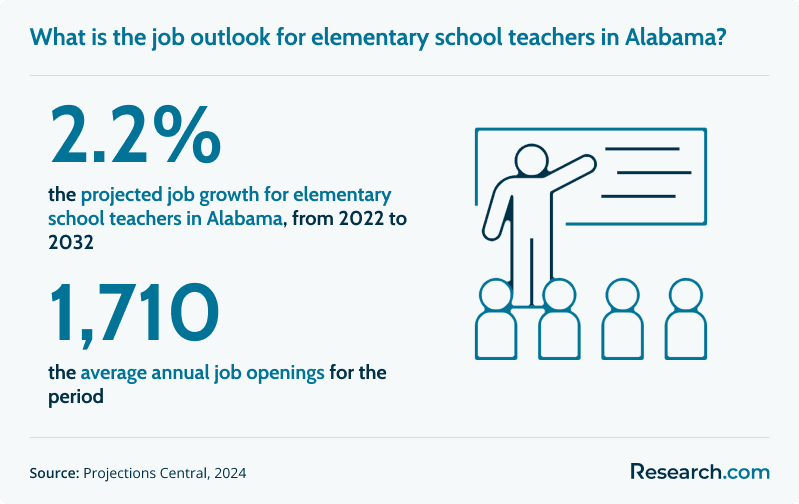
- Projected growth: Elementary teacher employment in Alabama is projected to grow 2.2% from 2022 to 2032.
- Annual openings: That projection represents about 1,710 new job openings per year.
- Average salary: Alabama elementary school teachers earned around $56,260 on average, compared with $53,400 for all occupations in the state.
- Location differences: Cities such as Birmingham, Huntsville, and Montgomery may offer more district options, professional development access, and specialized programs, although cost of living and competition can differ.
New teachers should apply broadly, prepare for district-specific interview processes, and consider whether they are willing to work in rural, suburban, or urban schools. Teachers interested in future administrative or leadership roles can also explore online doctoral options in educational leadership.
What is it like to teach in rural vs. urban schools in Alabama?
Rural and urban elementary schools in Alabama can offer very different teaching experiences. Neither setting is automatically easier or better. The right fit depends on your personality, support needs, teaching style, and career priorities.
| Factor | Rural schools | Urban schools |
| Community | Often smaller and more close-knit, with strong family and local ties | Often larger and more diverse, with broader student backgrounds |
| Resources | May have fewer specialists, programs, or extracurricular options | May have more specialized services, technology, and district resources |
| Teacher role | Teachers may take on multiple responsibilities beyond classroom instruction | Teachers may collaborate with larger teams and specialized support staff |
| Challenges | Geographic isolation, staffing shortages, and limited support services can be concerns | Larger class sizes, higher turnover, and performance pressures can be concerns |
| Best fit | Teachers who value community connection and adaptability | Teachers who enjoy diversity, pace, and access to broader systems of support |
A flexible graduate program such as an online master’s in teaching can help working teachers build skills for different school environments while continuing to work.
Why should you continue your education as an elementary teacher in Alabama
Continuing education matters because it supports license renewal, improves classroom practice, and can open pathways into specialization or leadership. In Alabama, teachers must renew their licenses every five years and complete 50 hours of professional development, so learning remains part of the profession after initial certification.
- Master’s degree options: Graduate study can deepen skills in literacy, curriculum, special education, assessment, or leadership. It may also support career movement into roles such as curriculum coordinator or administrator, depending on additional requirements.
- License renewal: Professional development helps teachers keep pace with instructional technology, classroom strategies, state standards, and student support practices.
- Online degree flexibility: Teachers who need to balance school, work, and family responsibilities may consider accredited online pathways, including a bachelor of education online when appropriate for their stage of training.
- Specialized credentials: ESL, STEM, literacy, early childhood, and special education credentials can strengthen your professional profile when they align with district needs.
What professional development opportunities are available for elementary teachers in Alabama?
Alabama elementary teachers can meet professional development needs through state, district, university, association, and online learning options. The best choices are practical, documented, and connected to your classroom responsibilities or career goals.
- Alabama State Department of Education resources: State-level training may address certification, curriculum expectations, instructional practice, and compliance topics.
- District in-service training: Local districts often provide professional learning days tied to school improvement goals, assessment data, classroom management, and technology tools.
- Workshops and conferences: Professional events can help teachers learn new instructional strategies and connect with peers across Alabama.
- National Board Certification: Advanced certification can deepen teaching practice and may support career advancement depending on district policies.
- Graduate coursework: Master’s, specialist, and doctoral programs can support specialization, leadership, or long-term professional growth.
- Professional associations: Groups such as the Alabama Education Association offer networking, advocacy, and professional learning opportunities.
If you are at the beginning of the process, start with a full overview of how to become a teacher in Alabama so you can connect professional development decisions to licensure and career goals.
Common mistakes to avoid when becoming an elementary teacher in Alabama
| Mistake | Why it can hurt you | Better approach |
| Choosing a program without checking Alabama licensure alignment | You may earn credits or a degree that does not qualify you for certification | Ask for written confirmation that the program leads to Alabama elementary certification |
| Comparing only tuition | Fees, books, exams, background checks, travel, and housing can change total cost | Build a full cost estimate before enrolling |
| Assuming online means fully remote | Student teaching and fieldwork still happen in person | Confirm placement requirements and local school partnerships |
| Waiting too long to prepare for exams | Failed or delayed exams can postpone certification and hiring | Plan exam dates early and use program test-prep resources |
| Ignoring renewal requirements | Missed professional development can create renewal problems | Track professional development hours throughout the five-year renewal cycle |
| Assuming salary outcomes are guaranteed | Pay varies by district, location, experience, and credentials | Review district salary schedules and benefits before accepting a role |
Key Insights
- Alabama elementary teachers generally need a bachelor’s degree, an approved educator preparation program, student teaching, required exams, and state certification.
- The full pathway can take about five to seven years for first-time college students, while candidates who already hold a bachelor’s degree may complete the licensure process in about 12 to 18 months depending on their route.
- Online programs can work, but only if they are accredited, approved for Alabama certification, and include required in-person field experience.
- Alabama elementary teacher employment is projected to grow 2.2% from 2022 to 2032, with about 1,710 openings per year.
- The cited average salary for Alabama elementary teachers is $56,260, which is above the state’s all-occupation average of $53,400, but individual pay depends on district, experience, credentials, and location.
- Do not choose a program based only on convenience or tuition. Verify licensure alignment, field placement support, exam preparation, total cost, and graduate outcomes.
- Specializations such as special education, literacy, ESL, STEM, and early childhood education can improve classroom effectiveness and may expand career options.
- Professional development is not optional in Alabama. Teachers must renew every five years and complete 50 hours of professional development.
Related Articles for Nearby States
- 2027 How to Become an Elementary School Teacher in Mississippi: Requirements & Certification
- 2027 How to Become an Elementary School Teacher in Tennessee: Requirements & Certification
- 2027 How to Become an Elementary School Teacher in Georgia: Requirements & Certification
- 2027 How to Become an Elementary School Teacher in Florida: Requirements & Certification
- 2027 How to Become an Elementary School Teacher in Louisiana: Requirements & Certification
- 2027 How to Become an Elementary School Teacher in Arkansas: Requirements & Certifications
- 2027 How to Become an Elementary School Teacher in Kentucky: Requirements & Certification
- 2027 How to Become an Elementary School Teacher in South Carolina: Requirements & Certification
- 2027 How to Become an Elementary School Teacher in North Carolina: Requirements & Certification
- 2027 How to Become an Elementary School Teacher in Missouri: Requirements & Certification
References:
- alabamaachieves.org (10 Feb 2021). Certificate renewal. alabamaachieves.org
- alleducationschools.com (26 Dec 2017). Learn how to earn teacher certification in Alabama. alleducationschools.com
- online.ua.edu (12 Aug 2020). Educational Specialist (EdS) in Elementary Education. online.ua.edu
- friends.edu (13 Apr 2020). Professions for elementary education. friends.edu
- bls.gov (17 Apr 2024). Kindergarten and elementary school teachers. bls.gov
Other Things You Should Know About Becoming an Elementary School Teacher in Alabama
Applicants for Alabama elementary teacher certification must complete a fingerprint-based criminal history background check through the Alabama State Department of Education and the FBI. The results are used to determine eligibility before certification is issued. Schools may also require additional local clearance before placement or employment.
To become an elementary school teacher in Alabama in 2027, candidates must pass the Praxis Core Academic Skills for Educators tests and the Praxis Subject Assessments specific to elementary education. These exams assess fundamental skills and specific teaching knowledge required for certification.


