Research.com is an editorially independent organization with a carefully engineered commission system that’s both transparent and fair. Our primary source of income stems from collaborating with affiliates who compensate us for advertising their services on our site, and we earn a referral fee when prospective clients decided to use those services. We ensure that no affiliates can influence our content or school rankings with their compensations. We also work together with Google AdSense which provides us with a base of revenue that runs independently from our affiliate partnerships. It’s important to us that you understand which content is sponsored and which isn’t, so we’ve implemented clear advertising disclosures throughout our site. Our intention is to make sure you never feel misled, and always know exactly what you’re viewing on our platform. We also maintain a steadfast editorial independence despite operating as a for-profit website. Our core objective is to provide accurate, unbiased, and comprehensive guides and resources to assist our readers in making informed decisions.

2026 How to Get Into SLP Grad School: Requirements & Acceptance Rate

Imed Bouchrika, PhD

by Imed Bouchrika, PhD

Co-Founder and Chief Data Scientist

What can you expect in an SLP graduate program?

A graduate program in speech-language pathology combines communication science, clinical reasoning, supervised practice, and professional ethics. Students study how typical communication and swallowing develop, how disorders are assessed, and how evidence-based intervention plans are selected for different ages and diagnoses.

Common coursework includes articulation and phonology, fluency, voice, child language, adult language disorders, motor speech disorders, dysphagia, augmentative and alternative communication, audiology, speech science, research methods, counseling, and clinical documentation. Programs also emphasize ethical decision-making, cultural responsiveness, interprofessional collaboration, and preparation for certification or licensure requirements.

The clinical practicum is one of the most important parts of the degree. Under supervision, students gradually move from observation to direct service delivery in settings such as schools, clinics, hospitals, rehabilitation facilities, or community programs. This is where students learn to assess clients, write goals, collect data, communicate with families and care teams, and adjust treatment based on progress.

Program componentWhat it usually includesWhy it matters for applicants
Academic courseworkCommunication development, disorders, assessment, treatment, research, ethics, and clinical methodsAdmissions committees look for evidence that you can manage graduate-level science and clinical coursework.
Prerequisite preparationFoundational courses such as phonetics, speech and hearing anatomy, language development, and audiologyNon-CSD applicants often need leveling coursework before full graduate enrollment.
Observation hoursTypically at least 25 hours under a certified SLPThese hours show that you understand the profession beyond the classroom.
Clinical practicumSupervised direct service in approved settingsClinical placement capacity can limit how many students a program can admit.
Professional preparationDocumentation, collaboration, ethics, certification planning, and licensure awarenessApplicants should choose programs that align with their intended state and career setting.

Where can SLP graduates work?

SLP graduates can pursue roles in many environments because communication and swallowing needs appear across age groups and medical, educational, and community settings. In schools, SLPs support students with speech sound disorders, language disorders, social communication needs, fluency disorders, and other communication challenges that may affect learning.

In hospitals and rehabilitation facilities, SLPs may work with patients recovering from stroke, traumatic brain injury, neurological disease, surgery, or conditions affecting swallowing and communication. Private practices may offer pediatric therapy, adult therapy, specialized evaluations, voice services, fluency treatment, or family-centered intervention.

Other employment settings include skilled nursing facilities, long-term care, early intervention programs, home health, universities, research organizations, and government agencies. The best setting for you depends on your tolerance for medical complexity, school-based caseloads, documentation demands, schedule preferences, and desired client population.

How much can SLP graduates earn?

SLP salary depends heavily on location, setting, experience, employer funding, and specialization. Another salary figure cited for speech-language pathologists is approximately $95,410 as of May 2024 according to the Bureau of Labor Statistics. Other reported ranges place the lowest 10 percent around $57,910 annually and the highest 10 percent above $129,930 per year.

Work setting can make a meaningful difference. SLPs in nursing and residential care facilities or hospitals often report higher average salaries than those in some educational settings, but schools may offer different benefits, calendars, and long-term stability. Applicants should compare total compensation, workload, caseload expectations, supervision quality, and cost of living rather than focusing on salary alone.

Table of Contents
  1. SLP grad school admission requirements
  2. Step-by-step application planRequirements checklist
  3. Applying without a CSD major
  4. GPA expectations for SLP programs
  5. Observation hours and clinical experience
  6. Average SLP grad school acceptance rates
  7. How many students top programs admit
  8. Affordable online SLP master’s programs
  9. Moving from teaching into SLP
  10. Checking SLP program accreditation
  11. Online versus campus acceptance rates
  12. Prerequisites for non-CSD applicants
  13. How long prerequisites take
  14. States with strong SLP employment opportunitiesPrerequisite timeline reminder

What are the requirements to get into an SLP graduate program?

Most SLP graduate programs require a completed bachelor’s degree, preferably in communication sciences and disorders or a closely related field. However, a CSD degree is not the only route. In 2023, 71% of speech-language pathology assistants have a bachelor’s degree, which reflects how common bachelor’s-level preparation is in related support roles.

Applicants without a CSD background usually need prerequisite coursework before they can begin graduate-level SLP classes. Common prerequisites include phonetics, speech and hearing anatomy and physiology, language development, audiology, and speech science. Programs also commonly review cumulative GPA, prerequisite GPA, letters of recommendation, a resume, a personal statement, and observation or volunteer experience. Many schools expect a GPA of at least 3.0, while highly competitive programs often prefer GPAs above 3.5.

Some programs still request GRE scores, but others have made the test optional or removed it. Because policies differ, applicants should verify each program’s current requirements before applying. Many SLP schools use CSDCAS, the centralized application system for communication sciences and disorders programs, which allows applicants to submit materials to multiple schools through one platform.

RequirementWhat programs are usually evaluatingHow to strengthen this part of your application
Bachelor’s degreeAcademic foundation and degree completionExplain how your undergraduate background connects to communication, learning, health, development, or service.
Prerequisite coursesReadiness for graduate SLP courseworkComplete required courses before applying when possible, and earn strong grades in science-heavy classes.
GPAConsistency, academic discipline, and ability to handle rigorHighlight upward grade trends, strong prerequisite grades, or additional coursework if your cumulative GPA is weaker.
Observation hoursExposure to real SLP workObserve multiple settings if possible and reflect on what you learned in your statement.
RecommendationsProfessionalism, communication, academic ability, and clinical potentialAsk faculty, supervisors, or SLPs who can write specific examples rather than generic praise.
Personal statementMotivation, fit, maturity, and understanding of the fieldUse concrete experiences to show why SLP is the right path and why the program fits your goals.

How do you get into a speech-language pathology grad school program?

Speech therapy is often discussed among the therapy fields with strong earning potential, but admission requires planning well before the application deadline. A strong application is built in layers: academic preparation, field exposure, thoughtful school selection, and polished materials.

  1. Finish a bachelor’s degree. A CSD major gives you the most direct preparation, but applicants from education, psychology, linguistics, biology, health sciences, and other fields can still apply if they complete prerequisites.
  2. Map each program’s prerequisites. Do not assume all schools require the same courses. Create a spreadsheet listing required classes, minimum grades, deadlines, GRE policy, observation-hour rules, and whether leveling coursework is accepted.
  3. Complete core foundational courses. Common requirements include phonetics, speech and hearing anatomy, language development, audiology, speech science, and introductory communication disorders.
  4. Secure observation hours early. Many applicants aim for at least 25 supervised hours because this aligns with ASHA-related expectations and many program policies.
  5. Choose a balanced school list. Include programs that match your GPA, prerequisite record, location needs, delivery format, cost limits, and career interests. Do not apply only to the most selective programs.
  6. Prepare application materials before deadlines. Request transcripts, confirm recommendation writers, update your resume, and draft your personal statement early enough to revise.
  7. Use CSDCAS carefully if required. Enter coursework accurately, monitor transcript verification, and submit early enough to avoid last-minute processing issues.
  8. Prepare for interviews. If a program interviews applicants, be ready to discuss ethical scenarios, teamwork, cultural responsiveness, clinical interests, and why you understand the realities of SLP work.
  9. Apply with a clear narrative. Admissions committees should be able to see why you chose SLP, what experiences informed that decision, and why you are prepared for graduate training.
How many clinical hours do grad students need to acquire?

Do you need a CSD major to apply to speech-language pathology grad school?

No. A communication sciences and disorders major can make the path simpler, but it is not always required. Many SLP graduate programs consider applicants from other academic backgrounds if they complete the required prerequisite or leveling courses before beginning graduate clinical coursework.

Non-CSD applicants often come from psychology, education, linguistics, biology, health sciences, social sciences, or humanities. Even students who completed an online philosophy degree with affordable tuition options can build a viable SLP pathway if they complete the necessary communication sciences, anatomy, phonetics, and audiology preparation.

The trade-off is time and cost. A non-CSD applicant may need a post-baccalaureate or leveling program before being fully eligible for an SLP master’s program. Depending on course load and program structure, this can extend the path by 1–2 years. That does not make the route impractical, but it does mean applicants should budget carefully and confirm which prerequisites each target school accepts.

A non-CSD background can also be an advantage when framed well. Teaching experience, bilingual skills, research work, healthcare exposure, child development experience, or disability services experience may help an applicant show maturity and commitment. In 2023, 79% of SLPs said there were more job openings than job seekers, which points to strong demand for qualified professionals.

Applicant backgroundMain advantageMain challengeBest next step
CSD majorLikely completed many prerequisites alreadyStill needs a competitive GPA, observation, and strong application materialsConfirm each program’s specific prerequisite and observation requirements.
Education or teachingExperience with students, IEPs, communication needs, and familiesMay need speech science, audiology, phonetics, and anatomy courseworkLook for leveling programs designed for career changers.
Psychology or linguisticsRelevant foundation in behavior, development, language, or cognitionMay lack anatomy, audiology, and clinical observation exposureComplete missing science and CSD prerequisites before applying.
Healthcare or biologyComfort with anatomy, medical terminology, and patient care conceptsMay need language development, phonetics, and communication disorders coursesGain observation hours in both medical and school-based SLP settings if possible.

What GPA do you need for speech pathology grad school?

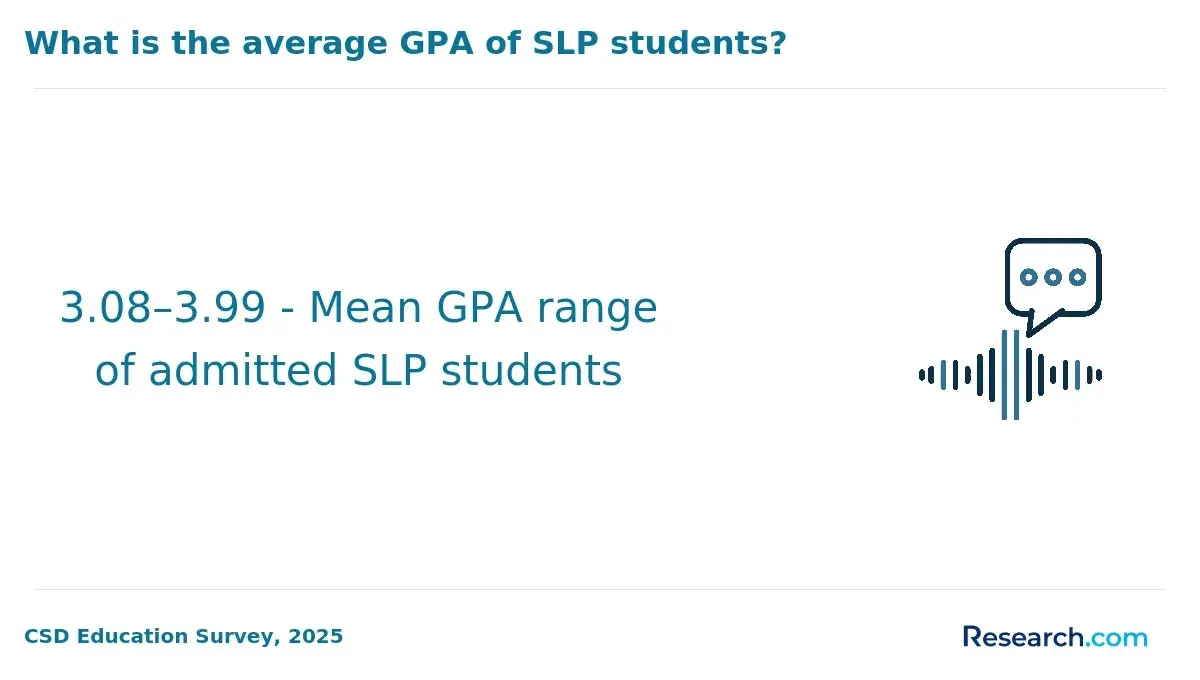
Most SLP graduate programs list a minimum GPA of 3.0, but the admitted-student profile at competitive schools is often higher. Applicants with GPAs of 3.5 or above are generally better positioned at selective programs, especially when their prerequisite grades are also strong.

Admissions committees usually consider more than one GPA number. They may evaluate cumulative GPA, major GPA, prerequisite GPA, recent coursework, and whether your grades improved over time. A lower first-year undergraduate GPA may be less damaging if later coursework shows strong academic growth, especially in relevant science, language, or communication courses.

Demand for speech-language pathologists is closely tied to the complexity of services they provide. In 2023, the four primary school-based intervention areas were autism spectrum disorder (94%), language disorders involving semantics, morphology, and syntax (90%), speech sound disorders (89%), and language disorders related to pragmatics and social communication (87%). These areas require careful assessment, documentation, and evidence-based intervention, which is why programs look closely at academic readiness.

If your GPA is below 3.5, you are not automatically out of consideration. You can improve your profile with strong prerequisite grades, persuasive recommendations, relevant experience, research exposure, a focused personal statement, and strong GRE scores if a program still requires them. Applicants comparing graduate entrance tests in other fields may find it useful to understand the differences between the GRE and GMAT, although SLP programs that request standardized tests generally refer to the GRE.

The chart below summarizes the school-based intervention areas most frequently reported by SLPs in 2023, showing why graduate programs prioritize applicants who can manage both academic and clinical complexity.

Do SLP grad schools require observation hours or clinical experience?

Most SLP graduate programs either require or strongly prefer observation hours before enrollment, and the commonly cited benchmark is at least 25 hours under the supervision of a certified speech-language pathologist. These hours help applicants understand the profession before committing to a demanding graduate program.

Observation is not the same as independent clinical work. Applicants usually watch a certified SLP provide services, ask appropriate questions, and document what they observed according to program instructions. Some programs require hours to be completed before applying, while others allow students to finish them before clinical practicum begins.

Additional experience can strengthen your application even if it is not formally required. Examples include volunteering in a clinic, working as a paraprofessional, assisting in a special education setting, participating in communication disorders research, supporting adults in rehabilitation settings, or shadowing professionals in multiple environments. Applicants considering related doctoral or mental health study options, such as online psychology doctorate programs, should note that SLP preparation is specifically tied to communication and swallowing practice standards.

Experience typeHow admissions committees may view itHow to use it in your application
Certified SLP observationDirect exposure to the field and professional expectationsDiscuss specific insights about assessment, therapy, documentation, and client interaction.
School volunteering or paraprofessional workRelevant experience with children, communication needs, and educational teamsConnect the experience to collaboration, family communication, and individualized support.
Healthcare volunteeringFamiliarity with patients, teams, and clinical environmentsShow comfort with professionalism, confidentiality, and service delivery.
Research assistanceEvidence of analytical thinking and interest in evidence-based practiceExplain your role, methods used, and what the research taught you about communication or learning.

What is the average acceptance rate for SLP grad school?

The average acceptance rate for SLP graduate programs in the United States is around 30% to 40%, although the range varies significantly by school. Highly selective programs may admit only 10% to 20% of applicants, particularly when they are well known, located in desirable areas, or limited by clinical placement capacity.

Acceptance rates can be misleading if viewed in isolation. A program with a lower acceptance rate is not automatically better, and a program with a higher acceptance rate is not necessarily easier if it has strict prerequisite, GPA, interview, or clinical placement requirements. Program size, number of applicants, rolling admissions policies, location, online format, and faculty-supervisor availability all affect selectivity.

Applicants interested in the quickest route into helping professions may compare SLP with other options, including the fastest paths to becoming a counselor or therapist. For SLP specifically, the strongest strategy is to apply broadly, meet prerequisites exactly, submit early, and tailor each statement to the program rather than sending the same generic essay everywhere.

Application strategyWhy it helpsRisk if ignored
Apply to a balanced mix of programsIncreases your chances across competitive, moderate, and fit-focused optionsApplying only to top-ranked schools can lead to no offers even with a strong profile.
Verify prerequisite rules school by schoolPrevents avoidable disqualificationA missing course can make an otherwise strong application incomplete.
Submit earlyAllows time for transcript verification and recommendation issuesLast-minute errors can cause missed deadlines.
Write a specific personal statementShows fit, maturity, and informed motivationGeneric essays make it harder for committees to remember you.
The average acceptance rate for SLP graduate programs

How many applicants are typically accepted into top SLP programs?

Top SLP programs commonly enroll small cohorts, often accepting about 20 to 60 students per year depending on program size, clinical resources, faculty availability, and delivery format. A competitive program may receive 300 to 500 applications and admit only 10% to 20% of applicants.

Small cohorts are not just about exclusivity. SLP programs need enough qualified supervisors, clinical sites, simulation resources, and faculty support to train students responsibly. Because clinical education is hands-on, programs cannot always expand enrollment even when demand is high.

This is why qualified applicants should avoid building a school list entirely around prestige. A program with strong accreditation status, reliable clinical placement support, and good fit for your goals may be a better choice than a famous program that does not match your needs. Some applicants also compare SLP with related helping professions, such as the path to becoming a rehabilitation counselor, before committing to the SLP graduate route.

Are affordable online SLP master’s programs a smart investment?

Affordable online SLP master’s programs can be a smart investment when they are accredited, transparent about clinical placement expectations, and aligned with your licensure goals. The lowest tuition is not always the best value if the program offers limited placement support, requires expensive travel, or does not match the state where you plan to practice.

When comparing the most affordable online master’s programs in speech pathology, look beyond advertised tuition. Review total fees, technology costs, campus visit requirements, clinical placement policies, graduation expectations, faculty access, and whether the program’s structure fits your work schedule. Affordability matters, but it should not come at the expense of accreditation or clinical preparation.

FactorWhat to check before enrollingWhy it affects ROI
AccreditationConfirm program recognition through the appropriate accrediting bodyAccreditation can affect certification, licensure, and employer acceptance.
Clinical placement supportAsk whether the school finds placements or expects students to secure themWeak placement support can delay graduation or increase stress.
Total program costInclude tuition, fees, travel, books, technology, and lost work timeThe cheapest advertised tuition may not reflect the full cost.
State licensure alignmentConfirm whether the program meets requirements in your intended stateLicensure problems can limit where you can work after graduation.
Schedule formatCheck synchronous class times, practicum demands, and residency requirementsA flexible program still needs to fit your weekly availability.

Can teaching experience help you transition into SLP?

Teaching experience can be a strong foundation for SLP graduate school because teachers often understand child development, classroom communication, family collaboration, progress monitoring, and individualized support. These strengths can make a career-change application more convincing when the applicant clearly explains why SLP is the next step.

However, teaching experience does not replace required SLP prerequisites. Career changers still need courses such as phonetics, speech and hearing anatomy, audiology, speech science, and communication development or disorders. Teachers considering this transition can review guidance on moving from teaching into an SLP career to understand how their existing skills may transfer and where additional academic preparation is required.

How can you verify whether an SLP program is accredited?

Accreditation is one of the most important checks before applying to an SLP master’s program. It signals that the program has been evaluated against established standards for curriculum, faculty qualifications, clinical education, student outcomes, and professional preparation.

Before applying, verify accreditation directly through official program materials and recognized accrediting sources. Do not rely only on marketing language, rankings, or third-party summaries. A program’s accreditation status can affect eligibility for certification, state licensure, clinical placements, and employer confidence. Research.com’s guide to ASHA-accredited online and on-campus SLP programs can help you understand what to look for when comparing options.

Do online SLP programs have higher acceptance rates?

Online SLP programs may have slightly higher acceptance rates in some cases, but applicants should not assume online means easier. Accredited online programs must still meet clinical education standards, and enrollment may be limited by faculty capacity, practicum supervision, and the availability of approved clinical sites.

Online programs are attractive because they can serve students outside a campus area, including working adults and applicants in remote regions. That flexibility can also increase competition because applicants from many states may apply to the same program. Like affordable online physics degree programs, online SLP options appeal to students who need flexibility, but the academic expectations remain serious.

The real advantage of online SLP education is access, not guaranteed admission. Applicants should still present strong grades, complete prerequisites, secure observation hours, and show they understand the demands of clinical training. They should also ask how placements are arranged in their area, whether travel is required, and whether the program meets licensure expectations where they plan to work.

Some SLPs eventually use telepractice or hybrid service models, and professionals interested in remote care may also explore what it takes to build a career in online therapy. Still, SLP licensure, supervision, client privacy, and state practice rules remain important considerations. The chart below highlights top-paying industries for SLPs using national employment and wage data.

What prerequisite courses do non-CSD majors need for SLP grad school?

Applicants without a communication sciences and disorders background usually need leveling or post-baccalaureate coursework before entering an SLP master’s program. In 2023, among SLPs employed fulltime or part-time, 90% were clinical service providers, which underscores how directly graduate preparation connects to clinical practice.

Common prerequisites for non-CSD applicants include foundational courses in communication sciences and disorders. Exact requirements differ by program, but many schools ask for coursework such as:

  • Anatomy and physiology of the speech and hearing mechanism
  • Phonetics
  • Speech and language development
  • Introduction to audiology
  • Speech science or hearing science
  • Neural bases of communication, neuroanatomy, or neurology for SLP
  • Introduction to communication disorders

Students coming from education-related backgrounds, including those exploring whether they can earn a teaching degree online, often already understand child learning and classroom communication. They still typically need the CSD-specific courses that prepare them for graduate assessment and intervention training.

Many programs also require or recommend statistics, biology, physical science such as physics or chemistry, and social or behavioral science coursework to meet certification-related standards. Because course titles and credit requirements vary, applicants should compare syllabi and confirm equivalencies with each target program before paying for prerequisites.

Share of clinical service providers among SLPs in 2023

How long does it take to complete SLP prerequisites with a different bachelor’s degree?

If your bachelor’s degree is not in CSD, completing SLP prerequisites usually takes one to two years. The exact timeline depends on how many courses you are missing, whether you study full-time or part-time, whether courses are offered every term, and whether your target programs accept online or transfer prerequisite credits.

Many prerequisite sequences include 8 to 10 core courses in areas such as phonetics, language development, audiology, speech science, speech and hearing anatomy, and communication disorders. Some accelerated post-bachelor’s leveling programs may be completed in as little as 9 to 12 months, while other formats take 18 to 24 months, especially for students balancing work, caregiving, or part-time study.

Timeline optionTypical fitImportant trade-off
9 to 12 monthsStudents who can study intensively and meet course sequencing requirementsFaster completion may require a heavier workload and less flexibility.
1 to 2 yearsCareer changers completing 8 to 10 core courses while preparing applicationsMore manageable pacing, but it delays graduate enrollment.
18 to 24 monthsWorking adults or students taking prerequisites part-timeLower weekly load, but longer total timeline and potential added cost.

Which states offer the best employment opportunities for SLP graduates?

Employment opportunities for SLP graduates vary by state because demand, licensure rules, school staffing needs, healthcare systems, salaries, and cost of living differ by region. A high salary in one state may not mean stronger purchasing power if housing and living expenses are also high.

Before choosing where to practice, compare state licensure requirements, expected work settings, pay ranges, school or medical job availability, and whether you prefer urban, suburban, rural, or telepractice opportunities. Research.com’s guide to the highest-paying states for speech-language pathologists can help you evaluate geographic salary differences alongside broader career considerations.

Current trends affecting SLP grad school applicants

  • Clinical placement capacity remains a major admissions constraint. Even programs with strong applicant demand cannot admit unlimited students because supervised practicum sites and qualified supervisors are limited.
  • Online and hybrid programs are expanding access. More applicants are considering distance formats, but accredited online programs still require rigorous coursework and in-person clinical training.
  • Telepractice skills are increasingly relevant. SLPs may use remote service delivery in some settings, but students must still understand privacy, documentation, state rules, and client suitability.
  • AI tools are changing documentation and study habits. Students may use technology for organization, literature searching, or drafting support, but clinical judgment, ethical documentation, human interaction, and evidence-based decision-making remain essential.
  • Career changers are a visible applicant group. Teachers, healthcare workers, linguistics graduates, psychology majors, and bilingual professionals may bring useful experience, but they must still complete SLP-specific prerequisites.

Common mistakes to avoid when applying to SLP grad school

MistakeWhy it can hurt youBetter approach
Choosing programs based only on rankingsA highly ranked program may not fit your budget, location, schedule, clinical interests, or state licensure needs.Compare accreditation, clinical placements, cost, faculty fit, delivery format, and licensure alignment.
Assuming all online programs are easier to enterOnline programs may attract large applicant pools and still have strict clinical capacity limits.Treat online and campus applications with the same level of preparation.
Ignoring accreditationAccreditation problems can affect certification, licensure, and employer acceptance.Verify status through official sources before applying or enrolling.
Focusing only on tuitionFees, travel, clinical placement expenses, technology, and lost income can change the true cost.Calculate total cost of attendance and compare it with realistic career plans.
Submitting a generic personal statementPrograms may not see why you are prepared or why you fit their mission.Use specific experiences, clear motivation, and program-specific details.
Waiting too long to request recommendationsRushed letters are often less detailed and may miss deadlines.Ask early and provide your resume, goals, deadlines, and program list.
Assuming prerequisites transfer automaticallyCourse titles may not meet a program’s content or credit expectations.Confirm equivalencies before enrolling in prerequisite classes.

Questions to ask before choosing an SLP graduate program

  • Is the program properly accredited for my certification and licensure goals?
  • Does the program meet requirements in the state where I plan to practice?
  • Who is responsible for finding clinical placements: the school, the student, or both?
  • How many campus visits, intensives, or residency requirements are required for online students?
  • What is the total cost after tuition, fees, travel, technology, books, and clinical expenses?
  • What populations and settings are available for clinical training?
  • How does the program support students who need remediation, advising, or placement help?
  • Does the program’s schedule work with my job, caregiving responsibilities, or relocation plans?
  • What are the program’s expectations for interviews, GRE scores, prerequisite grades, and observation hours?
  • How strong is the fit between the faculty’s expertise and my career interests?

What SLP graduates say about grad school

  • Graduate school pushed me academically and clinically. Managing coursework while learning to work with clients taught me how to connect theory to real treatment decisions, and seeing progress during practicum made the demanding schedule feel worthwhile. Samantha
  • My SLP program gave me the foundation to serve many different populations, from young children to adults recovering from neurological injuries. Faculty mentorship and supervised practice were the parts that most shaped my confidence. Marcus
  • I started the program unsure which area of SLP would fit me best. Courses in voice, AAC, child language, and motor speech helped me discover my interest in pediatric therapy while building a broader clinical base. Lena

Key Insights

  • SLP graduate admission is competitive because programs must balance applicant demand with faculty, supervision, and clinical placement capacity.
  • Most programs require a minimum GPA of 3.0, but applicants with GPAs of 3.5 or higher are often stronger candidates for competitive programs.
  • Applicants usually need at least 25 supervised observation hours, and additional relevant experience can help show commitment to the profession.
  • Non-CSD majors can apply, but they often need 1 to 2 years of prerequisite or leveling coursework before beginning graduate clinical training.
  • Top SLP programs commonly accept 20 to 60 students per year, and highly competitive programs may admit only 10% to 20% of applicants.
  • The average SLP grad school acceptance rate is around 30% to 40%, but acceptance rates should be interpreted alongside accreditation, cost, clinical placement support, and licensure alignment.
  • Online SLP programs offer flexibility, not guaranteed easier admission. Accredited programs still require rigorous coursework and in-person clinical training.
  • In 2023, 79% of SLPs reported more job openings than job seekers, and 90% of employed full-time or part-time SLPs were clinical service providers.
  • The best application strategy is to apply to a balanced school list, complete prerequisites carefully, document meaningful observation, submit early, and write a personal statement that shows informed motivation and program fit.

References:

Other Things You Should Know About Getting Into SLP Grad School

What are the key elements of applying to an SLP grad school in 2026?

To apply to an SLP grad school in 2026, focus on maintaining a strong GPA, gaining relevant experience, and crafting a compelling personal statement. Additionally, research each program’s prerequisites and tailor your application to highlight your suitability for their specific requirements.

How can aspiring SLP students make their grad school application stand out in 2026?

To make an SLP grad school application stand out in 2026, emphasize relevant clinical and research experiences, strong letters of recommendation, and a compelling personal statement. Also, showcase a commitment to community service or leadership roles related to communication sciences.

What GPA is competitive for speech-language pathology programs?

A competitive GPA for speech-language pathology programs is typically 3.5 or higher. While many schools have a minimum requirement of 3.0, top programs often admit students with GPAs well above that threshold. A strong GPA in major-specific or prerequisite courses can also help offset a lower overall GPA.

What is the worst aspect to focus on when applying to SLP grad school in 2026?

Focusing solely on academic metrics is less effective for SLP grad school applications in 2026. Programs increasingly value diverse experiences, such as clinical exposure and volunteer work, highlighting well-rounded candidates over purely academic ones.

Related Articles
2026 Best Online Schools for Fine Arts thumbnail
Universities & Colleges JUN 22, 2026

2026 Best Online Schools for Fine Arts

by Imed Bouchrika, PhD
2026 Criminology vs. Criminal Justice: Explaining the Difference thumbnail
Education MAY 19, 2026

2026 Criminology vs. Criminal Justice: Explaining the Difference

by Imed Bouchrika, PhD
2026 Accounting Schools in California – How to Become a CPA in CA thumbnail
Education JUN 22, 2026

2026 Accounting Schools in California – How to Become a CPA in CA

by Imed Bouchrika, PhD
2026 Accounting Schools in New York – How to Become a CPA in NY thumbnail
Education JUN 22, 2026

2026 Accounting Schools in New York – How to Become a CPA in NY

by Imed Bouchrika, PhD
2026 Fastest Online Master's in Engineering Management Programs thumbnail
Education APR 23, 2026

2026 Fastest Online Master's in Engineering Management Programs

by Imed Bouchrika, PhD
2026 Information Security vs. Cybersecurity: Explaining the Difference thumbnail
Education MAY 19, 2026

2026 Information Security vs. Cybersecurity: Explaining the Difference

by Imed Bouchrika, PhD

Newsletter & Conference Alerts

Research.com uses the information to contact you about our relevant content.
For more information, check out our privacy policy.

Newsletter confirmation

Thank you for subscribing!

Confirmation email sent. Please click the link in the email to confirm your subscription.