2027 How To Become A Marriage Counselor

Co-Founder and Chief Data Scientist
Becoming a marriage counselor is a licensure-based career decision, not simply a choice to “help couples.” You need graduate education, supervised clinical training, state approval, and the emotional stamina to work with people during conflict, betrayal, grief, parenting stress, financial strain, and major life transitions. This guide explains what marriage counselors do, how to qualify for the profession, what licenses and credentials matter, how much marriage and family therapists earn, and how to decide whether this path fits your goals for 2027.
Marriage counseling can be meaningful work for people who want a clinical mental health career centered on relationships and family systems. Reported outcomes vary by source and client situation, but some data cited in the field suggest a success rate of around 70%, and around 75% of married couples reported improved relationship satisfaction after working with a counselor. These figures should not be read as guarantees; therapy results depend on timing, client commitment, counselor training, presenting issues, and whether safety concerns such as abuse are present.
Quick answer: How do you become a marriage counselor?
To become a marriage counselor, you typically earn a bachelor’s degree, complete a master’s degree in marriage and family therapy or a closely related counseling field, finish supervised clinical hours required by your state, pass a licensing exam, and apply for state licensure. Most candidates complete 2,000 to 4,000 supervised clinical hours after graduate school before they can practice independently as licensed marriage and family therapists.
Key Things You Should Know About Becoming a Marriage Counselor for 2027
- Marriage counselors help individuals, couples, and families address relationship distress, communication breakdowns, conflict patterns, intimacy issues, parenting disagreements, and major transitions.
- The most common majors of MFTs in the United States are psychology (39%), family therapy (18%), counseling psychology (9%), and clinical psychology (5%).
- Graduate education is usually required for independent practice, and supervised clinical experience commonly ranges from 2,000 to 4,000 hours.
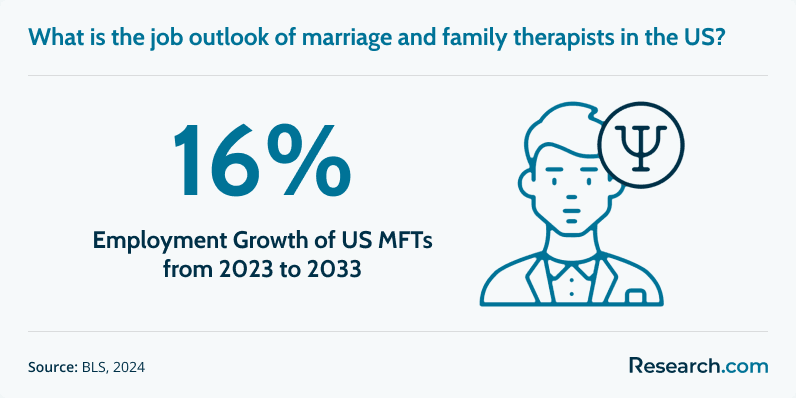
- The employment of marriage and family therapists is projected to grow by 16% from 2023 to 2033.
- The average annual salary of marriage and family therapists in the United States is $68,730.
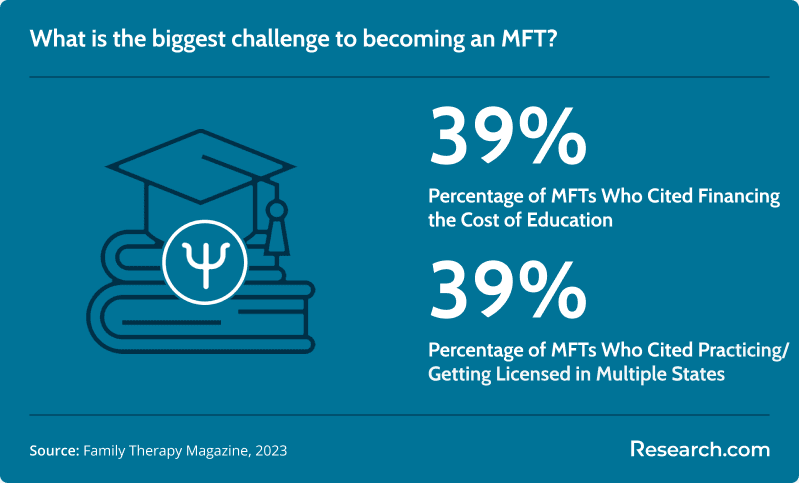
- The biggest reported obstacles to becoming a licensed MFT were financing education costs (39%) and practicing or obtaining licensure across multiple states (39%).
- What does a marriage counselor do?
- How do you become a marriage counselor?
- What education do marriage counselors need?
- What licensing rules apply to marriage counselors?
- What skills help marriage counselors succeed?
- Which marriage counseling specializations are common?
- What ethical and legal rules should counselors understand?
- How can marriage counselors build a private practice?
- What continuing education options are useful?
- How does pay compare with other mental health roles?
- Can a doctoral degree support career advancement?
- What trends are changing marriage counseling?
- How can marriage counselors reduce burnout risk?
- How can child psychology knowledge strengthen marriage counseling?
- Which certifications are useful for marriage counselors?
- Can interdisciplinary training improve counseling practice?
- What is the job outlook for marriage counselors?
- How much do marriage counselors earn?
- What challenges should future marriage counselors expect?
- How do marriage counselors handle insurance and billing?
- Are online psychology degrees useful for marriage counseling careers?
What does a marriage counselor do?
A marriage counselor, often licensed as a marriage and family therapist, provides therapy for couples, families, and individuals whose mental health concerns are connected to relationship systems. If you are comparing counseling paths and wondering which counseling degree fits your goals, marriage and family therapy is the route most focused on couple dynamics, family roles, communication patterns, and relational change.
Marriage counselors do not simply give relationship advice. They assess clinical concerns, identify patterns that keep couples stuck, help clients practice new behaviors, document treatment, manage risk, and follow ethical and legal standards. Their work may include premarital counseling, therapy after infidelity, co-parenting support, divorce adjustment, trauma-informed relationship work, and referrals when clients need medical, psychiatric, legal, or safety resources.
| Core responsibility | What it looks like in practice | Why it matters |
| Relationship assessment | Exploring conflict cycles, attachment patterns, communication habits, stressors, mental health symptoms, and family history. | Good treatment starts with understanding the pattern, not just the latest argument. |
| Communication coaching | Teaching clients to listen, speak clearly, de-escalate conflict, and discuss difficult topics without contempt or shutdown. | Many couples need structured practice, not another debate about who is right. |
| Therapeutic intervention | Using approaches such as Cognitive Behavioral Therapy (CBT), Emotionally Focused Therapy (EFT), or the Gottman Method when appropriate. | Evidence-informed methods give sessions more structure than casual advice. |
| Support for specific issues | Addressing infidelity, intimacy concerns, parenting conflict, finances, blended family adjustment, grief, trauma, or addiction-related stress. | Couples often enter therapy because one urgent issue exposes deeper patterns. |
| Risk management | Screening for abuse, self-harm, coercion, child safety concerns, and other situations that may require mandated reporting or referral. | Client safety takes priority over relationship preservation. |
| Documentation and care coordination | Maintaining records, treatment plans, progress notes, referrals, billing information, and consent documentation. | Clinical care must meet professional, legal, and insurance standards. |
Telehealth has also changed how marriage and family therapists deliver care. As shown below, 29% of MFTs see patients entirely through telehealth, while only 5% provide care entirely in person. This makes technology skills, privacy practices, and online rapport-building increasingly important for new counselors.
How does one become a marriage counselor?
The path to becoming a marriage counselor is structured because independent practice involves clinical responsibility. The exact sequence depends on your state, but most future marriage counselors follow the same broad timeline.
- Earn an undergraduate degree. A bachelor’s degree in psychology, social work, counseling, sociology, human services, nursing, or family studies can prepare you for graduate training. Students interested in family systems may also compare options such as a human development and family studies online degree.
- Review graduate admission requirements early. Some programs may require the GRE, prerequisite coursework, recommendation letters, volunteer experience, or a personal statement explaining your clinical goals.
- Complete a relevant master’s degree. Most future MFTs pursue a master’s in Marriage and Family Therapy or a closely related counseling field. Programs commonly include 48 to 60 credit hours plus practicum or internship training. If cost is a major concern, compare affordable MFT programs before applying.
- Accumulate supervised post-graduate hours. After graduation, candidates usually complete 2,000 to 4,000 supervised clinical hours, depending on the state.
- Pass the licensing exam required by your state. Many jurisdictions use the Marriage and Family Therapist National Examination, and some also require state law or ethics exams.
- Apply to the state licensing board. You will generally submit transcripts, supervised hour verification, exam results, application forms, fees, and background check materials.
- Choose a practice setting. Marriage counselors may work in clinics, hospitals, agencies, schools, community organizations, religious organizations, government offices, or private practice.
- Maintain the license. Licensed professionals usually complete continuing education and renew their credentials on a recurring schedule set by the state.
The overall timeline is similar to related counseling careers. Students comparing licensing paths can also review how long it takes to become a licensed mental health counselor.
| Stage | Main goal | Decision point |
| Bachelor’s degree | Build a foundation in human behavior, development, communication, research, and social systems. | Choose a major that keeps graduate school options open. |
| Graduate program | Learn family systems theory, ethics, assessment, diagnosis, and therapy techniques. | Check accreditation, practicum structure, licensure alignment, and total cost. |
| Supervised clinical experience | Develop competence with real clients under licensed supervision. | Confirm your supervisor and work setting meet state board rules. |
| Licensing exam and application | Demonstrate professional knowledge and meet legal requirements for practice. | Use your state board’s checklist rather than relying only on school marketing. |
| Early career practice | Gain experience, refine your specialty, and build a professional reputation. | Decide whether agency, healthcare, school, government, nonprofit, or private practice work fits best. |
What are the education requirements to become a marriage counselor?
Marriage counseling careers usually require graduate-level clinical education. The fastest way to become a therapist may involve accelerated coursework or transfer-friendly pathways, but students should not sacrifice accreditation, supervised training quality, or state licensure alignment just to finish faster.
Bachelor’s degree
A bachelor’s degree from an accredited institution is the starting point. Common undergraduate majors include:
- Psychology
- Social Work
- Sociology
- Counseling
- Nursing
- Interdisciplinary Social Sciences
Students exploring psychology-related routes can compare the different types of psychology degrees and jobs before committing to a major. According to Zippia, the most common majors of MFTs in the United States are psychology (39%), family therapy (18%), counseling psychology (9%), and clinical psychology (5%).
Master’s degree
A master’s degree in Marriage and Family Therapy or a closely related mental health field is the standard academic requirement for licensure. Students can choose campus-based programs or online MFT programs, but the key question is not format alone. The program must prepare you for the licensing rules in the state where you plan to practice.
Graduate programs typically include 48 to 60 credit hours of coursework in areas such as family systems, ethics, diagnosis, assessment, multicultural counseling, research, human development, and therapeutic methods. Many also require a practicum or internship with at least 250 hours of supervised clinical practice.
Accreditation matters. A program accredited by the Commission on Accreditation for Marriage and Family Therapy Education (COAMFTE), or one that clearly meets your state board’s requirements, can reduce the risk of discovering after graduation that you lack required coursework or clinical hours. Students trying to control tuition can also compare accredited low-cost counseling options, including the cheapest online master’s in counseling programs.
Doctoral degree
A doctorate is not usually required to become licensed as a marriage counselor. However, a Ph.D., Psy.D., or advanced clinical doctorate may be useful for professionals who want to teach, conduct research, supervise clinicians, move into leadership, or develop advanced specialization.
Supervised clinical experience
After formal education, aspiring marriage counselors must complete supervised clinical practice. Requirements typically range from 2,000 to 4,000 hours. During this period, candidates learn to manage complex cases, document care, apply ethical standards, and receive feedback from an approved supervisor.
| Education option | When it makes sense | Limitations to check |
| Bachelor’s in psychology, social work, sociology, counseling, nursing, or social sciences | You want broad preparation for graduate counseling study. | A bachelor’s degree alone generally does not qualify you for independent marriage counseling practice. |
| Master’s in Marriage and Family Therapy | You want the most direct academic route toward MFT licensure. | State-specific coursework, practicum, and hour requirements still apply. |
| Master’s in counseling, psychology, or social work | You want a related clinical route with possible flexibility across roles. | Additional coursework may be needed if your state has specific MFT education rules. |
| Doctoral degree | You want advanced clinical expertise, teaching, supervision, research, or leadership opportunities. | It can add time and cost and is not usually necessary for entry into licensed practice. |
What are the licensing requirements to become a marriage counselor?
Marriage counselor licensing is controlled by state boards, so you should treat your state’s official requirements as the final authority. In most cases, candidates need a master’s degree in Marriage and Family Therapy or a related mental health field, supervised clinical experience, a passing licensing exam score, and a complete application. Students comparing adjacent graduate options may also look at accelerated clinical social work routes such as the fastest online MSW programs, but social work and MFT licensure are not interchangeable.
Graduate programs often include 48 to 60 credit hours of coursework and a supervised clinical practice component of 300 to 500 hours. After graduation, candidates generally complete 2,000 to 4,000 hours of supervised clinical experience under a licensed professional. This stage often lasts 1.5 to 2.5 years and is where new clinicians learn to translate classroom knowledge into safe, effective client care.
After supervised experience, candidates usually take a licensing exam, commonly the National Marriage and Family Therapy Examination. Some states may also require exams or training in ethics, jurisprudence, child abuse reporting, or state-specific professional rules. For example, New York requires additional coursework on identifying and reporting child abuse.
| Licensing component | What to verify | Common mistake |
| Graduate degree | Whether the program meets your state’s MFT coursework and practicum rules. | Assuming any counseling or psychology master’s degree automatically qualifies. |
| Accreditation | Whether the program is COAMFTE-accredited or otherwise accepted by your licensing board. | Choosing a low-cost program without confirming licensure eligibility. |
| Supervised hours | The number of hours, supervision ratio, client contact rules, and approved supervisor requirements. | Starting a job before confirming that the hours will count. |
| Exams | Which national, state law, ethics, or jurisprudence exams are required. | Waiting until the end of supervision to learn about additional exam requirements. |
| Portability | Whether your license can transfer or qualify for reciprocity in another state. | Planning to move without checking multi-state licensing barriers. |
What are the skills needed to succeed as a marriage counselor?
Marriage counselors need more than compassion. They must be able to listen closely, manage intense emotion, think clinically, document carefully, and intervene without taking sides. The best counselors balance warmth with structure.
- Active listening: Hearing what clients say, noticing what they avoid, and tracking nonverbal cues that reveal fear, withdrawal, anger, or shame.
- Empathy: Validating each client’s experience without automatically agreeing with harmful behavior.
- Clinical communication: Explaining difficult concepts clearly and guiding tense conversations without escalating conflict.
- Assessment and critical thinking: Identifying patterns, risk factors, mental health symptoms, and treatment priorities.
- Conflict resolution: Helping clients slow down arguments, name needs, repair harm, and negotiate realistic changes.
- Cultural competence: Understanding how culture, religion, gender, sexuality, language, family expectations, and social context shape relationships.
- Ethical judgment: Protecting confidentiality, handling dual relationships, managing mandated reporting, and recognizing when referral is needed.
- Emotional regulation: Staying grounded when clients are angry, grieving, defensive, or in crisis.
- Patience: Accepting that relational change often happens unevenly and may require repeated practice.
- Business and documentation skills: Managing records, scheduling, billing, insurance, policies, and professional boundaries.
What are the most popular specializations for marriage counselors?
Specialization helps marriage counselors serve specific client needs and build a clearer professional identity. As with a fast track psychology degree, the right specialization depends on your goals, client population, and required training.
| Specialization | Focus | Best fit for counselors who want to work with... |
| Couples therapy | Communication, conflict, emotional distance, trust, and relationship repair. | Partners seeking to improve or decide the future of their relationship. |
| Premarital counseling | Expectations, finances, values, family roles, conflict style, and future planning. | Engaged or committed couples preparing for marriage. |
| Divorce counseling | Separation, grief, co-parenting, transition planning, and emotional adjustment. | Couples or individuals navigating the end of a relationship. |
| Infidelity counseling | Betrayal trauma, accountability, trust rebuilding, disclosure, and decision-making. | Couples deciding whether and how to repair after an affair. |
| Family therapy | Parenting conflict, adolescent behavior, family communication, and role changes. | Families whose relationship stress involves more than the couple. |
| Sex therapy | Desire differences, sexual communication, intimacy concerns, and sexual functioning. | Clients who need specialized, sensitive support around sexuality. |
| LGBTQ+ counseling | Affirming care, identity, family acceptance, minority stress, and relationship dynamics. | LGBTQ+ individuals, couples, and families seeking culturally responsive therapy. |
| Addiction-informed couples counseling | The relational effects of substance use, gambling, relapse, recovery, and trust repair. | Couples affected by addiction-related patterns. |
| Grief counseling | Loss, mourning, life restructuring, and how grief changes couple and family roles. | Individuals and couples coping with death or other major losses. |
| Parenting and co-parenting counseling | Discipline, parenting stress, co-parenting conflict, and children’s behavioral concerns. | Parents whose relationship strain is tied to caregiving roles. |
What are the legal and ethical guidelines for marriage counselors?
Marriage counselors work with sensitive information and emotionally charged situations, so legal and ethical competence is essential. Core responsibilities include informed consent, confidentiality, secure recordkeeping, appropriate boundaries, mandated reporting, accurate documentation, emergency planning, and careful handling of sessions involving multiple family members. Counselors should also understand when couple therapy may be inappropriate, such as when coercive control or violence makes joint sessions unsafe. Students who want a broader view of related behavioral health roles can review how to become a behavioral health therapist.
How can marriage counselors establish a thriving private practice?
Private practice requires clinical competence and business discipline. A counselor must choose a niche, understand local regulations, secure malpractice insurance, create intake and consent forms, set fees, decide whether to accept insurance, build referral relationships, manage scheduling, and maintain ethical marketing. A website, professional directory profiles, community partnerships, and relationships with physicians, schools, clergy, attorneys, and other therapists can help generate referrals. Counselors comparing career routes can also examine the fastest way to become a counselor, while remembering that speed should not replace licensure readiness or supervised experience quality.
What continuing education opportunities are available for marriage counselors?
Continuing education helps marriage counselors maintain licensure and keep their practice current. Useful topics include ethics, telehealth, trauma-informed care, domestic violence screening, culturally responsive practice, sex therapy, addiction, grief, child and adolescent development, documentation, and evidence-based couple therapy models. Some clinicians also add behavioral intervention knowledge through related fields; for example, online ABA programs may interest professionals who work with behavior change, parenting challenges, or developmental concerns.
How does compensation compare between marriage counselors and other mental health professionals?
Pay varies across mental health careers because each role has different licensing rules, employment settings, reimbursement patterns, and client populations. Marriage and family therapists have one salary profile, while behavior analysis, counseling, psychology, social work, and psychiatric roles may follow different compensation paths. Professionals comparing behavioral analysis credentials can review BCBA salary by state to understand how specialty, state, and setting can affect earnings.
Should marriage counselors consider an online doctoral degree for career advancement?
A doctoral degree is optional for most marriage counselors, but it may be worthwhile for clinicians who want advanced specialization, academic work, research, supervision, program leadership, or a stronger professional niche. Online doctoral study can be practical for working professionals, but applicants should examine accreditation, faculty qualifications, clinical requirements, dissertation expectations, residency requirements, and total cost. Counselors considering psychology doctoral pathways can compare accredited PsyD programs online.
What emerging trends are shaping marriage counseling practice?
Several trends are changing how marriage counselors work. Telehealth has expanded access and changed expectations for scheduling and privacy. Clients increasingly expect culturally responsive care, trauma-informed practice, and practical skills they can use between sessions. Digital tools may support screening, scheduling, reminders, and outcome tracking, while AI-assisted assessments may influence how clinicians organize information. However, technology does not replace clinical judgment, informed consent, confidentiality, or crisis management. Counselors who want advanced training while managing cost can compare options such as the cheapest PsyD programs, while verifying that any program supports their professional goals.
How can marriage counselors prevent burnout and sustain career longevity?
Marriage counseling can be emotionally heavy because sessions often involve conflict, grief, betrayal, trauma, and stalled change. Burnout prevention starts with realistic caseloads, regular supervision or consultation, clear boundaries, time off, peer support, continuing education, and a referral network for high-risk or highly specialized cases. Advanced study, including a PhD in psychology online, may help some clinicians deepen expertise, but education alone does not prevent burnout. Sustainable practice requires workload management and consistent self-care.
How can insights from child psychology improve marriage counseling?
Many couple conflicts are connected to parenting, child development, discipline, school concerns, custody arrangements, or stress around caregiving. Marriage counselors who understand child development can better help parents separate marital tension from parenting decisions, recognize age-appropriate behavior, and reduce conflict that affects children. Professionals who want to explore this area further can review child psychology careers.
What are the best certifications to pursue for marriage counselors?
Licensure is the essential credential for independent practice, while certifications and professional designations can strengthen a counselor’s niche. Not every certification is necessary. Choose credentials that match your client population, treatment model, and state rules.
| Credential or certification | Purpose | Best for |
| Licensed Marriage and Family Therapist (LMFT) | The primary license for independent marriage and family therapy practice in many states. | Clinicians who want to practice as marriage and family therapists. |
| National Certified Counselor (NCC) | A voluntary counseling credential that may support professional credibility. | Counselors who meet NBCC requirements and want an additional national credential. |
| Gottman Method Certification | Training in a structured, research-based approach to couples therapy. | Clinicians who want a recognizable couple therapy model. |
| AAMFT Clinical Fellow | A professional designation recognizing advanced MFT training and experience. | MFTs who want affiliation with a major professional organization. |
| Certified Emotionally Focused Therapist (EFT) | Specialized training in attachment-based couples therapy. | Counselors focused on emotional bonding and relationship repair. |
| Addiction counseling certification | Additional preparation for substance use and behavioral addiction concerns. | Therapists serving couples affected by addiction and recovery issues. |
| Trauma-informed care certification | Training in how trauma affects individuals, couples, and families. | Counselors working with betrayal, abuse histories, grief, or complex trauma. |
| Continuing education courses | Ongoing skill development required or encouraged for license renewal. | All licensed professionals who need to stay current and compliant. |
Can advanced interdisciplinary degrees boost a marriage counselor's expertise?
Interdisciplinary training can help marriage counselors work more effectively with complex families, developmental issues, behavior patterns, and co-occurring needs. For example, knowledge from ABA master’s programs may be useful for clinicians who collaborate with behavior analysts, support parents, or work with families navigating behavioral intervention plans. The value depends on whether the additional training aligns with your practice area, budget, and licensure goals.
What is the job outlook of marriage counselors?
According to the United States Bureau of Labor Statistics (BLS), employment of marriage and family therapists is projected to grow by 16% from 2023 to 2033. That is considerably larger than the national average of 4%. The number of MFTs is expected to rise from 76,000 in 2023 to about 88,200 by 2033.
During the same period, the country is projected to have around 7,500 job openings for MFTs each year. Growth may be supported by demand for mental health services, family-based treatment, integrated care, and telehealth access, but job availability still varies by state, employer type, insurance participation, and licensure status.
What is the average salary of marriage counselors?
BLS data show that marriage and family therapists in the United States earn an average annual salary of $68,730. The median annual salary is $58,510, which is higher than the national median annual wage of $48,060. These figures describe broad labor market earnings and should not be treated as a guaranteed salary for a new graduate.
The highest-paying states listed in the data are New Jersey ($92,120), Maryland ($87,090), Utah ($83,980), Virginia ($76,480), and Alaska ($74,420).
The highest-paying industries listed are home healthcare services ($122,120), elementary and secondary schools ($89,000), state government offices ($84,770), religious organizations ($81,600), and local government offices ($80,930).
| Salary factor | Why it matters |
| State | Licensing rules, cost of living, employer demand, and reimbursement rates can affect pay. |
| Work setting | Schools, government offices, home healthcare, community agencies, and private practices may pay differently. |
| Experience | Fully licensed clinicians often have more options than pre-licensed associates. |
| Specialization | Training in trauma, sex therapy, addiction, couples therapy models, or family systems may support niche positioning. |
| Business model | Private practice income depends on caseload, fees, insurance participation, overhead, cancellations, and referrals. |
What are the common challenges faced by marriage counselors?
An industry workforce survey from FTM Magazine found that the most significant challenges in becoming a licensed MFT were financing education costs (39%) and practicing or obtaining licensure across multiple states (39%).
When respondents were asked what would make licensure easier, the leading answers were greater portability and reciprocity between states (35%), streamlined and standardized requirements (21%), more financial assistance or reduced expenses (16%), a clearer understanding of the licensing process (12%), national licensing (12%), and increased supervision or mentorship opportunities (11%). These findings show why students should evaluate cost, state rules, and portability before enrolling.
| Challenge | What it means in practice | How to reduce the risk |
| Education cost | Graduate tuition, fees, books, supervision, exam fees, and unpaid practicum hours can add up. | Compare total program cost, transfer policies, scholarships, assistantships, and employer support. |
| Licensure portability | Moving states can create extra coursework, supervision, or exam requirements. | Check state boards before relocating or choosing an online program. |
| Ethical dilemmas | Couple and family therapy can involve conflicting client needs, abuse concerns, or confidentiality questions. | Use supervision, ethics consultation, clear policies, and mandated reporting guidance. |
| Insurance limitations | Managed care rules may limit sessions, require documentation, or affect reimbursement. | Learn billing requirements and set realistic client expectations. |
| Private practice administration | Scheduling, marketing, billing, records, taxes, and compliance can compete with clinical work. | Use practice management systems and seek business mentorship. |
| Burnout | Repeated exposure to conflict and trauma can affect a counselor’s wellbeing. | Limit caseload intensity, consult regularly, and protect nonclinical time. |
| Slow client progress | Couples may repeat patterns, resist change, or enter therapy late. | Set clear goals, measure progress, and revisit treatment fit when needed. |
Common mistakes aspiring marriage counselors should avoid
- Choosing a program before checking state licensure rules. Online and out-of-state programs can be useful, but only if they meet the requirements where you intend to practice.
- Looking only at tuition. Total cost includes fees, travel, residencies, supervision, exam costs, lost work time, and unpaid internship requirements.
- Assuming all counseling degrees lead to MFT licensure. Marriage and family therapy, clinical mental health counseling, psychology, and social work have different rules.
- Ignoring supervision quality. The supervision period is where many clinicians develop their professional identity and practical competence.
- Expecting salary data to predict your exact income. Earnings vary by location, setting, license level, caseload, and payer mix.
- Entering private practice too quickly without business preparation. Strong clinical skills do not automatically solve billing, marketing, documentation, and compliance demands.
How do marriage counselors manage insurance reimbursement and billing challenges?
Insurance billing can be one of the hardest nonclinical parts of counseling work. Marriage counselors must understand eligibility checks, diagnosis codes, documentation requirements, claim submission, denials, prior authorizations, reimbursement timelines, and payer contracts. Practice management software, billing consultation, accurate intake procedures, and clear financial policies can reduce administrative errors. Clinicians who want broader preparation in psychology and human behavior may explore an affordable online psychology degree, but billing competence usually requires targeted administrative training as well.
Are online psychology degrees a viable option for marriage counseling careers?
Online education can be a viable part of the route to marriage counseling if the program is properly accredited, clinically rigorous, and aligned with state licensure requirements. The main issue is not whether a course is online; it is whether the degree includes the right coursework, supervised experience, faculty support, practicum placement process, and board acceptance. Students should verify accreditation directly and can use resources on reputable psychology programs online to evaluate legitimacy and recognition.
Questions to ask before enrolling in a marriage counseling program
- Does this program meet the MFT licensure requirements in the state where I plan to practice?
- Is the program COAMFTE-accredited or otherwise accepted by my state board?
- How many practicum or internship hours are included, and who helps students find placements?
- What are the total tuition, fees, supervision-related costs, and residency or travel costs?
- What percentage of students complete the program and move into licensure-track roles?
- Does the program support online students with placement coordination, advising, exam preparation, and career services?
- Can credits transfer if I move, pause, or change programs?
- How does the curriculum prepare students for telehealth, ethics, documentation, trauma-informed care, and culturally responsive practice?
References:
- BLS (2024, April 3). 21-1013 Marriage and Family Therapists. BLS occupational employment data
- BLS (2024, August 29). Marriage and Family Therapists. BLS Occupational Outlook Handbook
- Counseling and Wellness Center of Pittsburgh (2024, January 7). The Marriage Counseling Success Rate: What The Data Shows. Counseling and Wellness Center of Pittsburgh
- Family Therapy Magazine (2023). Part 2: Marriage and Family Therapist Workforce Study 2022. Family Therapy Magazine
- Hancock, A. (2024, April 5). Does Marriage Counseling Really Work? Exploring Success Rates and Statistics. Wellness Counseling Center
- Zippia (2024, April 5). Marriage And Family Therapist Education Requirements. Zippia education requirements data
Key Insights
- Marriage counseling is a licensed clinical career focused on relationship systems, not informal advice-giving.
- The most direct route is a bachelor’s degree, a master’s in MFT or a related counseling field, 2,000 to 4,000 supervised hours, a licensing exam, and state board approval.
- Program choice should be based on accreditation, licensure alignment, practicum support, total cost, and state portability—not tuition or convenience alone.
- The field has strong projected growth, with employment of marriage and family therapists projected to grow by 16% from 2023 to 2033.
- The average annual salary is $68,730, but earnings depend heavily on state, setting, experience, specialization, and business model.
- Major career obstacles include education financing, state-to-state licensure barriers, insurance administration, emotional workload, and burnout risk.
- Online programs can work, but only when they meet clinical training and state licensing requirements.
- The best next step is to identify the state where you want to practice, read that board’s MFT requirements, and compare programs against that checklist before applying.
Other Things You Should Know About Becoming a Marriage Counselor
In 2027, obtaining licensure is vital for marriage counselors. Requirements vary by state but typically include a master's degree in counseling or a related field, supervised clinical experience, and passing a licensing exam. Being aware of specific state regulations will guide aspiring counselors in meeting these criteria.
To become a marriage counselor in 2027, you typically need a master's degree in psychology, counseling, or a related field. Additionally, obtaining state licensure, which includes completing supervised clinical hours and passing relevant exams, is essential for practice.
To become a marriage counselor in 2027, one should earn a relevant bachelor's degree, complete a master’s in marriage and family therapy or related field, gain supervised experience, and pass licensure exams. Time commitment varies, but typically takes 6-8 years including education and practical experience.