2027 Fastest Way to Become a Counselor in Indiana

Co-Founder and Chief Data Scientist
Becoming a counselor in Indiana is not a single-step decision. You need to choose the right counseling role, complete the required education, meet Indiana’s supervised experience rules, and avoid shortcuts that could delay licensure later. For many students and career changers, the real question is not simply “How do I become a counselor?” but “What is the fastest legitimate path that still leads to employability, licensure, and competent practice?”
This guide explains the practical routes into counseling in Indiana, including licensed mental health counseling, school counseling, substance abuse counseling, and bachelor’s-level behavioral health roles. You will learn which paths require a master’s degree, where accelerated or online programs may save time, what employers look for, how salaries vary, and when a fast-track option is worth the trade-off.
Quick answer: What is the fastest legitimate path to counseling licensure in Indiana?
The quickest route to becoming a licensed counselor in Indiana is to complete a qualifying 60-semester-hour master’s program, apply for Licensed Mental Health Counselor Associate status after graduation, begin supervised postgraduate practice immediately, complete 3,000 supervised clinical hours over two years, and pass the required counseling examinations. Bachelor’s-level jobs can get you into behavioral health sooner, but they do not replace the graduate education and supervised experience required for full independent clinical counseling licensure.
Key Benefits of Becoming a Counselor in Indiana
- Multiple entry points: Indiana offers roles for bachelor’s-prepared behavioral health workers as well as graduate-trained licensed counselors, making it possible to enter the field before reaching full licensure.
- Clear licensing milestones: The state’s pathway includes defined education, associate licensure, supervision, examination, and renewal requirements, which helps candidates plan their timeline.
- Strong purpose-driven work: Counselors support clients in schools, clinics, recovery programs, community agencies, and private practice settings.
- Salary potential with advancement: The average counselor salary in Indiana is approximately $71,734 annually, though earnings depend heavily on role, credentials, location, specialization, and experience.
- Need across communities: Demand is especially important in settings serving rural residents, students, people with substance use disorders, and clients with limited access to mental health care.
- Fastest path to licensed counseling in Indiana
- Counseling-related jobs with only a bachelor’s degree
- Accelerated counseling degree options in Indiana
- Online versus traditional counseling programs
- Challenges of fast-track counseling programs
- How Indiana employers evaluate fast-track candidates
- Cost considerations for fast-track and online programs
- Continuing education requirements in Indiana
- Career value of school counseling specialization
- Core licensing requirements for Indiana counselors
- Counseling versus social work education in Indiana
- Demand for counselors in Indiana
- Counselor salaries in Indiana
- Whether a fast route is worth it
What is the fastest way to become a licensed counselor in Indiana?
The fastest credible route is not the route with the fewest classes. It is the route that satisfies Indiana’s licensure rules the first time, allows you to start supervised practice quickly, and avoids administrative mistakes that can postpone approval. A student who chooses the wrong program, misses required coursework, or delays associate licensure may lose more time than someone in a slightly longer but better-aligned program.
| Step | What to complete | How to avoid delays |
| Graduate education | Earn a qualifying master’s degree in counseling or a related field with at least 60 semester hours from an accredited program. | Confirm before enrolling that the curriculum matches Indiana counseling licensure requirements. |
| Associate licensure | Apply for LMHCA status through Indiana’s MyLicenseOne portal after graduation. | Prepare transcripts, forms, and background check materials early so you can begin supervised work quickly. |
| Supervised experience | Complete 3,000 hours of postgraduate supervised clinical experience over two years. | Choose a job site that provides enough client contact and qualified supervision. |
| Supervision hours | Document at least 100 hours of individual supervision and 50 hours of group supervision under qualified supervisors. | Track hours continuously instead of reconstructing records at the end. |
| Examinations | Prepare for and complete the National Counselor Examination and the National Clinical Mental Health Counseling Examination. | Build exam preparation into your supervision period instead of waiting until the final stage. |
| Final documentation | Submit complete verification forms, supervision records, transcripts, and required state materials. | Review every form for signatures, dates, and consistency before submission. |
In practical terms, the fastest route usually looks like this: enroll in a licensure-aligned master’s program, use practicum and internship placements to build clinical confidence, apply for LMHCA status immediately after graduation, work full time in an approved setting, and maintain accurate supervision documentation from the first week of employment.
If you are still comparing long-term options, reviewing counseling career paths and salary information can help you decide whether licensed mental health counseling, school counseling, addiction counseling, or another counseling-related field fits your goals.
What counseling careers can you pursue in Indiana with only a bachelor’s degree?
A bachelor’s degree can help you enter behavioral health, human services, or recovery support work in Indiana, but it usually will not qualify you for independent clinical counseling practice. The distinction matters. Bachelor’s-level roles can provide client-facing experience, professional references, and exposure to crisis work, but graduate education is still necessary for many licensed counseling roles.
| Role | Typical work setting | What you may do | Best fit for |
| Substance abuse counselor or technician | Recovery centers, nonprofit treatment programs, residential programs | Support treatment plans, assist clients in recovery, document progress, and work under supervision. | Students interested in addiction counseling or recovery services. |
| Behavioral health technician | Hospitals, behavioral health facilities, community mental health agencies | Help clinical teams implement care plans, observe client behavior, and assist during crisis situations. | Applicants who want direct mental health experience before graduate school. |
| Case manager or wraparound facilitator | Social service agencies, youth programs, community organizations | Coordinate services, connect clients with resources, monitor needs, and communicate with providers. | People with degrees in psychology, social work, criminal justice, or related fields. |
These positions may not require a counseling master’s degree, but employers often look for supervised experience, strong documentation skills, trauma-informed communication, and relevant credentials. Certifications such as Certified Alcohol and Drug Abuse Counselor may improve competitiveness, especially for addiction-focused roles.
Bachelor’s-level work is often the smartest first step if you want to test whether counseling is right for you before committing to graduate school. It can also strengthen future applications by giving you real examples of client interaction, interdisciplinary teamwork, and ethical decision-making. To understand which therapy-related careers require graduate study, compare these roles with the broader education and licensing requirements for becoming a therapist.
The chart below compares lifetime earnings for mental and behavioral health professionals by education level, which can help you think beyond the first job and evaluate long-term return on education.
Are there accelerated counseling degree programs in Indiana?
Yes, but “accelerated” can mean different things. Some programs shorten the bachelor’s-to-master’s timeline, while others use year-round scheduling, heavier course loads, or continuous semesters to help students finish graduate requirements sooner. The key is to verify that speed does not come at the expense of licensure eligibility, practicum quality, or supervision readiness.
| Program option | Timeline or structure stated | Important considerations |
| Indiana University Bloomington | Accelerated Master’s Programs allow students to earn both a bachelor’s and a master’s degree within five years. | This route requires early planning during undergraduate study and sustained academic performance. Tuition varies by degree and residency. |
| University of Indianapolis | The Master of Arts in Mental Health Counseling is a 60-credit program that can be completed in as little as two years across five to six continuous semesters. | The curriculum is designed to meet Indiana licensure requirements. Graduate tuition is about $650 per credit hour, or near $39,000 for the full program. |
| Ball State University, Butler University, and Grace College | These schools offer CACREP-accredited programs, though clearly labeled accelerated options are less common. | Many counseling programs still require at least two years because clinical preparation, practicum, and internship cannot be rushed without consequences. |
When comparing accelerated programs, ask whether the program includes the required clinical training sequence, whether internship placements are available when you need them, whether courses are offered every term, and whether the school has a clear track record of preparing students for Indiana licensure.
Students should also compare the total cost of speed. A shorter program may reduce living expenses and time away from full-time work, but a heavy course load may limit your ability to earn income while enrolled. For a broader look at counseling degree types and how to evaluate fit, review this guide to different counseling degrees and affordability considerations.
Are online counseling programs in Indiana faster than traditional ones?
Online counseling programs can be faster for some students, but the format alone does not guarantee a shorter path to licensure. The main advantage is scheduling flexibility. If an online program offers year-round courses, asynchronous classes, and flexible enrollment, a motivated student may be able to move through didactic coursework more efficiently than in a campus program with fixed daytime schedules.
| Factor | Online counseling program | Campus counseling program |
| Scheduling | Often more compatible with work, caregiving, or evening study. | May require daytime attendance and commuting. |
| Pace | Can be faster if courses are offered continuously and prerequisites are sequenced well. | May follow fall and spring academic calendars with fewer year-round options. |
| Clinical training | Usually requires local practicum and internship placements, even if coursework is online. | May have established local placement relationships near campus. |
| Peer and faculty interaction | Depends heavily on program design, live sessions, supervision support, and cohort structure. | Often provides more routine in-person interaction. |
| Best for | Self-directed students who need flexibility and can manage placement requirements. | Students who want campus structure, face-to-face networking, and local faculty access. |
Before choosing an online option, confirm three things: the program meets Indiana licensure requirements, clinical placements are available in or near your community, and the school provides support for practicum and internship coordination. An online program that leaves you to find placements without guidance may not actually save time.
What challenges do fast-track counseling students face?
Accelerated counseling programs can be efficient, but they are demanding. Counseling is not only academic training; it requires self-awareness, ethical judgment, clinical skill development, and comfort with supervision. Compressing the timeline can make these developmental parts harder to absorb.
- Heavy academic workload: Shorter terms and continuous enrollment can make it difficult to process complex theories, diagnostic concepts, ethics, and treatment planning.
- Limited reflection time: Effective counselors need time to examine bias, communication patterns, emotional reactions, and professional identity. Acceleration can reduce that space.
- Practicum and internship pressure: Students still need at least 700 practicum and internship hours, and arranging these hours on a tight schedule can be stressful.
- Supervision quality concerns: A fast program is only useful if students receive meaningful feedback, not just enough hours to satisfy a requirement.
- Burnout risk: Balancing graduate coursework, clinical placements, paid work, and family responsibilities can become unsustainable without a realistic plan.
- Licensure paperwork mistakes: Students moving quickly may overlook forms, supervisor qualifications, examination timing, or state documentation rules.
A fast-track program works best for students who are organized, emotionally resilient, financially prepared, and able to prioritize clinical training. It may be a poor fit for students who need a slower pace to build confidence, maintain employment, or manage family obligations.
How do employers in Indiana view fast-track counselors?
Indiana employers generally care less about the label “fast-track” and more about whether the candidate is prepared, legally eligible to practice, well supervised, and safe with clients. A graduate from an accelerated program can be competitive if the program is accredited, clinically rigorous, and aligned with Indiana licensure expectations.
Employers may look closely at practicum quality, internship setting, supervisor evaluations, crisis experience, documentation ability, ethical judgment, and familiarity with the populations they serve. In high-acuity environments, such as community mental health, addiction treatment, and crisis response, hiring managers may be cautious if a candidate’s training appears too compressed or too theoretical.
However, fast-track students often bring strengths that employers value. Many are career changers from education, social services, healthcare, or criminal justice. That background can translate into strong communication, case coordination, classroom management, de-escalation, or community resource knowledge. The strongest candidates are those who can clearly explain not only how quickly they finished, but what they learned, where they trained, and how they respond to supervision.
Are fast-track and online counseling programs in Indiana more affordable?
They can be, but affordability depends on total cost, not tuition alone. A program with lower tuition may become expensive if it delays employment, requires relocation, offers limited financial aid, or makes it hard to complete internship hours. Likewise, a higher-cost program may be more practical if it allows you to keep working and finish on schedule.
| Cost factor | How fast-track or online programs may help | What to verify |
| Tuition and fees | Shorter enrollment may reduce the number of terms in which fees are charged. Some institutions keep the total cost under $30,000 for in-state students over two years. | Ask for a full program cost estimate, not just per-credit tuition. |
| Work income | Online evening or asynchronous classes may allow students to remain employed. | Confirm whether practicum and internship hours will conflict with your job schedule. |
| Commuting | Remote coursework can reduce transportation costs and time away from home. | Remember that clinical placements may still require in-person attendance. |
| Housing | Students in rural Indiana may avoid relocating near campus. | Check whether the program approves placements in your local area. |
| Financial aid | Some public universities extend in-state tuition and aid options to online or hybrid learners. | Ask whether your enrollment pace affects aid eligibility. |
The best affordability question is: “What will this program cost me by the time I am eligible to begin supervised clinical work?” Include tuition, fees, books, technology, transportation, lost wages, childcare, licensing fees, examination costs, and the financial effect of part-time versus full-time enrollment.
What are the continuing education requirements for counselors in Indiana?
Indiana counselors must complete continuing education during each license renewal cycle to maintain professional competence, stay informed about ethical standards, and keep up with changes in clinical practice. Approved CE activities may include workshops, courses, conferences, or specialized training related to counseling practice.
Continuing education is especially important for counselors who move into focused areas such as addiction treatment, trauma care, school-based services, or behavioral interventions. If you are considering an addiction-focused path, this overview of how to become a substance abuse counselor in Indiana can help you understand how specialization may affect training and career planning.
Keep detailed records of CE completion, including provider names, dates, topics, and certificates. Missing documentation can create problems during renewal even if you completed the training.
Is specializing in school counseling beneficial for your career?
School counseling can be a strong choice if you want to work with students, families, teachers, and administrators rather than primarily providing adult outpatient therapy. School counselors focus on academic planning, social-emotional support, college and career readiness, crisis response, and student advocacy.
This specialization may appeal to candidates who want a structured school-year environment, a clear student-centered mission, and opportunities to influence prevention and early intervention. It may be less ideal for someone whose primary goal is private practice psychotherapy with adults. For state-specific preparation details, review this guide on how to become a school counselor in Indiana.
What are the critical licensing requirements for counselors in Indiana?
Indiana counseling licensure generally requires a qualifying graduate degree, supervised clinical experience, examination, and ongoing renewal compliance. Candidates should pay close attention to whether their graduate program is CACREP-accredited or otherwise structured to meet the state’s coursework and clinical preparation expectations.
The main requirements to plan around include a 60-semester-hour master’s-level education, LMHCA application after graduation, 3,000 hours of postgraduate supervised clinical experience over two years, required supervision hours, counseling examinations, background checks, and continuing education after licensure. For a fuller state-specific breakdown, consult this resource on LPC license requirements in Indiana.
How do counselor and social work educational requirements differ in Indiana?
Counseling and social work both support mental health and human well-being, but their training models are not identical. Counseling programs tend to emphasize therapeutic methods, diagnosis, treatment planning, counseling theory, and supervised clinical practice. Social work programs often combine clinical skills with case management, policy, advocacy, community systems, and social service coordination.
| Path | Training emphasis | Common strengths | Consider this path if you want to... |
| Counseling | Therapy skills, counseling theory, ethics, assessment, and supervised clinical practice. | Individual, group, school, addiction, and mental health counseling preparation. | Focus primarily on counseling and psychotherapy-oriented roles. |
| Social work | Client support across individual, family, community, policy, and social service systems. | Case management, advocacy, systems navigation, and clinical or community practice. | Work across mental health, social services, healthcare, child welfare, or community programs. |
If you are unsure which route fits your goals, compare curricula, field placements, licensure outcomes, and the populations each profession serves. This guide to Indiana social worker educational requirements can help you evaluate the social work side of the decision.
Is there a demand for counselors in Indiana?
Indiana needs counselors across schools, community agencies, healthcare settings, recovery programs, and underserved areas. The need is shaped by mental health awareness, addiction treatment demand, student support needs, trauma-informed care, and access gaps in rural and low-income communities.
Demand does not mean every candidate will have the same opportunities. Employers still evaluate licensure status, clinical experience, specialization, geographic flexibility, and readiness to work with high-need populations. Candidates willing to work in community mental health, school-based counseling, addiction services, or underserved regions may find more openings than those seeking only a narrow private-practice path immediately after graduation.
Because licensure eligibility matters, prospective students should prioritize accredited programs that meet Indiana requirements. If cost is a major concern, compare CACREP accredited master’s programs that may offer recognized preparation while supporting affordability goals.
How much do counselors get paid in Indiana?
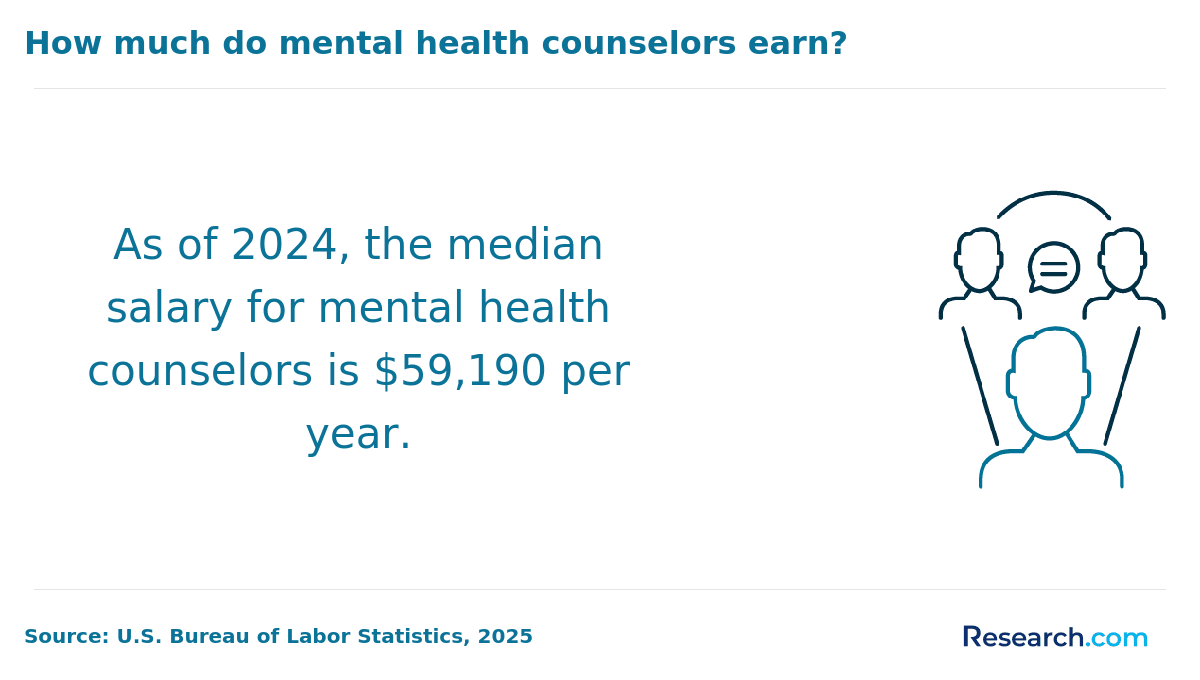
Counselor pay in Indiana varies by license level, specialty, employer type, location, and years of experience. The average counselor salary in Indiana is about $71,734 annually, with many salaries falling between $55,700 and $65,181. Those figures should be used as planning estimates, not promises of individual earnings.
| Counseling role or category | Salary information stated | What influences earnings |
| Licensed professional counselors | Average salaries span from $63,302 up to $76,691, with some positions reaching $90,000. | Licensure, specialization, private practice, high-demand regions, and experience. |
| Mental health and substance abuse counselors | These roles often begin with lower wages but may increase with credentials and experience. | Addiction training, clinical hours, employer type, and advancement into licensed roles. |
| School counselors and therapists | Pay is generally near the state average, typically between $61,000 and $83,000. | District funding, urban versus rural setting, tenure, and role responsibilities. |
Indiana counselor pay is roughly 12% below the national average, reflecting regional labor markets and cost-of-living differences. To improve earning potential, counselors often pursue full licensure, clinical specialization, advanced supervision experience, private practice opportunities, or roles in high-need service areas.
Degree structure may also affect career direction. If you are comparing graduate programs, understanding the differences between a Master of Arts and Master of Science in counseling can help you choose a program aligned with your professional goals.
Is taking the fast route to become a counselor in Indiana worth it?
A fast route can be worth it if it is accredited, licensure-aligned, clinically strong, and realistic for your life. It is not worth it if the program is so compressed that you struggle to complete practicum, secure supervision, prepare for exams, or develop confidence with clients.
| A fast route may make sense if... | A slower route may be better if... |
| You already have related experience in education, social services, healthcare, or behavioral health. | You are new to helping professions and need more time to build clinical confidence. |
| You can handle intensive coursework while managing practicum and internship expectations. | You must work full time and cannot reduce hours during clinical training. |
| The program clearly meets Indiana licensure requirements. | You are unsure whether the curriculum satisfies state rules. |
| You have local placement options and access to qualified supervision. | You may have difficulty finding practicum or internship sites near you. |
| You are comfortable with independent learning and careful documentation. | You need more structure, in-person support, or a slower academic rhythm. |
The best fast-track candidates treat speed as a planning advantage, not as a shortcut around professional formation. They choose reputable programs, build relationships with supervisors, document every requirement, and stay honest about stress and readiness. In counseling, finishing sooner only helps if you are prepared to practice responsibly.
Common mistakes to avoid when becoming a counselor in Indiana
- Choosing a program before checking licensure alignment: Do not assume every counseling-related master’s degree qualifies you for Indiana licensure.
- Looking only at tuition: Compare total cost, including fees, lost wages, commuting, books, technology, exams, and licensing expenses.
- Assuming online means easier: Online counseling students still need clinical placements, supervision, discipline, and strong time management.
- Waiting too long to plan practicum and internship: Placement delays can slow graduation even if coursework is on schedule.
- Poor supervision documentation: Keep accurate records of hours, supervisor credentials, dates, and activity types from the beginning.
- Ignoring employer expectations: Licensure eligibility matters, but employers also assess crisis skills, documentation quality, client population experience, and professionalism.
- Assuming salary outcomes are guaranteed: Published averages are useful, but actual pay depends on role, region, employer, credentials, and experience.
Questions to ask before choosing a counseling program in Indiana
- Does this program meet Indiana’s educational requirements for LMHCA and eventual full licensure?
- Is the program CACREP-accredited or otherwise clearly designed for Indiana counseling licensure?
- How long do most students actually take to graduate?
- Are courses offered year-round, or only during traditional semesters?
- Who helps students secure practicum and internship placements?
- Can I complete fieldwork near where I live?
- What is the total program cost, including fees and clinical requirements?
- Will I be able to keep working while enrolled?
- What exam preparation or licensure advising does the program provide?
- How do graduates perform in the job market after associate licensure?
What Counselors in Indiana Say About Their Careers
- Taking an accelerated route helped me enter Indiana’s counseling workforce sooner, but the real benefit was starting supervised practice early and learning directly from clients and supervisors. – Ben
- My path into counseling connected me with community programs serving veterans, youth, and families. The work can be intense, but it is meaningful when you see people gain access to support. – Chloe
- Licensure support, workshops, and professional networks made a major difference for me. Moving quickly only worked because I stayed organized and asked for guidance at each stage. – Marje
Key Insights
- The fastest legitimate path to licensed counseling in Indiana still requires a qualifying 60-semester-hour master’s degree, LMHCA status, 3,000 supervised postgraduate hours over two years, required supervision, and licensing exams.
- Bachelor’s-level roles can help you enter behavioral health sooner, but they are not the same as independent clinical counseling licensure.
- Accelerated and online programs can save time when they offer continuous coursework, strong placement support, and clear licensure alignment.
- Speed is only valuable if the program preserves clinical quality, supervision access, ethical training, and exam readiness.
- Indiana counselor salaries vary widely; the average counselor salary is about $71,734 annually, but credentials, specialty, employer, region, and experience strongly affect pay.
- Before enrolling, verify accreditation, total cost, practicum logistics, supervision requirements, and whether the program supports Indiana licensure.
- A fast route is worth considering for organized, prepared students, especially those with related work experience. Students who need more time, structure, or financial flexibility may benefit from a traditional or part-time path.
Related Articles for Nearby States
- 2027 Fastest Way To Become a Counselor in Ohio
- 2027 Fastest Way To Become a Counselor in Illinois
- 2027 Fastest Way to Become a Counselor in Kentucky
- 2027 Fastest Way To Become a Counselor in Michigan
- 2027 Fastest Way To Become a Counselor in Wisconsin
- 2027 Fastest Way To Become a Counselor in Missouri
- 2027 Fastest Way To Become a Counselor in Tennessee
- 2027 Fastest Way To Become a Counselor in Iowa
- 2027 Fastest Way To Become a Counselor in West Virginia
- 2027 Fastest Way To Become a Counselor in Minnesota
References:
- American Counseling Association. (2024). Counseling workforce report. https://www.counseling.org/resources/research-reports/counseling-workforce-report
- CACREP. (2024). CACREP VITAL STATISTICS 2023. https://www.cacrep.org/wp-content/uploads/2024/06/CACREP-2023-Vital-Statistics-Report.pdf
- Careers in Psychology. (n.d.). Indiana counselor licensing, certification and education requirements, careers. https://careersinpsychology.org/how-to-become-a-licensed-professional-counselor-in-indiana
- Grace College. (n.d.). Guide to becoming a licensed counselor in Indiana – Grace Online. https://www.grace.edu/mental-health-counseling-requirements-in-indiana
- International Journal of Research and Innovation in Social Science. (n.d.). Exploring the challenges faced by Bachelor of Education with Guidance and Counselling students during practicum. https://rsisinternational.org/journals/ijriss/articles/exploring-the-challenges-faced-by-bachelor-of-education-with-guidance-and-counselling-students-during-practicum
- Marquette University. (n.d.). Advancements and challenges in counseling practices. https://online.marquette.edu/education/blog/advancements-challenges-counseling-practice
- Online Counseling Programs. (n.d.). How to become a licensed counselor (LMHC) in Indiana. https://onlinecounselingprograms.com/become-a-counselor/counseling-licensure/how-to-become-a-counselor-in-indiana
- PNAS. (n.d.). The Fast Track intervention’s impact on behaviors of despair in adolescence and young adulthood. https://www.pnas.org/doi/10.1073/pnas.2016234117
- Prevention Science. (2024). Fast Track intervention effects and mechanisms of action through established adulthood. https://link.springer.com/article/10.1007/s11121-024-01736-0
- Public Health Online. (n.d.). Indiana counseling license | LMHCA, LMHC requirements & resources in IN. https://www.publichealthonline.org/mental-health/indiana-counseling-license
- University of Indianapolis (UIndy). (n.d.). Mental health counseling licensure. https://uindy.edu/cebs/pllsswc/counseling/master-of-arts-in-mental-health-counseling/licensure
- ZipRecruiter. (2025). Licensed Mental Health Counselor Salary in Indiana. https://www.ziprecruiter.com/Salaries/Licensed-Mental-Health-Counselor-Salary--in-Indiana; related licensure sources: https://uindy.edu/cebs/pllsswc/counseling/master-of-arts-in-mental-health-counseling/licensure and https://www.publichealthonline.org/mental-health/indiana-counseling-license
Other Things You Need to Know About the Fastest Way to Become a Counselor in Indiana
Indiana LCAC and LMHC applicants must pass the National Clinical Mental Health Counseling Examination (NCMHCE) or the National Counselor Examination (NCE), depending on the license path. The Indiana Behavioral Health and Human Services Licensing Board accepts the exam results as part of the full licensure review.
The Indiana Behavioral Health and Human Services Licensing Board oversees counselor licensure, ensuring candidates meet educational and supervised experience requirements. They evaluate applications, administer required exams, and issue licenses, playing a pivotal role in maintaining professional standards in the counseling field.
The fastest way to gain supervised experience in Indiana is by securing a position at a licensed counseling facility. The state requires 3,000 hours of post-degree supervised experience, with at least 100 hours under direct supervision, typically completed in 2 years.