
2027 Best Online Master’s in Emergency Management Programs

Co-Founder and Chief Data Scientist
Choosing an online master’s in emergency management is a high-stakes education decision. The field is no longer limited to storm response or public safety coordination; it now includes climate resilience, cyber disruption planning, public health readiness, humanitarian logistics, business continuity, and community recovery. Over the past 4 decades, the United States has endured 426 climate disasters with a cumulative cost of $3.1 trillion in damages (Climate Central, 2025). In 2025 alone, the country experienced 23 weather-related events, each causing at least $1 billion in damage to livelihoods and property.
For current public safety workers, military personnel, healthcare administrators, nonprofit leaders, and recent graduates, a master’s degree can help build the leadership, planning, policy, and analytical skills needed for larger emergency management roles. Online programs are especially useful for working adults because they make it possible to study without leaving a job, relocating, or pausing field experience.
This guide explains how online master’s in emergency management programs work, what they cost, how employers view them, what to look for before enrolling, and how to compare the 2027 programs selected by Research.com experts. It also covers admissions requirements, curriculum, career options, salary potential, accelerated study, financial aid, and common mistakes to avoid.
Online Master’s in Emergency Management Programs Table of Contents
- Can you complete an emergency management master’s fully online?
- Do employers respect online emergency management degrees?
- Are online degrees accepted internationally?
- Online vs. campus-based master’s in emergency management programs
- How much does an online master’s in emergency management cost?
- What admission requirements should applicants expect?
- Courses commonly included in emergency management master’s programs
- How to choose a strong online emergency management program
- 2027 Best Online Master’s in Emergency Management Programs
- Challenges to expect in an online emergency management master’s program
- How supply chain strategy supports emergency management
- Why economics can strengthen disaster planning
- How healthcare administration connects to emergency management
- Career prospects and salary potential after graduation
- How technology improves practical training in online programs
- Financial aid, scholarships, and cost-planning resources
- Key quality indicators for online emergency management education
- How business strategy improves emergency management leadership
- Can you finish an online emergency management master’s faster?
- Why community collaboration matters in emergency management education
Quick Answer: Is an Online Master’s in Emergency Management Worth Considering?
Yes, an online master’s in emergency management can be worth considering if you want to move into leadership, planning, policy, homeland security, disaster recovery, public safety coordination, healthcare preparedness, or business continuity roles. The strongest programs are institutionally accredited, taught by faculty with field experience, include applied exercises or capstone work, and align with your target sector.
The degree is not automatically worth it for everyone. It makes the most sense if your desired roles prefer graduate education, if your employer offers tuition assistance, if the curriculum builds skills you do not already have, and if the total cost fits your expected career return. It is less compelling if you only need an entry-level credential, already hold significant leadership experience, or choose a program without confirming accreditation, curriculum quality, and employer relevance.
| Choose an online master’s if... | Consider another path if... |
| You already work in public safety, emergency response, military, healthcare, government, nonprofit, or risk management and want to move into management or planning. | You are seeking your first exposure to the field and may benefit first from certificates, volunteer work, FEMA training, internships, or entry-level public safety roles. |
| You need flexibility because you are working full time, serving in the military, caregiving, or unable to relocate. | You learn best through in-person labs, campus networking, and scheduled face-to-face interaction. |
| Your target jobs value graduate-level skills in risk assessment, crisis communication, policy, leadership, and disaster recovery. | Your employer or region prioritizes experience, professional certifications, or agency-specific training over a graduate degree. |
| You can verify accreditation, cost, student support, and career fit before enrolling. | You are choosing primarily because a program is fast, heavily advertised, or ranked without checking fit and outcomes. |
Can you get a degree completely online?
Yes. Many universities offer emergency management master’s programs that can be completed fully online. Students typically view lectures, complete readings, join discussions, submit assignments, and work on simulations or projects through a learning management system rather than attending campus classes. In the past 6 years, 51.8% of students enrolled in postbaccalaureate programs were exclusively taking distance learning courses, which shows how common graduate-level online study has become.
A fully online emergency management master’s usually covers the same broad subjects as a campus program: disaster preparedness, risk analysis, mitigation, crisis communication, emergency operations, public policy, leadership, homeland security, recovery planning, and organizational resilience. Some programs are asynchronous, meaning students complete weekly work on their own schedule. Others include live online meetings, group projects, or scheduled presentations.
The most important distinction is not whether the program is online or on campus. It is whether the school is properly accredited, whether the curriculum is rigorous, and whether students get practical opportunities to apply what they learn. Before enrolling, confirm institutional accreditation and review whether the program has any emergency management-specific recognition, partnerships, or applied field expectations. You can also consult the list of EMAP-accredited universities and institutions while remembering that institutional accreditation, program recognition, and emergency management agency accreditation are not always the same thing.
Will employers take my online degree seriously?
Many employers now accept online degrees, especially when the degree comes from an accredited and recognizable institution. Employer response depends less on the delivery format and more on the school’s reputation, accreditation status, program rigor, your work history, and how clearly you can connect the degree to real emergency management responsibilities. This is similar to how employers evaluate other online graduate credentials, such as the best digital marketing masters programs, where institutional credibility and demonstrable skills matter.
Reputation remains a major consideration in hiring and organizational decision-making. Among more than 300 executives, 90% ranked reputation as the most significant risk area for companies, underscoring its weight in determining the value of credentials (Deloitte, 2024). For degree seekers, this means the name of the institution, the transparency of the program, and the quality of student outcomes can influence how the credential is received.
Experience is also critical. A candidate who has coordinated drills, managed emergency operations support, worked in public safety, served in the military, supported hospital preparedness, or participated in disaster recovery can often make a stronger case for advancement than someone with coursework alone. The same logic applies in technical fields: online coding credentials may support coding jobs when paired with a strong portfolio and relevant work experience.
For emergency management professionals, the best strategy is to present the degree as one part of a broader professional profile. Your resume should show the degree, but also incident response experience, planning work, certifications or training, leadership examples, cross-agency collaboration, and measurable contributions to preparedness or recovery.
Are online degrees recognized all over the world?
Online degree recognition varies by country, employer, industry, and licensing or civil service rules. The global need for skilled disaster professionals is clear: reports on the increasing frequency of global disasters show why emergency management education matters, especially when disaster activity is considered compared to the 30-year average. However, demand for expertise does not mean every online degree is treated identically everywhere.
If you plan to work outside the United States, check the credential evaluation rules in your target country before enrolling. Some employers may require a degree from a nationally recognized university, an officially accredited institution, or a program with a particular curriculum. Government agencies, international NGOs, military organizations, and humanitarian employers may also have their own hiring standards.
For international mobility, choose a school with clear accreditation, transparent transcripts, detailed course descriptions, and a program name that accurately reflects your training. If your career goal involves another country, ask admissions staff whether graduates have successfully used the degree there and whether the university can provide documentation for credential evaluation.
Online vs. Traditional Master’s in Emergency Management Programs
Online and campus-based emergency management master’s programs can both be credible, but they serve different learners. Online programs are often best for working professionals who need schedule flexibility and want to keep gaining job experience while studying. Campus programs may be better for students who want in-person faculty access, local agency networking, structured schedules, and face-to-face collaboration.
Neither format is automatically better. The right choice depends on your learning style, career stage, location, budget, and networking needs.
| Factor | Online master’s program | Campus-based master’s program |
| Schedule | Often designed for working adults; may include asynchronous coursework. | Usually follows fixed class times and campus calendars. |
| Networking | Depends on virtual events, group projects, faculty access, and alumni engagement. | Often stronger for local in-person networking and campus-based agency partnerships. |
| Practical learning | May use simulations, scenario exercises, capstones, and projects tied to the student’s workplace. | May include in-person exercises, campus events, internships, or local field partnerships. |
| Cost considerations | Can reduce relocation, commuting, and housing costs, though tuition varies widely. | May include campus fees, transportation, and housing costs, depending on location. |
| Best fit | Professionals who need flexibility and can manage independent learning. | Students who value structure, in-person interaction, and campus resources. |
Is an online degree cheaper?
An online degree can be less expensive overall, but it is not always cheaper. Tuition policies differ widely, and some universities charge the same rate for online and campus students. The real cost comparison should include tuition, fees, books, technology, travel, lost wages, and the time it takes to finish.
- Tuition and fees. Some online programs charge lower tuition, while others charge premium professional-program rates. Always compare the total program price rather than the per-credit price alone.
- Ability to keep working. Online formats may allow students to maintain full-time employment, which can reduce the opportunity cost of graduate school.
- Lower relocation and commuting expenses. Students who study from home may avoid housing changes, campus parking, transportation, and meal costs.
- Digital materials. Some programs rely more heavily on electronic readings and online resources, though textbooks and software fees can still apply.
- Time savings. Avoiding a commute can make graduate study more manageable, but online students still need dedicated weekly study time.
Is an online degree as good as a regular degree?
An online degree can be as valuable as a campus degree when it is offered by an accredited institution, includes a serious curriculum, uses qualified faculty, and provides meaningful academic and career support. The format matters less than quality, transparency, and relevance.
Employer attitudes have also changed. According to the latest hiring trends, approximately 50% of employers expressed no specific preference regarding whether a candidate earned a degree from a traditional or online institution. Still, perceptions can differ by employer, sector, and location.
Before choosing a program, ask whether the transcript or diploma identifies the learning format, whether the faculty teach both online and campus courses, how students interact with instructors, and what kind of applied projects are required. These details will help you judge quality more accurately than the word “online” alone.

How much does an online master’s in emergency management program cost?
The cost of an online master’s in emergency management varies by school, number of credits, residency rules, program length, and fees. Based on the latest fees posted by different universities, tuition for master's in emergency management online programs can range from $4,986 to $57,816 total program cost (OnlineU, 2026; Georgetown University, 2026). Related online management degrees, such as a masters in organizational management online, can also vary widely in cost depending on institution and format.
Do not compare programs using tuition alone. Add technology fees, online course fees, books, graduation fees, travel for any required residencies, and the cost of reducing work hours if needed. The cost of the program is almost the same as the starting salaries for marketing, which shows why prospective students should evaluate affordability carefully before borrowing.
Residency status can also matter. Some public universities offer different rates for in-state and out-of-state students, while others use one online tuition rate regardless of location. Ask each school for a total cost estimate in writing before applying.
| Cost item | Why it matters | Question to ask |
| Tuition | This is usually the largest expense and may be charged per credit, per course, or per term. | What is the full tuition cost for the entire degree? |
| Fees | Online, technology, student services, and graduation fees can increase the final price. | Which mandatory fees are not included in advertised tuition? |
| Books and software | Emergency management programs may require specialized readings, databases, or simulation tools. | What do students typically spend on materials each term? |
| Residency or travel | Some “online” programs may still require campus visits, field exercises, or in-person orientations. | Are there any required in-person components? |
| Time to completion | Taking longer can increase fees and delay career benefits; going too fast can increase workload pressure. | Can I study part time or accelerate without added costs? |
Is an online master’s degree in emergency management worth it?
The degree is worth it when the program helps you qualify for roles you could not realistically reach with your current education and experience alone. It is most valuable for students who want leadership, policy, planning, homeland security, recovery, or resilience responsibilities and who choose a program with strong accreditation, applied learning, and career alignment.
- Career advancement. Some senior roles may prefer or require graduate education. For example, those aiming for an emergency management director position should review job postings in their target region to see how often a master’s degree appears among preferred qualifications.
- Flexibility. Online study can make graduate school possible for professionals who cannot leave work or relocate. This matters in emergency management because field experience remains highly valuable.
- Networking. Campus programs may provide more immediate face-to-face networking, while strong online programs build networks through cohort projects, faculty mentoring, alumni events, and professional partnerships.
- Return on investment. Compare the total program cost with realistic career outcomes. Do not assume the degree guarantees a promotion or salary increase.
- Skill gap. The degree is more useful if it adds skills you need, such as budgeting, hazard mitigation planning, data analysis, public information, continuity planning, or interagency coordination.
What are the requirements for the best online master’s in emergency management programs?
Admissions requirements differ by university, just as professional requirements vary in other fields such as auditor requirements. Most online emergency management master’s programs look for evidence that applicants can succeed in graduate study and contribute to discussions about crisis planning, public safety, leadership, or community resilience.
- Bachelor’s degree. Most programs require a bachelor’s degree from an accredited institution. The major may be flexible; some applicants come from public administration, criminal justice, healthcare, military studies, homeland security, or even technical areas such as computer science degrees. Others enter after completing the best online bachelor’s in emergency management programs or a related campus-based degree.
- Official transcripts. Schools usually request transcripts from every college or university previously attended.
- Minimum GPA. Many programs prefer a GPA of 3.0 or higher, though some may review lower GPAs conditionally or consider professional experience.
- Work experience. Experience in emergency management is not always required, but it can strengthen an application. Relevant backgrounds may include public safety, disaster response, healthcare, military service, nonprofit work, logistics, risk management, or local government.
- Recommendation letters. Programs may ask for academic or professional references who can speak to your leadership, judgment, writing ability, and readiness for graduate work.
- Statement of purpose. This essay should explain why you want the degree, which emergency management problems interest you, and how the program fits your goals.
- Resume or CV. A current resume helps admissions committees evaluate your professional background, certifications, training, and leadership experience.
- Test scores. Some programs require GRE scores, while others have made the GRE optional or waived it entirely. Always check current program rules.
- English proficiency. Applicants whose first language is not English may need TOEFL or IELTS scores, depending on university policy.
What technology do online students need?
Online emergency management students need reliable technology because coursework may include video lectures, online discussions, data analysis, virtual simulations, group projects, and secure assignment submission. Requirements can differ from program to program; for example, an online computer science degree may have different technical expectations than an emergency management program.
- Reliable internet connection. Students need stable high-speed internet for live sessions, video materials, exams, and collaboration.
- Computer or laptop. A personal computer should meet the university’s minimum requirements for operating system, memory, processor, storage, camera, and microphone.
- Updated web browser. Common browsers include Google Chrome, Mozilla Firefox, Safari, and Microsoft Edge. Keeping the browser current helps avoid learning platform issues.
- Required software. Some programs may use Microsoft Office, statistical tools, mapping resources, communication platforms, or specialized emergency management software tools.
- Communication tools. Students should be comfortable with email, discussion boards, video conferencing, file sharing, and group messaging.
- Multimedia capability. Courses may include recorded briefings, interactive scenarios, audio files, or simulations that require updated hardware and software.
- Technical support access. McKinsey & Company conducted a study on the preparedness of online education providers and found that learners in the United States commonly experience frustration related to communication-related issues. Before enrolling, confirm whether the school offers help desk support, tutorials, after-hours assistance, and clear escalation steps for platform problems.
Courses to Expect in an Online Master’s in Emergency Management Program
Course names vary, but most programs combine policy, leadership, risk analysis, communication, research, and applied planning. Review each curriculum carefully because one program may emphasize homeland security, another may focus on disaster recovery, and another may prepare students for healthcare or public sector leadership.
| Common course area | What students usually learn | Why it matters in practice |
| Risk assessment and mitigation | How to identify hazards, assess vulnerability, prioritize risks, and develop mitigation strategies. | Emergency managers must reduce damage before disasters occur, not only respond afterward. |
| Crisis communication and public information | How to communicate during emergencies, work with media, share warnings, and maintain public trust. | Poor communication can slow response, increase confusion, and weaken community confidence. |
| Leadership and decision-making | How to lead teams, make ethical decisions, coordinate stakeholders, and act under pressure. | Emergency management requires calm leadership across agencies, organizations, and communities. |
| Legal and ethical issues | How laws, policies, liability, equity, privacy, and authority affect emergency operations. | Leaders must understand what they are allowed and obligated to do before, during, and after crises. |
| Research methods and data analysis | How to collect evidence, interpret findings, evaluate programs, and support decisions with data. | Preparedness plans, grants, mitigation efforts, and recovery strategies increasingly require evidence. |
Things to Look for in an Online Master’s in Emergency Management Program
A strong program should match your career target, budget, learning style, and professional responsibilities. Rankings can be useful, but they should not replace your own due diligence.
- Institutional accreditation. Confirm that the university is accredited by a recognized accrediting body. Accreditation affects degree credibility, transferability, employer recognition, and access to federal financial aid.
- Emergency management relevance. Look for courses tied to current emergency management practice, including mitigation, response, recovery, resilience, policy, continuity planning, and crisis communication.
- Faculty experience. Faculty with field experience can connect theory to real incidents, agency operations, and leadership challenges.
- Applied learning. Prioritize programs with simulations, case studies, capstones, workplace projects, or scenario-based exercises.
- Student support. Online students need academic advising, library access, technical support, writing help, and career services.
- Schedule flexibility. Check whether courses are asynchronous, synchronous, part time, accelerated, or cohort-based.
- Career alignment. Review whether the program supports your target sector: government, healthcare, homeland security, nonprofit relief, corporate risk, logistics, or consulting.
- Cost transparency. Around 74% of individuals who hold a master’s degree have taken out student loans (Georgetown University Center on Education & the Workforce, 2025). Ask for full cost details before borrowing.
- Alumni and employer connections. A useful alumni network can help with mentoring, internships, referrals, and professional visibility.
| Common mistake | Better approach |
| Choosing a program because it is the cheapest without checking accreditation. | Confirm accreditation first, then compare total cost and curriculum fit. |
| Assuming every online program has no in-person requirements. | Ask whether orientation, residencies, exams, fieldwork, or simulations require travel. |
| Looking only at rankings. | Use rankings as a starting point, then evaluate faculty, courses, support, outcomes, and cost. |
| Ignoring transfer credit and prior learning policies. | Ask whether graduate credits, military training, professional certifications, or prior coursework can reduce time or cost. |
| Assuming the degree guarantees a higher salary. | Compare job postings and salary data in your region and sector before enrolling. |
2027 Best Online Master’s in Emergency Management Programs
The programs below were selected by Research.com experts as notable online options for students comparing graduate study in emergency management, homeland security, disaster response, and emergency services leadership. Use this list as a starting point, then verify current tuition, admissions requirements, course availability, and accreditation directly with each university.
1. National University’s Master of Science in Homeland Security and Emergency Management
National University offers a Master of Science in Homeland Security and Emergency Management designed for students who want graduate preparation in risk assessment, crisis management, intelligence analysis, disaster response, and homeland security operations. The program emphasizes practical application and real-world scenarios, which can be useful for working professionals who need to connect coursework to field responsibilities. Its course format is structured so each course can be completed within one month, allowing students to begin sooner and potentially move through the curriculum at an accelerated pace.
- Program Length: 24 months
- Tracks/concentrations: Information Security Management, Emergency/Disaster Response, Domestic Terrorism
- Cost per Credit: $442 per quarter unit
- Required Credits to Graduate: 54 quarter units
- Accreditation: Western Association of Schools and Colleges
2. Arizona State University’s Online Master of Arts in Emergency Management and Homeland Security
Arizona State University’s online Master of Arts in Emergency Management and Homeland Security uses an interdisciplinary model to examine hazards, disasters, security issues, policy, resilience, sustainability, risk assessment, and information technology in decision support. Students can tailor the degree through concentrations in biosecurity, community resilience, cybersecurity policy, emergency management, or homeland security. The program also includes international learning opportunities, including collaborations with the University of New South Wales in Australia and other global educational experiences.
- Program Length: 24 months
- Tracks/concentrations: Biosecurity and threat management; Community resilience; Cybersecurity policy and management; Emergency management; Homeland security
- Cost per Credit: $718
- Required Credits to Graduate: 33
- Accreditation: Higher Learning Commission (HLC)
3. California State University, Long Beach’s Master of Science in Emergency Services Administration
California State University, Long Beach offers a 100% online Master of Science in Emergency Services Administration program for professionals preparing for leadership in emergency services and disaster risk management. Students complete practical projects and theses that can benefit their organizations and communities. The curriculum supports leadership development across public administration, private industry, healthcare, military, and emergency services; students comparing adjacent pathways may also want to understand public administration degree requirements.
- Program Length: 24 months
- Tracks/concentrations: Hazards and risk management; International emergency management; Emergency planning and management theory and practice
- Cost per Credit: $499
- Required Credits to Graduate: 32
- Accreditation: WASC Senior College and University Commission
4. Nova Southern University’s Master of Science in Disaster and Emergency Management
Nova Southeastern University’s Master of Science in Disaster and Emergency Management program combines online flexibility with coursework in disaster preparedness, response, recovery, and leadership. Students can select electives and emergency management degree specializations in areas such as maritime safety, cyber security, criminal justice, public health, fire administration, or environmental hazards. This structure can appeal to students who want emergency management training connected to a specific sector.
- Program Length: 24 months
- Tracks/concentrations: Maritime safety and security; Cybersecurity; Public health; Fire administration; Environmental hazards
- Cost: $11,646 for the entire program
- Required Credits to Graduate: 36
- Accreditation: Southern Association of Colleges and Schools Commission on Colleges (SACSCOC); Commission on Osteopathic College Accreditation of the American Osteopathic Association (AOA)
5. Georgetown University’s Master’s in Emergency and Disaster Management
Georgetown University’s Master of Professional Studies in Emergency and Disaster Management is offered in a flexible online format for entry- and mid-level professionals. The program covers the full disaster lifecycle, with attention to preparedness and recovery. Students develop communication, critical thinking, technical, and ethical decision-making skills while learning from experienced practitioners.
- Program Length: 2-5 years
- Tracks/concentrations: Humanitarian Logistics; Weapons of Mass Destruction and Terrorism
- Cost per Credit: $1,527
- Required Credits to Graduate: 33
- Accreditation: Middle States Commission on Higher Education
| Program | Best fit for students interested in... | Credits required | Listed cost detail |
| National University | Homeland security, disaster response, information security, and accelerated monthly courses. | 54 quarter units | $442 per quarter unit |
| Arizona State University | Interdisciplinary study with concentrations such as biosecurity, cybersecurity policy, community resilience, and homeland security. | 33 | $718 per credit |
| California State University, Long Beach | Emergency services administration, hazards and risk management, and practical organizational projects. | 32 | $499 per credit |
| Nova Southern University | Disaster and emergency management with electives in areas such as public health, cybersecurity, fire administration, and environmental hazards. | 36 | $11,646 for the entire program |
| Georgetown University | Emergency and disaster management with options in humanitarian logistics and weapons of mass destruction and terrorism. | 33 | $1,527 per credit |
The Importance of Advanced Degrees in Developing Strong Leaders in Emergency Management
A master’s degree can help emergency management professionals move from operational participation to strategic leadership. Graduate coursework often develops the ability to analyze hazards, create plans, evaluate policy, allocate resources, communicate under pressure, and coordinate across public, private, nonprofit, and community partners. These are the skills needed when leaders must make decisions with incomplete information and serious consequences.
For those asking how to get a job in emergency management with a master’s degree, the degree should be paired with experience, training, and professional visibility. Employers are usually looking for candidates who can apply graduate-level thinking to real emergencies: writing continuity plans, running exercises, managing stakeholders, supporting incident command, analyzing risk, and improving recovery systems.
How Can Technological Innovations Enhance Practical Training in Online Emergency Management Programs?
Technology is one of the main ways online programs make emergency management training practical. Virtual simulations, scenario-based exercises, mapping tools, emergency operations software, video briefings, and real-time data analysis can help students practice decisions before they face real incidents. These tools are especially valuable when students cannot gather on campus for tabletop exercises or field drills.
Technology also supports interdisciplinary learning. Emergency managers often need budgeting, operations, and logistics skills, so students may benefit from comparing related fields such as an online bachelor's degree in business to understand how financial and operational thinking connects to crisis management.
What Financial Resources and Scholarship Opportunities Can Support My Online Master's in Emergency Management?
Start financial planning before applying. Ask each school about federal aid eligibility, institutional scholarships, emergency management-specific awards, graduate assistantships, military or veteran benefits, public service support, and employer tuition reimbursement. Also ask whether aid applies to part-time enrollment, summer courses, or accelerated study.
Students comparing education investments can use cost frameworks from other professional degrees, including affordable MBA online options, to think carefully about tuition, debt, employer support, and long-term career value. The goal is not simply to find the lowest price, but to avoid borrowing more than the program’s career value can justify.
What Are the Key Criteria to Evaluate Program Quality in Online Emergency Management Education?
Program quality should be judged by evidence, not advertising. Look for institutional accreditation, transparent tuition, experienced faculty, current curriculum, applied learning, accessible support services, and credible career preparation. Review sample syllabi if available, ask about faculty availability, and request information on capstone projects, simulations, internships, or partnerships.
A cost-benefit analysis is also important. Students comparing emergency management programs can learn from the way doctoral students evaluate low cost online DBA programs: affordability matters, but only when the program also has academic credibility and career relevance.
How Can Business Strategies Drive Success in Emergency Management?
Emergency management leaders often make business decisions even when they do not work in business roles. They manage budgets, allocate scarce resources, protect operations, evaluate risk, coordinate vendors, and plan for continuity. Skills such as cost management, performance measurement, procurement, agile operations, and strategic planning can strengthen disaster preparedness and recovery.
Professionals who want stronger business training may compare emergency management graduate study with accelerated management options such as an online MBA 1 year. The right choice depends on whether your career goal is crisis leadership, organizational management, homeland security, healthcare operations, or corporate resilience.
Can I earn my online Master's in Emergency Management faster?
The traditional online Master's in Emergency Management program typically takes 1.5 to 2 years to complete. Some schools offer accelerated formats for students who want a shorter timeline, but faster completion usually means a heavier workload and less room for schedule disruptions.
Accelerated Programs:
Accelerated emergency management master’s programs condense coursework so students may finish in 12 to 16 months. This can be appealing for motivated professionals, but it requires strong time management, consistent weekly study time, and comfort with compressed assignments.
Factors to Consider When Choosing an Accelerated Program
- Workload intensity. Shorter terms can mean more reading, writing, group work, and deadlines in less time.
- Program availability. Not every university offers an accelerated option. Students comparing faster graduate routes can review broader options in one year online masters degree programs.
- Learning style. Accelerated programs work best for self-directed learners who can absorb complex material quickly.
- Professional schedule. Emergency management workers may face unpredictable shifts or deployments, so consider whether an intensive program can withstand job interruptions.
- Cost structure. Ask whether accelerating changes tuition, fees, aid eligibility, or employer reimbursement timing.
The Role of Community Collaboration in Emergency Management Education
Emergency management is built on relationships. Effective preparedness and response depend on cooperation among local government, first responders, hospitals, schools, businesses, nonprofits, faith-based organizations, utilities, transportation providers, and residents. A strong online master’s program should teach students how to coordinate across these groups, not just how to write plans.
Many programs use case studies, virtual simulations, tabletop exercises, and community-based projects to help students practice collaboration. Students pursuing fast track degrees should make sure speed does not come at the expense of applied teamwork, stakeholder communication, and community resilience training.
What Challenges Should I Anticipate When Pursuing an Online Master's in Emergency Management?
Online graduate study requires discipline. Students must manage deadlines, technology, readings, group projects, and communication without the structure of a physical classroom. Common challenges include limited face-to-face networking, fewer spontaneous conversations with faculty, delayed feedback, and the need to stay motivated during demanding weeks.
The best way to reduce these challenges is to create a weekly study schedule, join virtual discussions early, use faculty office hours, participate actively in group projects, and choose a program with strong advising and technical support. Related professional programs, such as accelerated MHA programs online, show how careful curriculum design and student support can make intensive online study more manageable.
How Can Integrated Supply Chain Strategies Enhance Emergency Management?
Disasters often become logistics problems: supplies must arrive, shelters must operate, food and water must move, medical resources must be tracked, and damaged infrastructure must be restored. Supply chain strategy helps emergency managers improve resource allocation, reduce delays, anticipate shortages, and coordinate recovery.
Skills from inventory management, procurement, transportation planning, vendor coordination, data analysis, and risk assessment can strengthen emergency operations. Professionals who add knowledge from an online supply chain management degree may be better prepared for roles involving humanitarian logistics, continuity planning, or critical infrastructure support.
Can Integrating Economics into Emergency Management Studies Provide Strategic Advantages?
Economics helps emergency managers think clearly about trade-offs. Preparedness, mitigation, response, and recovery decisions involve limited budgets, competing priorities, and long-term community impact. Cost-benefit analysis, budgeting, forecasting, and resource allocation can help leaders decide which risks to address first and how to justify investments.
Students interested in the financial side of resilience may find value in exploring related programs such as cheap online degree economics options, especially if their career goals involve policy analysis, grant planning, recovery funding, or public sector budgeting.
How Can a Master’s in Healthcare Administration Complement an Emergency Management Career?
Healthcare systems are central to many emergencies, including pandemics, mass casualty events, severe storms, infrastructure failures, and community evacuations. Emergency managers with healthcare administration knowledge can better understand hospital surge capacity, medical supply chains, patient movement, regulatory compliance, public health coordination, and crisis communication.
This combination is useful for professionals working in hospitals, public health departments, emergency medical services, long-term care systems, and healthcare coalitions. Those considering this direction can explore what can you do with a masters in healthcare administration to understand how healthcare leadership skills may support emergency preparedness roles.
Career Prospects and Salary Potential for Emergency Management Graduates
Graduates of emergency management master’s programs can work across government, public safety, healthcare, homeland security, utilities, education, corporate risk, nonprofit relief, consulting, and humanitarian organizations. The degree may support advancement into roles that involve planning, coordination, training, policy, recovery, continuity, and resilience.
Strategic Educational Investment
Emergency management students should evaluate graduate school the same way professionals compare other specialized degrees: by weighing quality, cost, career relevance, and risk. Students researching the cheapest online master's degree sports management programs often look for the strongest value, not merely the lowest price. Emergency management students should do the same.
Career Pathways
| Sector | Possible roles or settings | Why a master’s can help |
| Government | Federal Emergency Management Agency (FEMA), state emergency management offices, local emergency management departments, homeland security agencies. | Graduate study can strengthen policy, planning, interagency coordination, and leadership skills. |
| Public safety | Emergency operations, public safety coordination, fire service administration, law enforcement support, preparedness training. | Advanced coursework can support movement from field operations into management and planning. |
| Private sector | Corporate risk management, business continuity planning, insurance risk assessment, disaster recovery consulting. | Organizations need leaders who can protect operations, assets, employees, and supply chains. |
| Healthcare | Hospital emergency preparedness, public health readiness, healthcare coalition coordination, medical logistics. | Graduate training can support complex planning for surge capacity, communication, and resource allocation. |
| Nonprofit and humanitarian work | International relief agencies, disaster response NGOs, community resilience programs, humanitarian aid coordination. | Emergency management education can improve coordination, logistics, recovery planning, and community engagement. |
Salary Potential
According to the U.S. Bureau of Labor Statistics, the median annual wage for emergency management directors was $86,130 as of May 2024, with top performers earning over $151,560 annually. Actual pay depends on location, employer type, experience, certifications, organizational size, and level of responsibility.
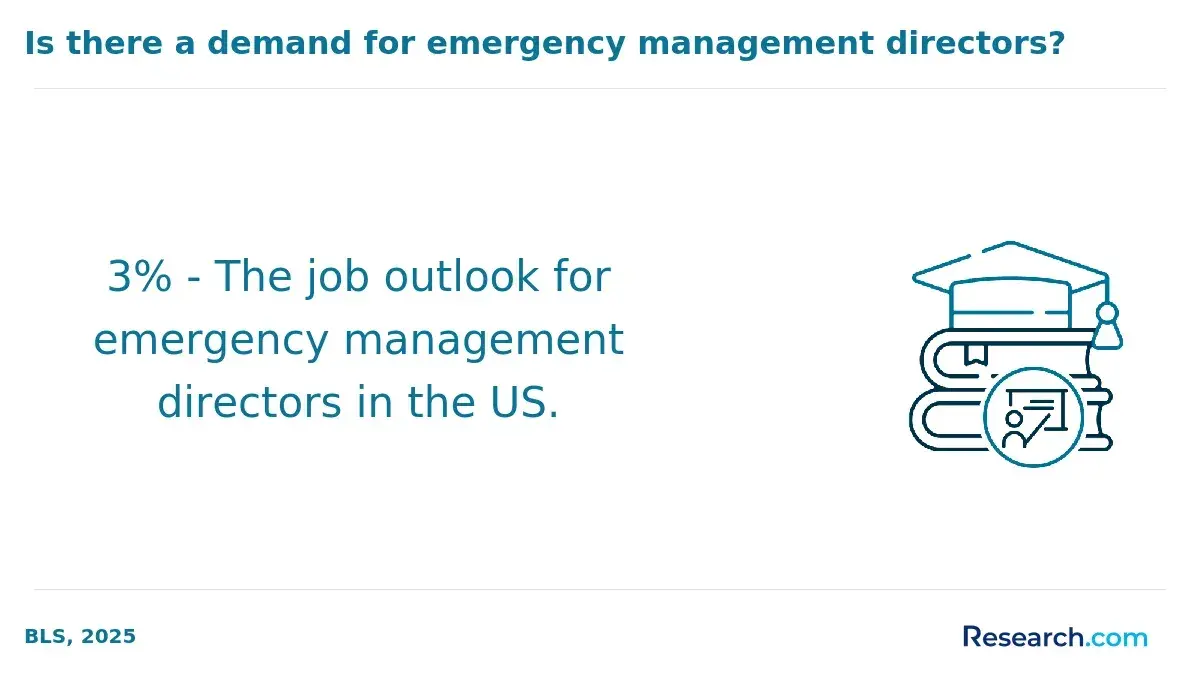
The Bureau of Labor Statistics projects a 3% growth in emergency management roles from 2024 to 2034, indicating a stable and important career field. Students should interpret this as a broad labor-market indicator, not a guarantee of employment after graduation.
- Geographic location can affect salary because local government budgets, disaster exposure, and cost of living differ.
- Experience level matters because many leadership roles require demonstrated planning, response, or management background.
- Industry affects compensation; private sector continuity and risk roles may differ from nonprofit or local government positions.
- Certifications and training may strengthen a candidate’s profile alongside the degree.
- Organizational size can influence the complexity of responsibilities and pay ranges.
References
- Gitnux. (2026). Public affairs industry statistics. https://gitnux.org/public-affairs-industry-statistics/
- Grand View Research. (2025). AI in government and public services market report, 2033. https://www.grandviewresearch.com/industry-analysis/ai-government-public-services-market-report
- Research and Markets. (2026). Social sciences and humanities services market report. https://www.researchandmarkets.com/reports/5735273/social-sciences-humanities-services-market-report
- U.S. Bureau of Labor Statistics. (2025). Emergency management directors: Occupational outlook handbook. https://www.bls.gov/ooh/management/emergency-management-directors.htm
- ZipRecruiter. (2025, July). Salary: Public Affairs (July, 2025) – United States. https://www.ziprecruiter.com/Salaries/Public-Affairs-Salary
Key Insights
- Online emergency management master’s programs can be credible. The deciding factors are accreditation, curriculum quality, faculty experience, applied learning, and employer relevance—not the online format alone.
- The degree is best for advancement-focused professionals. It is most useful for students targeting leadership, planning, policy, homeland security, resilience, healthcare preparedness, or business continuity roles.
- Costs vary widely. Published total tuition for online emergency management master’s programs can range from $4,986 to $57,816, so compare full program cost rather than per-credit tuition only.
- Work experience still matters. A master’s degree is stronger when paired with emergency response, public safety, military, healthcare, nonprofit, logistics, or risk management experience.
- Program fit is more important than speed. Accelerated options can shorten completion time to 12 to 16 months, but they require intensive study and may not suit students with unpredictable emergency response schedules.
- Technology and collaboration are now core skills. Strong programs should expose students to simulations, data tools, crisis communication, interagency coordination, and community resilience planning.
- Do not assume salary outcomes are guaranteed. The median annual wage for emergency management directors was $86,130 as of May 2024, but actual earnings depend on role, employer, region, experience, and responsibility level.
Other Things You Should Know About Online Master’s in Emergency Management Programs
In 2027, an online master’s in emergency management typically includes courses such as disaster response, risk analysis, crisis management, and public health emergencies. Programs often also cover policy development, leadership, and advanced data analytics to prepare students for diverse roles in the field.
Employers increasingly recognize and respect online degrees, especially those from accredited institutions. The reputation of the institution, accreditation, and the candidate's work experience are significant factors in employer acceptance. Many employers value the self-discipline and time management skills demonstrated by online graduates.
In 2027, top online master’s programs in emergency management typically require a bachelor's degree, relevant professional experience, and recommendation letters. Additionally, many programs might ask for a personal statement and a minimum GPA of 3.0. Check individual universities for specific criteria.
When selecting an online master’s in emergency management, consider accreditation, curriculum relevance, faculty expertise, and support services. Look for programs offering flexible learning schedules, networking opportunities, and practical experiences to ensure comprehensive knowledge and skills development in the field.
Common courses include risk assessment and mitigation, crisis communication and public information, leadership and decision-making in emergency management, legal and ethical issues, and research methods and data analysis. These courses provide a comprehensive education in various aspects of emergency management.
Online degrees can be more cost-effective due to lower tuition fees, the absence of commuting and housing costs, and the flexibility to work while studying. However, it is important to compare the total costs, including any additional fees and expenses, to ensure that the program fits within your budget.


