2027 Fastest Accredited Online Physical Therapy Programs: Accelerated Degrees and Completion Times

Co-Founder and Chief Data Scientist
With employment for physical therapists projected to grow 11% through 2034, much faster than the average for all occupations, the demand for licensed clinicians continues to outpace traditional educational pipelines. To help bridge this gap, a growing number of accredited universities now offer hybrid-online Doctor of Physical Therapy (DPT) degrees that combine flexible digital coursework with intensive, localized clinical rotations.
While traditional DPT programs require three full years of study, accelerated pathways compress this timeline into as few as 24 to 30 months without compromising clinical rigor. Through this guide, students can gain a clear breakdown of the top accredited online DPT programs, compare actual completion times and tuition structures, and learn how to navigate admission and licensure requirements so you can enter the healthcare workforce up to a year earlier.
Key Things You Should Know
- The fastest accredited entry-level physical therapy routes are usually hybrid, not fully online: accelerated DPT programs may advertise about 24 to 25 months after prerequisites and a bachelor's degree, while PTA associate programs often take about 18 to 24 months after admission.
- Accelerated terms are commonly 5 to 8 weeks for online general education or bachelor's-completion courses, but CAPTE-accredited PT and PTA programs still require in-person labs, clinical rotations, and competency checks that can limit how fast students finish.
- Transfer credit is the biggest timeline lever before professional PT training: many bachelor's-completion programs may accept up to about 90 credits toward a 120-credit degree, but DPT professional courses and PTA technical courses usually have stricter sequencing and lower transfer flexibility.
Which Colleges Offer the Fastest Accredited Online Physical Therapy Programs?
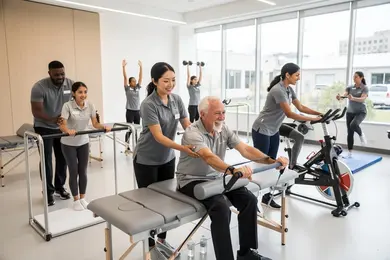
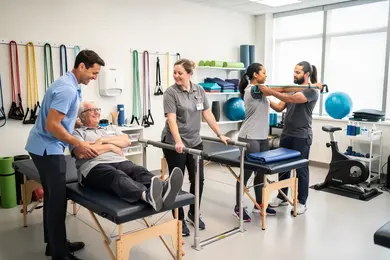
The fastest accredited online physical therapy programs are typically hybrid programs: didactic coursework may be online, but labs, practical exams, and clinical placements happen in person. If your goal is to become a licensed physical therapist, focus on CAPTE-accredited DPT programs; if your goal is to become a physical therapist assistant, look for CAPTE-accredited PTA programs with online lecture components.
Because program availability, accreditation status, and cohort schedules can change, use the table below as a decision-support snapshot rather than a permanent ranking. Always confirm the school's current accreditation status, state authorization, clinical placement model, and advertised timeline before applying.
| College or program type | Credential and delivery format | Fastest advertised or common completion pace | What may extend the timeline |
| Baylor University | Hybrid Doctor of Physical Therapy with online coursework, campus lab immersions, and clinical education | About 24 months for the professional DPT sequence | Prerequisites, clinical placement timing, campus immersion travel, and cohort start dates |
| South College | Hybrid DPT options with online learning, in-person lab sessions, and clinical education | Often advertised around 24 months for accelerated DPT tracks | Site-specific accreditation status, prerequisite completion, clinical scheduling, and full-time course load demands |
| Arcadia University | Hybrid DPT with online coursework, on-campus immersions, and clinical rotations | About 25 months for the DPT sequence | Admissions competitiveness, prerequisite gaps, clinical availability, and required travel |
| Tufts University School of Medicine | Hybrid DPT model with online instruction, in-person lab immersions, and clinical education | Accelerated multi-semester DPT format, commonly positioned near a 2-year pace | Campus location, cohort availability, clinical sequencing, and current accreditation status by program site |
| San Juan College and similar online-hybrid PTA programs | Associate-level PTA coursework delivered partly online with in-person labs and clinical experiences | Commonly about 5 semesters after admission | Prerequisite courses, lab attendance, clinical travel, and state licensure requirements |
| Online bachelor's-completion programs in kinesiology, health science, or exercise science | Pre-PT or PT-adjacent bachelor's degree, usually not a licensure program by itself | As little as 12 to 24 months with substantial transfer credit | Missing science prerequisites, transfer-credit limits, GPA requirements, and graduate DPT admissions timelines |
Students who still need a bachelor's degree before applying to a DPT program may benefit from comparing best online kinesiology programs, especially if they want a flexible pre-PT major that can cover anatomy, physiology, biomechanics, exercise science, and related prerequisites.
The "fastest" program is not always the best fit. A 24-month DPT can be efficient for students who already meet all prerequisites, can study full time, can travel for lab immersions, and can relocate or commute for clinical placements; it may be unrealistic for students who need to work full time or complete missing science courses first.
How Long Does It Take to Complete an Accredited Online Physical Therapy Degree?
Completion time depends on which "physical therapy" credential you mean. A licensed physical therapist needs a DPT, a physical therapist assistant typically needs an accredited associate degree, and a pre-PT student may first complete an online bachelor's degree before applying to graduate school.
The table below compares realistic timelines by pathway. It separates the fastest possible pace from the more common student experience so you can avoid assuming that the advertised timeline applies to everyone.
| Pathway | Fastest realistic completion time | Typical completion time | Best fit |
| Hybrid accelerated DPT | About 24 to 25 months after a completed bachelor's degree and prerequisites | 2 to 3 years for the professional program, not counting undergraduate work | Students ready for full-time graduate study and intensive clinical requirements |
| Traditional DPT with online components | About 3 years after prerequisites | 3 years after a bachelor's degree | Students who want a more conventional academic calendar or more campus support |
| Hybrid or online-coursework PTA associate degree | About 18 to 24 months after admission | 2 years plus prerequisites if required | Students seeking a faster clinical support role under PT supervision |
| Online bachelor's completion for pre-PT | About 12 to 24 months with major transfer credit | 2 to 4 years depending on prior credits | Students who need a bachelor's degree before applying to DPT programs |
| Post-professional or transitional DPT | Often about 1 to 2 years, depending on prior PT education | Varies widely by school and course load | Already licensed physical therapists, not first-time PT students |
A key distinction is that DPT completion time usually starts after the student already has a bachelor's degree. If you are starting with no college credit, the full path to becoming a physical therapist can still take roughly 6 to 7 years: about 4 years for the bachelor's degree plus 2 to 3 years for the DPT.
Shorter terms do not reduce the total learning outcomes required. An 8-week course may let you finish a calendar year faster, but it usually compresses the same amount of reading, exams, lab preparation, and assignments into fewer weeks.
How Do Accelerated and Competency-Based Online Physical Therapy Programs Work?
Accelerated online physical therapy programs shorten the calendar by changing the academic format, not by removing required competencies. In CAPTE-accredited PT and PTA programs, students still need to prove hands-on skills, patient safety, clinical reasoning, documentation ability, and professional behavior.
The most common acceleration models work in different ways. Understanding the model helps you estimate whether the program is genuinely faster for your situation or simply more intense.
- Short-course terms: Courses run in 5-, 6-, 7-, or 8-week blocks instead of a traditional 15- or 16-week semester, helping students complete more courses per year.
- Year-round enrollment: Programs use summer terms or trimester calendars so students do not pause for long breaks between academic periods.
- Cohort sequencing: Students move through a fixed course plan together, which can protect momentum but may make it harder to slow down without delaying graduation.
- Hybrid didactic delivery: Lectures, discussions, quizzes, and some simulations happen online, while labs and clinical education remain in person.
- Competency-based or self-paced general education: Some bachelor's-completion or prerequisite courses allow faster progress if students already know the material, but this is much less common for core DPT or PTA clinical training.
Competency-based education can be helpful before the professional PT program, especially for general education, statistics, psychology, or health science courses. However, hands-on physical therapy competencies usually require faculty observation, lab practice, practical exams, and supervised clinical experiences.
The trade-off is workload. Accelerated DPT and PTA programs often require full-time availability, strong study habits, and flexibility for labs or clinical placements; they may not be ideal for students who need a predictable part-time schedule.
What Accreditation Should an Online Physical Therapy Program Have?
Accreditation is the most important quality check when comparing fast physical therapy programs. For entry-level physical therapist and physical therapist assistant programs, the key programmatic accreditor is the Commission on Accreditation in Physical Therapy Education, commonly known as CAPTE.
There are several accreditation layers to verify before enrolling. Each affects eligibility for licensure, financial aid, credit transfer, or employer recognition.
- CAPTE accreditation: Required for U.S. entry-level DPT and PTA programs that prepare graduates for the national licensure exam pathway.
- Institutional accreditation: The college or university should be accredited by an agency recognized for federal financial aid purposes.
- State authorization: Online programs must be authorized to enroll students in your state, and clinical placements may depend on state-specific rules.
- Licensure alignment: The program should disclose whether it meets educational requirements for the state where you plan to practice.
- Site-specific status: Hybrid programs with multiple locations may have accreditation details that vary by campus, branch, or developing program site.
Be careful with programs that advertise "physical therapy" but are actually wellness, exercise science, rehabilitation aide, or pre-health degrees. These may be valuable for career exploration or DPT preparation, but they do not qualify a student to work as a licensed physical therapist or physical therapist assistant by themselves.
A practical rule: if a program claims to prepare you for PT or PTA licensure, verify the exact program name and campus in the CAPTE directory before applying. If the school cannot clearly explain its accreditation and licensure disclosures, treat that as a red flag.
How Can Transfer Credits and Prior Learning Shorten an Online Physical Therapy Degree?
Transfer credit can dramatically shorten a pre-PT bachelor's degree or health science completion program, but it usually has less impact once you enter a professional DPT or PTA sequence. That is because clinical programs are built around sequenced competencies, lab checkoffs, and supervised fieldwork.
The table below shows where transfer credit usually helps most. Use it to identify whether your fastest path is applying directly to a professional program or finishing missing undergraduate requirements first.
| Credit source | Where it helps most | Potential time savings | Common limitation |
| Community college general education credits | Online bachelor's-completion or pre-PT degree | Can reduce a 4-year bachelor's path to about 1 to 2 years if many credits transfer | Upper-division major requirements may still need to be completed at the degree-granting school |
| Completed anatomy, physiology, chemistry, physics, psychology, or statistics | DPT or PTA prerequisites | May allow earlier application to a professional cohort | Schools may require minimum grades, lab components, and recent completion dates |
| Prior bachelor's degree | DPT admission pathway | Can make the student eligible for direct DPT admission if prerequisites are complete | Missing science prerequisites can still add one or more terms |
| Military, healthcare, or work-based learning | Some online bachelor's or associate programs | May reduce elective or general education credits | Professional PT and PTA clinical courses are rarely waived solely for work experience |
| Advanced Placement, CLEP, or dual enrollment | Undergraduate prerequisites and general education | Can shorten the pre-professional stage | DPT programs may not accept exam credit for required science labs |
Before choosing a program, request a preliminary transfer evaluation. Ask whether the evaluation is unofficial or binding, which credits apply to the major rather than just electives, and whether any accepted credits also satisfy DPT or PTA prerequisite rules.
To finish as quickly as possible, students should collect syllabi for older science courses, confirm minimum grade requirements, and avoid retaking classes unnecessarily. However, retaking a prerequisite may be worthwhile if a stronger grade improves DPT admissions competitiveness.
What Are the Admission Requirements and Start Dates for Accelerated Online Physical Therapy Programs?
Admission requirements vary sharply by credential. Accelerated DPT programs are graduate-level and selective, while PTA programs are usually associate-level but still require science readiness, clinical availability, and background checks.
Most fast programs use cohort starts, which means missing an application deadline can delay graduation even if you are academically ready. Review these requirements early so you can line up prerequisites, documents, and clinical compliance tasks before the next start date.
- Hybrid DPT programs: Usually require a bachelor's degree, prerequisite science courses with labs, competitive GPA, observation or experience hours when required, recommendations, an interview, and completion of application materials through the school's chosen system.
- Hybrid PTA programs: Often require high school completion or prior college credit, prerequisite biology or anatomy courses, placement testing or minimum GPA, immunizations, CPR certification, background checks, and drug screening.
- Online bachelor's-completion programs: Typically require prior college credits, official transcripts, minimum GPA, and sometimes prerequisite coursework for upper-division kinesiology or health science courses.
- Post-professional DPT programs: Require prior physical therapy education and licensure or eligibility, making them unsuitable for first-time PT students.
Start dates also differ by format. Online bachelor's programs may offer several starts per year, while DPT and PTA cohorts often begin once, twice, or three times per year because lab and clinical schedules must be coordinated.
If you are comparing healthcare programs mainly by speed, remember that short training does not always lead to the same scope of practice. For example, accelerated medical assistant programs may lead to faster entry-level employment, but they do not replace the graduate education and licensure path required for physical therapists.
How Much Does a Fast Online Physical Therapy Degree Cost, and Is Financial Aid Available?
Fast completion can reduce living expenses and opportunity cost, but it does not automatically make a program cheaper. Accelerated DPT programs may charge graduate tuition over fewer terms, while hybrid students may also pay for travel, lodging, lab immersions, clinical relocation, technology, and exam-related expenses.
College Board's 2024 tuition data is useful for context: average published tuition and fees for 2024-25 were $11,610 for in-state students at public 4-year institutions and $43,350 at private nonprofit 4-year institutions. Physical therapy programs can fall outside these averages, especially at the graduate level, so always compare total program cost rather than term-by-term tuition.
When you request cost information, ask the school to separate direct tuition from other expenses. These cost categories often determine whether the fastest program is financially manageable.
- Tuition per credit, per term, or per program
- Mandatory university, technology, lab, and clinical education fees
- Travel and lodging for on-campus immersions
- Clinical rotation transportation, parking, relocation, or temporary housing
- Books, equipment, scrubs, background checks, immunizations, and CPR certification
- Licensure exam preparation, exam fees, and state application costs
- Lost wages if the program requires full-time daytime availability
Financial aid may be available if the institution and program meet federal eligibility rules. Students should complete the FAFSA, compare institutional scholarships, ask about graduate assistantships or employer tuition support, and review federal loan limits before assuming they can finance the full cost.
If affordability is your main concern and you are still exploring healthcare paths, comparing costs across fields can help. For instance, students looking at patient-care careers sometimes compare PT prerequisites with nursing online options to understand differences in tuition, clinical schedules, licensure pathways, and local job demand.
Can You Work Full Time While Completing an Accelerated Online Physical Therapy Degree?
Working full time is possible in some online bachelor's-completion or prerequisite programs, but it is much harder in accelerated DPT and PTA programs. The issue is not just online coursework; labs, exams, group assignments, and clinical rotations may require daytime attendance and travel.
The table below compares work feasibility by program type. Use it to decide whether the fastest calendar timeline is realistic or whether a slower pace would protect your grades, health, and finances.
| Program type | Full-time work feasibility | Why | Better option if you must work |
| Accelerated hybrid DPT | Low for most students | Graduate-level science load, lab immersions, practical exams, and full-time clinical rotations | Choose a traditional DPT timeline, save before enrolling, or reduce work hours during clinical phases |
| Hybrid PTA associate degree | Low to moderate | Some coursework may be online, but labs and clinical placements can conflict with work schedules | Ask about evening labs, part-time sequencing, or cohort flexibility |
| Online bachelor's completion | Moderate to high | Asynchronous courses and transfer credits may allow study around work | Take 1 to 2 accelerated courses per term instead of overloading |
| Prerequisite-only coursework | Moderate | Online lectures may be flexible, but science labs may be synchronous or in person | Plan science labs during lighter work periods |
Students should also consider burnout. An 8-week anatomy or physiology course can feel like taking a full semester at double speed, especially if it includes lab work, exams, and memorization-heavy content.
If you need a faster healthcare credential while keeping more work flexibility, an LPN accelerated program may be worth comparing as an alternative career route, though it prepares students for nursing practice rather than physical therapy.
Are Accelerated Online Physical Therapy Degrees Respected by Employers and Graduate Schools?
Employers and graduate schools usually care less about whether coursework was online and more about accreditation, licensure eligibility, clinical competence, school reputation, and your performance. For licensed PT and PTA roles, graduating from the correct accredited program and passing the required licensure exam are central.
The labor market gives students a reason to evaluate quality carefully. The Bureau of Labor Statistics reported a May 2024 median annual wage of $101,020 for physical therapists; that figure reflects the occupation overall, not a guarantee for any graduate, but it shows why students should avoid unaccredited shortcuts that could block licensure.
Accelerated hybrid DPT programs can be respected when they maintain the same clinical standards as campus programs. Employers may ask about clinical rotations, patient populations, documentation experience, professional references, and readiness for fast-paced care settings.
Graduate schools evaluating pre-PT bachelor's degrees typically review GPA, prerequisite grades, observation experience, recommendations, and fit with the DPT program. A flexible online kinesiology or health science degree can be acceptable if it comes from an accredited institution and includes the required lab sciences.
Students comparing health-related graduate study may also look at adjacent fields, such as an online masters in nutrition and dietetics, to understand how accreditation, supervised practice, and licensure expectations differ across healthcare professions.
How Should You Compare the Fastest Accredited Online Physical Therapy Programs?
The best comparison is not "Which program is shortest?" but "Which accredited program can I finish fastest without risking licensure eligibility, grades, clinical readiness, or finances?" A program that looks slower on paper may be faster in practice if it accepts more transfer credit, offers a better start date, or has clinical placements near you.
Use the following steps before applying. They focus on the variables that most often change the real time to graduation.
- Confirm whether the program leads to the credential you actually need: DPT for physical therapists, PTA associate degree for physical therapist assistants, or bachelor's/pre-PT study for future DPT applicants.
- Verify CAPTE accreditation for entry-level DPT or PTA programs and institutional accreditation for all degree programs.
- Request a transfer-credit review before enrollment and ask which credits apply to prerequisites, major requirements, or electives.
- Map the full timeline from today, including missing prerequisites, application deadlines, cohort starts, coursework, labs, clinical rotations, exam preparation, and licensure processing.
- Ask how many campus visits, lab immersions, or clinical placements are required and whether travel or relocation is likely.
- Compare total cost, not just tuition, including fees, travel, clinical expenses, supplies, and lost wages.
- Ask what happens if you fail or withdraw from one accelerated course, because cohort lockstep programs may delay graduation by a full term or year.
- Speak with admissions, financial aid, and clinical education staff before committing; each office sees different risks that affect completion time.
Some red flags are easy to miss when a school advertises a fast timeline. The table below pairs common mistakes with a better way to evaluate the program.
| Common mistake | Why it matters | Better approach |
| Assuming "online" means no campus visits | PT and PTA programs require hands-on skill assessment | Ask for the exact number, length, and location of lab immersions |
| Choosing the shortest advertised timeline without checking prerequisites | Missing science courses can add terms before admission | Complete a prerequisite audit before applying |
| Ignoring clinical placement logistics | Clinical rotations can require travel, daytime availability, or relocation | Ask how placements are arranged and whether local sites are realistic |
| Assuming all credits transfer | Schools may accept credits as electives but not toward the major | Get a written degree plan showing remaining requirements |
| Confusing pre-PT degrees with licensure programs | A bachelor's degree alone does not make someone a licensed physical therapist | Match the program to the exact role you want |
| Overloading accelerated terms while working full time | Compressed courses can damage GPA and delay progression | Choose a sustainable course load, especially for lab sciences |
If two programs are both accredited and reputable, the better choice is usually the one with the clearest clinical plan, strongest transfer fit, realistic workload, transparent cost, and licensure alignment in your state. Speed matters, but only if the program gets you to the correct credential safely and credibly.
Other Things You Should Know About Physical Therapy
No fully online-only route is sufficient for initial U.S. physical therapist licensure. Entry-level DPT programs require in-person labs, practical skill checks, and supervised clinical education, even when much of the classroom instruction is delivered online.
No. An online pre-PT, kinesiology, exercise science, or health science degree can help you qualify for DPT admission, but it does not make you a licensed physical therapist. You still need an accredited DPT program and licensure after graduation.
A PTA associate degree is usually faster, often taking about 18 to 24 months after admission. A DPT typically takes about 2 to 3 years after completing a bachelor's degree and prerequisites, but it leads to a different scope of practice.
Yes. Clinical rotations can delay graduation if placements are unavailable, compliance documents are incomplete, travel is not feasible, or a student must repeat a clinical experience. Ask each program how placements are assigned and what backup options exist.
References
- Commission on Accreditation in Physical Therapy Education https://www.capteonline.org/
- International Accelerated BS to DPT - University of Montana - Rehab Essentials https://umt-rehabessentials.com/track/international-accelerated-bs-to-dpt/
- Education - Physical Therapy Association of Georgia https://aptageorgia.org/page/Education
- Best Online Physical Therapy Degrees Of 2025 | AffordableCollegesOnline.org https://www.affordablecollegesonline.org/degrees/physical-therapy-schools/
- Online Doctor of Physical Therapy (DPT) Programs | 2026 Guide https://onlinephysicaltherapyprograms.com/
- College of Health and Human Services https://www.utoledo.edu/hhs/pt/outcomes.html
- Hybrid Accelerated Doctor of Physical Therapy (DPT) https://eimpartnerships.com/disciplines/doctor-of-physical-therapy-dpt
- CAPTE Guidance https://acapt.org/resources/capte-guidance
- How Long Is PT School? A Guide for Future Physical Therapists https://www.pteverywhere.com/media/how-long-is-physical-therapy-school-guide-for-professionals