2027 How to Become a Nurse in Minnesota

Co-Founder and Chief Data Scientist
Becoming a nurse in Minnesota is a structured process: choose the right nursing role, complete an approved education program, pass the required NCLEX exam, and maintain an active state license. The decision matters because the path you choose—LPN, RN, BSN-prepared RN, nurse practitioner, nurse midwife, or another advanced role—affects your timeline, tuition cost, clinical responsibilities, salary potential, and long-term mobility.
This guide is for prospective nursing students, career changers, licensed nurses moving to Minnesota, and current LPNs or RNs planning their next credential. It explains Minnesota nursing education options, licensure steps, job outlook, online program considerations, advanced practice pathways, common mistakes, and practical questions to ask before enrolling in a nursing program.
Quick answer: How do you become a nurse in Minnesota?
To become a nurse in Minnesota, you must complete a Minnesota Board of Nursing-approved nursing program, apply for licensure, pass the appropriate NCLEX exam, complete the required criminal background check, and renew your license on schedule. LPN candidates take the NCLEX-PN, while RN candidates take the NCLEX-RN. Advanced practice nurses need graduate education, national certification, and state recognition for their practice role.
Key Things You Should Know About Becoming a Nurse in Minnesota
- Minnesota is facing strong demand for nurses, with projections cited in this guide indicating a need for over 20,000 additional nurses by 203, driven by population aging and retirements among healthcare workers.
- The average salary for registered nurses in Minnesota is approximately $80,000 per year, though actual pay varies by city, employer, experience level, shift, and specialty.
- The two most common RN education routes are the Associate Degree in Nursing (ADN) and the Bachelor of Science in Nursing (BSN). Both can qualify graduates for the NCLEX-RN when the program meets state approval requirements.
- The Minnesota Department of Employment and Economic Development projects 10% growth for registered nurses from 2020 to 2030, reflecting ongoing healthcare workforce needs.
- Minnesota students can compare community colleges, universities, bridge programs, accelerated programs, and online or hybrid options, but every program should be checked for approval, accreditation, clinical placement support, and licensure alignment.
| Decision | Best fit | What to verify before enrolling |
| LPN program | Students who want a shorter route into basic nursing care | State approval, NCLEX-PN preparation, clinical hours, and LPN-to-RN transfer options |
| ADN program | Students seeking an RN pathway with a shorter academic timeline than a BSN | NCLEX-RN pass rates, clinical placements, transfer agreements, and employer preferences |
| BSN program | Students who want broader hospital, leadership, public health, or graduate school options | Accreditation, total cost, simulation labs, clinical partners, and graduation outcomes |
| Direct-entry MSN | Career changers who already hold a bachelor’s degree in another field | Prerequisites, clinical placement model, licensure eligibility, pace, and tuition |
| MSN, DNP, or certificate | Licensed nurses pursuing nurse practitioner, midwifery, anesthesia, education, or leadership roles | Specialty certification alignment, practicum requirements, state authorization, and employer support |
- What are the steps to becoming a nurse in Minnesota?
- What are the educational requirements for becoming a nurse in Minnesota?
- What types of nurses can legally practice in Minnesota?
- What are the licensing requirements for nurses in Minnesota?
- What types of nursing licenses are available in Minnesota?
- Can a Compact nurse practice in Minnesota?
- Can you practice as a nurse without a license in Minnesota?
- What are alternative healthcare career paths in Minnesota?
- What is the state of nursing in Minnesota?
- What are the nurse practitioner education requirements in Minnesota?
- What is the job outlook for nursing in Minnesota?
- What opportunities are available for LPN training in Minnesota?
- What is the pathway to becoming an LVN in Minnesota?
- How should prospective nursing students evaluate online nursing programs in Minnesota?
- How can nurses effectively maintain compliance with licensure requirements in Minnesota?
- What distinguishes the best nursing schools in Minnesota?
- What are the benefits of specializing in nurse midwifery in Minnesota?
- What are the educational opportunities for advanced nursing roles in Minnesota?
- How can nurse leaders leverage dual degree programs in Minnesota?
- Are there cost-effective options for advanced nursing education in Minnesota?
- What career support and practical training resources are available for nursing students in Minnesota?
What are the steps to becoming a nurse in Minnesota?
The Minnesota nursing pathway depends on the license you want. A practical nursing student follows a shorter LPN route, while an RN candidate usually completes an ADN or BSN. Career changers and advanced practice nurses may follow graduate-level routes. The core process, however, is similar: complete approved education, apply to the board, pass the exam, and keep your license active.
- Choose the nursing role you want. Decide whether your immediate goal is LPN, RN, or an advanced practice role. This choice determines your program length, cost, clinical responsibilities, and exam.
- Complete the correct education program. LPN programs typically take about one year. ADN programs commonly take two years. BSN programs are usually four-year degrees, while an accelerated BSN may be completed in as little as 16 months. Direct-entry MSN programs for students with a non-nursing bachelor’s degree typically take 2-3 years.
- Confirm state approval and accreditation. Before applying, verify that the program is approved for Minnesota licensure and that its accreditation status supports your employment and graduate school goals.
- Apply for Minnesota licensure. Submit the required application, fees, education documentation, and background check materials to the Minnesota Board of Nursing.
- Register for the correct NCLEX exam. LPN graduates take the NCLEX-PN. RN graduates take the NCLEX-RN. You must receive authorization before scheduling the exam.
- Pass the exam and receive your license. Passing the NCLEX is a required step before you can practice as an LPN or RN in Minnesota.
- Renew your license and track continuing education. Minnesota nurses must renew their licenses every two years and satisfy ongoing requirements to remain compliant.
Students comparing RN pathways can start by reviewing affordable ADN options, including cost-conscious online nursing programs. Career changers and current nurses considering graduate study can also compare online MSN programs to understand how master’s-level education may support advanced nursing roles.
| Pathway | Typical preparation | Licensing exam | When this route makes sense |
| LPN | High school diploma or GED plus a practical nursing program, often about one year | NCLEX-PN | You want a faster entry into nursing and are comfortable working within a supervised scope of practice |
| ADN-prepared RN | Associate Degree in Nursing, often completed in two years | NCLEX-RN | You want to become an RN sooner and may later complete an RN-to-BSN program |
| BSN-prepared RN | Bachelor of Science in Nursing, typically a four-year degree | NCLEX-RN | You want wider long-term options in hospitals, leadership, public health, military nursing, or graduate study |
| Direct-entry MSN | Graduate nursing program for students who already hold a bachelor’s degree in another field | Usually prepares for RN licensure and may support advanced study depending on the program | You are changing careers and want an intensive graduate-level route into nursing |
| Advanced practice nursing | MSN, DNP, or post-graduate certificate plus national certification | Specialty certification exam | You are already an RN and want to become an NP, nurse midwife, nurse anesthetist, or clinical nurse specialist |
If you are exploring specialties, salary and role expectations should be part of the decision. For example, students interested in newborn care may want to compare neonatal nurse salary information before committing to a specialty track.
The U.S. Bureau of Labor Statistics reported in 2022 that nurse anesthetists had the highest median annual wage among the nursing roles listed here, at $195,610. Nurse practitioners followed at $120,680, and nurse midwives at $112,830. Registered nurses had a median annual wage of $77,600, while licensed practical and licensed vocational nurses earned $48,070. By comparison, the median annual wage for all occupations combined was $45,760. The graph below presents these wage levels.
What are the educational requirements for becoming a nurse in Minnesota?
Minnesota nursing education requirements vary by role, but every licensure path begins with a program that meets state standards. The right credential depends on whether you want to enter nursing quickly, build toward RN practice, or qualify for advanced clinical, leadership, teaching, or research roles.
| Credential | Primary outcome | Typical student profile | Key consideration |
| Diploma in Practical Nursing (DPN) | Prepares graduates for LPN licensure | Students seeking a shorter route into nursing | Confirm NCLEX-PN preparation and whether credits transfer into RN programs |
| Associate Degree in Nursing (ADN) | Prepares graduates for RN licensure | Students who want an RN option often offered through community colleges | Ask about clinical placement sites, NCLEX-RN outcomes, and RN-to-BSN transfer agreements |
| Bachelor of Science in Nursing (BSN) | Prepares graduates for RN licensure and broader career mobility | Students seeking a comprehensive nursing degree from a college or university | Review total program cost, clinical quality, simulation resources, and employer preferences |
| Master of Science in Nursing (MSN) | Supports advanced practice, education, administration, or specialized nursing roles | RNs seeking graduate-level advancement | Make sure the concentration aligns with certification and state practice expectations |
| Doctor of Nursing Practice (DNP) | Terminal practice-focused nursing degree | Nurses preparing for high-level clinical leadership or advanced practice | Clinical practicum requirements are substantial; compare program structure carefully, including options marketed as DNP online programs |
| Doctor of Philosophy in Nursing (PhD) | Research and academic preparation | Nurses interested in scholarship, faculty roles, or research leadership | Evaluate research fit, faculty mentorship, funding, and dissertation expectations |
Program approval is not optional. Before enrolling, confirm the school’s status with the Minnesota Board of Nursing. Accreditation by a recognized nursing accreditor can also affect graduate school admission, employer preferences, and eligibility for some advanced credentials.
Online and hybrid nursing programs can be useful for working adults, parents, rural students, and career changers, but nursing is never fully theoretical. Clinical hours must be completed in approved settings. Ask whether the school arranges clinical placements in Minnesota or expects students to find their own sites.
Cost should also be evaluated in context. Tuition is only one part of the budget; students should account for fees, books, uniforms, background checks, exams, transportation to clinical sites, and lost work time. If compensation is part of your planning, it may help to compare travel nurse salary ranges by state with standard staff nurse roles.
What types of nurses can legally practice in Minnesota?
Minnesota recognizes several nursing roles, each with its own education requirements, scope of practice, and level of responsibility. Understanding the differences helps students avoid enrolling in a program that does not match their career goal.
- Licensed Practical Nurses (LPNs): LPNs provide basic nursing care, monitor patient status, assist with daily care needs, and administer certain medications under the direction of RNs, physicians, or other authorized providers. Candidates complete an approved practical nursing program and pass the NCLEX-PN.
- Registered Nurses (RNs): RNs assess patients, create and coordinate care plans, administer medications, educate patients and families, document care, and collaborate with healthcare teams. RN candidates generally complete an ADN or BSN and pass the NCLEX-RN.
- Advanced Practice Registered Nurses (APRNs): APRNs include nurse practitioners, clinical nurse specialists, nurse anesthetists, and nurse midwives. These nurses complete graduate-level education, obtain national certification, and meet Minnesota requirements for advanced practice.
- Clinical Nurse Specialists (CNSs): CNSs are advanced practice nurses with expertise in a patient population, clinical specialty, setting, disease area, or type of care. They often improve care quality, mentor staff, and support evidence-based practice.
| Nursing role | Core function | Education level | Career planning note |
| LPN | Basic bedside care and support under supervision | Practical nursing diploma or certificate | Good entry point, but advancement often requires additional RN education |
| RN | Comprehensive patient assessment, care coordination, medication administration, and education | ADN or BSN | BSN preparation may improve access to some hospital, leadership, and graduate school pathways |
| NP | Advanced assessment, diagnosis, treatment, prescribing, and patient management within specialty preparation | MSN, DNP, or post-graduate certificate | Requires national certification and state authorization |
| CNM | Pregnancy, birth, postpartum, reproductive, and women’s health services | Graduate nursing or midwifery preparation | Best for nurses committed to maternal and reproductive health care |
| CRNA | Anesthesia care and pain management services | Advanced graduate preparation | Highly specialized and competitive; clinical requirements are intensive |
The safest approach is to identify the exact job title you want, then work backward to the required credential, certification, and license. This is especially important for advanced practice roles because each specialty has distinct certification and clinical training expectations.
What are the licensing requirements for nurses in Minnesota?
Minnesota nursing licensure is administered through the Minnesota Board of Nursing. The process is designed to verify that applicants have the education, examination results, and background clearance needed to practice safely.
- Graduate from an approved nursing program. RN applicants usually complete an ADN or BSN. LPN applicants usually complete a practical nursing diploma or certificate program.
- Submit the licensure application. Applicants provide required personal, education, and eligibility information to the board.
- Pay the application fee. The current application fee stated here is $100 for RNs and $75 for LPNs.
- Complete the criminal background check. Minnesota requires fingerprinting and a background review. Fingerprinting costs typically range from $30 to $50.
- Register for the NCLEX. The NCLEX fee is approximately $200. LPN applicants register for the NCLEX-PN; RN applicants register for the NCLEX-RN.
- Pass the exam. A passing NCLEX result is required before a nursing license can be issued.
- Renew on time. Once licensed, nurses must renew every two years and complete applicable continuing education requirements.
| Licensure item | Who it applies to | Why it matters |
| Approved nursing education | LPN and RN applicants | Confirms the applicant completed the required academic and clinical preparation |
| NCLEX-PN or NCLEX-RN | LPN or RN applicants | Demonstrates minimum competency for entry-level practice |
| Application fee | All applicants | Required for board processing; stated here as $100 for RNs and $75 for LPNs |
| Background check and fingerprinting | All applicants | Supports public protection and patient safety review |
| License renewal | Licensed nurses | Required every two years to keep authority to practice active |
What types of nursing licenses are available in Minnesota?
The main Minnesota nursing licenses are LPN, RN, and APRN recognition or authority for advanced practice roles. Students should not choose a program based only on title; they should compare scope of practice, exam requirements, and long-term career goals.
- Licensed Practical Nurse license: This license is for graduates of practical nursing programs who pass the NCLEX-PN. LPNs work in long-term care, clinics, home health, and other settings where their scope of practice fits patient needs.
- Registered Nurse license: This license is for ADN or BSN graduates who pass the NCLEX-RN. RNs have broader responsibilities than LPNs and often work in hospitals, specialty clinics, public health, long-term care, and care coordination roles.
- Advanced Practice Registered Nurse authorization: Nurse practitioners, nurse midwives, clinical nurse specialists, and nurse anesthetists need graduate education and national certification in the relevant specialty area.
- Nurse Licensure Compact considerations: The Nurse Licensure Compact (NLC) allows multistate practice privileges in participating states, but nurses should verify Minnesota’s current compact status before assuming they can practice there on a multistate license.
Specialty interests may also shape your choice of license and education. For example, students interested in neonatal care can review neonatal nurse salary details while researching the clinical experience and certifications commonly expected in that specialty.
Can a Compact nurse practice in Minnesota?
A nurse holding a multistate compact license should not assume that the license automatically authorizes practice in Minnesota. The Nurse Licensure Compact gives mobility privileges only in states that participate in the compact. As stated in this guide, Minnesota has not adopted the NLC, so a compact license from another state does not replace the need for Minnesota licensure.
- What compact licensure normally does: In compact states, a nurse with a multistate license can practice in other compact states without applying for a separate single-state license, including through telehealth when the rules allow it.
- What Minnesota requires: Nurses who want to work in Minnesota must meet Minnesota’s licensure process, including application, background check, and any required documentation.
- Why this matters for travel and telehealth nurses: A telehealth assignment involving Minnesota patients may still trigger Minnesota licensure requirements. Always confirm with the board and employer before accepting an assignment.
- Future changes are possible: The original source material cited a survey indicating that over 80% of Minnesota's registered nurses and licensed practical nurses support joining the NLC, but legislative status must be checked through official sources.
Career changers who want a graduate-level nursing entry route may also compare direct entry MSN programs for non-nurses, but they should confirm that any program they choose supports the Minnesota licensure path they intend to pursue.
Can you practice as a nurse without a license in Minnesota?
No. Practicing as an RN, LPN, or advanced practice nurse in Minnesota without the required license is not permitted. Licensure is not just an administrative step; it is the legal authorization to provide nursing care within the state’s defined scope of practice.
Students and graduates should be especially careful during transition periods. Completing a nursing program does not by itself authorize independent practice as a nurse. Passing the NCLEX, satisfying board requirements, and receiving the license are the critical steps that make practice legal.
| Common situation | Can you practice as a nurse? | What to do instead |
| You finished nursing school but have not passed the NCLEX | No, not as a licensed nurse | Follow board rules for graduate status, if applicable, and do not represent yourself as licensed until authorized |
| You passed the NCLEX but the license has not been issued | No, not until licensure is active | Wait for official license confirmation before beginning licensed duties |
| You hold a license in another state | Not automatically | Apply for Minnesota licensure unless a valid legal exception applies |
| Your license expired | No | Complete renewal or reinstatement steps before returning to practice |
One Minnesota nurse described the licensing period as the most stressful part of her transition from student to professional. She recalled preparing for the NCLEX while knowing that she could not legally practice until the license was granted. Her takeaway was simple: the license is not just a credential; it is the public’s assurance that a nurse has met minimum standards for safe practice.
What are alternative healthcare career paths in Minnesota?
Nursing is not the only healthcare career with patient impact. Some students discover that they prefer medication management, health information, revenue cycle work, laboratory services, therapy support, or administrative roles. Exploring alternatives can prevent wasted tuition if direct bedside nursing is not the best fit.
Pharmacy is one example of a healthcare path that blends science, patient counseling, medication safety, and collaboration with prescribers. If medication-focused care sounds more aligned with your strengths, review the steps for becoming a pharmacist in Minnesota.
What is the state of nursing in Minnesota?
Minnesota offers a strong healthcare labor market, but the opportunities are not identical across regions, employers, and specialties. Urban hospitals, rural clinics, long-term care facilities, outpatient centers, home health agencies, and major health systems may have different hiring needs, schedules, pay structures, and educational preferences.
- Demand remains strong: Healthcare needs are increasing as the population ages and experienced nurses retire, creating opportunities for new graduates and experienced nurses.
- The workforce is broad: Minnesota employs RNs, LPNs, APRNs, nurse educators, care coordinators, case managers, and leaders across many care settings.
- Shortage concerns affect planning: Potential shortages can create job openings, but they may also increase workload pressure in some settings.
- Cost of living varies by location: The Twin Cities area generally has different housing and transportation costs than rural communities, so salary should be evaluated against local expenses.
- Major employers shape the market: Hospitals, outpatient care centers, nursing homes, home healthcare services, and systems such as the Mayo Clinic and Allina Health contribute to nursing employment across the state.
The cost of living in Minnesota for one person is $2,213, which is 1.01 times more expensive than the national average. The cited breakdown includes rent and utilities at $1,357, food at $623, and other expenses at $856 for those without rent. Minnesota is listed as the 26th most expensive and 28th best state to live in the United States. The figure below summarizes these cost categories.
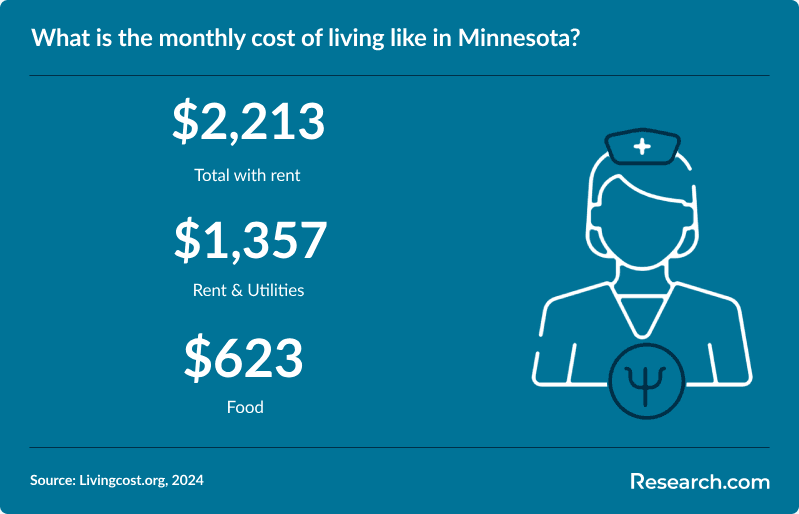
For nursing students, the practical takeaway is to compare salary, commute, housing, shift differentials, benefits, and tuition debt together. A higher-paying job in a more expensive location is not always the best financial choice, while a lower base wage in a lower-cost region may still produce a workable budget.
Licensure planning should begin early. Students who wait until graduation to understand the Minnesota nursing license requirements may run into avoidable delays with transcripts, background checks, exam registration, or renewal expectations.
What are the nurse practitioner education requirements in Minnesota?
Nurse practitioners in Minnesota need graduate-level nursing preparation, advanced clinical coursework, supervised practice experiences, national certification, and state authorization. Most NP students first become licensed RNs, complete a BSN or qualifying bridge pathway, and then enroll in an MSN, DNP, or post-graduate certificate program focused on a population area such as family, adult-gerontology, psychiatric-mental health, pediatrics, or women’s health.
NP coursework commonly includes advanced pharmacology, advanced health assessment, pathophysiology, diagnosis and management, clinical decision-making, and specialty practicum experiences. Because requirements can differ by certification population and program design, prospective students should review the detailed nurse practitioner education requirements in Minnesota before applying.
What is the job outlook for nursing in Minnesota?
The job outlook for nursing in Minnesota is favorable, but students should interpret statewide projections carefully. Demand does not guarantee a specific job, salary, schedule, or specialty placement. Hiring depends on location, experience, license type, clinical background, and employer needs.
According to the Minnesota Department of Employment and Economic Development, employment for registered nurses is projected to grow by 11% from 2020 to 2030, faster than the average for all occupations. Registered nurses in Minnesota earn an average annual salary of approximately $80,000 as of 2023, or about $38.46 per hour. Licensed practical nurses are cited as earning around $50,000 on average, while nurse anesthetists and nurse practitioners often exceed $100,000 annually.
Top-paying industries for nurses in Minnesota include:
- Outpatient care centers
- Specialty hospitals
- Home healthcare services
Location can make a significant difference. The average RN salary in Duluth, MN-WI is cited as $146,740, followed by Mankato-North Mankato, MN at $134,850. Rochester, MN has an average RN salary of $127,490, Minneapolis-St. Paul-Bloomington, MN-WI has an average of $125,940, and St. Cloud, MN is listed at $122,180. The figure below compares these metropolitan salary figures.
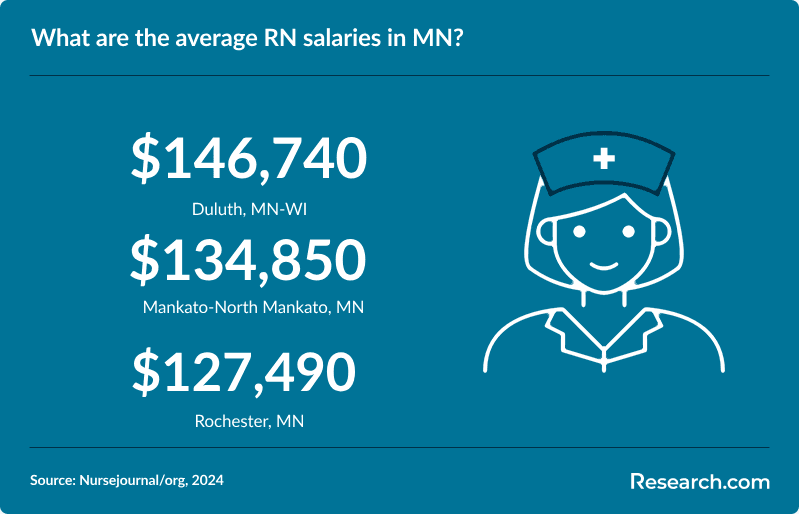
Students should use salary data as a planning tool, not a promise. Before accepting a job or choosing a specialty, compare base pay, shift differentials, overtime expectations, benefits, union status, commute, patient ratios, onboarding support, and opportunities for advancement.
What opportunities are available for LPN training in Minnesota?
LPN training in Minnesota is a practical option for students who want to enter nursing faster than a traditional RN pathway may allow. Programs typically combine classroom instruction, lab practice, and supervised clinical experience. Students learn basic nursing skills, medication administration within scope, patient monitoring, communication, documentation, and care support.
When comparing LPN programs, do not rely only on location or tuition. Check approval status, NCLEX-PN preparation, clinical site quality, student support, schedule flexibility, and whether the program has a bridge option into ADN or BSN study. Prospective students can compare online LPN programs in Minnesota as part of their research, while remembering that clinical requirements still occur in approved in-person settings.
What is the pathway to becoming an LVN in Minnesota?
Minnesota generally uses the title Licensed Practical Nurse rather than Licensed Vocational Nurse. Students searching for LVN information should understand that the Minnesota pathway is the LPN route: complete approved practical nursing education, apply to the board, pass the NCLEX-PN, and maintain the license.
If you are moving from a state that uses the LVN title, verify how your education and license transfer before accepting a Minnesota position. For role-specific guidance, review how to become an LVN in Minnesota.
How should prospective nursing students evaluate online nursing programs in Minnesota?
Online nursing programs can reduce travel and scheduling barriers, but they require careful evaluation. A program may advertise online coursework while still requiring in-person labs, simulations, campus visits, or local clinical rotations. The most important question is not whether the program is convenient; it is whether the program prepares you for Minnesota licensure and employment.
| Factor to evaluate | Why it matters | Question to ask |
| State approval | Required for licensure eligibility | Is this program approved for Minnesota nursing licensure? |
| Accreditation | Can affect employment, transfer, graduate study, and credibility | Which nursing accreditor recognizes the program? |
| Clinical placement support | Clinical hours are mandatory and can be difficult to arrange independently | Does the school place students in Minnesota clinical sites, or must students find their own? |
| NCLEX preparation | Licensure depends on passing the exam | What academic support is provided for NCLEX readiness? |
| Total cost | Online programs can still include major fees and travel costs | What is the full estimated cost, including books, exams, background checks, and clinical travel? |
| Student support | Online learners need advising, tutoring, technology help, and career services | What support is available outside standard business hours? |
For a program comparison starting point, review the best online nursing programs in Minnesota. Use rankings as a filter, not a final decision. Your best program is the one that fits your license goal, schedule, budget, learning style, and clinical placement needs.
How can nurses effectively maintain compliance with licensure requirements in Minnesota?
License compliance is an ongoing responsibility. Nurses should track renewal deadlines, continuing education documentation, name and address changes, employer requirements, and any board updates that affect practice. A missed renewal can interrupt employment and may require extra steps before returning to work.
- Create a renewal calendar. Add reminders several months before the two-year renewal deadline.
- Save continuing education records. Keep certificates, transcripts, course descriptions, and completion dates in one secure location.
- Monitor official board updates. Do not rely only on coworkers or social media for regulatory changes.
- Confirm employer-specific requirements. Hospitals and clinics may require certifications, competencies, immunization records, or training beyond state licensure.
- Ask early if your status changes. Moving, practicing telehealth, changing specialties, or accepting travel work may affect licensing obligations.
For a focused explanation of renewal and compliance expectations, review the requirements for nursing licensure in Minnesota.
What distinguishes the best nursing schools in Minnesota?
The best nursing school for one student may not be the best for another. A working parent may prioritize hybrid scheduling and local clinical sites, while a traditional undergraduate may value campus resources, residential life, and hospital partnerships. A current LPN may need transfer-friendly bridge options, while a future nurse practitioner may prioritize BSN-to-DNP progression.
| Quality marker | Why it matters | Red flag |
| Board approval | Essential for licensure eligibility | The school cannot clearly confirm Minnesota approval |
| Accreditation | Supports academic quality and may affect future education | Accreditation is missing, unclear, or only institutional rather than nursing-specific |
| NCLEX outcomes | Shows how well the program prepares graduates for licensure | Low or undisclosed pass rates |
| Clinical partnerships | High-quality clinical exposure builds confidence and employability | Students must find placements without meaningful school support |
| Transparent cost | Prevents surprise debt | Tuition is advertised but fees, supplies, and clinical costs are vague |
| Student support | Nursing programs are demanding and attrition can be costly | Weak advising, limited tutoring, or poor communication |
A strong starting point is Research.com’s guide to the best nursing schools in Minnesota, but students should still contact schools directly and verify current program details before applying.
What are the benefits of specializing in nurse midwifery in Minnesota?
Nurse midwifery can be a strong fit for nurses who want advanced practice responsibilities in pregnancy, birth, postpartum care, reproductive health, and patient education. Certified nurse midwives may work in hospitals, birth centers, clinics, and community health settings, depending on employer needs and state practice rules.
The benefits include deeper specialization, continuity-based patient relationships, advanced clinical autonomy, and opportunities to address maternal health access. The trade-off is that the path requires graduate education, certification, clinical training, and careful attention to scope-of-practice requirements. Students interested in this specialty should review how to become a nurse midwife in Minnesota.
What are the educational opportunities for advanced nursing roles in Minnesota?
Advanced nursing education in Minnesota includes MSN, DNP, post-graduate certificate, and specialized tracks for nurse practitioners, nurse educators, nurse leaders, nurse midwives, nurse anesthetists, and clinical nurse specialists. These programs are designed for licensed nurses who want broader clinical authority, leadership responsibilities, teaching roles, or specialty practice.
Graduate nursing programs often include advanced pharmacology, health assessment, pathophysiology, population health, evidence-based practice, policy, leadership, and supervised clinical or practicum hours. Some programs offer online coursework for flexibility, but clinical requirements remain tied to approved settings and qualified preceptors.
If your goal is advanced direct patient care, compare specialty fit before comparing tuition. Family nurse practitioner, psychiatric-mental health nurse practitioner, adult-gerontology, pediatric, and women’s health tracks prepare graduates for different patient populations. Research.com’s overview of the best NP programs in Minnesota can help narrow the initial search.
How can nurse leaders leverage dual degree programs in Minnesota?
Nurses moving into management, operations, strategy, finance, or executive leadership may benefit from dual degree options that combine clinical expertise with business training. An MSN can strengthen nursing leadership and systems knowledge, while an MBA can add finance, analytics, marketing, organizational behavior, and management skills.
Dual degrees make the most sense for nurses who want roles such as nurse manager, director of nursing, chief nursing officer, healthcare administrator, quality leader, or service line executive. They may be less useful for nurses who want to remain primarily in direct bedside care or a clinical specialty. Nurses considering this route can compare MSN MBA dual degree programs to evaluate format, cost, and career alignment.
Are there cost-effective options for advanced nursing education in Minnesota?
Yes, but “affordable” should mean more than low tuition. A cost-effective nursing program is one that supports your license goal, offers appropriate clinical training, fits your schedule, limits unnecessary debt, and helps you move into the role you want.
- Compare total program cost. Include fees, books, travel, testing, technology, background checks, and lost wages.
- Ask about employer tuition assistance. Some healthcare employers help fund RN-to-BSN, MSN, or certification-related education.
- Use transfer credits strategically. LPN-to-RN, RN-to-BSN, and bridge programs may reduce repeated coursework.
- Consider online or hybrid formats carefully. Flexibility can reduce commuting costs, but clinical placement challenges may add time and expense.
- Estimate return on investment realistically. Do not assume the highest reported salary applies to every graduate or location.
Graduate nursing students can begin their cost comparison with affordable online MSN programs, then verify Minnesota clinical placement policies and specialty certification alignment directly with each school.
What career support and practical training resources are available for nursing students in Minnesota?
Strong nursing programs do more than deliver lectures. They help students practice clinical judgment, prepare for licensure, build professional networks, and transition into employment. Career support can be especially important for first-generation college students, adult learners, and students entering competitive specialties.
- Clinical placements: Supervised practice in hospitals, clinics, long-term care facilities, community health settings, or specialty sites.
- Simulation labs: Controlled practice environments where students build skills before working with patients.
- NCLEX preparation: Test plans, practice exams, remediation, and faculty coaching.
- Mentorship: Connections with faculty, alumni, preceptors, and working nurses.
- Career services: Resume reviews, interview preparation, job fairs, employer introductions, and specialty advising.
- Alternative healthcare exposure: Some students benefit from learning about adjacent roles such as medical billing and coding in Minnesota, especially if they want non-bedside healthcare options.
Common mistakes to avoid when becoming a nurse in Minnesota
| Mistake | Why it can hurt you | Better approach |
| Choosing a school before checking approval | You may complete coursework that does not support Minnesota licensure | Verify program approval with the Minnesota Board of Nursing before enrolling |
| Looking only at tuition | Fees, supplies, exams, transportation, and lost income can change the real cost | Build a full program budget and compare financial aid options |
| Assuming online means fully remote | Nursing programs require in-person clinical training | Ask exactly where labs, simulations, and clinical rotations take place |
| Ignoring NCLEX outcomes | Poor exam preparation can delay licensure and employment | Review pass rates, remediation support, and student success services |
| Assuming compact licensure applies | You may not be legally authorized to practice in Minnesota | Confirm Minnesota licensure rules before accepting work |
| Choosing a specialty too early without exposure | You may invest in a path that does not match your work preferences | Use clinical rotations, shadowing, and informational interviews to test your interest |
| Relying only on salary averages | Pay varies by employer, shift, region, and experience | Compare compensation, workload, benefits, schedule, and advancement together |
Questions to ask before enrolling in a Minnesota nursing program
- Is the program approved for Minnesota nursing licensure?
- Is the nursing program accredited, and by which accreditor?
- What are the most recent NCLEX-PN or NCLEX-RN pass rates?
- Who arranges clinical placements, and where are they located?
- How many students graduate on time?
- What is the total cost after fees, books, supplies, testing, background checks, and clinical travel?
- Does the school offer tutoring, remediation, and NCLEX preparation?
- Can credits transfer into a higher nursing degree later?
- What percentage of graduates find nursing employment after licensure?
- Does the program support your intended specialty, employer type, or graduate school goal?
What do nurses say about becoming a nurse in Minnesota?
- Sheila said she entered nursing because she wanted work that mattered directly to patients. She values Minnesota’s collaborative healthcare environment and noted that nurses in the state earn an average of $80,000 annually, which she sees as one advantage of practicing there. Sheila
- Max, an LPN, described Minnesota as a place with varied employment settings, from hospitals to community clinics. He also emphasized the value of continuing education and said an employer-funded certification helped him move forward professionally. Max
- Harriet highlighted the professional community around nursing in Minnesota. She said community health initiatives helped her connect with patients outside the hospital setting and strengthened her pride in the profession. Harriet
Key Insights
- Becoming a nurse in Minnesota requires approved education, NCLEX success, background clearance, and an active license; completing a program alone is not enough to practice.
- The fastest route into nursing is usually practical nursing, but an ADN or BSN is required for RN practice, and graduate education is required for advanced roles such as nurse practitioner or nurse midwife.
- Salary and job outlook are favorable, with registered nurses cited at approximately $80,000 per year and RN employment projected to grow by 11% from 2020 to 2030, but outcomes vary by location, employer, specialty, and experience.
- Online nursing programs can be worthwhile, but only if they meet Minnesota licensure requirements and provide reliable clinical placement support.
- Compact licensure should be handled carefully; as stated in this guide, Minnesota has not adopted the NLC, so nurses should verify state licensing requirements before practicing there.
- The best nursing program is not necessarily the highest-ranked or cheapest. It is the program that is approved, affordable, clinically strong, supportive, and aligned with your specific nursing goal.
Related Articles for Nearby States
- 2027 How to Become a Nurse in Wisconsin
- 2027 How to Become a Nurse in Iowa
- 2027 How to Become a Nurse in North Dakota
- 2027 How to Become a Nurse in South Dakota
- 2027 How to Become a Nurse in Nebraska
- 2027 How to Become a Nurse in Illinois
- 2027 How to Become a Nurse in Missouri
- 2027 How to Become a Nurse in Michigan
- 2027 How to Become a Nurse in Kansas
- 2027 How to Become a Nurse in Indiana
References:
- Elmhurst University. (2024). How to become RN in Minnesota. Elmhurst University.
- Gentile, C. (2023, June 16). Average RN salary in Minnesota: See how much MN nurses make. NurseJournal.org.
- LivingCost.org. (2024). Cost of living & prices in Minnesota: 54 cities compared. LivingCost.org.
- Minnesota Board of Nursing. (2024). Minnesota nursing board. Minnesota Department of Health.
- Pelletier, D., Duffield, C., Gallagher, R., Soars, L., Donoghue, J., & Adams, A. (1994). The effects of graduate nurse education on clinical practice and career paths: a pilot study. Nurse Education Today, 14 4, 314-21. (94)90143-0. PubMed.
Other Things You Should Know About Becoming a Nurse in Minnesota
Minnesota nursing applicants must complete a criminal background check through the Minnesota Board of Nursing before licensure can be issued. The board uses fingerprint-based screening, and applicants must wait for clearance before testing or final approval. Certain convictions can delay or block licensure.
In 2027, aspiring registered nurses in Minnesota can take several educational pathways. These include obtaining an Associate Degree in Nursing (ADN) or a Bachelor of Science in Nursing (BSN) from an accredited program. After graduation, passing the NCLEX-RN exam is required for licensure.
Minnesota accepts the TOEFL and IELTS exams for international nursing applicants to demonstrate English proficiency. Applicants must score at least 84 on the TOEFL or 6.5 on the IELTS to meet the Minnesota Board of Nursing's requirements in 2027.
The NCLEX-RN does not have a defined minimum passing score as it adapts to the individual's ability. Instead, candidates in Minnesota must demonstrate a minimum level of competency, which is measured by passing the computer-adaptive questions designed to assess a broad range of nursing skills.