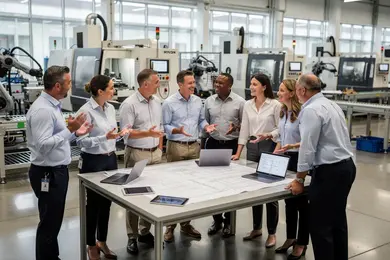
2027 Best Online Bachelor's in Engineering Management for Community College Graduates

Co-Founder and Chief Data Scientist
Community college graduates often face a high-stakes choice: finish an engineering-related bachelor's degree, move into management, or keep working without a four-year credential. An online bachelor's in engineering management can bridge technical training and leadership roles. The Bureau of Labor Statistics reported a $167,740 median annual wage for architectural and engineering managers in May 2024, showing why this pathway attracts experienced technical students. This guide explains transfer credits, accreditation, cost, timelines, coursework, jobs, and salary context so you can compare programs with confidence.
Key Things You Should Know
- The best online engineering management programs for community college graduates usually accept substantial transfer credit, but the most valuable programs clearly map associate-degree courses into junior-level major requirements.
- College Board's 2024 data lists average published tuition and fees at $4,050 for public two-year in-district colleges and $11,610 for public four-year in-state institutions, making transfer planning one of the strongest cost-control tools.
- For technical management careers, program accreditation, calculus and physics readiness, project-based coursework, and employer-recognized skills often matter more than whether the degree is fully online or hybrid.
What is an online bachelor's in engineering management for community college graduates?
An online bachelor's in engineering management is a four-year undergraduate degree designed for students who want to combine engineering, technology, operations, business, and project leadership. For community college graduates, the most attractive versions are degree-completion programs that accept an associate degree, prior technical coursework, or workforce training toward the bachelor's curriculum.
This degree is different from a traditional engineering major. A mechanical, civil, electrical, or environmental engineering degree usually focuses more deeply on engineering design and analysis, while engineering management prepares students to coordinate technical teams, budgets, production systems, quality processes, and product or process improvement projects.
The degree is often a good fit if you already have community college coursework in engineering technology, manufacturing, computer-aided design, industrial technology, electronics, construction technology, or pre-engineering. It may be less ideal if your main goal is to become a licensed professional engineer in a discipline that requires an ABET-accredited engineering degree and a state licensure pathway.
The table below summarizes how this degree compares with nearby academic options. Use it to decide whether engineering management matches your career direction or whether a more technical engineering pathway would be a better investment.
| Program type | Best fit | Main trade-off |
| Online bachelor's in engineering management | Community college graduates who want technical leadership, operations, quality, project coordination, or supervisory roles | Less specialized engineering depth than a traditional engineering major |
| Bachelor's in engineering technology | Students who prefer applied labs, manufacturing systems, field technology, or hands-on technical operations | May not align with all engineering licensure expectations |
| Bachelor's in industrial engineering | Students focused on systems optimization, production efficiency, logistics, and process improvement | Often more math-intensive and may have stricter prerequisite sequencing |
| Bachelor's in business administration | Students seeking broad management, finance, marketing, or entrepreneurship roles | Less technical credibility for engineering-heavy workplaces |
Which accreditation should an online engineering management program have?
Accreditation is one of the first quality checks you should make because it affects transferability, financial aid eligibility, employer recognition, and graduate school options. At minimum, choose a school accredited by an institutional accreditor recognized by the U.S. Department of Education or the Council for Higher Education Accreditation.
Programmatic accreditation is more nuanced. Some engineering management bachelor's programs are ABET-accredited, often through ABET's Engineering Accreditation Commission or Engineering Technology Accreditation Commission, depending on the curriculum. ABET accreditation can be especially important if you want a highly technical pathway, plan to pursue engineering licensure later, or want employers to see that the curriculum meets an external technical standard.
Before enrolling, use this sequence to verify accreditation rather than relying only on marketing language from a program page.
- Confirm the institution's accreditation status through the U.S. Department of Education's Database of Accredited Postsecondary Institutions and Programs or the accreditor's official directory.
- Check whether the specific engineering management degree, not just the school, has ABET accreditation if that matters for your goals.
- Ask the department whether online students earn the same diploma and transcript wording as campus students.
- If licensure may matter later, contact your state engineering board before assuming the degree will meet educational requirements.
A common mistake is assuming that any engineering-related bachelor's degree automatically supports the professional engineer pathway. In many states, licensure rules depend on the exact degree title, accreditation category, exam eligibility, and supervised engineering experience.
How do community college credits transfer into engineering management degrees?
Community college credits usually transfer in three ways: general education courses, lower-division technical courses, and electives. The strongest programs for transfer students publish articulation agreements, maintain course equivalency databases, and provide a preliminary transfer evaluation before you commit.
Transfer policy is where two similar-looking online programs can differ dramatically. One school may accept 60 to 75 credits toward the degree, while another may accept the same credits only as electives, forcing you to retake prerequisites or extend your timeline.
The table below shows common transfer scenarios and what they usually mean for a community college graduate. This is not a substitute for a school's official transfer evaluation, but it can help you ask better questions.
| Community college background | Likely transfer value | Questions to ask |
| Associate of Science in pre-engineering | Often strong for calculus, physics, chemistry, and general education requirements | Will calculus-based physics and engineering graphics count toward the major? |
| Associate of Applied Science in engineering technology | May transfer well to applied engineering management or technology-focused programs | Will technical courses satisfy major requirements or only electives? |
| Associate degree in business or management | Useful for general education and business foundations | Which math, science, and technical prerequisites are still missing? |
| Military, apprenticeship, or industry training | May count as prior learning credit at some schools | Is credit awarded by ACE recommendation, portfolio review, exam, or department approval? |
To protect your time and money, get transfer answers in writing before enrolling. The most important document is not a verbal estimate from admissions; it is a degree audit showing exactly which courses remain.
Use this checklist before you accept an offer of admission.
- Request an official or preliminary transfer evaluation that separates major credits, general education credits, and elective credits.
- Ask whether there is a maximum number of community college credits the university will apply toward the bachelor's degree.
- Confirm whether upper-division credit minimums require you to complete a set number of credits at the university.
- Check whether older math, science, or technical courses expire or require department review.
- Compare the remaining credits, not just the admitted credits, because the remaining credits determine your real cost and graduation date.
What admission requirements do online engineering management programs usually have?
Admission requirements vary, but online engineering management programs designed for transfer students usually look for completed college coursework, a minimum GPA, math readiness, and evidence that you can handle upper-division technical classes. Selective programs may require calculus, physics, statistics, or an associate degree before admission to the major.
Most applicants should prepare for the following requirements. These items matter because missing prerequisites can delay progress even after you are admitted to the university.
- Official transcripts from every college attended, including community college, dual enrollment, military education, or previous universities.
- A minimum transfer GPA, commonly set by the institution or engineering department rather than by the online division alone.
- Completed general education courses, especially college composition, communication, mathematics, and natural science.
- Prerequisite coursework in calculus, statistics, physics, chemistry, engineering graphics, computer applications, or technical writing, depending on the curriculum.
- A résumé or statement of purpose if the program is designed for working adults or evaluates technical experience.
If your community college transcript is strong in technical courses but weak in calculus or physics, do not assume you are out of options. Some programs offer bridge courses, summer prerequisites, or a technology-management version of the degree with more applied math. The better choice depends on whether you want technical management, engineering licensure preparation, or operations leadership.
The biggest admissions red flag is being accepted quickly without a clear academic plan. Fast admission is convenient, but it can hide prerequisite gaps that become expensive later.
How long does an online engineering management bachelor's degree take?
An online bachelor's in engineering management typically requires about 120 total semester credits, including transfer credits. For community college graduates who bring in a completed associate degree, the remaining timeline is often about two years of full-time study or three to four years part time, depending on course load, prerequisites, and term structure.
Accelerated online formats can shorten calendar time, but they are not always easier. Engineering management courses may include quantitative analysis, project work, team assignments, and technical writing, so taking too many credits while working full time can lead to withdrawal or lower grades.
The table below compares common pacing options. Use it to match the program format with your work schedule and family obligations.
| Enrollment pace | Typical fit | Main risk |
| Full time | Students who can handle 12 or more credits per term and want the fastest path to graduation | Heavy workload if advanced math, finance, and project courses overlap |
| Part time | Working adults, parents, military students, and students using employer tuition assistance | Longer completion time and potential course sequencing delays |
| Accelerated terms | Students with strong study habits and many completed prerequisites | Compressed deadlines can be difficult in technical courses |
| Cohort model | Students who want structure, peer support, and predictable scheduling | Less flexibility if you need to pause or change pace |
Students comparing management-oriented graduate pathways later may also look at a fast online master's in healthcare management or a technical master's program, but the bachelor's timeline should come first. Finishing the right undergraduate prerequisites can keep more graduate options open.
How much do online engineering management programs cost?
Cost depends on residency, transfer credits, tuition model, fees, books, technology requirements, and how many prerequisites you still need. For community college graduates, the most important cost metric is the price of the remaining credits, not the sticker price of a full four-year degree.
College Board's 2024 Trends in College Pricing reported average published tuition and fees of $11,610 for public four-year in-state students and $43,350 for private nonprofit four-year students for the 2024-25 academic year. That gap does not automatically make one option better, but it shows why transfer credit, institutional aid, and employer reimbursement can change the total cost substantially.
Use these cost benchmarks and categories when comparing programs.
- Public two-year in-district published tuition and fees average: $4,050 for 2024-25
- Public four-year in-state published tuition and fees average: $11,610 for 2024-25
- Public four-year out-of-state published tuition and fees average: $30,780 for 2024-25
- Private nonprofit four-year published tuition and fees average: $43,350 for 2024-25
Online programs may also charge distance education fees, proctoring fees, software subscriptions, lab kits, graduation fees, or higher tuition for upper-division engineering courses. Ask for a total program cost estimate based on your transfer evaluation, not a generic per-credit rate.
To reduce cost, compare net price instead of tuition alone. Net price includes grants and scholarships but excludes loans that must be repaid. If you work in manufacturing, utilities, construction, logistics, defense, healthcare technology, or public infrastructure, ask whether your employer reimburses engineering management coursework tied to promotion or supervisory tracks.
What coursework is included in an engineering management curriculum?
Engineering management curricula combine technical fundamentals with management tools. The goal is not just to teach students how engineering systems work, but how to lead projects, improve processes, evaluate costs, manage risk, and communicate across technical and nontechnical teams.
Most programs include coursework across the following areas. Review course descriptions carefully because two programs with the same degree title may lean toward manufacturing, construction, systems engineering, technology management, or industrial operations.
- Engineering foundations, such as engineering graphics, materials, mechanics, circuits, manufacturing processes, or systems engineering.
- Quantitative methods, including calculus, statistics, decision analysis, operations research, and data-based problem solving.
- Management coursework in project management, organizational behavior, leadership, finance, accounting, and engineering economics.
- Quality and process improvement topics such as Lean, Six Sigma, reliability, supply chain systems, safety, and continuous improvement.
- Capstone or applied project courses that require students to solve a technical management problem using data, cost analysis, and stakeholder communication.
AI and automation are increasingly relevant in engineering management because supervisors and project leads are expected to use dashboards, predictive maintenance data, simulation tools, and workflow automation. A strong program should teach students how to interpret technical data and make responsible decisions, not simply use software tools at a surface level.
A common mistake is choosing the program with the most business courses and assuming it will be better for management. In technical workplaces, credibility often comes from being able to understand constraints, safety requirements, production systems, and engineering trade-offs.
What jobs can you get with an engineering management degree?
An engineering management bachelor's degree can support roles that sit between engineering teams, operations departments, business units, and production environments. It is especially useful for community college graduates who already have technical experience and want to move into coordination, supervision, or process improvement.
The table below summarizes common career paths. Job titles vary by industry, so focus on responsibilities rather than titles alone when comparing postings.
| Role | Typical responsibilities | Where it appears |
| Engineering project coordinator | Tracks schedules, budgets, documentation, risk items, and communication between technical teams | Manufacturing, construction, utilities, product development, defense contractors |
| Manufacturing supervisor | Oversees production teams, safety, quality, workflow, equipment use, and performance targets | Advanced manufacturing, automotive, aerospace, electronics, food production |
| Quality assurance analyst or quality engineer associate | Analyzes defects, process variation, inspection data, corrective actions, and compliance documentation | Medical devices, manufacturing, pharmaceuticals, aerospace, suppliers |
| Operations analyst | Uses data to improve throughput, staffing, inventory, scheduling, and cost efficiency | Logistics, distribution, manufacturing, energy, service operations |
| Technical sales engineer associate | Explains technical products, supports customers, prepares proposals, and coordinates with engineering teams | Industrial equipment, software, automation, energy systems, materials suppliers |
This degree can also prepare students for graduate study in engineering management, systems engineering, operations, or business. If your long-term goal is broader executive or operations leadership, an operations management MBA online may become relevant after you gain professional experience.
The degree is probably not the best choice if you want a purely design-focused engineering role, a research-heavy engineering career, or a licensure-dependent civil engineering path. In those cases, a discipline-specific engineering degree may be more aligned with employer expectations.
How much can engineering management graduates earn?
Salary depends on industry, region, technical background, supervisory responsibility, and years of experience. An engineering management bachelor's degree can help position graduates for higher-responsibility roles, but it should not be treated as a guaranteed salary outcome.
BLS May 2024 wage data gives useful benchmarks for related U.S. occupations. These figures represent occupational medians, not starting salaries for new graduates.
| Occupation | Median annual wage, May 2024 | How to interpret it |
| Architectural and engineering managers | $167,740 | Usually requires substantial engineering or technical experience before moving into management |
| Industrial engineers | $101,140 | Relevant benchmark for systems, process improvement, production, and efficiency roles |
| Project management specialists | $100,750 | Useful comparison for technical project coordination and project control roles |
| Industrial production managers | $121,440 | Relevant for manufacturing leadership, plant operations, and production supervision |
For community college graduates, return on investment often depends on whether the bachelor's degree unlocks internal promotion, supervisory eligibility, or a move from hourly technical work into salaried technical management. The strongest ROI cases usually combine transfer credit, low remaining tuition, employer tuition assistance, and a clear target role.
If you already hold an engineering bachelor's degree and want deeper technical advancement, a cheapest online master's mechanical engineering option may be more relevant than a second undergraduate management degree. The right credential depends on whether your next step requires deeper engineering expertise or broader leadership capability.
Do engineering management careers require licensure or certification?
Many engineering management roles do not require licensure, especially in manufacturing, operations, project coordination, quality, logistics, technical sales, and internal process improvement. However, licensure can matter if your work involves offering engineering services to the public, signing off on engineering designs, or working in regulated civil, structural, environmental, or public infrastructure settings.
The professional engineer pathway is state-regulated. Requirements commonly include an eligible engineering degree, passing engineering exams, and supervised work experience under licensed engineers, but exact rules vary by state board. If licensure is even a possibility, check requirements before enrolling in an online engineering management program.
Certifications are more common than licenses for engineering management careers. They are usually optional, but they can help demonstrate specific skills to employers.
- Project Management Professional or Certified Associate in Project Management for students targeting project coordination, scheduling, risk, and stakeholder management.
- Lean Six Sigma Green Belt or Black Belt for students focused on process improvement, quality, waste reduction, and operational efficiency.
- Certified Manufacturing Engineer or related manufacturing credentials for students working in production, automation, machining, or industrial systems.
- Engineer in Training or Fundamentals of Engineering exam eligibility for students who may pursue professional engineering licensure later, subject to state rules.
A practical approach is to choose the degree first based on accreditation, transfer fit, and career goals, then add certifications that match the jobs you are applying for. Do not pay for multiple credentials at once unless a job posting, employer policy, or promotion pathway clearly values them.
Other Things You Should Know About Engineering Management
Community college graduates should consider accreditation, transfer credit policies, industry partnerships, and curriculum. A program with ABET accreditation and strong connections to the engineering industry can enhance job prospects and ensure comprehensive technical and management training.
Many students do, especially in programs built for transfer students and working adults. Part-time enrollment is often more realistic if you are taking advanced math, finance, quality, or capstone courses while working full time.
It is usually a hybrid. The best programs teach enough engineering and systems thinking to support technical credibility, while adding management, economics, quality, operations, and leadership coursework.
Most accredited online engineering management bachelor’s programs accept up to 60 to 90 transfer credits from a community college, with the final 30 to 60 credits completed at the university. The school’s registrar or transfer office must evaluate course equivalency, especially for calculus, physics, and general education courses.
References
- Best Online Master’s Programs in Engineering Management https://www.onlinemastersdegrees.org/best-programs/engineering/engineering-management/
- How to Become an Engineering Manager - Steps & Requirements https://www.onlineengineeringprograms.com/faq/how-to-become-an-engineering-manager
- Engineering Management Technology (BS) https://www.uagrantham.edu/online-degrees/engineering-management-technology-bachelors/
- 2025 Best Online Engineering Degrees https://www.onlineu.com/degrees/engineering
- Masters in Engineering Management Requirements: Everything You Need to Know https://authory.com/ErinCates/a/Masters-in-Engineering-Management-Requirements-Everything-You-Need-to-Know-a042e88d7bca1448f933a87eb4d386d43
- Why Pursue an Online Engineering Management Degree? https://engineeringmanagement.org/online-engineering-management-degree/
- Licensure and Certification for Engineering Professionals https://www.webuildstaffing.com/licensure-and-certification-for-engineering-professionals/