2027 How to Become a Nurse Midwife in Rhode Island - Midwife Schooling Requirements

Co-Founder and Chief Data Scientist
Becoming a nurse midwife in Rhode Island is a graduate-level nursing pathway for registered nurses who want to provide pregnancy, birth, postpartum, newborn, reproductive, and primary women’s health care. The decision matters because the route is not as simple as “go to midwifery school.” You must first become an RN, choose the right graduate program, complete supervised clinical training, pass national certification, and meet Rhode Island licensing requirements before you can practice as a certified nurse-midwife.
This guide is for nursing students, working RNs, career changers planning a nursing route, and Rhode Island residents comparing in-state, online, and out-of-state nurse-midwifery options in 2027. It explains the degree requirements, admissions expectations, clinical training, program costs, financial aid, accreditation, career outlook, and practical questions to ask before enrolling.
Quick answer: How do you become a nurse midwife in Rhode Island?
To become a nurse midwife in Rhode Island, you generally need to earn a BSN or enter an approved RN-to-MSN pathway, hold an active RN license, complete an ACME-accredited graduate nurse-midwifery program, finish supervised clinical training, pass the American Midwifery Certification Board exam, and apply for Rhode Island licensure as an advanced practice registered nurse. Plan for a long training timeline: about four years for a BSN, several months for RN licensure after the NCLEX-RN, and another two to three years for a graduate nurse-midwifery program.
Key Points About Becoming a Nurse Midwife in Rhode Island
- The minimum professional pathway is RN plus graduate education. Rhode Island practice depends on completing a recognized nurse-midwifery program and obtaining the required certification and licensure.
- Clinical preparation is central to the career. Some program summaries describe at least 600 hours of supervised practical experience, while Rhode Island-focused program guidance often cites 500 to 1,000 hours or at least 1,000 hours depending on the program and placement model.
- Accreditation is non-negotiable. Graduating from an ACME-accredited nurse-midwifery program is the key step that allows you to sit for national certification and pursue Rhode Island APRN authorization.
- Cost and location require planning. Dedicated in-state CNM options are limited, so many Rhode Island students compare online ACME-accredited programs that can arrange local clinical placements.
- The role can be rewarding, but it is not an entry-level nursing job. CNMs need advanced assessment, prescribing, birth management, emergency recognition, counseling, and interprofessional collaboration skills.
- Minimum degree needed to become a nurse midwife in Rhode Island
- Admission requirements for Rhode Island nurse-midwifery applicants
- Typical courses in nurse-midwifery programs
- Clinical training requirements and placement settings
- How long the CNM pathway usually takes
- Estimated nurse-midwifery school costs in Rhode Island
- Financial aid options for nurse-midwifery students
- Continuing education and professional development for Rhode Island CNMs
- Rhode Island nursing licensure requirements to know
- Accredited nurse-midwifery school and clinical pathway options
- Advanced degrees that support CNM career growth
- Accreditation for nurse-midwifery programs
- Job outlook for nurse midwives in Rhode Island
What is the minimum degree requirement to become a nurse midwife in Rhode Island?
The usual minimum degree for a certified nurse-midwife pathway in Rhode Island is a graduate nursing degree, most often a Master of Science in Nursing with a nurse-midwifery focus. Students must first become registered nurses, then complete advanced study in midwifery, reproductive health, primary care, pharmacology, assessment, and birth management.
An MSN in nurse-midwifery is not simply an academic credential. It is the professional preparation that connects RN-level nursing experience with advanced practice responsibilities. Students learn to evaluate pregnancy progression, identify complications, support physiologic birth when appropriate, manage postpartum and newborn care, provide gynecologic and reproductive health services, and collaborate with physicians and other clinicians when patients need higher-acuity care.
Some students pursue a Doctor of Nursing Practice instead of, or after, an MSN. A DNP may make sense for nurses who want to move into clinical leadership, quality improvement, policy, teaching, or program administration. However, the essential requirement for CNM eligibility is completion of an accredited nurse-midwifery educational pathway that qualifies the graduate for national certification.
For nurses comparing advanced practice specialties, nurse-midwifery is different from many other nursing tracks because it combines primary care, reproductive care, pregnancy care, labor and birth, postpartum support, newborn assessment, and health education. If you are also weighing earning potential across specialties, Research.com’s guide to high-paying nursing career paths can help you compare CNM training with other advanced nursing roles.
| Step | What it means | Why it matters for Rhode Island practice |
| Earn RN eligibility | Complete nursing education and pass the NCLEX-RN. | You need RN status before entering the advanced practice nurse-midwifery route. |
| Hold an active RN license | Maintain an unencumbered license in Rhode Island or another U.S. jurisdiction as required by the program. | Graduate programs and clinical sites usually require current RN authorization. |
| Complete graduate nurse-midwifery education | Finish an MSN, DNP, or approved bridge pathway with a nurse-midwifery concentration. | This is the academic foundation for national certification and APRN licensure. |
| Graduate from an ACME-accredited program | Verify that the program meets nurse-midwifery accreditation standards. | Accreditation affects certification eligibility, licensure, and employer recognition. |
What are the admission requirements for nurse midwife programs in Rhode Island?
Nurse-midwifery programs admit students who can handle graduate-level science, advanced clinical reasoning, and high-responsibility patient care. Rhode Island applicants should read each school’s requirements carefully because online, hybrid, MSN, DNP, and RN-to-MSN bridge programs may set different prerequisites.
- Prior nursing degree: A BSN is the standard entry credential. Some RN-to-MSN bridge programs accept applicants with an associate degree if they complete the required nursing and general education prerequisites.
- Active RN license: Applicants usually need a current, unencumbered registered nurse license from Rhode Island or another U.S. jurisdiction.
- Academic performance: Many programs expect at least a 3.0 undergraduate GPA, especially in nursing and science coursework.
- Clinical nursing background: One year or more of nursing experience is often preferred because midwifery requires strong patient assessment and communication skills. Labor and delivery, postpartum, women’s health, community health, and emergency care experience can be especially useful.
- Recommendations: Schools commonly request two or three letters from supervisors, faculty members, or clinicians who can speak to the applicant’s judgment, professionalism, and readiness for advanced practice.
- Personal statement or interview: Applicants may need to explain why they want to practice midwifery, how they understand the CNM role, and how they plan to serve patients and communities.
- GRE scores: Some programs still request GRE General Test results, but this requirement has become less common nationwide.
- International applicant documentation: Students educated outside the United States may need English proficiency results, evaluated transcripts, and proof of legal eligibility to study and complete clinical work.
- Accreditation check: Students should confirm that the program is accredited by the Accreditation Commission for Midwifery Education before enrolling.
- Background screening: A national criminal background check with fingerprints is required for state licensure after graduation, and clinical sites may require screening earlier.
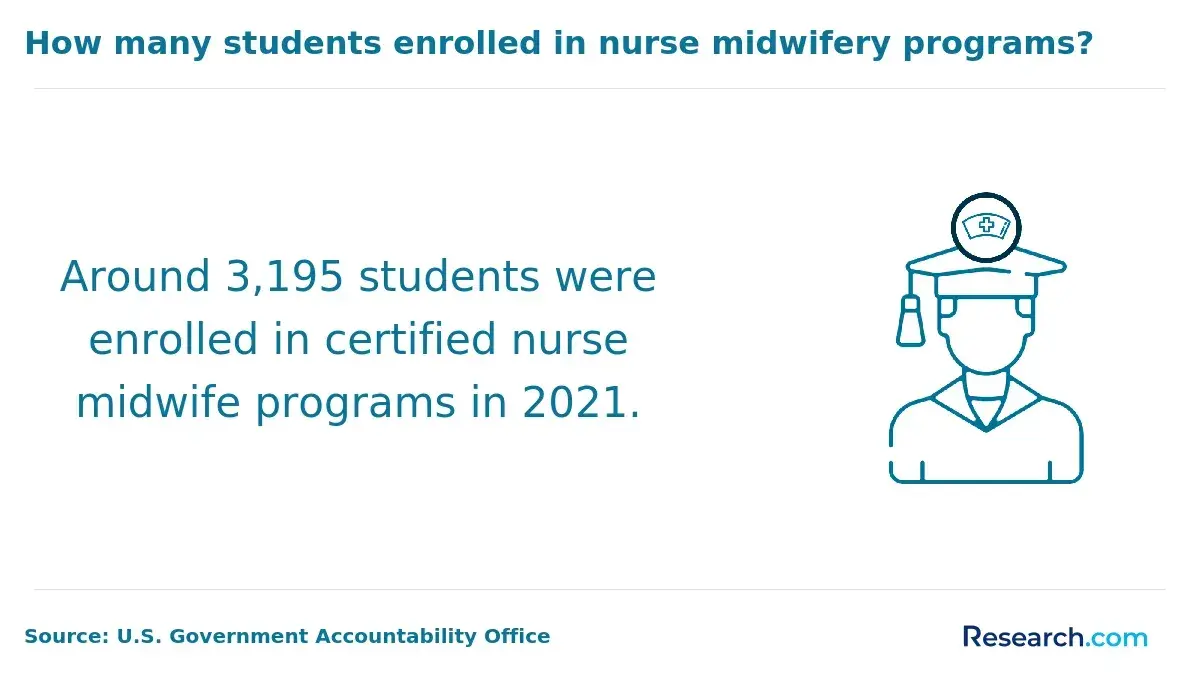
The graphic below notes that approximately 3,195 students enrolled in certified nurse-midwife programs in 2021. That interest reinforces why applicants should prepare early, especially if they need to strengthen prerequisites, obtain women’s health experience, or secure strong references.
| Applicant profile | Best next step | What to verify before applying |
| BSN-prepared RN | Compare MSN and DNP nurse-midwifery programs. | ACME accreditation, clinical placement support in Rhode Island, tuition, and certification eligibility. |
| ADN-prepared RN | Look for RN-to-MSN or bridge options. | Bridge prerequisites, transfer credit rules, and whether the route leads to CNM eligibility. |
| Non-nurse bachelor’s graduate | Plan first for RN education and licensure. | Accelerated BSN or entry-level nursing options before graduate midwifery training. |
| Internationally educated nurse | Request transcript evaluation and licensure guidance early. | English proficiency, RN license eligibility, immigration requirements, and clinical placement rules. |
What courses are included in nurse midwife programs in Rhode Island?
Nurse-midwifery coursework is designed to move registered nurses from generalist nursing practice into advanced, evidence-based care for women, pregnant patients, newborns, and families. While each school names courses differently, most accredited programs include the following areas.
- Advanced physiology and pathophysiology: Students study normal and abnormal body processes, including changes that occur during pregnancy, labor, postpartum recovery, and newborn transition.
- Advanced health assessment: This course builds the skills needed to conduct physical, reproductive, psychosocial, and newborn assessments and to recognize findings that require consultation or referral.
- Reproductive health across the lifespan: Students learn preventive care, gynecologic care, contraception counseling, sexual health, fertility-related concerns, and health promotion.
- Reproductive and perinatal pharmacology: Coursework covers medication selection, safety, prescribing considerations, and drug effects during pregnancy, lactation, and postpartum care.
- Pregnancy, birth, postpartum, and newborn care: These courses focus on antepartum management, labor support, intrapartum care, postpartum follow-up, newborn assessment, and patient education.
- Health promotion and disease prevention: Students learn how to counsel patients and families on nutrition, risk reduction, screening, mental health, and preventive care.
- Biostatistics and evidence-based practice: Students learn to interpret research, evaluate maternal and infant health data, and apply evidence to clinical decisions.
- Psychological and social dimensions of pregnancy: Programs address mental health, family dynamics, trauma-informed care, emotional adjustment, and culturally responsive support.
- Ethical and legal issues in midwifery: Students review professional boundaries, informed consent, scope of practice, documentation, collaboration, and state regulatory issues.
- Clinical practicums: Supervised rotations allow students to apply classroom learning in hospitals, clinics, birth centers, community health settings, and other approved sites.
These subjects help students meet the broader requirements for becoming a midwife while building skills that employers expect from advanced practice nurses. The chart below highlights common CNM resume competencies, including patient care, obstetrics, and CNM expertise, which are directly supported by this curriculum.
| Course area | Practical skill developed | Where the skill is used |
| Advanced assessment | Identifying normal and abnormal findings. | Prenatal visits, gynecologic care, labor triage, newborn exams. |
| Perinatal pharmacology | Making safe medication decisions. | Pregnancy care, postpartum care, contraception, infection management. |
| Birth management | Supporting labor and recognizing complications. | Hospital labor units, birth centers, collaborative care settings. |
| Evidence-based practice | Using research instead of habit or assumption. | Protocols, quality improvement, patient counseling, clinical decision-making. |
What are the clinical training requirements for nurse midwife programs in Rhode Island?
Clinical training is where nurse-midwifery students learn to make safe, timely decisions with real patients. Rhode Island does not add a separate clinical-hour standard beyond national program expectations, but students must complete the supervised experiences required by their accredited program and certification pathway.
Program descriptions commonly cite between 500 and 1,000 supervised clinical hours, while some Rhode Island-focused guidance refers to at least 1,000 clinical hours. Because requirements can vary by school, degree level, and certification plan, students should ask each program for its exact hour requirement, required birth numbers, patient encounter expectations, and placement process before enrolling.
Clinical rotations may take place in hospital labor and delivery units, OB/GYN practices, community health centers, birth centers, postpartum and newborn care settings, and, in some cases, supervised home birth environments. Preceptors may include certified nurse-midwives, women’s health nurse practitioners, and OB/GYN physicians. Their role is to supervise care, give feedback, protect patient safety, and help students develop independent clinical judgment.
Core clinical competencies include prenatal assessment, labor support, birth management, postpartum evaluation, newborn screening responsibilities, reproductive health care, counseling, documentation, and appropriate consultation or referral. Students should expect demanding schedules because births and clinical learning do not always fit neatly into standard daytime hours.
| Clinical setting | What students may learn | Questions to ask the program |
| Hospital labor and delivery | Labor assessment, intrapartum care, emergency recognition, interprofessional teamwork. | How many hospital shifts are required, and who supervises students? |
| OB/GYN or women’s health clinic | Prenatal visits, gynecologic care, contraception counseling, screening, preventive care. | Will the program help secure a Rhode Island-based preceptor? |
| Community health center | Culturally responsive care, patient education, care coordination, underserved population health. | Are students placed with patients across varied backgrounds and needs? |
| Birth center or home birth setting | Physiologic birth support, risk screening, transfer planning, family-centered care. | Does this setting count toward the program’s required competencies? |
Graduates often describe clinical training as the point where midwifery becomes real. It is not only about learning procedures; it is about learning when to reassure, when to intervene, when to consult, and how to communicate clearly during emotionally intense moments.
How long does it take to become a certified nurse midwife in Rhode Island?
From the start of a BSN to CNM certification, the full pathway commonly takes about seven to eight years. The timeline may be shorter for an RN who already has a BSN and relevant experience, and longer for students who study part time, repeat prerequisites, change programs, or wait for clinical placements.
- Complete RN preparation: A BSN typically takes about four years and provides the nursing foundation needed for graduate study.
- Pass the NCLEX-RN and obtain RN licensure: Exam scheduling and state processing can take several months.
- Build a competitive graduate application: Some applicants work for a year or more, especially in women’s health, labor and delivery, postpartum, emergency, or community health roles.
- Complete graduate nurse-midwifery education: Full-time MSN or DNP nurse-midwifery programs commonly take two to three years.
- Finish supervised clinical training: Students must meet their program’s clinical hour and competency requirements, often through placements in hospitals, clinics, and community settings.
- Pass national certification and apply for Rhode Island authorization: The AMCB exam and state licensing process are the final professional steps before independent CNM practice.
| Stage | Typical time mentioned in this guide | What can slow the timeline |
| BSN | About four years | Part-time enrollment, transfer issues, repeated science prerequisites. |
| NCLEX-RN and RN licensure | Several months | Testing availability, application errors, background check delays. |
| Graduate nurse-midwifery program | Two to three years full time | Part-time study, clinical placement delays, limited preceptor availability. |
| Total BSN-to-CNM route | About seven to eight years | Work schedules, program sequencing, licensing processing, failed or delayed exams. |
Online programs can make the academic portion more flexible, but they do not remove clinical requirements. Before choosing an online option, Rhode Island students should confirm who is responsible for finding preceptors, whether local clinical sites are available, and whether the program has experience placing students in the state.
How much does it cost to attend nurse midwife school in Rhode Island?
Nurse-midwifery education costs vary based on residency status, public versus private tuition, online fees, clinical travel, program length, and whether the student already holds a BSN. In Rhode Island, public graduate nursing tuition can serve as a useful reference point even when a school does not offer a dedicated nurse-midwifery track.
For in-state residents, tuition is described as near $17,789 per year. Out-of-state students may pay about $30,782 annually. Rhode Island College is cited as a benchmark even though it does not offer a dedicated nurse midwife track; its graduate nursing tuition is roughly $22,950 for the full program, or approximately $510 per credit.
Students should also budget for non-tuition costs. Mandatory program, clinical, and technology fees can add $500 to $2,000 yearly. Textbooks and materials may cost $1,000 to $2,000 over the program. Clinical supplies often total $200 to $500. Background checks, immunizations, and health requirements may add $100 to $300. Licensure and certification together may cost about $600 to $750.
| Cost category | Amount stated in this guide | Budgeting advice |
| In-state annual tuition benchmark | Near $17,789 per year | Confirm the rate for the exact graduate program and academic year. |
| Out-of-state annual tuition benchmark | About $30,782 annually | Ask whether online students pay resident, nonresident, or special program tuition. |
| Rhode Island College graduate nursing benchmark | Roughly $22,950 for the full program; approximately $510 per credit | Use this only as a comparison point if the program is not a dedicated CNM track. |
| Program, clinical, and technology fees | $500 to $2,000 yearly | Request a full fee sheet, not just the tuition number. |
| Books and course materials | $1,000 to $2,000 for the program | Ask whether digital resources, exam prep, or clinical software are included. |
| Clinical supplies | $200 to $500 | Include equipment, uniforms, lab coats, and required clinical tools. |
| Background checks, immunizations, health requirements | $100 to $300 | Clinical sites may require updated documentation before each rotation. |
| Licensure and certification | About $600 to $750 combined | Save for these costs before the final semester. |
If you are comparing CNM education with other advanced nursing routes, Research.com’s guide on how to become a nurse practitioner can help you understand where nurse-midwifery overlaps with, and differs from, other APRN pathways.
What financial aid options are available for nurse midwife students in Rhode Island?
Financial aid for nurse-midwifery students can include grants, loans, scholarships, work-study, fellowships, and loan repayment programs. The best approach is to build a funding plan early because graduate nursing costs often include tuition, fees, travel to clinical sites, exam fees, licensing costs, and reduced work hours during intensive rotations.
- Federal Pell Grants: Need-based grants of up to $7,495 annually are accessed through the FAFSA, though graduate eligibility depends on the student’s status and program type.
- Graduate Direct and PLUS Loans: Unsubsidized loans up to $20,500 and credit-checked PLUS loans can help cover tuition gaps.
- Federal Work-Study: Eligible students may earn $4,000–$8,000 yearly through part-time work, sometimes in healthcare-related settings.
- Rhode Island Foundation Scholarships: Nine scholarship funds support residents, minority students, and applicants committed to local practice through a single May 5 application.
- CPM Equity Initiative Fellowship: This fellowship provides full tuition and a stipend for Certified Professional Midwifery students with strong Rhode Island ties.
- Loan repayment programs: NHSC and state SLRPs may provide loan forgiveness or scholarship support for service in underserved areas.
Before borrowing, ask each school for its total cost of attendance, not only tuition. Then compare expected debt with realistic earnings, location preferences, and whether you are willing to work in underserved communities to qualify for repayment support.
| Funding option | Best for | Important caution |
| Scholarships | Students who meet residency, service, identity, academic, or community commitment criteria. | Deadlines can be early; missing one date can mean waiting another year. |
| Federal loans | Students who need predictable financing for graduate study. | Borrow only after calculating repayment under realistic salary assumptions. |
| Work-study or part-time work | Students who can balance employment with coursework and clinical rotations. | Clinical schedules can be unpredictable, especially around births. |
| Loan repayment programs | Graduates willing to serve in shortage or underserved settings. | Service obligations and eligible sites must be reviewed before relying on this aid. |
What are the continuing education and professional development opportunities for nurse midwives in Rhode Island?
Continuing education helps Rhode Island nurse midwives stay current with clinical standards, prescribing practices, maternal health priorities, risk management, newborn care, and changes in state requirements. CNMs may pursue workshops, conferences, specialty courses, simulation training, professional association events, and employer-based education.
Professional development can also include leadership training, quality improvement projects, preceptor preparation, health equity initiatives, lactation education, perinatal mental health training, and expanded reproductive health competencies. CNMs who want broader advanced practice preparation may compare related graduate options, including the best nurse practitioner programs in Rhode Island, especially if they are considering dual certification or a future DNP.
What are the unique requirements to be a nurse in Rhode Island?
Rhode Island nurses must meet state licensure rules in addition to completing their academic program. At the RN level, that means finishing approved nursing education, passing required national examinations, submitting the state application, and completing background checks as required. At the CNM level, the nurse must also meet advanced practice, national certification, and specialty education requirements.
Students should avoid assuming that admission to a school automatically guarantees Rhode Island licensure. Always confirm whether the program meets Rhode Island requirements, whether clinical placements are allowed in the state, and whether the curriculum supports the license or certification you intend to pursue. For a broader overview, see Research.com’s guide to the requirements for becoming a nurse in Rhode Island.
What are the top accredited nurse midwife schools in Rhode Island?
Rhode Island students should approach this question carefully. The state has limited dedicated in-state nurse-midwifery degree options, so the strongest pathway may involve an ACME-accredited online or out-of-state university combined with approved Rhode Island clinical placements. The priority is not the school’s name alone; it is whether the program is accredited, certification-eligible, clinically feasible, and accepted for Rhode Island licensure.
- Women & Infants Hospital Clinical Placement Program: This clinical training option connects nurse-midwifery students from partner universities with a high-acuity obstetric and newborn care environment.
- University of Rhode Island - College of Nursing (MSN/DNP Nurse-Midwifery): URI is described as collaborating with ACME-accredited programs through online didactic coursework and local clinical placements at major Rhode Island health systems.
- Commonsense Childbirth School of Midwifery-Rhode Island CPM Equity Initiative: This hybrid pathway focuses on Certified Professional Midwives and emphasizes maternal health equity, community-based midwifery, mentorship, and Rhode Island connections.
- Online ACME-Accredited Nurse-Midwifery Programs with RI Clinical Affiliates: Programs such as Frontier Nursing University and Georgetown University may offer online coursework with Rhode Island clinical placement possibilities for working RNs.
- Memorial Hospital of Rhode Island Clinical Training Sites: This clinical site can support hands-on labor, delivery, postpartum, and related care experiences under qualified supervision.
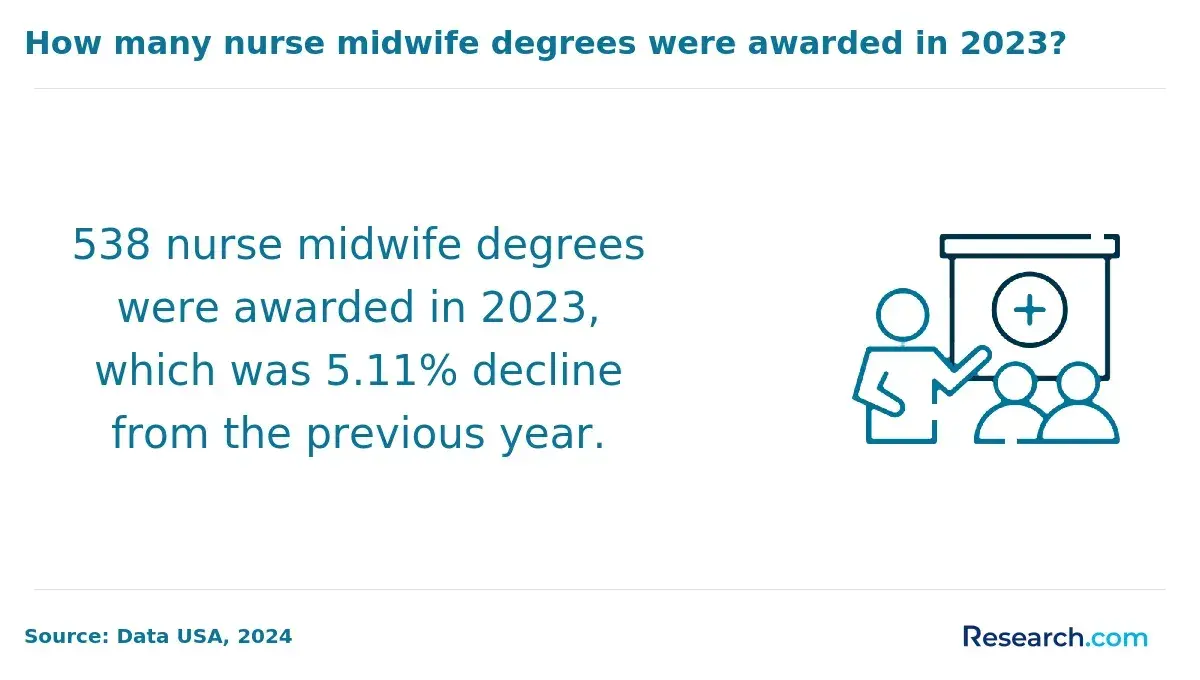
The chart below states that 538 nurse midwife degrees were awarded in 2023, a 5.11% decline from the prior year. That figure highlights why students should be strategic: compare accreditation, placement support, program outcomes, and costs before committing. If you are evaluating long-term financial return, Research.com’s overview of nursing salary by state can provide useful context.
| Program or pathway type | When it may make sense | What to verify |
| Rhode Island clinical placement through an accredited partner | You want local patient care experience while enrolled elsewhere. | Whether the academic program is ACME-accredited and whether the site has approved preceptors. |
| Online ACME-accredited nurse-midwifery program | You are a working RN who needs flexibility. | Who finds preceptors, whether Rhode Island placements are available, and whether the program meets state rules. |
| DNP nurse-midwifery route | You want advanced clinical leadership or policy preparation. | Total time, cost, clinical requirements, and certification eligibility. |
| CPM-focused pathway | You are interested in community midwifery outside the CNM route. | Licensure implications, scope differences, and whether the credential matches your career goal. |
Which advanced degrees support career advancement for CNMs in Rhode Island?
After becoming certified, nurse midwives can use additional graduate education to move into leadership, teaching, program development, policy, quality improvement, and specialized clinical practice. The right degree depends on whether the goal is direct patient care, administrative leadership, academic work, or broader advanced practice coverage.
- Master of Science in Nursing – Nurse Midwifery: This is the core graduate degree for many CNMs and prepares nurses for certification, licensure, and advanced clinical practice in pregnancy, birth, reproductive health, and newborn care.
- Dual Nurse-Midwife/Women’s Health Nurse Practitioner Programs: Dual preparation may expand a clinician’s ability to provide reproductive and women’s health care across a broader lifespan and may support roles in clinics, hospitals, and program leadership.
- Doctor of Nursing Practice: A DNP can strengthen skills in systems leadership, population health, quality improvement, policy, and evidence-based practice implementation.
- MSN with Other Specializations: Additional preparation in areas such as Family Nurse Practitioner or Psychiatric Mental Health Nurse Practitioner may support interdisciplinary practice, mental health integration, academic roles, or broader community-based care.
The chart below notes that over 70% of CNMs hold master’s or bachelor’s degrees, while associate, diploma, and other credentials are less common. That education pattern reflects how central graduate training is to modern CNM practice.
| Career goal | Degree or credential to consider | Why it helps |
| Independent CNM clinical practice | MSN in nurse-midwifery | Provides the standard graduate preparation for certification and licensure. |
| Expanded women’s health services | Dual CNM/WHNP preparation | Supports broader reproductive and gynecologic care across the lifespan. |
| Leadership or quality improvement | DNP | Builds skills in systems change, policy, outcomes, and clinical program design. |
| Interdisciplinary or mental health-focused care | Additional MSN specialization | May broaden practice options depending on certification and licensure rules. |
What organizations accredit nurse midwife programs in Rhode Island?
The Accreditation Commission for Midwifery Education is the key accrediting body for nurse-midwifery programs. ACME operates under the American College of Nurse-Midwives and is recognized by the U.S. Department of Education. For Rhode Island students, ACME accreditation is the main quality and eligibility checkpoint when choosing a CNM program.
Graduating from an ACME-accredited program is required for eligibility to sit for the American Midwifery Certification Board examination and to pursue Rhode Island advanced practice authorization. Without the right accreditation, a student may complete coursework and still be unable to become certified or licensed as intended.
This is especially important for students considering online programs. A flexible format can be helpful, but flexibility is not a substitute for accreditation, certification eligibility, and state approval. If you are still comparing midwifery roles and credentials, Research.com’s guide on how to become a midwife explains broader salary and career pathway considerations.
| Accreditation question | Why it matters | What to ask before enrolling |
| Is the program ACME-accredited? | Accreditation affects certification and licensure eligibility. | Can the school provide current ACME accreditation status in writing? |
| Does the program meet Rhode Island requirements? | State rules determine whether you can practice after graduation. | Has the program placed and licensed graduates in Rhode Island? |
| Are clinical placements approved? | Clinical hours must meet program and certification expectations. | Who secures preceptors, and what happens if a placement falls through? |
| Are graduates eligible for the AMCB exam? | The exam is required for CNM certification. | What is the program’s certification exam preparation process? |
What is the current job outlook for nurse midwives in Rhode Island?
The job outlook for nurse midwives in Rhode Island is shaped by demand for maternal health services, preventive reproductive care, community-based care models, and employer interest in advanced practice clinicians. CNMs may work in hospitals, OB/GYN practices, community health centers, academic health systems, birth centers, public health programs, and collaborative care teams.
Because Rhode Island is a small state, job openings may be more concentrated than in larger labor markets. That makes networking, clinical placement quality, preceptor relationships, and willingness to work across settings important. Students should track local employer postings, talk with practicing CNMs, and ask programs where recent graduates have found positions.
Technology is also affecting midwifery practice. Electronic health records, telehealth follow-ups, patient portals, remote education tools, and data-driven quality improvement are now part of many care environments. These tools do not replace the hands-on judgment required in pregnancy and birth care, but they do change how CNMs communicate, document, monitor, and coordinate care.
For students exploring healthcare entry points before advanced practice, Research.com’s guide to CNA requirements in Rhode Island may be useful, although CNA work is a separate pathway from becoming a CNM.
Is becoming a nurse midwife in Rhode Island worth it?
Becoming a nurse midwife in Rhode Island can be worth it for RNs who are committed to women’s health, pregnancy care, patient education, and advanced clinical responsibility. It is a strong fit for nurses who want long-term relationships with patients, can handle unpredictable schedules, and are comfortable making decisions in emotionally intense settings.
It may not be the best fit if you want a short training timeline, predictable office-only hours, minimal liability, or a role with no birth-related emergencies. The education is demanding, clinical placements can be competitive, and the work requires emotional resilience.
| Choose the CNM path if... | Consider another route if... |
| You want to provide pregnancy, birth, postpartum, newborn, and reproductive care. | You prefer a narrower nursing specialty with less birth-related responsibility. |
| You are ready for graduate-level science and clinical reasoning. | You are not prepared to complete an MSN, DNP, or bridge program. |
| You can manage unpredictable clinical schedules. | You need a role with consistent daytime hours throughout training and practice. |
| You value patient counseling, education, and shared decision-making. | You prefer technical tasks over ongoing patient relationships and counseling. |
Common mistakes to avoid when choosing a Rhode Island nurse-midwifery pathway
- Choosing a program before checking ACME accreditation: Accreditation should be verified first, not after enrollment.
- Assuming online means easier: Online coursework may be flexible, but clinical requirements are still intensive and must be completed in approved settings.
- Ignoring clinical placement responsibility: Some programs help arrange placements; others expect students to find preceptors. This can make or break the timeline.
- Comparing tuition only: Fees, supplies, travel, certification, background checks, and reduced work hours can significantly affect total cost.
- Assuming every midwifery credential has the same scope: CNM and CPM pathways are different. Make sure the credential matches your intended practice role.
- Waiting too long to review Rhode Island licensure rules: State requirements should be checked before applying, before starting clinicals, and before graduation.
- Relying only on rankings or name recognition: A well-known school is not useful if it cannot support Rhode Island clinical placement or certification eligibility.
Questions to ask before enrolling in a nurse-midwifery program
- Is the program currently accredited by the Accreditation Commission for Midwifery Education?
- Are graduates eligible to sit for the American Midwifery Certification Board exam?
- Has the program successfully placed students in Rhode Island clinical settings?
- Who is responsible for finding preceptors: the school, the student, or both?
- How many supervised clinical hours are required, and what patient experiences must be documented?
- What happens if a clinical site cancels or a preceptor becomes unavailable?
- Does the curriculum meet Rhode Island APRN and CNM licensure expectations?
- What is the total cost of attendance, including fees, supplies, travel, exams, and licensing?
- Can I attend part time, and how would that affect clinical sequencing and graduation?
- Where do recent graduates work, and how does the program support certification exam preparation?
Key Insights
- Rhode Island nurse midwives need RN preparation, graduate nurse-midwifery education, national certification, and state advanced practice authorization.
- The safest program choice is an ACME-accredited nurse-midwifery pathway that clearly supports AMCB exam eligibility and Rhode Island licensure.
- Clinical training is a major decision factor. Ask how placements are arranged, where Rhode Island students train, and what happens if preceptor access is limited.
- The full BSN-to-CNM route commonly takes about seven to eight years, though already licensed BSN-prepared RNs may move faster.
- Costs extend beyond tuition. Budget for annual fees, materials, clinical supplies, health requirements, background checks, certification, and licensure.
- Online programs can work well for Rhode Island RNs, but only if accreditation, clinical placement, and state eligibility are confirmed before enrollment.
- CNM practice is best suited to nurses who want advanced responsibility in reproductive, pregnancy, birth, postpartum, and newborn care—not those seeking a quick or low-intensity credential.
Related Articles for Nearby States
- 2027 How to Become a Nurse Midwife in Massachusetts - Midwife Schooling Requirements
- 2027 How to Become a Nurse Midwife in Connecticut - Midwife Schooling Requirements
- 2027 How to Become a Nurse Midwife in New York – Midwife Schooling Requirements
- 2027 How to Become a Nurse Midwife in New Jersey - Midwife Schooling Requirements
- 2027 How to Become a Nurse Midwife in Vermont – Midwife Schooling Requirements
- 2027 How to Become a Nurse Midwife in New Hampshire - Midwife Schooling Requirements
- 2027 How to Become a Nurse Midwife in Pennsylvania - Midwife Schooling Requirements
- 2027 How to Become a Nurse Midwife in Delaware – Midwife Schooling Requirements
- 2027 How to Become a Nurse Midwife in Maine – Midwife Schooling Requirements
- 2027 How to Become a Nurse Midwife in Maryland – Midwife Schooling Requirements
References:
- American College of Nurse Midwives. Guidance on becoming a midwife.
- Caring Careers Rhode Island. Career advancement resources.
- Common Sense Midwifery. Rhode Island CPM Equity Initiative Program information.
- GradSchools.com. Midwifery programs in Rhode Island 2025.
- Midwife Schooling. Nurse-midwife pathway in Rhode Island.
- NursingEducation.org. Certified nurse-midwife career guide.
- Nurse.org. Certified nurse-midwife program overview.
- Rhode Island Midwives. Rhode Island Midwives Equity Initiative.
- RNtoMSN. MSN options in Rhode Island.
- University of Nevada, Las Vegas. Certified nurse midwifery licensure information for Rhode Island.
Other Things You Need to Know About How to Become a Nurse Midwife in Rhode Island
Rhode Island licenses advanced practice registered nurses, including nurse midwives, through the Rhode Island Board of Nursing. Applicants must hold an active RN license, complete a graduate nurse-midwifery program, and meet national certification requirements before applying for state APRN authority.
To become a certified Nurse Midwife in Rhode Island by 2026, you need to earn a Bachelor's in Nursing, pass the NCLEX-RN exam, gain clinical experience, complete a Master’s or Doctorate in Nurse-Midwifery, and pass the AMCB certification exam. Also, obtain a state license and get credentialed in a healthcare facility.
To become a Nurse Midwife in Rhode Island in 2027, you must hold a registered nursing (RN) license, complete a Master’s degree in Nurse Midwifery accredited by the Accreditation Commission for Midwifery Education (ACME), and pass the national certification examination by the American Midwifery Certification Board (AMCB).