
2027 Nursing Informatics Salary by State

Co-Founder and Chief Data Scientist
The nursing informatics salary in the US continues to demonstrate strong growth in recent years. Payscale (2025) data shows average annual earnings climbing to $99,161 in 2025, which underscores the value of expertise in digital health and clinical technology.
However, with nearly 80% of nurse informaticists now working remotely in data analysis and EMR management, salary potential increasingly depends on specialization, location, and industry demand (IMIA, 2025).
In this guide, I will cover the projected outlook for nursing informatics compensation, examining salary trends, career pathways, and regional variations. I will also share how to maximize earnings, identify high-demand roles, and navigate career opportunities effectively.
What are the benefits of pursuing a nursing informatics degree?
- Pursuing a nursing informatics degree develops advanced expertise in combining clinical knowledge with healthcare technology to improve patient outcomes.
- The degree expands career opportunities, opening pathways to specialized roles in electronic health record management, data analytics, and health IT leadership.
- It strengthens professional competitiveness, equipping graduates with skills in informatics, digital health strategy, and evidence-based decision-making that are highly valued across healthcare systems.
- How much does a nursing informatics professional earn? Salary Overview
- What is the average nursing informatics salary by state? Average Salary
- Which cities offer the highest salaries for nursing informatics professionals? Highest Salaries
- Which states provide the most favorable tax advantages for nursing informatics nurses? Tax Advantages
- How much does an entry-level nursing informatics nurse earn? How much does an entry-level nursing informatics nurse earn?
- What additional pay or incentives are available for nursing informatics roles? Additional Pay & Incentives
- What career paths lead to the highest-paying nursing informatics positions? Career Paths
- Which advanced degrees can increase nursing informatics salaries? Advanced Degrees
- Which certifications can enhance nursing informatics' earning potential? Which certifications can enhance nursing informatics' earning potential?
- What is the projected outlook for nursing informatics salaries? Salary Outlook
Nursing Informatics Salary Guide: How Much Can You Earn?
Nursing informatics is one of the clearest career pivots for registered nurses who want to combine clinical judgment with electronic health records, data quality, workflow redesign, analytics, and digital patient care tools. Salary matters because this path often requires additional education, informatics experience, certifications, or a move away from traditional bedside schedules. Before investing in a certificate or graduate degree, nurses need to know what the pay looks like, which roles pay more, and what actually raises earning potential.
This guide explains nursing informatics salary ranges by role, location, experience level, education, certification, and advancement path. It is designed for nurses comparing informatics with other specialties, working RNs considering graduate study, and healthcare professionals deciding whether a move into clinical technology is worth the time and cost. If you are still looking for a flexible way to enter the field, reviewing the most accessible online nursing informatics programs can help you compare academic options that fit your schedule.
Quick answer: What is a typical nursing informatics salary?
Nursing informatics salaries vary widely by job title, employer, location, education, certification, and leadership responsibility. Payscale (2025) reports salaries ranging from $75,190 per year for a nursing informatics analyst to $105,973 per year for a clinical informatics manager among the roles listed below. Higher-level positions, such as director of clinical informatics or chief nursing informatics officer, can pay substantially more according to ZipRecruiter (2025), especially when the role includes enterprise strategy, budget oversight, and large-scale technology implementation.
| Role | Reported salary | What the role usually focuses on | Best fit for |
| Informatics Nurse | $85,161 per year | Improving how clinical teams use data, electronic health records, and care documentation tools. | RNs who want to stay close to clinical workflows while moving into technology-supported care improvement. |
| Clinical Informatics Specialist | $87,921 per year | Supporting electronic health record systems, translating clinical needs into system changes, and improving workflow integration. For a deeper role breakdown, see this guide to clinical informatics specialist salary and career paths. | Nurses who enjoy training users, solving workflow problems, and working with IT teams. |
| Nursing Informatics Analyst | $75,190 per year | Analyzing clinical data, reporting trends, and helping teams use information to improve care quality and operations. | Professionals who prefer analytics, reporting, data validation, and process measurement. |
| Clinical Informatics Manager | $105,973 per year | Leading informatics teams, managing projects, coordinating stakeholders, and aligning technology with clinical goals. | Experienced informatics professionals ready for supervision, planning, and organizational responsibility. |
| Health Informatics Specialist | $78,220 per year | Connecting healthcare operations, technology platforms, and clinical decision support needs. | Nurses or healthcare professionals who want a broader informatics role beyond nursing-specific workflows. |
| Informatics Consultant | $95,000 per year | Advising healthcare organizations on digital health strategy, system implementation, optimization, compliance, and workflow redesign. | Experienced professionals who can manage client expectations, diagnose system problems, and recommend practical improvements. |
The salary pattern is clear: roles with broader organizational impact, project ownership, stakeholder management, and leadership duties tend to pay more than roles focused mainly on support or analysis. However, salary data should be treated as a benchmark, not a guarantee. Employer type, local labor market, clinical background, and technical skills can all change the final offer.
What Is the Average Nursing Informatics Salary by State?
Location can change the real value of a nursing informatics salary. States with major hospital systems, high healthcare technology adoption, large academic medical centers, or strong digital health markets may offer higher pay. ZipRecruiter data cited for this article shows Washington averaging $111,457 per year and the District of Columbia averaging $111,204 per year for nurse informatics roles.
Lower reported averages appear in some states with smaller healthcare markets or different local wage structures. West Virginia is listed at $76,185 per year, while Florida is listed at $73,540 per year. These figures do not mean those states lack opportunity; they mean nurses should evaluate salary together with cost of living, tax treatment, remote work options, and employer benefits. For a broader look at the role itself, review this guide on how to become a nurse informaticist and salary expectations.
| Location factor | Why it affects pay | What to check before relocating |
| Healthcare market size | Large systems often need informatics staff for EHR optimization, reporting, training, compliance, and enterprise projects. | Look for academic medical centers, multi-hospital systems, telehealth programs, and health IT employers. |
| Cost of living | A higher salary may not translate into higher disposable income if housing, commuting, and taxes are also higher. | Compare rent, transportation, state taxes, and health insurance costs before accepting an offer. |
| Technology adoption | Organizations using advanced EHR tools, analytics platforms, telehealth systems, and AI-enabled workflows may need more specialized talent. | Ask what systems the employer uses and whether the role supports implementation, optimization, analytics, or governance. |
| Remote or hybrid flexibility | Some informatics tasks can be handled remotely, but implementation, training, and stakeholder meetings may require onsite work. | Confirm whether remote work is permanent, hybrid, department-specific, or subject to change. |
| Local demand for informatics expertise | Markets with fewer qualified informatics nurses may offer more competitive pay to attract experienced candidates. | Review job postings for repeated requirements such as EHR build, data analytics, project management, or certification. |
The chart below, based on ZipRecruiter data, highlights states with the highest nurse informatics salaries.
Which Cities Offer the Highest Salaries for Nursing Informatics Professionals?
City-level salary differences often reflect the concentration of hospitals, specialty clinics, research centers, software vendors, consulting firms, and healthcare headquarters. A city with a modest state average can still offer strong informatics pay if it has a dense healthcare ecosystem or major employers investing in digital health.
Reported city-level salary advantages include the following:
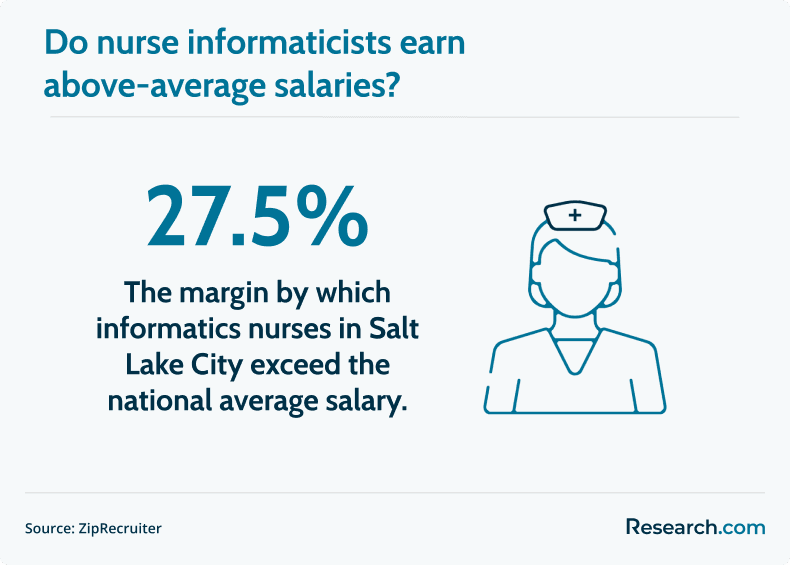
- Salt Lake City, Utah: Informatics nurses earn approximately 27.5% above the national average, supported by a growing healthcare sector and strong use of advanced medical technology.
- Nashville, Tennessee: Salaries are about 3.2% higher than the national average, reflecting the city’s large healthcare management and hospital system presence.
- Pittsburgh, Pennsylvania: Informatics nurses earn 2.1% more than average, helped by established healthcare networks, research institutions, and technology-supported medical initiatives.
Do not choose a city by salary alone. A better approach is to compare total compensation, professional growth, commute, housing, hybrid work policies, and licensing or continuing education requirements. Nurses should also keep track of nursing continuing education requirements by state, since renewal rules can affect long-term career planning and eligibility for advancement.
| Question to ask | Why it matters |
| Are there multiple employers hiring informatics nurses? | A city with several hospitals, vendors, or consulting firms gives you more leverage and mobility. |
| Does the role require onsite support? | Training, go-lives, and clinical rounding can reduce the flexibility that many nurses expect from informatics work. |
| Is the salary high after adjusting for living costs? | A higher offer may be less attractive if housing and transportation absorb the difference. |
| Can the role build transferable skills? | Experience with EHR optimization, analytics, governance, and project leadership can support future promotion. |
The chart below shows cities where nursing informatics salary levels are reported to be especially strong.
Which States Provide the Most Favorable Tax Advantages for Nursing Informatics Nurses?
Base salary is only part of compensation. State income tax rules can affect how much of a nursing informatics salary you actually keep. A job offer in a higher-paying state may be less valuable than it appears if taxes and living costs are high, while a slightly lower salary in a no-income-tax state may produce stronger take-home pay for some professionals.
According to state income tax information available through income tax rates by state, the following states are commonly noted for having no state income tax:
- Florida
- South Dakota
- Texas
- Nevada
- Wyoming
- Alaska
- Tennessee
Tax treatment should not be the only reason to accept or reject a role. Nurses should also consider salary growth, employer retirement contributions, health benefits, professional development funding, licensure costs, housing, and whether the role offers experience that leads to higher-paying informatics positions later.
| Compensation item | Why it changes take-home value |
| State income tax | It directly affects net income, especially for higher-paying informatics leadership roles. |
| Retirement match | A strong 401(k) or 403(b) match can make one offer more valuable than another with a slightly higher base salary. |
| Health insurance premiums | Lower premiums and better coverage can meaningfully improve total compensation. |
| Remote work policy | Hybrid or remote work can reduce commuting costs and may expand your job market. |
| Education reimbursement | Employer support for certificates, graduate study, or certification fees can reduce the cost of career advancement. |
How Much Does an Entry-Level Nursing Informatics Nurse Earn?
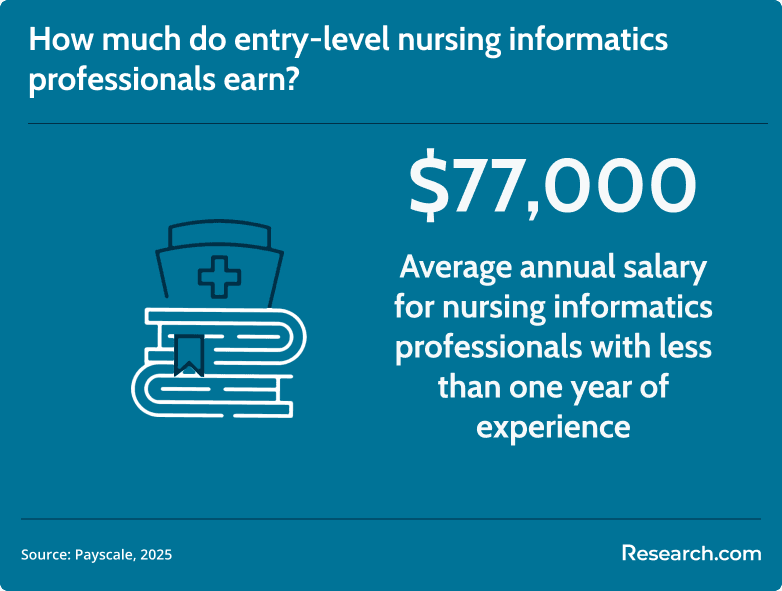
Entry-level nursing informatics professionals with less than one year of experience typically earn around $77,000 annually. At this stage, many nurses are still learning how clinical workflows, data standards, EHR tools, reporting needs, and stakeholder communication fit together. The early role may involve user support, documentation improvement, workflow observation, testing, training, and assisting with system optimization.
With one to four years of experience, informatics nurses report salaries of about $83,000 annually. The increase reflects a shift from learning the environment to handling more complex assignments, such as coordinating small projects, improving documentation processes, supporting analytics requests, or helping translate clinical problems into system requirements.
If you are comparing informatics with other nursing specialties, it can be useful to review compensation in clinical roles such as operating room nurse salary by state. The better question is not only which role pays more today, but which path matches your preferred work style, long-term schedule, technical interests, and advancement goals.
| Career stage | Reported salary | Typical focus | How to move up |
| Less than one year of experience | $77,000 annually | Learning systems, supporting users, assisting with documentation and workflow projects. | Build EHR fluency, learn reporting tools, document project contributions, and seek mentorship from senior informatics staff. |
| One to four years of experience | $83,000 annually | Managing more complex informatics tasks, helping improve clinical workflows, and supporting data-driven initiatives. | Take ownership of measurable projects, pursue certification when eligible, and develop project management skills. |
What Additional Pay or Incentives Are Available for Nursing Informatics Roles?
Nursing informatics compensation can include much more than base pay. Because informatics work can affect patient safety, compliance, documentation quality, care coordination, and operational performance, employers may use benefits and incentives to recruit and retain experienced professionals. Understanding where a role sits in the broader nursing hierarchy can also help explain why management and executive informatics roles often include stronger compensation packages.
HIMSS survey data cited in this article shows that 75% of nurse informaticists report having a money purchase pension plan, while 68% identify access to a 401(k) or 403(b) as a top benefit. Those retirement benefits can significantly change the long-term value of an offer, especially when comparing two roles with similar salaries.
| Benefit or incentive | How it may show up | Why it matters |
| Performance bonuses | Additional pay tied to project completion, department goals, implementation milestones, or quality improvement outcomes. | Can reward informatics professionals who lead successful system changes or measurable workflow improvements. |
| Shift differentials | Higher rates for evenings, nights, weekends, or implementation support outside normal business hours. | Relevant for hospital-based informatics roles involved in go-lives, upgrades, or urgent system support. |
| Certification stipends | Fee reimbursement, bonus pay, or salary recognition for approved informatics credentials. | Reduces the cost of professional validation and may support promotion eligibility. |
| Relocation packages | Employer support for moving expenses when hiring for hard-to-fill informatics positions. | Can make a high-opportunity market more accessible, but nurses should compare the offer against living costs. |
| Continuing education reimbursement | Funding for conferences, courses, graduate credits, or informatics training. | Helps nurses keep skills current as EHR tools, analytics platforms, and digital care models evolve. |
| Profit-sharing or 401(k)/403(b) matches | Employer contributions to retirement plans or long-term incentive programs. | Improves total compensation beyond salary and can support long-term financial planning. |
| Telecommuting or flexible work options | Remote, hybrid, compressed schedule, or flexible start-time arrangements. | Can lower commuting costs and improve work-life balance, but policies should be confirmed in writing. |
When comparing offers, ask for the full compensation package, not just the salary. A role with a slightly lower base salary may be better if it includes strong retirement contributions, paid certification support, flexible work, and graduate tuition reimbursement.
The chart below from HIMSS shows benefits and non-salary compensation commonly reported by nurse informaticists.
What Career Paths Lead to the Highest-Paying Nursing Informatics Positions?
The highest-paying nursing informatics paths usually combine clinical credibility, health IT knowledge, analytics, project leadership, and organizational strategy. Nurses who move from user support into implementation leadership, consulting, management, or executive digital health roles generally have stronger salary potential than those who remain in narrowly defined support positions.
ZipRecruiter (2025) reports the following salaries for advanced informatics-related roles:
| Advanced role | Reported salary | Main responsibility | Skills that matter most |
| Director of Clinical Informatics | $144,228/year | Leads system-wide clinical informatics strategy and helps align technology with care delivery goals. | Leadership, governance, EHR strategy, stakeholder management, and quality improvement. |
| Chief Nursing Informatics Officer | $155,833/year | Guides major nursing technology strategy and digital transformation across an organization. | Executive communication, nursing leadership, informatics governance, budgeting, and change management. |
| Health Informatics Consultant | $127,950/year | Advises organizations on informatics systems, implementation planning, optimization, and data use. | Client communication, workflow analysis, project delivery, EHR expertise, and problem solving. |
| EMR Implementation Specialist | $100,068/year | Coordinates electronic medical record adoption, testing, training, workflow build, and implementation support. | EHR configuration knowledge, training, troubleshooting, project coordination, and clinical operations understanding. |
| Health Informatics Manager | $93,422/year | Uses data and informatics processes to improve population health, community health, or operational outcomes. | Analytics, team management, reporting, process improvement, and cross-functional collaboration. |
| Telehealth Director | $103,744/year | Oversees virtual care strategy, remote patient engagement, and telehealth delivery models. | Virtual care operations, technology adoption, compliance awareness, workflow design, and leadership. |
For nurses weighing informatics against advanced practice specialties, comparing compensation with roles such as pediatric nurse practitioner salary by state can clarify the trade-off between clinical specialization and technology leadership. Informatics may be especially attractive if you enjoy systems thinking, training, analytics, and organizational change more than direct diagnosis and treatment.
A practical route into higher-paying roles is to combine clinical experience with targeted informatics education. An online graduate certificate in nursing informatics can be useful for nurses who already hold a nursing degree and want focused preparation without immediately committing to a full graduate program.
How to position yourself for higher-paying roles
- Build a clinical foundation. Employers often value informatics nurses who understand real bedside documentation, care coordination, safety risks, and workflow pressure.
- Get involved in technology projects. Volunteer for EHR optimization teams, documentation committees, super-user roles, or quality improvement initiatives.
- Learn the language of data and systems. Become comfortable with reporting, workflow mapping, data quality, privacy, testing, and user training.
- Document measurable outcomes. Keep examples of projects where your work improved documentation, reduced errors, improved adoption, or helped teams use data more effectively.
- Pursue education or certification strategically. Choose credentials that match the role you want, not simply the credential that is easiest to obtain.
Which Advanced Degrees Can Increase Nursing Informatics Salaries?
Advanced education can improve salary potential because many higher-paying informatics roles require leadership, research, analytics, systems thinking, and strategic planning. HIMSS (2023) data cited in this article shows that 25% of professionals with doctorates or nurse practitioner credentials report salaries of $176,000 or more, compared to 12% of those with master’s degrees and only 8% of those with bachelor’s degrees.
The same HIMSS data shows that most nurse informaticists with bachelor’s degrees (52%) earn between $76,000 and $125,000 annually. Among ADNs/LPNs, most (57%) earn $100,000 or less, with nearly a third earning under $75,000. These figures do not mean everyone needs a doctorate, but they do show that education can affect access to senior roles and higher salary bands.
| Advanced degree option | What it builds | Best suited for | Potential career direction |
| Master of Science in Nursing (MSN) – Informatics | Advanced nursing knowledge, informatics principles, EHR optimization, workflow design, and clinical technology leadership. | RNs who want to move into informatics management, systems improvement, or clinical technology leadership. | Clinical informatics manager, informatics nurse specialist, EHR optimization lead, or nursing technology project leader. |
| Doctor of Nursing Practice (DNP) – Informatics | Executive practice leadership, evidence-based systems change, care quality improvement, and organizational strategy. | Nurses aiming for senior leadership, enterprise transformation, or high-impact organizational roles. | Executive informatics leader, consultant, digital health strategist, or clinical transformation leader. |
| MBA with Healthcare Focus | Finance, operations, strategy, management, and business decision-making in healthcare settings. | Informatics professionals who want to manage budgets, teams, vendors, or health technology strategy. | Health IT director, operations leader, policy advisor, or healthcare technology executive. |
| PhD in Nursing Informatics | Research design, theory development, statistical methods, informatics scholarship, and academic leadership. | Professionals interested in research, academia, policy, or evidence generation. | Faculty member, researcher, policy contributor, or informatics scholar. |
| Master’s in Health Informatics | Healthcare systems, data science, information technology, analytics, and population health applications. | Nurses who want a broader interdisciplinary informatics path beyond nursing-specific roles. | Clinical systems analyst, health data specialist, policy consultant, or analytics-focused informatics professional. |
| MS in Information Systems with Nursing Focus | Database management, cybersecurity, systems architecture, integration, and healthcare technology application. | Nurses who want deeper technical preparation for systems, architecture, or implementation leadership. | Health IT architect, systems integration specialist, or senior project manager. For broader options, review this health informatics career guide. |
How to decide whether an advanced degree is worth it
- Choose an MSN or graduate certificate if your goal is to enter informatics or move into a clinical informatics specialist or manager role.
- Consider a DNP if you want to lead major organizational change, influence nursing technology strategy, or compete for executive roles.
- Consider an MBA if your target roles involve budgets, vendors, operations, and technology investment decisions.
- Consider a PhD if you want to publish research, teach, influence policy, or contribute to informatics science.
- Compare tuition against realistic salary movement. Do not assume a degree automatically guarantees a raise; ask employers how they evaluate education for promotion and salary placement.
Which Certifications Can Enhance Nursing Informatics Earning Potential?
Certifications can help nurse informaticists demonstrate specialized knowledge in clinical systems, data, workflow improvement, analytics, and healthcare information management. They may also strengthen a promotion case, help candidates stand out in competitive searches, or support movement into consulting and leadership. However, certification usually works best when paired with relevant experience; it is not a substitute for hands-on informatics work.
HIMSS data cited in this article reports that 58% of nurse informaticists with an informatics certification earn between $76,000 and $100,000 annually. The value of certification depends on the employer, the job description, and whether the credential matches the work being performed.
| Certification | What it signals | When it may be useful |
| ANA’s Informatics Nursing Certification (RN-BC) | Competence in nursing informatics practice, clinical data use, system support, and technology-enabled care improvement. | Useful for RNs seeking credibility in nursing-focused informatics roles or advancement within clinical informatics teams. |
| HIMSS Certified Professional in Healthcare Information and Management Systems (CPHIMS) | Knowledge of healthcare information systems, management, implementation, and health IT leadership. | Helpful for professionals pursuing management, consulting, project leadership, or enterprise health IT roles. |
| AMIA Health Informatics Certification (AHIC) | Interdisciplinary informatics expertise across patient care, analytics, research, and biomedical information practice. The credential is connected to the broader informatics work described by the American Medical Informatics Association. | Valuable for professionals working across clinical, research, analytic, or interdisciplinary informatics environments. |
| AHIMA Certified Health Data Analyst (CHDA) | Skill in healthcare data analysis, information governance, reporting, and population health data interpretation. | Best for nurses moving toward analytics-heavy roles, data quality work, reporting leadership, or health information management. |
| AMIA Specialty Pathways | Focused expertise in specialized areas such as clinical research informatics or translational bioinformatics. | Useful for nurses aiming for research, innovation, specialized analytics, or technology development roles. |
Certification decision checklist
- Does the credential appear in job postings for the roles you want?
- Does your employer reimburse exam fees, preparation courses, or renewal costs?
- Will certification support a promotion, raise, or transfer into an informatics department?
- Do you already meet the experience requirements, or would more project experience be more valuable first?
- Does the credential match your target path: nursing informatics, health IT leadership, analytics, research, or consulting?
What Is the Projected Outlook for Nursing Informatics Salaries?
The salary outlook for nursing informatics remains positive because healthcare organizations continue to rely on electronic records, digital care tools, data reporting, telehealth, compliance systems, and technology-supported quality improvement. Nurse informaticists are valuable because they understand both clinical realities and the systems that shape documentation, workflows, safety, and decision-making.
Salary estimates cited in this article show growth from an average of $93,722 in 2023 to $95,893 in 2024, with estimates reaching $99,161 in 2025. This upward movement reflects the increasing importance of professionals who can help healthcare teams use technology safely and effectively.
Several trends may continue to support demand for informatics expertise:
- Electronic medical record optimization: Healthcare organizations still need professionals who can improve documentation, reduce workflow friction, and support better data capture.
- Telehealth and virtual care: Remote care models require workflow design, patient engagement tools, compliance processes, and integration with existing clinical systems.
- AI and predictive analytics: As organizations test analytics-driven tools, they need clinically informed professionals who can evaluate usability, safety, bias, workflow fit, and documentation impact.
- Compliance and reporting pressure: Data quality, privacy, patient safety, and regulatory reporting continue to make informatics expertise important.
- Consulting and implementation work: System upgrades, vendor transitions, and workflow redesign projects create opportunities for experienced informatics professionals.
At the same time, nurses should avoid assuming that every informatics role is high-paying or fully remote. Entry-level roles may involve support tasks, hybrid work, off-hour implementation coverage, or limited authority. The strongest salary growth typically comes from combining clinical experience with measurable project results, technical fluency, certification, and leadership ability.
The chart below from Zippia shows nursing informatics salary movement from 2021 to 2025.
Is a Nursing Informatics Career Worth It?
Nursing informatics can be worth it for nurses who want to influence care delivery at the system level rather than provide direct bedside care full time. It may offer competitive salaries, leadership potential, exposure to healthcare technology, and opportunities in hospitals, vendors, consulting firms, academic medical centers, government-related health initiatives, and telehealth organizations.
It is not the right fit for every nurse. Informatics work often involves meetings, documentation review, user training, data validation, system testing, stakeholder negotiation, and project deadlines. Nurses who prefer direct patient contact, procedural work, or highly predictable clinical routines may find the transition less satisfying.
| This path may be a good fit if you... | You may want another path if you... |
| Enjoy solving workflow problems and improving systems. | Want most of your workday to involve direct hands-on patient care. |
| Are comfortable learning EHR tools, analytics platforms, and digital health systems. | Dislike technology troubleshooting, documentation analysis, or meetings. |
| Can communicate with nurses, physicians, administrators, analysts, and IT teams. | Prefer working independently without cross-functional collaboration. |
| Want long-term options in leadership, consulting, implementation, or analytics. | Are not interested in project timelines, change management, or system adoption challenges. |
| Like using clinical experience to improve care for large groups of patients indirectly. | Need immediate salary growth without additional learning, certification, or project experience. |
Common Mistakes to Avoid When Pursuing Higher Nursing Informatics Pay
- Choosing a program without checking accreditation. If you pursue a degree or certificate, confirm that the institution is properly accredited and that the credential is respected by employers in your target market.
- Looking only at tuition. Program cost should include fees, books, technology requirements, travel, lost work time, and whether your employer offers reimbursement.
- Assuming an online program automatically fits your career goal. Online study can be flexible, but you still need relevant coursework, faculty expertise, clinical technology exposure, and a curriculum aligned with informatics roles.
- Ignoring hands-on project experience. Employers often care about what systems you have used, what problems you solved, and whether your work improved workflows or data quality.
- Expecting certification alone to raise your salary. Certification may help, but it is strongest when paired with experience, leadership, and measurable accomplishments.
- Accepting a job based only on base pay. Compare retirement contributions, certification reimbursement, remote work policies, bonuses, health insurance, and growth opportunities.
- Overlooking state requirements. Licensure renewal and continuing education rules can differ by state, which matters if you relocate or work across state lines.
- Relying only on salary averages. Averages can hide major differences by employer, location, experience, technical stack, and leadership scope.
Questions to Ask Before Accepting a Nursing Informatics Role
- What EHR, analytics, reporting, or telehealth systems will I support?
- Is the position primarily support, training, analytics, implementation, optimization, management, or strategy?
- How is success measured in this role?
- Will I supervise staff, manage a budget, or lead projects?
- Is the position remote, hybrid, onsite, or dependent on implementation schedules?
- Does the employer pay for certification, conferences, graduate coursework, or continuing education?
- What are the promotion paths from this role?
- How often are salary reviews conducted?
- Will I be expected to provide after-hours support during upgrades, go-lives, or system outages?
- How does the organization involve nurses in technology decisions?
References
- HIMSS (2022). Nursing Informatics Workforce 2023 Salary and Benefits Report. Retrieved from HIMSS Nursing Informatics Workforce 2023 Salary and Benefits Report
- HIMSS (2023). Nursing Informatics Workforce 2023 Salary and Benefits Report. Retrieved from HIMSS Nursing Informatics Workforce 2023 Salary and Benefits Report
- IMIA (2025). IMIA Nursing Informatics. Retrieved from IMIA Nursing Informatics
- Payscale (2025). Average Clinical Informatics Manager Salary. Retrieved from Payscale Clinical Informatics Manager Salary
- Payscale (2025). Average Clinical Informatics Specialist Salary. Retrieved from Payscale Clinical Informatics Specialist Salary
- Payscale (2025). Average Health Informatics Specialist Salary. Retrieved from Payscale Health Informatics Specialist Salary
- Payscale (2025). Average Informatics Nurse Salary. Retrieved from Payscale Informatics Nurse Salary
- Payscale (2025). Average Nursing Informatics Analyst Hourly Pay. Retrieved from Payscale Nursing Informatics Analyst Salary
- Zippia (n.d.). Job Outlook for Informatics Nurses in the United States. Retrieved from Zippia Informatics Nurse Job Trends
- ZipRecruiter (2025). Chief Nursing Informatics Officer Salary. Retrieved from ZipRecruiter Chief Nursing Informatics Officer Salary
- ZipRecruiter (2025). Director Clinical Informatics Salary. Retrieved from ZipRecruiter Director Clinical Informatics Salary
- ZipRecruiter (2025). Director Telehealth Salary. Retrieved from ZipRecruiter Director Telehealth Salary
- ZipRecruiter (2025). EMR Implementation Specialist Salary. Retrieved from ZipRecruiter EMR Implementation Specialist Salary
- ZipRecruiter (2025). Health Informatics Consultant Salary. Retrieved from ZipRecruiter Health Informatics Consultant Salary
- ZipRecruiter (2025). Health Informatics Manager Salary. Retrieved from ZipRecruiter Health Informatics Manager Salary
- ZipRecruiter (2025). What Is the Average Informatics Nurse Salary by State. Retrieved from ZipRecruiter Average Informatics Nurse Salary by State
Key Insights
- Nursing informatics salaries depend heavily on role scope. Analyst and specialist roles tend to pay less than management, consulting, director, and executive informatics roles.
- Payscale (2025) salary examples in this guide range from $75,190 per year for a nursing informatics analyst to $105,973 per year for a clinical informatics manager.
- Advanced leadership roles can pay more: ZipRecruiter (2025) lists $144,228/year for director of clinical informatics and $155,833/year for chief nursing informatics officer.
- Location matters, but take-home value matters more. Compare salary with state income tax, housing, benefits, remote work options, and retirement contributions.
- Entry-level informatics nurses typically earn around $77,000 annually, rising to about $83,000 annually with one to four years of experience.
- Advanced degrees and certifications can improve earning potential, but they work best when paired with hands-on EHR, analytics, implementation, workflow, or leadership experience.
- The best-paying paths usually require more than technical knowledge. Communication, change management, stakeholder trust, and measurable project outcomes are often what move nurses into higher-paying informatics leadership roles.
Other Things You Should Know About the Nursing Informatics Salary
In 2027, nursing informatics salaries show significant variation by state due to factors like cost of living and demand for healthcare IT specialists. States like California, New York, and Massachusetts offer higher salaries, often exceeding $100,000 annually, while states with lower demand may offer salaries closer to $80,000.
Yes. Employers in compact-licensure states can hire nurses who hold a multistate RN license under the Nurse Licensure Compact, or NLC. However, most informatics jobs still base pay on the state where the employer is located, not the nurse’s license type.
In 2027, states like California, New York, and Massachusetts offer the highest salaries for nursing informatics professionals, driven by a higher cost of living and increased demand for healthcare technology expertise. These states typically provide better compensation packages to attract qualified talent.


