
2027 Best LPN Programs in South Carolina – Accredited Online LPN Programs

Co-Founder and Chief Data Scientist
Choosing an LPN program in South Carolina means making several decisions at once: whether the program is approved for licensure, whether the schedule works with your job or family responsibilities, whether clinical sites are realistic to reach, and whether the school prepares students well for the NCLEX-PN. Practical nursing remains a meaningful entry point into healthcare in the state. In 2022, South Carolina’s nursing workforce included around 76,800 professionals, including 9,080 licensed practical nurses (LPNs).
This guide is for prospective nursing students comparing online-friendly and hybrid LPN programs in South Carolina, working adults who need flexible coursework, and healthcare employees who want to move into licensed nursing. You will learn what “online LPN program” actually means, which South Carolina schools offer flexible options, how licensing works, what costs to expect, how clinical placement affects your schedule, and how to decide whether becoming an LPN fits your career plan.
Quick answer: Can you complete an LPN program online in South Carolina?
You can complete part of some South Carolina LPN programs online, but you cannot complete the entire program remotely. Practical nursing education requires in-person skills labs, simulations, and supervised clinical practice. To qualify for licensure, you must graduate from a state-approved practical nursing program, apply through the South Carolina Board of Nursing, and pass the NCLEX-PN.
Why choose an online-friendly or hybrid LPN program in South Carolina?
- Hybrid formats may make nursing school easier to manage because selected academic courses can be completed online while required clinical and lab training remains in person.
- According to the United States Bureau of Labor Statistics, licensed practical nurses in South Carolina earn an average annual wage of $51,060.
- An LPN license can support employment in hospitals, nursing homes, long-term care facilities, home healthcare agencies, physician offices, clinics, hospice, palliative care, and other direct-care environments.
What should you expect from an online LPN program?
In South Carolina, an “online LPN program” is usually a hybrid practical nursing program rather than a fully remote credential. A school may offer online lectures, assignments, discussion boards, or general education courses, but students still report to campus or approved healthcare sites for hands-on training. This distinction is important because LPNs must show competency in direct patient care before they can become licensed.
Typical practical nursing programs include nursing fundamentals, adult health, maternal-child nursing, pharmacology, anatomy and physiology, mental health concepts, professional standards, and clinical decision-making. Even when some coursework is online, expect firm attendance requirements for labs, simulations, and clinical rotations.
| Program element | What students usually complete | Online availability |
| General education | Courses such as English composition, psychology, algebra, or basic science requirements | Often offered online, depending on the college |
| Nursing theory | Foundational nursing concepts, pharmacology, medical-surgical topics, and professional practice standards | May be online, hybrid, or campus-based |
| Skills lab | Practice in assessment, procedures, infection control, safety, and basic patient-care techniques | No, generally completed face to face |
| Clinical rotations | Supervised training in hospitals, long-term care facilities, clinics, or community settings | No, completed at approved clinical sites |
| NCLEX-PN preparation | Review activities, practice questions, test strategies, and remediation support | May be online, on campus, or blended |
Where can you work with a practical nurse license in South Carolina?
Once licensed by the South Carolina Board of Nursing (SCBON), LPNs may work in a wide range of healthcare settings. Common workplaces include hospitals, long-term care centers, nursing homes, physician offices, outpatient clinics, home health agencies, school health offices, hospice and palliative care providers, correctional facilities, public health departments, and some research-related environments.
The right setting depends on the type of nursing work you want. Long-term care and home health often focus on chronic conditions, medication support, observation, and ongoing patient relationships. Clinics and physician practices may involve screenings, documentation, patient education, and routine care coordination. Hospital roles can provide broader clinical exposure, although availability may depend on the employer’s staffing model and preference for RN coverage.
How much do LPNs make in South Carolina?
The United States Bureau of Labor Statistics reports that LPNs in South Carolina earn an average annual wage of $51,060, or $24.55 per hour. The national average annual wage is $55,860. South Carolina’s cost of living is 6% lower than the national average based on cost of living data from the Council for Community and Economic Research, which can influence the practical value of wages across different regions.
Actual earnings can differ by location, employer, shift, specialty, care setting, and experience level. Compensation and scheduling may also vary across long-term care, home health, hospitals, correctional healthcare, and specialty clinics.
- Best Online LPN Programs in South Carolina for 2027
- How to Become an LPN in South Carolina
- Cost of Online LPN Programs in South Carolina
- How Long It Takes to Become an LPN in South Carolina
- Admission Requirements for Online LPN Programs in South Carolina
- Can an Online Certificate Lead to LPN Licensure?
- Online vs. Campus LPN Programs
- Is South Carolina a Good State for LPNs?
- LPN Job Outlook in South Carolina
- Courses in a Practical Nursing Program
- How to Choose an Online LPN Program in South Carolina
- Clinical Placement Options for LPN Students
- Accreditation and Regulatory Standards
- Nutrition Specialization for LPNs
- Specialized Certifications for South Carolina LPNs
- LPN Licensing Requirements in South Carolina
- Steps to Earn and Maintain LPN Certification
- Can LPNs Become Nurse Practitioners?
- How State Healthcare Policies Affect LPN Programs
- Support Systems for LPN Students in South Carolina
- How LPNs Can Transition to RN Roles in South Carolina
- Advanced Nursing Education Options
- Financial Aid and Scholarships for LPN Students
- Future Career Growth for LPNs in South Carolina
Best Online LPN Programs in South Carolina for 2027
How we evaluated these programs
Because practical nursing school requires a serious investment of time and money, program comparisons should rely on verifiable details instead of advertising language. Research.com reviewed South Carolina schools with online-friendly or hybrid practical nursing pathways using our established research methodology. We also considered data from the IPEDS database, Peterson’s database, including its Distance Learning Licensed Data Set, the College Scorecard database, and the National Center for Education Statistics.
Treat this list as an initial screening tool rather than a final decision. Before you apply, verify current tuition, program approval, clinical-site rules, application deadlines, NCLEX outcomes, and whether online course sections are available during your intended enrollment term.
| School | Program format | Estimated cost | 2022 exam pass rate listed | Best fit |
| Midlands Technical College | Hybrid format with online activities plus in-person clinical requirements | $188-$235/credit hour (resident), $564/credit hour (non-resident) | 100% (18/18) NCLEX-PN | Students seeking a three-semester diploma with ACEN accreditation |
| Piedmont Technical College | Campus-based nursing courses with selected online general education options | $2,325-$2,730/semester (resident), $3,399/semester (non-resident) | 90.24% (37/41) NCLEX-PN | Applicants who prefer a smaller cohort and future LPN-to-RN options |
| Williamsburg Technical College | Hybrid availability for some general education coursework | $187-$192/credit hour (resident), $350/credit hour (non-resident) | 95% (19/20) NCLEX-PN | Full-time students looking for a 40-week pathway |
| Technical College of the Lowcountry | Hybrid general coursework with in-person nursing components | $214-$239/credit hour (resident), $445/credit hour (non-resident) | 100% (1/1) NCLEX-PN | Students comparing 42-credit diploma options with ACEN accreditation |
| Aiken Technical College | Hybrid-friendly option with selected remote general education courses | $189-$204/credit hour (resident), $267/credit hour (non-resident) | 98% (49/50) NCLEX-RN ADN | LPNs planning to continue into an ADN bridge route |
| Orangeburg Calhoun Technical College | Flexible instruction option for eligible students | $205/credit hour (in-country), $246/credit hour (out-of-county), $330/credit hour (out-of-state) | 97.62% NCLEX-PN | Students who have completed coursework or bring some healthcare experience |
1. Midlands Technical College
Midlands Technical College provides a practical nursing diploma that combines online learning activities with required in-person participation. Students may be able to take courses such as English composition, general psychology, and anatomy online, while nursing labs and clinical experiences occur face to face under registered nurse supervision. The curriculum also includes community-based internship experiences intended to strengthen practical patient-care ability. The diploma can usually be completed in three semesters.
- Estimated Cost: $188-$235/credit hour (resident), $564/credit hour (non-resident)
- 2022 NCLEX-PN Pass Rate: 100% (18/18)
- Other Programs Offered: Nursing Assistant Certification, ADN
- Accreditation/Approval: SCBON, Accreditation Commission for Education in Nursing (ACEN)
2. Piedmont Technical College
Piedmont Technical College offers a diploma program for students preparing to seek LPN licensure in South Carolina. Nursing classes are held at either the Lex Walters-Greenwood or Laurens campus, while some general education requirements may be completed online if approved by the college or program director. Admission is capped at 32 students, which may benefit applicants who want a more limited cohort size. The 43-credit-hour curriculum includes subjects such as algebra, physiology, and pharmacology, and students must maintain a minimum GPA of 2.5 or higher to finish the three-semester sequence.
- Estimated Cost: $2,325-$2,730/semester (resident), $3,399/semester (non-resident)
- 2022 NCLEX-PN Pass Rate: 90.24% (37/41)
- Other Programs Offered: AAS in Nursing, LPN to ADN, RN to BSN
- Accreditation/Approval: SCBON
3. Williamsburg Technical College
Williamsburg Technical College offers a practical nursing diploma with limited hybrid flexibility. Core nursing courses, including surgical and maternal nursing, are delivered on campus. Some general education requirements, such as psychology or English, may be offered online, but students should verify availability with an advisor before building a schedule around remote classes. Applicants must pass the Test of Essential Academic Skills (TEAS) with a score of at least 60 or higher. The program requires 48 credit hours and can be completed by full-time students within 40 weeks.
- Estimated Cost: $187-$192/credit hour (resident), $350/credit hour (non-resident)
- 2022 NCLEX-PN Pass Rate: 95% (19/20)
- Other Programs Offered: Nursing Assistant Certification, ADN, LPN to RN
- Accreditation/Approval: SCBON
4. Technical College of the Lowcountry
Technical College of the Lowcountry offers a 42-credit-hour practical nursing diploma that may be completed in as little as one year, or three consecutive semesters. With college approval, selected general education courses may be available in a hybrid format. The curriculum includes topics such as anatomy and physiology, organizational strategies, and human growth and development. The college reports a graduate employment outcome of 95%, which may help applicants evaluate workforce alignment and career preparation.
- Estimated Cost: $214-$239/credit hour (resident), $445/credit hour (non-resident)
- 2022 NCLEX-PN Pass Rate: 100% (1/1)
- Other Programs Offered: CNA, ADN
- Accreditation/Approval: SCBON, ACEN
5. Aiken Technical College
Aiken Technical College provides an LPN-ADN pathway built around 30 credits of general education and 35 credits of major nursing coursework. Students begin with a transition semester and then complete two additional semesters that prepare them for the RN exam. Course topics may include clinical practice, psychiatric and mental health nursing, nursing fundamentals, and children’s care. Most courses meet during daytime or evening hours, while selected general education courses may be available remotely with school approval.
- Estimated Cost: $189-$204/credit hour (resident), $267/credit hour (non-resident)
- 2022 NCLEX-RN ADN Pass Rate: 98% (49/50)
- Other Programs Offered: Pre-Nursing Certificate, PN Diploma, AAS in Nursing
- Accreditation/Approval: SCBON, ACEN
6. Orangeburg Calhoun Technical College
Orangeburg Calhoun Technical College offers a practical nursing pathway with a flexible instructional option for students who have already completed some coursework and have some healthcare experience. Eligible students may complete certain classes online while still meeting required hands-on training expectations. The program is designed to build technical nursing skills and practical knowledge for entry-level care roles.
- Estimated Cost: $205/credit hour (in-country), $246/credit hour (out-of-county), $330/credit hour (out-of-state)
- 2022 NCLEX-PN Pass Rate: 97.62%
- Other Programs Offered: ADN, RN to BSN
- Accreditation/Approval: ACEN
What graduates say about online practical nursing study
“Being able to complete parts of practical nursing online helped me stay in school while handling work and family obligations. The flexible platform, interactive lessons, and accessible instructors kept me motivated and helped me feel ready for clinical learning.” Cathy
“Online coursework cut down on commuting and allowed me to replay lectures when I needed more time with a topic. Even with remote academic work, the program still encouraged peer connection and connected the classroom material to clinical practice.” James
“The mix of virtual instruction, simulation, and hands-on practice helped me become more confident with nursing skills. I also became more comfortable using technology, which matters more and more in healthcare.” Edna
Key findings for South Carolina LPN students
- Employment for LPNs in South Carolina is projected to grow 12% from 2020 to 2030.
- Online-friendly practical nursing programs in South Carolina often take 10 to 20 months, depending on the schedule, course load, and program structure.
- To practice as an LPN in South Carolina, you must complete an approved program, pass the NCLEX-PN, and obtain licensure through the South Carolina Board of Nursing.
- South Carolina has an average first-time NCLEX-PN pass rate of 87.1%.
- The SC General Assembly had set aside $20 million to help the local Commission on Higher Education attract and retrain nursing instructors.
How do you become an LPN in South Carolina?
South Carolina is among the top 10 states facing a major nursing shortage, with a projected deficit of 11% by 2035. For students who want a faster route into nursing than a four-year degree, practical nursing can provide a direct path into patient care.
The usual process for becoming an LPN in South Carolina includes the following steps:
- Complete an accredited or state-approved practical nursing program, including an approved hybrid or online-friendly South Carolina option if that format fits your needs.
- Gather required materials, such as identification documents, a Notarized Signature Affidavit with a passport photo, proof of legal name, and Social Security card number.
- File an initial licensure application with the Board and pay the $70 application fee without a Temporary License or the $80 fee with a Temporary License.
- Register for the National Council Licensure Examination for Practical Nurses (NCLEX-PN), including your Social Security number, the $200 payment, and the Certificate of Endorsement page of your SC Application for Licensure by Examination completed by your program director.
- Prepare for and pass the NCLEX-PN.
- Receive your LPN license from the SCBON before working independently within the practical nursing scope.
South Carolina also has a Temporary License option for qualified applicants completing the final exam and licensing steps. If granted a Temporary License, you must take the exam within 90 days of receiving it and practice only with the required supervision.
Licensure is not a one-time obligation. South Carolina LPNs renew every two years, pay a renewal fee of $75, and complete at least 30 verified contact hours from approved continuing education sources, including online nursing degree programs that provide continuing education. Other qualifying renewal options may include certification, recertification, or completion of an academic nursing program.
What is the typical cost of online LPN programs in South Carolina?
Many South Carolina practical nursing diplomas are offered by public technical or community colleges, which may make them more affordable than longer four-year nursing pathways. At public two-year institutions in South Carolina, the average tuition and fees from 2020 to 2021 were $4,964 for in-state students and $10,313 for out-of-state students, according to the National Center for Education Statistics, 2022.
Bridge programs or programs offered through four-year institutions can cost more. In the same period, public four-year institutions charged $12,544 for in-state tuition and fees and $33,055 for out-of-state tuition and fees, while private four-year schools charged $27,317. Your final cost can change based on residency, enrollment pace, clinical fees, lab fees, uniforms, textbooks, supplies, testing charges, distance learning fees, transportation, and background check requirements.
| Cost category | Why to include it | Question to ask the school |
| Tuition and fees | Published tuition is usually the biggest visible cost, but it may not show the full amount owed | Is tuition listed per credit, per semester, or for the entire program? |
| Clinical expenses | Students may need uniforms, immunizations, health screenings, and regular transportation | Where are clinical sites, and how frequently will I travel? |
| Testing and licensure | Board application and NCLEX registration costs are usually separate from tuition | Does tuition include NCLEX preparation materials? |
| Technology | Online courses may require a dependable computer, webcam, internet access, and specific software | What technology requirements must students meet before classes begin? |
| Reduced work hours | Clinical schedules may limit how much you can work while enrolled | Can I review a sample weekly schedule before accepting admission? |
How long does it take to become an LPN in South Carolina?
Most campus-based and online-friendly LPN programs in South Carolina take around 10 to 12 months. Some programs may require 15 to 20 months because of part-time scheduling, clinical availability, course sequencing, or state board requirements.
Bridge pathways usually take longer because they prepare students for RN-level responsibilities. For instance, options such as the top LPN to BSN programs online often require about two to four years and include additional general education, upper-division nursing coursework, and RN preparation. If you want to start working as an LPN as soon as possible, a diploma can be the faster route. If your goal is RN or BSN-level practice, planning for a bridge pathway early may be the better long-term strategy.
What are the prerequisites for enrolling in an online LPN program in South Carolina?
Each school sets its own admission rules, but most South Carolina practical nursing programs look for evidence of academic preparation, health readiness, and suitability for supervised patient-care training.
- High school diploma or equivalent credential, such as a GED
- Official high school transcripts and transcripts from any prior college coursework
- Minimum GPA, often between 2.0 and 2.5, depending on the program
- Required prerequisite courses, which may include anatomy, physiology, mathematics, or other foundational subjects
- TEAS exam results that meet the school’s required score
- Criminal background check and drug screening
- Current Cardiopulmonary Resuscitation (CPR) certification, if required
- Access to technology for online or hybrid coursework, including a reliable computer, internet connection, webcam, and required software
Before you apply, confirm whether prerequisites must be finished before admission or may be completed after enrollment. That single policy can affect your start date, total cost, and graduation timeline.
Can you become an LPN in South Carolina with an online certificate?
An online-friendly or hybrid practical nursing program can qualify you for licensure if it meets South Carolina Board of Nursing requirements. A fully online certificate by itself will not qualify you because practical nursing education requires supervised clinical experience and in-person skills training.
The key issue is approval and outcomes, not whether every lecture happens in a classroom. Approved hybrid programs may teach theory online while still requiring labs and clinical practice face to face. This mirrors broader nursing education, where flexible formats may include standard RN degree courses while preserving clinical requirements.
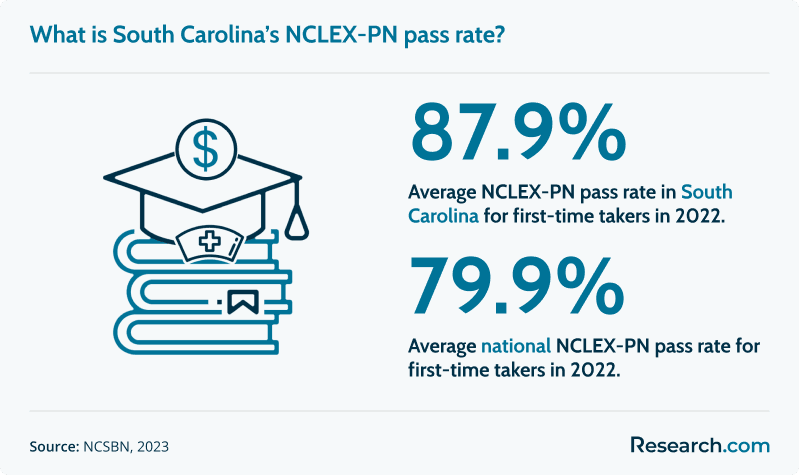
After graduation, all candidates must pass the NCLEX-PN before practicing as LPNs. In 2022, SC achieved a first-time NCLEX-RN pass rate of 87.1%, ranking fifth among all states nationwide. SC also ranked among the top 25 highest-achieving states for NCLEX-PN performance with a pass rate of 87.9%.
How does an online LPN program compare to an on-campus program?
The stronger choice depends on your schedule, study habits, transportation, need for structure, and comfort with online learning. Hybrid LPN programs may reduce time spent on campus for selected coursework, but they do not eliminate in-person labs or clinical rotations.
| Factor | Online or hybrid LPN program | On-campus LPN program |
| Schedule flexibility | Often better for students managing employment, caregiving, or long commutes | Usually follows fixed class, lab, and campus schedules |
| Learning style | Requires independence, organization, and confidence using online platforms | May suit students who want face-to-face instruction and immediate classroom feedback |
| Clinical training | Still completed in person at approved clinical locations | Typically coordinated through established school partnerships |
| Cost considerations | May reduce commuting for lectures, but technology and clinical travel still add costs | May involve more frequent commuting and campus-related expenses |
| Peer connection | Depends on active participation in discussion boards, virtual meetings, and study groups | Provides more routine in-person interaction with classmates |
| Best fit | Self-directed students who need flexibility and can manage deadlines independently | Students who benefit from structure, routine, and frequent in-person support |
Is South Carolina good for LPNs?
South Carolina can be a reasonable place to begin an LPN career, especially for students who want a relatively quick path into healthcare. Still, the opportunity should be assessed carefully. Average pay is below the national figure, workforce shortages are notable, and job conditions can differ by region and employer. Understanding how LPNs fit among the different nursing degrees and levels can help you decide whether practical nursing should be your final goal or your first step toward RN education.
- Average wages trail the national benchmark. South Carolina LPNs earn an average annual wage of $51,060, which is lower than the national average. Pay may be lower in places such as Sumter and Florence, while areas near neighboring states may be closer to the national benchmark.
- State funding is aimed at nursing education capacity. Nursing faculty shortages, limited facilities, and equipment constraints can restrict admissions. To address this challenge, the SC General Assembly set aside $20 million to help the local Commission on Higher Education attract and retrain nursing instructors through program reimbursements from 2022 to 2024 (SC Commission on Higher Education, 2023b).
- Compact licensure may improve mobility. South Carolina participates in the Nurse Licensure Compact, which allows eligible nurses from other compact states to practice in South Carolina and may allow eligible South Carolina nurses to work in other compact states if they meet the requirements.
For many students, the best approach is to choose a program that prepares them efficiently for LPN licensure while keeping future RN progression open. Compare NCLEX performance, clinical quality, transfer options, and bridge pathways before making a commitment.
The chart below compares regional average annual wages for LPNs in South Carolina. LPNs in National Avenue, Gastonia, Charleston, Columbia, and Greenville earn more than the overall state average annual wage.
What is the job outlook for LPNs in South Carolina?
O*NET OnLine projects LPN employment in South Carolina to increase 12% from 2020 to 2030, with about 900 yearly job openings. Demand is tied to ongoing needs in long-term care, home health, community health, and other patient-service settings.
A practical nursing diploma can also support related healthcare roles outside traditional bedside LPN work. Depending on employer rules and experience, LPNs may move into areas connected to health services assistance, case support, medical insurance claims, emergency response support, patient advocacy, or care coordination.
Additional training can widen career choices. Some LPNs build skills through a free online nursing course list, while others pursue bridge programs, supervisory responsibilities, administrative training, or specialized credentials. Joining the South Carolina Nurses Association may also provide networking opportunities, professional development, insurance and loan benefits, travel discounts, and employment-related resources.
The chart below shows that South Carolina is among the 10 states with the highest nursing shortages, including shortages that affect LPN-related workforce needs.
What courses are typically included in an online practical nursing program?
Practical nursing coursework is built to develop safe, entry-level patient-care skills. Course titles vary by school, but most approved programs include these core subjects:
- Anatomy and Physiology: Human body systems, structure, and function as they apply to nursing care.
- Fundamentals of Nursing: Basic nursing procedures, infection prevention, safety, documentation, communication, and routine care.
- Pharmacology: Medication administration, dosage safety, drug interactions, and legal responsibilities for medication support.
- Medical-Surgical Nursing: Care principles for common acute and chronic medical and surgical conditions.
- Mental Health Nursing: Communication, basic assessment, and care concepts for patients with mental health needs.
- Maternal-Child Health Nursing: Nursing concepts related to pregnancy, newborns, children, and families.
- Gerontological Nursing: Care for older adults, including chronic illness, mobility, safety, medication support, and quality-of-life concerns.
Some programs may also include more focused instruction in:
- Nutrition in Healthcare
- Wound Care
- Pain Management
- Palliative Care
- Public Health
How do you choose the best online LPN program in South Carolina?
The best LPN program is not automatically the cheapest or the fastest. The strongest option is approved for licensure, fits your schedule, provides accessible clinical training, supports NCLEX preparation, and aligns with your employment or future education goals.
- Verify approval and accreditation. Confirm that the program satisfies South Carolina Board of Nursing expectations and, when applicable, holds accreditation from a recognized nursing accreditor such as ACEN or the Commission on Collegiate Nursing Education (CCNE).
- Clarify the actual online format. Ask which courses are fully online, which are hybrid, and which require campus attendance. Do not rely on the word “online” without reviewing the schedule.
- Understand clinical placement rules. Find out whether the school assigns clinical sites, whether students help secure placements, and how far you may need to travel.
- Review NCLEX preparation. Ask about practice exams, tutoring, remediation, review modules, and recent pass-rate patterns.
- Assess student support. Look for advising, tutoring, technology help, skills lab access, counseling, and career services.
- Calculate the full cost. Include tuition, fees, books, uniforms, background checks, testing, supplies, transportation, technology, and licensure expenses.
- Use rankings as context, not as a substitute for research. Rankings and student reviews can be useful, but final decisions should be based on approval, outcomes, scheduling, and clinical logistics.
| Common mistake | Why it creates risk | Better decision |
| Picking the lowest-cost program before checking approval | A nonapproved program can create licensure problems | Verify SCBON approval before comparing tuition |
| Assuming “online” means fully remote | LPN education requires in-person skills labs and clinical rotations | Request a term-by-term schedule showing online, campus, and clinical requirements |
| Overlooking clinical travel | Transportation can affect attendance, finances, and work availability | Ask where clinical sites are and how placements are assigned |
| Comparing only tuition | Fees, supplies, exam costs, and lost work hours can change affordability | Ask for a complete estimated cost of attendance |
| Choosing based only on program length | An accelerated schedule can be difficult for students who need to work full time | Match the pace to your available study time, support system, and finances |
What are the clinical placement options for LPN students in South Carolina?
Clinical placements are mandatory because LPN students need supervised practice in real healthcare environments. In South Carolina, rotations may take place in several types of facilities:
- Hospitals: Depending on the program’s agreements, students may observe or support care in areas such as emergency care, medical-surgical units, or labor and delivery.
- Nursing homes and long-term care facilities: These sites help students practice medication support, mobility assistance, patient monitoring, communication, and chronic care routines for older adults.
- Community health clinics: Students may learn about preventive services, health assessments, and care for underserved populations.
- Home health agencies: These placements can expose students to care for patients managing chronic conditions in the home setting.
Before enrolling, ask whether the school secures clinical placements, whether evening or weekend options are available, and what happens if a clinical site cancels or becomes unavailable. Clinical logistics are often one of the most important practical factors in a hybrid LPN program.
What accreditation and regulatory standards shape online LPN programs in South Carolina?
State approval and accreditation help protect students by setting expectations for curriculum, faculty qualifications, clinical training, and student outcomes. For South Carolina applicants, the most important question is whether the program meets South Carolina Board of Nursing requirements. National recognition from organizations such as the Accreditation Commission for Education in Nursing (ACEN) can provide additional confidence and may support later academic mobility.
If you expect to continue into RN or BSN study, accreditation may influence credit transfer and bridge-program eligibility. Students already planning long-term advancement may also want to compare future pathways such as the easiest online RN to BSN programs after gaining licensure and experience.
Can LPNs leverage nutrition specialization to enhance patient care in South Carolina?
Nutrition training can help LPNs support patient education, chronic disease management, wound healing, preventive care, and long-term care. LPNs do not replace registered dietitians or licensed nutrition professionals, but added nutrition knowledge can help them reinforce care plans and identify when patients may need further assessment.
LPNs who want a more formal nutrition-focused pathway can review guidance on becoming a nutritionist in South Carolina. This may be especially relevant for nurses interested in wellness programs, community health, long-term care, or chronic disease support.
How can LPNs expand their expertise through specialized certifications in South Carolina?
Specialized certifications can help LPNs deepen knowledge in areas such as geriatrics, wound care, hospice, IV therapy, pediatrics, or behavioral health support. These credentials do not necessarily expand an LPN’s legal scope of practice, but they can strengthen job applications, improve confidence, and support movement into focused care settings.
LPNs interested in mental health may eventually consider a longer path through RN preparation and graduate education. Reviewing options such as the shortest online PMHNP certificate programs can help students understand what advanced psychiatric-mental health specialization may require later.
What are the LPN licensing and regulatory requirements in South Carolina?
South Carolina LPN candidates must graduate from an approved program, submit required documentation, pass the NCLEX-PN, and receive Board authorization before practicing. Requirements may include identity documents, fees, background screening, program endorsement, and compliance with state licensing rules.
Because licensing rules may change, applicants should review current South Carolina nursing license requirements before filing paperwork. This is especially important for applicants educated outside South Carolina, endorsement applicants, temporary license candidates, and nurses preparing for renewal.
What steps should I follow to achieve and maintain LPN certification in South Carolina?
A practical licensing plan begins with choosing an approved LPN program, completing all classroom, lab, and clinical requirements, preparing for the NCLEX-PN, and submitting a complete application. After licensure, you need to monitor renewal deadlines and continuing education requirements so the credential stays active.
- Confirm that your program prepares graduates for South Carolina LPN licensure.
- Finish the required courses, labs, simulations, and clinical rotations.
- Build an NCLEX-PN study plan using review materials, practice questions, and remediation resources.
- Submit Board documents and register for the exam according to state instructions.
- Pass the NCLEX-PN and receive your license before practicing as an LPN.
- Maintain licensure through renewal, fees, and continuing education obligations.
For a more detailed process, review Research.com’s guide on becoming a certified LPN in South Carolina.
Can LPNs pursue nurse practitioner roles in South Carolina?
LPNs cannot become nurse practitioners directly without additional education and licensure. The typical route is to become an RN, complete a BSN or qualifying bridge pathway if needed, and then enter a graduate program that prepares students for advanced practice nursing.
If nurse practitioner practice is your long-term goal, start planning before you choose an LPN program. Look for strong bridge options, maintain competitive grades, and understand RN licensing requirements. To see the full pathway, review how to become a nurse practitioner in South Carolina.
How do state healthcare policies influence online LPN programs in South Carolina?
State healthcare policy can affect LPN education through program approval standards, clinical training rules, faculty capacity, funding decisions, and licensure requirements. When South Carolina invests in nursing faculty, expands clinical partnerships, or updates workforce priorities, schools may adjust admissions capacity, curriculum design, or student services.
Applicants should pay attention to policy developments because they can influence program availability and clinical-training quality. Comparing broader nursing education options, including the best nursing schools in South Carolina, can help you see how practical nursing fits into the state’s wider nursing education pipeline.
What support systems and resources are available for LPN students in South Carolina?
Successful LPN students often need more than lectures and clinical hours. The right support can improve persistence, test readiness, and career planning.
- Financial aid resources: Many schools assist students with grants, scholarships, loans, payment plans, and state-supported aid options for nursing education.
- Professional associations: Organizations such as the South Carolina Nurses Association can offer networking, continuing education, advocacy updates, and career development support.
- Campus services: Tutoring, academic advising, skills labs, exam preparation, counseling, and career services can be especially valuable in accelerated or hybrid programs.
- Peer and employer connections: Study groups, mentorship, job fairs, and healthcare employer events can help students build confidence and professional networks.
If you are worried about competitive admissions, you may also compare broader nursing options such as the easiest nursing schools to get into, while still verifying that any program you choose meets licensure standards.
How can LPNs transition to becoming RNs in South Carolina?
Many practical nurses use the LPN credential as a first step toward registered nursing. An LPN-to-RN bridge program builds on prior coursework and clinical experience so students can prepare for RN-level practice without repeating an entire traditional nursing sequence.
Bridge programs may offer flexible scheduling for employed nurses, but they still require clinical training and NCLEX-RN preparation. Some schools grant credit for prior nursing coursework or experience, although policies vary.
If your long-term goal is RN licensure, ask prospective LPN programs about transfer agreements, LPN-to-ADN options, and BSN pathways before enrolling. You can also read Research.com’s guide on becoming a registered nurse in South Carolina for a broader view of education and licensing steps.
What are the options for advanced nursing education in South Carolina?
After gaining LPN experience, students who want a broader scope of practice, more responsibility, or leadership opportunities may pursue RN, BSN, MSN, or nurse practitioner pathways. The best next step depends on whether you want bedside RN practice, management, education, public health, or advanced clinical practice.
LPNs interested in graduate-level clinical roles should first understand the RN and BSN steps usually required before admission to advanced nursing programs. To compare graduate options, review the best nurse practitioner programs in South Carolina.
Are there financial aid and scholarship opportunities for LPN students in South Carolina?
Yes. Depending on the school and student eligibility, LPN students may qualify for federal aid, state aid, institutional scholarships, grants, loans, payment plans, or employer tuition assistance. Before applying, ask each program for a complete cost estimate and a financial aid timeline.
Many funding options are competitive and deadline-based, so prepare documents early. If you are comparing several entry-level healthcare paths, it may also help to review aid and program information related to the best medical assistant programs in South Carolina.
What are the future career growth opportunities for LPNs in South Carolina?
An LPN license can serve as either a long-term career credential or a stepping stone into further nursing education. Some LPNs build stable careers in practical nursing, while others move toward RN, BSN, leadership, or advanced clinical pathways.
- Bridge into RN or BSN education: LPNs who want broader practice authority can pursue LPN-to-RN or LPN-to-BSN programs. Flexible online LPN to BSN programs may help working nurses balance employment with school.
- Earn specialty credentials: Certifications in geriatric care, wound care, IV therapy, hospice, or related areas can help LPNs target specific roles and settings.
- Move into supervisory support roles: Experienced LPNs may qualify for charge nurse or nursing coordinator roles in some environments, depending on employer policy and state scope-of-practice rules.
- Contribute to case management and patient education: LPNs do not have advanced practice authority, but they may support care coordination, chronic disease education, and patient follow-up under appropriate supervision.
- Work in community-based care: Schools, clinics, home health agencies, outreach programs, and local health initiatives can provide alternatives to traditional facility-based nursing jobs.
Questions to ask before enrolling in a South Carolina online LPN program
- Is the program approved by the South Carolina Board of Nursing?
- Which courses are online, and which ones require campus attendance?
- Where are clinical sites located, and does the school arrange placement?
- What are the program’s most recent NCLEX-PN results?
- What is the full estimated cost after fees, supplies, testing, transportation, and technology?
- Can students realistically work while enrolled, and what schedules do successful students usually keep?
- Does the program provide tutoring, remediation, and NCLEX preparation?
- Will completed credits apply toward an LPN-to-RN, ADN, or BSN pathway later?
- What happens if I fail a course, miss required clinical hours, or need to pause enrollment?
- What scholarships, financial aid options, payment plans, or employer partnerships are available?
Key Insights
- Online LPN programs in South Carolina are generally hybrid programs. You should expect in-person labs, simulations, and clinical rotations.
- Many LPN pathways take about 10 to 12 months, but some students may need 15 to 20 months depending on course sequencing and schedule design.
- South Carolina Board of Nursing approval is nonnegotiable. Confirm licensure eligibility before paying deposits or enrolling.
- LPNs in South Carolina earn an average annual wage of $51,060, but actual pay depends on location, employer, setting, shift, and experience.
- Clinical placement logistics are a major decision factor. Ask how placements are assigned, where sites are located, and how much travel is required.
- If you eventually want to become an RN, BSN-prepared nurse, or nurse practitioner, choose an LPN program with bridge options and transferable coursework.
- Do not judge affordability by tuition alone. Include fees, books, uniforms, supplies, transportation, technology, licensure expenses, and possible lost work hours.
Related Articles for Nearby States
- 2027 Best LPN Programs in Georgia – Accredited Online LPN Programs
- 2027 Best LPN Programs in North Carolina – Accredited Online LPN Programs
- 2027 Best LPN Programs in Florida – Accredited Online LPN Programs
- 2027 Best LPN Programs in Tennessee – Accredited Online LPN Programs
- 2027 Best LPN Programs in Alabama – Accredited Online LPN Programs
- 2027 Best LPN Programs in Virginia – Accredited Online LPN Programs
- 2027 Best LPN Programs in Kentucky – Accredited Online LPN Programs
- 2027 Best LPN Programs in Mississippi – Accredited Online LPN Programs
- 2027 Best LPN Programs in West Virginia – Accredited Online LPN Programs
- 2027 Best LPN Programs in Arkansas – Accredited Online LPN Programs
References:
- National Council of State Boards of Nursing. (2023, June). 2022 NCLEX examination statistics. https://www.ncsbn.org/public-files/2022_NCLEXExamStats-final.pdf
- O*NET OnLine. (n.d.). South Carolina employment trends Licensed practical and licensed vocational nurses. Retrieved October 23, 2023, from https://www.onetonline.org/link/localtrends/29-2061.00?st=SC
- South Carolina Commission on Higher Education. (2023a, January 25). SC ranks 5th in nation for 2022 nursing license exam pass rates. https://www.che.sc.gov/news/2023-01/sc-ranks-5th-nation-2022-nursing-license-exam-pass-rates
- South Carolina Commission on Higher Education. (2023b, August 16). SC offers $10M in state funding for students to pursue nursing faculty credentials. https://che.sc.gov/news/2023-08/sc-offers-10m-state-funding-students-pursue-nursing-faculty-credentials
- U.S. Bureau of Labor Statistics. (2023, April 25). May 2022 state occupational employment and wage estimates South Carolina. Occupational Employment and Wage Statistics. https://www.bls.gov/oes/current/oes_sc.htm
- RentCafe. (2023). Cost of Living in South Carolina. RentCafe.
Other Things You Should Know About Being an LPN in South Carolina
Clinical training for online LPN programs in South Carolina is typically arranged through local healthcare facilities, requiring students to complete a set number of supervised hours. Coordination is done by the program, ensuring compliance with state board regulations for licensure eligibility.
The South Carolina Board of Nursing approves practical nursing programs and issues LPN licenses. Applicants must graduate from a board-approved program, apply for licensure, and pass the NCLEX-PN exam before practicing in South Carolina.
In 2027, top-rated online LPN programs in South Carolina include Midlands Technical College, Orangeburg-Calhoun Technical College, and Horry-Georgetown Technical College. These programs typically hold accreditation from bodies like the Accreditation Commission for Education in Nursing (ACEN), ensuring that they meet rigorous academic and professional standards.





