
2027 Best LPN to RN Bridge Programs

Co-Founder and Chief Data Scientist
Choosing an LPN to RN bridge program is not just about finding the shortest route to an RN license. It is a career decision that affects your schedule, clinical training, tuition costs, NCLEX-RN preparation, future degree options, and long-term earning potential. Licensed Practical Nurses who want more autonomy, broader clinical responsibilities, and access to higher-level nursing roles often use bridge programs to build on the training they already have instead of starting from the beginning.
This guide is written for working LPNs comparing online, hybrid, and campus-based LPN to RN programs in the United States. It explains how these programs work, what they cost, how long they take, which schools are included in our list, what prerequisites to expect, how to evaluate accreditation and clinical placements, and how to decide whether an ADN, ASN, or BSN pathway fits your goals.
Quick answer: Is an LPN to RN bridge program worth it?
For many licensed practical nurses, an LPN to RN bridge program is worth considering because it can shorten the path to RN licensure, expand job options, and improve earning potential. As of 2023, registered nurses earned an average annual salary of $86,070, while licensed practical nurses earned $59,730. That difference can make the investment worthwhile, especially for students who choose an accredited program with reasonable tuition, strong NCLEX-RN preparation, and clinical placements that fit their location and schedule.
The best program depends on your goal. If you want the fastest route to RN practice, an ADN or ASN bridge may be the better fit. If you want broader advancement options, leadership preparation, or a smoother path to graduate study, an LPN to BSN program may offer stronger long-term value.
Why LPNs choose RN bridge programs
An LPN to RN bridge program is designed for licensed practical nurses who already understand direct patient care but want to qualify for the broader scope of registered nursing practice. These programs usually give credit for prior nursing education or experience, then add RN-level coursework, clinical rotations, and preparation for the NCLEX-RN exam.
Key benefits of moving from LPN to RN
- More career options: RNs can work in emergency departments, medical-surgical units, pediatrics, labor and delivery, long-term care, ambulatory care, home health, public health, and many specialty settings.
- Higher earning potential: The average RN salary in the U.S. is $86,070 annually, compared with $59,730 for LPNs.
- Expanded clinical responsibility: RNs typically take on more assessment, care planning, patient education, coordination, and leadership duties than LPNs.
- Pathway to future degrees: Earning RN licensure can help you move toward BSN, MSN, nurse practitioner, nursing education, informatics, leadership, or DNP programs later.
- Flexible education formats: Many bridge programs offer online or hybrid coursework, though clinical hours must still be completed in approved healthcare settings.
What can I expect from an LPN to RN bridge program?
An LPN to RN bridge program is usually accelerated, clinically focused, and more demanding than many students expect. Because the program assumes you already have practical nursing knowledge, it moves quickly into RN-level decision-making, complex patient care, leadership, pharmacology, and preparation for licensure.
| Program feature | What it means for students | Why it matters |
| Accelerated structure | Many programs can be completed in 1-2 years, depending on the credential and enrollment pace. | You may finish faster than students entering nursing for the first time, but the workload is condensed. |
| RN competency focus | Coursework emphasizes assessment, clinical judgment, care planning, delegation, and patient safety. | These are core expectations for RN practice and NCLEX-RN preparation. |
| Clinical rotations | Students complete supervised experiences in hospitals, clinics, long-term care, community health, or specialty units. | Clinical placement quality can strongly affect confidence, skills, and job readiness. |
| Academic support | Programs may offer advisors, faculty office hours, clinical coordinators, tutoring, online platforms, and exam preparation. | Support services are especially important for working LPNs balancing school, shifts, and family responsibilities. |
| Significant time commitment | Students must manage lectures, assignments, labs, clinical hours, exams, and NCLEX-RN preparation. | Even online programs are not fully self-contained because clinical requirements are in person. |
Where can I work after completing an LPN to RN bridge program?
After earning RN licensure, graduates can pursue positions in a wider range of healthcare environments than most LPN roles allow. The exact options depend on state scope-of-practice rules, employer requirements, clinical experience, and whether you earn an ADN, ASN, or BSN.
- Hospitals: RNs work in emergency rooms, ICUs, labor and delivery, medical-surgical units, pediatrics, operating rooms, and step-down units.
- Physician offices: RNs may perform assessments, administer medications, coordinate care, assist with procedures, and educate patients.
- Long-term care facilities: Nursing homes and assisted living facilities need RNs for care planning, supervision, medication oversight, and chronic disease management.
- Home healthcare agencies: RNs visit patients at home, monitor conditions, provide education, manage treatment plans, and coordinate with physicians.
- Schools and universities: School nurses provide health screenings, medication administration, chronic condition support, and emergency care for students.
- Government agencies: RNs may work in public health departments, correctional facilities, military settings, or community health programs.
- Ambulatory care centers: Outpatient surgery, urgent care, diagnostics, and specialty clinics use RNs for patient preparation, monitoring, and follow-up.
- Community health clinics: RNs help deliver care, prevention education, screenings, and chronic disease support for underserved populations.
How much can I make after an LPN to RN bridge program?
Completing an LPN to RN bridge program can substantially increase earning potential, although individual pay depends on location, employer, experience, shift differentials, specialty, union agreements, and degree level. As of 2023, registered nurses earned an average annual salary of $86,070, or about $41.38 per hour. Licensed practical nurses earned an average annual salary of $59,730, or about $28.72 per hour. On average, that places RNs about $26,600 per year above LPNs.
RN salaries can vary widely. Depending on state, specialty, experience, and workplace, annual pay can range from $40,000 to over $100,000. Students should use salary data as a planning tool, not a guarantee.
- Best LPN to RN bridge programs for 2027
- How long does it take to complete an LPN to RN bridge program?
- Online vs. on-campus LPN to RN bridge programs
- Average cost of LPN to RN bridge programs
- Financial aid for LPN to RN bridge students
- Prerequisites for LPN to RN bridge programs
- Common LPN to RN bridge program courses
- Specializations available after or during RN preparation
- Accreditation and recognition
- LPN to RN bridge programs vs. other nursing pathways
- How to choose the right LPN to RN bridge program
- Online RN programs for non-nurses vs. LPN to RN bridge programs
- Career paths after an LPN to RN bridge program
- Return on investment for LPN to RN bridge programs
- Moving into advanced practice after becoming an RN
- Job market for LPN to RN graduates
- How programs use technology for clinical training
- How LPN to RN programs are changing with healthcare trends
- Advanced nursing degrees after an LPN to RN bridge program
- Common challenges and how to handle them
- Job placement and internship support
- How an LPN to RN bridge program can support long-term career growth
Best LPN to RN Bridge Programs for 2027
How do we rank schools?
Research.com builds rankings to help students compare programs with clearer context, not to replace individual program research. Our rankings are developed through structured research and data analysis by the Research.com team. The process uses authoritative education data sources, including:
- Integrated Postsecondary Education Data System (IPEDS database)
- Peterson’s database, including the Distance Learning Licensed Data Set
LPN to RN bridge programs are intended for licensed practical nurses who want to qualify for RN licensure without repeating all entry-level nursing coursework. Programs differ in degree type, length, cost, format, clinical expectations, and accreditation. The list below highlights LPN to RN and LPN to BSN options for 2027, along with the details students should verify before applying.
Program comparison at a glance
| School | Pathway | Program length | Tuition information listed | Accreditation |
| University of Arkansas | BSN | Approximately 3 years | In-state: $9,384 per year; Out-of-state: $25,872 per year | CCNE |
| Indiana State University | BSN | 3 years | In-state: $9,318 per year; Out-of-state: $20,582 per year | ACEN |
| Saint Xavier University | BSN | 2-3 years | $34,000 per year | CCNE |
| Herzing University | ASN, BSN | ASN: 16 months; BSN: 28 months | ASN: $59,000 total; BSN: $87,000 total | CCNE |
| University of Oklahoma | BSN | Approximately 2 years | In-state: $5,965 per semester; Out-of-state: $14,347 per semester | CCNE |
| North Dakota State University | BSN | 6 semesters | $5,545 per semester | CCNE |
| Saint Martin’s University | BSN | 3 years | $40,690 per year | CCNE |
| Chamberlain College of Nursing | ADN, BSN | 1-2 years | $699 per credit hour | CCNE |
| California State University East Bay | BSN | 2-3 years | In-state: $6,995 per year; Out-of-state: $18,875 per year | CCNE |
| Azusa Pacific University | BSN | 2-3 years | $41,410 per year | CCNE |
1. University of Arkansas
The University of Arkansas offers an LPN to BSN pathway for practical nurses who want to earn a Bachelor of Science in Nursing. The program blends online coursework with required on-campus clinical experiences, which can make it more manageable for working nurses while still preserving hands-on training. Students study areas such as advanced health assessment, nursing research, and community health nursing.
- Program Length: Approximately 3 years
- Tracks/Concentrations: BSN
- Tuition Cost: In-state: $9,384 per year; Out-of-state: $25,872 per year
- Required Credits to Graduate: 120 credit hours
- Accreditation: Commission on Collegiate Nursing Education (CCNE)
2. Indiana State University
Indiana State University provides a primarily online LPN to BSN track designed for students who need to balance coursework with employment and personal obligations. The curriculum includes adult health, mental health, and community nursing, preparing graduates for RN responsibilities in multiple care settings.
- Program Length: 3 years
- Tracks/Concentrations: BSN
- Tuition Cost: In-state: $9,318 per year; Out-of-state: $20,582 per year
- Required Credits to Graduate: 120 credit hours
- Accreditation: Accreditation Commission for Education in Nursing (ACEN)
3. Saint Xavier University
Saint Xavier University offers an LPN to BSN program that combines liberal arts coursework with professional nursing preparation. The program emphasizes evidence-based practice, ethical judgment, and leadership skills that support RN practice and future advancement.
- Program Length: 2-3 years
- Tracks/Concentrations: BSN
- Tuition Cost: $34,000 per year
- Required Credits to Graduate: 120 credit hours
- Accreditation: Commission on Collegiate Nursing Education (CCNE)
4. Herzing University
Herzing University offers LPN to RN bridge options through both Associate of Science in Nursing and Bachelor of Science in Nursing pathways. These tracks build on prior practical nursing training while developing higher-level clinical judgment, RN-level patient care skills, and preparation for licensure.
- Program Length: ASN: 16 months; BSN: 28 months
- Tracks/Concentrations: ASN, BSN
- Tuition Cost: ASN: $59,000 total; BSN: $87,000 total
- Required Credits to Graduate: ASN: 72 credits; BSN: 120 credits
- Accreditation: Commission on Collegiate Nursing Education (CCNE)
5. University of Oklahoma
The University of Oklahoma Health Sciences Center offers an LPN to BSN program that pairs online learning with in-person clinical requirements. The curriculum focuses on patient-centered care, quality improvement, collaboration across healthcare teams, and professional nursing competencies.
- Program Length: Approximately 2 years
- Tracks/Concentrations: BSN
- Tuition Cost: In-state: $5,965 per semester; Out-of-state: $14,347 per semester
- Required Credits to Graduate: 60 credit hours
- Accreditation: Commission on Collegiate Nursing Education (CCNE)
6. North Dakota State University
North Dakota State University offers an online LPN to BSN pathway for working nurses. The program runs across six consecutive semesters, including summers, and includes online classes along with in-person clinical rotations in Fargo and Moorhead, North Dakota.
- Program Length: 6 semesters
- Tracks/Concentrations: BSN
- Tuition Cost: $5,545 per semester
- Required Credits to Graduate: Varies; contact the university for details
- Accreditation: Commission on Collegiate Nursing Education (CCNE)
7. Saint Martin’s University
Saint Martin’s University provides an LPN to BSN program centered on holistic care, ethical practice, and nursing leadership. Students complete classroom instruction and clinical experiences across healthcare settings to prepare for RN practice.
- Program Length: 3 years
- Tracks/Concentrations: BSN
- Tuition Cost: $40,690 per year
- Required Credits to Graduate: 120 credit hours
- Accreditation: Commission on Collegiate Nursing Education (CCNE)
8. Chamberlain College of Nursing
Chamberlain College of Nursing offers LPN to RN bridge pathways for students pursuing either ADN or BSN preparation. The program is structured to strengthen advanced clinical skills, critical thinking, leadership, and readiness for the NCLEX-RN exam. Its flexible format may appeal to LPNs who want to continue working while progressing toward RN licensure.
- Program Length: 1-2 years
- Tracks/Concentrations: ADN, BSN
- Tuition Cost: $699 per credit hour
- Required Credits to Graduate: ADN: 72 credits; BSN: 122 credits
- Accreditation: Commission on Collegiate Nursing Education (CCNE)
9. California State University East Bay
California State University East Bay offers an LPN to BSN bridge program for experienced practical nurses. Students complete theory-based coursework, clinical practice, and interprofessional learning designed to strengthen RN-level patient care and collaboration skills.
- Program Length: 2-3 years
- Tracks/Concentrations: BSN
- Tuition Cost: In-state: $6,995 per year; Out-of-state: $18,875 per year
- Required Credits to Graduate: 120 credit hours
- Accreditation: Commission on Collegiate Nursing Education (CCNE)
10. Azusa Pacific University
Azusa Pacific University offers an LPN to BSN bridge program with a focus on holistic nursing, leadership, patient advocacy, ethics, and evidence-based practice. The program also integrates a Christ-centered educational framework.
- Program Length: 2-3 years
- Tracks/Concentrations: BSN
- Tuition Cost: $41,410 per year
- Required Credits to Graduate: 120 credit hours
- Accreditation: Commission on Collegiate Nursing Education (CCNE)
If your long-term goal is a bachelor’s degree after RN licensure, compare bridge options with the top ranked RN to BSN online programs to understand how your credits may apply later.
How long does it take to complete an LPN to RN bridge program?
Completion time depends on the credential, school calendar, transfer credits, prerequisites, enrollment status, and clinical placement schedule. Most students should plan around both classroom requirements and clinical availability, not just advertised program length.
- Full-time programs: Often take 12–18 months. This is shorter than many traditional nursing paths, and some later degree-completion options even allow students to move from RN to BSN in 6 months.
- Part-time programs: Commonly require 24–36 months, which may be more realistic for LPNs working full time or managing family responsibilities.
- Accelerated programs: Some allow completion in as little as 9 months, but these formats are intensive and may be difficult to combine with heavy work schedules.
- Online programs: Often range from 1–3 years, depending on pacing, transfer credits, and clinical requirements.
Students planning long-term advancement may eventually consider graduate or doctoral study. For example, some nurses later compare the most affordable online DNP programs after completing RN and advanced nursing prerequisites.
NCLEX-RN pass rates have moved up and down in recent years. Pass rates were 72.8% in 2019 and 72.4% in 2020, then declined to 68.9% in 2021 and 63.4% in 2022 before rising to 69.7% in 2023. These shifts make NCLEX preparation, faculty support, practice testing, and program outcomes important factors when comparing schools.
How does an online LPN to RN bridge degree compare to an on-campus program?
Online and on-campus LPN to RN programs can both lead to RN licensure when they are properly accredited and approved by the relevant state board of nursing. The difference is how the academic content is delivered and how much structure you need. Clinical training still requires approved in-person experiences.
| Factor | Online or hybrid LPN to RN program | On-campus LPN to RN program |
| Best for | Working LPNs who need scheduling flexibility | Students who prefer fixed class times and face-to-face instruction |
| Course delivery | Lectures, assignments, discussions, and exams may be delivered online | Most classroom instruction occurs in person |
| Clinical requirements | Completed in approved healthcare sites, sometimes arranged locally | Often coordinated through the school’s established local partners |
| Student support | Depends heavily on online advising, faculty access, tutoring, and technology support | May offer easier access to labs, faculty, study groups, and campus resources |
| Potential drawback | Requires strong self-discipline and careful confirmation of clinical placement logistics | Less flexible for students with rotating shifts, commuting limits, or family obligations |
Choose online or hybrid study only after confirming the program is approved for your state, can support clinical placements near you, and meets your state’s RN licensure expectations.
What is the average cost of LPN to RN bridge programs?
LPN to RN bridge program costs vary by school type, degree level, location, residency status, credit transfer, and fees. Students should compare total cost of attendance, not tuition alone.
- Community colleges: $6,000–$20,000.
- Private institutions: $25,000–$50,000.
- Online programs: $7,000–$30,000, excluding clinical fees.
- Additional expenses: Books, scrubs, lab fees, background checks, immunizations, travel to clinical sites, and NCLEX-RN exam fees can add around $1,000–$2,000.
In-state tuition, employer tuition assistance, scholarships, transfer credits, and shorter completion time can reduce the net cost. Students trying to control both time and tuition may also compare accelerated LPN to RN programs, while verifying that any shorter format still meets clinical and licensure requirements.
What are the financial aid options for students enrolling in LPN to RN bridge programs?
Financial aid can make an LPN to RN bridge program more affordable, but eligibility depends on the school, program level, enrollment status, accreditation, and the student’s financial situation. Start by asking whether the program qualifies for federal aid and whether your employer offers reimbursement.
- Federal aid: Eligible students may use Pell Grants, Federal Supplemental Educational Opportunity Grants, and federal loans.
- Pell Grants: Need-based undergraduate grants that do not need to be repaid.
- FSEOG: Grants for undergraduate students with exceptional financial need; these also do not require repayment.
- Federal Loans: Borrowed funds with federal terms, including subsidized options where the government pays interest while the student is in school and unsubsidized options where the student is responsible for interest.
- State programs: Some states offer nursing scholarships, workforce grants, or loan repayment support for students entering high-need areas.
- Employer assistance: Hospitals, long-term care facilities, and health systems may provide tuition reimbursement or sponsorship for LPNs moving into RN roles.
- Scholarships: Nursing organizations, including HRSA and ANA, provide funding opportunities that students can research and apply for.
- Work-study programs: Some eligible students can earn income through approved campus or community-based jobs while enrolled.
Before borrowing, ask the financial aid office for a full cost breakdown and projected out-of-pocket cost after grants, scholarships, employer support, and transfer credits.
What are the prerequisites for enrolling in an LPN to RN bridge program?
LPN to RN bridge programs use prerequisites to confirm that applicants are ready for accelerated RN-level coursework and clinical practice. Requirements vary, so always check the school’s admissions page and your state board of nursing rules.
- A valid, active LPN license.
- 1–2 years of professional nursing experience, depending on the program.
- Completed prerequisite courses such as anatomy, physiology, and microbiology.
- A minimum GPA requirement, typically 2.5–3.0.
- A passing score on entrance exams such as the TEAS.
Students who plan to move beyond the BSN may later compare graduate options, including some of the easiest RN to MSN online program pathways. For bridge program admission, however, focus first on LPN license status, science prerequisites, GPA rules, test requirements, and clinical eligibility.
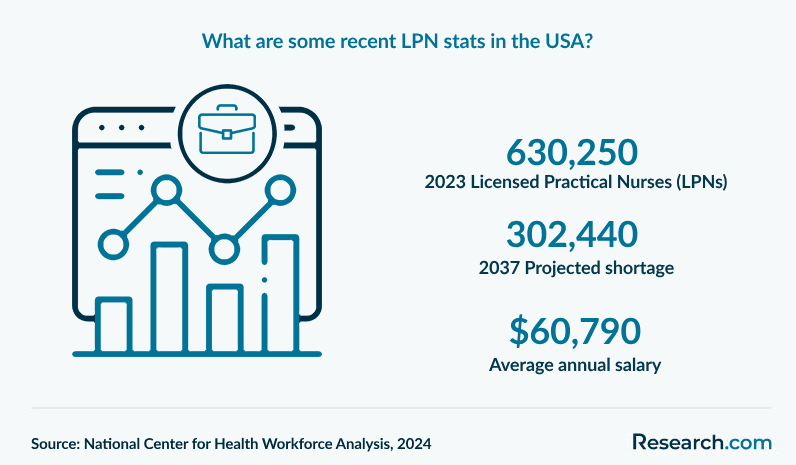
The LPN workforce is also changing. Despite an 8.4% decline in LPNs since 2018, with 630,250 currently in the U.S., a projected shortage of 302,440 LPNs is expected by 2037. The average national salary for LPNs is $60,790 per year, though pay varies by state. These figures show why healthcare employers continue to need practical nurses even as many LPNs look for RN advancement opportunities.
What courses are typically in LPN to RN bridge programs?
LPN to RN bridge programs combine nursing theory, applied clinical reasoning, general education, and supervised practice. Because these programs are built for licensed practical nurses, they usually move faster than traditional entry-level nursing curricula.
- Core nursing courses
- Advanced Pharmacology: Covers more complex medication administration, dosage considerations, interactions, monitoring, and patient education.
- Pathophysiology: Examines disease processes and how they affect body systems, symptoms, assessment findings, and care decisions.
- Leadership in Nursing: Prepares students for delegation, team communication, supervision, patient advocacy, and coordination of care.
- Specialized nursing topics
- Maternal and Child Nursing: Includes obstetric care, neonatal nursing, pediatrics, and family-centered care. Students interested in this area may also want to learn how much labor and delivery nurses make.
- Psychiatric Nursing: Focuses on mental health assessment, crisis response, therapeutic communication, and care planning.
- Geriatric Nursing: Covers aging-related health concerns, chronic illness, dementia care, mobility, safety, and end-of-life support.
- General education courses
- Common requirements include English composition, statistics, psychology, sociology, or related foundational courses.
- Clinical practicum
- Students apply RN-level skills in hospitals, outpatient clinics, community health settings, long-term care facilities, or specialty units.
- Rotations may include ICU, surgical units, maternity, mental health, pediatrics, and community health, depending on the program.
A strong curriculum should connect coursework directly to safe patient care and NCLEX-RN readiness. After RN licensure, students who want faster bachelor’s completion can compare RN to BSN in 6 months online programs.
What types of specializations are available in LPN to RN bridge programs?
Most LPN to RN bridge programs focus first on broad RN preparation because graduates must be ready for the NCLEX-RN and general nursing practice. Some programs offer electives, clinical exposure, or advising that helps students move toward specialty areas after licensure.
- Pediatrics: Child development, immunizations, family education, and care for acute and chronic childhood conditions.
- Geriatrics: Care for older adults, dementia support, chronic illness management, medication safety, and palliative care.
- Critical Care Nursing: Advanced monitoring, ventilator-related care, trauma response, and high-acuity patient management.
- Oncology Nursing: Cancer care, chemotherapy support, symptom management, and patient education.
- Surgical Nursing: Preoperative preparation, intraoperative support, postoperative monitoring, and recovery care.
- Community Health Nursing: Public health outreach, disease prevention, health education, and care coordination for communities.
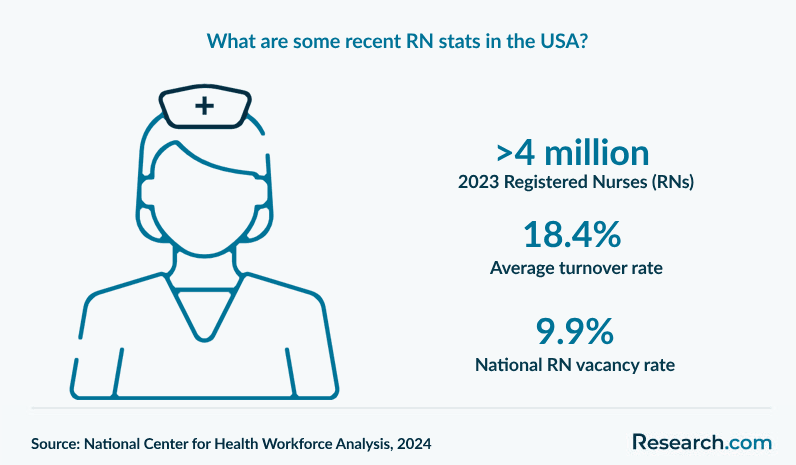
The U.S. RN workforce has grown by 5.3% since 2019, reaching more than 4 million in 2023. The average RN turnover rate has decreased to 18.4%, while the national RN vacancy rate remains 9.9%. These figures suggest that nursing remains a large, active labor market, but local hiring conditions can still vary by region and specialty.
Are LPN to RN Bridge Programs Accredited and Recognized?
Accreditation is one of the most important checks before enrolling in an LPN to RN bridge program. A properly accredited and state-approved program is more likely to meet educational standards, support federal financial aid eligibility, prepare students for licensure, and allow credits to transfer into later nursing degrees.
Look for programmatic accreditation from recognized nursing accreditors such as ACEN or CCNE, and confirm that the program is accepted by the state board of nursing where you plan to seek RN licensure. This is especially important for online and hybrid programs, because state authorization and clinical placement rules can differ. If you already know you want a bachelor’s degree after RN licensure, you can also compare options such as a 6-month RN to BSN program once you understand licensure and transfer requirements.
How do LPN to RN bridge programs compare to alternative nursing advancement pathways?
LPN to RN bridge programs are designed for people who already hold practical nursing credentials. They build on prior nursing knowledge and focus on the expanded scope, clinical judgment, and licensure preparation required of registered nurses. Other pathways serve different starting points. For example, a medical assistant to LPN pathway helps students move into practical nursing, not directly into RN-level practice.
| Pathway | Best for | Main outcome | Key decision point |
| LPN to ADN or ASN | LPNs who want a direct, often faster route to RN licensure | Eligibility to pursue RN licensure after meeting program and exam requirements | Good fit if speed and lower tuition are top priorities |
| LPN to BSN | LPNs who want RN preparation plus a bachelor’s degree | RN preparation with broader leadership, community health, and research coursework | Often better for long-term advancement, but may take longer and cost more |
| Medical assistant to LPN | Medical assistants seeking a licensed nursing role | LPN preparation | Appropriate for those who are not already LPNs |
| RN to BSN | Licensed RNs who already completed ADN or ASN preparation | Bachelor’s degree completion | Best after RN licensure, not before |
How do you choose the best LPN to RN bridge program?
The best LPN to RN bridge program is the one that is accredited, approved for your licensure goals, financially realistic, clinically accessible, and aligned with your desired timeline. A program that looks convenient online may not be a good choice if it cannot place you in clinical rotations or does not meet your state’s board requirements.
Checklist for comparing LPN to RN bridge programs
- Accreditation: Confirm recognition by ACEN, CCNE, or another appropriate accreditor, and verify state board approval.
- Degree type: Decide whether an ADN, ASN, or BSN pathway fits your timeline and career plans.
- Curriculum: Look for strong coverage of pharmacology, health assessment, medical-surgical nursing, mental health, maternal-child nursing, leadership, and clinical judgment.
- Clinical placement: Ask where clinicals happen, who arranges them, whether evening or weekend options exist, and whether sites are available near you.
- Program format: Compare online, hybrid, and campus options based on your work schedule and learning style.
- Total cost: Review tuition, fees, uniforms, supplies, background checks, lab costs, travel, exam fees, and lost work hours.
- Financial aid: Ask about grants, loans, scholarships, employer reimbursement, payment plans, and work-study options.
- NCLEX-RN pass rates: Review first-time pass rates and ask how the program supports students who need remediation.
- Faculty and support: Consider advising, tutoring, simulation labs, technology support, test preparation, and access to instructors.
- Career services: Look for resume help, interview preparation, employer connections, alumni networks, and job placement support.
- Personal fit: Consider commute, clinical schedule, learning culture, family demands, and whether you can realistically complete the workload.
Healthcare workers in adjacent roles may also consider nursing as a long-term advancement route. For example, if you are comparing healthcare occupations and wondering how much phlebotomists make, RN pathways can provide useful context for career planning.
How do online RN programs for non-nurses differ from LPN to RN bridge programs?
LPN to RN bridge programs are for licensed practical nurses. They assume the student already has nursing fundamentals, patient care experience, and an active LPN license. By contrast, online RN programs for non-nurses are built for students who do not already hold nursing credentials and need foundational nursing preparation from the beginning.
The difference affects admissions, coursework, clinical expectations, and timeline. LPNs should not choose a non-nurse pathway unless it better fits a specific academic goal. Non-nurses should not apply to LPN to RN bridge programs because these programs typically require active LPN licensure.
What career paths are available for graduates of LPN to RN bridge programs?
After completing the bridge program, meeting state requirements, and passing the NCLEX-RN, graduates can pursue RN roles across many clinical and nonclinical environments. Some roles may require additional experience, certifications, or a BSN.
| Career path | Typical setting | What the RN does |
| Hospital RN | Emergency, ICU, medical-surgical, pediatrics, labor and delivery, or surgical units | Assesses patients, administers medications, coordinates care, monitors changes, and communicates with the care team |
| Home Health Nurse | Patient homes | Provides follow-up care, education, wound care, medication support, and chronic disease monitoring |
| Community Health Nurse | Public health agencies, clinics, outreach programs | Supports prevention, screenings, education, vaccination efforts, and community-based care |
| Nurse Case Manager | Hospitals, insurers, clinics, care coordination teams | Coordinates services and care plans for patients with complex medical needs |
| Travel Nurse | Temporary assignments in high-demand locations | Provides short-term staffing support, often in hospitals or specialty units |
| Nurse Educator | Vocational schools, community colleges, healthcare employers | Teaches or trains nursing students, staff, or patients, depending on credentials and employer requirements |
| Telehealth Nurse | Remote care platforms, clinics, health systems | Provides patient triage, education, monitoring, and care coordination using technology |
| Informatics Nurse | Health systems, technology teams, data departments | Supports electronic health records, workflow improvement, data use, and clinical technology adoption |
Other possible areas include critical care nursing, geriatric nursing, oncology nursing, emergency room nursing, operating room nursing, flight nursing, legal nurse consulting, forensic nursing, and patient education. If your employer prefers bachelor-prepared nurses, you may also want to compare accelerated BSN programs after obtaining RN licensure.
What is the return on investment for an LPN to RN bridge program?
Return on investment depends on how much you pay, how long the program takes, how much work time you reduce while enrolled, how quickly you pass the NCLEX-RN, and what RN jobs are available in your area. The salary difference between LPNs and RNs can be meaningful, but students should calculate ROI using realistic local wages and actual program costs.
How to estimate your ROI before enrolling
- Add the full program cost: Include tuition, fees, books, uniforms, lab costs, clinical travel, background checks, immunizations, and exam costs.
- Subtract non-loan funding: Account for grants, scholarships, employer reimbursement, and personal savings.
- Estimate lost income: If you must reduce work hours, include that cost in your calculation.
- Compare local LPN and RN wages: Use employer postings and state wage data, not only national averages.
- Consider degree level: An ADN or ASN may cost less and finish faster, while a BSN may support broader long-term advancement.
- Check transfer options: If you choose ADN or ASN first, look at affordable RN to BSN routes, including an online cheap RN to BSN program later.
How can I transition to advanced practice roles after an LPN to RN program?
An LPN to RN bridge program is a step toward advanced nursing, but it is not the final requirement for advanced practice roles. After becoming an RN, nurses usually need additional education, clinical experience, and graduate-level preparation for roles such as nurse practitioner, clinical nurse specialist, nurse educator, or nurse leader.
A typical progression may include LPN to RN, then RN to BSN if needed, then MSN or DNP study depending on career goals. Nurses interested in adult and older adult care may later compare options such as the cheapest AGNP programs online, while carefully checking accreditation, clinical placement support, and state licensure requirements.
What is the job market for graduates of an LPN to RN degree?
The RN labor market remains broad, with opportunities across hospitals, outpatient care, long-term care, home health, public health, and specialty services. LPN to RN online programs have become attractive to many working nurses because they may offer a more flexible route into this labor market.
- Job Growth: Employment of registered nurses is projected to grow by 6% from 2023 to 2033, faster than the average for all occupations.
- Annual Openings: Approximately 194,500 openings for registered nurses are projected each year, on average, over the decade.
- Median Salary: The median annual wage for registered nurses was $86,070 in 2023, according to the Bureau of Labor Statistics.
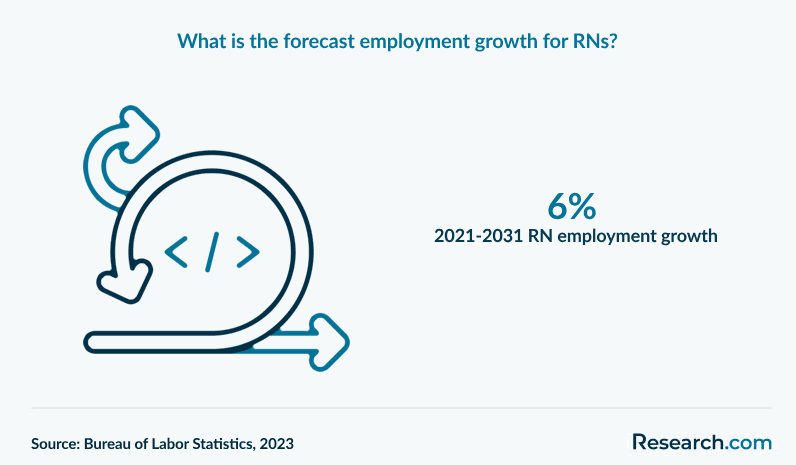
Registered nurse employment is also projected to grow 6% from 2021 to 2031. Demand is influenced by an aging population, preventive care needs, chronic conditions, and continued demand for healthcare services in hospitals, outpatient settings, and home healthcare.
High-demand RN settings
- Hospitals: RNs provide acute care, monitor patients, coordinate treatment, and support interdisciplinary teams.
- Outpatient Clinics: RNs work in specialty care, diagnostics, urgent care, chronic disease management, and same-day procedures.
- Rural Healthcare Settings: RNs help address care shortages and access gaps in underserved communities.
How Do LPN to RN Programs Leverage Technology for Enhanced Clinical Training?
LPN to RN programs increasingly use technology to help students practice clinical judgment before entering patient care settings. Simulation labs, virtual patient scenarios, online case studies, electronic health record practice, and telehealth activities can help students connect theory with real nursing decisions.
Technology is not a substitute for required clinical experience, but it can strengthen preparation. Good programs use simulations to teach prioritization, medication safety, communication, documentation, and emergency response. Students interested in future advanced practice roles may later explore options such as cheap online FNP programs after completing the necessary RN and graduate prerequisites.
How are LPN to RN Bridge Programs Evolving to Meet Future Healthcare Trends?
LPN to RN bridge programs are adapting to changes in healthcare delivery, employer expectations, and student needs. Many programs now include more hybrid learning, simulation-based practice, telehealth exposure, interprofessional communication, population health, and technology-supported assessment. These changes reflect how RNs increasingly work across hospitals, outpatient settings, home care, digital health platforms, and community-based services.
Programs are also responding to workforce pressure by offering more flexible formats for working nurses. Flexibility matters, but students should still prioritize state approval, clinical access, NCLEX-RN preparation, and faculty support over convenience alone. Nurses who later want to specialize in women’s health may compare options such as fast track MSN women's health nurse practitioner online programs after meeting RN, BSN, and graduate admissions requirements.
What advanced nursing degrees can I pursue after an LPN to RN bridge program?
After completing an LPN to RN bridge program and obtaining RN licensure, your next academic step depends on your current degree and career goals. ADN or ASN graduates often pursue RN to BSN completion. BSN-prepared nurses may move into MSN or DNP programs, depending on whether they want advanced clinical practice, leadership, education, informatics, or research-focused roles.
- RN to BSN: Often used by ADN or ASN-prepared RNs who want a bachelor’s degree.
- MSN: May support nurse practitioner, educator, leadership, or specialty roles, depending on the concentration.
- DNP: Designed for doctoral-level nursing practice, leadership, and advanced clinical preparation.
Students comparing doctoral options can review online nursing DNP programs to understand how flexible formats may fit future career plans.
What challenges might I face and how can I overcome them?
LPN to RN bridge programs can be demanding because students often work while completing accelerated coursework and clinical requirements. The most common challenges are time pressure, science-heavy coursework, clinical scheduling, test anxiety, and adjusting from LPN tasks to RN-level judgment and accountability.
| Common mistake or challenge | Why it creates problems | Better approach |
| Choosing a program without checking accreditation and state approval | You may risk licensure, transfer credit, or financial aid issues. | Confirm nursing accreditation and state board approval before applying. |
| Looking only at tuition | Fees, books, clinical travel, supplies, and reduced work hours can change the true cost. | Calculate total cost of attendance and ask for a written estimate. |
| Assuming online means fully remote | Nursing programs require in-person clinical experiences. | Ask exactly where clinicals happen and who arranges them. |
| Ignoring NCLEX-RN support | Graduation alone does not guarantee licensure. | Review pass rates, remediation policies, practice testing, and faculty support. |
| Underestimating the workload | Accelerated programs can be difficult with full-time work. | Plan your work schedule, study hours, childcare, transportation, and backup support before classes start. |
| Relying only on rankings | A highly ranked program may not fit your state, budget, or clinical needs. | Use rankings as a starting point, then compare accreditation, cost, format, outcomes, and fit. |
Students comparing accelerated nursing paths may also review formats such as a 12 month FNP program online later in their academic planning, but the immediate priority should be successfully completing RN preparation and licensure.
What are the job placement and internship opportunities available in LPN to RN programs?
Job placement support can make the transition from student to RN smoother. Strong LPN to RN programs often maintain relationships with hospitals, clinics, long-term care facilities, and community health organizations where students complete clinical experiences. These placements can also help students build professional references and learn which settings fit their strengths.
Before enrolling, ask whether the program offers resume review, interview preparation, employer networking, job fairs, alumni connections, and licensure advising. Also ask whether clinical placements are guaranteed or whether students must find sites themselves. If you are still comparing admissions options, Research.com’s guide What's the easiest nursing program to get into? can help you think through accessibility, requirements, and program fit.
How Can My LPN to RN Bridge Program Propel My Long-Term Nursing Career?
An LPN to RN bridge program can be a turning point because it moves you from task-focused practical nursing into a broader professional nursing role. RN preparation can strengthen clinical judgment, communication, documentation, delegation, leadership, patient education, and adaptability to healthcare technology.
Long term, the RN credential can open doors to specialty practice, charge nurse roles, case management, travel nursing, informatics, public health, education, leadership, and graduate study. Nurses who eventually want executive, advanced practice, or doctoral-level preparation may later consider a DNP fast track, depending on their prior degree and admissions eligibility.
Questions to ask before applying
- Is the program accredited by ACEN, CCNE, or another recognized nursing accreditor?
- Is it approved by the state board of nursing where I plan to become licensed?
- Does the program lead to an ADN, ASN, or BSN?
- How many credits will transfer from my LPN coursework and prerequisites?
- Where are clinical rotations located, and who arranges them?
- Can I complete the program while working my current schedule?
- What is the total cost, including fees and clinical expenses?
- What financial aid, scholarships, payment plans, or employer reimbursement options are available?
- What are the NCLEX-RN pass rates and student support policies?
- What happens if I fail a course, need to pause enrollment, or cannot attend a scheduled clinical rotation?
Key Insights
- An LPN to RN bridge program is best for licensed practical nurses who want RN licensure without repeating all entry-level nursing training.
- Degree type matters: ADN and ASN pathways may be faster, while LPN to BSN programs may provide stronger long-term academic and leadership options.
- Accreditation and state board approval are non-negotiable. Always verify both before enrolling, especially for online and hybrid programs.
- NCLEX-RN preparation should be a major selection factor. Pass rates were 72.8% in 2019, 72.4% in 2020, 68.9% in 2021, 63.4% in 2022, and 69.7% in 2023.
- Program costs vary widely: community colleges may cost $6,000–$20,000, private institutions $25,000–$50,000, and online programs $7,000–$30,000, excluding clinical fees.
- RNs earned an average annual salary of $86,070 in 2023, compared with $59,730 for LPNs, but salary outcomes depend on region, employer, specialty, and experience.
- The U.S. RN workforce surpassed 4 million in 2023 after a 5.3% increase since 2019, while the national RN vacancy rate remained 9.9% and average RN turnover was 18.4%.
- Despite an 8.4% decline in LPNs since 2018, with 630,250 currently in the U.S., a projected shortage of 302,440 LPNs is expected by 2037.
- Employment of registered nurses is projected to grow by 6% from 2023 to 2033, with approximately 194,500 openings projected each year, on average, over the decade.
- The best program is not always the fastest or cheapest. Choose the option that fits your state licensure needs, clinical access, schedule, budget, support needs, and long-term nursing goals.
References:
- American Association of Colleges of Nursing. (2023). The impact of education on nursing practice. American Association of Colleges of Nursing.
- Becker's Hospital Review. (2022). Nursing post-pandemic: The path forward. PubMed Central.
- American Association of Colleges of Nursing. (2024). New AACN data points to enrollment challenges facing U.S. schools of nursing. American Association of Colleges of Nursing.
- Bureau of Labor Statistics. (2023, September 6). Registered nurses. U.S. Department of Labor. Bureau of Labor Statistics.
- Bureau of Labor Statistics. (2023, September 6). Occupational outlook handbook: Registered nurses. U.S. Department of Labor. Bureau of Labor Statistics.
- Health Resources and Services Administration. (2024). State of the U.S. health care workforce, 2024. Health Resources and Services Administration.
- IntelyCare. (2024). 2024 LPN salary: Facts, figures, salaries by state. IntelyCare.
- Lasater, K., et al. (2021). Changes in proportion of bachelor's nurses associated with hospital employment. PubMed Central.
- National Council of State Boards of Nursing. (2022). The 2022 national nursing workforce survey. Journal of Nursing Regulation.
- NSI Nursing Solutions, Inc. (2024). 2024 NSI national healthcare retention & RN staffing report. NSI Nursing Solutions, Inc.
Other Things You Should Know About LPN to RN Bridge Programs
Many LPN to RN bridge programs require about 150 to 400 supervised clinical hours, plus skills lab or simulation time. The exact total is set by the nursing program and must meet state board of nursing and ACEN or CCNE standards for RN preparation.
Prerequisites for 2027 LPN to RN Bridge Programs typically include an active LPN license, a minimum number of practice hours, and specific coursework such as anatomy and physiology. Additional requirements often include CPR certification and a criminal background check.


