2027 Best Nursing Schools in South Carolina: Accredited ADN, BSN, MSN Programs

Co-Founder and Chief Data Scientist
Choosing a nursing school in South Carolina is not just a question of which campus looks best on a ranking list. It is a career decision shaped by licensure rules, program accreditation, clinical placement access, tuition, rural healthcare needs, and the type of nursing role you want to hold after graduation. South Carolina continues to face a serious nursing shortage, with an estimated average of 3,150 RN job openings each year through 2030 and an additional 5,200 nursing jobs expected by the end of that period (Projections Central, 2024).
For students, career changers, LPNs, RNs, and graduate-level nurses, that demand creates opportunity—but it does not remove the need for careful planning. The best nursing program for one student may be a traditional BSN, while another may be better served by an ADN, LPN pathway, RN-to-BSN bridge, MSN, DNP, or specialized advanced practice track. Understanding the different levels of nursing degrees can help you avoid overpaying, choosing the wrong credential, or enrolling in a program that does not support your intended license.
This guide explains how nursing education works in South Carolina, what to consider before enrolling, how long programs take, what costs to expect, which schools offer strong options, and how to evaluate career outcomes. It also covers licensure, online learning, advanced practice pathways, rural healthcare needs, and practical questions to ask before committing to a nursing program.
The Research.com team built this guide to help you compare South Carolina nursing schools with a decision-focused lens. Rankings can be useful, but they should be used alongside accreditation status, NCLEX preparation, clinical site access, faculty support, cost, flexibility, and your long-term career goals.
Best Nursing Schools in South Carolina Table of Contents
- Is nursing a good job in South Carolina?
- What are the steps to becoming a nurse in South Carolina?
- Nursing Program Length in South Carolina
- Tuition and Costs of Nursing Programs in South Carolina
- South Carolina Schools Offering Nursing Programs for 2027
- What to Look For in Nursing Program in South Carolina
- How Do Nurse Practitioner Programs Elevate Nursing Careers in South Carolina?
- How Can an MBA-MSN Dual Degree Transform Nursing Careers in South Carolina?
- What Steps Should New Nurses Take to Transition Into Clinical Practice in South Carolina?
- What career support and mentorship opportunities are available for nurses in South Carolina?
- How Can Interdisciplinary Collaboration Enhance Healthcare Delivery?
- What are the employment outcomes for nursing graduates in South Carolina?
- What are the long-term career benefits of advancing to a nurse practitioner role in South Carolina?
- How Can LPN Programs Accelerate Your Nursing Career in South Carolina?
- Can nurses diversify their careers with administrative and technical roles?
- How Do Nurse Midwives Contribute to Improving Maternal Health in South Carolina?
- What are the top emerging specializations in nursing in South Carolina?
- Navigating Licensure and Certification Requirements for Nurses in South Carolina
- Addressing Rural Healthcare Challenges Through Nurse Workforce Development
- What Online Learning Options Are Available for Nursing Students in South Carolina?
Quick Answer: What is the best nursing path in South Carolina?
For most new students who want the widest long-term nursing options, a CCNE- or ACEN-accredited BSN program is usually the strongest entry route because it prepares graduates for RN licensure, broader hospital opportunities, leadership development, and graduate study. An ADN can be a faster and often lower-cost route to RN licensure, while an LPN program can help students enter patient care more quickly. Current RNs who want advancement should compare RN-to-BSN, MSN, DNP, and advanced practice programs based on cost, clinical requirements, schedule flexibility, and licensure fit.
| Goal | Program path to consider | Why it may fit |
| Enter nursing as quickly as possible | LPN program | Shorter training focused on practical bedside care and foundational nursing tasks. |
| Become an RN with a shorter academic route | ADN or nursing diploma | Can lead to NCLEX-RN eligibility and entry-level RN roles, depending on program approval and licensure requirements. |
| Build the strongest entry-level RN foundation | BSN | Provides broader preparation in clinical care, leadership, research, public health, and future graduate study. |
| Advance from RN to leadership or specialization | RN-to-BSN, MSN, or DNP | Supports career growth, advanced practice preparation, teaching, administration, and specialty roles. |
| Move into advanced practice | MSN, DNP, NP, CRNA, nurse midwife, or other APRN track | Required for many advanced clinical roles, with additional certification and state authorization. |
Is nursing a good job in South Carolina?
Nursing can be a strong career choice in South Carolina for students who want steady healthcare work, direct patient impact, and room for advancement. Demand is supported by the state’s shortage of nurses, ongoing healthcare needs, and projected RN openings. However, the opportunity is uneven. Pay, working conditions, staffing levels, rural access, and employer support can vary significantly by region and facility.
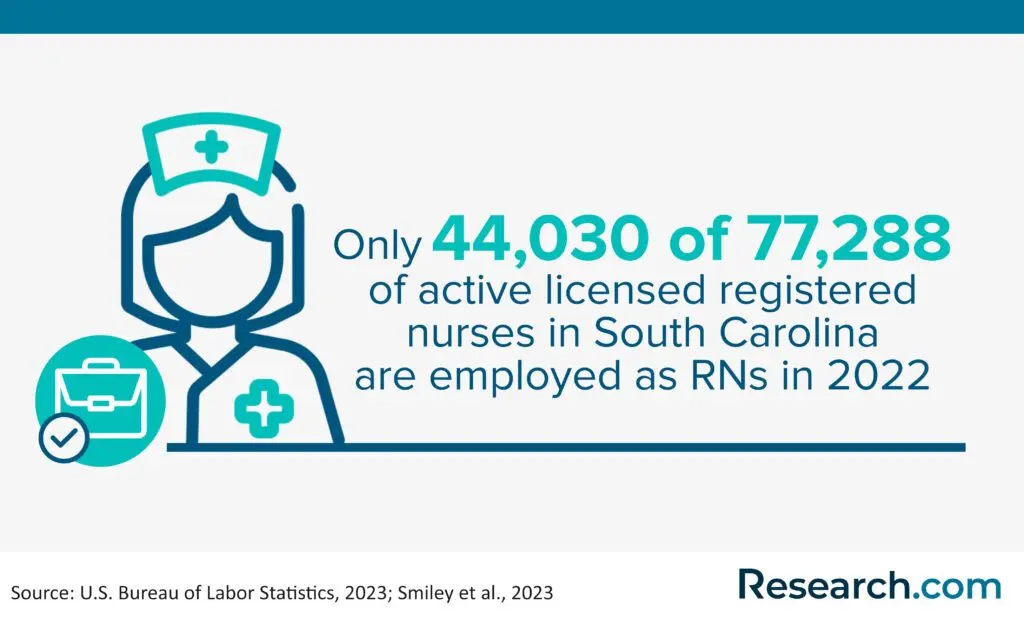
The workforce gap is visible in the difference between the 77,288 active RN licenses in South Carolina in 2024 and about 46,210 active nurses in the workforce (U.S. Bureau of Labor Statistics, 2024). That gap suggests that licensure alone does not guarantee an available workforce. Some nurses may work outside the state, leave bedside care, move into nonclinical roles, retire, or step away because of workplace pressures.
Rural healthcare is another major factor. South Carolina Area Health Education Consortium data cited in the original source show a 20% decline in healthcare professionals in rural counties, compared with a 9% decrease in the rural population itself (South Carolina Area Health Education Consortium, 2023a). That imbalance makes nursing in underserved South Carolina communities especially important, but it can also mean heavier workloads, longer travel, and fewer local resources.
Pay is part of the decision. The reported average wage for RNs in South Carolina was $82,750 in 2024 (U.S. Bureau of Labor Statistics, 2024). Another source cited in the original article reported an average annual RN salary of $112,040 through Indeed in 2024, described as 18% above the national average. Students considering graduate education or affordable online MSN programs should compare salary sources carefully because pay estimates can differ by methodology, city, specialty, employer, overtime, and experience level.
Nursing is also a service profession, not just a labor-market opportunity. The work can be physically demanding, emotionally intense, and schedule-driven, but many nurses find it meaningful because they support patients and families during vulnerable moments. If that mission fits your strengths, the benefits of a nursing career can extend beyond income to purpose, mobility, and professional growth.
What are the steps to becoming a nurse in South Carolina?
The route to becoming a nurse in South Carolina depends on the license and role you want. A student who wants to become an LPN will follow a different path than someone planning to become an RN, nurse practitioner, nurse anesthetist, nurse midwife, or nurse executive. In general, you must complete an approved nursing education program, meet state eligibility requirements, pass the appropriate licensure exam, and apply through the South Carolina Board of Nursing or relevant credentialing process.
- Choose the nursing role you want first. Decide whether you are aiming for LPN, RN, APRN, CRNA, nurse midwife, nurse educator, or nursing leadership. This decision affects program length, cost, admissions requirements, and licensing exams.
- Enroll in an approved and accredited nursing program. Look for state approval and recognized nursing accreditation, especially CCNE or ACEN where applicable. Accreditation can affect licensure eligibility, transfer options, graduate school admission, and employer confidence.
- Complete classroom, lab, simulation, and clinical requirements. Nursing programs combine science courses, clinical judgment training, patient-care labs, supervised clinical rotations, and professional standards.
- Apply for licensure and pass the required exam. LPN candidates generally take the NCLEX-PN, while RN candidates take the NCLEX-RN exam. Advanced practice nurses must complete additional education, certification, and state authorization requirements.
- Start practice with support. New nurses should seek structured onboarding, residencies, preceptorships, mentorship, and continuing education to move from student practice into safe independent clinical work.
| Nursing role | Typical education route | Licensure or certification step | Best fit for |
| Licensed Practical Nurse (LPN) | State-approved LPN program, generally around 12 to 18 months | NCLEX-PN | Students who want a faster entry into bedside care and may later bridge into RN education. |
| Registered Nurse (RN) | ADN, BSN, or nursing diploma route | NCLEX-RN | Students who want broader clinical responsibility, hospital roles, and long-term advancement options. |
| Advanced Practice Registered Nurse (APRN) | MSN or DNP depending on specialization | National certification and South Carolina authorization | RNs seeking advanced assessment, diagnosis, treatment, leadership, or specialty practice. |
| Certified Registered Nurse Anesthetist (CRNA) | Master’s or doctoral nurse anesthesia program, typically around 24 to 36 months | National Certification Examination for Nurse Anesthetists | Experienced nurses pursuing anesthesia care in surgical and procedural settings. |
Nursing Program Length in South Carolina
Nursing school length in South Carolina depends on your starting point and target credential. A first-time student may spend about 12 to 18 months in an LPN program, around two to three years in an ADN or diploma pathway, or about four years in a traditional BSN. Graduate programs vary more because specializations require different clinical hours, practicum experiences, and certification preparation.
Undergraduate Nursing Programs
- Associate Degree in Nursing (ADN). ADN programs commonly take around two to three years and focus on the nursing knowledge and clinical skills needed for entry-level RN practice. Graduates are typically prepared to sit for the NCLEX-RN if they meet program and state requirements.
- Bachelor of Science in Nursing (BSN). Traditional BSN programs usually take about four years. In addition to clinical nursing preparation, BSN curricula often include leadership, evidence-based practice, population health, research, communication, and systems-level care.
Nursing Diploma Option
Nursing diploma programs remain another route into RN preparation. These programs are often connected to hospitals or healthcare institutions and usually last around two to three years. They tend to emphasize clinical practice and direct patient-care training, although graduates must still meet NCLEX-RN and state licensure requirements.
Compared with BSN programs, diploma and ADN routes can be more narrowly focused on entry-level clinical practice. That is not necessarily a disadvantage if your immediate goal is RN licensure at a lower cost or faster pace. However, students who want graduate school, leadership, public health, research, or advanced practice should ask whether credits transfer smoothly into BSN or MSN pathways.
Graduate Nursing Programs
- Master of Science in Nursing (MSN). MSN programs often take 1.5 to two years of full-time study, although timing depends on specialty, enrollment status, clinical requirements, and whether the student enters with a BSN or another background. Common tracks include nurse practitioner, nurse educator, nurse anesthetist, and nurse administrator preparation.
- Doctor of Nursing Practice (DNP). DNP programs are commonly structured for around three to four years of full-time study. They emphasize advanced clinical practice, systems leadership, quality improvement, evidence-based care, and organizational change.
- Doctor of Philosophy in Nursing (PhD in Nursing). A PhD in Nursing is different from a DNP because it is research-centered rather than practice-centered. Students may focus on Nursing Education, Health Policy, Nursing Leadership, or Nursing Research. Full-time completion may take approximately three to five years, while part-time study can extend the timeline.
Graduate-Level Specializations
Graduate nursing students can pursue advanced tracks such as family nurse practitioner, pediatric nurse practitioner, adult-gerontology nurse practitioner, nurse anesthetist, nurse educator, psychiatric mental health, nursing administration, and other specialties. These graduate tracks function somewhat like advanced nursing degree concentrations, but they are tied more directly to clinical scope, certification, leadership, or teaching outcomes. Depending on the specialization, students may need 1 to 2 years of additional focused study beyond the core MSN or DNP structure.
| Program type | Typical length cited | Primary outcome | Decision note |
| LPN | 12 to 18 months | Practical nursing preparation | Good for faster workforce entry, but advancement usually requires more education. |
| ADN | Two to three years | RN licensure preparation | Can be cost-effective, but confirm transfer options into BSN programs. |
| Nursing diploma | Two to three years | RN licensure preparation | Clinical-heavy route; check employer expectations and credit transferability. |
| BSN | About four years | RN licensure preparation plus broader professional foundation | Often the best long-term starting point for leadership and graduate study. |
| MSN | 1.5 to two years of full-time study | Advanced practice, education, leadership, or specialty preparation | Choose based on certification goals and clinical placement support. |
| DNP | Around three to four years of full-time study | Advanced clinical leadership and practice doctorate preparation | Best for nurses aiming at high-level practice, systems leadership, or advanced roles. |
| PhD in Nursing | Approximately three to five years full time | Research, academic, policy, or scholarly leadership | Best for nurses who want to generate research rather than primarily expand clinical scope. |
Is the BSN the best entry-level nursing program?
For many students, the BSN is the strongest entry-level nursing degree because it keeps more doors open. A BSN can support RN licensure preparation while also building skills in leadership, evidence-based practice, population health, interprofessional communication, quality improvement, and research. These areas matter because hospitals and healthcare systems increasingly expect nurses to work across complex care teams, digital systems, and patient populations with multiple conditions.
That does not mean every student must start with a BSN. An ADN or diploma may make sense if cost, speed, or local access is your priority. The key is to plan the next step before you enroll. If you choose an ADN or diploma, ask whether the school has clear bridge options, whether credits transfer, and whether you can later move into an RN-to-BSN route. Working RNs can often find accelerated or flexible bridge programs, including online and 12-month RN program options. Students comparing budget-conscious pathways can also review affordable RN-to-BSN programs.
Tuition and Costs of Nursing Programs in South Carolina
Nursing school costs in South Carolina vary by credential, residency status, institution type, program format, and specialization. Tuition is only one part of the total price. Students should also budget for fees, books, uniforms, clinical supplies, background checks, drug screening, immunizations, transportation, parking, technology, testing costs, licensure exam fees, and living expenses.
| Program or track | In-state cost range cited | Out-of-state cost range cited |
| Nursing Diploma | $11,000 to $22,000 | $18,500 to $35,000 |
| Licensed Practical Nurse (LPN) | $9,000 to $16,500 | $18,000 to $23,000 |
| Bachelor of Science in Nursing (BSN) | $14,000 to $26,500 | $27,000 to $38,000 |
| MSN, Family Nurse Practitioner focus | $25,500 to $47,000 | $34,500 to $58,000 |
| MSN, Nurse Anesthesia focus | $48,000 to $70,000 | $55,000 to $76,500 |
| DNP, Nurse Educator specialization | $33,000 to $58,000 | $40,000 to $67,000 |
| DNP, Nursing Leadership specialization | $40,000 to $68,000 | $50,000 to $78,000 |
Beyond tuition, students should prepare for additional yearly expenses. The original cost guidance recommends setting aside approximately $6,000 to $12,000 annually for books, supplies, transportation, and living-related costs. This range can be higher or lower depending on housing, commute distance, childcare needs, work schedule, and whether clinical rotations require travel.
How to estimate the real cost before you enroll
- Ask for the full program cost, not just tuition per credit. Nursing programs often carry lab, simulation, testing, insurance, clinical, and technology fees.
- Confirm whether summer terms are required. Accelerated tracks can shorten time but may compress costs into fewer semesters.
- Calculate lost income if you reduce work hours. Clinical schedules may limit full-time employment.
- Compare transfer and bridge policies. A cheaper first credential can become expensive if credits do not apply toward the next degree.
- Check residency rules. In-state tuition and state-funded aid often require meeting South Carolina residency requirements.
Apply for Scholarships and Financial Aid to Enroll in the Best Nursing Schools in South Carolina
Financial aid can make a major difference in whether a nursing program is realistic. Students should complete required aid applications early, ask each school about nursing-specific scholarships, and compare institutional, state, federal, employer-sponsored, and service-based funding options. Schools may offer awards based on academic merit, financial need, community service, diversity goals, or commitment to nursing practice.
South Carolina students should review resources from the South Carolina Commission on Higher Education, which provides information about scholarships and grants for eligible residents. Universities may also offer nursing scholarships through their colleges of nursing, graduate schools, or financial aid offices. Because funding rules can change, verify deadlines, eligibility, renewal requirements, service obligations, and whether awards apply to online, part-time, accelerated, or graduate programs.
The ROI of a Nursing Degree
Return on investment in nursing depends on more than the first salary after graduation. Students should compare total program cost, debt, time out of the workforce, expected licensure timeline, job placement support, employer tuition reimbursement, overtime potential, and advancement opportunities. A low-cost program with weak NCLEX support may not be a good value, while a higher-cost program with strong clinical partnerships and licensure outcomes may offer better long-term returns.
The original article cited a 2025 base salary for registered nurses in South Carolina of $112,500 (Bureau of Labor Statistics, 2024), along with benefits such as a 401(k) plan and potential overtime pay of around $12,000. Students asking whether nursing school is worth it should treat these figures as planning references rather than guarantees, because pay can vary by employer, city, shift, experience, credential, specialty, overtime availability, and local staffing needs.
Location can affect earnings. The original salary examples identified Columbia with an average RN salary of $130,958, Florence with $119,842, and North Charleston with $112,145. These figures suggest that local labor markets can differ within the state, so students should compare job postings in the region where they plan to work rather than relying only on statewide averages.
A strong ROI case is most convincing when the program supports licensure, clinical readiness, and advancement. Before enrolling, ask each school for NCLEX preparation support, clinical placement policies, graduate employment outcomes, scholarship availability, transfer options, and employer partnerships.
South Carolina Schools Offering Nursing Programs for 2027
Research.com reviewed South Carolina institutions offering nursing programs across ADN, BSN, MSN, and related pathways, considering factors such as accessibility, faculty expertise, student outcomes, networking opportunities, and program offerings. Use this list as a starting point, not a final decision. A ranking can help you identify reputable options, but you should still verify accreditation, admissions standards, clinical placement availability, licensure preparation, cost, and fit.
South Carolina’s nursing education landscape has also shown strength on licensure outcomes. The state was reported as fifth in the nation for nursing license exam pass rates, an indicator students may want to review alongside each school’s individual results.
1. University of South Carolina Columbia
The University of South Carolina College of Nursing offers a broad nursing education and research environment. Its work is connected to initiatives such as the Center for Nursing Leadership and the Cancer Survivorship Center. Students benefit from simulation-based learning, virtual teaching tools, and clinical experiences in acute care hospitals, ambulatory clinics, and community health settings in and around Columbia.
- Available Programs: BSN, MSN, DNP, and PhD
- Available Specializations: Family Nurse Practitioner, Adult-Gerontology Acute Care Nurse Practitioner, Psychiatric Mental Health Nurse Practitioner, and Nurse Executive Leadership
- Accreditation: Commission on Collegiate Nursing Education (CCNE)
2. Clemson University
Clemson University School of Nursing is one of 16 institutions across the United States recognized by the National League for Nursing as a Center of Excellence in Nursing Education. Clemson has held this recognition since 2014, reflecting a sustained institutional focus on nursing education quality and professional preparation.
- Available Programs: BSN, MSN, DNP, and PhD
- Available Specializations: Family Nurse Practitioner, Adult-Gerontology Acute Care Nurse Practitioner, Psychiatric Mental Health Nurse Practitioner, and Nurse Executive Leadership.
- Accreditation: Commission on Collegiate Nursing Education (CCNE)
3. Medical University of South Carolina Charleston
The Medical University of South Carolina College of Nursing is described as the state’s oldest nursing school and has a long-standing role in education, research, and clinical practice. The college’s Center for Community Health Partnerships supports collaboration with community organizations, and students can train through simulation and clinical placements across Charleston-area healthcare settings, including MUSC Health System.
- Available Programs: BSN, MSN, DNP, and PhD
- Available Specializations: Family Nurse Practitioner, Adult-Gerontology Primary Care Nurse Practitioner, Psychiatric Mental Health Nurse Practitioner, Nurse Anesthesia, and Nursing Administration
- Accreditation: Commission on Collegiate Nursing Education (CCNE)
4. Anderson University Anderson
Anderson University School of Nursing integrates Christian values with professional nursing education. Its curriculum emphasizes compassionate care, personal mentoring, and practical skill development. Students may train through simulation and clinical experiences with healthcare organizations in the Anderson area, including AnMed Health Medical Center, Hospice of the Upstate, and Anderson County Health Department.
- Available Programs: BSN, RN to BSN
- Available Specializations: None
- Accreditation: Commission on Collegiate Nursing Education (CCNE)
5. Bob Jones University Greenville
Bob Jones University Division of Nursing combines nursing education with biblical principles and professional standards. The program emphasizes holistic care that accounts for physical, mental, spiritual, and social needs. Students can develop clinical reasoning and technical skills through simulation and complete clinical rotations in Greenville-area healthcare settings such as Greenville Health System, Bon Secours St. Francis Health System, and Shriners Hospitals for Children.
- Available Programs: BSN, RN to BSN
- Available Specializations: None
- Accreditation: Commission on Collegiate Nursing Education (CCNE)
What to Look For in Nursing Program in South Carolina
The best nursing program is the one that prepares you for licensure, fits your finances, provides quality clinical training, and supports your intended career path. Before applying, compare schools using practical criteria rather than relying only on reputation, location, or tuition.
| Factor | What to ask | Why it matters |
| Accreditation and state approval | Is the program approved for South Carolina licensure and accredited by CCNE or ACEN where applicable? | Accreditation can affect licensure eligibility, transfer credit, graduate admission, and employer trust. |
| NCLEX preparation | How does the school prepare students for NCLEX-PN or NCLEX-RN? | Passing the licensing exam is essential before entering practice as an LPN or RN. |
| Clinical placements | Where are clinical sites, and does the school arrange placements? | Clinical quality affects confidence, competence, networking, and job readiness. |
| Faculty support | What are faculty credentials, advising practices, and student-to-faculty interaction like? | Strong mentorship can help students handle rigorous coursework and clinical expectations. |
| Program flexibility | Are full-time, part-time, evening, weekend, hybrid, or online options available? | Flexibility matters for working adults, parents, military students, and career changers. |
| Cost and aid | What is the total program cost after fees, books, supplies, and aid? | The cheapest tuition is not always the lowest total cost. |
| Specializations | Does the program offer tracks that match your goals? | Graduate students especially need alignment between specialty, certification, and clinical placement. |
| Career services | Does the school offer resume help, interview coaching, employer events, and placement support? | Career support can smooth the transition from student to professional nurse. |
| Transfer and bridge options | Can credits move into RN-to-BSN, MSN, or DNP pathways? | Good transfer policies protect your long-term education investment. |
Common mistakes when choosing a South Carolina nursing school
| Mistake | Better approach |
| Choosing a program only because it is nearby. | Compare location with accreditation, clinical sites, NCLEX support, cost, and schedule fit. |
| Looking only at tuition. | Calculate total cost, including fees, supplies, travel, testing, and lost work hours. |
| Assuming every online nursing program meets South Carolina requirements. | Confirm state approval, clinical placement rules, and licensure eligibility before enrolling. |
| Ignoring clinical placement responsibility. | Ask whether the school secures placements or expects students to find their own sites. |
| Assuming salary estimates are guaranteed. | Review local job postings and understand how pay varies by employer, city, shift, specialty, and experience. |
| Choosing an ADN without planning the BSN bridge. | Confirm transfer pathways and RN-to-BSN options before starting. |
| Applying to an advanced practice program without checking certification alignment. | Make sure the curriculum matches the specialty certification and state authorization you need. |
Students should also evaluate student support, tutoring, simulation resources, graduation requirements, academic progression policies, remediation options, and employer relationships. Nursing programs are demanding; support systems matter as much as curriculum design.
How Do Nurse Practitioner Programs Elevate Nursing Careers in South Carolina?
Nurse practitioner programs can help experienced RNs move into advanced clinical roles with greater responsibility in assessment, diagnosis, treatment planning, patient education, and care coordination. In South Carolina, NP preparation may be especially valuable in primary care, behavioral health, adult-gerontology, family practice, and underserved communities where access to providers can be limited.
Strong NP programs should combine advanced pathophysiology, pharmacology, health assessment, evidence-based practice, specialty coursework, and supervised clinical hours. Students should compare certification pass preparation, clinical placement support, faculty practice experience, and whether the program aligns with their intended population focus. Prospective students can review Research.com’s guide to the best nurse practitioner programs in South Carolina for additional program comparisons.
How Can an MBA-MSN Dual Degree Transform Nursing Careers in South Carolina?
An MBA-MSN dual degree is designed for nurses who want to combine clinical knowledge with business, operations, finance, strategy, and organizational leadership. This pathway may fit nurses aiming for executive leadership, healthcare administration, service-line management, quality improvement, consulting, or system-level innovation.
The dual-degree route is not necessary for every nurse. It makes the most sense if you want to lead people, budgets, programs, or organizations—not only provide direct clinical care. South Carolina nurses considering this path should compare curriculum balance, practicum expectations, online flexibility, tuition, employer tuition assistance, and leadership outcomes. Programs such as online MBA-MSN dual degree programs may be useful for working nurses who need schedule flexibility.
What Steps Should New Nurses Take to Transition Into Clinical Practice in South Carolina?
Graduating from nursing school is not the end of preparation. The first year of practice is a critical transition period. New nurses in South Carolina should secure licensure, choose supportive employers, seek structured onboarding, and build habits that protect patient safety and professional resilience.
- Confirm licensure status before accepting independent responsibilities. Review South Carolina requirements and maintain documentation related to your South Carolina nursing license.
- Prioritize residency or preceptor-supported roles. A structured transition can reduce the shock of moving from supervised student practice to full patient assignments.
- Ask about staffing, orientation length, and escalation policies. New nurses need safe channels for asking questions and obtaining clinical backup.
- Join professional networks. Local associations, alumni groups, and hospital committees can help with mentoring and career direction.
- Build core professional skills early. Time management, communication, documentation, medication safety, and prioritization often determine early success.
What career support and mentorship opportunities are available for nurses in South Carolina?
Career support can include resume preparation, interview coaching, employer fairs, alumni networking, clinical residency placement, faculty advising, peer mentoring, and connections with local hospitals. Students should ask each school how it helps graduates move from coursework into employment, especially if they are entering nursing for the first time or returning to school after years in another field.
Mentorship is also important for LPN students and early-career nurses who may be deciding whether to continue into RN or BSN education. Students exploring practical nursing can review LPN program options, but they should still confirm clinical requirements and state licensure alignment because nursing cannot be completed entirely through online theory alone.
How Can Interdisciplinary Collaboration Enhance Healthcare Delivery?
Nurses rarely work in isolation. Effective care in South Carolina depends on collaboration among nurses, physicians, pharmacists, therapists, social workers, case managers, informatics teams, and community health professionals. Interdisciplinary teamwork improves communication, medication safety, discharge planning, chronic disease management, and continuity of care.
For example, nurses who understand medication workflows can communicate more effectively with pharmacy professionals. Students interested in the broader healthcare team can explore what it takes to become a pharmacist through this guide on how to become a licensed pharmacist in South Carolina. For nurses, the practical takeaway is simple: choose programs that teach collaboration, not just task performance.
What are the employment outcomes for nursing graduates in South Carolina?
Employment outcomes depend on the school, credential, licensure success, clinical network, geographic area, and current employer demand. Strong nursing programs often maintain relationships with hospitals, clinics, long-term care facilities, community health organizations, and specialty practices. These partnerships can support internships, clinical placements, residencies, and job interviews.
Before enrolling, ask schools for recent graduate employment information, NCLEX pass support, employer partners, and the percentage of graduates working in nursing roles after licensure. Students considering the practical nursing route should also understand the licensing process and job scope; Research.com’s guide to LPN requirements in South Carolina explains that pathway in more detail.
What are the long-term career benefits of advancing to a nurse practitioner role in South Carolina?
Becoming a nurse practitioner can expand a nurse’s clinical scope, decision-making responsibility, leadership opportunities, and service impact. NPs may work in family practice, adult-gerontology, psychiatric mental health, pediatrics, women’s health, urgent care, rural clinics, and specialty settings. In areas with provider shortages, advanced practice nurses can play a meaningful role in access to care.
This path requires careful planning. Nurses should review state practice rules, national certification requirements, clinical placement availability, and specialty fit before choosing a program. For a step-by-step overview, see Research.com’s guide on how to become a nurse practitioner in South Carolina.
How Can LPN Programs Accelerate Your Nursing Career in South Carolina?
LPN programs can provide a faster entry into nursing-related patient care than an RN or BSN route. They focus on practical care skills, safety, documentation, basic nursing procedures, and patient support under the appropriate supervision and scope of practice. This can be a useful option for students who want to start working sooner, test their fit with healthcare, or build a bridge toward RN education later.
The trade-off is that LPN roles have a narrower scope than RN roles and may offer fewer advancement options without additional education. When comparing programs, check approval status, NCLEX-PN preparation, clinical site quality, schedule options, and bridge agreements. Research.com’s guide to the best online LPN programs in South Carolina can help students compare flexible options while remembering that clinical training must still be completed in approved settings.
Can nurses diversify their careers with administrative and technical roles?
Yes. Nurses can move into administrative, technical, quality, compliance, informatics, revenue cycle, case management, education, public health, and leadership roles. These paths can be appealing for nurses who want to use clinical knowledge outside traditional bedside care or reduce physical demands while staying connected to healthcare.
Some nurses add skills in billing, coding, data, documentation improvement, or health information workflows. Those interested in nonclinical healthcare operations can learn about how to become a medical biller and coder in South Carolina. This type of career diversification can complement nursing experience, especially for nurses interested in utilization review, revenue integrity, quality reporting, or informatics.
How Do Nurse Midwives Contribute to Improving Maternal Health in South Carolina?
Nurse midwives provide care related to pregnancy, childbirth, postpartum recovery, newborn health, reproductive health, and family education. Their work can be especially important in communities where maternity care access is limited or where patients need continuity across prenatal, delivery, and postpartum services.
Students interested in this role should understand that nurse midwifery requires advanced education, clinical preparation, certification, and state authorization. The pathway is rigorous because maternal and newborn care involves high-stakes clinical judgment. Research.com’s guide to nurse midwife education requirements in South Carolina explains the preparation process in more detail.
What are the top emerging specializations in nursing in South Carolina?
Healthcare delivery is changing, and South Carolina nurses can strengthen their careers by building expertise in specialties connected to population needs, digital care, chronic disease management, and workforce gaps. Not every specialization requires the same degree level, but each can shape the type of setting, patient population, and responsibilities a nurse may pursue.
- Telehealth Nursing: Telehealth nursing supports remote assessment, education, monitoring, triage, and follow-up care. It can be particularly relevant in rural areas where patients may face distance, transportation, or provider-access barriers.
- Geriatric Nursing: Geriatric nurses focus on older adults, chronic conditions, fall prevention, medication coordination, caregiver communication, long-term care, hospice, and quality of life.
- Infection Control Nursing: Infection prevention nurses help healthcare organizations reduce infection risks, monitor protocols, educate staff, and support safer clinical environments.
- Community Health Nursing: Community health nurses work with local agencies, health departments, schools, nonprofits, and outreach programs to address prevention, vaccination, education, chronic disease, and health equity.
- Nursing Informatics: Informatics nurses connect clinical practice with health technology, electronic records, workflow design, data quality, patient safety, and care improvement.
Advanced Nursing Pathways and Career Growth Opportunities in South Carolina
Advanced nursing education can help South Carolina nurses move into primary care, specialty practice, education, administration, anesthesia, psychiatric mental health, family care, and leadership. These routes are especially relevant as healthcare systems manage complex patients, workforce shortages, rural access issues, and digital transformation.
Family nurse practitioners, nurse anesthetists, and nurse educators are among the advanced roles that may appeal to RNs who want more responsibility. Nurses with a BSN who are interested in primary care can compare online BSN-to-FNP programs, but they should confirm clinical placement expectations, certification alignment, and South Carolina practice requirements before enrolling.
MSN and DNP programs may also prepare nurses for management, education, quality improvement, policy, and systems-level work. The right choice depends on whether you want to remain primarily clinical, teach future nurses, lead teams, manage programs, or influence organizational decisions.
Advanced practice nurses can also support rural communities by expanding access to primary and specialty care. Students motivated by rural health should ask schools whether they offer rural clinical rotations, telehealth training, community health partnerships, or service-based scholarships.
Higher credentials may improve earning potential, but salary outcomes are not automatic. Pay depends on specialty, city, employer, scope of practice, experience, shift, and demand. Students should compare local job postings and employer requirements before assuming that any advanced degree will produce a specific income level.
Navigating Licensure and Certification Requirements for Nurses in South Carolina
Licensure is mandatory for nursing practice in South Carolina. RN candidates generally must complete an approved nursing program, meet eligibility requirements, and pass the NCLEX-RN. LPN candidates take the NCLEX-PN. Advanced practice nurses must complete graduate-level preparation, obtain national certification where required, and meet South Carolina authorization rules for their role.
South Carolina participates in the Nurse Licensure Compact (NLC), which can allow eligible nurses to practice in other compact states without obtaining separate licenses in each one. This can support travel nursing, cross-state employment, and some telehealth roles, but nurses should always verify current compact rules and employer requirements before practicing across state lines.
Non-nurses with a bachelor’s degree in another field may consider accelerated or direct-entry graduate pathways. Programs such as online direct-entry MSN options can offer an alternative route, but applicants must verify that the program leads to the correct licensure outcome for South Carolina.
Licensure maintenance also matters. Nurses must stay current with renewal rules, continuing education expectations, employer competency requirements, and any specialty certification renewals. Waiting until the end of a renewal period can create unnecessary stress, so build a compliance calendar early.
Addressing Rural Healthcare Challenges Through Nurse Workforce Development
Rural healthcare access is one of the most important nursing workforce issues in South Carolina. Rural communities may face provider shortages, transportation barriers, hospital access challenges, and higher needs related to chronic disease and preventive care. Nurses can help close these gaps, but workforce development must be intentional.
One practical solution is stronger alignment between nursing education and rural healthcare needs. Programs that include rural rotations, community health experiences, telehealth training, and partnerships with rural clinics can help students understand the realities of practice outside large urban hospitals.
Scholarships, loan forgiveness, service commitments, and employer-sponsored education can also encourage nurses to practice in underserved areas. Students interested in this mission should ask schools and employers whether financial incentives are available for rural service.
Advanced practice preparation is also relevant. Family nurse practitioners and other APRNs may help expand access to primary care in communities with provider shortages. Students who are still at the beginning of the pathway can use Research.com’s guide on how to become an RN in South Carolina to map the steps toward later advancement.
Technology is another part of the solution. Telehealth, remote monitoring, electronic health records, and data-informed outreach can help nurses extend care beyond traditional facility walls. Nursing programs that teach digital care delivery may better prepare graduates for rural and community-based practice.
What Online Learning Options Are Available for Nursing Students in South Carolina?
Online nursing education can be useful for working adults, parents, rural students, military-affiliated learners, and RNs returning for a higher credential. However, students should understand that “online nursing program” usually means online coursework combined with in-person clinical, lab, simulation, or practicum requirements. Nursing is a hands-on profession, so clinical training cannot be skipped.
Before enrolling in an online or hybrid program, verify accreditation, South Carolina licensure alignment, clinical placement support, technology requirements, residency rules, and whether the school is authorized to enroll students in your state. Research.com’s list of online nursing programs in South Carolina can help students compare flexible options while keeping licensure and clinical requirements at the center of the decision.
The Advantage of Enrolling in the Best Nursing Schools in South Carolina
Attending a strong nursing school can improve your preparation for licensure, clinical practice, professional networking, and long-term advancement. The value comes not from the name alone, but from the quality of instruction, simulation training, clinical partnerships, advising, exam preparation, and career support.
Top nursing schools may offer experienced faculty, diverse clinical placements, research opportunities, specialty tracks, leadership development, and pathways into MSN, DNP, or PhD study. These features can matter when students pursue advanced practice roles, teaching, nursing administration, public health, informatics, or specialty certification.
Specialized credentials can also shape career options. The original article cited an Infection Control Certification as being associated with an average 41.5% salary increase (Bureau of Labor Statistics, 2025). Students should treat such figures cautiously and verify current employer demand, but the broader point is valid: targeted expertise can improve marketability when it aligns with healthcare needs.
Nurses interested in population health, prevention, policy, epidemiology, or community programs may also consider a public health degree. Public health training can complement nursing by preparing professionals to address community health needs, health education, policy development, and healthcare disparities. The original article also cited a 56.22% salary increase around the country for nursing professionals with such a degree, though individual outcomes will vary by role, employer, and region.
Questions to Ask Before Choosing a South Carolina Nursing Program
- Is the program approved for the license I want? Never assume approval based on marketing language.
- Is the nursing program accredited by a recognized body such as CCNE or ACEN? Accreditation can affect future mobility.
- What are the program’s recent NCLEX outcomes and remediation supports? Ask for the most recent data available from the school.
- Who arranges clinical placements? This is especially important for online, hybrid, graduate, and NP programs.
- What is the total cost after fees and required materials? Compare full budgets, not only tuition.
- Can I work while enrolled? Clinical schedules and accelerated formats may limit employment.
- Do credits transfer into BSN, MSN, or DNP programs? This matters if you plan to advance.
- What student support is available if I struggle academically? Nursing coursework can be rigorous.
- Does the program serve the region where I want to work? Local clinical networks can support hiring.
- Does the program match my specialty goal? Graduate students should confirm certification and population-focus alignment.
Key Insights
- South Carolina needs nurses, but demand is not the same as guaranteed success. The state has an estimated average of 3,150 RN openings annually through 2030 and 5,200 additional nursing jobs expected by the end of that period, but students still need accredited education, licensure, clinical readiness, and strong job-search preparation.
- The BSN is often the strongest entry-level choice, but not the only smart route. ADN, diploma, and LPN programs can be practical options when cost, speed, or access matters. The key is to plan bridge and transfer pathways early.
- Accreditation and licensure alignment are non-negotiable. Before enrolling, confirm program approval, CCNE or ACEN accreditation where applicable, NCLEX preparation, and South Carolina Board of Nursing requirements.
- Costs vary widely by credential and residency. Cited ranges run from $9,000 for some in-state LPN programs to $76,500 for some out-of-state MSN Nurse Anesthesia pathways, before considering annual living and supply costs of approximately $6,000 to $12,000.
- Salary data should be used carefully. The article cites RN wage figures including $82,750, $112,040, and $112,500 from different sources and contexts. Compare local job postings, not just statewide or national averages.
- Rural healthcare creates both need and opportunity. South Carolina’s rural workforce challenges make community health, telehealth, family practice, and advanced practice nursing especially important.
- Online nursing programs can add flexibility, but clinical training remains in person. Verify clinical placement support and licensure eligibility before choosing an online or hybrid option.
- The best nursing school is the one that fits your license, finances, schedule, and long-term goal. Use rankings as a starting point, then make the final decision based on accreditation, cost, clinical quality, support, and outcomes.
Related Articles for Nearby States
- 2027 Best Nursing Schools in Georgia – Accredited ADN, BSN, MSN Programs
- 2027 Best Nursing Schools in North Carolina – Accredited ADN, BSN, MSN Programs
- 2027 Best Nursing Schools in Florida – Accredited ADN, BSN, MSN Programs
- 2027 Best Nursing Schools in Tennessee – Accredited ADN, BSN, MSN Programs
- 2027 Best Nursing Schools in Alabama – Accredited ADN, BSN, MSN Programs
- 2027 Best Nursing Schools in Virginia – Accredited ADN, BSN, MSN Programs
- 2027 Best Nursing Schools in Kentucky – Accredited ADN, BSN, MSN Programs
- 2027 Best Nursing Schools in Mississippi – Accredited ADN, BSN, MSN Programs
- 2027 Best Nursing Schools in West Virginia – Accredited ADN, BSN, MSN Programs
- 2027 Best Nursing Schools in Louisiana – Accredited ADN, BSN, MSN Programs
References:
- AACN. (2025). 2024-2025 Enrollment and Graduations in Baccalaureate and Graduate Programs in Nursing. AACN nursing enrollment data
- College Ave. (2025). BSN Nurse Salary: What Graduates Can Expect to Earn. College Ave nursing salary resource
- NCSBN. (2025). 2024 National Nursing Workforce Study. NCSBN workforce study
- Nurse.org. (2025). New 2025 Report Shows Where Nurse Pay Is Growing Fastest. Nurse.org pay report
- Projections Central. (2024). RN job openings in South Carolina. Projections Central RN projections
- U.S. Bureau of Labor Statistics. (2024). Employment and wages of registered nurses. BLS registered nurse employment and wage data
- U.S. Bureau of Labor Statistics. (2025). Occupational Outlook Handbook: Registered Nurses. BLS Occupational Outlook Handbook for registered nurses
Other Things You Should Know About the Best Nursing Schools in South Carolina
The top nursing schools in South Carolina for 2027 include the University of South Carolina, Clemson University, and Medical University of South Carolina. These institutions offer highly-regarded ADN, BSN, and MSN programs with comprehensive curriculums and clinical experience.
South Carolina nursing programs must include supervised clinical practice, and hour totals vary by degree. ADN and BSN programs often require hundreds of clinical hours, while MSN specialties may require advanced practicum hours. Programs must meet South Carolina Board of Nursing standards and prepare students for NCLEX or specialty certification.