
2027 An Overview of Master of Social Work (MSW) Specializations

Co-Founder and Chief Data Scientist
Choosing a Master of Social Work specialization is not just a course-planning decision. It can affect the clients you serve, the field placement you need, the license or certification you may pursue, and the kinds of employers that will consider you after graduation. According to the US Bureau of Labor Statistics (BLS), 751,900 social workers were employed as of 2023, showing how widely the profession supports schools, hospitals, mental health systems, family services, public agencies, and community organizations. This guide explains the major master of social work specializations for 2027, how they differ, what career paths they support, and how to choose the option that fits your goals.
Quick answer: What MSW specialization should you choose?
The best MSW specialization depends on the population you want to serve, the work setting you prefer, and whether you want to provide direct services, clinical treatment, program leadership, policy advocacy, or community-level support. Clinical, healthcare, mental health and substance abuse, child and family, school, gerontology, macro, and forensic social work are among the most common options. Students who want therapy-focused roles should look closely at clinical licensure requirements, while students drawn to systems change may be better suited to macro or policy-focused tracks.
Key Things You Should Know About Master of Social Work Specializations
- MSW specializations prepare students for different practice settings, including therapy, healthcare, schools, child welfare, aging services, justice systems, and policy work.
- Each track emphasizes a different mix of assessment, counseling, advocacy, case management, research, community engagement, and ethical decision-making.
- Healthcare, mental health, child and family, and school social work remain especially important areas because they respond to persistent needs in care coordination, behavioral health, student support, and family services.
- What MSW specializations are available for 2027?
- What do social workers contribute to society?
- Why does your MSW specialization matter?
- What skills do MSW students need across specializations?
- What licensing and certification rules should MSW students check?
- What is the employment outlook for MSW graduates?
- Should you choose a full-time, part-time, or online MSW program?
- How can you pay for an MSW specialization?
- How do you select the right MSW specialization?
- Is a BSW useful before starting an MSW specialization?
- Can certifications improve your MSW career options?
- How is technology changing MSW specializations?
- How is an MSW different from other mental health training?
- How can psychology strengthen MSW practice?
- What ethical challenges should specialized social workers expect?
- How can organizational psychology support social work leadership?
- What trends are shaping MSW specializations?
- Should MSW graduates consider a doctoral degree?
- How does accreditation affect MSW quality and career readiness?
- What are the long-term career and salary prospects after an MSW?
What MSW specializations are available for 2027?
MSW programs are designed to build advanced social work knowledge beyond the undergraduate level. A social worker degree can lead to many forms of practice, but the specialization you choose usually determines your field placement, elective coursework, career preparation, and sometimes your licensure pathway. The sections below explain the main MSW specialization options and the students who may fit each path.
| MSW specialization | Best fit for students who want to | Common work settings |
| Clinical Social Work | Provide therapy, assessment, and ongoing mental health support | Private practice, hospitals, outpatient clinics, community mental health centers |
| School Social Work | Support students, families, teachers, and school systems | K-12 schools, districts, educational agencies |
| Healthcare Social Work | Help patients and families manage illness, treatment, discharge planning, and care access | Hospitals, clinics, hospice care, public health agencies |
| Macro Social Work | Work on policy, advocacy, community programs, and systems-level change | Government agencies, nonprofits, advocacy organizations, community programs |
| Child and Family Social Work | Protect children, strengthen families, and respond to family crises | Child welfare agencies, family service organizations, community outreach programs |
| Mental Health and Substance Abuse Social Work | Support people with behavioral health needs, addiction, crisis concerns, and recovery goals | Rehabilitation centers, mental health clinics, community treatment programs |
| Gerontology Social Work | Serve older adults and families navigating aging, care needs, and end-of-life planning | Senior centers, assisted living facilities, elder care organizations |
| Criminal Justice and Forensic Social Work | Work with people affected by courts, incarceration, reentry, probation, or legal systems | Correctional facilities, probation departments, reentry programs |
Clinical Social Work
- Main focus: Counseling, psychotherapy, assessment, and mental health treatment.
- What you study: Students usually learn evidence-informed intervention methods, diagnosis-related concepts, trauma-informed practice, ethics, risk assessment, and therapeutic relationship-building.
- Career direction: Graduates often seek roles in private practice, hospitals, community mental health agencies, outpatient clinics, and other clinical environments. Students interested in independent therapy practice should confirm their state’s clinical licensure requirements before choosing a program.
School Social Work
- Main focus: Student well-being, family engagement, crisis response, attendance, behavior, and school climate.
- What you study: This track often emphasizes child development, educational policy, trauma-informed school practice, special education collaboration, and family systems.
- Career direction: Graduates commonly work in K-12 schools, school districts, and education-focused agencies. Some states or districts may require additional school social work certification or education-related credentials.
Healthcare Social Work
- Main focus: Helping patients and families navigate medical systems, treatment decisions, care transitions, and psychosocial stress.
- What you study: Students build skills in discharge planning, interdisciplinary teamwork, grief support, patient advocacy, care coordination, and health-related case management.
- Career direction: Graduates may work in hospitals, outpatient clinics, hospice programs, rehabilitation facilities, and public health organizations.
Macro Social Work
- Main focus: Community organizing, policy analysis, social program design, advocacy, and institutional change.
- What you study: The macro social work path often includes leadership, research, program evaluation, public policy, coalition building, and grant-related work.
- Career direction: Graduates may work for government agencies, nonprofit organizations, advocacy groups, foundations, or community-based initiatives.
Child and Family Social Work
- Main focus: Child safety, family stability, foster care, adoption, family intervention, and crisis support.
- What you study: Coursework and fieldwork often cover child welfare systems, family assessment, mandated reporting, trauma, domestic violence, and culturally responsive family practice.
- Career direction: Common employers include child welfare departments, foster care agencies, family service nonprofits, and community programs serving parents and children.
Mental Health and Substance Abuse Social Work
- Main focus: Behavioral health assessment, crisis intervention, recovery support, addiction treatment, and coordinated care.
- What you study: Students may focus on co-occurring disorders, relapse prevention, group work, motivational interviewing, harm reduction concepts, case management, and therapeutic intervention.
- Career direction: Graduates can pursue work in rehabilitation centers, mental health agencies, crisis programs, and community-based treatment services.
Gerontology Social Work
- Main focus: Aging, caregiving, elder advocacy, healthcare access, long-term care, and end-of-life needs.
- What you study: Students often examine aging policy, dementia-related support, family caregiving, benefits navigation, grief, and interdisciplinary elder care.
- Career direction: Possible workplaces include senior centers, assisted living facilities, long-term care programs, hospice agencies, and community organizations serving older adults.
Criminal Justice and Forensic Social Work
- Main focus: Social work practice within legal, correctional, reentry, victim advocacy, and court-related systems.
- What you study: This specialization may cover restorative justice, reentry planning, forensic assessment, crisis response, trauma, legal advocacy, and rehabilitation services.
- Career direction: Graduates may work in correctional settings, probation or parole departments, diversion programs, court-connected services, or community reentry organizations.
What do social workers contribute to society?
Social workers connect people to support, protect vulnerable populations, help communities respond to crises, and advocate for fair access to services. Their work can be individual, family-based, school-based, medical, clinical, community-centered, or policy-focused.
Child, Family, and School Social Workers
- Help children and families address social, emotional, behavioral, and safety concerns.
- Support parents, assist with adoption-related services, and help arrange foster care for children who have been abused, neglected, or abandoned.
- Collaborate with educators on concerns such as truancy, student behavior, pregnancy among teenagers, crisis situations, and family-school communication.
Healthcare Social Workers
- Help individuals and families manage the practical and emotional effects of chronic, acute, or terminal illness.
- Provide counseling, case management, discharge support, service referrals, and caregiver guidance.
- Serve as a link between medical treatment plans and the social, emotional, financial, and family realities that affect patient outcomes.
Mental Health and Substance Abuse Social Workers
- Assess and support clients experiencing mental health conditions, emotional distress, substance use concerns, or co-occurring challenges.
- Provide therapy, crisis support, recovery planning, case management, and referrals to additional services.
Across all settings, social workers help stabilize families, improve access to care, support schools, strengthen communities, and advocate for people who may otherwise struggle to navigate complex systems. Their value often lies in seeing the whole person, not only the presenting problem.
The chart below breaks down employed social workers by specialization as of 2023. Child, family, and school social workers accounted for the largest group at 365,900.
Why does your MSW specialization matter?
Your MSW specialization can influence your field education placement, the populations you work with, the credentials you may need, and the roles you can credibly pursue after graduation. The Council on Social Work Education (CSWE) reported that “The top areas of specialized practice offered in master’s programs included health/behavioral health, children, youth, and families, and school social work.” That pattern reflects how programs respond to continuing needs in healthcare, behavioral health, education, and family services.
Specialization is useful because general social work knowledge is broad. A focused track helps you build deeper competence in a specific practice area, whether that means providing therapy, supporting families in crisis, coordinating healthcare resources, advocating for policy change, or leading community programs. It can also help employers understand the kind of preparation you bring to the role.
Students who are unsure whether they prefer direct services or systems-level work should first understand the levels of social work practice. Micro practice typically centers on individuals and families, mezzo practice often involves groups and organizations, and macro practice focuses on communities, institutions, and policy.
A good specialization choice should connect three things: the population you care about, the work environment you can sustain, and the credential requirements in the state or setting where you want to practice. Passion matters, but so do licensing rules, field placement quality, supervision access, and local employer demand.
The table below shows leading master of social work specialization areas by the number of programs offering each type.
| MSW Specialization | Number of Programs | Average Enrollment per Program | Total Enrollment |
| Healthcare, Mental Health, and Substance Abuse | 74 | 89.0 | 5,349 |
| Child and Family | 49 | 56.6 | 2,266 |
| School | 44 | 32.2 | 1,160 |
| Gerontology | 32 | 14.5 | 347 |
What skills do MSW students need across specializations?
Every MSW specialization requires a strong foundation in social work ethics, human behavior, social justice, research-informed practice, and field education. The emphasis changes by track, but several competencies matter across the profession.
- Clear communication. Social workers must listen carefully, ask effective questions, document accurately, explain options, and communicate with clients, families, agencies, courts, schools, medical teams, and supervisors.
- Empathy and cultural responsiveness. Effective practice requires respect for each client’s identity, community, history, strengths, and barriers. Cultural humility is not a single course topic; it is an ongoing professional responsibility.
- Assessment and analytical thinking. Social workers often make decisions with incomplete information. They must evaluate risk, strengths, resources, family dynamics, social context, and intervention options.
- Ethical judgment. Confidentiality, informed consent, boundaries, mandated reporting, conflicts of interest, and equitable service access can create difficult decisions. Strong ethical reasoning protects both clients and practitioners.
- Resilience and professional boundaries. Social work can involve trauma exposure, high caseloads, crisis situations, and resource shortages. Sustainable practice requires supervision, consultation, self-awareness, and realistic workload management.
- Collaboration. Most social workers do not work alone. They coordinate with teachers, nurses, physicians, counselors, case managers, attorneys, public agencies, and community partners.
| Skill area | Why it matters | Specializations where it is especially visible |
| Clinical assessment | Helps identify client needs, risk, strengths, and appropriate interventions | Clinical, mental health and substance abuse, healthcare |
| Case management | Connects clients to services and keeps care plans coordinated | Healthcare, child and family, gerontology, forensic |
| Advocacy | Addresses barriers in institutions, policies, benefits, and service access | Macro, school, healthcare, child and family |
| Crisis response | Supports safety and decision-making during urgent situations | School, mental health and substance abuse, child welfare, forensic |
| Program evaluation | Helps agencies understand whether services are effective and equitable | Macro, community practice, administration, policy |
What licensing and certification rules should MSW students check?
Licensing and certification requirements vary by state, practice setting, and specialization. Clinical social work roles usually have the most defined licensure pathway. A typical path involves graduating from an accredited MSW program, completing required supervised clinical experience, and passing the state-required examination. The exact title, supervised-hour requirement, and exam process depend on the state.
Other specializations may involve additional credentials. School social work, for example, may require a state education credential, school social work endorsement, or district-specific requirements. Healthcare, behavioral health, and substance abuse settings may prefer or require specialized training, continuing education, or employer-specific certifications.
If your goal is school-based practice, compare social work licensing rules with education credential requirements. Research.com’s guide on how to get a teaching certificate in your state can help you understand why state-by-state credential review matters before enrolling.
Before choosing a program, review the specific licensing guidelines for the state where you plan to work. Then ask the MSW program whether its curriculum and field placement options are designed to support that state’s requirements. This step is especially important for online students who may enroll in a program based in a different state.
Licensure questions to ask before enrolling
- Is the MSW program accredited by the appropriate social work accreditor?
- Does the program publish licensure disclosures for each state?
- Can the school place students in field sites near where they live?
- Does the specialization include the coursework or field hours expected for the license or credential you want?
- Who helps students verify state-specific requirements before graduation?
- What support is available for supervision planning after graduation?
What is the employment outlook for MSW graduates?
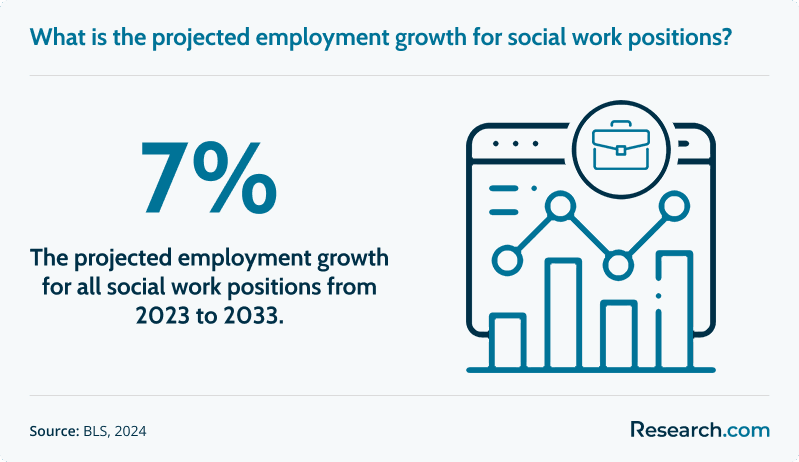
The employment outlook for social workers is positive overall. BLS projects social work employment to reach 806,600 by 2033 and forecasts 7% growth from 2023 to 2033, which is faster than the average for all occupations. This growth reflects demand for social services as well as the need to replace workers who retire or move into other fields.
If you are asking what can you do with a masters in social work, the answer depends heavily on your specialization and licensure status. MSW graduates may work in clinical care, hospitals, schools, child welfare, public agencies, community programs, behavioral health treatment, senior services, advocacy, administration, and policy roles.
Salary outcomes also vary by role, state, employer, experience, and credential. A masters in social work salary comparison can be useful, but prospective students should avoid assuming that a degree alone guarantees a specific wage. Licensure, specialization, location, and the ability to move into supervisory or clinical roles can all affect long-term earning potential.
Should you choose a full-time, part-time, or online MSW program?
The right MSW format depends on your schedule, finances, location, field placement needs, and learning preferences. Full-time, part-time, and online programs can all be strong options when they are properly accredited and aligned with your career goals.
| Program format | Best for | Trade-offs to consider |
| Full-time MSW | Students who can prioritize graduate study and want a more immersive experience | May be harder to balance with full-time employment or caregiving responsibilities |
| Part-time MSW | Working adults, caregivers, and students who need a slower academic pace | May extend the time before graduation and licensure-related progress |
| Online MSW | Students who need geographic flexibility or cannot regularly commute to campus | Requires careful review of field placement support, state authorization, and licensure alignment |
| Accelerated online MSW | Students who already meet eligibility requirements and can handle a faster workload | Can be demanding because coursework and field education move quickly |
Full-time campus-based programs may offer easier access to faculty, peer networks, student services, and local agency partnerships. They can be a strong fit for students who learn best in structured environments and want consistent in-person interaction.
Part-time programs can make graduate study more realistic for students who need to keep working while enrolled. The main advantage is pacing. The main caution is planning: field education hours can still be time-intensive even when classes are spread out.
Online options have expanded access to graduate social work education. A high-quality online masters in social work should provide rigorous coursework, faculty access, field placement coordination, and clear licensure information. Students who want to move quickly may also compare fast track social work degree online options, but speed should not come at the expense of accreditation, field quality, or readiness for practice.
How can you pay for an MSW specialization?
Financing an MSW requires more than comparing tuition. Students should also estimate fees, books, technology costs, commuting or residency expenses, lost work hours during field placement, licensure exam costs, and post-graduation supervision costs if they plan to pursue clinical licensure. Lower tuition can help, but the least expensive option is not always the best value if the program does not support your specialization or licensing goals.
Start by reviewing federal aid eligibility, institutional scholarships, grants, employer tuition support, assistantships, and public service-focused repayment options. Students comparing online routes may find affordable MSW programs useful when building a shortlist, especially if they need flexibility and want to manage debt.
Ways to reduce MSW costs without weakening career preparation
- Choose an accredited program that supports the license or specialization you actually need.
- Ask whether your BSW qualifies you for advanced standing if applicable.
- Compare total program cost, not only per-credit tuition.
- Check whether field placements are arranged by the school or left mainly to the student.
- Look for scholarships tied to public service, behavioral health, child welfare, school social work, or underserved communities.
- Consider part-time study if it helps you keep income and benefits while enrolled.
How do you select the right MSW specialization?
The best specialization is the one that fits your interests, strengths, preferred work environment, licensing plan, and tolerance for the realities of the field. A student who wants long-term therapeutic relationships may choose differently from someone who wants policy influence, hospital-based care coordination, or school crisis support.
- Identify the population you want to serve. Consider whether you are most drawn to children, families, students, older adults, patients, people with behavioral health needs, communities, or justice-involved populations.
- Choose your preferred level of practice. Decide whether you want direct one-on-one service, group or organizational work, community practice, policy advocacy, or leadership.
- Research day-to-day work. Talk with working social workers, review job descriptions, and ask programs what field sites are available in your area.
- Check licensing requirements early. This is essential for clinical, school, and state-regulated practice areas.
- Compare field placements carefully. In social work education, field learning is not an add-on. It is where students test whether the specialization actually fits them.
- Review career outcomes realistically. Look at likely employers, supervision expectations, work conditions, salary data, and advancement pathways.
Students interested in behavioral interventions may also review the steps to become a behavior therapist to compare how social work training differs from behavior-focused career preparation.
| If you want... | Consider this MSW specialization | Ask the program... |
| To provide therapy or clinical services | Clinical Social Work | Does the curriculum support clinical licensure preparation in my state? |
| To work in schools | School Social Work | Does this program meet school credential or endorsement requirements where I plan to work? |
| To support patients in medical systems | Healthcare Social Work | What healthcare field placements are available? |
| To influence policy or programs | Macro Social Work | Are there field placements in advocacy, government, nonprofit leadership, or program evaluation? |
| To work with families in crisis | Child and Family Social Work | How does the program prepare students for child welfare systems and trauma-informed practice? |
| To support recovery and behavioral health | Mental Health and Substance Abuse Social Work | Are placements available in community mental health, addiction treatment, or crisis services? |
For students comparing wages by specialization, the chart below shows mean annual wages for specialized social workers. Healthcare social workers are among the highest paid groups shown, with a mean annual wage of $67,430.
Is a BSW useful before starting an MSW specialization?
A Bachelor of Social Work can be a strong foundation for graduate study because it introduces social work values, ethics, human behavior, policy, research, and field education before the MSW level. Students with a solid BSW background may enter graduate school with a clearer understanding of the profession’s expectations and practice settings.
When comparing undergraduate options, pay attention to accreditation, field education quality, transfer policies, and cost. Students seeking a lower-cost path may review affordable online BSW programs before committing to graduate school. A BSW can also help students decide whether social work is the right profession before investing in an MSW.
Can certifications improve your MSW career options?
Professional certifications can strengthen an MSW graduate’s profile when they align with a specific role, employer requirement, or state credential. They are most useful when they add recognized competence rather than simply adding letters after a name.
School social work is one area where credentials can matter significantly. Students who want school-based roles should review school social work certification expectations in the state where they plan to practice. Certifications may also support advancement in clinical supervision, substance abuse practice, healthcare, trauma-informed care, gerontology, or administration, depending on employer and jurisdiction requirements.
How is technology changing MSW specializations?
Technology now affects nearly every area of social work, from telehealth and digital case records to online intake systems, secure messaging, and virtual supervision. In 2023, the Centers for Medicare and Medicaid Services (CMS) reported that 24% of Medicare fee-for-service users had a telehealth service, illustrating how widely remote service delivery has become part of healthcare and related social service environments.
For clinical and behavioral health social workers, telehealth can expand access for clients who face transportation, mobility, scheduling, or geographic barriers. For healthcare and case management roles, digital systems can improve coordination among providers and agencies. For macro social workers, data tools can support program evaluation, needs assessment, grant reporting, and community planning.
Technology also creates risks. Social workers must understand privacy, informed consent, documentation, emergency protocols, accessibility, and digital equity. A telehealth platform may improve access for one client while creating barriers for another who lacks private space, reliable internet, or comfort with digital tools.
Students comparing social work with broader health roles may also explore how to become a holistic nurse practitioner to understand how other care professions combine patient support, technology, and whole-person care.
The key is not to treat technology as a replacement for social work judgment. It is a tool that can improve reach, coordination, and documentation when used ethically and appropriately.

How is an MSW different from other mental health training?
MSW education is distinctive because it combines direct practice skills with a systems-oriented view of people’s lives. Social workers are trained to consider mental health, family context, housing, income, discrimination, school or workplace environment, community resources, policy barriers, and access to care. That perspective can make MSW-trained professionals especially useful in settings where clinical needs and social needs overlap.
Other mental health professions may place greater emphasis on psychological testing, diagnosis, or specific therapy models, depending on the degree and license. To compare scopes of practice more clearly, review the difference between psychologist and social worker. The professions can overlap in some settings, but their training models and career pathways are not identical.
How can psychology strengthen MSW practice?
Psychology can deepen a social worker’s understanding of behavior, development, cognition, trauma, motivation, and emotional regulation. This can be especially valuable in clinical, school, behavioral health, child and family, and healthcare social work. MSW students do not need a separate psychology degree to practice social work, but psychology coursework or continuing education may strengthen assessment and intervention skills.
Professionals who want additional study in psychology-related topics can compare affordable online master's programs in psychology. This route may be useful for people who want broader academic grounding, but students should still verify whether another degree is necessary for their actual career goal.
What ethical challenges should specialized social workers expect?
Social work can be deeply meaningful, but it is also demanding. High caseloads, limited resources, exposure to trauma, administrative pressure, and emotionally intense client situations can contribute to burnout. Students should evaluate not only whether they care about a specialization, but whether they can sustain the day-to-day realities of that work.
Common ethical issues include confidentiality, informed consent, mandated reporting, dual relationships, client autonomy, service eligibility, documentation accuracy, and fair resource allocation. Specialized settings can add further complexity. School social workers may balance student privacy with family and school responsibilities. Healthcare social workers may navigate discharge pressure and limited community resources. Clinical social workers must maintain boundaries and manage risk. Macro social workers may face conflicts between funder expectations and community needs.
Digital practice adds another layer. Social workers need to understand data security, client privacy, remote service boundaries, and emergency planning when using online tools. The National Association of Social Workers provides guidance on the legal and ethical implications of digital tools, which is especially relevant as telehealth and digital case management become more common.
Common mistakes to avoid when choosing an MSW specialization
| Mistake | Why it can hurt you | Better approach |
| Choosing only based on passion | You may overlook licensure, field placement, workload, and employer requirements | Match interests with credential rules and realistic job settings |
| Ignoring accreditation | Licensure and employer eligibility may be affected | Confirm accreditation before applying |
| Assuming every online MSW works in every state | State authorization and licensure alignment can differ | Request written licensure disclosures for your state |
| Looking only at tuition | Fees, field placement costs, lost work time, and supervision costs can add up | Compare total cost and career fit |
| Choosing a specialization without reviewing field placements | You may graduate without relevant practice experience | Ask for examples of recent placement sites in your specialization |
| Assuming salary outcomes are guaranteed | Pay varies by employer, geography, role, experience, and licensure | Use salary data as a planning tool, not a promise |
How can organizational psychology support social work leadership?
Organizational psychology can help social workers who want to move into supervision, administration, program management, training, or systems improvement. Many social service challenges are not only clinical or policy-related; they also involve staffing, team communication, burnout, workflow, leadership, and organizational culture.
MSW graduates who understand organizational behavior may be better prepared to improve service delivery, support teams, manage change, and evaluate program performance. Those interested in this leadership angle can explore affordable online masters programs in organizational psychology to compare how organizational psychology training complements social work practice.
What trends are shaping MSW specializations?
Several trends are affecting how MSW programs train students and how employers evaluate graduates. Telehealth and digital case management have become more common. Programs are also placing more emphasis on trauma-informed practice, interdisciplinary collaboration, field education quality, competency-based assessment, and community-engaged learning.
Hybrid and online learning formats have expanded access, but students still need strong field education and licensure alignment. AI and automation may also affect documentation, triage, administrative tasks, and program analysis, but social work remains a human-centered profession where ethical judgment, empathy, relationship-building, and contextual assessment are central.
Prospective students should compare programs on more than convenience. Look at accreditation, field placement support, specialization depth, faculty expertise, licensure disclosures, student support, and whether the program’s learning model fits your needs. If admissions flexibility is important, you can compare the easiest MSW program options while still checking quality indicators carefully.
What do Master of Social Work graduates say about specialization?
Choosing clinical social work helped me focus on direct therapy skills, field experience, and the preparation I needed for licensure-focused practice. The specialization made my career direction much clearer. Rose
School social work gave me a practical way to support children and families while working inside an education system. The coursework on trauma-informed care and school policy helped me understand how to advocate for students. Jean
Macro social work helped me move beyond one-on-one services and think about policy, programs, and community-level impact. The leadership and research training shaped the kind of work I do now. Annie
Should MSW graduates consider a doctoral degree?
A doctoral degree may make sense for MSW graduates who want to teach, conduct research, lead organizations, influence policy, or develop advanced expertise beyond professional practice. It is not required for most social work roles, and students should be clear about the career payoff before enrolling.
Doctoral study can be valuable when your goals include senior leadership, academic work, high-level program development, or systems-level research. Professionals who want a flexible route can compare DSW online programs and evaluate cost, dissertation or capstone expectations, faculty expertise, and whether the degree supports their intended career direction.
How does accreditation affect MSW quality and career readiness?
Accreditation is one of the most important quality checks for an MSW program. It signals that the program is evaluated against social work education standards, including curriculum, field education, ethics, assessment, and professional preparation. For students who plan to pursue licensure, accreditation can be especially important because state boards and employers may require graduation from an accredited program.
Accreditation does not guarantee a perfect program or a specific job outcome, but it helps reduce risk. Students should still evaluate specialization options, field placement quality, faculty support, graduation requirements, online learning structure, and licensure disclosures. For comparison with another regulated mental health education pathway, review online accredited PsyD programs and note how accreditation functions as a quality and readiness signal across professional fields.
What are the long-term career and salary prospects after an MSW?
Long-term advancement after an MSW depends on specialization, licensure, experience, supervision, employer type, geography, and whether the graduate moves into clinical practice, leadership, administration, policy, or specialized service areas. Some graduates remain in direct service roles, while others become supervisors, program directors, consultants, administrators, educators, or policy advocates.
Salary should be evaluated carefully. Healthcare social workers have a mean annual wage of $67,430, while mental health and substance abuse social workers make $63,870. These figures are useful benchmarks, but individual compensation can vary. Students comparing clinical and nonclinical paths can review the difference between MSW and LCSW salary to understand how licensure may affect career options and earning potential.
Key Insights
- MSW specialization should be chosen strategically. The right option depends on your preferred population, practice level, work setting, licensing plan, and field placement opportunities.
- Clinical, healthcare, mental health and substance abuse, child and family, school, gerontology, macro, and forensic social work each prepare students for different responsibilities and employers.
- BLS projects 7% employment growth for social workers from 2023 to 2033, with total employment expected to reach 806,600 by 2033.
- As of 2023, the U.S. employed 365,900 child, family, and school social workers, 193,200 healthcare social workers, and 123,700 mental health and substance abuse social workers.
- Healthcare social workers report a mean annual wage of $67,430, and mental health and substance abuse social workers report $63,870, but salary outcomes vary by location, role, employer, experience, and credentials.
- Technology is now part of social work practice. In 2023, 24% of Medicare fee-for-service users used telehealth services, making digital ethics, privacy, and access important issues for MSW students.
- Before enrolling, verify accreditation, state licensure alignment, specialization depth, field placement support, total cost, and whether the program format fits your life.
References:
- BLS. (2024, April 3). Child, Family, and School Social Workers. BLS.
- BLS. (2024, April 3). Healthcare Social Workers. BLS.
- BLS. (2024, April 3). Mental Health and Substance Abuse Social Workers. BLS.
- BLS. (2024, April 3). Social Workers, All Other. BLS.
- BLS. (2024, August 29). Social workers. BLS.
- CMS. (2024, November 12). Medicare Telehealth Trends Report. CMS.
- CSWE. (2023). 2022–2023 statistics on social work education in the United States. CSWE.
Other Things You Should Know About Master of Social Work Specializations
In 2027, MSW students can choose from various specializations such as clinical social work, school social work, healthcare social work, and community organization, among others. Each focuses on different skill sets and career paths, tailored to meet diverse societal needs.
The requirements for the highest social work license, typically the Licensed Clinical Social Worker (LCSW) in 2027, include completing a Master of Social Work, gaining supervised clinical experience, and passing a licensure exam specific to your state. Continued education credits may also be necessary to maintain the license.
Popular MSW specializations in 2027 include Clinical Social Work, focusing on mental health care and therapy; Community Practice, targeting social change and advocacy; and Gerontology, which emphasizes elder care and services. Each offers unique opportunities depending on career goals.





