
2027 What Degree Do You Need to Be a Social Worker: Education Requirements in Missouri

Co-Founder and Chief Data Scientist
Becoming a social worker in Missouri starts with one practical question: which degree do you actually need for the license and job you want? The answer depends on whether you plan to work in generalist services, clinical mental health, schools, healthcare, child welfare, policy, or administration. Missouri’s need for trained social workers is also growing, with employment for social workers projected to reach 1,620 by 2032, a 7% increase from 2022–2032.
This guide explains Missouri social work education requirements in plain language. You will learn the minimum degree needed for licensure, how BSW and MSW programs differ, what courses and fieldwork to expect, how long programs take, what they may cost, how online programs are treated, and how to compare schools before enrolling.
Quick answer: What degree do you need to become a social worker in Missouri?
The minimum degree for social work licensure in Missouri is a Bachelor of Social Work (BSW) from a Council on Social Work Education (CSWE)-accredited program. A BSW can prepare you for Licensed Baccalaureate Social Worker (LBSW) status and supervised generalist practice. If you want to provide clinical services, pursue advanced practice, or qualify for licenses such as LMSW, LCSW, or LAMSW, you generally need a CSWE-accredited Master of Social Work (MSW).
Key facts about Missouri social work degree requirements
- A BSW is the entry-level licensure degree. In Missouri, a Bachelor of Social Work is the standard minimum credential for beginning licensed social work practice.
- An MSW is required for advanced licensure. Missouri candidates pursuing the Licensed Master Social Worker (LMSW), Licensed Clinical Social Worker (LCSW), or Licensed Advanced Macro Social Worker (LAMSW) path need a Master of Social Work from a CSWE-accredited program.
- Accreditation matters. Missouri licensure depends heavily on whether your degree comes from a CSWE-accredited social work program.
- The ASWB exam is part of licensure. Missouri candidates must pass the appropriate Association of Social Work Boards exam for their license level.
- Field education is not optional. Social work programs include supervised practicum or field placement hours because Missouri licensure and employers expect applied training.
- Minimum degree needed for Missouri social work licensure
- Courses in Missouri social work degree programs
- Program length for BSW, MSW, DSW, and PhD pathways
- Cost of a social work degree in Missouri
- Degree requirements by social work specialization
- Financial aid options for Missouri social work students
- Licensing and continuing education requirements
- Career advancement options for Missouri social workers
- Alternative paths into social work
- Recognition of online social work degrees in Missouri
- Accreditation for Missouri social work programs
- Missouri schools offering social work degrees
What is the minimum degree required to become a licensed social worker in Missouri?
Missouri ties social work licensure to your education level. Before choosing a program, identify the license and practice setting you want because a BSW and an MSW lead to different responsibilities, supervision rules, and career options.
| Degree | Typical Missouri license path | Best fit | Important limitation |
| Bachelor of Social Work (BSW) | Licensed Baccalaureate Social Worker (LBSW) | Entry-level generalist practice, case management, community services, supervised social work roles | Does not qualify you for independent clinical practice |
| Master of Social Work (MSW) | LMSW, LCSW, or LAMSW pathways | Clinical practice, supervision, healthcare, school social work, advanced direct practice, macro practice | Requires graduate study and additional licensure steps |
| Doctoral degree in Social Work, PhD or DSW | Can support LMSW, LAMSW, and LCSW eligibility depending on requirements | Research, teaching, advanced leadership, high-level program development | Usually not necessary for most direct-practice social work jobs |
- BSW: A CSWE-accredited Bachelor of Social Work is the minimum academic credential for the Licensed Baccalaureate Social Worker path in Missouri. It prepares graduates for supervised, non-clinical generalist practice.
- MSW: A CSWE-accredited Master of Social Work is the required graduate degree for advanced Missouri licenses, including LMSW, LCSW, and LAMSW. This route is essential if your goal is clinical work, independent practice, or advanced supervision.
- PhD or DSW: A doctoral degree is less common for initial practice but can support careers in university teaching, research, policy leadership, executive administration, or specialized practice development.
If you are still comparing possible roles, review the broader career path of a social worker before committing to a degree level.
What courses are covered in a social work degree program in Missouri?
Missouri social work programs combine classroom study with supervised field education. The goal is to prepare students to assess client needs, understand social systems, apply ethical standards, advocate for services, and work effectively with individuals, families, groups, organizations, and communities.
Although course titles vary by school, most CSWE-aligned BSW and MSW programs include the following areas:
- Introduction to Social Work and Social Issues: Explains the profession’s history, mission, ethics, values, and role in responding to individual and community needs.
- Social Welfare Policy and Services: Examines how policies shape access to public benefits, health services, child welfare, housing, aging services, and community support systems.
- Human Behavior in the Social Environment: Studies development, behavior, identity, family systems, culture, trauma, and social conditions across the lifespan.
- Diversity and Social Justice: Builds cultural humility, anti-oppressive practice skills, and awareness of structural barriers affecting Missouri communities.
- Practice with Individuals, Families, and Groups: Develops interviewing, assessment, planning, intervention, documentation, and referral skills for direct service roles.
- Research Methods and Statistics: Teaches students how to evaluate evidence, interpret data, assess programs, and use research responsibly in practice.
- Supervised Field Experience or Practicum: Places students in agencies where they apply classroom learning under supervision. BSW students complete at least 400 hours, while MSW placements are structured around graduate-level competencies.
- Professionalism, Ethics, and Integrative Seminars: Connects field experience with professional standards, NASW ethics, legal responsibilities, and Missouri practice expectations.
Students should pay close attention to field placement policies. A program may be academically strong, but if it cannot help you secure an approved practicum near where you live or work, completion can become difficult.
How long does it take to complete a social work degree program in Missouri?
The timeline depends on your starting point, enrollment status, transfer credits, fieldwork schedule, and whether you qualify for advanced standing. Field placements are often the factor students underestimate because they require scheduled hours at an approved agency, not just online coursework or evening classes.
| Program type | Typical full-time timeline | Part-time or flexible timeline | Who it fits best |
| BSW | Usually four years | May take longer with part-time enrollment or limited course availability | Students entering social work for the first time or seeking LBSW eligibility |
| Traditional MSW | Generally two years | Can extend to four years | Career changers or students with a non-BSW bachelor’s degree |
| Advanced standing MSW | As little as one year for eligible BSW graduates | Varies by school and enrollment pace | Recent graduates of CSWE-accredited BSW programs |
| DSW | Usually three to four years | Can extend to six years | Experienced professionals seeking advanced practice or leadership preparation |
| PhD in Social Work | Typically three to five years | Often longer depending on dissertation progress | Students focused on research, academia, or policy scholarship |
- BSW programs: A full-time BSW commonly takes four years and includes required field education. Transfer credits can shorten the path, while part-time study can lengthen it.
- MSW programs: Traditional MSW students usually spend two years full time or up to four years part time. Advanced standing can reduce the timeline by up to one year for eligible graduates of CSWE-accredited BSW programs.
- DSW programs: These are less common in Missouri and typically take three to four years full time, with part-time options extending the schedule.
- PhD programs: Research-focused doctoral study often takes three to five years full time and can take longer if dissertation work is delayed.
- Course format: Online, hybrid, night, and weekend courses can make school more manageable, but they may also limit how many courses you can take each term.
- Field placement scheduling: Practicum requirements, such as 480 hours for BSW students at Missouri universities, can affect work schedules and graduation timelines.
A Missouri social worker who completed a local BSW program explained that the degree took slightly more than four years because she balanced school with part-time work and family obligations. She said the most surprising challenge was not the coursework but the hours required for practicum outside the classroom.
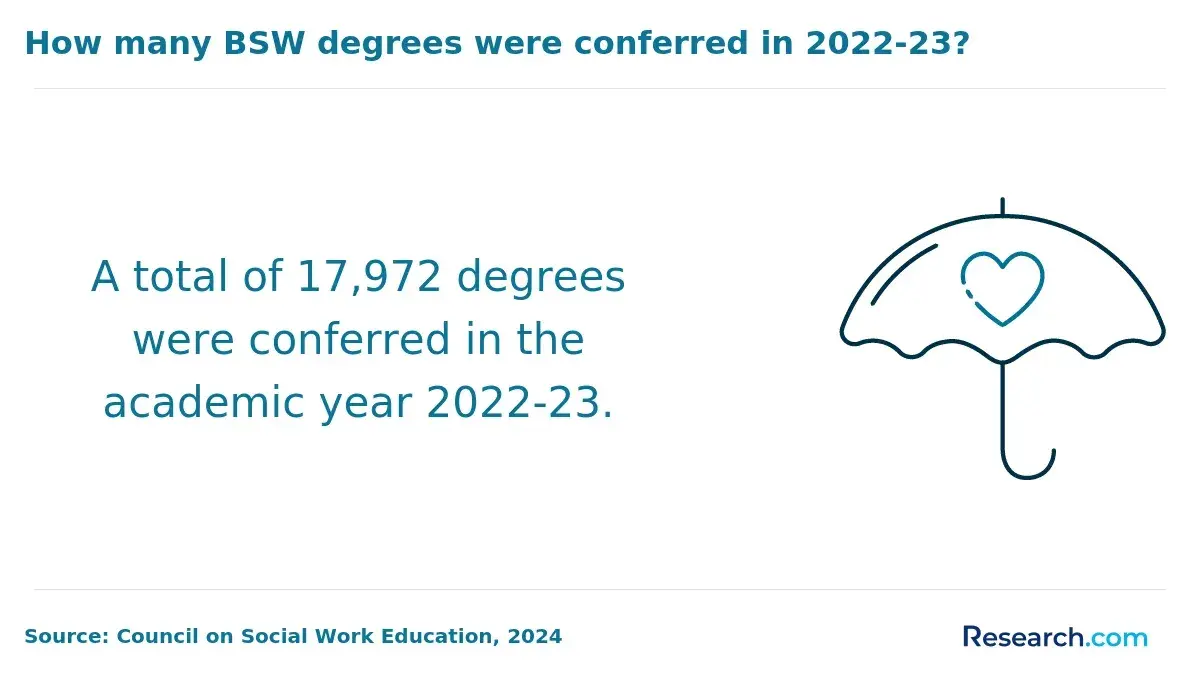
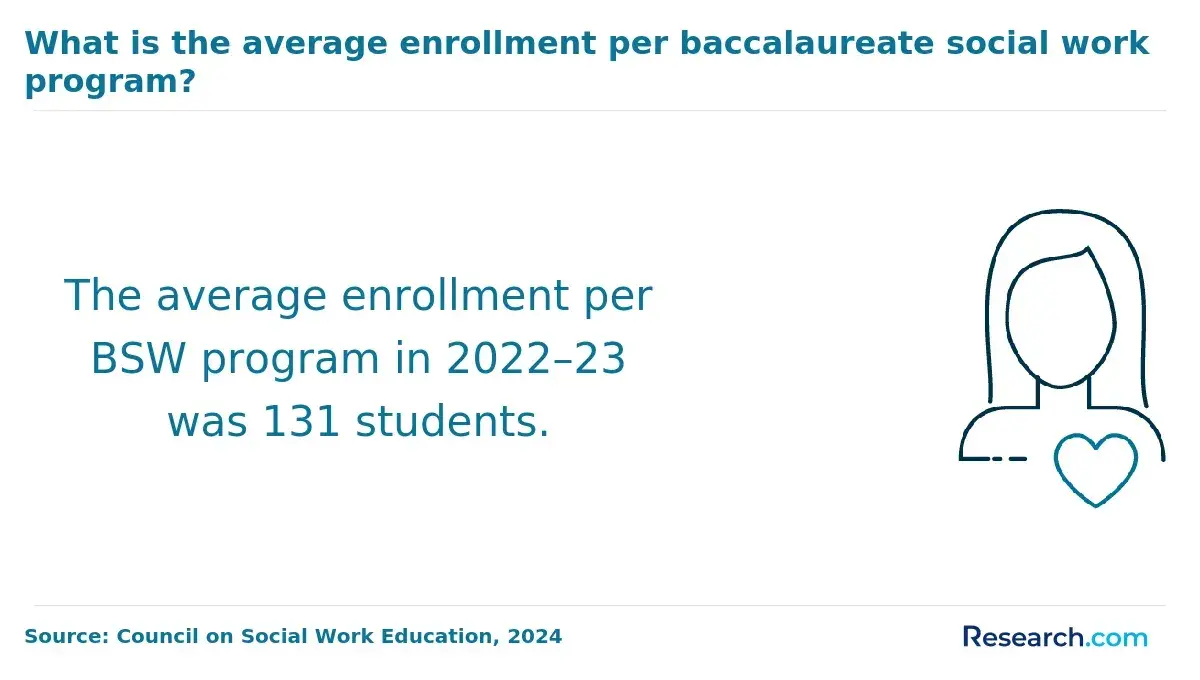
Her experience shows why advising matters. Careful transfer credit review, summer courses, and early field planning can reduce delays. The chart below provides additional context on BSW enrollment rates during the 2022–23 school year.
How much does a social work degree cost in Missouri?
The price of a Missouri social work degree depends on degree level, residency status, public versus private institution, online fees, books, commuting, field placement costs, and how long you remain enrolled. Tuition is only one part of the real cost.
| Degree level | Public in-state tuition | Out-of-state tuition | Private or other cost notes |
| BSW | $8,000 to $12,000 per year | $16,000 to $22,000 per year | Private colleges may charge $25,000 to $35,000 annually; some online programs use lower flat-rate pricing |
| MSW | $10,000 to $15,000 yearly | $18,000 to $28,000 yearly | Private schools usually charge $30,000 to $40,000; online pricing may vary |
| DSW | $12,000 to $18,000 per year | $20,000 to $32,000 per year | Some online offerings match in-state tuition |
| PhD in Social Work | $10,000 to $16,000 where tuition is charged | Up to $30,000 | Many Missouri PhD programs reduce or waive tuition through assistantships, though funding is competitive |
When comparing costs, look beyond annual tuition. Ask whether field placement requires daytime availability, whether online students pay additional technology fees, whether transfer credits are accepted, and whether scholarships continue after the first year. If you are comparing social work with related helping professions, this guide to social work versus counseling can help clarify the career differences.
What degrees are required for different social work specializations in Missouri?
Social work is not a single career track. The right degree depends on the population you want to serve, whether you want clinical authority, and whether your goal is direct service, supervision, policy, administration, or program leadership.
| Specialization | Common minimum degree | When an MSW becomes important |
| General social work | CSWE-accredited BSW | For supervision, advanced practice, or broader career mobility |
| Clinical social work | MSW | Required for the LCSW path, clinical assessment, diagnosis, and treatment responsibilities |
| School social work | Often BSW for some roles | Preferred or required for advanced school-based positions and public school roles with additional state requirements |
| Healthcare social work | BSW for some support positions | Needed for advanced patient counseling, discharge planning leadership, and many hospital-based roles |
| Child, family, and school services | BSW for entry-level positions | Needed for specialized, supervisory, or clinical roles |
| Macro or administrative social work | BSW for some community roles | Recommended for policy, nonprofit leadership, program administration, and LAMSW preparation |
- Generalist practice: A CSWE-accredited BSW is the usual foundation for LBSW eligibility and supervised entry-level roles.
- Clinical practice: The LCSW path requires an MSW, supervised clinical experience, and the appropriate licensing exam.
- School social work: Some positions may accept a BSW, but many advanced or public school roles expect graduate preparation and state-specific credentials.
- Healthcare social work: A BSW can lead to support roles, while counseling-intensive hospital or medical positions often require an MSW and, in many cases, LCSW licensure.
- Child and family services: A BSW may be enough for entry-level casework, but specialized and leadership positions commonly call for an MSW.
- Macro practice: Students interested in policy, community organization, advocacy, or administration should consider an MSW with macro practice preparation and the LAMSW route.
What financial aid options are available to social work students in Missouri?
Financial aid can determine whether a social work degree is realistic, especially for students who must reduce work hours during practicum. The average annual salary for social workers in Missouri is $71,537, but salary outcomes vary by license level, employer, location, specialization, and experience. Borrow carefully and compare total program cost against your likely career path.
Missouri social work students may be able to use several forms of aid:
- Federal grants: Pell Grants and Federal Supplemental Educational Opportunity Grants (FSEOG) provide need-based undergraduate aid that does not have to be repaid. Students apply through the FAFSA.
- Missouri scholarships and grants: State options, including the “Grow Your Own” Social Work Grant, can help Missouri residents in BSW or MSW programs cover tuition and fees when eligibility requirements are met.
- Institutional scholarships: Schools such as the University of Missouri and Missouri State University offer awards based on academic performance, financial need, service, leadership, or social work department criteria.
- Graduate assistantships: Some MSW students may receive tuition support and stipends in exchange for teaching, research, or program support work.
- Federal Work-Study: Eligible students can earn income through part-time work, sometimes in roles connected to social services or campus community programs.
- Student loans: Federal Direct Loans, including subsidized and unsubsidized options, are available to eligible undergraduate and graduate students. Compare loan amounts and repayment obligations before borrowing.
- Professional association scholarships: Organizations such as the National Association of Social Workers, Missouri Chapter, may offer scholarships for students with strong academic records, leadership, or commitment to social justice.
- University foundation scholarships: Donor-funded awards may support students based on merit, leadership, community involvement, or financial need.
- Employer tuition assistance: Some healthcare, school, nonprofit, and public service employers help employees pay for social work education through tuition reimbursement or scholarships.
Students who need flexibility should compare accredited campus programs with an online masters of social work, especially if work, caregiving, or location makes relocation difficult.
What are the licensing and continuing education requirements for social workers in Missouri?
Missouri’s licensing process verifies that applicants completed the correct accredited degree, passed the required ASWB exam, and met the practice standards attached to their license level. Advanced and clinical license paths may also involve supervised experience after graduation. Because requirements can change, applicants should confirm details with the Missouri licensing board before applying, enrolling, or moving from another state.
After licensure, Missouri social workers must complete continuing education to keep their knowledge current and maintain professional standing. Continuing education often covers ethics, legal responsibilities, documentation, practice updates, clinical issues, diversity, supervision, and emerging service needs. For a more step-by-step overview, see this guide on how to become a social worker in Missouri.
How can social workers advance their careers in Missouri?
Career growth in Missouri usually comes from combining a higher license level, stronger supervision record, specialized training, and experience with a specific population or setting. A BSW can lead to valuable entry-level work, but an MSW can open more advanced options in clinical practice, healthcare, leadership, school services, and macro practice.
- Move from generalist to advanced practice: BSW-level professionals who want more autonomy should consider an MSW and the appropriate Missouri license path.
- Build a specialization: Focused experience in child welfare, behavioral health, aging, substance use, schools, healthcare, or community development can improve long-term mobility.
- Seek quality supervision: Strong supervision helps new practitioners improve documentation, ethics, assessment, intervention planning, and professional judgment.
- Add complementary skills: Grant writing, program evaluation, trauma-informed care, crisis intervention, data-informed practice, and interdisciplinary collaboration can make candidates more competitive.
- Understand related credentials: Some professionals compare counseling and social work options; exploring the fastest way to become a counselor in Missouri can help clarify whether social work or counseling better fits your goals.
What are the alternative pathways to become a social worker in Missouri?
You do not always need to start with a BSW to enter social work. Many students come from psychology, sociology, education, criminal justice, public health, human services, or nonprofit backgrounds. However, Missouri licensure still depends on completing the required accredited social work degree for the license you want. Since 58.6% of social workers nationwide hold a bachelor’s degree, the BSW remains a common entry route, but it is not the only academic starting point.
- Traditional MSW for non-BSW graduates: Students with a bachelor’s degree in another field can enter a regular-standing MSW program, often completing graduate study in about two years full time.
- Related undergraduate degrees: Majors such as psychology, sociology, human services, and education can provide useful preparation for MSW coursework and field practice.
- Post-bachelor’s certificates or bridge coursework: Some schools use prerequisite or bridge options to help students strengthen their social work foundation before or during graduate study.
- Missouri-focused alternative routes: Certain programs may combine coursework, advising, and supervised practice planning for students transitioning from adjacent fields into licensure-focused social work education.
One Missouri practitioner described moving into social work after a teaching career. He said the transition required humility because the field had its own ethical standards, documentation practices, and supervision expectations. Advisors and field supervisors helped him connect his classroom experience with social work practice.
For career changers, the lesson is simple: prior experience can help, but it does not replace accredited social work education. The following CSWE chart shows full-time social work faculty by gender.
Are online social work degrees recognized in Missouri?
Yes, online social work degrees can be recognized in Missouri if they meet the same accreditation expectations as campus-based programs. The delivery format is less important than whether the program is CSWE-accredited and whether it provides approved field education.
This distinction is critical. An online BSW or MSW that lacks CSWE accreditation may not satisfy Missouri licensure requirements, even if the school is legitimate in other ways. Students should verify accreditation directly rather than relying only on marketing language.
Online programs can work well for adults, rural students, caregivers, and working professionals, but field placement logistics deserve careful attention. Ask how the school approves local agencies, whether placements are available near your community, who supervises students, and whether field hours can be completed around employment.
| Question to ask an online program | Why it matters |
| Is the BSW or MSW program CSWE-accredited? | Missouri licensure eligibility depends on approved social work education. |
| How are field placements arranged in Missouri? | You need supervised practice, not just online coursework. |
| Are there any required campus visits? | Residencies can add travel costs and scheduling demands. |
| Does the program support your intended license path? | Clinical, macro, school, and generalist goals may require different preparation. |
| What support is available for ASWB exam preparation? | Licensure requires passing the appropriate exam. |
What organizations accredit social work degree programs in Missouri?
Accreditation is one of the most important checks you can perform before applying to a social work program. It affects licensure eligibility, transferability, employer confidence, and graduate school options.
- Council on Social Work Education (CSWE): CSWE is the key programmatic accreditor for social work education in the United States. Missouri licensure generally requires a CSWE-accredited BSW or MSW for the corresponding license level.
- Regional higher education accreditation: Missouri colleges and universities should also hold institutional accreditation, commonly through the Higher Learning Commission (HLC). This helps confirm broader academic quality and can affect transfer credits, financial aid, and graduate admission.
- Missouri Department of Higher Education & Workforce Development (MDHEWD): MDHEWD does not replace CSWE accreditation, but it provides state-level oversight for institutions operating in Missouri.
If you are evaluating whether the cost, time, and licensing process make sense for your goals, this overview of whether a degree in social work is worth it can help you think through return on investment.
What are the top institutions offering social work degree programs in Missouri?
The best Missouri social work program for you is not always the most famous one. Choose based on accreditation, license alignment, field placement access, cost, schedule, faculty expertise, student support, and whether the program serves your intended practice area.
Missouri students often consider the following institutions for social work education:
- Washington University in St. Louis, George Warren Brown School of Social Work: Known nationally for graduate social work education, dual-degree options, and field connections with health, legal, and community organizations.
- Saint Louis University, School of Social Work: Offers a strong clinical orientation, urban practicum opportunities, and a social justice focus in underserved communities.
- University of Missouri - Columbia, School of Social Work: Provides BSW and MSW pathways, a broad alumni network, and graduates earning above the state median salary.
- Missouri State University, Master of Social Work Program: Offers a fully accredited online MSW with an advanced generalist focus designed to support LCSW preparation.
- University of Central Missouri, Bachelor of Social Work Program: Provides a CSWE-accredited BSW with night and hybrid course options that can help working students manage school and other responsibilities.
Students planning for advanced leadership, teaching, or specialized practice may also compare DSW programs after completing graduate-level preparation.
What do Missouri social workers say about their education and careers?
- My social work studies at the University of Missouri challenged me academically while keeping me connected to real community needs. Field experiences with local families helped me understand how policy, school systems, and family stressors intersect in Missouri communities. Working in a school setting now allows me to support students’ emotional and social growth in practical ways. The work is demanding, but seeing students build stability and confidence reminds me why I chose this profession. - Aleah
- Completing my degree at Saint Louis University prepared me for the complexity of child welfare work in Missouri. The program helped me strengthen my advocacy skills, understand ethical decision-making, and work with families facing difficult circumstances. My first role in a school environment taught me how much social workers balance direct care, documentation, collaboration, and crisis response. That preparation gave me confidence as I entered the field. - Choi
- Missouri State University gave me a stronger understanding of the systemic issues affecting both rural and urban communities. Faculty encouraged us to connect with local agencies, which made the transition from classroom learning to field practice much smoother. In my school-based role, I use those lessons every day when supporting students and families. Missouri’s diversity of needs keeps the work challenging, but it also makes the impact meaningful. - Tanya
Common mistakes to avoid when choosing a Missouri social work program
- Choosing a program before checking CSWE accreditation: Institutional accreditation alone is not enough for social work licensure. Confirm programmatic accreditation.
- Looking only at tuition: Fees, books, commuting, technology costs, lost work hours, and field placement expenses can change the real price.
- Assuming every online degree qualifies for Missouri licensure: Online format is acceptable only when accreditation and field education requirements are met.
- Ignoring practicum logistics: Field placements may require daytime availability, reliable transportation, background checks, and agency approval.
- Picking a degree level without a license goal: A BSW, MSW, DSW, and PhD serve different purposes. Start with the license and role you want.
- Relying only on rankings: A highly ranked school may still be a poor fit if it is too expensive, lacks local placements, or does not support your specialization.
- Assuming salary is guaranteed: Missouri salaries vary by employer, license level, specialty, region, and experience.
How to choose the right social work degree program in Missouri
- Identify your target role. Decide whether you want generalist practice, clinical work, school services, healthcare, child welfare, macro practice, or administration.
- Match the role to the required degree. Choose a BSW for entry-level licensure or an MSW if your goal requires advanced or clinical credentials.
- Verify CSWE accreditation. Confirm accreditation through official sources before applying.
- Ask about field placement support. Find out where students are placed, who arranges placements, and whether placements fit your schedule and location.
- Compare total cost. Include tuition, fees, books, commuting, online fees, reduced work hours, and possible exam costs.
- Review licensure outcomes and advising. Ask how the program prepares students for the ASWB exam and Missouri licensure paperwork.
- Evaluate flexibility honestly. Online or evening classes help, but practicum hours may still require daytime availability.
- Speak with current students or alumni. Ask what support was strong, what surprised them, and how field placement worked in practice.
Related Articles for Nearby States
- 2027 What Degree Do You Need To Be a Social Worker: Education Requirements in Kansas
- 2027 What Degree Do You Need To Be a Social Worker: Education Requirements in Iowa
- 2027 What Degree Do You Need To Be a Social Worker: Education Requirements in Nebraska
- 2027 What Degree Do You Need To Be a Social Worker: Education Requirements in Arkansas
- 2027 What Degree Do You Need To Be a Social Worker: Education Requirements in Oklahoma
- 2027 What Degree Do You Need To Be a Social Worker: Education Requirements in Illinois
- 2027 What Degree Do You Need to Be a Social Worker: Education Requirements in Kentucky
- 2027 What Degree Do You Need To Be a Social Worker: Education Requirements in Tennessee
- 2027 What Degree Do You Need to Be a Social Worker: Education Requirements in Indiana
- 2027 What Degree Do You Need To Be a Social Worker: Education Requirements in South Dakota
References:
- Council on Social Work Education (2024). Research Briefs and Publications. Retrieved from https://www.cswe.org/Research-Statistics/Research-Briefs-andPublications/2022-2023-Annual-Statistics-on-Social-Work-Education
- O*NET OnLine (n.d.). Missouri Employment Trends 21-1029.00 - Social Workers, All Other. Retrieved from https://www.onetonline.org/link/localtrends/21-1029.00?st=MO
- Zippia (2025). What is a Social Worker and How to Become One. Retrieved from https://www.zippia.com/social-worker-jobs/
- ZipRecruiter (2025). Social Work Salary in Missouri. Retrieved from https://www.ziprecruiter.com/Salaries/Social-Work-Salary--in-Missouri
Key Insights
- The BSW is Missouri’s minimum entry point for licensed social work. It prepares students for LBSW eligibility and supervised generalist practice.
- The MSW is the key degree for advanced roles. Clinical practice, LCSW preparation, macro leadership, and many healthcare or school roles typically require graduate-level social work education.
- CSWE accreditation should be nonnegotiable. Whether you study online, on campus, or in a hybrid format, Missouri licensure depends on completing an approved social work program.
- Field placement can affect your timeline as much as coursework. Before enrolling, ask how practicum sites are approved, scheduled, supervised, and matched to students.
- Cost comparisons should include more than tuition. Financial aid, transfer credits, assistantships, fees, transportation, and reduced work hours all shape affordability.
- Your specialization should guide your degree choice. A BSW may be enough for entry-level casework, but clinical, supervisory, policy, and advanced practice goals usually point toward an MSW.
- Online social work degrees can work in Missouri when they are properly accredited. The safest choice is a CSWE-accredited program with clear Missouri field placement support.
Other Things You Should Know About Being a Social Worker in Missouri
To become a licensed social worker in Missouri in 2027, a Bachelor of Social Work (BSW) is generally the minimum requirement. For clinical positions, a Master of Social Work (MSW) is typically needed. Licensure is mandatory for practicing, with different levels requiring specific degrees and fieldwork experience.
In 2026, the job outlook for social workers in Missouri is expected to be favorable, with a steady demand due to increasing societal needs for mental health and family services. The demand for qualified social workers often varies by specialization and location within the state.





