
2027 How to Become a Physical Education Teacher in Washington

Co-Founder and Chief Data Scientist
Becoming a physical education teacher in Washington is a structured process: you need the right degree, a state-approved teacher preparation program, required exams, a background check, and a Washington teaching certificate with the appropriate Health/Fitness endorsement. The career can appeal to people who want to teach movement, wellness, teamwork, and lifelong fitness rather than work in a traditional classroom all day. But it is still a licensed teaching role, and the requirements are specific.
This guide explains how to become a PE teacher in Washington, what education and certification steps are required, how long the process can take, what it may cost, and how salaries and demand vary across the state. It is designed for high school students planning a teaching career, college students choosing a major, career changers, and licensed teachers from other states who want to understand Washington’s rules before making a move.
Quick Answer: How to Become a PE Teacher in Washington
To teach physical education in Washington public schools, you generally need to earn a bachelor’s degree, complete a Washington-approved teacher preparation program, pass required educator assessments such as the WEST-B and the Health/Fitness content exam, complete fingerprint-based background checks, and apply for a Residency Teacher Certificate with a Health/Fitness endorsement through the state certification system.
- Minimum education: A bachelor’s degree in physical education, kinesiology, sport science, health and fitness, or a closely related field from an accredited institution.
- Required preparation: A state-approved teacher preparation program that includes supervised student teaching.
- Required testing: The Washington Educator Skills Test—Basic (WEST-B) and the subject-area assessment for physical education or Health/Fitness, depending on the certification route.
- Best fit: People who enjoy teaching, coaching, youth development, health education, inclusive activity design, and active school environments.
- Career outlook: Washington ranks among the top states for physical education employment, with a projected 6% growth in teaching positions over the next decade.
- What education do you need to become a PE teacher in Washington?
- What skills matter most for Washington PE teachers?
- Is a teaching license required for PE teachers in Washington?
- What are the certification steps for PE teachers in Washington?
- Can out-of-state PE teachers transfer a license to Washington?
- How long does it take to become a PE teacher in Washington?
- How can Washington PE teachers advance their careers?
- How much does it cost to become a PE teacher in Washington?
- Are scholarships available for future PE teachers in Washington?
- Is there demand for PE teachers in Washington?
- How much do PE teachers earn in Washington?
- What do Washington PE teachers say about the career?
What are the education requirements to become a physical education teacher in Washington?
Washington PE teachers need more than athletic ability or coaching experience. They must understand child development, movement science, safety, classroom management, assessment, inclusive instruction, and state teaching standards. The usual path starts with a bachelor’s degree and continues through a teacher preparation program that qualifies the candidate for certification.
- Earn a bachelor’s degree: Most candidates major in physical education, health and fitness, kinesiology, sport science, exercise science, or a closely related field. Relevant coursework often covers motor development, anatomy, physiology, nutrition, health education, adaptive physical education, and methods for teaching physical activity across grade levels.
- Complete a Washington-approved teacher preparation program: Public school PE teachers must complete an approved preparation program. These programs combine education coursework, teaching methods, field observations, and supervised student teaching so candidates can practice lesson planning, behavior management, assessment, and safety procedures in real school settings.
- Build subject-area knowledge: Strong PE instruction depends on more than running games. Teachers need to understand fitness principles, injury prevention, adolescent development, motivation, inclusive practices, and how to adapt lessons for students with different physical abilities and learning needs.
- Consider transfer or stepping-stone options carefully: Students who are not ready for a bachelor’s program may begin with community college coursework or an associate pathway. Programs such as online associate in education programs can help students complete general education requirements before transferring, but candidates should confirm whether credits apply toward a Washington-approved teacher preparation route.
| Education option | When it makes sense | Important caution |
| Bachelor’s degree with integrated teacher preparation | Best for first-time college students who know they want to become licensed PE teachers. | Confirm that the program is approved for Washington teacher certification and supports the Health/Fitness endorsement. |
| Bachelor’s degree first, teacher preparation later | Useful for students who majored in kinesiology, sport science, or a related field before deciding to teach. | Additional coursework, testing, or supervised teaching may be required before certification. |
| Associate degree or transfer pathway | Can lower initial costs and help students complete foundational courses before entering a four-year program. | An associate degree alone does not qualify someone to teach PE in Washington public schools. |
| Alternative route to certification | May fit career changers or paraprofessionals who already have substantial education or school experience. | Eligibility rules vary, and candidates still must meet Washington certification and endorsement requirements. |
What skills are essential for physical education teachers in Washington?
Successful PE teachers combine instructional skill with safety awareness, communication, organization, and the ability to motivate students who may have very different relationships with physical activity. In Washington, where schools serve urban, suburban, rural, and culturally diverse communities, adaptability is especially important.
- Clear communication: PE teachers must explain rules, movement patterns, expectations, and safety directions quickly and understandably. They also communicate with parents, classroom teachers, administrators, nurses, counselors, and coaches when students need extra support.
- Classroom and activity management: A gym, field, or outdoor space can become chaotic without structure. Teachers need routines, safety procedures, transitions, equipment systems, and behavior expectations that keep students active without losing control of the learning environment.
- Inclusive and adaptive teaching: Students differ in coordination, stamina, confidence, disability status, cultural background, and prior exposure to sports. Effective PE teachers modify activities so participation is meaningful rather than embarrassing or unsafe.
- Knowledge of movement and fitness science: Strong teachers understand exercise physiology, injury prevention, skill progression, age-appropriate conditioning, and how to design lessons that promote health rather than simply reward athletic performance.
- Motivation and relationship-building: PE can shape how students feel about physical activity for years. Teachers who encourage effort, teamwork, body awareness, and personal improvement can help students build healthier long-term habits.
- Assessment skills: PE teachers need to evaluate skill development, participation, fitness concepts, teamwork, and health knowledge in fair and age-appropriate ways.
Teachers who later want to move into higher education, district leadership, curriculum design, or teacher preparation may consider advanced study. For example, the best online doctorate in higher education programs can be relevant for educators who want to work beyond K-12 classroom instruction.
| Skill area | Why it matters in PE | How to strengthen it |
| Safety management | PE involves movement, equipment, group activity, and physical risk. | Practice emergency procedures, equipment checks, injury prevention, and clear activity rules. |
| Differentiated instruction | Not every student learns movement skills at the same pace. | Design multiple versions of the same activity with different intensity levels or supports. |
| Student engagement | Some students love PE; others feel anxious or excluded. | Use choice, cooperative activities, personal goals, and non-elimination games. |
| Professional collaboration | PE often connects with health, special education, athletics, and wellness programs. | Coordinate with classroom teachers, special educators, school nurses, and coaches. |
Do PE teachers in Washington need a teaching license?
Yes. PE teachers in Washington public schools need a state-issued teaching certificate and the appropriate Health/Fitness endorsement. The license shows that the teacher has completed required education, professional preparation, testing, and background checks.
For public school employment, candidates typically need a bachelor’s degree, a state-approved teacher preparation program, the National Evaluation Series (NES) WEST-E Health/Fitness exam, the WEST-B basic skills assessment, and fingerprint-based criminal background checks. New teachers begin with a Residency Certificate with a Health and Fitness endorsement. The initial Residency Certificate is valid for three years and must be renewed or advanced through additional professional development requirements.
Private schools and charter schools may handle hiring differently. Many private schools prefer or require state certification, but some may consider candidates with related experience, coaching credentials, or specialized expertise. Charter schools may have more flexibility than traditional districts, though certification can still strengthen a candidate’s competitiveness and mobility.
The practical takeaway is simple: if you want the broadest access to PE teaching jobs in Washington, pursue state certification. Without it, your options may be narrower, less predictable, and more dependent on individual school policies.
| School setting | Is Washington certification usually needed? | What this means for job seekers |
| Public schools | Yes, certification is required. | This is the standard route for candidates seeking stable district employment and portability across public schools. |
| Private schools | Often preferred or required, but policies vary. | Certification improves credibility, even when a school has flexibility. |
| Charter schools | Requirements can vary by school. | Licensed candidates may have stronger prospects and more long-term options. |
| Coaching or youth fitness roles | Not always the same as teacher certification. | These roles can build experience but may not replace the teaching license needed for public school PE positions. |
How do you get certified as a PE teacher in Washington?
The certification process is designed to verify that new PE teachers can teach safely, assess learning, support student development, and meet Washington’s professional expectations. Candidates should treat certification as a sequence rather than a single application.
- Choose the right undergraduate or post-baccalaureate path: Select a bachelor’s program or teacher preparation route that aligns with Washington certification requirements and the Health/Fitness endorsement.
- Complete required coursework and field experiences: Preparation programs include education courses, PE teaching methods, classroom observation, and supervised student teaching.
- Pass the required assessments: Candidates must complete the WEST-B basic skills assessment and the National Evaluation Series (NES) WEST-E Health/Fitness test, unless an approved alternative applies.
- Complete fingerprinting and background checks: Washington requires fingerprint-based screening through the Washington State Patrol and the FBI to help protect student safety.
- Apply through Washington’s E-Certification system: After completing the required degree, preparation, exams, and background check, candidates submit the application for the Residency Teacher Certificate.
- Maintain and advance the certificate: New teachers should track renewal deadlines, professional development, and any requirements for moving beyond the initial certificate.
A Washington PE teacher who completed a local preparation program described the certification process as demanding but useful. The hardest part was not one single requirement; it was balancing coursework, student teaching, exam preparation, documentation, and the online application process. He said passing the exams brought relief, but the real confidence came from supervised teaching practice and learning how to translate fitness knowledge into lessons students could actually use.
| Certification step | Purpose | Common mistake to avoid |
| Degree planning | Ensures the academic program supports teacher certification. | Choosing a general fitness or sport science degree without confirming teacher preparation eligibility. |
| Teacher preparation | Builds classroom teaching ability through coursework and student teaching. | Assuming coaching experience is a substitute for supervised student teaching. |
| Testing | Verifies basic skills and Health/Fitness content knowledge. | Waiting until the end of the program to understand testing requirements. |
| Background check | Meets student safety and state employment requirements. | Delaying fingerprinting and slowing down the certification timeline. |
| E-Certification application | Formally requests the Washington teaching certificate. | Submitting incomplete documentation or overlooking OSPI instructions. |
Can out-of-state teachers transfer their license to Washington for PE teaching?
Out-of-state teachers cannot assume that a PE license from another state will automatically qualify them to teach in Washington. Washington reviews applications individually and requires educators to meet state certification and endorsement standards.
Many out-of-state applicants must show that their preparation, exams, and teaching credentials are comparable to Washington’s expectations. Some may need to pass Washington assessments such as the WEST-B or WEST-E Health/Fitness exam. Coursework related to abuse issues may also be required before advancing to a full Professional Certificate.
For PE teachers, the endorsement issue is especially important. A general teaching certificate is not enough if the teacher does not meet Washington’s Health/Fitness endorsement requirements. Candidates whose prior license closely matches Washington’s expectations may have a smoother process, while others may need additional coursework or testing.
Only a few out-of-state credentials, such as the Wisconsin Masters Educator License or Ohio Professional Teaching License, are considered equivalent for immediate professional certification. Because the process can take time, out-of-state teachers should start the Washington review before relocating or resigning from a current position.
How long does it take to become a PE teacher in Washington?
Most candidates should plan for at least five years of combined education, teacher preparation, testing, and initial teaching experience. The timeline can be shorter for people who already hold a relevant bachelor’s degree, but it can also take longer for part-time students, transfer students, career changers, or out-of-state teachers with missing requirements.
- Bachelor’s degree: A bachelor’s degree in physical education or a related field commonly takes about four years for full-time students.
- Teacher preparation: A state-approved preparation program can be built into the bachelor’s degree or completed afterward. Post-baccalaureate preparation often adds one to two years.
- Testing and background checks: Exam scheduling, score reporting, fingerprinting, and application processing may take several months, especially if a candidate needs to retake an assessment.
- Residency Certificate period: After certification, the initial credential allows new teachers to begin working while they continue building professional experience.
- Professional growth and renewal: Teachers must continue meeting renewal or advancement expectations, which may include professional development such as 100 clock hours or a ProTeach portfolio.
| Candidate type | Likely timeline | Why it may vary |
| First-time college student | At least five years when education, preparation, testing, and initial teaching experience are considered. | Program structure, student teaching placement, and exam timing can affect completion. |
| Student with an associate degree | Depends on transfer credits and remaining bachelor’s requirements. | Not all credits may apply to a teacher preparation program. |
| Career changer with a bachelor’s degree | Often one to two years for teacher preparation, plus certification steps. | Additional PE content coursework may be required. |
| Licensed out-of-state teacher | Varies based on Washington’s review of prior credentials. | Testing, endorsement gaps, or state-specific coursework can add time. |
Teachers planning long-term advancement may later explore graduate education. For example, the cheapest EdD programs may be relevant for educators considering leadership, curriculum, or administrative roles after gaining classroom experience.
How can PE teachers in Washington pursue career advancement through professional development?
PE teachers can grow beyond entry-level classroom roles by adding endorsements, improving instructional practice, taking leadership assignments, mentoring newer teachers, coaching, coordinating wellness programs, or moving into curriculum and administration. Advancement usually depends on district pay structures, experience, professional development, graduate credits, and demonstrated leadership.
- Add relevant endorsements: Additional teaching areas may increase scheduling flexibility and make a teacher more valuable to a district.
- Use professional development strategically: Workshops in adaptive PE, trauma-informed teaching, culturally responsive instruction, health education, assessment, and student mental wellness can improve classroom effectiveness.
- Build leadership experience: Department chair roles, wellness committees, coaching assignments, and curriculum development projects can support future advancement.
- Consider graduate study only when it fits your goals: Advanced degrees can support higher pay or leadership opportunities in some districts, but candidates should compare tuition, salary schedules, and career goals before enrolling.
- Understand the broader teacher pathway: Educators comparing timelines can review how long it takes to become a teacher in Washington to see how PE certification fits within the state’s overall teacher preparation process.
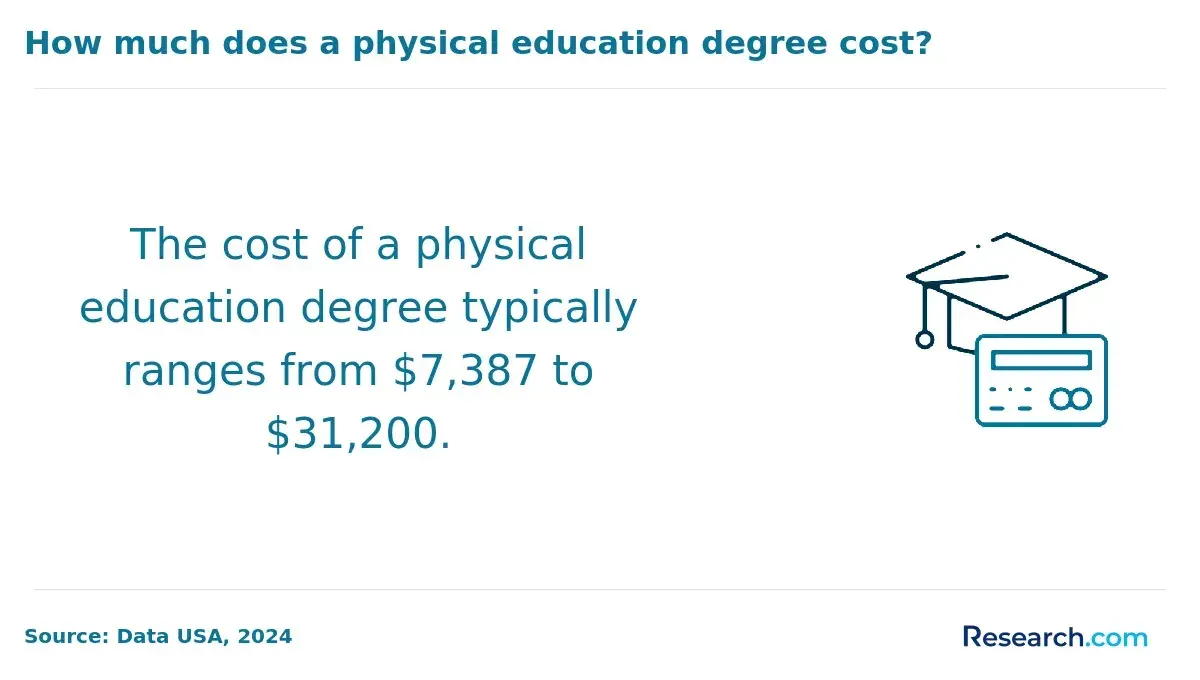
How much does it cost to become a PE teacher in Washington?
The cost depends on where you study, whether you attend full time or part time, whether teacher preparation is included in your bachelor’s program, and how many exams or application steps you need. Tuition is usually the largest expense, but certification, testing, books, materials, and fingerprinting also matter.
- Bachelor’s degree tuition: In-state students at public universities may pay between $8,000 and $12,000 annually, or roughly $32,000 to $48,000 over a four-year degree.
- Teacher preparation program costs: If teacher preparation is not included in the undergraduate program, certificate-only or graduate-level preparation may cost from a few thousand dollars to over $16,000.
- Exam and certification fees: The National Evaluation Series WEST-E Health/Fitness exam costs between $155 and $170. State certification processing requires a $51 fee, with possible additional charges based on certificate length and related requirements.
- Books, materials, and background checks: Textbooks and program materials may exceed $1,000 over the course of study. Fingerprinting and background checks typically add $45 to $55.
| Cost category | Stated cost range or amount | How to manage the expense |
| Bachelor’s tuition | $8,000 to $12,000 annually for in-state public university students; around $32,000 to $48,000 for four years. | Compare in-state options, transfer policies, scholarships, and whether teacher preparation is included. |
| Teacher preparation | From a few thousand dollars to over $16,000, depending on route. | Ask whether the program leads directly to Washington certification and the Health/Fitness endorsement. |
| WEST-E Health/Fitness exam | $155 to $170. | Prepare early to reduce the risk of retake costs. |
| Certification processing | $51, with possible additional charges. | Review application instructions before submitting documents. |
| Books, materials, fingerprinting, and checks | Materials may exceed $1,000; background checks and fingerprinting usually add $45 to $55. | Budget for non-tuition expenses before the student teaching term begins. |
Students comparing graduate-level or certification-related costs across education fields can also review resources such as the most affordable online library science master’s degrees to understand how program format, tuition model, and institutional fees affect total cost.
Are there scholarships for physical education teaching students in Washington?
Yes. Future PE teachers in Washington may qualify for federal aid, state aid, university scholarships, teaching-related grants, conditional scholarships, and loan forgiveness programs. The best strategy is to combine multiple sources rather than rely on one award.
- Federal financial aid: Students can submit the FAFSA to be considered for Pell Grants, FSEOG, and federal student loans based on eligibility and financial need.
- Washington State aid: The Washington College Grant provides need-based support for eligible residents in approved programs and may cover substantial tuition costs at public institutions.
- Institutional scholarships: Universities, including Western Washington University, may offer scholarships for PE majors based on merit, financial need, teaching commitment, or department criteria.
- Teaching grants and conditional scholarships: Programs such as the Educator Workforce Program may provide aid tied to teaching in shortage areas, including PE roles in Washington public schools.
- Loan forgiveness: Teachers who work in high-need schools may qualify for federal or state loan forgiveness options, depending on program rules and service requirements.
A Washington PE teacher who received a departmental scholarship said the award did more than reduce her bill. It made her feel that her community involvement and commitment to teaching were recognized. She also noted that loan forgiveness options helped her feel more secure about choosing public school teaching as a long-term career.
| Funding source | Who should look at it | Question to ask |
| FAFSA-based aid | Nearly every student entering a degree or teacher preparation program. | What grants, loans, or work-study options am I eligible for? |
| Washington College Grant | Washington residents with financial need. | Does my school and program qualify? |
| University scholarships | Students admitted to PE, health, fitness, kinesiology, or education programs. | Are there separate department applications and deadlines? |
| Conditional teaching aid | Students willing to teach in shortage areas or public school settings. | What service obligation must I complete? |
| Loan forgiveness | Teachers planning to work in qualifying schools after graduation. | Which loans qualify, and how many years of service are required? |
Is there demand for physical education teachers in Washington?
Washington offers meaningful opportunities for PE teachers, but demand is not equal in every district. Openings depend on enrollment, retirements, district budgets, state wellness priorities, and whether schools are trying to fill broader Health/Fitness roles rather than PE-only schedules.
The state is considered one of the stronger locations for physical education employment, with projected 6% growth in teaching positions over the next decade. Nationally, projections for physical education teachers show modest growth of around 3.1% between 2022 and 2032. In Washington, demand can be stronger in public schools, underserved districts, rural communities, and lower-income areas where recruitment and retention are more difficult.
Candidates can improve their job prospects by building skills beyond traditional sport instruction. Schools may value PE teachers who can coach, teach health concepts, support inclusive activity design, contribute to wellness initiatives, and work effectively with students from diverse backgrounds.
For educators who later want broader leadership options, a PhD in education online may support careers in research, curriculum leadership, teacher education, or administration, depending on the program and professional goals.
| Factor affecting demand | How it influences PE hiring | How candidates can respond |
| Regional shortages | Some rural and underserved districts may have more difficulty filling teaching roles. | Consider a wider geographic job search instead of focusing only on major metro areas. |
| Retirements | Departures of experienced teachers can create openings. | Monitor district job boards early and build substitute or student teaching connections. |
| Health and wellness priorities | Schools may seek teachers who can connect PE with broader student wellness goals. | Develop strengths in health education, fitness assessment, and inclusive programming. |
| Coaching and extracurricular needs | Some districts value teachers who can also support athletics or clubs. | Gain coaching, first aid, or youth activity experience when possible. |
What is the average salary of a PE teacher in Washington?
The average salary for physical education teachers in Washington is approximately $60,840 per year. This is slightly below the national average range of $61,000 to $64,000 annually. Actual earnings can vary widely by district, experience level, education, union contract, location, and whether the teacher takes on additional duties such as coaching.
- Experience level: New PE teachers may start between $48,490 and $59,791. Experienced teachers can earn up to $103,890 depending on district pay schedules and step increases.
- Education level: Graduate degrees, additional credits, or advanced certifications can increase pay in districts that reward additional education.
- Public versus private employment: Public schools often use established salary schedules and negotiated contracts. Private schools may offer different pay structures and benefits.
- Location: Urban districts such as Seattle may pay experienced teachers more than $100,000, while rural districts may offer lower salaries that reflect local budgets and cost structures.
| Salary factor | Effect on earnings | What to check before accepting a job |
| District salary schedule | Determines pay by years of experience and education credits. | Where would I enter on the salary schedule? |
| Advanced education | May raise pay if the district awards compensation for graduate credits or degrees. | Will a master’s or doctorate increase my salary enough to justify the cost? |
| Coaching or extra duty | May add stipends or supplemental pay. | Are coaching duties required, optional, or separately paid? |
| Location | Urban and rural districts can differ significantly in pay and cost of living. | How does the salary compare with housing, commuting, and benefits? |
Salary should be evaluated alongside benefits, retirement contributions, workload, commute, professional support, and long-term advancement opportunities. A higher salary may not always be the better offer if the workload, cost of living, or lack of mentoring creates burnout risk.
What Do Physical Education Teachers in Washington Say About Their Career?
- After completing physical education certification at Evergreen State College, I felt prepared because the program combined demanding coursework with real teaching practice. Working in a Washington school has given me stability, but the most rewarding part is using the community’s interest in sports, recreation, and outdoor activity to help students see fitness as part of everyday life. Yasmien
- My preparation at Seattle Pacific University taught me that PE is not just about athletic performance. I learned how to adapt lessons for students with different abilities and confidence levels. Once I began teaching in Washington, cultural awareness and inclusive planning became central to my work, especially in classrooms where students bring very different experiences with movement and health. Jeremy
- Gonzaga University helped me understand both classroom teaching and long-term career growth in Washington education. I enjoy connecting physical education with local organizations and outdoor fitness opportunities. The work can be challenging, but it is meaningful to know that students may carry these wellness habits into adulthood. Linh
Common Mistakes to Avoid When Becoming a PE Teacher in Washington
- Choosing a program without checking certification approval: A degree in fitness or sport science may be valuable, but it may not automatically lead to Washington teacher certification.
- Assuming coaching experience is enough: Coaching can strengthen an application, but public school PE teaching requires state certification and supervised teacher preparation.
- Ignoring the Health/Fitness endorsement: Candidates need the correct endorsement for the subject they plan to teach.
- Waiting too long to plan for exams: Testing delays or retakes can push back certification and hiring timelines.
- Looking only at tuition: Certification fees, exams, materials, background checks, transportation, and unpaid student teaching time can affect the total cost.
- Assuming all online coursework meets Washington requirements: Online or out-of-state programs should be evaluated carefully for Washington certification eligibility.
- Relying only on average salary: District pay schedules, cost of living, benefits, and advancement rules matter more than a single statewide average.
Questions to Ask Before Choosing a PE Teacher Preparation Program in Washington
- Is the program approved for Washington teacher certification?
- Does it prepare students for the Health/Fitness endorsement?
- Is student teaching included, and where are placements typically located?
- What are the program’s exam preparation supports for the WEST-B and Health/Fitness content assessment?
- How many transfer credits will the program accept?
- What is the total estimated cost, including tuition, fees, books, testing, certification, and fingerprinting?
- Are scholarships, grants, or conditional teaching awards available for PE education students?
- Does the program support career changers or only traditional undergraduate students?
- How does the program help graduates find jobs in Washington districts?
- Will the credential support public school employment, private school employment, or both?
Key Insights
- Washington public school PE teachers need a teaching certificate and a Health/Fitness endorsement; athletic ability or coaching experience alone is not enough.
- The standard route includes a bachelor’s degree, a state-approved teacher preparation program, student teaching, required exams, fingerprinting, and an application through Washington’s certification system.
- Most candidates should plan for at least five years when degree completion, preparation, testing, and initial teaching experience are considered.
- Costs vary widely, but students should budget for tuition, preparation program fees, exams, certification processing, books, materials, and background checks.
- Washington’s projected 6% growth in teaching positions suggests opportunity, but hiring conditions differ by district, region, and school type.
- The average PE teacher salary in Washington is approximately $60,840 per year, with experience, education, district pay schedules, and location strongly affecting earnings.
- The strongest candidates combine PE content knowledge with inclusive instruction, safety management, health education, communication, and the ability to motivate students with different fitness levels.
- Before enrolling, confirm that a program leads to Washington certification and the Health/Fitness endorsement. This single step can prevent costly delays later.
Related Articles for Nearby States
- 2027 How to Become a Physical Education Teacher in Oregon
- 2027 How to Become a Physical Education Teacher in Idaho
- 2027 How to Become a Physical Education Teacher in Montana
- 2027 How to Become a Physical Education Teacher in California
- 2027 How to Become a Physical Education Teacher in Nevada
- 2027 How to Become a Physical Education Teacher in Utah
- 2027 How to Become a Physical Education Teacher in Wyoming
- 2027 How to Become a Physical Education Teacher in Arizona
- 2027 How to Become a Physical Education Teacher in Colorado
- 2027 How to Become a Physical Education Teacher in New Mexico
References:
- How to Become a PE Teacher in Washington State | Requirements for PE Teacher Jobs in WA https://www.peteacheredu.org/washington/
- Alternative routes to teacher certification - Professional Educator Standards Board https://www.pesb.wa.gov/pathways/alternative-routes-to-teacher-certification/
- Washington State Certification - Frequently Asked Questions https://ospi.k12.wa.us/certification/teacher-certificate/washington-state-certification-frequently-asked-questions
- How to Become a Pe Teacher - Kutest Kids https://www.kutestkids.com/blog/how-to-become-a-pe-teacher
- Do Physical Education Teachers Teach Any Other Classes? https://www.sports-management-degrees.com/faq/do-physical-education-teachers-teach-any-other-classes/
- Endorsements | Educational Certification & Career Services | Whitworth University https://www.whitworth.edu/cms/administration/educational-certification-and-career-services/endorsements/
- Endorsements for certified teachers | Saint Martin's University https://www.stmartin.edu/directory/offices-departments-directory/college-arts-sciences-and-education/endorsements-certified-teachers
- The job market for physical education teachers in the United States - CareerExplorer https://www.careerexplorer.com/careers/physical-education-teacher/job-market/
- Advanced online education doctorate options for educators considering leadership roles https://research.com/degrees/online-doctorate-degrees-in-education
- Health & Physical Education (BAE) - Wellness & Movement Sciences - College of Health Science & Public Health - EWU - The Region's Polytechnic https://www.ewu.edu/chsph/wellness-movement-sciences/health-physical-education-bae/
Other Things You Should Know About Becoming a Physical Education Teacher in Missouri
The Washington Office of Superintendent of Public Instruction (OSPI) is responsible for issuing the teaching certificate for aspiring Physical Education teachers. Prospective educators must meet all specified requirements and apply through the OSPI to obtain certification.
Washington requires a fingerprint-based criminal history background check through the Washington State Patrol and the FBI before issuing a teaching certificate. Applicants must complete this clearance through the state educator certification process, and any disqualifying findings can delay or prevent certification.


