
2027 Fingerprint Specialist Careers: Skills, Education, Salary & Job Outlook

Co-Founder and Chief Data Scientist
Becoming a fingerprint specialist is a career decision that combines forensic science, criminal justice, technology, and courtroom responsibility. The field can be attractive if you want investigative work with a clear public-safety purpose, but it is not a casual entry-level job. Employers often expect relevant education, hands-on training, careful documentation habits, and the judgment to make defensible comparisons under legal scrutiny.
This guide is for students, career changers, and early forensic professionals who want to understand whether fingerprint analysis is a realistic path for them. It explains what fingerprint specialists do, the skills and credentials that matter, how training usually works, where the job can lead, and what trade-offs to expect in day-to-day work.
The financial picture varies by employer, state, experience, and specialization. Median salaries start at $45,560 and rise to over $110,000 in senior roles, with top states offering up to 58% higher pay. Those figures make the career worth considering, but the better question is whether you are prepared for the precision, patience, and accountability the work requires.
Key Things You Should Know About Fingerprint Specialist Career
- The typical earning potential for a fingerprint specialist is around $53,919 per year, with some positions offering salaries between $51,897 and $67,440 depending on experience and specific roles.
- This field is stable and growing, as the demand for forensic science technicians, including fingerprint specialists, continues to rise with advances in crime lab technology and forensic evidence use.
- A bachelor's degree in forensic science, criminal justice, or a related area is usually required, along with specialized training from agencies like the FBI or state crime labs.
- Success relies on attention to detail, strong analytical skills, proficiency in digital fingerprint analysis, clear communication, and the ability to work independently under pressure.
- Career advancement often moves from entry-level technician to senior analyst or supervisor, with opportunities to join federal agencies or become forensic educators and consultants.
What do Fingerprint Specialists do?
Fingerprint specialists identify, examine, compare, and document friction ridge impressions from fingers, palms, and sometimes other skin surfaces. Their work helps law enforcement agencies, courts, government offices, and other authorized organizations determine whether a print can be associated with a known person.
The role is not just “matching fingerprints.” A specialist must evaluate print quality, understand how impressions are formed, use databases responsibly, document every step, and explain conclusions in reports or testimony. In criminal investigations, that work may help connect a person to a scene, exclude a person from consideration, or support the identification of an unknown victim. In civil or administrative settings, fingerprint work may support background checks, immigration processing, employment screening, or licensing procedures.
A Day in the Life of Fingerprint Specialists
Most fingerprint specialists divide their time between laboratory or office analysis, database work, report writing, and communication with investigators or agency staff. A typical day may include reviewing latent prints from a case, processing tenprint cards or live scan submissions, searching AFIS or another biometric system, comparing candidate results, and documenting whether a print is suitable for identification.
The work can be quiet and highly focused, but it is rarely isolated from the larger justice process. Specialists may coordinate with detectives, crime scene personnel, prosecutors, defense attorneys, supervisors, and other forensic experts. Some roles include occasional fieldwork, especially when evidence collection or specialized processing is needed outside the lab.
The best fit is someone who enjoys detail-heavy analysis, can stay objective under pressure, and understands that careful process matters as much as the final conclusion.
What are the key responsibilities of Fingerprint Specialists?
Fingerprint specialists are responsible for turning fingerprint evidence and biometric records into reliable, well-documented findings. Their responsibilities may vary by agency, but most roles include a mix of technical analysis, record management, quality control, and communication.
- Analyze and compare fingerprint evidence using visual examination, accepted comparison methods, and systems such as AFIS.
- Capture, classify, and process fingerprints from individuals using ink-based methods, live scan equipment, or other approved collection tools.
- Evaluate latent prints for clarity, ridge detail, distortion, and suitability for comparison.
- Maintain fingerprint databases and records so that searches, identifications, and exclusions are traceable and accurate.
- Prepare written reports that clearly explain findings, limitations, and case documentation.
- Coordinate with law enforcement agencies, forensic units, attorneys, and court personnel when fingerprint results affect an investigation or proceeding.
- Testify in court as an expert witness when fingerprint evidence must be explained to judges, juries, or attorneys.
The Most Challenging vs. The Most Rewarding Tasks
The hardest part of the job is often working with partial, distorted, contaminated, or low-quality impressions. A print may contain enough detail to suggest a possible lead but not enough for a defensible identification. In those situations, the specialist must resist pressure, apply standards consistently, and document limitations honestly.
The most rewarding part is when a careful comparison helps move a case forward. A reliable identification can help investigators find a suspect, identify a victim, support an exoneration, or resolve an administrative matter. That impact is why accuracy, restraint, and documentation are central to the profession.
If you want to prepare for this field while managing time or cost constraints, researching quick degree programs may help you compare education options that can support an entry path into forensic or criminal justice work.
What are the key skills for Fingerprint Specialists?
Fingerprint specialists need more than sharp eyesight. The job requires technical skill, disciplined reasoning, consistent documentation, and the ability to explain specialized findings in plain language. Employers look for people who can be accurate, objective, and calm when their work is questioned.
Technical Skills
- Fingerprint classification and pattern analysis: Specialists must recognize ridge patterns, minutiae, distortion, and quality issues that affect comparison.
- Latent print processing knowledge: Understanding how prints are deposited, developed, photographed, lifted, and preserved helps specialists evaluate evidence properly.
- AFIS and biometric system use: Automated systems can generate candidate lists, but specialists must still evaluate results and avoid overreliance on software.
- Data entry and record management: Fingerprint work depends on accurate names, identifiers, case numbers, image records, and audit trails.
- Quality assurance and compliance: Specialists must follow agency procedures, laboratory standards, and review requirements so findings can withstand scrutiny.
- Equipment operation and troubleshooting: LiveScan devices, imaging tools, scanners, and forensic software must be used correctly to avoid poor-quality records.
Soft Skills
- Attention to detail: Small differences in ridge characteristics, image quality, or documentation can change the direction of a case.
- Critical thinking: Specialists must separate what the print supports from what investigators may hope it proves.
- Patience and mental stamina: Repetitive comparisons require sustained focus without rushing conclusions.
- Active listening: Understanding case context, collection details, and legal questions helps specialists respond appropriately.
- Clear communication: Reports and testimony must be precise enough for experts and understandable enough for non-specialists.
The One Overlooked Skill That Separates the Good from the Great
Courtroom communication is often the difference between being technically competent and being trusted as an expert. A fingerprint specialist may perform a sound comparison, but that work loses value if the explanation is vague, overly technical, or vulnerable to misinterpretation under cross-examination.
Strong specialists can explain what was examined, what methods were used, what the findings mean, and what the findings do not prove. They avoid overstating certainty and can answer difficult questions without becoming defensive. This skill is especially important for professionals seeking higher-level agency roles, including positions in the Federal Executive Branch where technical expertise and testimony experience may carry significant weight.
If you need a flexible academic starting point, reviewing colleges offering open enrollment can help you identify programs that may fit your schedule while you build relevant forensic, science, or criminal justice coursework.
Fingerprint Specialist Careers: A Step-by-Step Guide to Getting Started
The path to becoming a fingerprint specialist is usually built in stages. You develop a foundation in science or criminal justice, gain exposure to evidence handling, complete focused fingerprint training, and build enough supervised experience to qualify for more advanced responsibilities or certification.
- Complete foundational education. Start with coursework in forensic science, criminal justice, biology, chemistry, or another relevant applied science area. The goal is to understand evidence, investigation, documentation, and scientific reasoning.
- Gain practical exposure. Look for internships, lab assistant roles, law enforcement support positions, evidence technician jobs, or other entry-level roles that teach chain of custody and agency procedures.
- Complete specialized fingerprint training. Learn fingerprint classification, latent print development, comparison methods, AFIS use, documentation, and courtroom expectations.
- Build supervised work experience. Many employers want proof that you can apply methods consistently on real cases or records under qualified review.
- Pursue professional credentialing. Certification can strengthen credibility once you meet education, training, and experience requirements.
- Advance through specialization. With experience, you can move into senior analysis, quality assurance, laboratory supervision, expert testimony, training, or related forensic disciplines.
A common mistake is treating certification as the first step. In practice, certification usually comes after education, formal training, and documented experience. Another mistake is focusing only on technology. AFIS and digital tools matter, but employers still need specialists who can make defensible decisions and explain their reasoning.
What education, training, or certifications are required?
The most common qualifications for a Fingerprint Specialist include a bachelor's degree in Forensic Science, Criminal Justice with a forensics focus, Biological Sciences, Chemistry, or Social Justice. Some employers also consider candidates with an associate degree in Criminal Justice or Forensic Science, though that route typically requires more work experience to demonstrate readiness.
Training is essential because fingerprint analysis is a specialized skill. On-the-job training may include between 80 to 160 hours of board-approved latent print training. Supervised work experience is also commonly required and may range from two to four years depending on educational background and employer standards. Programs such as the FBI Fingerprint Examiner Training Program may be preferred or required by some agencies.
Professional certification can help demonstrate competence and commitment. Important credentials include the Certified Latent Print Examiner and Certified Tenprint Examiner, both issued by the International Association for Identification (IAI). These credentials are not a substitute for experience, but they can support advancement and strengthen credibility in forensic settings.
How to choose the right education path
- Choose forensic science if you want a lab-centered path with stronger exposure to evidence, scientific methods, and forensic procedures.
- Choose criminal justice if you want broader preparation for law enforcement, investigations, courts, and agency operations.
- Choose biology or chemistry if you want a science-heavy foundation that may also support related forensic laboratory careers.
- Choose an associate degree carefully if speed or cost is a major factor, but verify whether target employers require a bachelor's degree or additional experience.
Are advanced degrees or niche certifications worth the investment?
Advanced degrees such as a Master of Science in Forensic Science or Criminal Justice may help candidates who want supervisory, federal, teaching, research, or specialized forensic roles. They can also strengthen a resume when competing for positions that value advanced academic preparation. However, many standard fingerprint specialist positions do not require a graduate degree, so the return depends on your target employer and career goal.
Specialized certifications from the IAI or FBI-related training often carry more direct value for fingerprint advancement than a graduate degree alone. Employers want to see that you can perform the work, follow standards, handle review, and communicate findings responsibly. If you are considering graduate study, compare it with other fields where a high paying master's degree may have clearer salary leverage.
The practical approach is to start with the minimum education required by your target agencies, then add training, supervised experience, and certification as your role becomes more specialized.
What is the earning potential for Fingerprint Specialists?
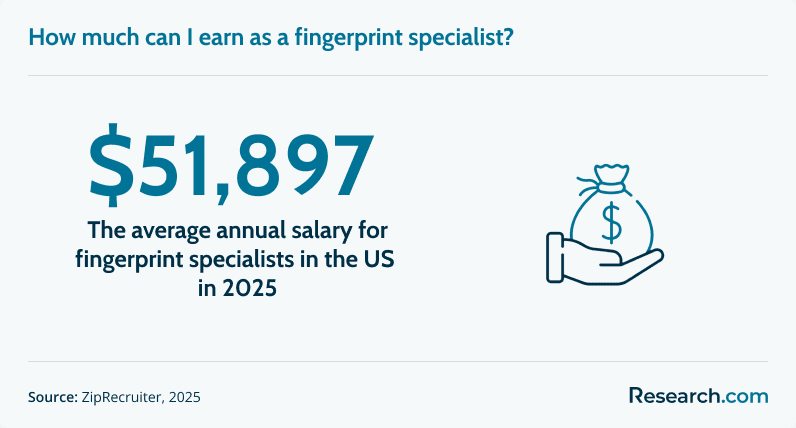
The median annual salary for a Fingerprint Specialist in the United States is $51,897. The fingerprint specialist salary range 2025 runs from about $38,000 at entry level to $60,000 for senior roles. Those figures provide a realistic planning range for many candidates, but actual pay depends heavily on employer type, location, experience, certification, and whether the role includes testimony, supervision, or advanced forensic responsibilities.
The broader earning picture can be stronger in some settings. Median salaries start at $45,560 and rise to over $110,000 in senior roles, with top states offering up to 58% higher pay. Federal agencies, state forensic laboratories, large metropolitan law enforcement departments, and specialized public safety roles may offer more competitive compensation than smaller local agencies.
Location can make a significant difference. Maryland, ranking 22nd nationwide, shows how state-level pay may vary even within a stable forensic occupation. Candidates should compare salary against cost of living, public-sector benefits, overtime policies, retirement plans, union coverage, and advancement opportunities rather than looking only at starting pay.
What affects pay the most?
- Experience level: Entry-level technicians typically earn less than senior analysts, lead examiners, or supervisors.
- Employer type: Federal, state, county, city, and private employers may use different pay scales.
- Certification: Recognized credentials can support advancement, especially when combined with case experience.
- Specialized duties: Expert testimony, quality assurance, difficult latent print work, and laboratory leadership can increase value.
- Geography: State demand, agency budgets, and cost of living all affect compensation.
What is the job outlook for Fingerprint Specialists?
The job outlook for fingerprint specialists is strong, with a projected growth rate of 13% from 2024 to 2034. That outlook reflects the continued importance of biometric identification, forensic evidence, public safety operations, and government record systems.
Fingerprint work is also relatively stable because it is tied to law enforcement, courts, public agencies, background checks, and forensic laboratories. These functions are not easily outsourced, and many require secure systems, chain-of-custody controls, and onsite access to evidence or records.
The Key Factors Shaping the Future Outlook
Technology is changing the work rather than eliminating it. Digital imaging, biometric databases, AFIS, and advanced forensic software can make searches faster and improve image handling, but trained specialists are still needed to evaluate print quality, interpret results, avoid false assumptions, and document conclusions.
Courts and investigators continue to rely on physical and biometric evidence, which supports steady demand for specialists who can meet scientific and legal expectations. Public safety investments, persistent case backlogs, and the need for reliable identification also contribute to career stability.
For readers comparing forensic options with shorter education pathways, fingerprint specialization may be worth considering alongside other forms of quick schooling to make good money. The key is to confirm local employer requirements before choosing a program, because many roles still expect formal training and supervised experience.
What is the typical work environment for Fingerprint Specialists?
The fingerprint specialist work environment is usually a laboratory, records unit, or office within a government agency, law enforcement department, or forensic science facility. About 85% of fingerprint specialists work in government settings, 10% work for private companies, and the remaining 5% work in other industries.
Work is often structured and procedure-driven. Specialists may sit for long periods while reviewing images, comparing prints, entering records, or writing reports. They may also handle physical evidence, operate scanning equipment, or coordinate with crime scene and investigative personnel. Some positions include occasional visits to crime scenes or evidence collection areas, but many roles are primarily lab- or office-based.
The typical fingerprint analyst work schedule usually follows standard business hours. However, some agencies require flexibility for urgent cases, court deadlines, evening work, weekends, or on-call needs. Remote work is limited because fingerprint specialists often need secure databases, controlled lab environments, evidence access, and agency-approved equipment.
Work environment fit
- Good fit if you prefer: structured procedures, focused analysis, public service, detailed documentation, and specialized technical work.
- Challenging if you dislike: repetitive tasks, strict review processes, legal scrutiny, limited remote work, or exposure to sensitive case material.
What are the pros and cons of Fingerprint Specialist careers?
A fingerprint specialist career can be meaningful, stable, and intellectually satisfying, but it also comes with pressure. The work affects real investigations and legal outcomes, so mistakes can have serious consequences. Before choosing this path, weigh both the purpose of the role and the daily demands.
Pros
- Public safety impact: Your work can help identify suspects, victims, missing persons, or individuals in civil processes.
- Clear professional purpose: The role supports justice by providing evidence-based identification work.
- Specialized expertise: Fingerprint analysis gives you a defined technical skill set that can grow through training and certification.
- Structured career paths: Government agencies and forensic laboratories often have defined ranks, review systems, and advancement opportunities.
- Intellectual challenge: Complex comparisons require pattern recognition, judgment, and disciplined reasoning.
Cons
- Repetitive work: Long periods of image review, database checks, and documentation can become mentally tiring.
- High accountability: Fingerprint conclusions may be challenged in court, audits, or peer review.
- Emotional exposure: Some evidence is connected to violent crimes, trauma, or sensitive personal situations.
- Limited remote flexibility: Secure systems, evidence handling, and lab procedures usually require onsite work.
- Continuous learning: Specialists must keep up with technology, standards, legal expectations, and agency procedures.
If you want a practical education route into forensic or public safety work, exploring the best online trade schools may help you compare programs that build job-ready skills. Just make sure any program you consider aligns with employer expectations for fingerprint, forensic science, or criminal justice roles.
What are the opportunities for advancement for Fingerprint Specialists?
Fingerprint specialists can advance by gaining experience, earning certification, handling more complex cases, leading quality review, training others, or moving into laboratory management. Advancement is usually based on a combination of technical competence, documentation quality, reliability, testimony skill, and leadership ability.
Clear Advancement Paths
- Entry-Level Fingerprint Specialist / Technician: Handles routine fingerprint collection, record processing, basic comparisons, database work, or case support under supervision.
- Fingerprint Specialist / Analyst: Performs independent comparisons, prepares reports, works with investigators, and may participate in peer review.
- Senior Fingerprint Analyst / Lead Fingerprint Specialist: Manages complex cases, mentors junior staff, supports quality assurance, and may testify more frequently.
- Forensic Fingerprint Specialist / Laboratory Supervisor / Crime Lab Director: Oversees technical standards, personnel, operations, policy, training, and laboratory performance.
- Related forensic moves: Experienced specialists may transition into evidence management, crime scene investigation, forensic quality assurance, training, or other comparison disciplines.
Emerging Specializations in Fingerprint Analysis
- Digital Latent Print Recovery Specialist: Focuses on improving, recovering, and documenting prints from digital images or difficult visual sources.
- AI-Assisted Fingerprint Analysis Integrator: Works with artificial intelligence tools while maintaining human review, validation, and defensible conclusions.
- Difficult Surface & Post-Blast Recovery Expert: Develops expertise in prints from challenging materials, damaged evidence, or hazardous scenes.
- Training, Education & Expert Witness Services: Moves into teaching, courtroom consultation, curriculum development, or professional training.
- Quality Assurance & Laboratory Management: Concentrates on standards, audits, method validation, technical review, and operational consistency.
The strongest advancement strategy is to document your training, seek feedback from experienced examiners, build a record of reliable work, and pursue certification when you meet the requirements. Technical skill gets you started; credibility and leadership expand your options.
What other careers should you consider?
If you are interested in fingerprint analysis but unsure whether it is the best fit, compare it with related forensic and evidence-focused careers. Many use similar strengths: attention to detail, documentation, pattern recognition, chain-of-custody awareness, and comfort with legal procedures.
- Forensic Technician: Collects, preserves, and analyzes physical evidence. This is a broader forensic role that may include crime scene work, laboratory support, and evidence processing.
- Digital Forensic Examiner: Examines computers, phones, storage media, and digital records. This path suits people who like investigation but prefer technology-centered evidence.
- Forensic Biologist / DNA Analyst: Analyzes biological evidence such as DNA. This option is stronger for candidates who enjoy laboratory science and biological analysis.
- Forensic Evidence Coordinator / Evidence Technician: Manages evidence intake, storage, documentation, transfers, and chain-of-custody procedures. It is a strong fit for highly organized candidates.
- Forensic Firearm/Toolmark Examiner: Compares markings from firearms, bullets, cartridge cases, or tools. Like fingerprint work, it requires careful comparison and defensible documentation.
Use these alternatives to clarify what you want most from a career. If you prefer biological science, DNA analysis may fit better. If you like secure records and chain of custody, evidence coordination may be a stronger match. If you want identification work with direct investigative value, fingerprint specialization remains a focused and meaningful path.
Here's What Professionals Say About Their Fingerprint Specialist Careers
- Marcus: "One of the most meaningful parts of my work as a fingerprint specialist is knowing that the precision I bring to processing each print directly supports public safety. The moment I identify a match that helps close a case or prevents a wrongful conviction, I feel the weight of responsibility and the value of my role. Every fingerprint has a story, and it's my job to ensure that story is told accurately. It's a constant reminder that attention to detail matters deeply in the pursuit of justice."
- Anisa: "The demands of my role as a fingerprint specialist often mean spending long hours scrutinizing minutiae on prints, sometimes under tight deadlines that add pressure. A single oversight could have serious consequences, so I focus heavily on organization and rely on the support network around me. Keeping up with the latest technology and refining my skills is essential to handle the workload and courtroom testimonies with confidence. The mental stamina required is intense, but it sharpens my commitment to accuracy every day."
- Jalen: "There's a powerful sense of accomplishment when my detailed analysis leads to a positive identification that advances an investigation or assists someone applying for citizenship. Those moments remind me why I took this path-the work I do matters beyond the lab. Whether contributing to a criminal case or civil matters, knowing I play a part in resolving complex situations makes the challenging hours worthwhile. It's deeply satisfying to see how my role can positively impact people's lives."
Key Findings
- Fingerprint specialists examine, compare, document, and explain fingerprint evidence for criminal, civil, and administrative identification purposes.
- The career is best suited for people who are patient, detail-oriented, objective, and comfortable with legal accountability.
- Common education paths include Forensic Science, Criminal Justice with a forensics focus, Biological Sciences, Chemistry, Social Justice, or related associate degree options with additional experience.
- Training and experience matter. On-the-job preparation may include between 80 to 160 hours of board-approved latent print training and two to four years of supervised work experience depending on background.
- Important credentials include the Certified Latent Print Examiner and Certified Tenprint Examiner from the International Association for Identification (IAI).
- The median annual salary for a Fingerprint Specialist in the United States is $51,897, while the fingerprint specialist salary range 2025 runs from about $38,000 at entry level to $60,000 for senior roles.
- Long-term earning potential can rise in senior, specialized, or higher-paying government roles, with median salaries starting at $45,560 and rising to over $110,000 in senior roles, and top states offering up to 58% higher pay.
- The job outlook is strong, with a projected growth rate of 13% from 2024 to 2034.
- Most specialists work onsite in government, law enforcement, or forensic laboratory settings; about 85% work in government settings, 10% work for private companies, and 5% work in other industries.
- Technology will continue to shape the field, but human judgment, quality control, documentation, and courtroom communication remain central to the profession.
Other Things You Should Know About Fingerprint Specialist
In 2027, a fingerprint specialist typically needs a bachelor's degree in forensic science, criminal justice, or a related field. Training programs or certifications, such as those offered by the International Association for Identification, can enhance job prospects.
In 2027, advancements such as automated fingerprint identification systems (AFIS) and AI-driven analysis tools are significantly impacting fingerprint specialist careers. These technologies enhance accuracy and efficiency, requiring specialists to update their skills continuously to meet evolving forensic standards.
References
- Fingerprint officer https://nationalcareers.service.gov.uk/job-profiles/fingerprint-officer
- How to become a fingerprint analyst | edX https://www.edx.org/become/how-to-become-fingerprint-analyst
- What does a Fingerprint Technician do? Career Overview, Roles, Jobs | AARST https://jobs.aarst-nrpp.com/career/fingerprint-technician
- 30 Fingerprint Analyst Interview Questions and Answers https://interviewprep.org/fingerprint-analyst-interview-questions/
- Becoming a Fingerprint Analysis Pro | National University https://www.nu.edu/blog/becoming-a-fingerprint-analysis-pro/
- Fingerprint Specialist Details | HCSO, Tampa FL https://www.teamhcso.com/JobDescription/Detail/W2769
- 5 Fingerprint Expert Job Description Templates and Examples | Himalayas https://himalayas.app/job-descriptions/fingerprint-expert
- Forensic Identification Specialist - QUALIFIED Fingerprint Expert https://www.lumesse-engage.com/policejobssurreyandsussex/jobs/forensic-identification-specialist-qualified-fingerprint-expert-sysx-staff04273
- Q&A Interview with Fingerprint Expert Philip Gilhooley https://www.forensic-access.co.uk/news/interviews/fingerprint-forensics-interview-with-philip-gilhooley/


