2027 AI Master's Degrees With Global Study Options

Co-Founder and Chief Data Scientist
Transitioning into the artificial intelligence field from an unrelated undergraduate background can be overwhelming, especially when considering education options that fit diverse schedules and geographic constraints. Many prospective students struggle to find accredited programs that combine flexibility with global study opportunities while meeting high academic standards. This challenge intensifies for working professionals balancing career and personal commitments.
Understanding the variety of available AI master's degrees worldwide can simplify this transition. This article explores flexible, accredited AI master's degree programs with global study options, aiming to guide readers toward informed decisions and smoother career pivots into the artificial intelligence industry.
Key Things You Should Know
- In 2027, over 60% of AI master's programs offer global study options, enabling students to engage with international faculty and diverse research initiatives.
- Top AI master's degrees emphasize interdisciplinary skills, combining computer science, ethics, and data analysis to meet evolving industry demands.
- Average tuition varies widely; however, 45% of global programs provide scholarships or assistantships, supporting U.S. students pursuing AI education abroad.
What are AI master's degrees with global study options?
AI master's degrees with global study options offer graduate students the chance to combine advanced artificial intelligence coursework with international exposure. These international AI graduate programs often include joint or dual degrees, semester exchanges, and blended formats that mix online learning with in-person residencies abroad. Such flexibility supports professionals who want to maintain work commitments while gaining cross-border academic and cultural experience.
These programs respond to growing worldwide demand for AI talent and facilitate building diverse professional networks. Curriculum choices frequently cover specializations like machine learning, natural language processing, and computer vision. Many institutions collaborate with leading AI research centers in Europe, Asia, and North America, providing valuable insight into distinct innovation ecosystems and industry standards. According to OECD data, master's programs comprise roughly 31% of international enrollments across member countries, underscoring their role in global education mobility.
When evaluating programs, students should consider visa and residency rules, accreditation, language prerequisites, and availability of scholarships for international learners. Those seeking to advance careers in applied artificial intelligence may find opportunities to engage in research and practical projects that align with industry needs. For more detailed career outcomes, explore applied artificial intelligence.
Choosing an AI master's degree that offers global study options can enhance employability in multinational sectors and foster meaningful international collaborations.
Which universities offer accredited AI master's programs with international study?
Several leading universities offer accredited AI master's programs with global study options tailored for international learners. Notable institutions include the Technical University of Munich (Germany), which provides joint degrees through Erasmus+ partnerships, allowing student exchanges across Europe. Imperial College London (UK) features flexible AI master's curricula with opportunities for international internships and research collaborations. In North America, the University of Toronto (Canada) attracts international students and supports mobility through exchange programs.
Universities addressing global learning challenges like visa, credit transfers, and tuition include KU Leuven (Belgium) and the University of Edinburgh (Scotland), which provide AI master's tracks with double degree options across institutions in different countries. These programs emphasize centralized support for international students to ease transitions and ensure degree recognition worldwide.
Accreditation from bodies such as ABET (U.S.), AACSB (for business-related AI applications), and EUR-ACE (Europe) underscores academic rigor. For U.S. students, Erasmus+ funded mobility remains an attractive pathway to gain global experience, with the European Commission reporting about 1.3 million learning-mobility participants in 2023.
Professionals seeking international AI master's degrees benefit greatly from programs emphasizing practical experience abroad, such as internships and collaborative research projects. Prospective students should verify each program's accreditation, international student services, and partnerships. Explore affordable options by reviewing data science degrees suitable for your goals.
How do online AI master's programs include global immersion experiences?
Online AI master's programs increasingly integrate global immersion opportunities to connect students with international perspectives despite remote learning formats. These programs commonly feature virtual collaborative projects where learners from various countries address real-world AI challenges together, building cross-cultural teamwork and diverse problem-solving skills. Some programs also include synchronous sessions led by international faculty or industry experts to enrich understanding of global AI applications and ethics.
International study options within online AI master's degrees often include short-term residencies abroad lasting one to three weeks. During these residencies, students engage with tech hubs or partner universities, attend workshops, network with professionals, and gain practical experience in different AI ecosystems. Additionally, many programs emphasize global case studies and immersive simulations that replicate challenges faced by AI practitioners worldwide.
Partnerships with overseas firms or research centers provide students with opportunities for virtual or onsite internships, helping them apply knowledge in varied economic and regulatory contexts. Language and intercultural communication training are frequently incorporated to prepare students for collaboration in global AI projects.
According to Coursera's Learner Outcomes Report, 77% of learners report job advancements following online studies, highlighting how internationalized online AI programs boost employability by developing valued global competencies. Prospective students should review programs for strong global immersion offerings and clear pathways to practical international experience. Those considering interdisciplinary fields might also explore a game design and development degree as a complementary option.
What accreditation should AI master's programs meet in the United States?
In the United States, accreditation standards for AI master's programs require institutional accreditation by bodies recognized by the U.S. Department of Education (ED) and the Council for Higher Education Accreditation (CHEA). This ensures programs meet established quality criteria regarding faculty, curriculum, resources, and student outcomes. Over 6,000 institutions hold such accreditation, including those offering graduate degrees in artificial intelligence and related fields.
Students should verify their chosen program's accreditation status through the ED database, focusing on institutions accredited by one of the six regional accreditors, such as the Middle States Commission on Higher Education (MSCHE) or the Western Association of Schools and Colleges (WASC). National accreditors recognized by ED are also valid but often emphasize technical or specialized institutions. Specialized programmatic accreditation, like ABET (Accreditation Board for Engineering and Technology), may apply if the AI master's degree is part of an engineering school, though this is less common.
Choosing a non-accredited program risks gaps in quality and may impact eligibility for federal financial aid, licensure, or employer recognition. Accredited degrees help working professionals with credential recognition for career advancement or further education. Prospective students may find it useful to review data science degrees as a related area to consider when exploring graduate options in AI.
What courses and specializations are common in AI master's curricula?
Master's programs in artificial intelligence offer core courses that build a solid foundation in machine learning algorithms, deep learning, natural language processing, computer vision, and reinforcement learning. These areas cover key methods like supervised and unsupervised learning, neural networks, and model optimization. Students also often choose specializations in fields such as robotics, AI ethics, data science, or AI system design, allowing deeper expertise in perception and control systems, societal impacts, or big data management.
Proficiency in programming, especially Python, is essential. According to Lightcast (2025), Python is the most requested programming language in U.S. AI job listings, highlighting the need for courses in Python programming, AI software engineering, and frameworks like TensorFlow or PyTorch. Many curricula emphasize hands-on projects, system development, and internships to provide practical experience.
Advanced elective topics may include AI applications in healthcare, finance, autonomous systems, and explainable AI, helping students align their skills with industry demands. Programs are designed to balance theoretical knowledge with applied skills, preparing graduates for roles in research, development, or applied AI sectors. This comprehensive approach reflects the evolving job market needs and supports diverse career trajectories.
What are typical admission requirements for AI master's programs?
Admission to AI master's programs typically demands a strong foundation in quantitative and technical skills. Applicants usually need a bachelor's degree in computer science, engineering, mathematics, or related STEM fields. Proficiency in programming languages such as Python, Java, or C++ is essential. Admissions committees examine academic transcripts for excellence in courses like calculus, linear algebra, statistics, and algorithms. While some schools require GRE scores, many have begun making this optional.
English proficiency is vital for international students. According to ETS's TOEFL Test and Score Data Summary 2024, the average TOEFL iBT score was around 88, whereas most U.S.-based AI master's programs set minimum requirements between 90 and 100 to ensure graduate-level communication skills.
Applicants must provide two or three letters of recommendation, highlighting their technical skills, research potential, or professional experience related to AI. A statement of purpose is also required, detailing motivation, career objectives, and alignment with program strengths.
Research experience or internships in AI, machine learning, or data science add value, especially for working professionals. Demonstrating problem-solving ability and innovation through project portfolios or coding samples is advantageous.
International candidates should also anticipate visa paperwork and degree verification, which could extend processing times.
How long do AI master's programs take, and what do they cost?
Master's programs in artificial intelligence typically require one to two years of full-time study, usually amounting to 30 to 36 credit hours. Full-time students often complete their degree within three to four semesters, while part-time students may take two to three years, benefiting working professionals seeking flexibility. Accelerated options exist, allowing completion in as little as 12 months, but these demand an intensive, continuous course load.
Tuition costs vary widely based on institution type and residency. According to National Center for Education Statistics data assessed by the Education Data Initiative, average yearly tuition for in-state students at public universities is about $20,500. Out-of-state students can expect roughly $29,900 annually, and private nonprofit universities typically charge around $29,100. These do not include additional expenses such as textbooks, technology fees, or living costs.
Financial planning should consider scholarships, assistantships, and tuition reimbursement programs, often available at many universities. International students usually face higher fees and should confirm costs with specific institutions. Online programs generally align with these tuition ranges but offer savings on relocation and commuting.
Comparing program length and costs is essential. A two-year public university program may total $41,000 to $60,000, while private institutions can exceed $58,000. Evaluating schedule flexibility, overall expenses, and financial aid options supports an informed choice for pursuing an AI master's degree.
How do global study tracks differ from standard AI master's program formats?
Global study tracks in AI master's programs offer a distinct approach by integrating international collaboration and diverse learning environments. Unlike standard programs restricted to one campus, these tracks provide cross-border coursework, faculty exchanges, and joint projects with partner universities worldwide. Students often rotate between campuses or participate in virtual immersive experiences, gaining exposure to varied AI ethics, data privacy regulations, and market needs.
This structure enhances multicultural understanding and prepares graduates for international careers. For example, a student might learn foundational machine learning concepts in the U.S. and then apply them to healthcare AI challenges at a European or Asian institution. Global tracks also incorporate language support, international networking, and cross-cultural teamwork to break down communication barriers.
Flexible scheduling accommodates different time zones and academic calendars, which traditional programs rarely offer. Financially, tuition models reflect the involvement of multiple institutions, requiring careful financial planning. Yet, the benefits include greater mobility and diversity in education.
According to NAFSA (International Student Economic Value Tool, 2024), international students injected approximately $43.8 billion into the U.S. economy and helped sustain about 378,000 jobs, underscoring the economic and cultural importance of attracting global talent through such programs.
What jobs can an AI master's degree lead to in the United States?
An AI master's degree in the United States offers access to a variety of high-demand careers across diverse industries. Common roles include data scientist, machine learning engineer, AI research scientist, and business intelligence analyst. The U.S. Bureau of Labor Statistics forecasts a 35% growth in data scientist employment between 2022 and 2032, driven by expanding AI applications.
Data scientists extract insights from complex datasets using machine learning methods often taught in master's programs. Machine learning engineers create algorithms that enable systems to learn from data, playing key roles in sectors such as healthcare, finance, retail, and technology.
AI research scientists develop new AI models and methods, usually working in academic, corporate, or government labs. Business intelligence analysts apply AI tools to formulate strategic business recommendations that improve operations and customer experience.
Specialized careers also exist in natural language processing, robotics, computer vision, and autonomous systems. Emerging fields like AI ethics address the societal impacts of AI deployment. Candidates typically need programming skills in languages like Python, knowledge of deep learning frameworks, and solid mathematical foundations.
Internships or cooperative education during studies offer valuable practical experience. Joining professional organizations such as the Association for the Advancement of Artificial Intelligence (AAAI) can aid job placement. Employers prioritize a mix of technical expertise and problem-solving abilities tailored to real-world AI challenges.
What are AI master's graduate salaries and job outlook in the United States?
The median annual wage for AI-related master's graduates in the United States remains notably high, reflecting strong demand for specialized skills. Computer and information research scientists, a common role for these graduates, earn a median salary of $145,080 according to the U.S. Bureau of Labor Statistics (Occupational Employment and Wage Statistics, May 2024). Salaries are generally competitive in tech hubs like Silicon Valley, Seattle, and Boston, but vary by industry, location, and experience.
Job growth in computer and information research roles is projected at 22% from 2022 to 2032, driven by increased AI adoption in healthcare, finance, automotive, and government sectors. Job titles include machine learning engineer, data scientist, AI researcher, and robotics engineer, with entry-level salaries starting around $90,000 and senior roles exceeding $180,000 annually.
Remote AI positions are increasingly common, allowing geographic flexibility while maintaining strong earning potential. Certifications in emerging AI tools alongside a master's degree enhance employability and income.
Key tips to maximize career growth after an AI master's include:
- Targeting industries with significant AI investment such as autonomous vehicles or cybersecurity
- Developing expertise in niche AI subfields like natural language processing or computer vision
- Networking within professional AI communities to discover innovative projects and job openings
Other Things You Should Know About Artificial Intelligence
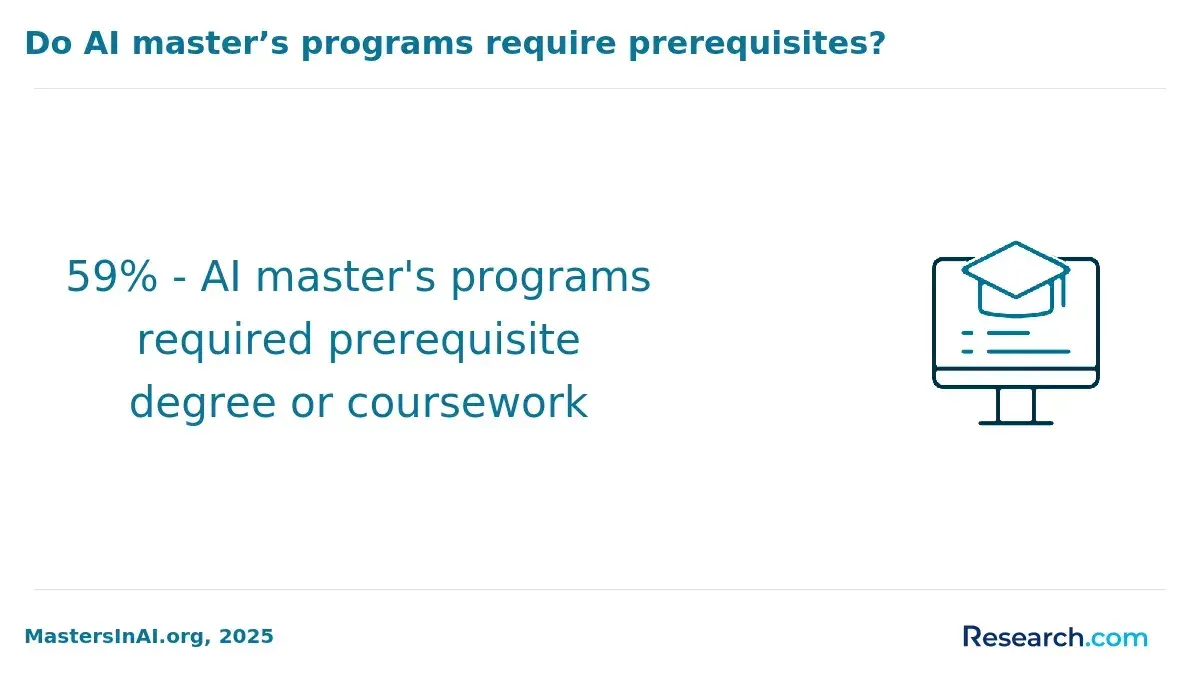
While a background in computer science is highly beneficial due to the technical nature of artificial intelligence, many programs accept students from related STEM fields such as mathematics, engineering, or physics. Some AI master's degrees offer foundational courses to help students with less programming experience catch up early in the curriculum.
Most AI master's programs in 2027 require around 30 to 36 credit hours for completion. These programs often include a combination of core AI courses, electives, and a thesis or capstone project to provide in-depth knowledge and practical experience.
Many programs waive GRE or GMAT requirements for AI master's admissions, but some universities still ask for GRE scores, usually with a quantitative focus. When required, official scores, English test results, and transcripts are submitted during the application review stage, often before departmental deadlines in late winter or spring.
Yes, international students are typically encouraged to apply for AI master's programs that offer global study options. These programs often provide visa support, multicultural campus communities, and partnerships with universities abroad to facilitate international learning experiences.
References
- How an Online Master’s in AI Can Prepare You for the Future of Tech https://www.ucumberlands.edu/blog/how-online-masters-ai-can-prepare-you-future-tech
- Study Masters in AI Programs Abroad - AEC Overseas https://www.aecoverseas.com/masters-in-ai/
- Experience Global Immersion at Minerva University https://www.minerva.edu/experience-global-immersion-at-minerva-university/
- Masters Artificial Intelligence https://www.udacity.com/masters-artificial-intelligence
- 25 Best Master's in AI Programs - MastersInAI.org https://www.mastersinai.org/degrees/best-masters-in-artificial-intelligence/
- Comparative Analysis Vision of Worldwide AI Courses https://arxiv.org/html/2407.16881v1
- MS in Artificial Intelligence (AI) in USA: Top Universities & Fees 2025 https://yocket.com/blog/masters-in-artificial-intelligence-in-usa
- Master's in AI: US Job Market & Salary Outlook (2024) https://drrajus.com/masters-in-ai-career-outlook-and-salary-trends/
- How to Check if a Graduate Program is Accredited (and Why This Matters) | ProFellow https://www.profellow.com/tips/how-to-check-if-a-graduate-program-is-accredited-and-why-this-matters/
- The Ultimate Guide to MS in Artificial Intelligence in USA https://www.nomadcredit.com/blog/ms-in-artificial-intelligence-in-usa