2027 AI Doctorate Degrees for Research Careers

Co-Founder and Chief Data Scientist
Many professionals with unrelated undergraduate degrees face challenges when seeking to enter the field of artificial intelligence research. Identifying accredited and flexible doctorate programs that accommodate diverse academic backgrounds is difficult. This often leads to wasted time and resources on unsuitable courses or unaccredited institutions. The complexity increases when balancing career shifts with personal commitments. Understanding the options that offer quality education and recognized credentials is essential for a successful transition. This article examines current doctorate degree pathways designed to prepare candidates for research careers in artificial intelligence and aims to guide readers toward informed program choices aligned with their goals.
Key Things You Should Know
- In 2027, AI doctorate programs increasingly emphasize interdisciplinary research, blending computer science, ethics, and domain-specific applications to meet evolving industry demands.
- Over 40% of new AI PhD graduates secure roles in research labs or tech firms within six months, reflecting robust job market growth driven by AI innovation.
- Funding opportunities in AI doctoral studies have grown by 25% since 2024, with more grants available for projects addressing responsible AI and real-world problem solving.
What is an AI doctorate degree, and how is it different from computer science?
An AI doctorate degree programs in research careers specialize in advanced innovation within artificial intelligence technologies such as machine learning, natural language processing, robotics, and computer vision. Unlike a traditional computer science doctorate, which covers broader topics like algorithms and software engineering, an AI doctorate focuses intensely on building and scaling AI models and systems. It addresses unique challenges like bias mitigation, model interpretability, and deploying AI at scale.
The contrast is evident in research goals. Computer science PhD students typically explore foundational computing principles, while AI doctorate candidates tackle specialized problems such as developing reinforcement learning algorithms for autonomous navigation or optimizing AI for real-time decision-making. This distinction is critical for students deciding between the two fields.
According to the Stanford University AI Index Report 2025, 78% of organizations reported using AI in at least one business function, up from 55% the previous year. This growth reflects how AI research now prioritizes practical deployment, model development, and large-scale evaluation, setting it apart from general computer science research.
Prospective students should align their goals carefully: those aiming to lead in AI innovation benefit from an AI doctorate, while others targeting broader computing roles might prefer a general computer science PhD. Exploring applied AI degree jobs can also help clarify career pathways relevant to each degree type.
Which accredited U.S. universities offer AI PhD programs for research careers?
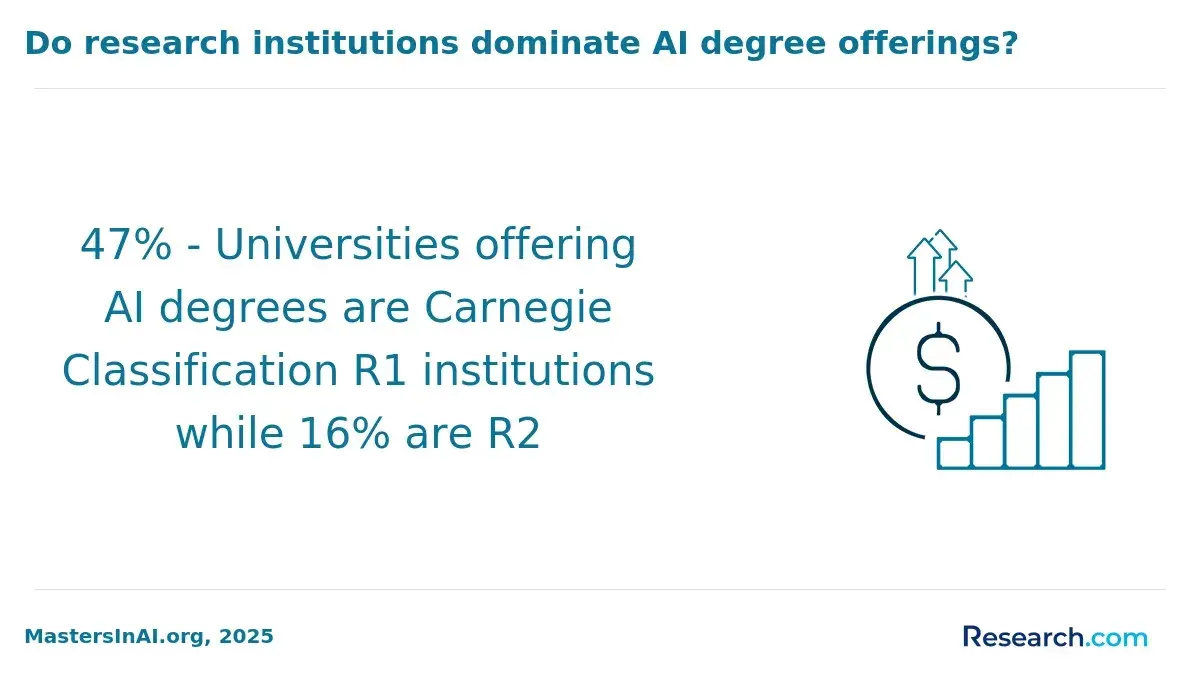
Many accredited U.S. universities offer AI doctorate programs designed for research careers. Based on the Carnegie Classification (2025 R1/R2 update), 187 institutions categorized as R1: Very High Research Activity serve as the main centers providing rigorous AI PhD tracks. These universities generally feature dedicated AI labs and interdisciplinary faculties spanning computer science, data science, robotics, and cognitive science.
Among the top U.S. PhD programs in AI for research careers are:
- Massachusetts Institute of Technology (MIT) - specializes in machine learning, natural language processing, and autonomous systems.
- Stanford University - combines AI PhD options with focuses in computer vision and human-computer interaction.
- Carnegie Mellon University - known for robotics and reinforcement learning research.
- University of California, Berkeley - integrates deep learning and ethical AI studies.
- University of Washington - applies AI in healthcare, computer vision, and speech recognition.
Prospective students should assess faculty expertise, research output, and centers when choosing accredited U.S. universities offering AI doctorate programs. Smaller R2 institutions may also provide opportunities but often with fewer resources and funding. Access to high-performance computing and interdisciplinary collaboration are important factors typically found at R1 universities.
For those exploring AI-focused doctoral degrees, reviewing official university sites and Carnegie Classification data is essential to verify program quality. Additionally, to understand cost considerations, check detailed rankings such as the top us colleges for data science, which can guide financial planning for graduate studies.
What careers can you pursue with an AI doctorate in industry, academia, or government?
An AI doctorate opens diverse career opportunities across industry, academia, and government sectors. In industry, graduates often work as research scientists or machine learning engineers at leading tech firms like Google or Microsoft, as well as at smaller AI startups. These roles involve developing new algorithms and advancing applied AI in fields such as natural language processing, computer vision, and robotics. Careers with an AI doctorate in academia and industry also include positions as data scientists or AI architects, where expertise shapes product design and AI integration.
Government and industry roles for AI doctorate graduates extend to agencies like DARPA, the National Institutes of Health, and the Department of Energy. These positions focus on solving complex national challenges in cybersecurity, defense, healthcare analytics, and public policy, often requiring collaboration across multidisciplinary teams and emphasizing ethical AI development.
Academia primarily hires AI doctorate holders as faculty members, postdoctoral researchers, or principal investigators focused on theoretical AI advancements, publishing, mentoring, and securing research funding. Graduates may also contribute to university-affiliated research labs or national research centers.
The U.S. Bureau of Labor Statistics projects a 26% growth in computer and information research scientist roles from 2023 to 2033, reflecting strong industry demand. Specific career paths include:
- AI research scientist in private tech firms
- University professor and academic principal investigator
- Government research scientist focused on applied AI solutions
- Senior AI consultant for corporate and defense projects
- Lead data scientist driving strategic AI initiatives
For prospective students exploring AI education, choosing programs tied to affordability can ease financial commitment. Consider reviewing the cheapest engineering degree options as a starting point on your educational path.
Can you earn an AI doctorate online, and what research requirements still apply?
You can earn an online doctorate in artificial intelligence research, but most accredited programs require significant on-site components. While distance learning is widespread-about 60% of postbaccalaureate students took at least one online course recently-the doctoral research requirements for AI degrees in North America still include critical in-person elements. These typically involve:
- Designing and conducting original research projects under faculty supervision
- Participating in laboratory or research group activities on campus or at partner institutions
- Regular meetings with a principal investigator and research mentors
- Writing and defending a dissertation that contributes new knowledge to the field
Many programs offer hybrid formats that combine remote coursework on theory and methods with on-site residencies or lab visits to complete experimental work and collaboration. Purely online AI doctorates without any physical presence are rare due to the experimental nature of the research.
Access to research resources and faculty expertise often requires physical or close virtual connections to research centers. Prospective students should discuss residency schedules, lab access, and mentorship expectations with admissions advisors to ensure they meet program standards remotely.
For those interested in data science graduate options, several affordable alternatives exist, and it's helpful to explore ms data science online programs for comparison and planning.
What coursework and research areas are typical in AI PhD programs?
AI PhD programs focus on a blend of fundamental and advanced topics such as machine learning, large-scale modeling, and empirical methods. Core coursework typically includes algorithms, statistical learning theory, neural networks, natural language processing, computer vision, and reinforcement learning. Students also explore optimization, probabilistic models, and ethical considerations in AI, equipping them to address rapidly evolving research challenges.
Research plays a central role, emphasizing the development, testing, and refinement of AI models using real-world data and benchmarks. Doctoral candidates often work on projects involving scalable deep learning architectures, multi-agent systems, or AI safety. These efforts integrate knowledge from computer science, mathematics, and cognitive sciences. The Stanford University AI Index Report 2025 shows the industry produced three times more notable AI models than academia, underscoring the importance of bridging theory with impactful applications.
Students are expected to develop research proposals early and contribute original findings through publications. Collaboration across laboratories and industry partnerships enhances exposure to practical problems and provides access to high-performance computing resources.
Prospective students should seek programs with strong faculty expertise, opportunities for interdisciplinary study, and support for empirical experimentation. Balancing theoretical foundations with applied research is essential to succeed in AI doctoral studies.
What are the admissions requirements for AI doctorate programs?
Admission to AI doctorate programs requires strong research experience, quantitative skills, and solid recommendations. Applicants generally hold degrees in computer science, engineering, mathematics, or related fields with emphasis on programming, machine learning, algorithms, statistics, and linear algebra.
Research background is often evidenced through thesis work, published papers, or AI project involvement. A clear statement of purpose aligning research interests with faculty expertise is crucial. Admissions committees value original thinking and familiarity with current AI challenges.
Letters of recommendation must come from professors or supervisors familiar with the applicant's analytical abilities and research potential. These letters play a key role amid growing competition, as applications to U.S. graduate programs have risen notably.
Standardized tests like the GRE are increasingly optional but may still be required-especially for international students-with a good quantitative score enhancing competitiveness. TOEFL or IELTS scores may also be necessary for non-native English speakers.
Additional criteria often include a coding portfolio, relevant internships, or AI-related work experience. Interviews may assess technical knowledge and research ideas, further contributing to admission decisions.
How long does an AI doctorate take, and what does it cost?
An AI doctorate generally requires four to six years to complete, influenced by program structure, research demands, and the candidate's previous experience. Students with strong computational skills often finish closer to four years, while those facing complex interdisciplinary projects or additional coursework may take longer. Dissertation work can also extend the timeline.
Tuition costs mirror broader graduate education trends. According to the National Center for Education Statistics Digest/Trends in Graduate Education (2024), average annual graduate tuition and fees were about $12,600 at public universities and $29,000 at private nonprofit institutions in the 2022-23 academic year. Over a typical five-year AI PhD program, this totals roughly $63,000 at public schools and $145,000 at private ones, excluding living expenses and research fees.
Many students offset these expenses through funding such as fellowships, teaching or research assistantships, and grants. These financial supports often provide full tuition coverage plus stipends to cover living costs. It is essential to carefully evaluate funding options when applying since funded programs dominate STEM and AI fields.
Prospective students should consider how the length of the program affects overall costs, including opportunity costs and living expenses. Programs with defined funding durations and strong completion rates may reduce financial burdens. Additionally, out-of-state and international candidates must budget for higher tuition and visa-related expenses.
How do funding, assistantships, and stipends work in AI PhD programs?
Funding for AI PhD programs mainly comes from assistantships and fellowships, covering tuition and providing stipends. Most full-time science and engineering doctoral students in the U.S. rely on such support rather than personal funds, according to the National Science Foundation. Graduate assistantships are common and include teaching assistantships, which involve leading discussions or grading, and research assistantships that fund work on faculty-led projects.
Stipends usually range from $20,000 to $35,000 annually, depending on the university and location. Fellowships often offer similar or higher amounts with greater flexibility and no work requirements. Competitive external fellowships from entities like the NSF or industry partners can enhance financial security and academic freedom.
Typically, assistantships come with full tuition waivers, but confirm this with each program. International students generally have equal access to funding but may face visa-related employment limits outside the university.
Helpful tips for applicants include:
- Applying early to programs that detail funding options.
- Asking about average stipends, typical workloads (10-20 hours per week), and guaranteed funding length (usually 3-5 years).
- Considering cost of living when comparing stipends between urban and rural campuses.
- Planning for funding gaps and checking if health insurance is included.
For reliable guidance, consult official program websites and documented NSF reports. These sources provide crucial insights into funding structures that impact financial planning and academic success in artificial intelligence doctoral studies.
What salaries can AI PhD graduates expect in common research roles?
PhD graduates pursuing careers in AI research typically see median salaries near $145,000 annually, according to data from the U.S. Bureau of Labor Statistics for computer and information research scientists. This benchmark applies across academic, government, and private sectors.
Salary ranges vary significantly based on specialization and employer type:
- Industry research scientists at technology companies generally earn between $140,000 and $180,000, with top-tier firms and locations like Silicon Valley offering higher pay.
- Academic roles such as postdoctoral fellows or assistant professors focusing on AI often start from $70,000 to $110,000, with increases linked to tenure and successful grant acquisition.
- Government research positions provide salaries from $90,000 up to $150,000, combining stable income with comprehensive benefits.
Experts in specialized AI fields like machine learning, natural language processing, or computer vision may command salaries at the higher end, with leadership roles exceeding $180,000 due to additional responsibilities.
Factors such as geographic location, institutional reputation, and funding resources play important roles in determining compensation. Collaborations with industry partners and contracts further enhance earning potential.
For ongoing salary insights and detailed benchmarks, consulting the U.S. Bureau of Labor Statistics Occupational Employment and Wage Statistics is recommended.
Which professional certifications complement an AI doctorate for research careers?
As AI becomes integral to security-sensitive fields, professional certifications complementing an AI doctorate enhance research careers, especially in cybersecurity and data privacy. The ISACA State of Cybersecurity 2024 reveals that 73% of organizations face understaffed cybersecurity teams, highlighting demand for AI researchers with security expertise to innovate solutions in trustworthy AI and secure machine learning.
Key certifications that add value include:
- Certified Information Systems Security Professional (CISSP), which covers cybersecurity knowledge relevant to AI vulnerabilities and defense.
- Certified Information Security Manager (CISM), focusing on enterprise security management useful for AI compliance and risk assessment research.
- Certified Information Privacy Professional (CIPP), essential for research in AI data privacy, ethics, and user data regulation.
- Certified Ethical Hacker (CEH), providing insights into adversarial methods to build resilient AI models.
Domain-specific credentials like AWS Certified Security Specialty support AI research in cloud environments. Those working on reinforcement learning with safety constraints may benefit from certifications in formal verification or safety engineering. Choosing certifications aligned with individual research interests and career goals maximizes impact.
Other Things You Should Know About Artificial Intelligence
Students in artificial intelligence doctorate programs frequently engage in empirical, theoretical, and computational research methods. Empirical research often involves experimenting with machine learning models using large data sets, while theoretical work focuses on the mathematical foundations of algorithms. Computational simulations and developing new software tools to test hypotheses are also key methods. These diverse approaches help advance understanding and innovation within the field.
Interdisciplinary collaboration is highly important in artificial intelligence research, as AI applications often intersect with fields such as neuroscience, psychology, robotics, and ethics. Doctoral candidates are frequently encouraged to work alongside experts from other disciplines to gain diverse perspectives and enhance the impact of their research. This cross-field cooperation can lead to innovations that address complex, real-world problems more effectively.
Ethical considerations in 2027 AI doctorate curriculums play a crucial role by guiding researchers to address issues like bias, privacy, and accountability. Programs often include courses and discussions on ethics to prepare students for responsible research and the impact of their work on society.
Research outcomes in artificial intelligence doctoral programs are primarily evaluated through peer-reviewed journal articles, conference papers, and presentations at academic symposiums. Faculty committees also assess the quality and originality of the dissertation. Publication in respected AI conferences such as NeurIPS or ICML is often a key indicator of impactful research, contributing to a candidate's academic and professional recognition.
References
- Top AI Graduate Programs To Kickstart Your Career in Artificial Intelligence Today https://www.investopedia.com/top-ai-graduate-programs-to-kickstart-your-career-in-artificial-intelligence-today-11916749
- Artificial Intelligence vs. Computer Science | University of Bridgeport https://www.bridgeport.edu/news/artificial-intelligence-ai-vs-computer-science-degree-whats-the-difference/
- PhD in Artificial Intelligence: Salary, Career Scope 2026 https://collegevidya.com/blog/phd-artificial-intelligence-salary-career-scope/
- Funding model impact on PhD output? https://researchcollab.ai/funding-phd-output/
- Artificial Intelligence (AI) PhD Program Curriculum - AI Degrees Online https://aidegreesonline.com/resources/phd-curriculum/
- Doing a PhD in Artificial Intelligence | DiscoverPhDs https://www.discoverphds.com/advice/subjects/phd-in-artificial-intelligence
- Do you need a master’s or PhD for AI careers? | edX https://www.edx.org/resources/do-you-need-a-masters-or-phd-to-work-in-ai
- How to Get Into a Top AI PhD Program: Admission Requirements https://www.explica.co/how-to-get-into-a-top-ai-phd-program-admission-requirements/
- Advance your AI research career in Europe https://ellis.eu/news/advance-your-ai-research-career-in-europe
- Seeking Advice on a PHD Research Path https://community.deeplearning.ai/t/seeking-advice-on-a-phd-research-path/873463