2027 Industry Demand for AI Master's Graduates

Co-Founder and Chief Data Scientist
Many professionals from unrelated fields face uncertainty when considering a transition into the AI industry in 2027. The rapid evolution of AI technologies demands skilled graduates who can adapt quickly. However, the lack of clear guidance on market demand and viable educational pathways often hampers career shifts.
Understanding where opportunities lie and how to position oneself effectively is crucial for success. This article examines the current industry demand for AI master's graduates and offers insights to help prospective students and professionals navigate the educational and career landscape to make informed decisions about entering the AI field.
Key Things You Should Know
- Demand for AI master's graduates in 2026 is projected to grow by over 35% from 2024, driven primarily by advancements in machine learning and natural language processing applications.
- Employment opportunities concentrate in healthcare, finance, and autonomous systems, with a 40% median salary increase compared to other STEM master's fields.
- Companies increasingly seek candidates with hands-on AI experience, emphasizing practical skills in AI ethics, data engineering, and software deployment.
What is the current job market demand for AI master's degree graduates in the United States?
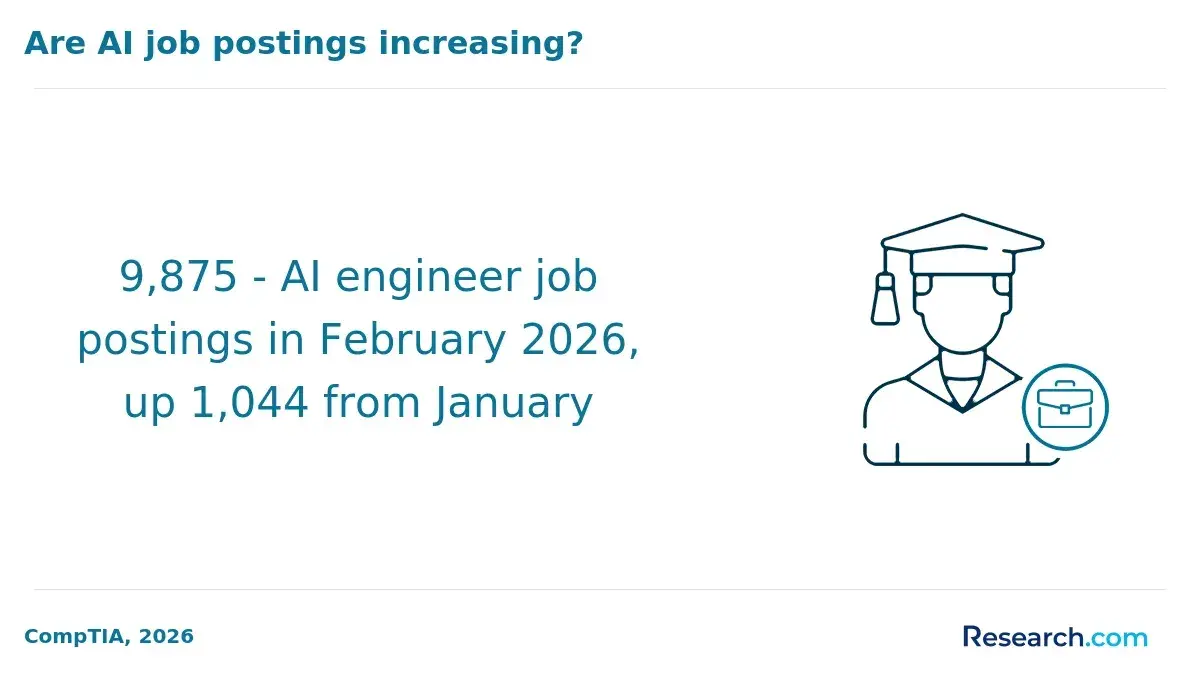
The demand for AI master's degree job opportunities in the United States remains exceptionally strong, with a projected 35% growth rate from 2023 to 2033 according to the U.S. Bureau of Labor Statistics. This rate outpaces the average growth for all occupations by seven times, signaling expanding career options for graduates specialized in AI technologies.
Employment trends for AI master's graduates in the US show a wide range of industries, including healthcare, finance, automotive, and technology, actively seeking professionals skilled in machine learning, natural language processing, and intelligent automation.
Roles such as AI engineer, machine learning engineer, data scientist, and research scientist often require or prefer candidates holding a master's degree in AI or related fields.
Graduates with expertise in data analysis, neural networks, and computer vision are particularly competitive. Practical experience through internships or real-world projects further enhances job prospects. With AI advancements growing in sectors like autonomous vehicles and personalized medicine, career paths continue to diversify.
Mid-career salaries for AI specialists typically range from $120,000 to $160,000 annually, reflecting the demand for specialized skills. Candidates interested in governmental or defense-related AI roles should be prepared for additional requirements such as security clearances and domain-specific knowledge.
Those considering further education should explore options such as an accelerated CS degree to strengthen their credentials and align with employment trends for AI master's graduates in the US.
Which industries and job roles are actively hiring AI master's graduates right now?
Technology companies are leading industries actively hiring AI master's graduates, accounting for 38% of AI-related job openings. Popular roles include AI research scientist, machine learning engineer, and data scientist, with employers seeking deep learning, natural language processing, and computer vision expertise to drive innovation in algorithms and intelligent products.
Financial services represent the second-largest sector, contributing 18% of AI job vacancies focused on risk analysis, fraud detection, and algorithmic trading. Positions such as quantitative analyst and AI-powered credit analyst require strong skills in predictive modeling and data-driven decision-making.
Healthcare accounts for 15% of demand, offering roles in medical imaging analysis, drug discovery, and personalized medicine. Titles like clinical data scientist and AI healthcare specialist emphasize bioinformatics knowledge and regulatory compliance alongside technical AI skills.
Other sectors actively hiring AI master's graduates include automotive companies working on autonomous driving, retail businesses optimizing supply chains, and government agencies using AI for cybersecurity and public safety. Selecting top job roles for AI master's degree holders depends on individual interests; some may pursue natural language applications like digital assistants, while others explore AI ethics and policy within corporate or public institutions.
A strong grasp of domain-specific AI applications improves job search success. Students seeking an affordable data science degree can enhance their qualifications and career prospects. Monitoring sector trends and obtaining relevant certifications further support growth in this expanding field.
What is the average salary range for professionals with an AI master's degree?
Professionals holding a master's degree in artificial intelligence earn an average base salary of around $165,000 annually, according to Levels.fyi's 2024 compensation data. This average salary range for professionals with an AI master's degree in the United States varies by location, industry, and experience. In major tech hubs like Silicon Valley, New York, and Seattle, total compensation packages often exceed $250,000, including bonuses and stock options.
Entry-level graduates typically start between $130,000 and $150,000, while those with 3-5 years of experience earn between $180,000 and $220,000. Top performers and leaders can surpass $250,000 in total pay.
Industries such as finance and healthcare may offer similar or slightly higher salaries due to specific demands. Skills in model development, natural language processing, computer vision, and machine learning operations often lead to higher pay scales. Leadership roles or specializations in autonomous systems and AI ethics can command additional premiums.
Geographic factors are significant; professionals working remotely or in lower-cost regions may earn 10-30% less than those in tech-centric cities. Typical earnings for AI master's graduates in North America reflect this dynamic.
For those evaluating educational investments, identifying the right programs matters. Exploring options like the cheapest engineering degree online can help prospective students balance quality and cost.
This compensation data provides a realistic outlook for prospective students and professionals considering advanced studies in artificial intelligence.
What are the core curriculum requirements and coursework in accredited AI master's programs?
Accredited artificial intelligence master's programs require a rigorous core curriculum that balances theoretical foundations with practical skills. Coursework covers advanced machine learning, data structures and algorithms, statistical analysis, and programming languages like Python and R.
Studies in neural networks, natural language processing, and computer vision are essential to address modern AI applications, ensuring graduates are well-prepared across the field.
The coursework requirements for artificial intelligence master's degrees also include ethics, AI policy, and human-computer interaction to highlight the social impact and responsible development of AI technologies. Many programs culminate in a capstone project or thesis, which offers students an opportunity to apply their knowledge to real-world challenges, demonstrating hands-on expertise highly valued by employers.
Electives often delve into reinforcement learning, robotics, and big data analytics, giving students flexibility to focus on specialized career paths. Nowadays, programs commonly integrate cloud computing and AI deployment strategies to keep pace with evolving industry demands.
Skills in scalable algorithm design, model interpretation, and cross-disciplinary collaboration are also increasingly emphasized.
Employers prioritize candidates proficient in both theoretical and applied AI techniques. According to the Computing Research Association, 72% of AI-focused companies seek graduates with this balanced expertise. Prospective students should confirm programs include comprehensive programming training alongside statistical methods, aligned with job requirements for AI engineers, data scientists, and research roles.
Practical experience through internships or research assistantships enhances readiness for a competitive job market. Interested learners might also explore an accelerated cyber security program to complement their AI skills.
How do online AI master's programs compare to campus-based options in terms of outcomes and employer recognition?
Online AI master's programs now rival traditional campus-based degrees in outcomes and employer recognition when they are accredited and offer rigorous curricula. Employers prioritize skills and tangible project experience over study format, with 89% of AI job listings requiring machine learning and deep learning expertise, according to Coursera's 2024 Skills Gap Report.
Programs that include hands-on labs, real-world datasets, and capstone projects provide students with valuable practical experience, a key hiring factor.
Though campus programs often provide networking and access to research labs, well-established online master's degrees from reputable universities offer virtual labs, synchronous sessions, and professional mentorship to bridge these gaps. For instance, online AI programs from institutions with strong industry connections can facilitate internships and career fairs comparable to on-campus options.
Employers focus on accreditation, curriculum quality, and proof of skills rather than delivery format alone. Graduates from recognized online programs increasingly secure roles in major tech firms and research labs, reflecting reduced bias against online credentials.
Prospective students should consider each program's specialization relevance, project scope, and alumni outcomes, prioritizing advanced machine learning and deep learning expertise.
Building a portfolio or gaining internship experience remains crucial to demonstrating proficiency and meeting workforce demands in AI careers.
What are the admission requirements and prerequisites for entering a master's program in artificial intelligence?
Admission to a master's program in artificial intelligence usually requires a bachelor's degree in computer science, engineering, mathematics, or a related field. Applicants must show programming skills in languages like Python, Java, or C++ and possess a strong foundation in linear algebra, calculus, probability, and statistics.
Coursework or experience in algorithms, data structures, and machine learning basics is often necessary. Some schools may waive prerequisites for candidates with relevant work experience or advanced certifications in AI or data science.
Application materials typically include transcripts, letters of recommendation, a statement of purpose, and a resume demonstrating technical expertise. While GRE scores remain important at some institutions, they are increasingly optional. International students often need TOEFL or IELTS scores to prove English proficiency.
Programs tend to favor candidates with demonstrated project work or research in areas such as neural networks, natural language processing, or robotics.
Online master's degrees in AI have expanded rapidly, offering greater access for working professionals. Career data indicates nearly equal advancement rates for online and campus graduates within two years, highlighting the flexibility these programs provide without compromising academic standards.
For those lacking traditional STEM backgrounds, bridge courses and clear prerequisite pathways help ensure preparedness and success.
How long does it take to complete an AI master's degree, and what are the typical program costs?
Completing a master's degree in artificial intelligence usually takes 1.5 to 2 years of full-time study. Many programs also offer part-time and online formats, extending the duration to 3 or more years for working professionals.
Most curricula require 30 to 36 credit hours, covering core areas like machine learning, data science, and ethics, along with electives and a capstone or research project.
Costs vary significantly depending on the institution and location. Tuition at public universities ranges from $15,000 to $30,000 for in-state students, while private schools can exceed $50,000. Additional expenses may include fees, textbooks, and technology.
Financial aid, scholarships, and assistantships can reduce these costs considerably; prospective students are encouraged to explore these options thoroughly.
Applicants from a variety of academic backgrounds are accepted. According to NCES 2024 data, 64% of admitted students in artificial intelligence master's programs hold related STEM bachelor's degrees without prior formal AI education.
This makes the field accessible to candidates with strong programming and mathematics skills but limited AI experience.
Part-time options provide flexibility for those balancing careers but may lengthen the time to graduation. Some programs also incorporate internships, which can extend study length but enhance practical skills and job prospects.
Candidates should weigh their availability and financial situation when selecting program formats.
What accreditation standards and certifications should you verify when choosing an AI master's program?
Verifying accreditation and certifications is essential when selecting an AI master's program to ensure quality education and industry relevance. Confirm that the institution holds regional accreditation from recognized bodies such as the Middle States Commission on Higher Education or the Western Association of Schools and Colleges.
This accreditation ensures academic standards meet federal guidelines, which affects eligibility for financial aid and credit transfer.
Program-level accreditation, like that from ABET (Accreditation Board for Engineering and Technology), signals a rigorous curriculum related to engineering and technology. Although AI-specific ABET accreditation is still emerging, programs with ABET accreditation in computer science or software fields generally maintain high standards.
Professional certifications from organizations like the Association for Computing Machinery or the Institute of Electrical and Electronics Engineers add value by reflecting faculty expertise and alignment with industry advancements. These complement but do not replace formal accreditation.
Tuition for full-time AI master's programs typically ranges from $40,000 to $120,000 total, with public universities averaging $50,000 and private institutions around $90,000. Higher cost does not always guarantee better outcomes, so evaluate programs based on accreditation, graduate employment rates, and industry connections.
Review the curriculum for coverage of AI ethics, machine learning, and data management aligned with standards such as those from the IEEE Global Initiative on Ethics of Autonomous and Intelligent Systems. Faculty credentials and published research in AI further indicate program quality, protecting your educational investment and career prospects.
What professional certifications complement an AI master's degree and improve career competitiveness?
Certifications that complement an AI master's degree significantly enhance career prospects by demonstrating practical expertise beyond academic knowledge. Highly respected credentials include the Certified Analytics Professional (CAP), AWS Certified Machine Learning Specialty, and Google Professional Machine Learning Engineer.
These qualifications validate skills in data science, machine learning, and cloud-based AI deployment, which are essential for scalable AI solutions in many organizations.
Other valuable certifications, such as Microsoft Certified: Azure AI Engineer Associate and IBM AI Engineering Professional Certificate, focus on integrating AI into enterprise environments and reinforcing capabilities in AI model development and operationalization.
Additionally, credentials in project management and business analytics, like PMP or CBAP, strengthen profiles by showcasing interdisciplinary communication skills often needed in AI roles bridging data teams and business units.
ABET data reveals that graduates from accredited engineering and computing programs receive about 18% more recruitment interest from employers compared to those from non-accredited programs. This highlights the importance of selecting ABET-accredited master's programs alongside industry certifications to boost credibility.
AI master's graduates should carefully align certifications with target job roles and industries to meet employer demands for real-world AI application skills, cloud infrastructure knowledge, and effective collaboration across teams.
How should prospective students evaluate and compare different accredited AI master's programs?
Accredited AI master's programs should be evaluated based on curriculum relevance and alignment with industry demands. Look for programs covering machine learning, natural language processing, computer vision, and data ethics, including hands-on projects or internships that provide essential practical experience.
Accreditation by recognized agencies ensures academic quality and can influence employer recognition.
Faculty expertise plays a critical role; professors active in cutting-edge AI research or industry collaborations offer valuable mentorship and networking opportunities. Availability of electives or specializations, such as reinforcement learning or AI policy, allows customization of your education to fit specific career goals.
Flexibility is important, especially for working professionals. Compare offerings of full-time, part-time, and online options along with class size, student support, and access to AI labs or high-performance computing resources.
Review alumni outcomes related to employment rates, sectors, and salary data for insights into program effectiveness.
Certification programs that complement a master's degree can significantly enhance employability and salary. Analysis shows professionals with a master's and certifications like TensorFlow or AWS ML earn approximately 22% more than those without certifications.
Confirm if programs integrate certification prep or partnerships for credentials.
Consider tuition costs alongside financial aid options, weighing the investment against career advancement potential. Selecting a program with strong industry ties and practical training maximizes return on investment and prepares graduates for success in a competitive AI job market.
Other Things You Should Know About Artificial Intelligence
In 2027, sectors such as technology, finance, healthcare, and automotive are among the most active in hiring AI master's graduates. These industries are leveraging AI to enhance efficiency, improve decision-making, and drive innovation, fueling demand for skilled professionals in AI-related positions.
Ethical concerns in artificial intelligence include biases in algorithms, data privacy issues, and the potential impact on employment. AI systems can perpetuate or amplify existing societal biases if not carefully designed. Understanding these challenges is essential for responsible AI development and deployment.
Artificial intelligence is expected to advance with improved natural language processing, more efficient machine learning models, and greater integration across industries. There will likely be increased focus on explainable AI and ethical frameworks to ensure transparency and accountability. These trends will shape both research and practical applications.
Besides technical expertise, skills such as critical thinking, problem-solving, and effective communication are vital for AI master's graduates. Collaboration across multidisciplinary teams and the ability to translate technical concepts for non-expert stakeholders enhance career success. These soft skills complement the rigorous analytical foundation of AI programs.
References
- 11 Best AI Certifications in 2025 to Deepen Your Technical Knowledge | DigitalOcean https://www.digitalocean.com/resources/articles/ai-certifications
- Top AI Certifications to Advance Your Career https://whitefiretechnologies.com/top-ai-certifications-to-advance-your-career/
- How to Evaluate a Student Information System in an AI-First Era https://moderncampus.com/blog/how-to-evaluate-a-student-information-system-in-an-ai-first-era.html
- Top 10 Careers You Can Pursue With an Online Master’s in AI https://www.ucumberlands.edu/blog/careers-you-can-pursue-with-an-online-masters-in-ai
- University Degree vs AI Bootcamp: Which is Best Career Path? https://agilefever.com/university-degree-vs-ai-bootcamp-which-is-best/
- 59 AI Job Statistics: Future of U.S. Jobs | National University https://www.nu.edu/blog/ai-job-statistics/
- AI Hiring Trends: Job Market Data, Salaries, and Industry Demand https://patentpc.com/blog/ai-hiring-trends-job-market-data-salaries-and-industry-demand
- Despite AI Cutting Entry-Level Roles, These Graduate Careers Remain in High Demand https://www.investopedia.com/despite-ai-cutting-entry-level-roles-these-graduate-careers-remain-in-high-demand-11913594
- Top AI Certifications for 2026: A Guide to Advancing Your Tech Career | DataCamp https://www.datacamp.com/blog/top-ai-certifications
- How to Check if a Graduate Program is Accredited (and Why This Matters) | ProFellow https://www.profellow.com/tips/how-to-check-if-a-graduate-program-is-accredited-and-why-this-matters/