Interview With Supply Chain Management Experts: Answering Students' Questions About Supply Chain Management Trends

Co-Founder and Chief Data Scientist
The role of supply chain management has become increasingly critical in ensuring business continuity. From managing disruptions to optimizing operations, supply chain professionals are at the forefront of keeping businesses resilient in an ever-changing world.
Graduates with an MS in Supply Chain Management had an average base salary of $79,400 annually based on data from the Bureau of Labor Statistics while employment is expected to grow 18% from 2022-2032. Supply chain management is a field brimming with opportunities for those who possess the right blend of analytical skills, strategic thinking, and a global perspective.
To shed light on the essential steps students should take to embark on a successful supply chain career, we interviewed industry experts who offer invaluable insights into the complexities and rewards of this dynamic field. Our experts delve into the specific skills and knowledge needed to navigate these challenges and emerge as leaders in the field.
Experts We Interviewed
- Harry C. Moser: President, Reshoring Initiative
- Sampath Rajagopalan, Ph.D.: Professor Emeritus of Data Sciences and Operations, University of Southern California Marshall School of Business
- Steven Carnovale, Ph.D.: College of Business at Florida Atlantic University
- Tathagata Dasgupta, Ph.D.: Adjunct Professor of Data Sciences and Operations, University of Southern California Marshall School of Business
- What are the most critical skills and competencies that supply chain management students should focus on developing during their studies?
- How important are internships and practical experiences for supply chain management students, and what types of opportunities should they seek out?
- How can students best prepare for the global nature of supply chain management, and what international experiences or perspectives are most beneficial?
- How is technology, such as AI and blockchain, transforming supply chain management, and what should students do to stay ahead in these areas?
- Can you describe the typical career paths for supply chain management graduates and how they can strategically progress in their careers?
- What are some of the most valuable resources that you recommend to supply chain management students to supplement their classroom learning?
- How can military experience translate into supply chain management success?
- What is sustainable supply chain management?
- Are fast track degree programs beneficial for supply chain career acceleration?
- What supply chain management certifications are worth pursuing?
- Are online one-year degree programs ideal for advancing your supply chain career?
- What are the best alternative education paths for supply chain management careers?
- How can I fund my supply chain management education?
- How can I verify the accreditation and quality of my supply chain program?
- Why are short-term certificate programs effective for supply chain management careers?
What are the most critical skills and competencies that supply chain management students should focus on developing during their studies?
Supply chains are intricate systems with countless interconnected variables. To navigate these complexities, professionals must be adept at analyzing data, identifying patterns, and making informed decisions.
Our experts emphasized that supply chain management requires a multifaceted skill set, which is why it is one of the highest paying degrees. Critical thinking, analytical, and problem-solving skills are the bedrock of successful supply chain management.
Dr. Rajagopalan: Supply chain management students should acquire knowledge about specific topics such as logistics, transportation, supply chain network design, inventory management, procurement and supplier management, production and material requirements planning, demand planning and forecasting, warehousing, and sustainability in supply chains. They should also acquire competency in AI, ... machine learning, and robotics, and understand how they have impacted and will impact the above-mentioned areas. Some critical skills that they should acquire during their studies are problem-solving skills using a case-based approach, data acquisition and analytics skills, and communication and negotiation skills as they will need [these] with suppliers and customers.
Critical thinking allows supply chain managers to question assumptions, explore alternative solutions, and anticipate potential challenges. When disruptions occur, as they inevitably do, strong problem-solving skills are essential to develop effective and timely responses. These cognitive abilities are crucial for optimizing operations, reducing costs, and ensuring customer satisfaction.
For Dr. Carnovale, “Analytical ability and critical thinking skills are key in this industry which is fast-paced and characterized by constant change. Developing the ability to analyze data and situations is critical.”
Dr. Dasgupta: My recommendation is to get the quantitative rigor from an IE degree that is so desperately needed in the discipline of supply chain management. Additional exposure to emerging technologies such as IoT, CNC machines, RFID technology, drones, and 3D manufacturing would round this up. If you enroll in a Supply Chain Management Program, make sure that this mathematical rigor is not compromised and diluted. Procurement and purchasing are often focus areas in such programs, but even that discipline is best managed through rigorous data analytics.
Aside from having these competencies, Moser adds that students should have a solid grasp of key concepts in supply chain management to effectively create value for the business.
Moser: Understanding total cost of ownership (TCO) and the advantages of using TCO instead of FOB price or Landed Cost. About half of the material purchased is imported, directly or via distribution. About 60% of companies make sourcing decisions based on price. As a result, about 25% of what they import would be more profitably sourced domestically. If they shifted to TCO, benefits for profitability, stability, the economy, the environment, income equality, and defense capability would be immense.
Supply chain executives are aware of the pivotal role of big data in supply chain management as shown in this chart.
How important are internships and practical experiences for supply chain management students, and what types of opportunities should they seek out?
Internships and practical experiences are invaluable for supply chain management students. They bridge the gap between theoretical knowledge and real-world application, providing students with a comprehensive understanding of the industry. Moser underscored this, saying, “Internships provide useful experience and a foot in the door. Seek opportunities that include at least some chance for individual initiative.”
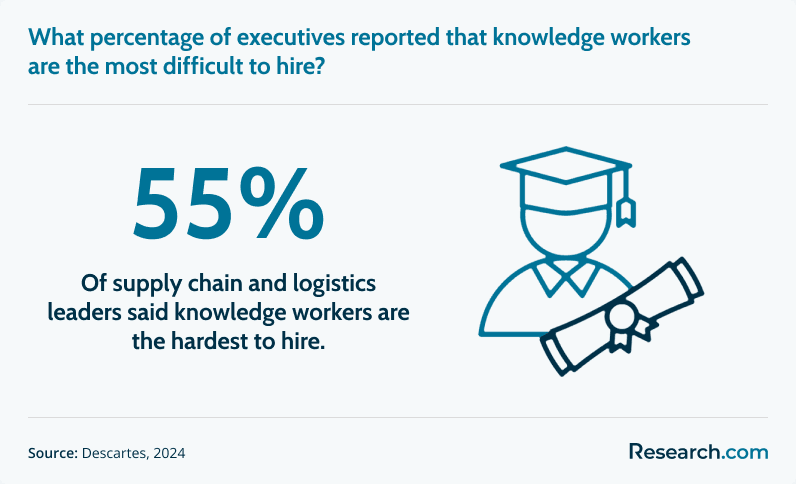
Practical experiences allow students to do actual inventory management, logistics, procurement, and supply chain analytics. These experiences allow them to have an understanding of different supply chain models and challenges faced by various organizations, especially with a recent survey revealing that 55% of supply chain and logistics leaders agree that knowledge workers are the hardest to hire. Dr. Rajagopalan’s advice is for students to persevere in gaining practical knowledge, and mentions some companies that can provide the best training.
Dr. Rajagopalan: Internships and practical experiences are an absolute must to gain practical knowledge, given the real-world focus of SCM. They should ideally seek internships and do class projects either at companies that are world-class in SCM such as Amazon, Walmart, etc. or at startups that are developing cutting-edge supply chain capabilities. Examples are Gatik, Transmetrics, Optimbus, Covariant. The key focus should be to get experience in a firm where you can learn the most.
Rotational internship, as suggested by Dr. Dasgupta, can be a valuable experience for students as it exposes them to various aspects of operations.
Dr. Dasgupta: SCM is a subset of operations management as a discipline, and it involves both quant modeling as well as hands-on problem-solving. It also involves working with people—[the] labor force as well as cross-functional stakeholders. An internship gives exposure to these aspects of the role early on, so securing a rotational internship would be ideal.
As for Dr. Carnovale, internships are also opportunities for the student to explore what specific type of career to pursue as the immersive experience helps them identify which sector to focus [on].
Dr. Carnovale: Internships are crucial for two reasons: knowing what field you want to work in, and perhaps more importantly knowing what you do not want to study. Internships are like soft launch opportunities for your career: not only do they provide excellent resume building but also they allow for a trial run on an industry/focus area.
Chunseng et al. (2020) investigated the value of supply chain resistance and found that organizations with risk management culture and supply chain flexibility have an advantage when it comes to business continuity in periods of disruption. These are among the crucial skills that students are able to adopt during internships.
How can students best prepare for the global nature of supply chain management, and what international experiences or perspectives are most beneficial?
Aside from developing the essential skills, it is also important for students to develop a global mindset, gain international experience, and critically study international perspectives. If you are looking for the easiest business majors, supply chain management should be taken off your list as this field requires awareness of political, economic, social, technological, environmental, and legal aspects.
Studying geopolitics is essential as suggested by Moser because every person who wants to be effective in supply chain management must “Understand the increasing risk of sourcing from potential adversaries.”
In addition, Moser adds that students must also “Learn to make long-term decisions rather than short-term decisions that seem to increase the current quarter’s profitability, at the expense of the company’s longer-term survival.”
Students should be provided the opportunity to understand that supply chain managers' social capital, human capital, and cognition are instrumental to the development of three organizational supply chain resilience antecedents, namely visibility, responsiveness, and flexibility, as found by the research of Nikookar and Yanadori (2021).
Dr. Dasgupta: Supply chain management today is inherently global, with suppliers, vendors, raw materials, and finished goods ... mapped out through a global network design. With exposure to PESTEL analysis across geographies along with global logistics, students would do well to familiarize themselves with these facts.
For Rajagopalan, there is no single approach to prepare for managing global supply chains. Instead, there are a variety of ways, “Either learn about global supply chain issues such as trade regulations, global supply chain trends over the years by reading articles, white papers, case studies, etc., or they (students) can get internships at a global supply chain firm such as Amazon or Alibaba or Tencent.”
The interconnectedness of the global economy means that disruptions in one region can have far-reaching consequences. Understanding these interdependencies is crucial for building resilient and sustainable supply chains. A global perspective is essential for optimizing supply chain performance, mitigating risks, and seizing opportunities in today's interconnected world.
How is technology, such as AI and blockchain, transforming supply chain management, and what should students do to stay ahead in these areas?
Two key technologies, AI and blockchain, are significantly impacting the industry. Artificial intelligence is transforming supply chain management by forecasting demand, predicting supply chain disruptions, and optimizing inventory levels. Blockchain offers benefits such as tracking products from origin to consumer, while also enhancing supply chain visibility and trust. The effect is revolutionary, as highlighted by Dr. Rajagopalan and Dr. Carnovale.
Dr. Rajagopalan: AI is revolutionizing supply chain management by enhancing predictive analytics, especially in forecasting demand as well as returns, better matching of supply and demand, identifying where and how much inventory to stock, picking and sorting items in warehousing operations efficiently, moving goods and managing [the] movement of trucks in a transportation network efficiently, etc. The best way to learn this is to take courses in AI and also attend webinars, conferences, etc. to understand how firms are using [it]. Also, there are many online resources. For instance, Amazon has many white papers on how it uses AI in its operations (Amazon Science).
Based on a survey of supply chain executives, about 85% plan to invest in new technology and/or build upon existing technology in the next year, with more than half (53%) indicating they intend to increase automation by up to 30%.
Dr. Carnovale: AI—and related digitalization—is certainly making its presence known in SCM. Many firms are trying to implement it as fast as possible, while others are more cautious. [The] best practices here regardless of where students will work is to learn as much as possible and to immerse yourself in as much credible information as possible. For example, read the latest trade reports/white papers detailing the potential applications, watch keynote speeches at tech conferences, use your professors as resources, etc. Gather as much information as possible and ultimately try to triangulate the information!
For Modgil et al., (2021) there are five critical areas where AI can contribute to enhanced supply chain resilience; (1) transparency, (2) ensuring last-mile delivery, (3) offering personalized solutions to both upstream and downstream supply chain stakeholders, (4) minimizing the impact of disruption and (5) facilitating an agile procurement strategy.
Dr. Dasgupta adds that students should understand ERP, APS, BI, AI, GenAi, IoT, RFID, and blockchain as these are crucial supply chain technologies. By combining technical expertise with a deep understanding of supply chain management, students can acquire proficiency in data analysis, programming, and machine learning.
In addition, it is also crucial to build a strong foundation in supply chain management principles to apply technology effectively.
Supply chain managers plan to invest in new technologies as part of their strategy moving forward, as shown in the next chart.
Can you describe the typical career paths for supply chain management graduates and how they can strategically progress in their careers?
Typically, supply chain management graduates take on entry-level roles such as procurement analyst, logistics coordinator, and inventory control specialist. After a few years, they move into roles with more responsibilities such as supply chain analyst supply chain manager, procurement manager, and logistics manager.
Graduates can strategically progress in their supply chain careers by focusing on a combination of skill development, experience acquisition, and networking. The key lies in continuously developing analytical, problem-solving, and critical thinking skills. Most practitioners also pursue the cheapest online master's in supply chain management, and pursue certifications like APICS or CSCMP to validate expertise.
While Rajagopalan admits that he is not very familiar with specific careers, based on his observation of the career trajectory of his former students, “they start as analysts or planners and then become managers and directors in the SC or Logistics area and then rise to VP of [the] supply chain.” In the same manner, Dr. Dasgupta stated that graduates typically start as analysts, then planners, and eventually managers. After gaining cross-functional experience, they move on to executive roles.
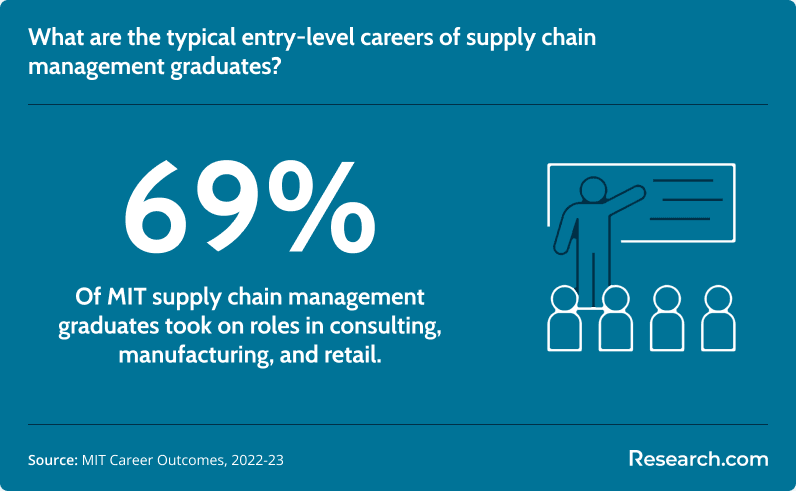
At MIT, 23% of supply chain management graduates in 2023 accepted consulting roles, 23% [took] manufacturing roles, and 23% got into retail roles. In supply chain management, it is crucial to develop business acumen to understand the broader business context and how supply chain decisions impact the bottom line.
Students should also seek opportunities to work on cross-functional projects, handle increased responsibilities, and take on leadership roles. Also, they should consider rotational programs to gain exposure to different supply chain functions.
What are some of the most valuable resources that you recommend to supply chain management students to supplement their classroom learning?
To complement classroom learning in supply chain management, students should prioritize practical experience and skill development. Mastering data analysis tools, pursuing certifications, and building a strong professional network are essential for career advancement.
While Dr. Rajagapolan offers good textbooks, he also suggests checking related websites and trade publications.
Dr. Rajagapolan: A good textbook is Supply Chain Management: Strategy, Planning, and Operation by Sunil Chopra. I have used it in my classes. Some good websites and trade publications to learn about current SC trends include Supply Chain Quarterly, Supply Chain Management Review, Supply and Demand Chain Executive, Supply Chain Brain, Journal of Commerce, Logistics Management, Global Trade, [and] Industry Week.
Big data and advanced analytics, as well as supply chain digitization, are two top trends that will affect supply chain management as cited by 65% of industry professionals. By combining academic knowledge with hands-on experience and professional development through accelerated MBA programs, students can position themselves for success in the dynamic field of supply chain management.
For Dr. Carnovale, websites like supplychainbrain.com supplychaindojo.com and other business press sites can also be ... good sources of insights that can help students make sense of current developments in the supply chain industry. Dr. Carnovale reminds students to “evaluate everything critically” ... applies [to] choosing learning resources.
How can military experience translate into supply chain management success?
Military service instills leadership, strategic planning, and crisis management skills that are directly transferable to managing complex supply chains. Veterans often have hands-on experience with logistical operations, resource allocation, and risk mitigation under challenging conditions—capabilities that are highly valued in supply chain roles. By leveraging military-honed competencies, transitioning professionals can pursue targeted certifications and specialized training that further bridge the gap between operational experience and modern supply chain technologies. Many institutions recognize the unique value of these skills and offer programs tailored to such backgrounds, as seen with military friendly online colleges.
What is sustainable supply chain management?
Sustainable supply chain management is the practice of integrating environmental, social, and economic considerations into the sourcing, production, and distribution of goods and services. It involves managing the entire supply chain, from raw materials to final disposal, with sustainability in mind.
A key course included in the most affordable online supply chain management degree, this approach aims to minimize the negative impact of business operations on the environment and society while ensuring the long-term viability of the supply chain.
Key components of sustainable supply chain management include:
- Environmental sustainability: Reducing greenhouse gas emissions, minimizing waste, and conserving resources.
- Social responsibility: Fair labor practices, worker safety, and community development.
- Economic viability: Ensuring financial profitability and long-term business success.
Are fast track degree programs beneficial for supply chain career acceleration?
Accelerated degree options can offer supply chain professionals a strategic advantage by combining rigorous curriculum with a shortened time-to-completion, allowing for quicker entry into advanced roles. Fast track degree programs are designed to meet the demands of a fast-evolving industry while offering flexibility for working professionals and career changers. These programs typically integrate real-world case studies, technology-enhanced learning, and industry-focused modules that emphasize emerging trends such as AI, blockchain, and sustainable practices. Learners considering this path benefit from condensed coursework that maintains academic rigor while optimizing return on investment. For more details on these educational pathways, explore the fast track degree programs.
What supply chain management certifications are worth pursuing?
Choosing the right certification depends on your specific career goals and area of expertise within the supply chain. Aside from the online certification programs that pay well, here are some of the most recognized and respected certifications in supply chain management:
APICS Certifications
- Certified Supply Chain Professional (CSCP): Offers a comprehensive overview of supply chain management.
- Certified in Production and Inventory Management (CPIM): Focuses on production and inventory management strategies.
- Certified Logistics and Transportation Professional (CLTD): Specializes in logistics and transportation operations.
Other Notable Certifications
- Certified Professional in Supply Management (CPSM): Offered by the Institute for Supply Management, focusing on procurement and sourcing.
- Supply Chain Professional (SCPro): Provided by the Council of Supply Chain Management Professionals (CSCMP), offering a broad-based certification.
- Certified in Logistics, Transportation, and Distribution (CLTD): Also offered by APICS, emphasizing logistics and transportation.
This chart shows that driving growth is the top priority of supply chain executives.
Are online one-year degree programs ideal for advancing your supply chain career?
Online one-year degree programs offer an accelerated curriculum that equips professionals with advanced technical and leadership skills in a condensed timeframe. These programs are designed for individuals who require flexibility without compromising academic rigor, allowing them to integrate real-world case studies, practical projects, and industry insights into their learning experience. By focusing on high-demand areas such as data analytics, technology integration, and global supply chain strategies, these programs can help participants transition rapidly into senior roles. For more information on these targeted learning paths, explore one year degree programs.
What are the best alternative education paths for supply chain management careers?
For those seeking flexible, cost-effective routes into supply chain management, alternative education paths offer valuable opportunities. Online certification programs, such as APICS’ CSCP or CLTD, provide industry-recognized credentials without the time and financial commitment of a full degree. Bootcamps and micro-credential courses from platforms like Coursera and edX deliver targeted skills in supply chain analytics, logistics, and procurement. Additionally, professionals looking to balance work and study can explore online construction management degrees, which often share key operational and project management principles relevant to supply chain roles. These options help aspiring professionals build expertise and gain employer recognition while maintaining flexibility.
How can I fund my supply chain management education?
Procuring the necessary financial support for a quality supply chain management program is a strategic decision that can significantly influence your career trajectory. Students are encouraged to explore federal aid, scholarships, and alternative financing options to minimize tuition costs while gaining access to leading-edge curricula. Many institutions now offer flexible financing models, and candidates may benefit from enrolling in online degrees that accept FAFSA, which streamline the application process for federal loans and grants. Evaluating these opportunities early can empower future professionals to invest confidently in their education with reduced financial risk.
How can I verify the accreditation and quality of my supply chain program?
To ensure your education meets industry standards, begin by checking that the program is accredited by reputable agencies and recognized by leading supply chain associations. Evaluate the curriculum against current industry requirements and seek independent reviews from current professionals. Additionally, compare application processes and fee structures, verifying details with resources like colleges with no application fee other. This diligence helps you choose a program that not only advances your career but also aligns with evolving market demands.
Why are short-term certificate programs effective for supply chain management careers?
Short-term certificate programs offer a targeted approach to skill enhancement by providing industry-relevant curricula that focus on emerging technologies and data-driven strategies. These programs enable professionals to gain specialized expertise quickly, improving their adaptability in a rapidly evolving market. By emphasizing practical, hands-on learning experiences and real-world applications, such certificates facilitate immediate alignment with current industry demands. Consider exploring 6 month certificate programs that pay well online to accelerate your competency and career progression in supply chain management.
Build a Career Towards Supply Chain Excellence
Supply chain management is a multifaceted discipline that requires a blend of strategic thinking, analytical prowess, and a global perspective. The ability to navigate complexities, optimize operations, and build resilient supply chains is paramount for business success.
By investing in education, gaining practical experience, and pursuing relevant certifications, individuals can position themselves as valuable assets in this dynamic field. As technology continues to reshape the industry, professionals who embrace innovation and sustainability will be at the forefront of driving supply chain excellence.
About the Experts That We Interviewed

Harry Moser
Harry Moser established the Reshoring Initiative to restore as much manufacturing as feasible to the current level of competitiveness in the United States. Subsequently, the organization endeavors to enhance the competitiveness of the United States by advocating for necessary policy modifications and fortifying the nation's qualified labor force. Harry won the Jan. 2013 The Economist debate on outsourcing and offshoring, participated in President Obama's 2012 Insourcing Forum at the White House, and received the Manufacturing Leadership Council's Industry Advocacy Award in 2014. He obtained a BS in Mechanical Engineering and an MS in Engineering from MIT in 1967, as well as an MBA from the University of Chicago in 1981. Harry serves on the Leadership Council of the Manufacturing Skill Standards Council (MSSC), a prominent manufacturing credentialing organization.

Sampath Rajagopalan, Ph.D.
Prof. Raj Rajagopalan is the Richard and Jarda Hurd Chair Emeritus in Distribution Management and the Professor Emeritus of Data Sciences and Operations at the USC Marshall School of Business. He conducts research on the acquisition of technology and capacity, the administration of supply chains, and the development of a diverse range of products. He has contributed to journals including Operations Research, Production and Operations Management, and Management Science. He was an Associate Editor at Management Science and Operations Research and a Department Editor at IIE Transactions. At Marshall, he has instructed courses in supply chain management and operations in a variety of MBA programs. He has provided consulting services to Hewlett Packard, Fidelity Investments, and Johnson & Johnson.

Steven Carnovale, Ph.D.
Steven Carnovale is the co-editor-in-chief of the Journal of Purchasing and Supply Management and an associate professor of supply chain management at the College of Business at Florida Atlantic University. Carnovale is a supply chain strategist who specializes in equity-based partnerships, global sourcing/production networks, and risk management, with a particular emphasis on interfirm networks. His research has been published in a variety of journals, including the Journal of Supply Chain Management, the Journal of Business Logistics, and the Journal of Purchasing and Supply Management, among others. Carnovale, who specialized in supply chain management and marketing sciences, obtained both a Ph.D. and a Bachelor of Science degree from Rutgers University.

Tathagata Dasgupta, Ph.D.
Dr. Das Dasgupta serves as Starbucks' Chief Data and Analytics Officer. He has accumulated decades of experience in data strategy and technology, having held leadership positions in data science and digital transformation at Amazon, McKinsey, EY, and, most recently, Saatchi & Saatchi. Dr. Dasgupta is an expert in the application of artificial intelligence, machine learning, and technology to facilitate data-driven decision-making in the areas of marketing and advertising, supply chain and operations, and back-office automation. He holds a Dual Ph.D. Title in Operations Research and Management Science from Penn State University and currently teaches Business Analytics and Logistics courses at the Marshall School.
References:
- Chunsheng, L., Wong, C.W.Y., Yang, C.-C., Shang, K.-C. and Lirn, T.-C. (2020). Value of supply chain resilience: roles of culture, flexibility, and integration. International Journal of Physical Distribution & Logistics Management, Vol. 50 No. 1, pp. 80-100.
- Descartes Systems Group. (2023). How Bad is the Supply Chain and Logistics Workforce Challenge? Descartes Systems Group.
- Modgil, S., Singh, R.K. and Hannibal, C. (2022). Artificial intelligence for supply chain resilience. The International Journal of Logistics Management, Vol. 33 No. 4, pp. 1246-1268.
- National Association of Manufacturers (2023). 2023 Third Quarter Manufacturers' Outlook Survey.
- Nikookar, E. and Yanadori, Y. (2022). Preparing supply chain for the next disruption: managerial antecedents of supply chain resilience. International Journal of Operations & Production Management, Vol. 42 No. 1, pp. 59-90.
- Supply Chain Management Review (2024). Preparing for 2024 supply chain challenges and priorities. Supply Chain Management Review.