2027 What to Do If Your Financial Aid Offer Is Too Low

Co-Founder and Chief Data Scientist
A low financial aid offer can turn an acceptance letter into a hard financial decision. College Board's 2024 data shows average published tuition and fees reached $11,610 for in-state public four-year colleges and $43,350 for private nonprofit four-year colleges, before housing and other costs.
This guide is for students and families who need to close a college funding gap without overborrowing. You'll learn how to review the offer, appeal for more aid, compare schools, find additional funding, and decide whether the college is still financially realistic.
Key Things You Should Know
- A low aid offer is not always final: schools may reconsider aid after job loss, medical bills, income changes, family separation, disaster-related expenses, or unusual circumstances that were not fully reflected on the FAFSA.
- The federal Pell Grant maximum is $7,395 for the 2024-2025 award year, while first-year dependent undergraduates can generally borrow only up to $5,500 in federal Direct Loans, so many funding gaps require a mix of appeal, scholarships, work, payment plans, or lower-cost enrollment choices.
- Compare offers by net price, not total aid; a school that gives a larger scholarship can still cost more if its tuition, housing, fees, travel, or required borrowing are higher.
What immediate steps should you take if your financial aid offer is too low?
If your financial aid offer is too low, act quickly but do not panic. Your goal in the first few days is to verify the offer, identify whether something is missing, and preserve your ability to appeal before enrollment and housing deadlines pass.
Start with a structured review instead of immediately taking private loans or declining the offer. These steps help you determine whether the aid package is incomplete, inaccurate, or simply unaffordable:
- Read the full financial aid notice and separate grants, scholarships, work-study, federal loans, parent loans, and expected family contribution or student aid index-related information.
- Check whether the offer is based on full-time enrollment, on-campus housing, state residency, satisfactory academic progress, or a minimum GPA for scholarship renewal.
- Compare the offer with the school's full cost of attendance, including books, supplies, transportation, health insurance, course fees, housing deposits, and personal expenses.
- Confirm that your FAFSA was processed correctly and that the school has received any required verification documents, tax forms, or residency paperwork.
- Write down the remaining funding gap after grants, scholarships, realistic family contributions, and federal student loans you are comfortable using.
- Contact the financial aid office and ask whether the school has a formal appeal, special circumstances, professional judgment, or scholarship reconsideration process.
A common mistake is treating the first award letter as a take-it-or-leave-it decision. Another is comparing "total aid" without noticing that some of the aid may be loans that must be repaid. If the gap is large, it is also reasonable to review lower-cost programs, including a lowest cost online bachelor's degree, before committing to a school that would require risky borrowing.
How can you appeal or request a reconsideration of your financial aid package?
You can appeal a financial aid offer by asking the college to reconsider your aid based on new, missing, or unusual financial information. Colleges often call this a financial aid appeal, special circumstances review, professional judgment request, scholarship appeal, or reconsideration request.
The strongest appeals are specific, documented, and respectful. The financial aid office usually cannot increase aid just because a college feels expensive, but it may be able to adjust eligibility if your financial situation has changed or was not captured accurately.
Situations that may support an appeal include job loss, reduced work hours, divorce or separation, death of a parent or spouse, high unreimbursed medical costs, private school tuition for siblings, natural disaster expenses, one-time income that inflated tax-year earnings, loss of child support, or a sibling's college costs that are not reflected in the current aid formula.
Before submitting an appeal, gather documents that match your claim. The following materials are commonly useful because they help the school verify the change rather than rely only on a personal statement:
- Recent pay stubs, layoff notices, unemployment benefit letters, or employer statements showing reduced income.
- Medical bills, insurance statements, or payment records for major unreimbursed healthcare expenses.
- Divorce, separation, death, or child support documentation when family circumstances have changed.
- Updated tax information, business income records, or proof that a prior-year income event was unusual and not expected to continue.
- Competing financial aid offers from comparable colleges, if the school allows merit scholarship or aid matching reviews.
Your appeal should be brief enough to read quickly but detailed enough to make the decision clear. A useful structure is: thank the office, state that the current offer leaves an affordability gap, explain the specific financial change, attach documentation, and ask what reconsideration options are available.
Sample wording: "Thank you for reviewing my financial aid offer. Since our FAFSA information was submitted, my family's financial situation has changed because of a reduction in household income. The current offer leaves an estimated remaining gap of $X after grants, scholarships, and federal student loans. I have attached documentation and would be grateful to be considered for any need-based adjustment, institutional grant, scholarship review, or other funding options available."
Do not exaggerate, hide assets, or submit incomplete documents. Schools can deny appeals that are unsupported, and inaccurate financial information can create serious aid eligibility problems later.
How do you calculate your actual college costs and remaining funding gap?
Your actual college cost is the school's cost of attendance minus gift aid, not the headline tuition price and not the total aid number. Gift aid includes grants and scholarships that generally do not need to be repaid. Loans, work-study, and payment plans can help manage cash flow, but they are not discounts.
The table below shows why net price matters. College Board's 2024 pricing data makes clear that tuition varies widely by institution type, so a larger scholarship at a higher-priced school may still leave you with a bigger bill:
| Institution type | Average published tuition and fees, 2024-2025 | What this means for your decision |
| Public two-year, in-district | $4,050 | Often the lowest-cost starting point, especially for transferable general education credits. |
| Public four-year, in-state | $11,610 | Usually more affordable than out-of-state or private options, but housing can still create a large gap. |
| Public four-year, out-of-state | $30,780 | May require careful comparison because nonresident tuition can reduce the value of grants. |
| Private nonprofit four-year | $43,350 | Can be affordable with strong institutional aid, but the sticker price should not be ignored. |
To calculate your funding gap, use the school's full cost of attendance and subtract only resources you can actually use. This gives you a realistic number before you borrow or commit:
- Start with the official cost of attendance for your enrollment plan, housing choice, residency status, and program.
- Subtract grants and scholarships that are guaranteed or renewable under conditions you can realistically meet.
- Subtract family contributions that are available without relying on emergency savings, high-interest debt, or unrealistic monthly payments.
- Subtract federal student loans only if the monthly repayment after graduation fits your likely career path and risk tolerance.
- Treat work-study and part-time earnings as help for ongoing expenses, not guaranteed money available on the first tuition due date.
- Record the remaining amount as your true gap, then decide whether to appeal, find outside aid, choose a payment plan, reduce costs, or compare other schools.
One red flag is an award letter that lists a Parent PLUS Loan or private loan next to grants in a way that makes the package look larger. Those loans can increase access, but they are still debt and should be evaluated separately from scholarships.
When should you contact the financial aid office, and what should you say?
Contact the financial aid office as soon as you understand your gap, especially if enrollment deposits, housing applications, or scholarship acceptance deadlines are approaching. Aid offices are busiest near major FAFSA, admissions, and billing dates, so early, organized communication gives you the best chance of getting clear instructions.
Before calling or emailing, prepare the exact numbers from your offer. This helps the counselor move beyond general advice and identify whether you need a document correction, appeal, scholarship review, or payment conversation:
- Your student ID, admission term, program, residency status, and whether you plan to live on campus, off campus, or at home.
- The total cost of attendance and the amount of gift aid, loans, and work-study in your offer.
- Your estimated remaining gap after realistic family contributions and federal student loans.
- The reason the offer may not reflect your current financial situation.
- The deadline by which you need to make an enrollment or housing decision.
Use a calm and direct message. The office may not be able to promise more aid, but it can tell you which review process applies and whether additional institutional grants, emergency aid, state aid, departmental scholarships, or payment plans are available.
Suggested email: "Hello, I recently received my financial aid offer for the upcoming term. After reviewing the full cost of attendance, grants, scholarships, and federal student loans, I estimate that my remaining gap is $X. My family's current circumstances differ from the information reflected on the FAFSA because of [brief reason]. Could you please tell me whether I should submit a special circumstances appeal, scholarship reconsideration request, or other documentation? I would also appreciate any deadline information before I make my enrollment decision."
Keep records of every conversation, including dates, names, requested documents, and deadlines. If you speak by phone, follow up with a short email summarizing what you were told so there is a written trail.
How can comparing financial aid offers from multiple schools help you decide where to enroll?
Comparing financial aid offers helps you avoid choosing a college based on the biggest award amount instead of the lowest affordable net cost. Two colleges can use very different formats, so you may need to rebuild each offer in the same spreadsheet before making a decision.
The comparison should separate cost, gift aid, loans, work expectations, and renewal conditions. The table below summarizes what to compare and why each item affects affordability:
| Comparison factor | Why it matters | Decision signal |
| Net price | Shows what remains after grants and scholarships. | Lower net price usually means less financial pressure if academic quality and outcomes are comparable. |
| Loan amount | Shows how much of the package must be repaid. | A smaller gap funded by loans may be riskier than a larger grant-based package. |
| Renewability | Some scholarships require GPA, major, enrollment level, or campus residency. | A strong first-year award is less valuable if it is not renewable or has difficult conditions. |
| Housing and transportation | Living arrangements can change the real cost more than small tuition differences. | Commuting or living at home may improve affordability if it does not harm academic success. |
| Program fit and outcomes | A lower-cost school still needs to support your intended major, transfer path, licensure, or career goal. | The best value is usually a balance of affordability, completion likelihood, and career relevance. |
After comparing offers, decide whether each school falls into one of three categories: affordable without excessive debt, possible only if the appeal succeeds, or financially risky even after reconsideration. If you are still choosing a field of study, reviewing the top 10 best majors for the future can help you connect cost decisions with long-term career demand.
Common mistakes include assuming a prestigious school is always worth any debt, ignoring scholarship renewal requirements, and forgetting that travel costs can make a distant college more expensive than it appears. A better approach is to compare four-year total cost, not just the first-year offer.
What additional scholarships, grants, and need-based programs can help you close the gap?
Scholarships, grants, and need-based programs can reduce your funding gap without adding debt, but they require targeting and follow-through. The best opportunities are usually the ones for which you are clearly eligible, not the ones with the biggest national prize amount and thousands of applicants.
Use a layered search strategy. The following sources are worth checking because they may have different deadlines, eligibility rules, and award sizes:
- Institutional scholarships from the college, academic department, honors program, alumni association, or admissions office.
- State grants based on residency, income, academic record, intended major, or enrollment at an in-state institution.
- Local scholarships from community foundations, employers, unions, religious organizations, civic groups, and high school counseling offices.
- Need-based emergency grants for students facing sudden hardship, food insecurity, housing instability, medical expenses, or technology needs.
- Major-specific scholarships in areas such as nursing, teaching, engineering, accounting, cybersecurity, public service, or skilled technical fields.
- Tuition assistance from employers, especially for students who can work part time while pursuing a degree or credential.
Prioritize applications that match your profile closely and ask for materials you can submit well. A smaller local scholarship can be more realistic than a national award with broad eligibility and heavy competition.
Shorter credentials may also help some students improve earnings while reducing upfront college costs. If you need a faster workforce option before or during a degree, compare online certificate programs that pay well with the degree requirements for your target career.
Watch for scholarship scams. Do not pay a fee to "unlock" awards, share banking credentials with unknown organizations, or trust any service that promises guaranteed scholarship money. Legitimate scholarships may be competitive, but they should be transparent about eligibility, deadlines, selection criteria, and contact information.
How do federal, state, and private student loans differ when your aid isn't enough?
When aid is not enough, student loans can help cover remaining costs, but the type of loan matters. Federal student loans generally offer stronger borrower protections than private loans, including fixed interest rates, income-driven repayment options, deferment, forbearance, and potential forgiveness programs for eligible borrowers.
For undergraduate Direct Subsidized and Unsubsidized Loans first disbursed in the 2024-2025 award year, the fixed interest rate is 6.53%. That rate is useful for planning because it helps you estimate future payments before deciding whether the gap is manageable.
The table below compares common loan options. It is not a recommendation to borrow; it is a way to understand the trade-offs before accepting debt:
| Loan type | Who borrows | Main advantage | Main risk |
| Federal Direct Subsidized Loan | Undergraduate student with financial need | The government pays interest during certain in-school and deferment periods. | Annual limits may be too low to cover a large gap. |
| Federal Direct Unsubsidized Loan | Undergraduate or graduate student | Available without demonstrating financial need, subject to limits. | Interest accrues while in school unless paid. |
| Federal Parent PLUS Loan | Parent of a dependent undergraduate | Can cover remaining cost up to the cost of attendance after other aid. | Parent is legally responsible, and borrowing can affect family finances. |
| Private student loan | Student, often with a cosigner | May fill a gap when federal options are exhausted. | Protections vary by lender, rates may be higher, and repayment flexibility is usually more limited. |
Borrow in this order if you decide loans are necessary: subsidized federal loans first, then unsubsidized federal loans, then consider whether parent or private loans are truly affordable. Private loans should usually be a last resort because approval, interest rate, cosigner release, deferment, and hardship options depend on lender policies.
A helpful borrowing test is to estimate your total debt at graduation and compare the monthly payment with entry-level pay in your intended field. If the loan payment would force you to delay rent, transportation, healthcare, or emergency savings, the school may not be affordable enough.
What role can work-study, part-time work, and payment plans play in financing college?
Work-study, part-time employment, and payment plans can reduce the amount you need to borrow, but they work best for specific types of costs. They are usually better for books, transportation, food, personal expenses, and monthly balances than for large upfront tuition bills.
Federal Work-Study is a need-based program that lets eligible students earn wages through approved jobs. It is not a lump-sum grant; you typically receive paychecks as you work, so it may not cover a bill due before the semester starts.
Part-time work can be useful, but the academic trade-off matters. Too many work hours can reduce study time, course availability, internship participation, and completion momentum. Students in demanding majors, clinical programs, lab-heavy schedules, or accelerated formats should be especially careful about relying on high weekly work hours.
Payment plans can spread a balance over several months, often with a setup fee. They may be a good fit if your family has predictable monthly cash flow but cannot pay the semester bill all at once. They are less helpful if the monthly amount would require credit card debt or missed essential bills.
Use the following decision guide to match the tool to the gap you are trying to fill:
- Use work-study when you qualify, can find a campus job, and need help with ongoing expenses during the term.
- Use part-time work when the schedule will not interfere with classes, labs, commuting, studying, or required internships.
- Use a payment plan when the remaining balance is small enough to pay from reliable monthly income.
- Avoid using work or payment plans as the main solution for a large annual gap that repeats every year.
The red flag is building a plan that only works if everything goes perfectly. A safer budget includes room for reduced work hours during exams, unexpected car repairs, medical costs, and unpaid academic requirements such as clinical rotations or student teaching.
How might starting at a community college or deferring enrollment reduce your costs?
Starting at a community college, choosing a commuter option, enrolling part time, or deferring enrollment can reduce costs when the original aid offer leaves too large a gap. These choices are not failures; they are financial strategies that can protect your future options.
Community college is often the most direct cost-reduction path. College Board's 2024 data lists average published tuition and fees at $4,050 for public two-year in-district colleges, far below the average for four-year institutions. The savings can be meaningful if credits transfer cleanly into your intended bachelor's program.
Before choosing this route, verify transfer details in writing. The most important questions are whether credits apply to your major, whether there is a guaranteed transfer agreement, what GPA is required, and whether scholarships will still be available after transfer.
An online associate's degree may be worth considering if you need flexibility, want to complete general education requirements, or must keep working while studying. However, online programs still require careful checks for accreditation, transferability, student support, and total fees.
Deferring enrollment can make sense if you have a clear plan to work, save, establish residency, complete prerequisites, improve your scholarship profile, or handle a family financial disruption. It is riskier if you defer without a plan, lose scholarship eligibility, or are unlikely to return to school.
Consider these alternatives when the four-year plan is unaffordable as currently offered:
- Start at a community college and transfer after completing approved general education or major prerequisites.
- Choose an in-state public university instead of an out-of-state option with limited aid.
- Live at home or commute if transportation costs and time will not hurt academic performance.
- Enroll part time only if your aid, completion timeline, housing, and work plans still make sense.
- Defer enrollment if the college confirms how deferral affects scholarships, housing, admission status, and financial aid.
The key is to compare total time to completion, not just first-year savings. A cheaper path can become more expensive if credits do not transfer, required courses are unavailable, or part-time enrollment stretches the degree for too long.
What long-term financial and career impacts should you consider before borrowing more for school?
Before borrowing more, consider the long-term financial and career impact of the degree, the school, and the amount of debt. College can still be a strong investment for many students, but the payoff depends on completion, major, labor market demand, licensure requirements, location, and borrowing level.
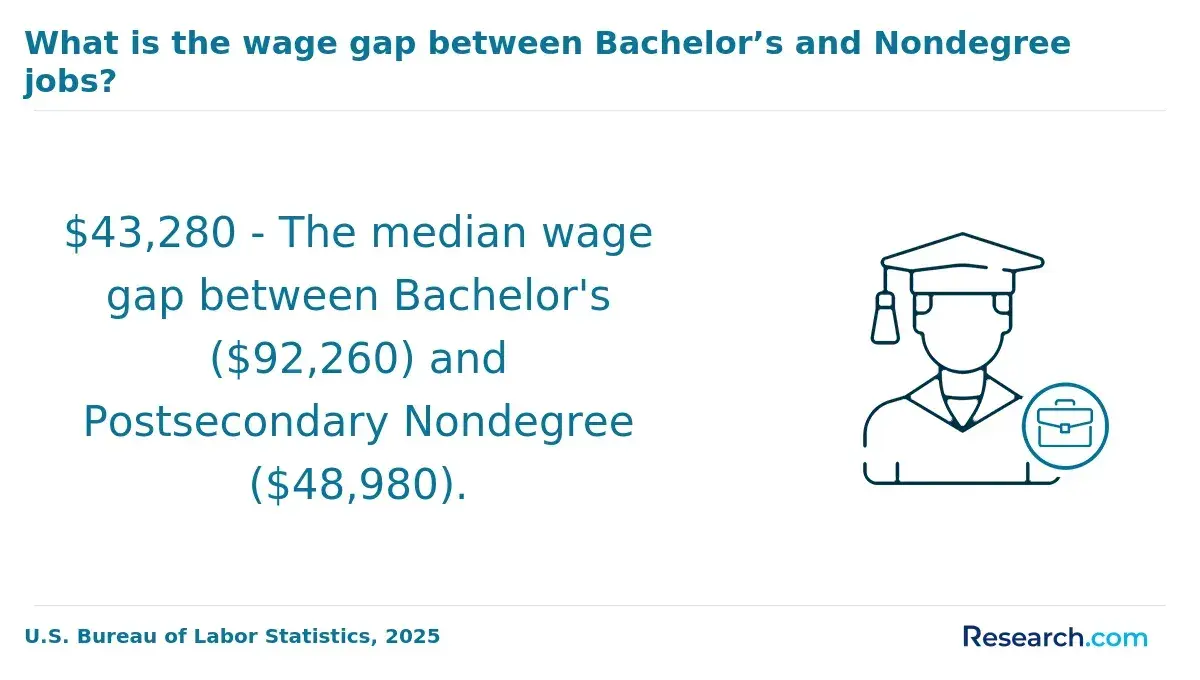
BLS 2024 data shows median weekly earnings of $1,543 for workers age 25 and older with a bachelor's degree, compared with $930 for those with only a high school diploma. That gap supports the value of postsecondary education in general, but it does not mean every degree, school, or debt level is equally safe.
Ask whether the program has the academic and career infrastructure to help you finish and move toward employment. Relevant indicators include accreditation, graduation rates, transfer outcomes, internship access, licensure exam preparation, career services, employer connections, and transparent program costs.
Use these questions before accepting additional loans:
- What is the total estimated debt at graduation, including interest and any parent borrowing?
- What entry-level roles does this program realistically prepare students for, and do those roles require this degree?
- Does the major lead to licensure, certification, graduate school, or portfolio requirements that add time and cost?
- What happens financially if you need an extra semester or change majors?
- Would a lower-cost school, transfer pathway, certificate, apprenticeship, or employer-funded option reach the same career goal?
- Are there personal factors, such as a criminal record or licensing restriction, that could affect career access after graduation?
Students who may face background-check barriers should research program and career restrictions early. Resources on degrees for felons can help frame questions about licensing, employer screening, and realistic career pathways before taking on debt.
The main red flag is borrowing based on optimism rather than a plan. A stronger decision connects the aid offer to a specific academic path, realistic completion timeline, expected early-career income range, and backup option if circumstances change.
Other Things You Should Know About
Yes. Contact the financial aid office and ask about an appeal, special circumstances review, professional judgment request, or scholarship reconsideration. You will usually need documentation showing why the original offer does not reflect your current financial situation.
Ask whether there are other scholarships, payment plans, emergency grants, state programs, or department awards available. Then compare the school with lower-cost options and decide whether the remaining gap would require too much debt.
Not automatically. Accept grants and scholarships first, then evaluate federal student loans carefully. You can usually accept less than the full loan amount offered if you only need part of it.
It depends on net price, debt, academic fit, completion likelihood, and career outcomes. A higher-priced college may be affordable with strong grants, but a large scholarship does not help enough if the remaining cost is still too high.
References
- 5 financial aid questions to ask prior to paying for college https://www.citizensbank.com/learning/financial-aid-questions.aspx
- 13 Important Questions to Ask your College Financial Aid Office https://americhoice.org/blog/13-important-questions-ask-college-financial-aid-office
- Need More Financial Aid? Learn About the Appeal Process https://www.mefa.org/article/need-financial-aid-learn-appeal-process/
- How to Decode Your College Financial Aid Offer Letter https://www.consumerreports.org/paying-for-college/how-to-decode-your-college-financial-aid-offer/
- Gap Year Scholarships: Fully Funded Options For Students After A Gap Year https://scholarshipinfocenter.com/gap-year-scholarships/
- Comparing Financial Aid vs Student Loans | SoFi https://www.sofi.com/learn/content/financial-aid-vs-student-loans/
- How much to save for college https://www.savingforcollege.com/article/how-much-to-save-for-college
- Should you take a loan to finance higher studies? - MoneyandMe https://www.pgimindia.com/moneyandme/save-invest/articles/Should-you-take-a-loan-to-finance-higher-studies
- Bridging the Gap: The Rise in Scholarships and Grants | Loc8me https://loc8me.co.uk/blog/bridging-the-gap/
- What to Do When Federal Student Loans Aren't Enough (2026 Guide) https://www.fastweb.com/financial-aid/articles/when-federal-student-loans-aren-t-enough