
2027 Accounting Schools in Pennsylvania – How to Become a CPA in PA

Co-Founder and Chief Data Scientist
Choosing an accounting school in Pennsylvania is not just about finding a recognizable university name. If your goal is to become a Certified Public Accountant, you also need to understand Pennsylvania’s education rules, CPA exam process, supervised work requirement, renewal obligations, and how a graduate accounting program may help you reach the 150-semester-hour threshold. The decision matters because the right program can shorten your path to licensure, improve exam readiness, and connect you with employers in public accounting, corporate finance, government, tax, audit, advisory, and forensic accounting.
This guide is for students comparing accounting schools in Pennsylvania, career changers planning a CPA pathway, and working professionals deciding whether a master’s degree, certificate, or alternative credential makes sense. You will learn how CPA licensure works in Pennsylvania, what the exam may cost, which master’s programs are listed in this guide, how to compare program formats, and what practical steps can help you avoid expensive mistakes.
Pennsylvania remains a major accounting labor market. According to data from the U.S. Bureau of Labor Statistics, Pennsylvania employs the fifth-highest number of accountants and auditors in the country (BLS, 2024). That does not guarantee a job for every graduate, but it does mean the state has a large base of employers that need accounting talent. If you are still exploring the field, Research.com’s guide to accounting careers and job opportunities can help you compare roles before committing to a program. Students considering graduate study can also review affordable online master’s programs in accounting.
Accounting Schools in Pennsylvania Table of Contents
- CPA jobs and accounting career outlook in Pennsylvania
- Step-by-step guide to becoming a CPA in Pennsylvania
- CPA exam costs in Pennsylvania
- 2027 accounting schools in Pennsylvania with master’s in accounting degrees
- Skills and credentials that can strengthen a CPA career
- How interdisciplinary skills may support CPA work
- How to select an accounting specialization
- How forensic science knowledge can support accounting careers
- Common challenges in Pennsylvania CPA licensure
- How technology is changing accounting careers in Pennsylvania
- Regulatory issues affecting CPA licensure in Pennsylvania
- How accountants can move into teaching
- Interdisciplinary skills and broader CPA career options
- Networking and mentorship for Pennsylvania CPAs
- How legal knowledge can support an accounting career
- Study strategies for accounting school and the CPA exam
- Alternative accounting certifications and credentials in Pennsylvania
- Business programs that can complement CPA preparation
- Career alternatives for accounting students in PennsylvaniaBusiness program optionsAlternative credentialsCPA study tips
Quick Answer: What is the CPA path in Pennsylvania?
To become a CPA in Pennsylvania, you generally need at least a bachelor’s degree, 150 semester hours of college education, qualifying accounting coursework, a passing score on all required sections of the Uniform CPA exam, and at least 1,600 hours of supervised accounting experience completed over at least one year. A master’s degree is not required by the Pennsylvania State Board of Accountancy, but it can help candidates reach the 150-hour requirement and build advanced technical skills.
For students comparing schools, the best choice is usually a program that clearly maps its curriculum to Pennsylvania CPA education requirements, offers strong CPA exam preparation, has recognized accreditation, provides internship or employer connections, and fits your budget and schedule. Online programs can be a good option, but you should verify course eligibility, transfer policies, and whether the program supports Pennsylvania CPA preparation before enrolling.
CPA jobs and accounting career outlook in Pennsylvania
Pennsylvania has a broad accounting employment base, with opportunities in public accounting firms, Fortune 500 companies, healthcare systems, universities, banks, insurance firms, state and local government, nonprofit organizations, and independent advisory practices. CPAs may work in tax, audit, financial reporting, consulting, internal controls, fraud examination, business valuation, compliance, or financial planning.
The expected job outlook for Pennsylvania accountants and auditors is 2.5% until 2028. The BLS reports that Pennsylvania has 55,210 accountants and auditors earning an average annual salary of $78,780. Salary outcomes vary by location, employer, experience, specialization, CPA status, and industry. For a regional comparison, you can review Research.com’s guide to CPA salary and accounting schools in Illinois.
| Question | Practical answer for Pennsylvania CPA candidates |
| Are accounting jobs available in Pennsylvania? | Yes. Pennsylvania has one of the largest accountant and auditor workforces in the country, according to BLS data cited in this guide. |
| Is a CPA license useful? | Yes, especially for roles involving audit, attest services, public accounting, senior tax work, advisory, or advancement into controller and finance leadership positions. |
| Does a master’s degree guarantee higher pay? | No. Graduate education may improve preparation and competitiveness, but compensation depends on experience, employer, specialization, location, and performance. |
| What roles can CPAs pursue? | Common options include auditor, tax accountant, forensic accountant, internal auditor, financial analyst, controller, compliance specialist, and advisory consultant. |
Do you need a master’s degree to become a CPA in Pennsylvania?
No. The Pennsylvania State Board of Accountancy does not require candidates to complete a traditional or online master’s degree in accounting to become licensed. The key academic requirement is meeting the required college credit and accounting coursework standards. A graduate degree can still be useful because it may help you reach 150 semester hours, deepen your technical accounting knowledge, and prepare for more specialized roles.
Some students choose a master’s in accounting because it is the most direct way to build CPA-ready coursework. Others combine undergraduate accounting credits, electives, certificates, transfer credits, or graduate courses. If your interests extend beyond accounting, a related graduate option such as a master’s degree in public policy may support work in public finance, economic development, public administration, or government accountability, but you must still verify that your coursework satisfies CPA education rules.
How long does it take to become a CPA in Pennsylvania?
The timeline depends on how quickly you complete the 150 semester hours, pass the CPA exam, and document qualified experience. A full-time bachelor’s degree commonly takes four years and is often structured around 120 semester hours. Because Pennsylvania CPA candidates need 150 semester hours, many students need additional coursework through a certificate, second major, graduate study, or master’s program.
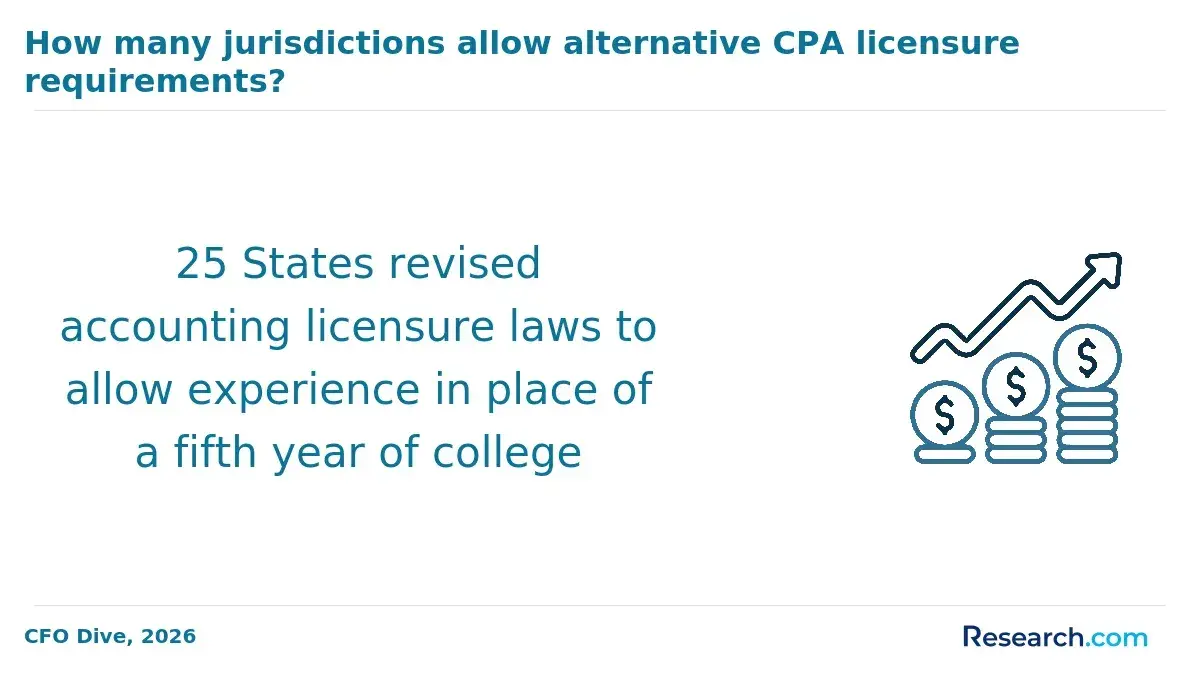
After completing the education requirement, candidates must complete 1,600 hours of qualifying experience over at least one year. Application processing and documentation review can add additional time. At the very least, the full process of meeting CPA exam and licensure requirements takes five years and may take close to six or seven years for many candidates (Dean, n.d.).
| Stage | What happens | Planning tip |
| Undergraduate education | Complete a bachelor’s degree and build core accounting coursework. | Ask early whether your courses count toward Pennsylvania CPA education requirements. |
| Additional credits | Earn the remaining hours needed to reach 150 semester hours. | Compare a master’s degree, graduate certificate, extra undergraduate credits, or combined programs. |
| CPA exam preparation | Apply, schedule, study for, and pass the required exam sections. | Do not schedule more sections than you can realistically take before your Notice to Schedule expires. |
| Work experience | Complete 1,600 supervised hours over at least one year. | Keep documentation organized and confirm your supervisor is a licensed CPA. |
| Licensure application | Submit education, experience, fees, and required background checks. | Use the Pennsylvania Licensing System portal to monitor application status. |
Step-by-step guide to becoming a CPA in Pennsylvania
The Pennsylvania State Board of Accountancy oversees CPA licensure in the state. The process is straightforward in concept, but candidates often lose time because they misunderstand credit requirements, wait too long to document experience, or apply for exam sections before they are ready. Use the following steps as a planning framework.
1. Complete the required accounting education
To qualify for a Pennsylvania CPA license, you must hold at least a bachelor’s degree and complete 150 semester hours of college education. Those hours must include at least 24 semester credits in accounting-related subjects, including:
- Accounting and auditing
- Tax
- Finance
- Microeconomics
- Macroeconomics
- Business law
If you are not ready to start a bachelor’s degree immediately, an associate degree may be a lower-commitment first step. Before enrolling, confirm whether credits will transfer into a bachelor’s program that supports CPA preparation. Research.com’s guide to online associate degrees can help you compare flexible starting points.
2. Complete the supervised work experience requirement
Pennsylvania CPA applicants must complete at least 1,600 hours of accounting experience over a period of at least one year. The experience must be completed within the 60-month period before the application date.
Qualifying experience may involve financial advisory work, tax return preparation, public accounting, attest services, management advisory, or analytics-related accounting work. Students interested in data-heavy accounting roles can also compare data analytics degree programs. Regardless of the setting, your work must be supervised by a licensed CPA.
3. Pass the Uniform CPA exam
Eligible candidates apply for the Uniform CPA exam through the National Association of State Boards of Accountancy. If you are unsure whether your education qualifies, NASBA provides a pre-evaluation option. All required CPA exam sections must be passed with a score of 75 or higher within an 18-month period.
4. Submit your CPA license application
After meeting the education, exam, and experience requirements, submit your CPA certification application and application fee through the Pennsylvania Licensing System. Your application must include documentation of education and qualifying experience. You must also submit state and federal criminal background checks from any state where you have lived, studied, or worked during the past five years.
5. Wait for license approval before using the CPA title
You can track your application through the Pennsylvania Licensing System portal. Once the Board receives and reviews all required documents, your license will be issued and will appear in your online profile. You should not present yourself as a CPA until the license has been officially issued.
Renewing a Pennsylvania CPA license
Pennsylvania CPA licenses must be renewed every two years. The renewal cycle runs from January 1 through December 31 every two years, and online renewal may be available up to 60 days before expiration. To renew, CPAs must complete 80 hours of continuing education, including at least 20 hours in each calendar year.
CPAs who perform attest activity must complete at least 24 continuing education hours in accounting and attest topics. Pennsylvania also requires at least four continuing education hours in professional ethics.
CPA exam costs in Pennsylvania
For all four CPA exam sections in Pennsylvania, candidates should prepare for a listed total of $1,059.20, based on a $264.80 fee per section. First-time applicants must also pay an initial application fee of $95, and re-exam candidates pay a $95 registration fee per application (National Association of State Boards of Accountancy, 2024). Because a Pennsylvania Notice to Schedule expires in six months after issuance, you should only pay for exam sections you can realistically complete within that window.
The fee table below reflects the section amounts listed in this guide. Candidates should always verify current fees directly with NASBA and the Pennsylvania State Board of Accountancy before applying because exam costs and administrative fees can change.
| CPA exam item | Listed fee |
| Auditing and Attestation (AUD) | $195.35 |
| Business Environment and Concepts (BEC) | $176.25 |
| Financial Accounting and Reporting (FAR) | $195.35 |
| Regulation (REG) | $176.25 |
| Application Fee | $95 |
Can a Pennsylvania CPA license transfer to another state?
Yes, but the process depends on the state where you are licensed, the state where you want to practice, and whether the move is temporary or permanent. State boards of accountancy set their own rules, and not every state applies mobility and reciprocity in exactly the same way.
For temporary practice, CPA mobility may apply under the Uniform Accountancy Act. Mobility rules generally allow CPAs in good standing to provide certain services in another state without immediately obtaining a new license, although limitations may apply, especially for attest work.
For a permanent move, reciprocity is usually the relevant process. Reciprocity allows a CPA to use an existing license as the basis for obtaining a comparable license in another state. Because rules differ by jurisdiction, contact both state boards before accepting clients, opening a practice, or advertising services across state lines.
2027 accounting schools in Pennsylvania with master’s in accounting degrees
The following Pennsylvania programs are included for students who want graduate-level accounting education, CPA preparation, or a path toward the 150-semester-hour requirement. Some are campus-based, some are online, and some are better suited to students who already have an accounting background. If you need a flexible format, you may also want to compare online education degree options and other online program structures to understand scheduling models before choosing an accounting program.
| School and program | Format or structure | Best fit |
| Pennsylvania State University Master of Accounting | Traditional program, usually completed in 12 to 15 months | Students seeking a well-known business school network and accounting concentrations |
| Temple University Master of Accountancy | On-campus full-time option with part-time, evening, and hybrid options | Students who want CPA-focused preparation with scheduling flexibility |
| University of Pennsylvania MBA, Major in Accounting | Two-year MBA with accounting major | Students who want accounting plus broader management and finance training |
| Carlow University Online Master’s Degree in Accounting | 100% online program | Working students who need remote coursework |
| Pennsylvania Western University Global Master of Accountancy | Fully online program with part-time enrollment available | Students seeking online graduate accounting coursework with advanced electives |
1. Pennsylvania State University Master of Accounting
Pennsylvania State University offers a Master of Accounting for students with any bachelor’s degree. The program typically takes one year, while students without an undergraduate accounting background may need additional coursework and may finish in 15 months. Penn State may appeal to students who want access to university activities, employer connections, and a large alumni network.
- Program Length: 12 to 15 months
- Tracks/concentrations: Forensic Accounting & Litigation Support; Accounting Information Systems; Taxes and Business Planning; and Topics in Financial Reporting
- Cost: Varies
- Required Credits to Graduate: Varies
- Accreditation: Association to Advance Collegiate Schools of Business
2. Temple University Master of Accountancy
The Fox School of Business at Temple University offers a Master of Accountancy designed to support CPA exam preparation and CPA certification goals. The program is available as an intensive on-campus, full-time degree, with part-time, evening, and hybrid options also available. Students from non-accounting majors may need to complete six prerequisite courses in Advanced Studies in Financial Reporting.
- Program Length: One to two years
- Tracks/concentrations: Advanced Auditing, Advanced Studies in Financial Reporting, Advanced Taxation, Colloquium on Current Issues in Accounting Practice, Concepts and Analysis of Financial Statements, and Professional Skills Development
- Cost: $1,165 per credit
- Required Credits to Graduate: 30
- Accreditation: Association to Advance Collegiate Schools of Business
3. University of Pennsylvania Master of Business Administration, Major in Accounting
The University of Pennsylvania offers an MBA with an Accounting major through the Wharton School. The program combines in-person coursework, business projects, internships, and graduate-level business training. Students may also pursue a double major in areas such as Finance, Insurance and Risk Management, Strategic Management, and other fields that can complement accounting-focused study.
- Program Length: Two years
- Tracks/concentrations: Fundamentals of Financial Accounting; Accounting for Mergers, Acquisitions and Complex Financial Structures; and Cost Management
- Cost: $118,568 for the first year; $116,568 for the second year
- Required Credits to Graduate: 19
- Accreditation: Middle States Commission on Higher Education
4. Carlow University Online Master’s Degree in Accounting
Carlow University offers a 100% online master’s in accounting with 10 core courses, including governmental accounting, strategic analysis, and agile project management. Students also complete a capstone course. The program may be useful for learners who need remote study and want graduate accounting coursework. Students interested in investigation-focused accounting can also review Research.com’s guide to online forensic accounting degree schools.
- Program Length: 1.5 years
- Tracks/concentrations: no information available
- Cost: $675
- Required Credits to Graduate: 30
- Accreditation: Accreditation Council for Business Schools and Programs
5. Pennsylvania Western University Global Master of Accountancy
The Master of Accountancy from PennWest Global is available fully online and accepts students for fall start dates. Part-time enrollment is available. The curriculum includes required courses plus advanced electives in areas such as tax, forensics, and auditing.
- Program Length: Varies
- Tracks/concentrations: Financial Accounting Research; Strategic Cost Management; and Business Law-Tax & Securities
- Cost: No information available
- Required Credits to Graduate: 30
- Accreditation: Middle States Commission on Higher Education
How to choose the right accounting school in Pennsylvania
A strong accounting program should do more than award credits. It should help you understand CPA eligibility, prepare for the exam, build technical judgment, and connect classroom learning to real accounting work. Before choosing a school, compare the factors below.
| Decision factor | Why it matters | Questions to ask |
| CPA alignment | You need qualifying coursework and enough total credits for Pennsylvania CPA eligibility. | Does the program publish a CPA course map for Pennsylvania candidates? |
| Accreditation | Accreditation affects academic quality, credit transfer, employer perception, and financial aid eligibility. | Is the institution accredited, and does the business or accounting program hold specialized accreditation? |
| Cost and aid | Tuition is only one part of the total cost; fees, books, exam prep, and lost work time also matter. | What is the total program cost after fees, and what aid is available? |
| Format | Online, hybrid, evening, and full-time formats serve different students. | Can I complete required courses while working or meeting family obligations? |
| Prerequisites | Students without accounting backgrounds may need extra courses before graduate study. | How many prerequisite courses will I need, and how much will they cost? |
| Employer access | Internships and recruiting pipelines can improve the transition from school to work. | Which firms and employers recruit from the program? |
| Exam support | CPA exam preparation requires disciplined study and familiarity with exam structure. | Does the program include review support, faculty advising, or exam planning resources? |
Skills and credentials that can strengthen a CPA career
A CPA license can open doors, but long-term career growth often depends on specialized expertise. Employers increasingly value accountants who can interpret data, explain risk, manage technology-enabled workflows, communicate with non-accounting stakeholders, and apply accounting rules to industry-specific problems.
- Data analysis and financial modeling: Advanced Excel, SQL, Tableau, Power BI, and forecasting skills can help accountants move from routine reporting into analysis, planning, and advisory work.
- Certified Fraud Examiner: The CFE credential from the Association of Certified Fraud Examiners can support forensic accounting, fraud detection, and investigation-focused careers.
- Certified Internal Auditor: The CIA credential from the Institute of Internal Auditors is relevant for professionals who evaluate internal controls, governance, and enterprise risk.
- Project management: Skills tied to PMP or CAPM preparation can help CPAs manage audits, system implementations, finance transformation projects, and cross-functional teams.
- IT auditing and cybersecurity knowledge: As companies rely on cloud systems, automated controls, and digital financial records, CPAs with CISA-related knowledge may be better prepared for technology risk and control roles.
- Advanced taxation: Specialized tax knowledge can support work in corporate taxation, individual tax planning, international tax, and tax controversy, depending on the credential and training pursued.
How interdisciplinary skills may support CPA work in Pennsylvania
Interdisciplinary learning is valuable when it directly improves your ability to solve accounting problems. For example, CPAs who understand healthcare operations, public budgets, legal processes, technology systems, or municipal planning may be better prepared for specialized advisory work. A healthcare compliance lens may be useful for accountants serving hospitals, clinics, or medical practices, and students curious about that regulated environment can review Research.com’s guide on how to become a nurse practitioner in Pennsylvania.
How to select an accounting specialization
The right specialization depends on your preferred work style, tolerance for regulation, interest in client-facing work, and long-term career goals. Tax may fit detail-oriented professionals who like research and planning. Audit may fit those who enjoy systems, evidence, and client interaction. Forensic accounting may appeal to investigative thinkers. Corporate accounting may suit candidates who want to grow inside one organization. If you need a deeper comparison, Research.com’s guide to accounting specializations explains how to match your strengths with different accounting paths.
How forensic science knowledge can support an accounting career
Forensic accounting requires more than knowing debits, credits, and tax rules. Professionals may need to evaluate evidence, reconstruct transactions, understand investigative procedures, document findings clearly, and support litigation or regulatory inquiries. Students interested in fraud investigation may benefit from learning how forensic disciplines approach evidence and analysis. Research.com’s guide to a forensic science degree in Pennsylvania can help you understand adjacent investigative training.
Common challenges in Pennsylvania CPA licensure
CPA candidates in Pennsylvania often struggle with four issues: reaching 150 semester hours without taking unnecessary classes, documenting 1,600 supervised experience hours correctly, passing all CPA exam sections within the required 18-month window, and staying current with continuing education after licensure. These challenges are manageable, but they require early planning. Students should keep course syllabi, maintain experience records, confirm supervisor eligibility, and use a realistic exam schedule. For a broader role overview, see Research.com’s guide to what a CPA does.
How technology is changing accounting careers in Pennsylvania
Automation, cloud accounting platforms, artificial intelligence, data visualization, and continuous monitoring tools are changing how accounting work is performed. Routine data entry and reconciliation tasks may become more automated, while demand may grow for professionals who can validate data, interpret exceptions, test controls, explain insights, and advise decision-makers. Accountants working in healthcare billing, insurance, and revenue cycle roles may also benefit from understanding specialized coding and billing systems; Research.com’s guide on how to be a medical coder in Pennsylvania offers context for that adjacent field.
Regulatory issues affecting CPA licensure in Pennsylvania
CPA candidates should treat licensure rules as current-state requirements, not permanent assumptions. Boards can update documentation procedures, education pathways, renewal rules, and application processes. Before applying for the exam or license, review official Pennsylvania State Board of Accountancy information and confirm current standards. Research.com’s guide to CPA requirements in Pennsylvania can also help you understand the broader accountant career path in the state.
How accountants can move into teaching
Accounting professionals who enjoy explaining complex ideas may consider teaching at the high school, community college, university, corporate training, or continuing education level. The requirements vary by teaching setting. K-12 teaching usually involves educator certification, while college teaching may require graduate education and subject-matter expertise. If you are considering a classroom transition, review Pennsylvania educator preparation rules and Research.com’s guide to what degree you need to be a teacher in Pennsylvania.
Interdisciplinary skills and broader CPA career options
Accounting intersects with public policy, real estate, infrastructure, healthcare, law, technology, and economic development. CPAs who understand a client’s operating environment can provide more useful advice than professionals who only read financial statements in isolation. For example, accountants working with municipal budgets, grants, infrastructure projects, or development authorities may benefit from understanding planning concepts. Research.com’s guide on how to become an urban planner in Pennsylvania can provide useful context for public-sector and development-related work.
Networking and mentorship for Pennsylvania CPAs
Relationships can accelerate an accounting career because hiring, referrals, promotion readiness, and specialization often depend on trust. Students should attend accounting society events, meet recruiters early, ask faculty about alumni contacts, and seek mentors in public accounting, corporate finance, government, or nonprofit work. Accountants who want to improve communication and leadership may also learn from education-related career paths, including Research.com’s guide on how to become a high school math teacher in Pennsylvania.
How legal knowledge can support an accounting career
Legal awareness can be especially useful in tax, forensic accounting, compliance, contract review, litigation support, bankruptcy, and corporate governance. CPAs do not replace attorneys, but they often work beside them. Understanding legal terminology, evidence, regulatory frameworks, and documentation standards can improve collaboration. Students interested in law-adjacent work can review Research.com’s guide on how to become a paralegal in Pennsylvania.
Study strategies for accounting school and the CPA exam
Accounting success depends on cumulative learning. Later topics build on earlier ones, and CPA exam preparation requires both conceptual understanding and timed practice. The strongest students usually treat accounting as a skills discipline, not a memorization exercise.
Stay organized from the first week
- Build a weekly study plan: Assign time blocks for reading, problem sets, review, and exam practice.
- Track deadlines carefully: Accounting courses often involve layered assignments, quizzes, projects, and exams.
- Prioritize weak areas: Spend extra time on topics that repeatedly cause errors, such as leases, consolidations, tax basis, audit evidence, or cost accounting.
Learn actively instead of passively reading
- Attend class consistently: Missing one technical lecture can make later material harder to follow.
- Work problems by hand: Watching solutions is not the same as being able to produce them under time pressure.
- Explain concepts out loud: If you can teach a topic clearly, you likely understand it more deeply.
Use support resources before you fall behind
- Create focused study groups: Meet with classmates to compare reasoning, not just final answers.
- Ask faculty specific questions: Bring your attempted work so instructors can identify where your logic breaks down.
- Use supplemental materials strategically: Online tutorials, accounting forums, and review tools can help, but they should not replace assigned coursework.
Gain practical experience while studying
- Pursue internships: Internships help you test whether tax, audit, corporate accounting, or advisory work fits your goals.
- Attend employer events: Recruiting timelines can begin earlier than students expect.
- Join accounting organizations: Student accounting clubs and professional associations can provide networking, speaker events, and peer support.
Prepare for the CPA exam with a realistic plan
- Understand the exam structure: Know the tested content, timing, question formats, and scoring expectations.
- Use review materials consistently: CPA review courses can be helpful if you follow the schedule and practice regularly.
- Simulate exam conditions: Timed practice builds endurance and helps you avoid spending too long on difficult questions.
Consider online accounting programs carefully
Online study can work well for disciplined students, working adults, and those who need location flexibility. However, not every online program is equally strong for CPA preparation. Compare curriculum, faculty access, accreditation, exam support, and transfer policies. Research.com’s guide to top online accounting programs can help you evaluate options.
Protect your health during CPA preparation
- Use sustainable study blocks: Long, unfocused sessions often produce weaker results than consistent practice.
- Sleep and exercise matter: Cognitive performance declines when exam candidates ignore basic health routines.
- Set measurable milestones: Break the process into course completion, application, section scheduling, practice scores, and final review.
Alternative accounting certifications and credentials in Pennsylvania
A CPA license is one of the most recognized accounting credentials, but it is not the only path. Some professionals choose credentials that better match corporate finance, internal audit, fraud investigation, tax representation, investment analysis, or a career change into accounting. The right credential depends on the work you want to do.
| Credential | Best for | When it may make sense |
| Certified Management Accountant | Management accounting and corporate finance | You want budgeting, performance management, and strategic finance responsibilities. |
| Certified Internal Auditor | Internal audit, governance, and risk control | You want to evaluate controls inside companies, banks, government agencies, or nonprofits. |
| Certified Fraud Examiner | Fraud prevention, detection, and investigation | You want to work in forensic accounting, insurance, law enforcement, or financial investigations. |
| Enrolled Agent | Tax representation before the IRS | You want a tax-focused credential that is not controlled by state CPA licensing rules. |
| Accounting graduate certificate | Career changers and students needing focused accounting coursework | You already have a bachelor’s degree and need accounting knowledge without completing a full master’s degree. |
| Chartered Financial Analyst | Investment analysis and wealth management | You want to move toward portfolio analysis, corporate finance, or investment-related roles. |
Certified Management Accountant
- The CMA is designed for accountants interested in management accounting and financial management.
- It is widely used in corporate finance roles involving budgeting, forecasting, performance measurement, and strategic decision support.
- Candidates must pass the CMA exam and meet applicable education and work experience requirements.
Certified Internal Auditor
- The CIA credential is built for professionals focused on internal auditing.
- Internal auditors evaluate risk, controls, governance, and financial processes across industries such as banking, government, and corporate operations.
- Candidates must pass the CIA exam and meet education and experience standards.
Certified Fraud Examiner
- The CFE focuses on fraud detection, deterrence, and investigation.
- It is relevant for accountants who want to work in forensic accounting, compliance investigations, insurance, financial services, or law enforcement-related roles.
- The credential may be especially useful when combined with audit, tax, data analytics, or legal knowledge.
Enrolled Agent
- An Enrolled Agent is authorized by the IRS to represent taxpayers before the agency.
- This path is useful for professionals who want to specialize in tax preparation, tax planning, or taxpayer advocacy.
- Unlike CPA licensure, the EA credential is not based on state-specific CPA board requirements and is obtained by passing the IRS Special Enrollment Examination.
Accounting graduate certificate
- An accounting graduate certificate can help students with a non-accounting bachelor’s degree build accounting knowledge.
- Certificates may take less time than a full master’s degree, but students should verify whether credits apply toward CPA education requirements.
Chartered Financial Analyst
- The CFA credential is widely recognized in investment management and financial analysis.
- It may be valuable for accountants moving into corporate finance, valuation, wealth management, or investment analysis.
Business programs that can complement CPA preparation
Some aspiring CPAs benefit from business coursework beyond accounting. Finance, analytics, management, business law, economics, and information systems can all support accounting careers, especially in advisory, consulting, corporate finance, and leadership roles.
Students who want a broader business foundation can compare the best business schools in Pennsylvania. A business school with strong employer partnerships, internships, and career services may help students turn technical accounting training into practical career opportunities.
When comparing business programs, avoid choosing based only on prestige. Look at curriculum fit, recruiting outcomes, cost, scheduling format, CPA alignment, faculty expertise, and whether the program supports your intended specialization.
Career alternatives for accounting students in Pennsylvania
Not every accounting student becomes a CPA, and that is not necessarily a problem. Accounting training can support careers in finance, business operations, compliance, banking, government, nonprofit administration, budgeting, payroll, financial analysis, and education. Some professionals may eventually teach financial literacy, business, mathematics, or accounting concepts. If you are considering education as a long-term pivot, Research.com’s guide to elementary school teacher requirements in Pennsylvania can help you understand one teaching route.
Educational and professional options for accountants
Graduate education can help accountants specialize, meet credit requirements, or move into research and teaching. A master’s degree in accountancy may be useful for students seeking advanced technical coursework. Those interested in academic research or university teaching may eventually consider doctoral study; Research.com explains the meaning of a PhD degree and how it differs from other graduate credentials.
Professional associations can also help accounting students and CPAs stay connected. In Pennsylvania, options include the Pennsylvania Institute of CPAs and the Pennsylvania Society of Public Accountants. National organizations such as the American Institute of CPAs can provide conferences, publications, professional development, networking, and other member resources.
If you are comparing CPA pathways across states, Research.com’s guide to accounting schools in Florida can help you see how education and licensure planning may differ outside Pennsylvania.
Common mistakes to avoid when choosing an accounting program
- Assuming every accounting degree meets CPA requirements: Always verify Pennsylvania-specific coursework and credit rules before enrolling.
- Looking only at tuition: Include fees, books, exam review materials, transportation, technology, and the cost of extra prerequisite courses.
- Ignoring accreditation: Accreditation can affect transfer credits, financial aid, employer recognition, and graduate study options.
- Taking unnecessary credits: More credits are not automatically better. Choose courses that support CPA eligibility, career goals, or specialization.
- Waiting too long to plan experience hours: Confirm early that your role and supervisor qualify for Pennsylvania’s work experience requirement.
- Overloading CPA exam sections: A Notice to Schedule can expire, so schedule only what you can prepare for and complete.
- Relying only on rankings: Rankings can be a starting point, but fit, cost, CPA alignment, and career support matter more.
Key Insights
- Pennsylvania is a strong accounting market: The state employs 55,210 accountants and auditors, with an average annual salary of $78,780 according to BLS data cited in this guide.
- A master’s degree is optional, not mandatory: Pennsylvania CPA candidates do not need a master’s degree, but graduate coursework can help meet the 150-semester-hour requirement and support advanced specialization.
- The CPA path requires planning: Candidates need a bachelor’s degree, 150 semester hours, required accounting coursework, passing CPA exam scores, and 1,600 supervised experience hours.
- Exam costs require careful scheduling: This guide lists $1,059.20 for all four CPA exam sections and a $95 initial application fee; candidates should verify current fees and avoid paying for sections they cannot take before the Notice to Schedule expires.
- Program fit matters more than name alone: The best accounting school for you should match your CPA goals, budget, schedule, prerequisites, and preferred specialization.
- Technology skills are becoming essential: Data analytics, automation, cloud systems, and IT controls are increasingly important in audit, advisory, compliance, and corporate accounting roles.
- Alternative credentials can be strategic: CMA, CIA, CFE, EA, graduate certificates, and CFA pathways can support careers that do not require—or do not center on—a CPA license.
- Documentation prevents delays: Keep records of coursework, syllabi, experience hours, supervisor information, exam notices, and continuing education from the beginning.
Related Articles for Nearby States
- 2027 Accounting Schools in New Jersey – How to Become a CPA in NJ
- 2027 Best Accounting Schools in Delaware – How to Become a CPA in DE
- 2027 Best Accounting Schools in Maryland – How to Become a CPA in MD
- 2027 Best Accounting Schools in West Virginia – How to Become a CPA in WV
- 2027 Accounting Schools in Ohio: How to Become a CPA in OH
- 2027 Best Accounting Schools in Virginia – How to Become a CPA in VA
- 2027 Best Accounting Schools in Connecticut – How to Become a CPA in CT
- 2027 Best Accounting Schools in Rhode Island – How to Become a CPA in RI
- 2027 Best Accounting Schools in Massachusetts – How to Become a CPA in MA
- 2027 Best Accounting Schools in Kentucky – How to Become a CPA in KY
References:
- AICPA & NASBA (approximate formal guidance – locate via official NASBA website). NASBA Uniform CPA Examination information. https://www.nasba.org/exams/cpaexam/
- Bureau of Labor Statistics. (2025). Accountants and auditors: Occupational Outlook Handbook. https://www.bls.gov/ooh/business-and-financial/accountants-and-auditors.htm
- Commonwealth of Pennsylvania, Department of State. (2026). Certified Public Accountant Pennsylvania licensure requirements snapshot. https://www.pa.gov/agencies/dos/department-and-offices/bpoa/boards-commissions/accountancy-board/cpa-snapshot
- Commonwealth of Pennsylvania, Department of State. (2026). State Board of Accountancy. https://www.pa.gov/agencies/dos/department-and-offices/bpoa/boards-commissions/accountancy-board
- Commonwealth of Pennsylvania. (2026). CPA FAQ (Certified Public Accountant) [PDF]. https://www.pa.gov/content/dam/copapwp-pagov/en/dos/programs/professional-licensing/applications-and-forms/Acct%20Website%20FAQ.pdf
- CPA Credits. (2025). CPA license Pennsylvania: Opportunities and salary expectations. https://www.cpacredits.com/resources/cpa-license-pennsylvania-opportunities-salary/Pennsylvania CPA FAQ source variant
- Indeed. (2026). Certified public accountant salary in Pennsylvania. https://www.indeed.com/career/certified-public-accountant/salaries/PA
- Pennsylvania Institute of Certified Public Accountants. (2026). Pennsylvania Act 27 modernizes CPA licensure and opens new pathways. https://www.picpa.org/professional-resources/research-publications/pennsylvania-cpa-journal/fall-2025/2025/09/12/pennsylvania-act-27-modernizes-cpa-licensure-and-opens-new-pathways-into-accountingIndeed CPA salary source variantPennsylvania CPA FAQ tracking variantPennsylvania Accountancy Board tracking variantPennsylvania Code continuing education source variantPennsylvania CPA snapshot
Other Things You Should Know About Accounting Schools in Pennsylvania
The Pennsylvania State Board of Accountancy regulates CPA licensing and enforcement. It sets education, experience, and examination rules, issues CPA licenses, and handles renewals and discipline under Pennsylvania law. The board works with NASBA and the AICPA on exam administration and score reporting.
No, a master’s degree is not required to become a CPA in Pennsylvania. However, obtaining a master’s degree can improve earning potential and job prospects. The Pennsylvania State Board of Accountancy requires candidates to have a bachelor’s degree and 150 semester hours of education to sit for the CPA exam.
Typically, it takes about five to seven years to become a CPA in Pennsylvania. This includes four years to complete a bachelor's degree, additional time to fulfill the 150 semester hours requirement, and one year of relevant work experience.
The Pennsylvania CPA Exam covers four main sections: Auditing and Attestation (AUD), Business Environment and Concepts (BEC), Financial Accounting and Reporting (FAR), and Regulation (REG). Candidates must pass all four parts to meet the CPA requirement in Pennsylvania.
Gaining a CPA license in Pennsylvania involves costs such as exam fees, application fees, and study materials. In 2027, the CPA exam fees may range from $1,000 to $1,500 in total, while additional costs for review courses can vary significantly based on the chosen provider. It's essential to budget for these expenses during your CPA journey. --- **Question** What are the continuing education requirements for renewing a CPA license in Pennsylvania? **Answer** In Pennsylvania, CPAs must complete 80 hours of continuing professional education (CPE) every two years to renew their licenses in 2027. This includes four hours in ethics and recommendations for courses in accounting and auditing, ensuring CPAs stay informed about industry standards and practices. --- **Question** Is it required to have a master's degree to become a CPA in Pennsylvania? **Answer** A master's degree is not required to become a CPA in Pennsylvania. The primary educational requirement is completing 150 semester hours of education and holding at least a bachelor's degree in accounting or a related field. Many candidates fulfill this through additional coursework or a fifth year of study. --- **Question** What are the educational requirements to become a CPA in Pennsylvania? **Answer** Aspiring CPAs in Pennsylvania must complete 150 semester hours of education along with a bachelor's degree in accounting or a closely related field, as of 2027. These requirements prepare candidates for CPA exam content and help ensure they're equipped with essential accounting knowledge and skills for the profession.
To become a CPA in Pennsylvania, you must have a bachelor’s degree and complete 150 semester hours of education, including at least 24 semester credits in accounting-related subjects. Additionally, you need 1,600 hours of accounting experience.





