
2027 How to Become a Nursing Assistant

Co-Founder and Chief Data Scientist
If you are looking for a fast, practical way to enter healthcare, becoming a nursing assistant can be one of the most direct starting points. Nursing assistants provide hands-on care to patients, support nurses, and work in settings where reliable personal care is essential, including hospitals, nursing homes, assisted living facilities, and home healthcare.
This guide explains what nursing assistants do, how certification works, where they work, what training usually includes, how much they earn, and how the role can lead to LPN, RN, or other healthcare careers. It is written for students, career changers, medical assistants, and caregivers who want a realistic view of the job before enrolling in a CNA or nursing assistant training program.
Quick answer: How do you become a nursing assistant?
To become a nursing assistant, you generally need to complete a state-approved nursing assistant training program, finish supervised clinical practice, pass your state’s competency exam, and be listed on the state nurse aide registry. Requirements vary by state, so you should always confirm training hours, exam rules, renewal requirements, and registry procedures with your state board or approved testing provider before enrolling.
What are the benefits of becoming a nursing assistant?
- Faster entry into healthcare: Nursing assistant training is usually shorter than many other healthcare education paths, making it useful for people who want to begin working sooner.
- Broad workplace options: CNAs and nursing assistants may work in nursing care facilities, hospitals, assisted living communities, home healthcare, and government healthcare settings.
- Hands-on patient care experience: The role gives you direct exposure to patient needs, clinical routines, documentation, and care teams, which can help if you later pursue LPN, RN, or other nursing pathways.
- What does a nursing assistant do?
- How much do nursing assistants make?
- Where do nursing assistants work?
- What education do you need to become a nursing assistant?
- What do CNA training programs teach?
- Can you complete nursing assistant training online or on a flexible schedule?
- How do CNA programs provide clinical experience?
- How do you get certified as a nursing assistant?
- Do CNA certification requirements differ by state?
- What can you do after completing a nursing assistant program?
- What is the job outlook for nursing assistants?
- How can a medical assistant become a registered nurse?
- Can specialty credentials help a nursing assistant advance?
- How should you compare online nursing programs?
- Does networking matter for nursing assistant career growth?
- Are affordable online LPN programs worth considering?
- How do you choose a nurse practitioner program?
- How do online nursing programs help non-nurses prepare for licensure exams?
- What alternative healthcare roles can nursing assistants move into?
- Can nursing assistants pursue travel nursing?
- Can ADN-to-MSN bridge programs speed up nursing advancement?
- What are the best advancement options after becoming a nursing assistant?
What is a nursing assistant?
A nursing assistant is a direct-care healthcare worker who helps patients with basic daily needs under the supervision of registered nurses (RNs), licensed practical nurses (LPNs), or licensed vocational nurses (LVNs). The title may appear as nursing assistant, certified nursing assistant, CNA, nursing aide, or nurse aide, depending on the employer and state terminology.
The role is patient-facing and physically active. Nursing assistants often spend more time with patients than many other members of the care team, so they are frequently the first to notice changes in comfort, mobility, appetite, hygiene, mood, or vital signs.
| Core responsibility | What it usually involves | Why it matters |
| Activities of daily living | Helping patients bathe, dress, groom, eat, toilet, and maintain personal hygiene | Supports dignity, comfort, and daily functioning |
| Vital signs | Measuring and recording temperature, pulse, respiration, blood pressure, and other assigned observations | Helps nurses and clinicians monitor changes in condition |
| Mobility support | Assisting with walking, transfers, turning, repositioning, and wheelchair movement | Reduces risks linked to immobility and helps prevent avoidable injuries |
| Observation and reporting | Noticing changes in pain, skin condition, behavior, breathing, intake, or alertness | Gives licensed staff timely information for care decisions |
| Patient environment | Changing linens, keeping rooms clean, following infection-control rules, and maintaining safety precautions | Promotes comfort and reduces preventable hazards |
| Emotional support | Listening, reassuring, communicating clearly, and respecting patient preferences | Improves patient experience and supports compassionate care |
| Documentation | Recording care provided, measurements taken, and observations according to facility policy | Creates an accurate care record for the healthcare team |
A good nursing assistant must be dependable, observant, patient, and comfortable working closely with people who may be ill, elderly, disabled, confused, or recovering from surgery or injury. The job is not limited to technical tasks; communication and compassion are central to safe care.
How much do nursing assistants make?
Nursing assistant pay depends on location, employer type, shift, experience, certification status, and the level of patient care required. In 2022, nursing assistants in the United States had a median annual wage of $35,760 [US Bureau of Labor Statistics (BLS), 2023]. That was below the estimated $53,616 median annual wage of all full-time wage and salary workers across the country in 2023, based on their $1,117 median weekly earnings that year (US BLS, 2024).
For many workers, the CNA role is not the highest-paying destination in healthcare; it is often the first step. If your long-term goal is higher income, compare nursing assistant work with broader nursing and healthcare education options, including college majors with stronger earning potential. In 2022, registered nurses (RNs) had a median annual wage of $81,220 (US BLS, 2023). Advanced practice registered nursing roles reported higher medians: nurse midwives had a median annual wage of $120,880; nurse practitioners (NPs) had $121,610; and nurse anesthetists had $203,090 (US BLS, 2023).
| Role | Median annual wage cited | What to understand before choosing this path |
| Nursing assistant | $35,760 in 2022 | Shorter training path, direct patient care, but lower median pay than licensed nursing roles |
| Registered nurse | $81,220 in 2022 | Requires nursing education, clinical preparation, and RN licensure |
| Nurse midwife | $120,880 in 2022 | Advanced practice role requiring graduate-level preparation and certification |
| Nurse practitioner | $121,610 in 2022 | Advanced clinical role with graduate education and state-specific practice rules |
| Nurse anesthetist | $203,090 in 2022 | Highly specialized advanced practice nursing role with substantial education and clinical requirements |
The chart below visualizes the median annual wages of nursing professionals in the US in 2022, according to 2023 data from the US BLS.
Where can I work as a nursing assistant?
Nursing assistants are needed wherever patients require help with daily care, mobility, monitoring, and comfort. Your work environment can shape your pace, schedule, physical demands, patient relationships, and advancement opportunities.
In 2022, 1.4 million nursing assistants were employed in the United States (US). Of those, 33% worked in nursing care facilities; another 33% were employed in state, local, and private hospitals; 11% worked in retirement and assisted living facilities; 6% worked in home healthcare services; and 4% were employed in the government (US BLS, 2023).
| Work setting | What the work may feel like | Best fit for |
| Nursing care facilities | Ongoing support for residents who need help with daily living, mobility, and long-term care routines | People who value continuity with the same patients or residents |
| Hospitals | Faster pace, changing patient needs, coordination with larger clinical teams | People who want exposure to acute care and multiple departments |
| Retirement and assisted living facilities | Supportive care focused on independence, safety, and daily assistance | People interested in aging services and resident-centered care |
| Home healthcare | Care delivered in private homes, often with more one-on-one interaction | People who prefer individualized care environments and travel between clients |
| Government healthcare settings | May include public facilities, veterans’ care, or other government-operated services | People interested in public-sector healthcare employment |
The chart below illustrates the employment distribution of nursing assistants in the US in 2022, according to data from the US BLS.
What are the educational requirements to become a nursing assistant?
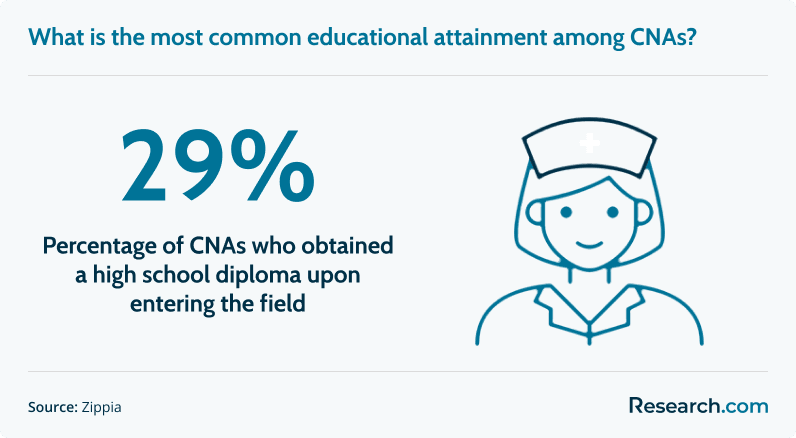
The usual path to becoming a nursing assistant combines basic education, state-approved training, supervised clinical practice, a competency exam, and placement on a state registry. Based on recent data, the most common educational qualification among CNAs is a high school diploma, constituting 29% of individuals in this role (Zippia, 2023). The second most common educational level CNAs attain is an associate degree, accounting for 19% of the workforce.
Requirements are designed to make sure nursing assistants understand patient rights, infection control, safe body mechanics, communication, documentation, and basic care procedures before working independently in approved settings.
| Step | What you need to do | Decision point |
| Meet the entry requirement | Most programs expect a high school diploma or GED, though exact admissions rules vary. | Ask whether the program requires age minimums, background checks, immunizations, CPR, or drug screening. |
| Choose an approved program | Complete a state-approved nursing assistant training program through a community college, vocational school, technical institute, healthcare facility, or other approved provider. | Do not enroll until you confirm the program is approved for your state’s CNA exam and registry. |
| Complete classroom and lab instruction | Study basic nursing care, safety, infection control, communication, ethics, and related topics. | Compare class format, schedule, instructor access, and skills lab quality. |
| Finish clinical training | Practice care skills in an approved healthcare setting under supervision. | Confirm where clinicals occur and whether the schedule fits your work or family obligations. |
| Pass the competency exam | Complete the required written and skills portions of the CNA exam. | Ask about exam pass support, retake policies, fees, and testing locations. |
| Join the state registry | Apply for listing with your state’s nurse aide registry or meet applicable state licensure/registration steps. | Check renewal deadlines and continuing education rules before your first job. |
Training may be available through community colleges, technical schools, workforce programs, healthcare employers, and some institutions that also appear in guides to affordable online colleges. If you are comparing short healthcare programs, it can also help to understand how CNA training differs from a 6 week medical assistant program, since medical assistants and nursing assistants prepare for different work settings and scopes of practice.
What courses are typically in a nursing assistant program?
Nursing assistant programs focus on the specific skills needed for safe, respectful, direct patient care. Coursework is usually practical rather than theory-heavy, but students still need to understand why each procedure matters.
- Basic nursing skills: Students learn vital signs, hand hygiene, standard precautions, infection-control practices, and basic comfort measures.
- Personal care: Training covers bathing, dressing, grooming, toileting, feeding, oral care, and other activities of daily living.
- Patient safety: Programs teach fall prevention, safe transfers, bed positioning, use of assistive devices, and body mechanics.
- Medical terminology: Students are introduced to common healthcare terms, abbreviations, and documentation language used in patient care settings.
- Communication: CNA students practice clear communication with patients, families, nurses, and other healthcare staff, including active listening and respectful language.
- Ethics and professionalism: Programs address confidentiality, patient rights, abuse prevention, boundaries, accountability, and workplace conduct.
- Cognitive health support: Students learn how to assist people with dementia, Alzheimer’s disease, confusion, or cognitive changes.
- Emergency response: Training may include first aid principles, CPR exposure or requirements, recognizing distress, and knowing when to alert licensed staff.
Do nursing assistant programs offer flexible schedules or online options?
Yes, some nursing assistant programs offer flexible formats, but the hands-on portion cannot be fully online. CNA students must demonstrate physical care skills, complete clinical practice, and meet state testing requirements, which means in-person attendance is normally required for labs, skills checks, and clinical rotations.
| Format | How it works | Best for | Watch out for |
| Full-time campus program | Classes, labs, and clinicals are scheduled closely together. | Students who want to complete training quickly and can attend consistently. | May be difficult if you work full time or have limited transportation. |
| Part-time or evening program | Coursework is spread across evenings, weekends, or fewer days per week. | Working adults, parents, and students with other obligations. | Clinical shifts may still occur during specific daytime or facility-approved hours. |
| Hybrid program | Some theory content is online, while labs and clinical training happen in person. | Students who want schedule flexibility but can attend required in-person sessions. | Not all hybrid programs are state-approved; verify approval first. |
| Self-paced online coursework | Students may complete some modules within set deadlines. | Independent learners who can manage assignments without frequent reminders. | Clinical, lab, and exam requirements still apply. |
How do nursing assistant programs provide hands-on clinical experience?
Clinical experience is where CNA students move from learning procedures to applying them with real patients or residents. Programs usually arrange supervised placements in approved healthcare facilities so students can practice within the rules of the training program and state requirements.
- Clinical rotations: Students are assigned to approved facilities such as hospitals, nursing homes, clinics, or long-term care settings for supervised practice.
- Direct care practice: Students assist with hygiene, feeding, mobility, repositioning, vital signs, and comfort care while supervised by instructors or licensed professionals.
- Instructor feedback: Faculty or preceptors observe performance, correct unsafe habits, and help students prepare for the skills exam.
- Simulation labs: Some programs use mannequins, mock patient rooms, and practice equipment so students can build confidence before clinical rotations.
- Documentation practice: Students learn how to record care accurately and follow facility policies for reporting patient changes.
What is the process to obtain certification as a nursing assistant?
Certification usually begins with an approved training program and ends with state registry placement. Although details vary, the basic sequence is similar across many states: complete training, finish clinical hours, apply for the competency exam, pass both the knowledge and skills portions, and complete any required registry paperwork.
- Confirm state requirements before enrolling. Check whether the program is approved by the state agency responsible for nurse aide training and certification.
- Complete the training program. Attend required classroom, lab, and clinical sessions.
- Apply for the CNA competency exam. Follow your state’s process for testing registration, identification, fees, and scheduling.
- Pass the written or knowledge exam. This portion evaluates patient care concepts, safety, rights, infection control, communication, and related topics.
- Pass the skills evaluation. You will demonstrate selected hands-on skills according to testing standards.
- Get listed on the state registry. Once approved, your name is added to the registry that employers use to verify eligibility.
- Maintain certification. Renewal and continuing education rules may apply, including required in-service training hours depending on state regulations.
Do different states have varying certification requirements for nursing assistants?
Yes. CNA certification is state-specific, and rules can differ in important ways. States may set different minimum training hours, clinical requirements, exam vendors, renewal timelines, background check policies, and registry procedures. A program that is acceptable in one state may not automatically qualify you for certification in another.
Before you pay tuition or fees, ask the school these questions:
- Is this nursing assistant program approved for certification in my state?
- How many classroom, lab, and clinical hours are required?
- Where are clinical placements held, and who arranges them?
- Which competency exam will I take, and what are the pass requirements?
- Are exam fees, uniforms, textbooks, background checks, and supplies included in tuition?
- What happens if I fail the written or skills exam?
- Will this training help if I later move to another state?
What career paths are available for graduates of nursing assistant programs?
A nursing assistant program can lead directly to entry-level patient care work, but it can also become a stepping stone toward licensed nursing, specialized care, healthcare operations, or advanced nursing education. The best next step depends on your goals, finances, schedule, and tolerance for additional schooling.
| Path | Typical next move | When this path makes sense |
| Licensed practical nurse or licensed vocational nurse | Complete an LPN/LVN program and pass the NCLEX-PN exam. | You want a licensed nursing role with more clinical responsibility than a CNA role. |
| Registered nurse | Complete an approved nursing degree and pass the RN licensure exam. | You want broader patient assessment, care planning, medication, leadership, and advancement options. |
| Specialized CNA or care role | Add training in medication assistance, geriatrics, mental health, pediatrics, rehabilitation, or related areas where allowed. | You want to deepen skills without immediately completing a nursing degree. |
| Healthcare administration support | Move toward unit coordinator, scheduler, supervisor, or medical office roles with experience and additional training. | You like healthcare but may prefer operations, coordination, or leadership over bedside care. |
| Education or training | With experience and further education, pursue roles helping train new aides or staff. | You enjoy mentoring, onboarding, and teaching practical care skills. |
| Advanced practice nursing | Progress through RN education, graduate study, and advanced certification. | You have long-term goals such as NP, CNS, nurse midwife, or nurse anesthetist roles. |
If you plan to continue in nursing, research nursing degree options early so you understand prerequisites, transfer policies, clinical requirements, and admission competitiveness. CNA experience can help you confirm whether patient care is the right fit before investing in a longer program.
Many CNAs later explore LPN or LVN programs. If that is your goal, learn the requirements to become an LVN and compare whether a bridge option such as an online LPN-to-RN program could eventually fit your timeline. For students comparing nursing degree levels, an ASN vs BSN degree comparison can clarify how education choices affect RN preparation and advancement. If you already know you want a specialty, explore nursing specializations, including fields such as obstetrics; learning how to become an obstetrics nurse can help you see what advanced preparation may require.
What is the job market for graduates of nursing assistant programs?
The labor market for nursing assistants is tied to healthcare access, long-term care needs, hospital staffing, assisted living demand, and home healthcare services. The role remains important because many patients need hands-on help that cannot be replaced by software or remote monitoring.
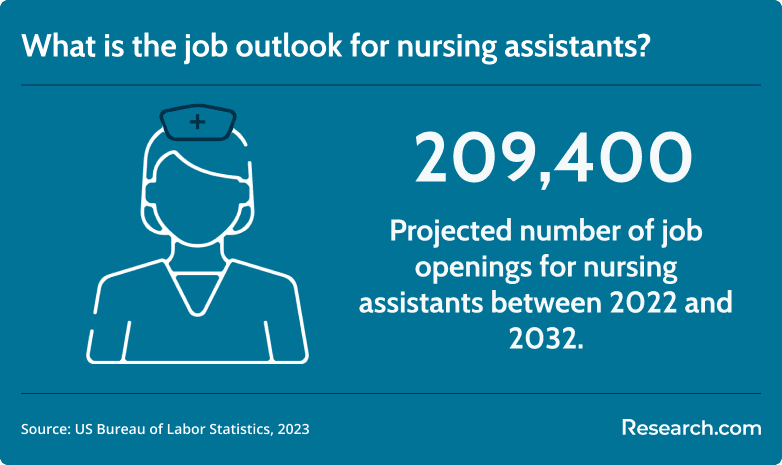
Employment for nursing assistants in the US has been projected to increase by 4% between 2022 and 2032, which is as fast as the average job growth rate for all occupations across the country. On average, about 209,400 new positions for nursing assistants and orderlies are expected annually during the period (US BLS, 2023). Many openings are expected because workers retire, leave the labor force, or move into other occupations.
Current trends affecting nursing assistants
- Aging-related care needs: Nursing care facilities, assisted living communities, and home healthcare providers continue to rely on aides for daily care support.
- Technology in documentation: Electronic health records, mobile charting, and facility systems are increasingly part of CNA workflows, but they do not replace bedside care skills.
- Employer focus on reliability: Attendance, teamwork, communication, and safe patient handling are critical because staffing gaps directly affect patient care.
- Pathway hiring: Some healthcare employers value CNAs who plan to continue into LPN or RN roles because they already understand patient care environments.
How can I transition from a medical assistant to a registered nurse?
Medical assistants who want to become registered nurses need to move into an approved nursing education pathway, complete required clinical training, and meet RN licensure requirements. Medical assisting experience can be helpful because it builds comfort with patients, vital signs, documentation, and clinical settings, but it usually does not replace the full nursing curriculum or RN clinical requirements.
Start by comparing programs that accept your previous coursework, offer required clinical placements, prepare students for licensure exams, and meet the rules of the state where you plan to practice. If you want a more detailed breakdown of bridge options, admissions questions, and timelines, use our guide to MA to RN programs.
What are the typical working conditions for nursing assistants?
Nursing assistant work can be rewarding, but it is not easy. The role often involves long periods of standing, frequent movement, emotional situations, and close contact with patients who need significant support.
- Work environments: CNAs commonly work in hospitals, nursing homes, assisted living facilities, retirement communities, home healthcare, and government settings.
- Schedules: Because many healthcare facilities operate around the clock, nursing assistants may work nights, weekends, holidays, rotating shifts, or extended shifts.
- Teamwork: Nursing assistants regularly report to RNs, LPNs, LVNs, and supervisors, so clear communication is essential.
- Patient contact: Daily work includes feeding, bathing, toileting, repositioning, transferring, and observing patients.
- Physical demands: Safe lifting, transferring, and body mechanics matter because injury risk is real for both workers and patients.
- Emotional demands: CNAs may care for people who are confused, grieving, seriously ill, disabled, or near the end of life, so resilience and professional boundaries are important.
Can specialized certifications further advance a nursing assistant's career?
Specialized training can help nursing assistants qualify for more focused responsibilities, but the value depends on state rules, employer needs, and whether the credential is recognized in your work setting. Examples may include medication aide training, dementia care, restorative care, CPR, first aid, mental health support, or geriatric care.
If your long-term goal is advanced nursing or integrative care, use specialty credentials as a way to explore interests rather than as a substitute for required nursing education. For example, learning about a functional medicine certification can help you understand one possible advanced practice direction, but becoming a nurse practitioner requires a much longer licensed nursing pathway.
How Do I Compare the Value of Online Nursing Programs?
Online nursing programs can be useful for working adults, but value depends on more than convenience. You should verify accreditation, state authorization, clinical placement support, licensure preparation, student outcomes, total cost, and whether the program matches your career target.
| Question to ask | Why it matters |
| Is the program properly accredited and approved for my state? | Accreditation and state approval can affect licensure eligibility, transfer options, employer recognition, and financial aid access. |
| Who arranges clinical placements? | Online coursework does not remove the need for in-person clinical experience in nursing programs. |
| What is the full cost? | Tuition is only part of the price; fees, books, travel, exams, uniforms, and lost work hours may also matter. |
| What outcomes does the school publish? | Licensure pass rates, completion rates, and job placement information can help you judge program quality. |
| Does the format fit my life? | Even online programs may require synchronous sessions, campus visits, clinical shifts, and strict deadlines. |
If you are comparing advanced nursing options and cost is a major concern, lists such as affordable online NP programs can be a starting point, but you should still verify accreditation, clinical rules, and state eligibility yourself.
Is Professional Networking Essential for Nursing Assistants’ Career Growth?
Networking is not required to become a nursing assistant, but it can help you find better training options, learn which employers support advancement, identify mentors, and hear about openings before they are widely advertised. Practical networking for CNAs often happens through clinical rotations, supervisors, coworkers, instructors, local healthcare events, and professional associations.
If you want to move beyond CNA work into licensed nursing or advanced practice, relationships with nurses, educators, and advisors can help you understand the steps ahead. For example, someone planning a long academic path may eventually compare graduate nursing options such as an affordable DNP program online, but that decision should come after completing the required nursing education and licensure stages.
Are affordable LPN online programs a smart financial investment?
An affordable LPN program can be a good investment if it is approved for licensure, provides adequate clinical training, fits your schedule, and helps you move into a licensed practical nursing role without taking on unmanageable debt. The lowest tuition option is not always the best choice if the program lacks clinical support, has weak student outcomes, or does not meet your state’s requirements.
When comparing cheapest LPN online programs, review the total cost, state approval, clinical placement process, exam preparation, completion support, and whether credits may apply toward future RN education.
How do I choose the best nurse practitioner program for my career?
Choosing a nurse practitioner program is a later-stage decision for nurses who already meet the required academic and licensure prerequisites. If that is your long-term goal, focus first on building a strong nursing foundation, then compare NP programs by accreditation, specialty track, clinical placement support, state authorization, faculty expertise, costs, and licensure preparation.
Convenience should not be the only factor. A program that seems easy to enter may not be the best fit if it does not support your intended specialty or practice state. Use resources such as easy NP online programs as a comparison point, but make your final choice based on licensing alignment, quality, and career goals.
How Online Nursing Programs Prepare Non-Nurses for Licensure Exams
Non-nurses who enter online nursing programs must still prepare for licensure exams, clinical judgment, and hands-on patient care. Online delivery can make didactic coursework more flexible, but nursing licensure preparation depends on a combination of rigorous instruction, supervised clinical learning, testing practice, and faculty support.
1. Integrated NCLEX-RN preparation
Many programs include licensure-focused content throughout the curriculum rather than waiting until the end. This may include NCLEX-style questions, case-based learning, content reviews, and simulated exams that help students practice decision-making under exam conditions.
- Practice questions and simulated exams: These tools help students become familiar with question formats and clinical judgment scenarios.
- Targeted review modules: Programs may focus on patient care, pharmacology, safety, infection control, prioritization, and other tested areas.
2. Clinical application of knowledge
Clinical placements allow students to connect online coursework to real patient care. This is where students practice assessment, communication, safety, prioritization, and critical thinking under supervision.
3. Faculty and academic support
Strong programs provide access to nurse educators, feedback, review sessions, tutoring, and remediation when students struggle. Before enrolling, ask each school how it supports students who are at risk of failing a course or licensure exam.
If you are entering nursing without a prior nursing background, compare programs carefully. A guide to online BSN programs for non-nurses can help you understand how these pathways combine coursework, clinical requirements, and licensure preparation.
What are alternative healthcare roles nursing assistants can transition into?
Nursing assistants who want to stay in healthcare but not necessarily continue in nursing can move into related patient care, technical, or support roles. Some options require short additional training; others require formal programs, certification, or licensure.
| Alternative role | How CNA experience helps | Additional preparation may include |
| Medical assistant | Patient interaction, vital signs, documentation, and clinical familiarity | Medical assisting training, administrative skills, and possible certification |
| Patient care technician | Bedside care experience and comfort working with nurses and patients | Training in tasks such as EKGs or phlebotomy, depending on employer and state rules |
| Home health aide | Personal care, mobility assistance, and communication with patients and families | Employer-specific training and any state-required preparation |
| Rehabilitation aide | Safe movement, transfers, encouragement, and patient support | Training related to therapy support and rehabilitation settings |
| Pharmacy technician | Healthcare environment awareness and attention to detail | Pharmacy technician training, certification, or registration depending on state rules |
| Emergency medical technician | Patient care confidence and ability to work under pressure | EMT training, certification, and emergency response preparation |
| Surgical technologist | Understanding of clinical teamwork and patient safety | Formal surgical technology education and possible certification |
If income growth is your main reason for changing roles, compare training time, debt, licensing requirements, working conditions, and realistic wages before choosing. You can also review highest paying nursing jobs to understand which roles usually require deeper nursing education.
Can nursing assistants pursue specialized roles like travel nursing?
Nursing assistants can work in temporary or travel-style aide assignments in some cases, but “travel nurse” usually refers to licensed registered nurses who accept short-term contracts in different locations. If your goal is true travel nursing, you will typically need to become an RN first and build strong clinical experience.
Learning how to become a travel nurse can help nursing assistants understand the longer pathway: nursing education, RN licensure, clinical experience, flexibility, and the ability to adapt quickly to new facilities. CNA experience can be a useful foundation, but it is not the same credential as RN travel nursing.
Can ADN to MSN Bridge Programs Accelerate Your Nursing Career?
ADN-to-MSN bridge programs are designed for registered nurses with an associate degree who want to move toward graduate-level nursing preparation. They are not usually the immediate next step for a new nursing assistant, but they may become relevant later if you complete RN education and want to advance into leadership, education, or advanced clinical roles.
If you eventually become an RN through an associate-degree pathway, ADN to MSN bridge programs may help you compare options for moving from associate-level nursing education toward a master’s credential. Before enrolling, verify admission requirements, prerequisites, clinical expectations, accreditation, and state authorization.
What are the opportunities for career advancement after becoming a nursing assistant?
Becoming a nursing assistant can be a stable entry point, but advancement usually requires intentional planning. The most common growth routes are becoming an LPN/LVN, becoming an RN, adding specialty training, moving into supervisory or administrative support, or using CNA experience to confirm a long-term nursing specialty.
| Goal | Best next step | Common mistake to avoid |
| Start working quickly | Choose a state-approved CNA program with strong clinical preparation. | Picking a program based only on speed without checking approval. |
| Earn a nursing license | Compare LPN/LVN and RN pathways based on cost, time, admissions, and licensing rules. | Assuming CNA certification automatically shortens every nursing program. |
| Become an RN faster | Research accelerated or bridge pathways that match your background and state requirements. | Ignoring prerequisites, clinical schedules, and transfer credit limits. |
| Specialize in patient care | Add employer-recognized training in geriatrics, dementia care, medication assistance, rehabilitation, or related areas. | Paying for credentials that employers in your area do not value. |
| Move into leadership | Build reliability, communication, documentation, and mentoring skills while pursuing additional education as needed. | Expecting promotion based only on years of experience. |
If you want to move up quickly, research the fastest way to become a nurse, but be cautious with any program that promises unrealistic timelines or guaranteed outcomes. Licensure, clinical training, and state approval requirements cannot be skipped.
Common mistakes to avoid before becoming a nursing assistant
- Enrolling without checking state approval: A program must meet your state’s requirements if you want to sit for the exam and join the registry.
- Looking only at tuition: Books, uniforms, exam fees, background checks, transportation, immunizations, and lost work time can affect the real cost.
- Assuming online means fully remote: CNA training requires in-person skills practice and clinical experience.
- Ignoring physical demands: Patient transfers, repositioning, and long shifts can be challenging; safe body mechanics are essential.
- Overlooking work schedule realities: Nights, weekends, holidays, and rotating shifts are common in many healthcare settings.
- Choosing a job with no growth plan: If you want to become an LPN, RN, or NP, ask employers about tuition support, scheduling flexibility, and internal mobility.
- Assuming salary outcomes are guaranteed: Pay varies by location, employer, shift, experience, and certification status.
References
- CNA Programs. (2022, November 16). Average tuition and fees for a CNA program. https://www.cnaprograms.org/tuition-and-fees.html
- US Bureau of Labor Statistics. (2024, January 26). 39. Median weekly earnings of full-time wage and salary workers by detailed occupation and sex. Labor Force Statistics from the Current Population Survey. https://www.bls.gov/cps/cpsaat39.htm
- US Bureau of Labor Statistics. (2023, September 6). Nurse Anesthetists, Nurse Midwives, and Nurse Practitioners. Occupational Outlook Handbook. https://www.bls.gov/ooh/healthcare/nurse-anesthetists-nurse-midwives-and-nurse-practitioners.htm
- US Bureau of Labor Statistics. (2023, September 6). Nursing Assistants and Orderlies. Occupational Outlook Handbook. https://www.bls.gov/ooh/healthcare/nursing-assistants.htm
- US Bureau of Labor Statistics. (2023, November 27). Registered Nurses. Occupational Outlook Handbook. https://www.bls.gov/OOH/healthcare/registered-nurses.htm
- Zippia. (2023, July 21). Certified Nursing Assistant Demographics and Statistics [2023]: Number of certified nursing assistants in the US. https://www.zippia.com/certified-nursing-assistant-jobs/demographics
Key Insights
- Becoming a nursing assistant usually requires a state-approved training program, supervised clinical practice, a competency exam, and state registry listing.
- The role is a strong entry point into healthcare, but it is physically demanding and pays less than licensed nursing roles.
- In 2022, nursing assistants had a median annual wage of $35,760, while RNs had a median annual wage of $81,220, according to US BLS data cited in this guide.
- Most CNA jobs are concentrated in nursing care facilities and hospitals, but opportunities also exist in assisted living, home healthcare, and government settings.
- Online CNA coursework may be available, but clinical training and skills evaluation must be completed in person.
- The best program is not simply the fastest or cheapest one; it must be state-approved, clinically sound, transparent about costs, and compatible with your schedule.
- CNA experience can help you advance toward LPN, RN, specialty care, patient care technician, medical assistant, or other healthcare roles, but each path has separate training and licensing requirements.
Other Things You Should Know About Becoming a Nursing Assistant
In 2027, typical CNA training programs last between 4 to 12 weeks, depending on the state and program specifics. These programs include classroom instruction and hands-on clinical experience to ensure readiness for certification exams and entry into the workforce.
In 2027, to become a certified nursing assistant (CNA), candidates typically need to complete a state-approved training program lasting 4-12 weeks, which includes classroom instruction and clinical practice, followed by passing a state certification exam. Requirements may vary by state, so checking local regulations is advisable.
In 2027, nursing assistant training programs typically cover essential topics such as basic nursing skills, patient care techniques, communication skills, infection control, and safety procedures. Programs also include supervised clinical experience to ensure practical, hands-on learning and proficiency in real-world healthcare settings.


