
2027 Nursing Salary: How Much Does a Critical Care Nurse Make?

Co-Founder and Chief Data Scientist
Critical care nursing can raise your earning potential, but it also asks more of you clinically, emotionally, and physically than many general nursing roles. If you are comparing ICU nursing, travel critical care, advanced practice nursing, or a bridge program, salary is only one part of the decision. You also need to weigh licensure requirements, shift demands, certifications, state pay differences, education costs, burnout risk, and long-term advancement options.
This guide explains what critical care nurses earn, which roles pay the most, where salaries are strongest, how education and certifications affect income, and what steps can help you move into higher-paying critical care positions without making costly career or school-selection mistakes.
Quick answer: What should you know about critical care nurse salaries?
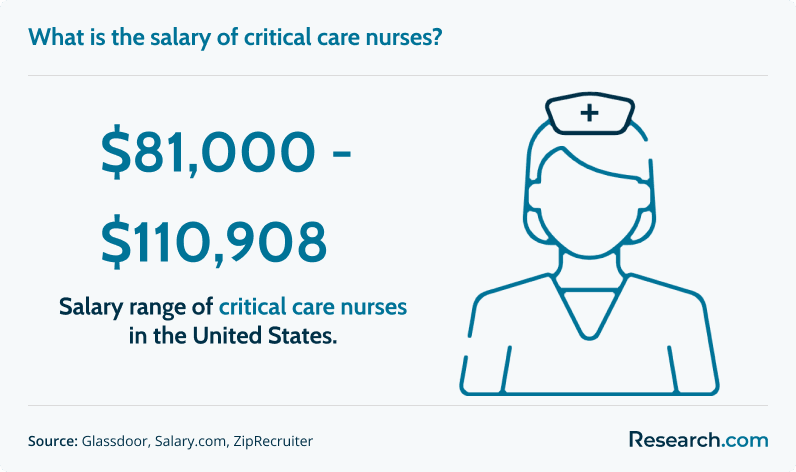
- Critical care nurse salaries in the U.S. are commonly reported between $81,220 and $110,908, while advanced practice roles such as nurse midwives and nurse practitioners can reach up to $125,900.
- Nurse anesthetists are the highest-paid group discussed in this guide, with reported salaries from $138,690 to $242,105.
- Location has a major effect on pay. Massachusetts, Washington, and Colorado are listed among the top-paying states, with Massachusetts reported at $137,411.
- Education, ICU experience, specialty certification, travel assignments, and advanced practice credentials can all influence compensation, but none guarantee a specific salary.
- Average critical care nurse salary
- Critical care nurse job outlook
- Highest-paying critical care nursing roles
- Common workplaces for critical care nurses
- Work conditions and schedule expectations
- Highest-paying states for critical care nurses
- How education affects critical care nurse pay
- Critical care nursing workforce demographics
- Skills critical care nurses need
- Ways to raise your critical care nurse salary
- Certifications and specializations that may improve career options
- How to evaluate the return on nursing education
- Using bridge programs to move into advanced roles
- Professional development options for critical care nurses
- When an accelerated RN to BSN program makes sense
- Burnout prevention in critical care nursing
- Career risks that can slow long-term progress
- How a Public Health MSN can support critical care leadership
- Salary trends affecting critical care nurses
- How higher education can shape your critical care career
- Online nursing degree factors to review
- LPN to RN pathways for critical care careersOnline degree credibility checklist
- How to start a critical care nursing careerProfessional development planningSalary trend review
What is the average critical care nursing salary?
Reported critical care nurse salaries in the United States range from $81,220 to $110,908 annually. That range is higher than many entry-level nursing support and vocational routes, although the right path depends on your timeline, budget, and licensure goals. If you are still comparing entry points into nursing, it may help to review how long it takes to become a vocational nurse before committing to a longer critical care pathway.
Advanced practice nursing can move earnings higher. Nurse midwives and nurse practitioners are cited at a median of around $120,880, reflecting the additional education, clinical authority, and patient-care responsibilities associated with those roles.
Travel critical care can also be financially attractive. ZipRecruiter reports an average ICU travel critical care nurse salary of $126,164 annually. However, travel pay should be evaluated carefully because contracts may vary by location, staffing urgency, housing arrangements, benefits, tax treatment, and assignment length.
| Role or category | Reported salary figure | What to consider before choosing this path |
| Critical care nurse | $81,220 to $110,908 | Good fit for RNs who want high-acuity clinical work and are prepared for demanding shifts. |
| Nurse midwives and nurse practitioners | Around $120,880; up to $125,900 | Usually requires graduate-level preparation and may involve additional licensure or certification requirements. |
| ICU travel critical care nurse | $126,164 | Can offer higher pay, but income depends heavily on contracts, location, benefits, and flexibility. |
| Nurse anesthetist | $138,690 to $242,105 | Highest-paid path discussed here, but it requires advanced preparation and significant clinical responsibility. |
What graduates say about critical care nursing education
“Completing my nursing degree online gave me enough flexibility to keep working in a local clinic while building my clinical foundation. The critical care coursework was demanding, but it helped me feel ready for fast-moving emergency situations.” Emily
“The critical care focus changed the way I approach patient decisions. Managing school alongside work and family was not easy, but the online format and interactive support helped me stay on track.” Marcus
“The online critical care track used case studies and simulations that made complex patient scenarios feel practical. I now rely on that training when managing unstable patients and coordinating with the care team.” Hannah
Key salary findings
- Critical care nurse salaries are reported from $81,220 to $110,908 annually, while specialized roles such as nurse anesthetists are cited up to $125,900 and, at the high end, between $138,690 and $242,105.
- Geography matters. Massachusetts ($137,411), Washington ($130,493), and Colorado ($129,123) are listed among the strongest-paying states for critical care nurses.
- Graduate education may improve access to higher-paying roles. Zippia reports that critical care nurses with a master’s degree earn an average annual salary of $100,568.
- Nurse anesthetists sit at the top of the compensation range in this article, with salaries reported between $138,690 and $242,105 annually.
- Demand remains an important salary factor. The cited job outlook for specialized roles is 38%, and nursing workforce shortages continue to influence hiring needs.
- Employment settings vary. Nearly 47% of advanced practice nurses work in physicians’ offices, while others work in hospitals, outpatient care centers, educational services, home healthcare, and other clinical environments.
What is the job outlook for critical care nurses?
The job outlook is favorable for nurses with advanced clinical skills, especially in specialized practice areas. The BLS reports a 38% outlook from 2022 to 2032 for nurse anesthetists, nurse midwives, and nurse practitioners, which is much higher than the general registered nurse outlook referenced in the original data.
Workforce supply is another major issue. According to the National Council of State Boards of Nursing, about 100,000 RNs have left the profession in the past two years, and another 610,388 plan to do so by 2027. For hospitals and health systems, that creates pressure to recruit, retain, and develop nurses who can safely manage complex patients.
Research summarized by the National Center for Biotechnology Information also points to the growing need for specialized nurses in critical care, with demand shaped by population aging and increasingly complex healthcare needs.
Unemployment has also been low in recent years. Zippia reports that the unemployment rate for critical care nurses has ranged from 1.04% to 1.97%, which supports the view that experienced critical care nurses remain in demand.
What are the highest-paying critical care nursing jobs?
The strongest salary potential in this guide belongs to nurse anesthetists, with reported earnings from $130,000 to $240,000 annually based on ZipRecruiter, Glassdoor, and Salary.com figures. General nurse practitioners follow at around $130,295 annually. Psychiatric nurse practitioners are also highly compensated, with earnings ranging from $120,500 to $154,000 and an average of about $126,683.
NICU nurses, who care for critically ill newborns, are reported at approximately $127,348 annually. ICU nurses, who monitor and treat patients with life-threatening conditions, are listed at approximately $85,196 annually, with some figures reaching as high as $103,209.
Higher-paying roles generally require a stronger mix of education, certification, experience, autonomy, and risk management. Before choosing a specialty only for salary, compare the daily work, schedule demands, liability exposure, and education requirements.
| Critical care role | Reported salary | Best fit for nurses who want... |
| Nurse anesthetist | $130,000 to $240,000; $138,690 to $242,105 | Advanced procedural work, anesthesia care, and high responsibility in surgical or procedural settings. |
| General nurse practitioner | Around $130,295 | More clinical autonomy, assessment responsibilities, and advanced practice opportunities. |
| Psychiatric nurse practitioner | $120,500 to $154,000; average about $126,683 | Specialized mental health practice with advanced assessment and treatment responsibilities. |
| NICU nurse | Approximately $127,348 | High-acuity newborn care and close collaboration with neonatal teams and families. |
| ICU nurse | Approximately $85,196; up to $103,209 | Direct bedside care for unstable patients in intensive care units. |
The chart below compares salary figures for selected critical care nursing roles.
Where do critical care nurses work?
Critical care nurses work in settings where patients need close monitoring, rapid intervention, complex medication management, or advanced procedures. BLS data cited here shows that nurse anesthetists, nurse midwives, and nurse practitioners held about 323,900 jobs in 2022, with many working in physicians’ offices rather than hospitals. Registered nurses, by contrast, are more heavily concentrated in hospitals.
Major employment settings include:
- Offices of physicians: 47% of APRNs work in these settings, often providing specialty or advanced clinical services.
- Hospitals, including state, local, and private hospitals: 25% of APRNs and 59% of RNs work in hospitals, where intensive care, emergency care, surgical recovery, and step-down units are common.
- Outpatient care centers: 9% of APRNs work in these facilities, including some nurse midwives in birthing centers.
- Offices of other health practitioners and educational services: These settings employ smaller shares of APRNs, at 4% and 3%, respectively, and RNs at 3%.
- Home healthcare and community-based care: Some critical care nurses support medically complex patients outside hospital settings, especially where staffing shortages affect access to care.
What are the work conditions for critical care nurses?
Critical care nurses often work in units that operate continuously, so nights, weekends, holidays, rotating shifts, and on-call expectations may be part of the job. Nurses in physicians’ offices, schools, or other non-24-hour settings may have more predictable schedules, but those roles may not offer the same exposure to high-acuity critical care.
The work is physically and emotionally demanding. Nurses may spend long shifts standing, lifting or repositioning patients, responding to emergencies, and supporting families during severe illness or end-of-life situations. Exposure to infectious disease and hazardous substances also makes safety protocols, protective equipment, and proper staffing essential.
| Work factor | What it can mean in practice | Question to ask before accepting a role |
| Shift schedule | Night, weekend, holiday, rotating, or on-call work may be required. | How often are shifts rotated, and what is the policy for overtime or call? |
| Patient acuity | Patients may be unstable and require rapid assessment and intervention. | What nurse-to-patient expectations apply in this unit? |
| Physical demands | Long periods on your feet and injury risk can be part of bedside care. | What lift equipment, staffing support, and injury-prevention policies are available? |
| Emotional load | Frequent exposure to trauma, death, and family distress can contribute to burnout. | What mental health, debriefing, and peer-support resources does the employer provide? |
Which states offer the highest salaries for critical care nurses?
Critical care nurse pay varies widely by state. ZipRecruiter lists Massachusetts at the top, with an average annual salary of $137,411 for critical care nurses. Washington follows at $130,493, and Colorado is listed at $129,123.
For students considering a nursing major, this is an important planning point: where you work may affect earnings as much as your degree or specialty. Regional demand, staffing shortages, cost of living, union presence, hospital systems, and specialty concentration can all influence pay.
The chart below highlights the best places to work as a nurse when salary is a major factor. Use it as a starting point, not the only decision tool, because a high salary may be offset by housing costs, commuting, taxes, or contract limitations.
Does more education lead to a higher critical care nursing salary?
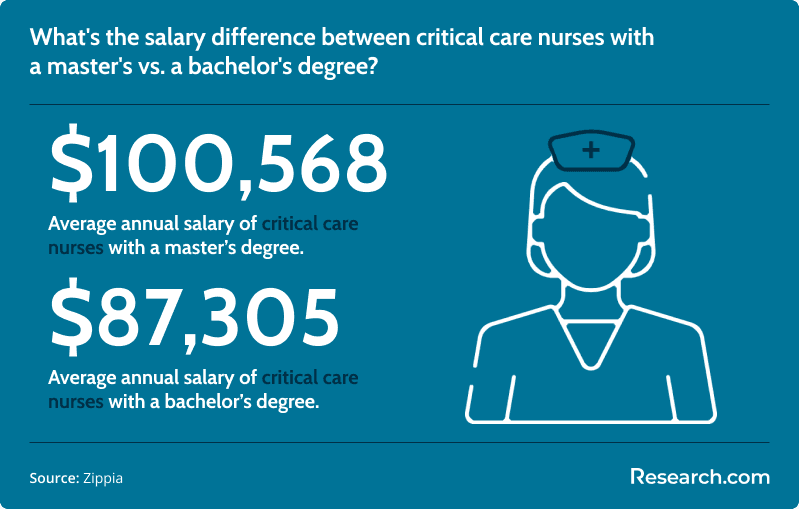
Additional education can improve access to higher-paying roles, but the relationship is not automatic. Zippia reports that critical care nurses with a master’s degree earn an average annual salary of $100,568. Critical care nurses with a doctorate degree are listed with a median annual income of $91,671, while those with bachelor’s degrees earn about $87,305 annually. These figures show that degree level matters, but role, specialty, location, employer, and experience also shape income.
Even a bachelor’s-level nursing role can pay substantially more than many support positions, including some roles discussed in a nursing assistant salary pathway. Nurses who want advanced practice roles may compare traditional graduate programs with online nurse practitioner programs, but they should confirm accreditation, clinical placement expectations, state authorization, and licensure alignment before enrolling.
BSN salary options
A Bachelor of Science in Nursing can support movement into specialized bedside, technology, or management roles. Whether you attend a campus program or one of the affordable online nursing programs, the degree is often valued because it combines clinical preparation with leadership, evidence-based practice, and systems-level thinking. ADN-prepared nurses comparing low-cost online RN to BSN programs should look closely at transfer policies, clinical requirements, and employer tuition support.
Informatics Nurse
Salary: $102,230
Informatics nurses connect nursing practice with healthcare technology. They may analyze clinical data, support electronic health record improvements, train staff on systems, and help organizations use information to improve care quality and workflow.
ICU Nurse
Salary: $91,986
ICU nurses care for patients with life-threatening conditions, use advanced monitoring equipment, respond to rapid changes, and coordinate closely with physicians, respiratory therapists, pharmacists, and families. Nurses comparing specialties may also want to understand how to become an OB nurse if maternal or fertility-related care is another interest.
Operating Room Manager
Salary: $77,280 per year
Operating room managers coordinate surgical suite operations, staffing, schedules, safety procedures, compliance expectations, equipment needs, and workflow improvements that support surgical care.
MSN salary options
Master of Science in Nursing graduates can qualify for advanced clinical, leadership, and administrative roles. Working nurses often compare campus programs with online MSN programs because flexibility matters, but clinical placement support and state authorization should be reviewed carefully.
Clinical Nurse Specialist (CNS)
Salary: $140,872
Clinical nurse specialists provide advanced expertise in a focused patient population or specialty area. Their work may include consultation, staff education, quality improvement, research support, and clinical leadership.
Nurse Administrator
Salary: $104,830
Nurse administrators manage teams, staffing plans, patient-care systems, budgets, compliance processes, and operational priorities in healthcare settings such as hospitals and clinics.
Certified Registered Nurse Anesthetist (CRNA)
Salary: $171,340
Certified Registered Nurse Anesthetists administer anesthesia and monitor patients during procedures, including surgery and obstetrical care. The role requires advanced patient assessment, anesthesia knowledge, and emergency readiness.
DNP salary options
A Doctor of Nursing Practice can prepare nurses for high-level clinical practice, executive leadership, education, and systems improvement. The degree may be useful for nurses pursuing advanced practice authority or leadership roles, but students should compare tuition, time commitment, clinical requirements, and expected career outcomes before enrolling.
Nurse Practitioner (NP)
Salary: $111,840
DNP-prepared nurse practitioners may diagnose and treat conditions, prescribe medications where authorized, manage patient care, and provide education focused on prevention, chronic disease management, and health promotion.
Nurse Executive
Salary: $119,000
Nurse executives guide nursing strategy, staffing models, policy implementation, budgeting, quality improvement, and organizational change across healthcare systems.
Nurse Educator
Salary: $83,160
Nurse educators teach students or practicing nurses, design curricula, evaluate learning outcomes, and help prepare future nurses. While this may not be the fastest route among nursing career paths, it can be meaningful for nurses who want to shape workforce development.
| Education level | Reported salary example | Career use |
| BSN | $87,305 for bachelor’s-prepared critical care nurses; role examples include $102,230, $91,986, and $77,280 per year | Supports ICU practice, specialty roles, and some management or technology-focused positions. |
| MSN | $100,568 for master’s-prepared critical care nurses; role examples include $140,872, $104,830, and $171,340 | Can open clinical specialist, administrator, nurse practitioner, and nurse anesthesia pathways. |
| DNP | $91,671 for doctorate-prepared critical care nurses; role examples include $111,840, $119,000, and $83,160 | May support advanced practice, executive leadership, education, and quality improvement roles. |
What is the demographic profile of critical care nurses in the U.S.?
Zippia reports more than 61,298 critical care nurses in the United States. The workforce is 81.1% women and 18.9% men, which reflects the broader gender distribution historically seen in nursing.
The average critical care nurse is 43 years old. Zippia also reports the workforce as 65.5% white, 11.7% Black or African American, 9.2% Hispanic or Latino, and 8.9% Asian. These figures help describe the current workforce but should not be read as limiting who can enter or succeed in critical care nursing.
The field is shaped by a mature workforce, low unemployment, continuing staffing pressures, and rising need for nurses who can manage complex patients. That combination creates both opportunity and strain for nurses entering or advancing in the specialty.
What skills do critical nurses need?
Critical care nurses need advanced clinical judgment first. They must identify subtle patient changes, interpret monitoring data, respond to emergencies, communicate clearly, and keep patients safe in high-pressure settings. Many programs, including an online nursing school, include coursework beyond bedside skills because success in critical care also depends on communication, teamwork, ethics, and technology use.
- Advanced clinical knowledge: Critical care nurses must understand emergency interventions, hemodynamic monitoring, medication safety, ventilator support, and changes in patient status.
- Clear communication: They need to relay urgent information to physicians, families, respiratory therapists, pharmacists, and other nurses without confusion.
- Emotional resilience: ICU work involves high stress, grief, uncertainty, and difficult conversations.
- Rapid decision-making: Nurses must assess risk quickly and take appropriate action when a patient deteriorates.
- Empathy: Technical skill is not enough; patients and families need compassion during frightening situations.
- Technical proficiency: Comfort with monitors, pumps, ventilators, electronic records, and advanced equipment is essential.
How can I increase my salary as a critical care nurse?
The most reliable salary-growth strategy is to build credentials and experience that employers can connect to higher responsibility. That may mean becoming stronger at the bedside, moving into a harder-to-staff specialty, accepting travel assignments, pursuing graduate education, or stepping into leadership.
- Earn advanced credentials: A master’s degree or DNP can support movement into advanced practice, education, administration, or specialty leadership.
- Build ICU experience: Critical care pay often improves as nurses become more confident with high-acuity patients, complex equipment, and emergency response.
- Add specialty certification: Credentials such as CCRN can signal focused expertise in critical care nursing.
- Choose a high-demand specialty: Cardiac care, pediatric critical care, neonatal care, and other focused areas may improve competitiveness.
- Compare employers carefully: Salary, differentials, overtime rules, benefits, tuition support, staffing ratios, and burnout risk all affect real compensation.
- Prepare for salary conversations: Track certifications, preceptor experience, committee work, charge nurse duties, quality-improvement projects, and measurable contributions.
| Salary strategy | Potential benefit | Risk or limitation |
| Specialty certification | Can strengthen your case for specialty roles or raises. | May require exam preparation, fees, and renewal requirements. |
| Travel nursing | Can increase pay in some contracts. | May involve relocation, variable benefits, temporary assignments, and tax complexity. |
| Graduate degree | Can open advanced practice, leadership, or educator roles. | Tuition and clinical requirements can be substantial. |
| Leadership duties | Can support charge nurse, manager, educator, or administrator pathways. | May reduce direct patient-care time and increase administrative stress. |
What impact do certifications and specializations have on my career as a critical care nurse?
Certifications and specializations can improve career mobility because they show focused competence beyond general RN preparation. A credential such as CCRN may help when applying for ICU, cardiac, trauma, pediatric, or other high-acuity roles. It can also support promotion discussions, although pay increases depend on employer policy and local labor conditions.
Specialization can also help you move toward roles with more responsibility. For example, nurses with deep experience in cardiac, neonatal, or pediatric critical care may become preceptors, charge nurses, clinical educators, transport nurses, or advanced practice candidates. The key is to choose a specialization that matches both your clinical strengths and the market where you plan to work.
How does the investment in nursing education pay off in your critical care career?
Education can pay off when it leads to a role with higher compensation, greater stability, better working conditions, or stronger advancement options. It can also fail to pay off quickly if tuition is high, credits do not transfer, clinical placements are weak, or the degree does not match your state’s licensure rules.
Before enrolling, compare total cost, not just advertised tuition. Include fees, books, technology, travel, clinical placement expenses, exam costs, unpaid time away from work, and certification expenses. Reviewing how much nursing school costs can help you estimate whether a degree or certificate is likely to fit your financial plan.
Can bridging programs enhance my career prospects in critical care nursing?
Bridge programs can help nurses move from one credential level to another without repeating unnecessary coursework. For example, an ADN-prepared nurse may use a bridge pathway to progress toward graduate-level preparation while building advanced clinical, leadership, and evidence-based practice skills.
Programs such as online ADN to MSN programs may be useful for nurses who already know they want advanced roles. Before enrolling, confirm accreditation, clinical placement responsibilities, state authorization, admission requirements, and whether the program’s specialty track aligns with critical care or advanced practice goals.
What types of professional development opportunities are available for critical care nurses?
Professional development matters because critical care changes quickly. New technologies, medication protocols, sepsis practices, monitoring tools, and safety standards require nurses to keep learning after graduation.
- Continuing education courses: Hospitals and healthcare organizations may offer training in updated protocols, advanced monitoring, medication safety, and critical care procedures.
- Workshops and seminars: Hands-on sessions may focus on advanced cardiovascular life support, infection control, ventilator care, or unit-specific skills.
- Professional conferences: Events from organizations such as the American Association of Critical-Care Nurses can support networking and exposure to current practice trends.
- Mentorship programs: New ICU nurses benefit from structured guidance, and experienced nurses can use mentorship to develop leadership and teaching skills.
- Research and academic pathways: Some nurses participate in quality improvement, patient-outcome research, or graduate education that supports educator and leadership roles.
Can an accelerated RN to BSN program propel my critical care nursing career?
An accelerated RN to BSN program may make sense if you are already licensed as an RN and need a bachelor’s degree for ICU advancement, magnet hospital expectations, leadership eligibility, or graduate school admission. A faster format can be useful, but speed should not be the only criterion.
When comparing the quickest RN to BSN program options, check accreditation, total cost, transfer-credit acceptance, workload, employer recognition, and whether the schedule is realistic alongside shift work.
How can I manage burnout while excelling in critical care nursing?
Burnout prevention is a career strategy, not a personal weakness issue. Critical care nurses regularly face trauma, moral distress, staffing pressure, high workloads, and emotionally intense family interactions. Ignoring those pressures can lead to errors, exhaustion, turnover, or leaving the specialty altogether.
Practical steps include using peer debriefing, requesting mentorship, setting limits on overtime, monitoring sleep and recovery, rotating away from the highest-stress assignments when possible, and seeking professional support early. Nurses returning to school may compare accessible RN to BSN programs, but “easy” should never mean unaccredited or clinically weak. The best option is one that fits your workload while still meeting professional standards.
What challenges could hinder my long-term career success in critical care nursing?
Several issues can slow or derail a critical care career: chronic burnout, limited mentorship, weak clinical orientation, poor staffing, outdated skills, unplanned education debt, and choosing programs that do not support licensure or advancement. Technology changes and evolving regulations also require continuous learning.
Some nurses broaden their scientific foundation or prepare for roles outside direct bedside care through related academic fields, including an online biology bachelor’s degree. That type of path may be useful for nurses considering research, education, public health, or healthcare technology, but it should be matched to a clear career goal.
Can a Public Health MSN degree open new doors in critical care nursing?
A Public Health MSN can be useful for critical care nurses who want to move beyond individual bedside care into population health, quality improvement, emergency preparedness, policy, or health-system leadership. Critical care experience gives nurses insight into severe illness; public health training adds tools for prevention, data analysis, community-level planning, and systems improvement.
Nurses considering this direction can explore public health MSN degree careers to understand how the credential may connect to leadership, program design, or healthcare improvement roles.
What are the emerging trends affecting salaries for critical care nurses?
Recent salary pressure is tied to staffing shortages, demand for high-acuity care, and the difficulty of retaining experienced nurses in intensive care environments. When hospitals struggle to fill critical care positions, they may use higher wages, differentials, or sign-on bonuses, although these vary by employer and market.
Technology is also changing the skill profile employers value. Critical care nurses increasingly work with telemedicine support, robotic-assisted surgery environments, advanced monitoring systems, and complex electronic documentation. Nurses who can adapt to these tools may be more competitive for specialized roles.
The aging population also contributes to demand for critical care expertise, especially in cardiovascular care, neurology, and geriatrics. Nurses who want to move into advanced practice may compare some of the most affordable online FNP programs, but they should confirm that the program’s scope, clinical placements, and licensure outcomes fit their intended role.
How can higher education shape your career in critical care nursing?
Higher education can change your career by expanding the roles you can pursue. A BSN may support ICU hiring and leadership preparation. An MSN may open doors to nurse practitioner, clinical specialist, educator, administrator, or nurse anesthesia pathways. A DNP may support advanced clinical practice and executive-level responsibilities.
Some nurses compare nurse practitioner specialties with more accessible admission pathways, but admissions ease should not outweigh fit. Choose a specialty based on patient population, state practice rules, clinical placement quality, employer demand, and your tolerance for responsibility.
Higher education can also build your professional network and expose you to research, leadership, informatics, and quality improvement. The best program is not always the fastest or cheapest; it is the one that helps you reach a specific next role without unnecessary debt or licensure problems.
What factors should I consider when pursuing an online nursing degree?
An online nursing degree can be credible when it is properly accredited, recognized by employers, and structured to meet clinical and licensure requirements. If you are wondering whether an online nursing degree is credible, focus on evidence rather than marketing language.
- Accreditation: Confirm institutional and nursing program accreditation before applying.
- Clinical placement: Ask who secures clinical sites and what happens if placements are delayed.
- State authorization: Verify that the program can enroll students in your state and supports your intended licensure path.
- Transfer credits: Review how prior coursework, ADN credits, or professional experience may apply.
- Total cost: Compare tuition, fees, books, travel, exam costs, and lost work hours.
- Employer recognition: Ask local hospitals or health systems whether they accept graduates from the program.
Can transitioning from LPN to RN accelerate my critical care nursing career?
Moving from LPN to RN can significantly expand your scope of practice and make critical care roles more realistic. LPN experience can provide a useful clinical foundation, but ICU and high-acuity nursing generally require RN preparation, licensure, and additional training.
Accelerated LPN to RN pathways build on existing clinical knowledge while preparing students for more complex assessment, medication, decision-making, and patient-management responsibilities. If you are comparing online LPN to RN programs, verify accreditation, clinical hours, NCLEX preparation, state approval, and whether local employers hire graduates into acute care or transition programs.
How to start your journey: accessible pathways to critical care nursing
Becoming a critical care nurse requires a planned sequence: complete an accredited nursing program, earn RN licensure, gain acute care experience, develop ICU competence, and pursue specialty certification or advanced education when it supports your goals.
Step-by-step pathway
- Choose an accredited nursing program. Entry options commonly include an Associate Degree in Nursing or a Bachelor of Science in Nursing. If admission access is your biggest concern, review nursing schools with more accessible admissions options, but do not compromise on accreditation or licensure eligibility.
- Pass the required licensure exam and become an RN. Critical care employers generally require RN licensure before ICU placement.
- Gain acute care experience. Emergency departments, step-down units, telemetry units, and hospital transition programs can help build the foundation for ICU work.
- Seek ICU orientation and mentorship. Strong preceptorship is crucial because critical care skills are developed through supervised practice, not classroom learning alone.
- Pursue certification when eligible. Credentials such as CCRN can validate your critical care expertise and strengthen your advancement profile.
- Reassess your long-term goal. Decide whether you want to remain at the bedside, become a charge nurse, move into management, enter advanced practice, teach, travel, or specialize further.
Who should choose critical care nursing?
- Nurses who want complex clinical decision-making and can stay calm during emergencies.
- RNs who enjoy technology, monitoring, physiology, and fast-changing patient conditions.
- Professionals who are willing to keep learning through certifications, skills training, and updated protocols.
- Nurses who can balance compassion with emotional boundaries in high-stress settings.
Who may want a different nursing path?
- Students who need predictable daytime schedules as a top priority.
- Nurses who prefer lower-acuity, relationship-based care over emergency response and intensive monitoring.
- Professionals who are not ready for frequent exposure to trauma, death, or family distress.
- Students considering costly graduate programs without a clear role target or licensure plan.
Common mistakes to avoid when planning a critical care nursing career
| Mistake | Why it can hurt you | Better approach |
| Choosing a program without checking accreditation | It can affect licensure, transfer credits, employer acceptance, and graduate school options. | Verify accreditation and state approval before applying. |
| Looking only at salary | High pay may come with burnout, relocation, night shifts, or weak benefits. | Compare total compensation, schedule, staffing, support, and long-term fit. |
| Assuming every online program meets licensure needs | State authorization and clinical requirements vary. | Ask the school and your state board before enrolling. |
| Ignoring clinical placement support | Delayed or weak placements can slow graduation and licensure progress. | Confirm who arranges placements and where students typically train. |
| Taking on debt without an advancement plan | A degree may not pay off quickly if it does not lead to a specific role. | Map the degree to a job target, expected timeline, and realistic salary range. |
| Relying only on rankings | A highly ranked program may still be too expensive, inflexible, or poorly matched to your state. | Use rankings as one input alongside accreditation, cost, outcomes, and licensure fit. |
References
- AHA. (2023, April 13). Study projects nursing shortage crisis will continue without concerted action | AHA News. American Hospital Association.
- BLS. (2023a). Nurse Anesthetists, Nurse Midwives, and Nurse Practitioners: Occupational Outlook Handbook. U.S. Bureau of Labor Statistics.
- BLS. (2023b). Registered Nurses. Bureau of Labor Statistics.
- Glassdoor. (2023). Salary: Critical Care Nurse in United States 2023. Glassdoor.
- Haddad, L. M., Annamaraju, P., & Toney-Butler, T. J. (2023). Nursing Shortage. In StatPearls. StatPearls Publishing.
- Martin, B., Kaminski-Ozturk, N., O’Hara, C., & Smiley, R. (2023). Examining the Impact of the COVID-19 Pandemic on Burnout and Stress Among U.S. Nurses. Journal of Nursing Regulation, 14(1), 412.
- Salary.com. (2023). Critical Care Nurse Salary. Salary.Com.
- Zippia. (2023). Critical Care Nurse Demographics and Statistics [2023]: Number Of Critical Care Nurses In The US. Zippia.
- ZipRecruiter. (2023a). Salary: Critical Care Nurse (December, 2023) United States. ZipRecruiter.
- ZipRecruiter. (2023b). Salary: Icu Travel Nursing Salary. ZipRecruiter.
Key Insights
- Critical care nursing can be financially rewarding, with reported salaries from $81,220 to $110,908 and higher figures for travel, advanced practice, and nurse anesthesia roles.
- The highest salaries usually require more than bedside RN preparation. Graduate education, specialty credentials, ICU experience, and advanced clinical responsibility are common salary drivers.
- State choice can strongly affect income. Massachusetts, Washington, and Colorado are among the top-paying states cited in this guide.
- Online and bridge programs can support advancement, but only if they are accredited, accepted in your state, realistic for your schedule, and aligned with licensure or promotion goals.
- Burnout risk is real in critical care. Before chasing a higher-paying role, evaluate staffing, schedule, support, mentorship, and whether the work environment is sustainable.
- The best salary strategy is targeted: choose the role you want, identify the required credential, calculate the cost and time, then compare the expected career benefit against the personal and financial investment.
Other things you should know about nursing salaries
In 2027, the salary of a critical care nurse is influenced by several factors, including geographic location, level of education, years of experience, and the specific healthcare institution of employment. Certifications and specialization within critical care can also lead to higher earnings.
In 2027, critical care nurses across the United States earn an average salary of around $85,000 to $110,000 per year. Salaries can vary significantly based on location, experience, and hospital setting, with higher pay rates often found in urban areas and states with higher living costs.
In 2027, critical care nurses in California, Massachusetts, and New York receive some of the highest salaries, with averages exceeding $110,000 annually. Contributing factors include higher cost of living and the demand for specialized nursing skills in these regions.
Yes. Hospitals often pay shift differentials of about $2 to $10 extra per hour for nights, weekends, and holidays. For critical care nurses, that can raise annual pay by several thousand dollars, especially in intensive care units with regular overnight staffing needs.
Obtaining certifications such as the CCRN (Critical Care Registered Nurse) or CSC (Cardiac Surgery Certification) can boost a critical care nurse's salary. These credentials demonstrate advanced knowledge and expertise, often leading to higher earning potential in 2027.


