
2027 How to Become a Nurse in Maryland

Co-Founder and Chief Data Scientist
Becoming a nurse in Maryland means choosing the right education path, meeting Maryland Board of Nursing requirements, passing the correct NCLEX exam, and planning for the cost and timeline before you enroll. The decision matters because nursing school is a major investment, Maryland employers increasingly look for well-prepared nurses, and licensing delays or program mistakes can slow your entry into the workforce.
This guide is for prospective nursing students, current LPNs planning to become RNs, RNs considering advanced practice, and nurses moving to Maryland from another state. You will learn the main licensing steps, degree options, legal nursing roles, compact license rules, salary and job outlook information, financial aid considerations, and practical ways to avoid common mistakes.
Quick answer: How do you become a nurse in Maryland?
To become a nurse in Maryland, complete a state-approved or accredited nursing program, apply through the Maryland Board of Nursing, pass the NCLEX-PN for LPN licensure or the NCLEX-RN for RN licensure, complete required fingerprinting and background checks, and maintain your license according to Maryland renewal rules. RNs usually enter through an Associate Degree in Nursing (ADN) or Bachelor of Science in Nursing (BSN), while LPNs typically complete a shorter practical nursing program.
Key Things You Should Know About Becoming a Nurse in Maryland
- Maryland is facing a meaningful nursing workforce gap, with projections pointing to a need for over 10,000 additional nurses by 2030. Demand is influenced by an aging population and retirements among experienced healthcare workers.
- Registered nurses in Maryland earn an average salary of approximately $80,000 per year, placing compensation above the national average cited in the original data. Pay still varies by location, experience, employer, shift, and specialty.
- The employment outlook remains favorable. The Bureau of Labor Statistics projects a 9% growth rate for RNs from 2020 to 2030, supported by healthcare technology growth and greater attention to preventive care.
- The basic RN route requires an accredited ADN or BSN program, followed by a passing score on the NCLEX-RN. LPN candidates take a practical nursing route and sit for the NCLEX-PN.
- Maryland students can study through community colleges, universities, and selected online or hybrid programs, but clinical placement requirements must be reviewed carefully before enrolling.
- Steps to become a nurse in Maryland
- Education requirements for Maryland nurses
- Types of nurses allowed to practice in Maryland
- Maryland nursing licensing requirements
- Nursing license types in Maryland
- Compact nursing license rules in Maryland
- Whether you can practice without a nursing license
- Current state of nursing in Maryland
- Online acute care nurse practitioner programs for Maryland nurses
- Maryland nursing job outlook and salary context
- Financial aid options for Maryland nursing students
- LPN training opportunities in Maryland
- Education options for nurses who want to advance
- Online nursing programs in Maryland
- Common licensure obstacles in Maryland
- How technology is changing nursing work
- Ways Maryland nurses can diversify their careers
- Medical billing and coding as an adjacent path
- LVN and LPN advancement considerations
- Renewal and continuing education requirements
- Nurse midwife pathways in Maryland renewal rules career options education options
What are the steps to becoming a nurse in Maryland?
The Maryland nursing path is easier to manage when you treat it as a sequence: choose the right role, complete the correct program, pass the licensing exam, apply to the board, and plan for renewal. Skipping one step, especially accreditation or clinical eligibility, can delay licensure.
- Choose your nursing role. Decide whether you want to become a CNA, LPN, RN, or APRN. Each role has a different scope of practice, education level, exam requirement, and career ceiling.
- Complete the required education. LPN candidates generally complete a one-year diploma or practical nursing program. RN candidates usually complete a two-year ADN or a four-year BSN. Advanced practice nurses need graduate-level nursing education.
- Confirm program approval and accreditation. Before enrolling, verify that the program prepares graduates for Maryland licensure and, if relevant, is recognized by nursing accreditation bodies.
- Apply for licensure with the Maryland Board of Nursing. Submit the required application materials, education verification, fees, and background check information.
- Pass the correct NCLEX exam. LPN candidates take the NCLEX-PN, while RN candidates take the NCLEX-RN.
- Begin practice within your legal scope. After licensure, work only within the responsibilities allowed by your license type and employer policies.
- Maintain your license. Maryland nurses must meet renewal expectations. Nurses who cannot document at least 1,000 hours of practice within the past five years may need a board-approved refresher course.
| Goal | Typical education route | Licensing exam | Best fit |
| Licensed Practical Nurse | One-year practical nursing or diploma program | NCLEX-PN | Students who want a faster entry into bedside care under RN or physician supervision |
| Registered Nurse | Two-year ADN or four-year BSN | NCLEX-RN | Students seeking broader clinical responsibility, more job options, and stronger advancement potential |
| Advanced Practice Registered Nurse | Graduate nursing program plus national specialty certification | Specialty certification requirements apply | RNs who want to diagnose, treat, prescribe within rules, or move into advanced clinical practice |
Some nurses later move into specialized roles with different earning profiles. For example, nurses interested in cosmetic or aesthetic practice may compare specialty compensation by reviewing how much aesthetic nurses make an hour.
National workforce data from 2015 to 2022 shows that the majority of nurses, 94.9%, are registered nurses. Advanced practice registered nurses represent 9.8% of the nursing workforce, while licensed practical nurses or licensed vocational nurses make up 0.8%, as shown below.
What are the educational requirements for becoming a nurse in Maryland?
Maryland nursing education requirements depend on the license you want. The most important decision is whether you want a short practical nursing route, an RN pathway, or a graduate-level advanced practice route.
| Credential | Typical length stated | What it prepares you for | Decision point |
| Associate Degree in Nursing | 2 to 3 years | NCLEX-RN eligibility and entry-level RN practice | Often a practical choice for students who want a lower-cost community college route before working as an RN |
| Bachelor of Science in Nursing | 4 years | NCLEX-RN eligibility plus broader preparation in leadership, community health, and care coordination | Often preferred by employers for roles with advancement potential |
| Accelerated BSN | As little as 16 months for students with a bachelor’s degree in another field | A faster RN route for second-degree students | Can be intensive and may be difficult to combine with full-time work |
| Master of Science in Nursing | 1 to 2 years beyond the BSN | Specialized practice, leadership, education, or advanced clinical roles | Best for RNs who already know the specialty or leadership direction they want |
| DNP or PhD in Nursing | Several years of advanced study | High-level clinical leadership, systems improvement, research, or academic roles | Appropriate for nurses seeking top-level practice, scholarship, or executive influence |
A BSN is not the only way to become an RN, but it can create more room for advancement. An ADN may be more affordable and faster, while RN-to-BSN programs can help working nurses continue their education later. If you are comparing advanced practice titles, it is useful to understand the difference between DNP vs FNP roles before choosing a graduate path.
Online and accelerated formats can help working adults, but they are not automatically easier. Nursing requires supervised clinical experience, so students should ask where clinical placements occur, whether the school assists with placement, and whether the program meets Maryland licensure expectations. Nurses who already hold a graduate degree and want a family nurse practitioner credential may also compare the fastest post master's FNP certificate programs available.
Accreditation should be checked before tuition is paid. A nursing program that lacks the right approval or accreditation can affect licensure eligibility, transfer credit, graduate admissions, and employer recognition.
What types of nurses can legally practice in Maryland?
Maryland recognizes several nursing and nursing-support roles. The right choice depends on how much responsibility you want, how long you can spend in school, and whether you plan to move into advanced practice later.
- Registered Nurses. RNs assess patients, administer medications, coordinate care, educate patients, and collaborate with physicians and other clinicians. Candidates complete an accredited ADN or BSN program and pass the NCLEX-RN. Programs may be accredited by organizations such as the Accreditation Commission for Education in Nursing (ACEN) or CCNE.
- Licensed Practical Nurses. LPNs provide basic nursing care under the direction of RNs, physicians, and other authorized clinicians. Most candidates complete a practical nursing program and pass the NCLEX-PN.
- Advanced Practice Registered Nurses. APRNs include nurse practitioners, clinical nurse specialists, nurse anesthetists, and certified nurse midwives. These nurses complete graduate education, hold national certification in a specialty, and practice under advanced scope rules.
- Certified Nursing Assistants. CNAs are not licensed nurses, but they are essential members of the care team. They assist with daily living activities, mobility, hygiene, and patient comfort after completing approved training and competency requirements. Students comparing entry-level roles can review how CNA salary varies by state and experience.
What are the licensing requirements for nurses in Maryland?
Maryland licensure is handled through the state board and requires education, testing, identity verification, and fees. Build time for each requirement into your plan, especially if you are applying near graduation or moving from another state.
- Approved education. RN applicants generally need an ADN or BSN from an acceptable nursing program. LPN applicants complete a practical nursing program. Current LPNs who want to move up may compare options such as 6 month LPN to RN program online pathways, while working RNs may look at online RN to BSN programs without clinical requirements.
- NCLEX examination. RN candidates must pass the NCLEX-RN, and LPN candidates must pass the NCLEX-PN.
- Board application. Applicants submit materials to the Maryland Board of Nursing, including education documentation, exam information, and a non-refundable application fee, typically around $100.
- Fingerprinting and background check. Maryland requires a criminal background check. Candidates should budget approximately $50 to $75 for fingerprinting, though the exact amount can vary.
- Licensing fee. After meeting the requirements, applicants generally pay an additional licensing fee, which is generally around $100 for RNs and LPNs.
The safest approach is to create a checklist before graduation: confirm your school has submitted required documents, schedule fingerprinting early, keep copies of all correspondence, and check the Maryland Board of Nursing website rather than relying only on informal advice.
What types of nursing licenses are available in Maryland?
Maryland nursing credentials differ in legal scope and career mobility. Choosing the wrong level can limit your options, while choosing too much education too soon may increase cost without a clear return.
| License or credential | Main responsibilities | Education and exam route | When it makes sense |
| RN | Patient assessment, medication administration, care planning, patient education, and coordination | ADN or BSN plus NCLEX-RN | Best for students seeking broad nursing practice and long-term advancement |
| LPN | Basic nursing care, monitoring, support with daily care, and medication-related duties within scope | Practical nursing program plus NCLEX-PN | Best for faster workforce entry or as a bridge toward RN education |
| CNA | Direct support with daily living activities and patient comfort | State-approved training and competency exam | Best for early healthcare exposure before committing to nursing school |
| APRN | Advanced assessment, diagnosis, treatment, specialty care, and prescribing authority where allowed | Master’s or doctoral nursing degree plus national certification | Best for experienced RNs who want advanced clinical autonomy or specialty practice |
If your long-term goal is advanced practice, begin with the end in mind. A BSN may make the transition to graduate nursing simpler, while an ADN can still be a valid first step if you plan to complete a bridge program later.
Can a Compact nurse practice in Maryland?
Yes. Maryland participates in the Nurse Licensure Compact, which allows eligible nurses with a multistate license to practice in Maryland and other compact states without applying for a separate single-state license each time. Maryland was the first state to join the NLC in 1999, and participating states currently number twenty-five in the original source material.
Maryland moved to the Enhanced Nurse Licensure Compact on January 19, 2018. Under the eNLC, nurses must meet enhanced eligibility standards, including background check requirements and other licensure criteria.
- For Maryland residents. If Maryland is your primary state of residence and you qualify, a multistate license can support practice across compact states.
- For nurses moving to Maryland. You should confirm whether your current license is multistate and whether Maryland becomes your primary state of residence.
- For telehealth nurses. Compact status can matter when patients are located in different states, so verify practice rules before accepting remote roles.
Compact privileges can expand job mobility, but they do not remove the need to follow Maryland scope-of-practice rules, employer policies, and renewal requirements. Nurses planning advancement may also consider online acute care nurse practitioner programs if their goal is higher-level acute or critical care practice.
Can you practice as a nurse without a license in Maryland?
No. You cannot legally practice as an RN or LPN in Maryland without the appropriate nursing license. Licensure is not a formality; it confirms that the nurse has completed required education, passed the appropriate examination, and met Maryland’s public safety requirements.
- Unlicensed practice can create legal risk. Representing yourself as a nurse without a valid license can lead to serious consequences.
- Patients can be harmed. Medication administration, assessment, documentation, and care decisions require verified competence.
- Employers verify credentials. Hospitals, clinics, long-term care facilities, and agencies generally require active licensure before assigning nursing duties.
- Student and assistant roles are different. Nursing students and CNAs may perform approved tasks under defined supervision, but they cannot independently practice as licensed nurses.
A safer pathway is to work in a legal support role, such as CNA or patient care technician, while completing nursing education. That experience can strengthen your confidence without crossing scope-of-practice boundaries.
What is the state of nursing in Maryland?
Maryland offers strong healthcare employment opportunities, but the market is not uniform. Demand, pay, cost of living, and specialty access can differ between Baltimore, counties near Washington, D.C., rural areas, hospitals, long-term care, and home health employers.
Recent reports cited in the original article estimate approximately 100,000 licensed nurses working across Maryland, including RNs, LPNs, and CNAs. Demand is supported by population aging, healthcare service needs, turnover, burnout, and the lingering workforce effects of the COVID-19 pandemic.
The U.S. Bureau of Labor Statistics projects registered nurse employment growth of about 6% from 2021 to 2031, aligning with broader national trends. Maryland has also experienced nurse shortages in certain specialties and rural areas, while operational constraints have contributed to licensure and certification processing delays.
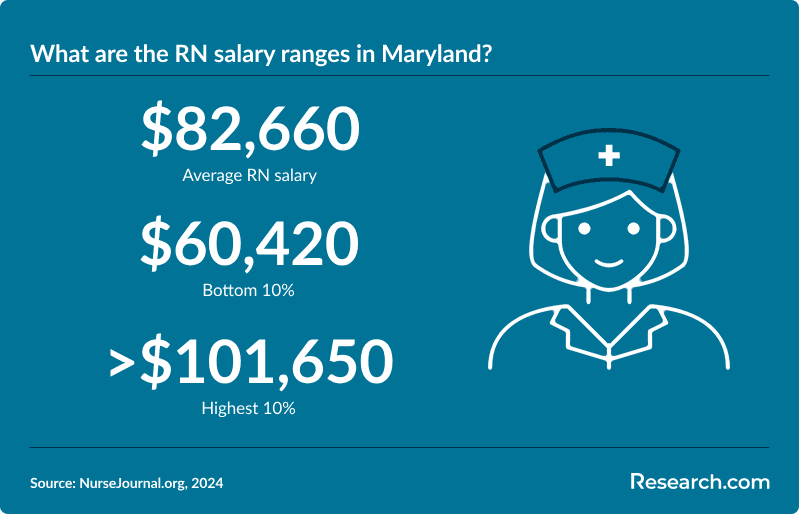
Salary must be viewed alongside cost of living. The average RN salary in Maryland is $82,660. The bottom 10% of RNs earn less than $60,420 annually, while the top 10% earn more than $101,650, as shown in the graphic below.
Nurses in Maryland commonly work in these settings:
- Hospitals. These remain major employers for acute care, emergency care, specialty units, perioperative services, and inpatient nursing.
- Long-term care facilities. Nursing homes and extended-care settings need nurses to support older adults and patients with chronic conditions.
- Home healthcare services. Home-based care can offer scheduling flexibility and growing demand as more patients receive services outside hospitals.
- Outpatient care centers. Ambulatory clinics and same-day care settings need nurses for procedures, education, triage, and care coordination.
Maryland can be a strong nursing market, but students should compare expected wages with commuting costs, housing, schedule demands, and specialty availability before choosing a school or employer.
Are online acute care nurse practitioner programs the right choice for Maryland nurses?
Online acute care nurse practitioner programs may be a good fit for Maryland RNs who already have strong clinical experience and want graduate preparation for higher-acuity care. These programs can offer flexibility for working nurses, but they still require rigorous coursework and clinical experiences.
Before enrolling, ask whether the program is accredited, whether it accepts Maryland students, how clinical placements are arranged, and whether graduates are prepared for the certification and practice expectations tied to acute care roles. Online format should not be the only deciding factor; clinical quality, faculty access, preceptor support, and board pass outcomes matter more.
Nurses comparing options can review online acute care nurse practitioner programs to understand how programs differ in structure and expectations.
What is the job outlook for nursing in Maryland?
The nursing outlook in Maryland is positive overall, although outcomes vary by license level, specialty, geography, and employer. The U.S. Bureau of Labor Statistics projects RN employment in Maryland to grow by approximately 9% from 2020 to 2030. Demand is influenced by older patients, healthcare technology, preventive care, chronic disease management, and staffing needs across care settings.
As of May 2022, the average annual salary for registered nurses in Maryland was around $82,000, equal to approximately $39.42 per hour. This figure should be treated as a statewide average, not a guaranteed starting salary.
Top-paying industries for nurses in Maryland include:
- Outpatient care centers
- Specialty hospitals
- Home healthcare services
Among nursing roles, nurse anesthetists and nurse practitioners often earn the highest salaries, often exceeding $120,000 annually. Licensed practical nurses generally earn less, with an average salary of around $50,000.
For national wage comparison, the U.S. Bureau of Labor Statistics reports median annual wages of $195,610 for nurse anesthetists, $120,680 for nurse practitioners, $112,830 for nurse midwives, $77,600 for registered nurses, and $48,070 for licensed practical and licensed vocational nurses. The median annual wage for all occupations in the United States is $45,760.
What financial aid options can help Maryland nursing students manage education costs?
Nursing school costs can include tuition, fees, uniforms, background checks, testing, transportation to clinical sites, supplies, and lost work hours. Maryland students should compare the full cost of attendance, not just tuition.
- Start with federal aid. Complete the FAFSA and review eligibility for grants, loans, and work-study options.
- Ask schools about nursing-specific awards. Some colleges offer scholarships, emergency grants, or employer partnerships for nursing students.
- Compare program formats. Community college ADN programs, accelerated BSN programs, and online bridge programs can have very different cost structures.
- Look for service-based support. Some healthcare employers offer tuition reimbursement or loan repayment in exchange for employment commitments.
- Plan for NCLEX and licensing costs. Application fees, fingerprinting, exam preparation, and test registration should be included in your budget.
Students seeking faster or lower-cost options can compare the cheapest accelerated nursing programs, while remembering that affordability should be weighed against accreditation, graduation support, NCLEX preparation, and clinical placement quality.
What opportunities are available for LPN training in Maryland?
LPN training can be a practical entry point for students who want to begin nursing work sooner than a traditional RN pathway may allow. Practical nursing programs focus on foundational care, patient monitoring, medication-related responsibilities within scope, and supervised clinical practice.
This route may make sense if you want a shorter program, need to start earning sooner, or plan to bridge into RN education later. It may be less ideal if your goal is rapid movement into leadership, public health, specialty acute care, or graduate nursing.
Prospective students can compare online LPN programs in Maryland and should verify clinical requirements, Maryland approval, NCLEX-PN preparation, and graduate outcomes before applying.
What educational opportunities can help Maryland nurses excel?
Maryland nurses can advance through RN-to-BSN programs, graduate nursing degrees, post-master’s certificates, specialty certifications, and leadership-focused education. The right option depends on whether you want higher pay potential, a different specialty, advanced practice authority, teaching roles, management, or more flexible work.
| Career goal | Education option to consider | What to verify first |
| Move from bedside RN to broader advancement options | RN-to-BSN program | Transfer credit policy, clinical expectations, employer tuition support |
| Become a nurse practitioner | MSN, DNP, or post-master’s NP route | Accreditation, certification pass support, Maryland clinical placement access |
| Enter leadership or education | MSN with leadership, education, or administration focus | Faculty credentials, practicum structure, employer recognition |
| Specialize in a high-acuity setting | Acute care NP or specialty certification pathway | Required experience, clinical site quality, certification eligibility |
Nurses interested in advanced clinical practice can explore the best NP programs in Maryland. The strongest programs combine rigorous academics, supervised clinical learning, faculty support, and clear alignment with certification requirements.
What are the best online nursing programs in Maryland?
The best online nursing program is not simply the one with the lowest tuition or most convenient schedule. For Maryland students, the strongest choice is usually the program that is accredited, accepted for Maryland licensure or advancement goals, transparent about clinical requirements, and realistic for your work schedule.
When comparing programs, review curriculum, faculty access, student services, clinical placement assistance, NCLEX or certification preparation, transfer credit rules, and total cost. A flexible online format is valuable only if it leads to the credential you actually need.
Students can begin their comparison with the best online nursing programs in Maryland.
What obstacles can hinder the nursing licensure process in Maryland?
Licensure delays often happen because applicants underestimate documentation and timing. Problems can arise from incomplete applications, delayed transcripts, background check issues, name mismatches, exam scheduling problems, or confusion about compact license rules.
| Common mistake | Why it causes problems | Better approach |
| Choosing a program without checking approval or accreditation | It may affect NCLEX eligibility, transfer options, or employer recognition | Verify approval before applying and keep documentation |
| Focusing only on tuition | Clinical travel, fees, books, exams, and lost wages can change the true cost | Compare full cost of attendance and financial aid packages |
| Assuming online means no clinicals | Nursing programs generally require hands-on clinical training | Ask who arranges placements and where they occur |
| Waiting to complete fingerprinting | Background check processing can delay licensure | Complete required steps as early as the board allows |
| Relying only on rankings | A highly ranked program may not fit your schedule, budget, or licensure goal | Use rankings as one factor, not the full decision |
Applicants should review the requirements for nursing licensure in Maryland and use official Maryland Board of Nursing guidance whenever requirements are unclear.
How is technology reshaping nursing roles in Maryland?
Technology is changing how Maryland nurses document care, monitor patients, communicate with teams, and support clinical decisions. Electronic health records, telehealth, remote monitoring, medication safety tools, and data-driven quality initiatives are now part of everyday nursing work in many settings.
This shift does not replace core nursing judgment. Instead, it raises expectations. Nurses must be comfortable using digital systems while still recognizing patient deterioration, communicating clearly, protecting privacy, and applying evidence-based care.
Students who want stronger preparation for technology-enabled care should compare curricula at the best nursing schools in Maryland and ask whether programs include informatics, simulation, telehealth exposure, and documentation training.
How can Maryland nurses diversify their healthcare career paths?
Nursing can lead beyond traditional bedside roles. Maryland nurses may move into clinical leadership, case management, informatics, quality improvement, patient education, public health, utilization review, research coordination, compliance, school nursing, home health leadership, or advanced practice.
The best diversification strategy is to build from your clinical strengths. A nurse with emergency or ICU experience may pursue acute care or transport-related roles. A nurse with strong communication skills may move into education or care coordination. A nurse interested in systems may consider informatics or quality improvement.
Some healthcare professionals also compare adjacent licensed careers. For example, nurses interested in medication systems and interdisciplinary care may research how to become a pharmacist in Maryland, although pharmacy requires a separate education and licensure pathway.
Could nurses augment their clinical expertise with medical billing and coding?
Yes, medical billing and coding can be a useful adjacent skill set for nurses who want to move toward documentation review, revenue cycle work, compliance, utilization management, auditing, or administrative healthcare roles. Clinical knowledge can help nurses understand diagnoses, procedures, documentation gaps, and payer requirements.
This path is usually best for nurses who enjoy detail-oriented work, records, coding systems, and policy. It may be less satisfying for nurses who want direct patient care or advanced clinical responsibility.
Maryland nurses considering this shift can review how to become a medical biller and coder in Maryland to understand training and certification considerations.
Do LVNs have clear pathways for career advancement in Maryland?
Maryland commonly uses the term LPN rather than LVN, but the career question is still important: practical nurses can advance by earning RN credentials, completing bridge education, gaining specialty experience, or moving into supervisory roles where permitted.
The most direct advancement path is usually LPN-to-RN education. This can expand scope of practice, improve access to hospital roles, and create a foundation for BSN, MSN, or APRN study later. Practical nurses should compare admission prerequisites, transfer credit, clinical scheduling, and NCLEX-RN preparation before choosing a bridge program.
For a broader credential roadmap, review how to become an LVN in Maryland, while confirming Maryland-specific terminology and licensing rules with official sources.
What are the continuing education and certification renewal requirements for Maryland nurses?
Maryland nurses must keep their licenses active and comply with renewal expectations. The original source material notes that nurses must show at least 1,000 hours of practice within the past five years, and those who do not meet that benchmark may need a board-approved refresher course. It also notes that the Maryland Board of Nursing does not set mandatory continuing education requirements in the same way some states do, although national certification agencies may require continuing education for specialty certification renewal.
Because renewal rules can change and specialty organizations may impose separate requirements, nurses should confirm current instructions directly with the Maryland Board of Nursing and any certification body tied to their role.
- RNs and LPNs. Track practice hours, renewal deadlines, address changes, and board notices.
- APRNs. Maintain national certification and any additional requirements tied to the advanced practice role.
- Nurses returning to practice. Ask the board whether a refresher course is required before reactivation or renewal.
- Nurses pursuing advanced practice. Review nurse practitioner education requirements in Maryland if your renewal planning is tied to a future NP role.
What are the pathways to becoming a nurse midwife in Maryland?
To become a nurse midwife in Maryland, an RN typically progresses into graduate-level midwifery education, completes supervised clinical preparation, and meets national certification requirements for nurse midwifery. This path is best suited for nurses interested in reproductive health, pregnancy, birth, postpartum care, patient education, and long-term relationships with patients and families.
Before choosing a program, confirm accreditation, clinical placement support, certification preparation, Maryland eligibility, and whether the curriculum matches your preferred practice setting. Mentorship from practicing nurse midwives can also help you understand schedule demands, liability considerations, and the realities of maternal healthcare practice.
Detailed pathway information is available at how to become a nurse midwife in Maryland.
What do nurses say about becoming a nurse in Maryland?
- Louise describes Maryland nursing as a career environment where ongoing learning matters. She values the state’s healthcare resources and sees continuing education as a way to strengthen patient care and remain professionally confident. Louise
- Harry emphasizes the variety of patients and conditions nurses encounter in Maryland. He also points to competitive compensation, noting that U.S. Bureau of Labor Statistics data places Maryland nurses at an average salary of over $80,000. Harry
- Jenny highlights the transition from RN practice to a nurse practitioner role. She credits Maryland’s educational environment and professional networking opportunities with helping her grow into advanced practice. Jenny
Related Articles for Nearby States
- 2027 How to Become a Nurse in Virginia
- 2027 How to Become a Nurse in West Virginia
- 2027 How to Become a Nurse in Pennsylvania
- 2027 How to Become a Nurse in Delaware
- 2027 How to Become a Nurse in New Jersey
- 2027 How to Become a Nurse in New York
- 2027 How to Become a Nurse in Ohio
- 2027 How to Become a Nurse in North Carolina
- 2027 How to Become a Nurse in Kentucky
- 2027 How to Become a Nurse in Connecticut
References:
- Bureau of Labor Statistics. (2022). Occupational employment and wage statistics. Bureau of Labor Statistics.
- Journal of Nursing Regulation. (2023). The 2022 National Nursing Workforce Survey. Journal of Nursing Regulation.
- Maryland Board of Nursing. (2024). Nurse licensure compact states. Maryland Board of Nursing.
- Marymount University. (2023, April 5). How to become a nurse in Maryland. Marymount University.
- NurseJournal.org. (2024). Maryland nursing license requirements. NurseJournal.org.
- NurseJournal.org. (2024). Registered nurse salary in Maryland. NurseJournal.org.
- U.S. Bureau of Labor Statistics. (2024). Nursing assistants and orderlies. U.S. Bureau of Labor Statistics.
Key Insights
- Maryland nursing careers begin with the license goal: CNA, LPN, RN, or APRN. Each requires a different education route, scope of practice, and exam process.
- For RN licensure, an ADN or BSN can both lead to the NCLEX-RN, but a BSN may offer broader advancement options. An ADN can still be a practical lower-cost starting point.
- You cannot practice as a nurse in Maryland without the proper license. Education, NCLEX passage, application approval, fingerprinting, and background checks are central parts of the process.
- Maryland’s compact license participation can help eligible nurses work across state lines, but compact privileges do not override Maryland practice rules.
- Salary and job outlook are favorable, with cited Maryland RN salary figures including $82,660 on average and a projected 9% RN growth rate from 2020 to 2030, but individual outcomes depend on role, location, employer, specialty, and experience.
- The biggest avoidable mistakes are enrolling without checking accreditation, ignoring clinical placement requirements, budgeting only for tuition, and waiting too long to complete licensure paperwork.
- The best next step is to compare approved programs, estimate total cost, confirm clinical and licensure eligibility, and choose the nursing level that matches your timeline, finances, and long-term career goal.
Other Things You Should Know About Becoming a Nurse in Maryland
Yes, to practice as a nurse in Maryland, you must pass the National Council Licensure Examination (NCLEX-RN) after completing an approved nursing program in 2027. This exam assesses your readiness to begin practicing as an entry-level nurse.
To become a nurse in Maryland in 2027, first complete an accredited nursing program. Afterward, pass the NCLEX-RN licensure exam, and apply for licensure through the Maryland Board of Nursing. Lastly, start seeking employment within healthcare facilities across the state to kickstart your nursing career.


