
2027 Nursing Accreditation: How It Works and How to Choose a Nursing Program

Co-Founder and Chief Data Scientist
Choosing the right nursing program is one of the most important steps in becoming a nurse, and accreditation remains the key factor to consider. Accreditation serves as a quality check, ensuring that a nursing program meets national standards for education, training, and student outcomes.
For aspiring nurses, this directly affects everything from gaining eligibility for the NCLEX licensing exam to accessing financial aid and landing strong career opportunities.
In this guide, I’ll explore why nursing accreditation is so important and how it directly impacts your education and career in 2027. Accreditation is more than just a stamp of approval—it’s a guarantee that a nursing program meets national standards for academic quality, clinical training, and student success.
What are the benefits of attending an accredited nursing program?
- Only graduates of accredited programs can sit for the NCLEX-RN or NCLEX-PN exams, which are required to become a licensed nurse.
- Federal student aid, scholarships, and many private funding options are only available to students enrolled in accredited programs.
- If you continue your education or transfer schools, accredited coursework is far more likely to be recognized.
- What does “nursing accreditation” mean? Nursing Accreditation
- Why does accreditation matter in nursing education? Importance of Accreditation
- How does nursing accreditation affect licensure, career growth, and educational quality? Impact of Accreditation
- How is institutional accreditation different from programmatic accreditation? Institutional vs Programmatic
- Who are the main accrediting bodies for nursing programs in the U.S.? Accreditation Bodies
- What criteria do accreditors use to evaluate a program? Accreditation Criteria
- How often must nursing programs renew accreditation? Accreditation Renewal
- How can you verify a program’s accreditation status? How can you verify a program’s accreditation status?
- What databases and resources list accredited nursing programs? What databases and resources list accredited nursing programs?
- Why are NCLEX pass rates and graduation outcomes important when choosing a school? Why are NCLEX pass rates and graduation outcomes important when choosing a school?
Nursing accreditation: what it means and why it should shape your school choice
Choosing a nursing program is not just about tuition, location, online flexibility, or how quickly you can start. The bigger question is whether the program is recognized by the right authorities and can actually help you move toward licensure, employment, transfer options, or graduate study. That is where nursing accreditation becomes essential.
Nursing accreditation is an external quality review that evaluates whether a nursing program meets accepted standards for curriculum, faculty preparation, clinical training, student support, and graduate outcomes. For students, it is one of the clearest signals that a program has been reviewed for academic quality and professional readiness.
This guide explains what nursing accreditation means, how it affects NCLEX eligibility and career mobility, how institutional accreditation differs from nursing program accreditation, which organizations review nursing programs, and how to verify a school before you enroll. It is especially useful if you are comparing ADN, ASN, BSN, MSN, DNP, practical nursing, or bridge programs and want to avoid a costly mistake.
Quick answer: what is nursing accreditation?
Nursing accreditation means that an independent accrediting organization has reviewed a nursing program and determined that it meets defined standards for educating future nurses. Accreditation helps confirm that students receive appropriate coursework, supervised clinical experience, qualified instruction, and academic support. It can also affect whether graduates qualify for licensure exams, employment, transfer credit, financial aid, and further nursing education.
In practical terms, accreditation is a risk check. It helps students avoid programs that may not be accepted by state boards of nursing, employers, or graduate schools. It also supports career planning for students considering entry-level nursing roles or longer-term options, including nursing associate degree jobs.
Why nursing accreditation matters before you enroll
Accreditation matters because nursing is a licensed healthcare profession. A weak or unrecognized program can create serious problems: you may have trouble qualifying for the NCLEX, transferring credits, receiving employer recognition, or entering an advanced degree program. For patients and healthcare employers, accreditation supports a baseline expectation that graduates were trained to provide safe, ethical, and competent care.
Students should treat accreditation as a first-screening requirement, not a minor detail to check after admission. This is especially true for applicants comparing online, hybrid, accelerated, or career-change nursing pathways. Academic prerequisites also matter; for example, students should understand the math requirements for nursing programs because accredited programs must ensure students are prepared for medication calculations, dosage safety, statistics, and evidence-based practice.
Accreditation is important because it can influence:
- Licensure eligibility: State boards of nursing often require graduation from an approved program, and accreditation can be part of that review environment.
- Educational quality: Accredited programs must document that their curriculum, faculty, clinical learning, and student outcomes meet established standards.
- Employer confidence: Hospitals, clinics, long-term care facilities, and public health employers may prefer or require graduates from accredited programs.
- Transfer and graduate school options: Credits and degrees from non-accredited programs may be harder to transfer or use for BSN, MSN, DNP, or certificate admission.
- Financial aid access: Institutional accreditation is commonly tied to eligibility for federal financial aid, while programmatic accreditation can support professional recognition.
- Student protection: Accreditation creates a formal accountability process that requires programs to review outcomes and make improvements.
According to a recent study by the Core Higher Education Group, accreditation standards ranked third among the types of criteria used to measure student competency in 2024.
How accreditation affects licensure, jobs, and long-term career growth
Nursing accreditation can affect nearly every major step after admission: whether you can sit for a licensing exam, whether an employer recognizes your degree, whether credits transfer, and whether you can move into advanced practice, leadership, education, informatics, or care coordination roles later.
| Decision area | Why accreditation matters | What students should verify |
| NCLEX and licensure | A program must meet state requirements for graduates to become eligible for nursing licensure exams. | Confirm both state board approval and the program’s accreditation status before enrolling. |
| First nursing job | Employers may use accreditation as evidence that a graduate completed a recognized nursing curriculum with appropriate clinical preparation. | Ask local employers whether they hire graduates from the program you are considering. |
| Continuing licensure | Licensure does not end at graduation. Nurses must follow renewal rules that vary by state. | Review nursing continuing education requirements by state so you understand obligations after becoming licensed. |
| Career mobility | Accredited credentials are more likely to be accepted when applying across states, employers, or education levels. | Check whether the degree will support bridge programs, specialty certifications, or advanced study. |
| Specialization and advancement | Advanced nursing pathways often require prior degrees from accredited institutions or programs. | If you plan to move beyond entry-level roles, verify admission requirements for BSN, MSN, or doctoral programs early. |
For entry-level students, accreditation can help protect access to practical career options connected to associate-level preparation, including ASN degree jobs. For licensed nurses who plan to specialize later, accredited education can also support pathways into informatics, care coordination, leadership, or graduate nursing education.
The main takeaway is simple: accreditation does not guarantee a job, a salary, or a passing NCLEX score. It does, however, reduce avoidable risk by showing that the program has gone through recognized quality review.
Institutional vs. programmatic accreditation: the difference nursing students must understand
Many students see the word “accredited” on a school website and assume the nursing program itself is covered. That is not always true. Nursing applicants need to check two different levels of recognition: institutional accreditation and programmatic accreditation.
| Type of accreditation | What it reviews | Why it matters | Student risk if ignored |
| Institutional accreditation | The college, university, or technical school as a whole. | It supports overall academic legitimacy and may affect financial aid, transfer credit, and degree recognition. | You may choose a school that lacks broad higher education recognition. |
| Programmatic nursing accreditation | The specific nursing program, such as an ADN, BSN, MSN, DNP, practical nursing, or bridge program. | It evaluates whether the nursing curriculum, clinical experiences, faculty, and outcomes meet professional nursing standards. | You may complete coursework that is not accepted for licensure, employment, transfer, or advanced nursing education. |
A school can be institutionally accredited while a specific nursing program is not programmatically accredited. The reverse question also matters: a nursing program may promote state approval, but that does not automatically mean it has national programmatic accreditation. Students should verify both.
Career planning can also make accreditation more important. For example, nurses interested in technology-focused roles may compare nursing informatics salary by state while evaluating whether a school’s credentials will support future education or employer expectations. Students thinking about advanced roles should also consider whether a program can support graduate options such as MSN care coordination careers.
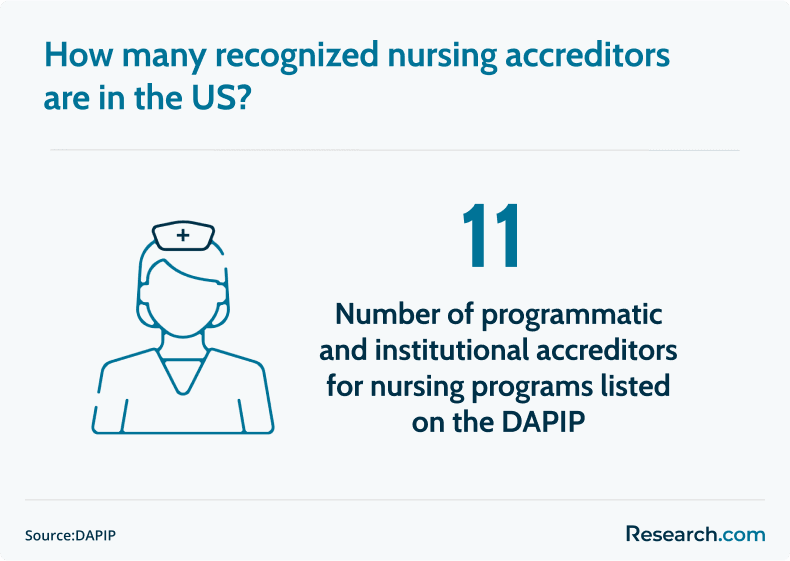
At the moment, the Database of Accredited Postsecondary Institutions and Programs (DAPIP) lists 11 programmatic and institutional accreditors for nursing programs.
Main nursing accrediting bodies in the United States
Several organizations play a role in nursing education oversight, but students most often encounter two national nursing accreditors: the Accreditation Commission for Education in Nursing and the Commission on Collegiate Nursing Education. State boards of nursing are also critical because they determine whether programs meet state approval requirements for licensure eligibility.
| Organization | Role in nursing education | Programs commonly associated with the organization |
| Accreditation Commission for Education in Nursing (ACEN) | Reviews nursing programs across multiple education levels. | Practical nursing, diploma, associate, baccalaureate, master’s, post-master’s certificate, and doctoral nursing programs. |
| Commission on Collegiate Nursing Education (CCNE) | Focuses on collegiate nursing education quality and outcomes. | Baccalaureate, graduate, and doctoral nursing programs. |
| State boards of nursing | Approve nursing programs for state licensure purposes and determine whether graduates can pursue the NCLEX under state rules. | Programs operating within the state’s jurisdiction. |
| Specialized nursing accreditors | Review focused advanced practice areas when applicable. | Specialized fields such as nurse anesthesia or midwifery programs. |
The structure is similar in many healthcare fields: professional programs often need recognition from specialized accreditors or approving agencies. Students exploring other allied health credentials, such as occupational therapy certifications and specialties, may see similar quality-control systems.
For nursing students, the most important action is not memorizing accreditor names. It is confirming that the exact program, degree level, and campus or delivery format you plan to attend is listed correctly by an official source.
What accreditors review when evaluating a nursing program
Accreditation is more than a paperwork exercise. Accrediting bodies review whether a program has the people, curriculum, clinical partnerships, student services, assessment processes, and improvement systems needed to educate competent nurses. The review is designed to protect students and the public.
Common evaluation areas include:
- Faculty qualifications: Reviewers examine whether instructors have appropriate nursing credentials, licenses, teaching preparation, clinical experience, and professional development.
- Curriculum quality: The program must show that required courses cover core nursing knowledge, clinical judgment, ethics, patient safety, evidence-based practice, communication, and current healthcare expectations.
- Clinical learning: Accreditors look at supervised clinical placements, simulation experiences, healthcare partnerships, and whether students receive appropriate hands-on preparation.
- Student outcomes: Programs are expected to monitor indicators such as NCLEX pass rates, graduation rates, job placement, and student satisfaction.
- Academic and student support: Reviewers consider advising, tutoring, technology access, libraries, laboratories, and other resources that help students complete the program.
- Program governance: The nursing program must have clear leadership, policies, assessment systems, and processes for responding to problems.
- Continuous improvement: Accreditation requires programs to collect data, evaluate results, and make changes when outcomes or standards indicate a need.
These criteria also matter for students planning beyond initial licensure. A nurse who wants to enter research, academia, or advanced clinical leadership later may need degrees that are recognized by graduate programs, including options such as the best BSN to PhD nursing programs online.
Current capacity challenges make quality review even more important. In 2023, CNN reported that nursing school faculty shortages reduced the number of students programs could enroll. In 2022, more than 66,000 qualified nursing students were denied acceptance into their bachelor's programs.
How often nursing programs renew accreditation
Accreditation is not permanent. Nursing programs must periodically show that they still meet standards and that they are using outcome data to improve. Renewal timelines depend on the accreditor, the program level, and prior review findings.
| Accreditor | Typical accreditation review cycle | What renewal usually involves |
| ACEN | Programs are typically reviewed every six to eight years, depending on the program level and prior findings. | Self-study, outcome reporting, peer review, and site evaluation. |
| CCNE | Accreditation is usually awarded for either five or ten years, depending on the review outcome. | Program documentation, standards review, outcome evidence, and a site visit. |
During renewal, programs commonly need to provide updated information on curriculum changes, faculty credentials, student achievement, clinical partnerships, NCLEX outcomes, graduation data, and improvement plans. The process is meant to ensure that a program does not rely on an old approval while failing to keep pace with current nursing education expectations.
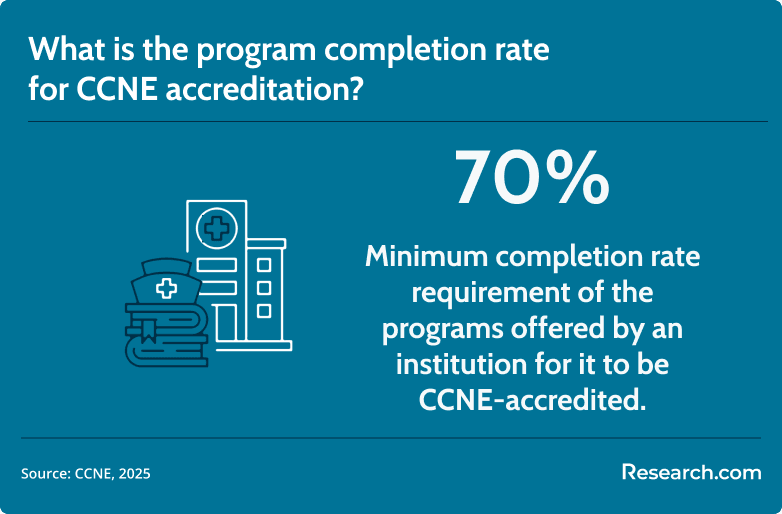
One requirement from CCNE for program accreditation is a 70% completion rate of nursing programs at an institution.
How to verify a nursing program’s accreditation status
Never rely only on a school’s brochure, social media post, admissions script, or “approved” language. Verification should come from official sources. Before you apply, and again before you enroll, confirm that the exact nursing program is accredited or approved in the way you need.
- Search the accreditor’s official directory. Look up the school and nursing program in the ACEN or CCNE database, depending on the program type.
- Check the U.S. Department of Education database. The Database of Accredited Postsecondary Institutions and Programs can help confirm recognized institutional and programmatic accreditation information.
- Review your state board of nursing website. State approval is essential because boards determine whether a program qualifies graduates for NCLEX eligibility under state rules.
- Ask the school for documentation. Request the accreditor name, accreditation status, next review date, state board approval status, and whether the status applies to your campus or online format.
- Confirm the program level. A school may have one accredited nursing degree but not another. Verify the exact ADN, ASN, BSN, MSN, DNP, certificate, bridge, or practical nursing option you intend to enter.
- Watch for misleading phrases. Terms such as “licensed,” “authorized,” “candidate,” “seeking accreditation,” or “approved to operate” may not mean the nursing program is accredited.
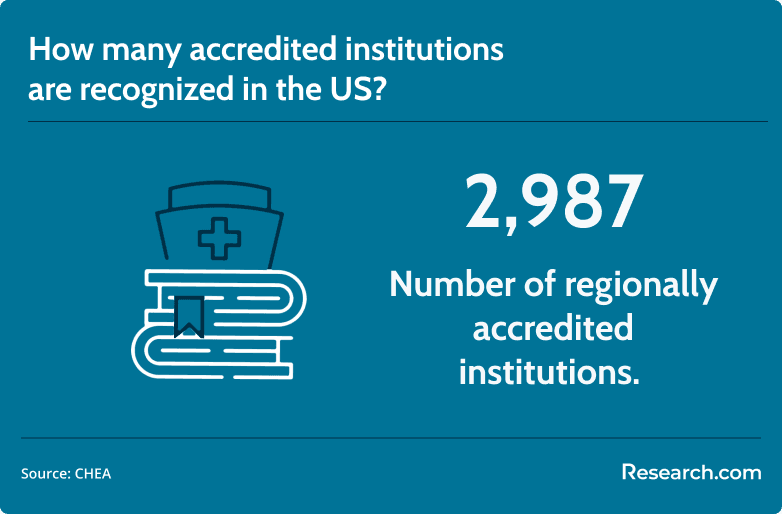
Use official directories rather than marketing claims. The Council for Higher Education Accreditation (CHEA) has nearly 3,000 records of regionally accredited institutions, as of 2027.
Trusted places to find accredited nursing programs
The safest way to research nursing accreditation is to use multiple official sources. A school website can be a useful starting point, but it should not be the final proof.
| Resource | Best use | What to look for |
| ACEN directory | Verifying programs accredited by the Accreditation Commission for Education in Nursing. | Program name, degree level, location, accreditation status, and review information. |
| CCNE directory | Checking baccalaureate, graduate, and doctoral nursing programs accredited by CCNE. | Exact institution, degree level, accreditation term, and program details. |
| U.S. Department of Education DAPIP | Confirming recognized accreditation records for institutions and programs. | Institutional accreditor, programmatic accreditor, and recognition details. |
| CHEA database | Reviewing recognized accreditors and accredited institutions. | Accreditor type, institution records, and recognition information. |
| State board of nursing | Determining whether a program is approved for licensure eligibility in a specific state. | Approved program lists, warning notices, NCLEX eligibility rules, and program status changes. |
If any source conflicts with what the school says, pause your application and ask for written clarification. Accreditation or approval issues can affect your timeline, financial aid planning, licensing eligibility, and job search.
Why NCLEX pass rates, graduation rates, and outcomes should influence your decision
Accreditation tells you that a program has met formal standards, but outcomes show how students are actually performing. NCLEX pass rates, completion rates, graduation rates, and job placement information help you judge whether the program supports students from admission through licensure.
Strong outcomes can suggest that a program has effective teaching, appropriate admissions standards, useful clinical experiences, and student support systems. Weak or declining outcomes do not automatically mean you should reject a program, but they should lead to deeper questions.
| Outcome measure | Why it matters | Questions to ask the school |
| NCLEX pass rate | Shows whether graduates are prepared for the licensing exam. | What is the most recent pass rate, and how does it compare with state expectations? |
| Graduation or completion rate | Indicates whether students are able to finish the program within expected timelines. | What percentage of admitted students complete the nursing sequence? |
| Job placement | Can show whether local employers hire program graduates. | Which employers recruit graduates, and how is placement data collected? |
| Student support | Support services can affect persistence, exam preparation, and clinical success. | What tutoring, remediation, advising, simulation, and NCLEX preparation resources are available? |
| Clinical placement quality | Nursing requires supervised practice in real healthcare or simulation settings. | Who arranges clinical placements, and where do students complete them? |
Do not choose a program based on a single number. Compare outcomes across several years if available, ask whether results differ by campus or delivery format, and find out what the school does when students struggle.
Accredited vs. non-accredited nursing programs: practical trade-offs
A non-accredited or poorly recognized nursing program may seem attractive if it is cheaper, faster, easier to enter, or heavily advertised. The problem is that nursing education is tied to licensure and employer trust. A shortcut that blocks NCLEX eligibility or transfer options can become more expensive than a higher-tuition accredited program.
| Program choice | Potential advantage | Main risk | When it may make sense |
| Accredited nursing program | Stronger recognition for licensure, employment, transfer, and future education. | Admission may be competitive, and clinical schedules can be demanding. | Best choice for most students pursuing nursing licensure or advancement. |
| State-approved but not nationally accredited program | May still qualify graduates for licensure in some situations, depending on state rules. | May limit transfer, graduate school admission, employer options, or mobility. | Only consider after confirming NCLEX eligibility and long-term consequences in writing. |
| Program seeking accreditation | May be new, expanding, or designed around current workforce needs. | Accreditation is not guaranteed, and timing may affect your cohort. | Consider only if you understand the risk and have verified state approval. |
| Unaccredited or unclear program | May advertise convenience, fast completion, or low cost. | Could fail to support licensure, employment, transfer, or advanced study. | Usually not advisable for students seeking a recognized nursing career path. |
Common mistakes students make when checking nursing accreditation
Many accreditation problems happen because students assume instead of verify. Avoid these mistakes before paying application fees, signing enrollment agreements, or accepting financial aid.
- Assuming school accreditation covers the nursing program. Institutional accreditation and nursing program accreditation are not the same thing.
- Confusing state approval with national accreditation. Both can matter, but they serve different purposes.
- Checking only the main campus. Accreditation status may vary by location, branch, or delivery format.
- Ignoring online or hybrid clinical requirements. Online coursework does not eliminate the need for approved clinical experiences.
- Choosing based only on tuition. A lower-cost program can become expensive if credits do not transfer or licensure eligibility is uncertain.
- Not asking about outcomes. Accreditation is important, but NCLEX pass rates, completion data, and clinical support also matter.
- Believing “pending accreditation” means approved. A program seeking accreditation has not necessarily earned it.
- Waiting until graduation to verify requirements. Licensure and accreditation questions should be answered before enrollment.
Questions to ask before choosing a nursing program
Use these questions when speaking with admissions counselors, nursing advisors, financial aid staff, and state board representatives. Ask for written answers whenever possible.
- Is the institution accredited, and by which accreditor?
- Is the specific nursing program accredited, and by which nursing accreditor?
- Is the program approved by the state board of nursing for NCLEX eligibility?
- Does accreditation apply to my campus, online option, hybrid format, or cohort?
- What are the program’s most recent NCLEX pass rates?
- What percentage of students complete the program?
- How are clinical placements arranged, and where do students train?
- What happens if a student fails a course, clinical requirement, or NCLEX predictor exam?
- Will credits transfer to BSN, MSN, or doctoral nursing programs?
- Do local employers hire graduates from this program?
- Is the program under warning, probation, show-cause status, or special monitoring?
- When is the next accreditation review?
Current trends making accreditation even more important
Nursing education is changing quickly. Accreditation helps students evaluate whether a program is responding to these changes rather than relying on outdated practices.
- Clinical placement pressure: Programs must secure appropriate clinical learning sites even as healthcare systems face staffing and capacity challenges.
- Faculty shortages: As reported by CNN in 2023, faculty shortages have affected how many qualified students nursing schools can admit.
- Growth in online and hybrid learning: Flexible formats can help working adults, but students still need verified clinical training and state approval.
- Greater focus on outcomes: NCLEX performance, completion data, and job placement are increasingly important indicators for students comparing programs.
- Technology and informatics expectations: Nurses increasingly use electronic health records, data tools, simulation, telehealth systems, and decision-support technology, making curriculum quality more important.
- Advanced practice and specialization: Students considering future graduate study should choose programs that will be recognized by later admissions committees and employers, including pathways such as MSN health informatics careers.
What graduates say about accredited nursing programs
- Patrice: "My accredited online nursing program let me manage work and family responsibilities while still knowing the curriculum met recognized standards. Passing the NCLEX on my first attempt made me feel that the training, faculty support, and clinical preparation had been worth the effort."
- Brandi: "Accreditation mattered because it helped me qualify for federal financial aid and a state-funded scholarship. The online courses were structured, the simulation work made the lessons practical, and I felt more confident knowing the program had been reviewed by an outside body."
- Barney: "I chose an accredited online program because I wanted my degree to be recognized by employers. After passing the NCLEX, I was able to move into a hospital role quickly, and the advising support helped me stay on track throughout the program."
References
- CCNE. (2025). Procedures for Accreditation of Baccalaureate and Graduate Nursing Programs. In CCNE. https://www.aacnnursing.org/portals/0/PDFs/CCNE/Procedures.pdf
- DAPIP. (n.d.). https://ope.ed.gov/dapip/#/agency-list
- Luhby, T. (2023). Nursing schools are turning away thousands of applicants during a major nursing shortage. Here’s why. CNN. https://edition.cnn.com/2023/10/05/business/nursing-staff-shortage-school-enrollmentDAPIP agency list
Key Insights
- Nursing accreditation is a formal quality review of a nursing program’s curriculum, faculty, clinical training, outcomes, and student support.
- Students should verify both institutional accreditation and programmatic nursing accreditation because they are not the same.
- State board approval is essential for licensure eligibility; national accreditation can also affect employment, transfer, graduate study, and professional mobility.
- ACEN and CCNE are the main national nursing accreditors students commonly encounter, while state boards of nursing determine licensure-related approval.
- NCLEX pass rates, completion rates, job placement information, and clinical placement quality should be reviewed alongside accreditation status.
- Programs that are “seeking,” “pending,” or “approved to operate” are not automatically accredited. Confirm status through official directories.
- The safest approach is to verify accreditation before applying, before enrolling, and before paying significant tuition or fees.
Other Things You Should Know About Nursing Accreditation
To verify a nursing program's accreditation in 2027, check the official website of the accrediting body, such as the ACEN or CCNE, or the U.S. Department of Education's database of accredited institutions. Direct inquiries to the nursing program or academic advisor can also confirm the accreditation status.
Accreditation status for nursing programs in 2027 is determined by various criteria including curriculum quality, faculty qualifications, student outcomes, and institutional resources. Accrediting bodies like CCNE and ACEN evaluate these factors to ensure programs meet established standards.
The main nursing program accreditors are the Commission on Collegiate Nursing Education (CCNE) and the Accreditation Commission for Education in Nursing (ACEN). Both are recognized by the U.S. Department of Education, and many employers and licensing boards look for one of these approvals.


