
2027 Best Online Nursing Programs in Pennsylvania: Accredited RN to BSN Programs

Co-Founder and Chief Data Scientist
Registered nurses in Pennsylvania who already hold an ADN or nursing diploma often look at RN to BSN programs for one main reason: they want broader career options without stepping away from work. A BSN can strengthen preparation in leadership, population health, evidence-based practice, care coordination, and graduate nursing pathways. That matters in Pennsylvania, where 2023 reports indicate that the state will need around 26,000 more qualified nurses by 2026 to meet healthcare demands.
This guide is designed for licensed RNs comparing online and hybrid RN to BSN programs in Pennsylvania. It explains what these programs include, how long they take, what they cost, how to check accreditation, how online study compares with campus learning, and which career paths may become more accessible after earning the BSN. It also highlights ranked programs, licensing considerations, common selection mistakes, and practical questions to ask before enrolling.
Quick Answer: Is an Online RN to BSN Program in Pennsylvania Worth Considering?
An online RN to BSN program in Pennsylvania can be a practical choice for working registered nurses who want to keep practicing while completing a bachelor’s degree. The strongest candidates are RNs who already have an ADN or diploma, hold or are eligible for RN licensure, can manage independent coursework, and want better preparation for leadership, public health, graduate study, or specialized nursing roles.
The decision should not be based on convenience alone. Before applying, confirm that the program is properly accredited, fits your schedule, accepts your transfer credits, offers meaningful faculty support, and aligns with your career goals. Cost also matters: online RN to BSN programs in Pennsylvania typically range from approximately $13,000 to over $35,000, with cost per credit commonly ranging from $320 to more than $610.
What are the benefits of getting an online RN to BSN degree in Pennsylvania?
- A BSN can support roles such as registered nurse, nurse manager, public health nurse, case manager, nurse navigator, or graduate nursing student.
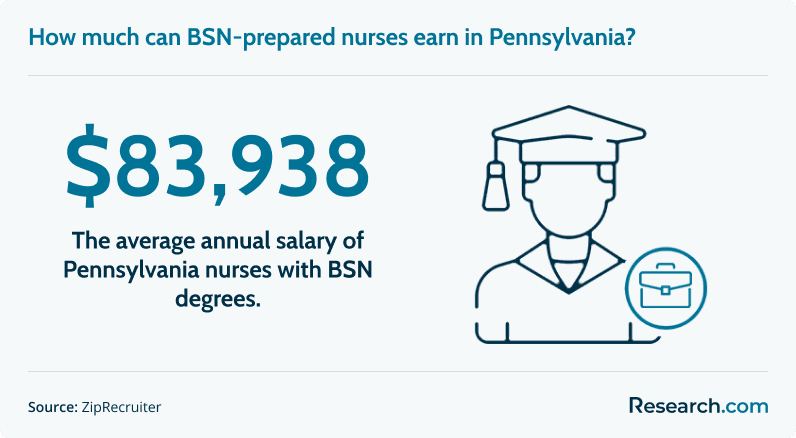
- BSN graduates in Pennsylvania earn $83,938 per year, according to the salary source cited in this article.
- Online and hybrid formats can make degree completion more realistic for RNs balancing shifts, family responsibilities, and continuing education requirements.
What can I expect from an online RN to BSN nursing degree in Pennsylvania?
An RN to BSN program is a bachelor’s-completion pathway for registered nurses who already have prior nursing education. It does not replace initial RN preparation. Instead, it builds on existing clinical experience and adds upper-division nursing coursework in areas such as leadership, community health, research, health assessment, quality improvement, ethics, informatics, and evidence-based practice.
- A nursing degree prepares students to deliver safe, ethical, and patient-centered care across healthcare settings.
- Pursuing an online RN to BSN program in 2026 may cost over $6,000, although total price depends on tuition, fees, transfer credits, books, and whether the school charges in-state or out-of-state rates.
- Full-time students may finish in 12 to 18 months, while part-time learners may need up to 4 years.
- Because BSN programs include broader coursework than many ADN or diploma pathways, they may support stronger advancement opportunities.
- Common course areas include medical-surgical nursing, mental health nursing, community health nursing, leadership, evidence-based practice, and health assessment.
| Factor | What it means for RN to BSN students | Why it matters |
| Program format | Fully online, hybrid, accelerated, or part-time | Your schedule must fit shift work, clinical responsibilities, and family obligations. |
| Transfer credits | Schools may apply ADN, diploma, general education, or RN license credits toward the BSN | More accepted credits can reduce time and total cost. |
| Accreditation | Look for recognized nursing accreditation such as CCNE or ACEN | Accreditation can affect graduate school eligibility, employer recognition, and educational quality. |
| Clinical or practice-based requirements | RN to BSN programs may include projects, community health experiences, or practice-based assignments | You need to know whether any in-person or local site work is required. |
| Career support | Advising, resume help, alumni networks, employer partnerships, and graduate school planning | Support services can help translate the BSN into advancement opportunities. |
Where can I work with an online RN to BSN degree in Pennsylvania?
BSN-prepared nurses in Pennsylvania may work in hospitals, outpatient clinics, long-term care facilities, rehabilitation centers, community health organizations, schools, home health agencies, public health departments, insurance organizations, and healthcare administration offices.
The BSN can also serve as preparation for graduate nursing education. Nurses who want to become nurse practitioners, nurse anesthetists, nurse midwives, educators, researchers, or healthcare leaders often use the BSN as the next academic step before entering MSN, DNP, or certificate programs.
How much can I make with an online RN to BSN degree in Pennsylvania?
BSN-prepared RNs in Pennsylvania earn an average salary of $83,938 each year, based on the salary source cited in the references. Actual earnings can vary by employer, region, shift differential, years of experience, specialty, union status, overtime, and leadership responsibilities.
Advancement can change earning potential. For example, nurse managers/supervisors in Pennsylvania earn an average of $95,183 each year. A BSN does not guarantee a specific salary, but it may help qualify nurses for roles that require or prefer bachelor’s-level preparation.
- Best Online RN to BSN Programs in Pennsylvania for 2027
- How long does it take to become a nurse in Pennsylvania?
- How does an online nursing program compare to an on-campus program?
- What is the average cost of an online RN to BSN program in Pennsylvania?
- What are the prerequisites for enrolling in an online RN to BSN program in Pennsylvania?
- What courses are typically in an online RN to BSN program in Pennsylvania?
- What types of specializations are available in an online RN to BSN program in Pennsylvania?
- How to choose the best online RN to BSN program in Pennsylvania?
- How to get your nursing certification/license in Pennsylvania?
- What career paths are available for graduates of online RN to BSN programs in Pennsylvania?
- What accreditation and quality standards should I look for in an online RN to BSN program in Pennsylvania?
- Career Advancement Opportunities for RN to BSN Graduates in PennsylvaniaCareer roles after the BSN
- Do online RN to BSN programs provide dedicated career support and networking opportunities?
- How are emerging healthcare technologies integrated into online RN to BSN curricula in Pennsylvania?
- What is the job market for graduates of an online RN to BSN program in Pennsylvania?
- How do online RN to BSN programs foster cultural competence and diversity in Pennsylvania?
- What financial aid options are available for online RN to BSN students in Pennsylvania?
- How do online RN to BSN programs accommodate working professionals in Pennsylvania?
- The Importance of Advanced Education Pathways for Pennsylvania's NursesFlexible RN to BSN study options
- What Are the Licensing and Regulatory Considerations for Online RN to BSN Graduates in Pennsylvania?
- How Do Online RN to BSN Programs Foster Interprofessional Collaboration in Pennsylvania?
- What Are the Success Metrics and Post-Graduation Outcomes for Online RN to BSN Graduates in Pennsylvania?
- How Can an RN to BSN Degree Accelerate the Transition to Advanced Practice Nursing?
- What Non-Clinical Career Paths Complement an RN to BSN Degree in Pennsylvania?
- Can an Online RN to BSN Degree Lead to a Career as a Nurse Midwife in Pennsylvania?
- Accessible Nursing Programs in PennsylvaniaWorking RN program formatsPennsylvania nursing job marketAdditional nursing program options
Best Online RN to BSN Programs in Pennsylvania for 2027
How do we rank schools?
This ranked list focuses on online and hybrid RN to BSN options in Pennsylvania. Program data and institutional context were reviewed using the IPEDS database, Peterson's database, the College Scorecard database, and the National Center for Education Statistics (NCES). Research.com also applies a transparent ranking methodology so students can compare programs using consistent criteria rather than marketing claims alone.
Use this ranking as a starting point, not as the only deciding factor. The best program for you depends on your transfer credits, employer tuition benefits, work schedule, desired completion speed, and whether the curriculum supports your next career step.
1. The Pennsylvania State University - Abington, RN to BSN
The Pennsylvania State University - Abington offers a hybrid RN to BSN pathway built for licensed nurses who want to connect prior nursing experience with bachelor’s-level study. Students may explore nurse scholarship opportunities and gain access to a large university alumni network.
- Program length: 22 months
- Cost per Credit: $368 (in-state); $571 (out-of-state)
- Required Credits to Graduate: 120 (including transfer credits)
- Accreditation: Commission on Collegiate Nursing Education (CCNE)
2. La Salle University, RN to BSN
La Salle University provides an online RN to BSN program focused on clinical judgment, compassionate practice, care quality, patient safety, and continued professional learning. Its accelerated structure may appeal to RNs who want a shorter completion timeline.
- Program length: 12 to 24 months
- Cost per Credit: $450
- Required Credits to Graduate: 27
- Accreditation: CCNE
3. Drexel University, RN to BSN
Drexel University's online RN to BSN program is intended for nurses who entered the profession through an associate degree or nursing diploma. Qualified students may also consider the RN/BSN/MSN pathway by sub-matriculating into the MSN while enrolled in the BSN.
- Program length: 12 months
- Cost per Credit: $622
- Required Credits to Graduate: 180 quarter credits (up to 135 transferable)
- Accreditation: CCNE
4. Immaculata University, RN to BSN
Immaculata University offers an RN to BSN program centered on patient-focused care and evidence-based nursing. The university has educated nurses for over 25 years and prepares students for expanded professional responsibilities in healthcare environments.
- Program length: 2 years or less
- Cost per Credit: $465
- Required Credits to Graduate: 125 (72 transfer credits)
- Accreditation: CCNE
5. Elizabethtown College, RN to BSN
Elizabethtown College offers a fully online RN to BSN option for licensed RNs with an ADN or nursing diploma. The program emphasizes knowledge integration, collaborative practice, and caring partnerships with patients, families, and interprofessional teams.
- Program length: 12 months
- Cost per Credit: $525.00
- Required Credits to Graduate: 125 (including transfer credits)
- Accreditation: CCNE
6. Waynesburg University, RN to BSN
Waynesburg University allows nurses to transfer 35 credits from associate degree or diploma preparation and RN licensure. Students who have completed Statistics and Ethics coursework may transfer an additional six credits.
- Program Length: 12 months
- Cost per Credit: $400
- Required Credits to Graduate: 33-39
- Accreditation: CCNE
7. York College of Pennsylvania, RN to BSN
York College of Pennsylvania offers an RN to BSN pathway in which bachelor’s degree holders complete required nursing and support courses. Preferred tuition may extend to spouses, family members, and military members.
- Program Length: 1 year
- Cost per Credit: $347
- Required Credits to Graduate: 75
- Accreditation: CCNE
8. Saint Joseph's University, RN to BSN
Saint Joseph's University offers an RN to BSN program with individualized scheduling. Students who already hold a bachelor’s degree may also be considered for admission into the university’s MSN program.
- Program Length: 22 months
- Cost per Credit: $670
- Required Credits to Graduate: 120
- Accreditation: CCNE
9. Moravian University, RN to BSN
Moravian University provides a fully online RN to BSN degree with start dates every eight weeks. The curriculum highlights evidence-supported nursing, professional leadership, and community health.
- Program Length: Varies
- Tuition: $25,034.50/semester
- Required Credits to Graduate: 128
- Accreditation: CCNE
10. Bloomsburg University, RN to BSN
Bloomsburg University offers an RN to BSN program with a long-standing reputation in nursing education. The program is designed for adult learners seeking a broader academic foundation for professional nursing practice.
- Program Length: Varies
- Tuition: $7,716-$19,290
- Required Credits to Graduate: 120
- Accreditation: CCNE
Program comparison at a glance
| School | Program length | Cost or tuition listed | Credits listed | Accreditation |
| The Pennsylvania State University - Abington | 22 months | $368 (in-state); $571 (out-of-state) | 120 (including transfer credits) | CCNE |
| La Salle University | 12 to 24 months | $450 | 27 | CCNE |
| Drexel University | 12 months | $622 | 180 quarter credits (up to 135 transferable) | CCNE |
| Immaculata University | 2 years or less | $465 | 125 (72 transfer credits) | CCNE |
| Elizabethtown College | 12 months | $525.00 | 125 (including transfer credits) | CCNE |
| Waynesburg University | 12 months | $400 | 33-39 | CCNE |
| York College of Pennsylvania | 1 year | $347 | 75 | CCNE |
| Saint Joseph's University | 22 months | $670 | 120 | CCNE |
| Moravian University | Varies | $25,034.50/semester | 128 | CCNE |
| Bloomsburg University | Varies | $7,716-$19,290 | 120 | CCNE |
What do online RN to BSN students in Pennsylvania often value?
Students who choose online nursing programs commonly point to three advantages: schedule control, the ability to remain employed, and continued access to instructors and classmates through digital platforms. Those benefits can be especially important for RNs working rotating shifts or caring for family members.
- Meryl’s experience: Online learning made it possible to balance work, family obligations, virtual simulations, and peer interaction while continuing toward a nursing goal.
- Jane’s experience: The ability to study around family responsibilities, use online resources, and collaborate with classmates made the format manageable.
- Shane’s experience: Asynchronous coursework and faculty support helped make the transition to online nursing study less intimidating while continuing part-time work.
Key Findings
- RN program enrollment in Pennsylvania has increased by 49% since 2023.
- Pennsylvania nursing pathways include CNA, LPN, RN, APRN, and CRNA routes, each with different education and licensing requirements.
- An MSN or a DNP adds another two to three years to the overall nursing program length.
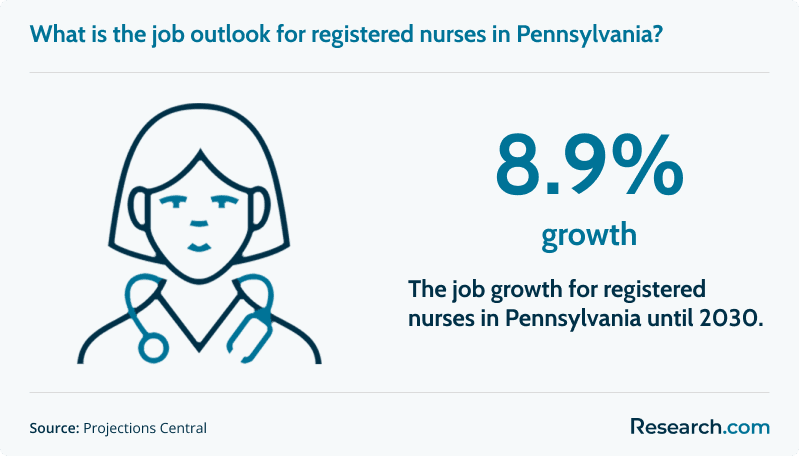
- Employment for RNs in Pennsylvania is expected to grow by 8.9% until 2030.
- A BSN is not the only path into nursing, but it can support leadership, specialization, graduate education, and broader employment mobility.
How long does it take to become a nurse in Pennsylvania?
A traditional BSN usually takes four years, similar to many bachelor’s degrees. Students also need time to prepare for and pass the National Council Licensure Examination for Registered Nurses (NCLEX-RN) before becoming licensed RNs.
For those starting with an ADN, becoming an RN can take two to three years. A BSN route generally takes four years. Licensed RNs who later enter RN to BSN programs may finish the bachelor’s-completion portion in 12 to 18 months full time or up to 4 years part time.
Advanced practice nursing takes longer. After becoming an RN, nurses may pursue an MSN, which adds another two to three years, or a DNP, which may require one to three more years after the MSN. Some nurses use RN to MSN online programs to move more directly toward graduate-level preparation.
How does an online RN to BSN program compare to an on-campus program?
Online RN to BSN programs offer flexibility, but they are not necessarily easier than campus programs. Students still complete readings, discussions, papers, projects, exams, and practice-based assignments. The main difference is how and when much of the learning takes place.
| Option | Best for | Potential drawbacks |
| Fully online RN to BSN | Working RNs who need maximum schedule flexibility | Requires strong self-management, reliable technology, and comfort with virtual learning platforms |
| Hybrid RN to BSN | Students who want online coursework but still value some in-person interaction | May require travel to campus or scheduled sessions that conflict with work shifts |
| On-campus RN to BSN | Students who prefer face-to-face learning and direct campus access | Less flexible for nurses working full time or rotating shifts |
Students considering online nursing school should evaluate more than convenience. Ask whether courses are asynchronous or live, whether faculty respond quickly, whether technical support is available outside regular hours, and whether any campus visits or local practice experiences are required.
What is the average cost of an online RN to BSN program in Pennsylvania?
Online RN to BSN programs in Pennsylvania typically cost approximately $13,000 to over $35,000. Cost per credit commonly ranges from $320 to more than $610. The final amount may change based on transfer credits, institutional fees, books, technology charges, residency status, and whether an employer helps pay tuition.
Students searching for affordable online nursing programs should compare total program cost, not just the advertised per-credit rate. A lower tuition rate may not save money if the school accepts fewer transfer credits or requires more credits to graduate.
Questions to ask about cost before enrolling
- How many of my ADN, diploma, or general education credits will transfer?
- Is tuition charged per credit, per semester, or as a flat program rate?
- Are online learning, clinical placement, graduation, transcript, or technology fees separate?
- Does my employer offer tuition reimbursement, preferred tuition, or scholarship support?
- Will I need to reduce work hours to keep up with coursework?
What are the prerequisites for enrolling in an online RN to BSN program in Pennsylvania?
Admission requirements vary by school, but most RN to BSN programs expect applicants to have prior nursing education and RN licensure or eligibility. Requirements may also include transcripts, minimum grades in prerequisite courses, proof of employment or clinical experience, health documentation, background checks, and professional references.
- Standardized Tests. Some programs may request SAT or ACT scores for undergraduate admission or GRE scores for graduate-level nursing pathways. Some nursing programs may also require the Test of Essential Academic Skills (TEAS) or the Health Education Systems, Inc. (HESI) exam.
- CPR Certification. Many schools expect applicants to hold current CPR certification, often through organizations such as the American Heart Association or the American Red Cross.
- Background Check and Drug Screening. Nursing students may need to complete criminal background checks and drug screenings before beginning program or practice-based requirements. Certain results can affect admission or placement eligibility.
- Immunizations. Programs commonly require documentation for immunizations such as measles, mumps, rubella (MMR), hepatitis B, tetanus, diphtheria, and varicella (chickenpox).
What courses are typically in an online RN to BSN program in Pennsylvania?
RN to BSN curricula often combine advanced nursing theory with applied assignments connected to current practice. Although course names differ by school, students commonly study anatomy and physiology, nursing fundamentals, pathophysiology, pharmacology, leadership, community health, research, and quality improvement.
- Anatomy and Physiology. This area strengthens understanding of body systems, normal function, and disease-related changes so nurses can connect assessment findings to patient needs.
- Nursing Fundamentals. Foundational nursing topics reinforce patient assessment, medication administration, infection prevention, safety, documentation, and ethical care.
- Pathophysiology. Students examine how illness alters normal body processes, helping them interpret symptoms, lab results, and treatment priorities.
- Pharmacology. Coursework covers medication actions, side effects, interactions, patient teaching, safe administration, and monitoring for adverse reactions.
What types of specializations are available in online RN to BSN programs in Pennsylvania?
Most RN to BSN programs are not full specialty programs in the same way graduate NP, CNM, CNS, or CRNA programs are. However, BSN coursework can prepare nurses for later specialization by strengthening leadership, assessment, community health, research literacy, and professional practice skills.
- Nurse Practitioner (NP) Specializations. Nurses interested in primary or specialty care can use the BSN as preparation for graduate NP programs serving populations such as families, adults, older adults, children, or psychiatric-mental health patients.
- Clinical Nurse Specialist (CNS) Specializations. CNS pathways focus on advanced clinical expertise, quality improvement, staff education, evidence-based practice, and system-level patient care improvement.
- Nurse Anesthetist (CRNA). CRNA preparation centers on anesthesia delivery, surgical patient monitoring, and post-anesthesia management in collaboration with surgical and anesthesia teams.
- Nurse Midwife (CNM). CNM pathways prepare nurses for reproductive healthcare, prenatal care, labor and delivery support, postpartum care, patient education, and holistic childbirth support.
How to choose the best online RN to BSN program in Pennsylvania?
The best online RN to BSN program is the one that is accredited, affordable for your situation, realistic for your work schedule, generous with valid transfer credits, and connected to your professional goals. Rankings can help narrow options, but they should not replace a detailed program review.
- Accreditation. Confirm that the nursing program meets recognized academic and professional standards. Accreditation can influence graduate school options, employer confidence, and educational quality.
- Program focus. Review whether the curriculum supports your goals in bedside nursing, leadership, public health, healthcare administration, graduate study, or another nursing pathway. Broader nursing degree options may be useful if you are still comparing paths.
- Practice-based requirements. Ask where projects, clinical-style experiences, or community health assignments can be completed and whether your current workplace may qualify.
- Student and alumni feedback. Talk with current students, alumni, and nurse colleagues about faculty availability, workload, scheduling, advising, and career outcomes.
| Common mistake | Why it can hurt you | Better approach |
| Choosing based only on tuition per credit | Total cost may be higher if fewer credits transfer or extra fees apply | Ask for a full degree audit and total estimated program cost |
| Ignoring accreditation | It may affect graduate school, employer recognition, or quality assurance | Verify nursing accreditation before applying |
| Assuming online means self-paced | Many programs still have weekly deadlines and group assignments | Review the course calendar and attendance expectations |
| Not checking practice requirements | You may need local site access, preceptor approval, or workplace permission | Ask how practice-based assignments are arranged |
| Relying only on rankings | A highly ranked program may not fit your schedule, budget, or goals | Use rankings together with accreditation, cost, transfer, and support data |
How to get your nursing certification/license in Pennsylvania?
Pennsylvania nursing licensure depends on the role you are pursuing. Requirements differ for CNAs, LPNs, RNs, and APRNs, so students should confirm current rules with the Pennsylvania State Board of Nursing before making enrollment decisions.
- Certified Nursing Assistant (CNA). Complete a state-approved CNA training program, pass the state competency exam, and apply for listing on the Pennsylvania CNA registry.
- Licensed Practical Nurse (LPN). Complete a state-approved LPN program and pass the National Council Licensure Examination for Practical Nurses (NCLEX-PN). LPNs work under the supervision of RNs and physicians.
- Registered Nurse (RN). Pennsylvania offers multiple RN pathways, including diploma, ADN, and BSN options. Applicants must pass the NCLEX-RN exam and complete three hours of approved training on child abuse recognition and reporting for initial RN licensure.
- Advanced Practice Registered Nurse (APRN). Pennsylvania APRN pathways include NP, CNM, and CRNA roles. These typically require graduate-level nursing education and national certification in the chosen specialty.
RNs licensed in other states may apply for licensure by endorsement through the Pennsylvania State Board of Nursing. Applicants generally provide proof of current licensure, RN training, and a criminal background check from their home state. Pennsylvania nurses also need to renew their licenses every two years.
What career paths are available for graduates of online RN to BSN programs in Pennsylvania?
A BSN can help RNs pursue broader responsibilities in clinical care, supervision, population health, and care coordination. Some nurses also compare RN to BSN programs with other entry or bridge options, including accredited online LPN programs, depending on where they are in their nursing journey.
- Registered Nurse. BSN-prepared RNs work in hospitals, clinics, long-term care facilities, home health, and other settings. They may be considered for broader responsibilities than diploma- or ADN-prepared nurses in some organizations.
- Nurse Manager/Supervisor. Nurses in these roles coordinate staffing, oversee teams, support quality standards, and help maintain efficient patient care delivery.
- Public Health Nurse. Public health nurses focus on community education, disease prevention, health promotion, outreach, and advocacy.
What accreditation and quality standards should I look for in an online RN to BSN program in Pennsylvania?
Accreditation should be one of your first checks. Look for institutional accreditation and nursing program accreditation from recognized bodies such as the Commission on Collegiate Nursing Education (CCNE) or the Accreditation Commission for Education in Nursing (ACEN). These reviews evaluate curriculum quality, faculty preparation, student learning, and program outcomes.
Accreditation is especially important if you plan to continue into graduate nursing study or move into leadership roles. It also helps ensure that the program aligns with professional expectations. Students who are still mapping their pathway can review this guide on how to become an RN in Pennsylvania.
Career Advancement Opportunities for RN to BSN Graduates in Pennsylvania
The BSN can be a career inflection point for nurses who want to move beyond routine staff assignments. It does not automatically create a promotion, but it can help meet employer preferences for leadership, specialty, public health, teaching, or graduate nursing preparation.
1. Leadership and Management Roles
BSN-prepared nurses may pursue roles such as charge nurse, nurse supervisor, clinical nurse manager, or unit-based leader. These positions usually require strong communication, staffing judgment, quality oversight, and the ability to support other nurses during complex patient care situations.
2. Specialized Nursing Roles
Some nurses use the BSN to move toward specialty areas such as pediatrics, oncology, cardiology, geriatrics, or mental health. Specialty transitions may also require experience, employer training, or certification beyond the BSN.
3. Nurse Educator or Clinical Instructor
Nurses who enjoy teaching may use the BSN as a step toward academic or clinical education roles. Some teaching positions require graduate study, but BSN-level preparation can strengthen mentoring, precepting, and staff-development skills.
4. Nurse Navigator or Case Manager
Nurse navigators and case managers help coordinate care, communicate with patients and families, connect services, and support transitions across healthcare settings. These roles require clinical knowledge, organization, and familiarity with healthcare systems.
5. Advanced Practice Roles and Nurse Practitioner Programs
For nurses planning to become NPs or other advanced practice clinicians, the BSN is often the academic bridge to graduate nursing programs. Nurses considering a broader career shift into nursing may also compare options such as an online nursing degree for non nurses.
6. Research and Policy Roles
BSN-prepared nurses may also contribute to quality improvement, public health projects, healthcare policy, or research support. These paths are a fit for nurses who want to improve systems of care, not only individual patient encounters.
Do online RN to BSN programs provide dedicated career support and networking opportunities?
Many online RN to BSN programs offer career services, but the quality and depth vary. Useful services may include resume reviews, interview preparation, graduate school advising, employer connections, alumni networking, virtual career events, and guidance on specialty nursing paths.
Ask whether online students receive the same career support as campus students. Strong advising can help you connect the BSN to next-step roles, including specialized careers such as nutrition nurse.
How are emerging healthcare technologies integrated into online RN to BSN curricula in Pennsylvania?
Technology is now part of daily nursing practice, so RN to BSN programs increasingly include digital tools tied to patient care and healthcare operations. Coursework may involve virtual simulation, telehealth concepts, electronic health record use, informatics, data-informed quality improvement, and online collaboration.
When comparing programs, ask how technology is taught and assessed. A strong curriculum should help nurses use digital systems to improve communication, documentation, safety, and care coordination. Students comparing healthcare training options can also review medical assistant programs in Pennsylvania.
What is the job market for graduates of an online RN to BSN program in Pennsylvania?
The job market for Pennsylvania nurses remains favorable based on the projections cited here. Projections Central expects employment for RNs in Pennsylvania to grow by 8.9% until 2030. Since 2023, enrollment in RN programs in the state has increased by 49%.
Pennsylvania’s healthcare landscape includes hospitals, academic medical centers, outpatient networks, long-term care organizations, public health agencies, and community-based providers. A BSN may help nurses compete for roles that require stronger preparation in leadership, care coordination, health systems, and evidence-based practice.
These are what hospitals are looking for in the state right now:
How do online RN to BSN programs foster cultural competence and diversity in Pennsylvania?
RN to BSN programs often address cultural competence through coursework on health disparities, social determinants of health, community assessment, communication, ethics, and equitable care. In Pennsylvania, this preparation matters because nurses serve patients across rural, urban, suburban, immigrant, aging, and economically diverse communities.
Look for programs that use case studies, community-based projects, reflective assignments, and interprofessional discussion to help nurses care for patients whose backgrounds, beliefs, and needs differ from their own. Students comparing institutions can also review accredited nursing schools in Pennsylvania.
What financial aid options are available for online RN to BSN students in Pennsylvania?
Online RN to BSN students may be able to use federal aid, state scholarships, institutional awards, employer tuition reimbursement, payment plans, loans, and funding from nursing organizations. Eligibility depends on enrollment status, school policies, financial need, academic standing, and employer rules.
Before borrowing, ask the school for a full cost estimate and compare it with your expected career benefit. Nurses exploring alternative pathways can also review how to become an LVN nurse in Pennsylvania.
How do online RN to BSN programs accommodate working professionals in Pennsylvania?
Most RN to BSN students are already employed nurses, so program design matters. The strongest online options reduce unnecessary scheduling barriers while still maintaining academic rigor.
- Asynchronous Course Delivery: Many programs allow students to review lectures, post discussions, and complete assignments outside fixed class meeting times.
- Accelerated and Extended Pathways: Fast tracks may suit students who can handle heavier course loads, while part-time options help nurses balance full-time work.
- Customized Clinical Placement Options: Some programs help students complete practice-based requirements at their workplace or near their community, when allowed.
- Modular Learning Structure: Shorter course blocks can help students focus on fewer subjects at once while maintaining progress.
- Career Support Services: Resume help, interview preparation, and job search support can assist students who want advancement while finishing the degree.
- Access to 24/7 Online Resources: Digital libraries, course platforms, and technical support can make late-night or off-shift study more manageable.
The Importance of Advanced Education Pathways for Pennsylvania's Nurses
The BSN can be the foundation for advanced nursing education. Nurses who want greater clinical autonomy, specialized practice, or leadership responsibilities often continue into MSN, DNP, certificate, or nurse practitioner programs after completing the BSN.
If your long-term goal is advanced practice, compare RN to BSN programs based on graduate school preparation, advising, research coursework, and academic partnerships. Nurses focused on advanced clinical roles can explore nurse practitioner programs in Pennsylvania to understand possible next steps.
What Are the Licensing and Regulatory Considerations for Online RN to BSN Graduates in Pennsylvania?
RN to BSN programs are typically designed for nurses who already hold RN licensure, so the BSN itself does not replace state licensing requirements. However, students should still confirm that the program aligns with Pennsylvania expectations, especially if they plan to move, pursue graduate study, or complete practice-based requirements in another state.
Program advisors should be able to explain licensure renewal expectations, continuing education requirements, child abuse recognition and reporting training, and any state-specific obligations. For a deeper overview, review nursing license requirements in Pennsylvania.
How Do Online RN to BSN Programs Foster Interprofessional Collaboration in Pennsylvania?
Modern nursing requires teamwork with physicians, therapists, pharmacists, social workers, case managers, administrators, and community organizations. Online RN to BSN programs may build these skills through group projects, case-based assignments, virtual simulations, and care coordination exercises.
Students who want to understand earlier nursing pathways can also review how to become an LPN in Pennsylvania.
What Are the Success Metrics and Post-Graduation Outcomes for Online RN to BSN Graduates in Pennsylvania?
Before choosing a program, ask for outcome data. Helpful indicators include graduation rates, student retention, transfer credit acceptance, faculty accessibility, alumni satisfaction, employer partnerships, graduate school admission support, and employment-related services.
NCLEX-RN pass rates are especially relevant for pre-licensure programs, while RN to BSN students should also look closely at completion rates and advancement support. Students interested in shorter routes may compare features found in the best 12 month accelerated online nursing degree program.
How Can an RN to BSN Degree Accelerate the Transition to Advanced Practice Nursing?
An RN to BSN program can help nurses prepare for graduate study by strengthening academic writing, research interpretation, leadership, health assessment, and systems thinking. These skills are useful for nurses who plan to become NPs, CNMs, CNSs, CRNAs, educators, or administrators.
If your goal is advanced practice, choose an RN to BSN program that offers strong advising and a curriculum aligned with graduate expectations. Nurses planning an NP route can review how to become a nurse practitioner in Pennsylvania.
What Non-Clinical Career Paths Complement an RN to BSN Degree in Pennsylvania?
Not every BSN-prepared nurse stays in direct bedside care. Some move into healthcare administration, quality improvement, informatics, case management, utilization review, insurance, patient safety, public health, revenue cycle management, or education support.
These roles can be a fit for nurses who want to use clinical knowledge in operational, analytical, or administrative settings. Nurses considering non-clinical healthcare work may also explore how to become a medical biller and coder in Pennsylvania.
Can an Online RN to BSN Degree Lead to a Career as a Nurse Midwife in Pennsylvania?
An online RN to BSN degree can be part of the pathway to nurse midwifery, but it is not the final credential. Nurses who want to become certified nurse midwives generally need graduate-level education, national certification, and state-specific authorization after completing the required nursing preparation.
The BSN can help build the academic foundation for advanced coursework in reproductive health, prenatal care, labor and delivery, postpartum care, and patient education. For specific next steps, review how to become a nurse midwife in Pennsylvania.
Accessible Nursing Programs in Pennsylvania
Some future nurses need programs with more flexible admission pathways, especially if they are changing careers, returning to school, or rebuilding academic credentials. Accessible nursing programs may consider prior healthcare experience, transfer credits, prerequisite completion, and personal commitment alongside GPA or test scores.
If you are still trying to enter nursing rather than complete a BSN as an already licensed RN, compare admission requirements carefully. This guide on what is the easiest nursing program to get into can help you understand which options may be more attainable.
The right program should match your current status. Licensed RNs should focus on accredited RN to BSN completion programs, while non-nurses or practical nurses may need a different pathway into the profession.
Key Insights
- An online RN to BSN program in Pennsylvania is best for licensed RNs who want bachelor’s-level preparation without leaving the workforce.
- Do not choose a program only because it is online. Accreditation, transfer credit policy, total cost, faculty support, and practice requirements are more important than convenience alone.
- Program costs vary widely. Pennsylvania online RN to BSN programs typically range from approximately $13,000 to over $35,000, and cost per credit commonly ranges from $320 to more than $610.
- Completion time depends on enrollment pace. Full-time students may finish in 12 to 18 months, while part-time students may take up to 4 years.
- A BSN can support advancement into leadership, public health, case management, specialty nursing, graduate school, and non-clinical healthcare roles, but salary and promotion outcomes are not guaranteed.
- Before enrolling, request a transcript evaluation, confirm CCNE or ACEN accreditation, ask about online student support, and verify whether any local practice-based assignments are required.
Related Articles for Nearby States
- 2027 Best Online Nursing Programs in New Jersey – Accredited RN to BSN Programs
- 2027 Best Online Nursing Programs in Delaware – Accredited RN to BSN Programs
- 2027 Best Online Nursing Programs in Maryland – Accredited RN to BSN Programs
- 2027 Best Online Nursing Programs in New York – Accredited RN to BSN Programs
- 2027 Best Online Nursing Programs in West Virginia – Accredited RN to BSN Programs
- 2027 Best Online Nursing Programs in Ohio – Accredited RN to BSN Programs
- 2027 Best Online Nursing Programs in Connecticut – Accredited RN to BSN Programs
- 2027 Best Online Nursing Programs in Massachusetts – Accredited RN to BSN Programs
- 2027 Best Online Nursing Programs in Kentucky – Accredited RN to BSN Programs
- 2027 Best Online Nursing Programs in North Carolina – Accredited RN to BSN Programs
References:
- BLS. (2025). Occupational Employment and Wages: Registered Nurses. BLS.
- Carson-Newman. (2025). By the Numbers: Nursing Statistics 2025. https://onlinenursing.cn.edu/news/nursing-by-the-numbers
- NurseJournal. (2025). The Top 20 Highest-Paying Nursing Specialties. https://nursejournal.org/articles/best-nursing-specialities-for-the-future/Carson-Newman nursing statistics
- ZipRecruiter. (2024). BSN salary in Pennsylvania. ZipRecruiter.
- ZipRecruiter. (2024). Nurse manager in Pennsylvania. ZipRecruiter.
Other Things You Should Know About Online Nursing Programs in Pennsylvania
A strong online RN to BSN program should be accredited by the Commission on Collegiate Nursing Education (CCNE) or the Accreditation Commission for Education in Nursing (ACEN), and its nursing curriculum should align with Pennsylvania State Board of Nursing expectations for RN-to-BSN completion and licensure-related coursework.
After completing an RN to BSN program in Pennsylvania, nurses can pursue roles such as Nurse Manager, Clinical Nurse Leader, or specialized nursing positions. The degree often leads to opportunities in leadership and higher-paying roles within healthcare facilities across the state.
Applicants for 2027 online RN to BSN programs in Pennsylvania generally need an active RN license, an associate degree in nursing or a diploma, and a minimum GPA, often around 2.5 to 3.0. Some programs may also require certain prerequisite courses in healthcare or science.








