2027 How to Become a Cloud Engineer

Co-Founder and Chief Data Scientist
Becoming a cloud engineer is no longer a single-track career decision. Some people enter through a computer science degree, others move in from IT support or networking, and many build credibility through cloud certifications and hands-on projects. The challenge is knowing which path fits your background, budget, timeline, and target role.
This guide explains how to become a cloud engineer, what the job involves, which education and certification options matter, how long the transition can take, and how to evaluate whether the career is worth pursuing. It is designed for students, career changers, IT professionals, and self-taught learners who want a practical route into cloud computing without wasting time or money on the wrong credentials.
Quick Answer: How Do You Become a Cloud Engineer?
To become a cloud engineer, build a foundation in networking, operating systems, programming, security, and cloud platforms such as AWS, Microsoft Azure, or Google Cloud. Then choose an education path, earn relevant certifications, complete hands-on cloud projects, and apply for cloud support, DevOps, infrastructure, or junior cloud engineering roles. A bachelor’s degree can help, but many employers also consider candidates with strong portfolios, certifications, and practical cloud experience.
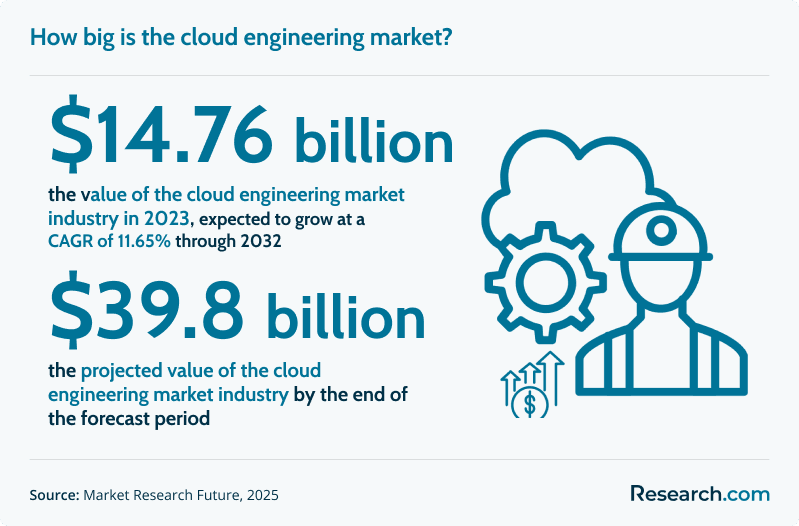
In 2025, the average annual salary for cloud engineers in the US is $130,802, with reported earnings ranging from $49,000 to $181,500. The broader cloud engineering market was valued at $14.76 billion in 2023 and is projected to reach $39.8 billion by 2032, growing at a compound annual growth rate of 11.65%.
Key Things to Know Before Starting
- Cloud engineering is a high-paying technology path. The average annual salary for cloud engineers in the US in 2025 is $130,802, and top reported earnings reach $181,500.
- A degree is useful but not the only route. Many employers prefer a bachelor’s degree in computer science, information technology, or engineering, but certifications, project work, and experience can also qualify candidates.
- Certifications help prove platform-specific skills. Credentials from AWS, Microsoft Azure, Google Cloud, Kubernetes, and CompTIA can strengthen your resume when paired with real projects.
- Cloud work overlaps with several fast-growing IT occupations. Software development, network architecture, and database administration are expected to grow 17%, 13%, and 9%, respectively, from 2023 to 2033.
- The field rewards continuous learning. Cloud tools, security practices, automation platforms, and AI-enabled infrastructure management change quickly, so long-term success depends on keeping skills current.
- How to Become a Cloud Engineer for 2027
- What Is a Cloud Engineer?
- What Education Do Cloud Engineers Need?
- How Long Does It Take to Become a Cloud Engineer?
- What Cloud Engineering Specializations Can You Choose?
- What Certifications Are Best for Cloud Engineers?
- Which Professional Organizations Support Cloud Engineers?
- What Career Paths Are Available in Cloud Engineering?
- Are There Affordable Education Options for Cloud Engineers?
- Can an Accelerated Online Computer Science Degree Help?
- What Trends Are Changing Cloud Engineering?
- Do Cybersecurity Skills Improve Cloud Career Options?
- Which Online IT Degree Fits Cloud Engineering?
- Can Cloud Skills Apply to Gaming? Compare IT degree options
- How Much Do Cloud Engineers Earn?
- Can Interdisciplinary Graduate Study Help Cloud Engineers?
- Can a Cybersecurity Associate Degree Support Cloud Careers?
- Can Specialized Education and Certifications Speed Up Career Growth?
- What Is the Job Outlook for Cloud Engineers?
- Is Becoming a Cloud Engineer Worth It?
- What Soft Skills Do Cloud Engineers Need? Review the value of the career Read the key insights
How to Become a Cloud Engineer for 2027
Cloud engineering sits at the intersection of infrastructure, software, networking, cybersecurity, automation, and business operations. That is why the best path into the field is not just “learn AWS” or “get a certification.” You need a sequence: core IT knowledge, cloud platform practice, proof of skill, and a job search strategy targeted to realistic entry points.
Step 1: Build the Technical Base Employers Expect
Start with the fundamentals that appear in nearly every cloud role: computer networking, Linux or Windows administration, scripting, virtualization, databases, security basics, and troubleshooting. Cloud platforms abstract away some hardware management, but cloud engineers still need to understand how systems communicate, fail, scale, and stay secure.
Step 2: Pick an Education Route That Matches Your Situation
A bachelor’s degree in computer science, information technology, information systems, cybersecurity, or engineering remains a common route, especially for candidates who want broad technical training and more hiring flexibility. However, it is not the only option. Career changers may prefer certificates, bootcamps, or flexible programs from online colleges with open enrollment if they need a lower-barrier way to begin formal study.
Step 3: Choose One Cloud Platform First
Beginners often try to learn AWS, Azure, and Google Cloud at the same time. That usually slows progress. Choose one major platform first, learn its compute, storage, networking, identity, monitoring, and security services, and then build projects that show you can deploy and manage working systems. After that, expanding into a second platform becomes easier.
Step 4: Create Real Cloud Projects
Employers want evidence that you can work beyond tutorials. Build a portfolio that includes projects such as hosting a web application, configuring identity and access controls, setting up monitoring alerts, automating infrastructure deployment, creating a CI/CD pipeline, or designing a secure network architecture. Free-tier cloud services can help beginners practice without taking on unnecessary costs, but you should still monitor usage carefully.
Step 5: Earn Certifications Strategically
Certifications are most valuable when they support your intended role. For cloud architecture, consider AWS Certified Solutions Architect, Microsoft Certified: Azure Solutions Architect, or Google Professional Cloud Engineer. For DevOps-focused roles, Kubernetes and infrastructure-as-code skills may be more relevant. For security-focused roles, prioritize identity, compliance, logging, encryption, and threat detection.
Step 6: Apply for Entry Points That Lead Into Cloud Engineering
Many cloud engineers do not start with the exact title “cloud engineer.” Practical entry roles can include cloud support associate, systems administrator, network technician, junior DevOps engineer, technical support engineer, security analyst, or infrastructure analyst. Once you have production experience, it becomes easier to move into architecture, platform engineering, or cloud security.
| Path | Best For | Main Advantage | Main Limitation |
| Bachelor’s degree | Students and career changers who want broad technical preparation | Builds a strong foundation in programming, systems, networking, and theory | Usually takes longer and can cost more than shorter training routes |
| Associate degree plus certifications | Learners who want a lower-cost starting point | Can support entry-level IT roles while you continue building cloud skills | Some employers still prefer bachelor’s-level education for engineering roles |
| Bootcamp or certificate program | People who already have some technical background and want focused training | Can be faster and project-oriented | Quality varies, and a bootcamp alone may not be enough without experience |
| Self-study plus portfolio | Motivated learners with discipline and access to practice environments | Flexible and often lower cost | Requires strong proof of skill because there is no formal academic credential |
Bottom Line
The most effective route is the one that produces job-ready evidence: technical fundamentals, hands-on cloud projects, relevant certifications, and a resume aligned with specific roles. A degree can improve your competitiveness, but practical ability is what usually determines whether you can perform in the job.
What Is a Cloud Engineer?
A cloud engineer is a technology professional who builds, manages, secures, and improves cloud-based systems. These systems may run on Amazon Web Services, Microsoft Azure, Google Cloud, or a combination of platforms. Instead of maintaining only physical servers in one location, cloud engineers help organizations run applications, store data, automate infrastructure, and scale computing resources through cloud services.
What Cloud Engineers Do Day to Day
- Design cloud environments. Plan secure and scalable architectures that match business and technical requirements.
- Deploy infrastructure. Set up compute instances, storage, databases, virtual networks, identity controls, and monitoring tools.
- Automate operations. Use DevOps practices, CI/CD pipelines, Terraform, Kubernetes, Ansible, or related tools to reduce manual work.
- Improve security and compliance. Configure access controls, encryption, logging, backups, and policies that reduce risk.
- Control performance and cost. Monitor usage, tune resources, and help teams avoid inefficient cloud spending.
- Support migrations. Move applications, data, or infrastructure from on-premises systems to cloud or hybrid environments.
Cloud Engineer vs. Related IT Roles
| Role | Primary Focus | How It Connects to Cloud Engineering |
| Software developer | Writing and maintaining applications | Cloud engineers help deploy, scale, and operate those applications in cloud environments. |
| Computer network architect | Designing communication networks | Cloud engineers apply networking concepts to virtual private clouds, hybrid networks, VPNs, and secure connectivity. |
| Database administrator | Managing data storage, performance, and access | Cloud engineers often configure managed databases, backups, replication, and data security in cloud platforms. |
| DevOps engineer | Automating software delivery and infrastructure | Cloud engineering and DevOps frequently overlap in CI/CD, infrastructure as code, containers, and monitoring. |
Why the Role Matters
Businesses use cloud platforms to launch products faster, reduce reliance on physical infrastructure, support remote operations, and improve resilience. Cloud engineers make those benefits possible while managing trade-offs around security, cost, availability, and complexity. According to a 2025 report, the worldwide cloud engineering market industry is expected to grow at a CAGR of 11.65% from 2023 ($14.76 billion) to 2032 ($39.8 billion).
What Education Do Cloud Engineers Need?
Cloud engineering does not have one mandatory degree requirement, but it does require a strong technical foundation. Many employers prefer candidates with a bachelor’s degree in computer science, information technology, engineering, cybersecurity, or a related field. Others will consider applicants who can demonstrate platform experience, certifications, and practical project work.
Do You Need a Degree?
You do not always need a degree to become a cloud engineer, but a degree can make the path smoother. It can help with internships, entry-level IT roles, structured learning, and employers that use degree requirements in screening. A degree also builds deeper understanding of programming, systems design, algorithms, networking, databases, and security.
If you are comparing majors, a computer science degree is one of the strongest options because it covers many concepts used in cloud engineering. However, information technology, information systems, cybersecurity, software engineering, and some engineering programs can also align well depending on your target specialization.
Degree and Non-Degree Options
| Education Option | What It Can Provide | When It Makes Sense |
| Associate degree | Introductory programming, networking, operating systems, and IT support skills | You want a lower-cost start and plan to add certifications or continue to a bachelor’s program. |
| Bachelor’s degree | Broad technical depth, stronger hiring flexibility, and preparation for advanced roles | You are early in your education or want a credential many employers recognize. |
| Bootcamp | Condensed, skills-focused training in cloud tools, coding, DevOps, or cybersecurity | You already have basic IT knowledge and need structured, project-based practice. |
| Certifications | Verification of skills in a specific platform or technical domain | You want to prove AWS, Azure, Google Cloud, Kubernetes, or cloud security competence. |
| Self-study | Flexible learning through documentation, labs, projects, and open-source work | You are disciplined and can build a portfolio strong enough to show employers. |
What Matters More: Education or Skills?
The best answer is usually both. Education can help you understand why systems work; skills prove you can operate them. For hiring, a strong candidate often combines formal learning or equivalent self-study with certifications, labs, GitHub projects, troubleshooting examples, and clear explanations of past technical work.
How Long Does It Take to Become a Cloud Engineer?
The timeline depends on your starting point. Someone already working in IT support, networking, software development, or systems administration may move into cloud work faster than someone starting with no technical background. In general, the path can take a few months for focused upskilling or several years through a traditional degree route.
Common Timelines by Route
| Route | Typical Timeline Stated | Best Fit | Important Consideration |
| Associate degree | 2 years or less | Learners seeking an affordable technical foundation | An affordable online associate degree in computer science can support entry-level IT work, but many employers prefer a bachelor’s degree for engineering roles. |
| Bachelor’s degree | 4 years | Students who want broad preparation and stronger long-term flexibility | This is a common route for cloud engineers because it covers programming, systems, security, and architecture. |
| Master’s degree | 2 additional years, often required for research roles | Professionals targeting advanced research, AI-enabled cloud systems, or specialized technical leadership | Computer and information research scientists had an annual median salary of $145,080 in 2023 and typically need at least a master’s degree. |
| Bootcamp | 3-6 months | People with some technical background who want structured cloud or DevOps training | Bootcamps should be evaluated carefully for project depth, instructor quality, career support, and employer recognition. |
| Certifications | A few weeks to a year, depending on experience level | Learners validating skills in AWS, Azure, Google Cloud, Kubernetes, or cloud fundamentals | Certifications work best when supported by labs and real projects. |
| Self-study and experience | Varies widely | Independent learners and working IT professionals | The timeline depends on discipline, prior knowledge, and the quality of your portfolio. |
What Is a Realistic Expectation?
If you pursue a degree-based route, plan for two to four years before entering many professional technical roles, with more time for advanced research or leadership tracks. If you already have IT experience, a focused combination of certifications, labs, and projects may position you for cloud-related work in six months to two years, depending on your background and local job market.
What Cloud Engineering Specializations Can You Choose?
Cloud engineering is not one job. It includes several specializations, and choosing the right one can help you decide which courses, certifications, and projects to prioritize.
Cloud Solutions Architect
Cloud solutions architects design the overall structure of cloud systems. They make decisions about scalability, security, availability, cost, data flow, and platform services. This path is a strong fit for professionals who like high-level design, stakeholder communication, and trade-off analysis.
Cloud Security Engineer
Cloud security engineers focus on protecting cloud environments. Their work may involve identity and access management, encryption, logging, threat detection, compliance controls, incident response, and secure architecture. This specialization is especially relevant for organizations handling sensitive data.
Cloud DevOps Engineer
Cloud DevOps engineers automate application delivery and infrastructure operations. They commonly work with CI/CD pipelines, infrastructure as code, containers, Kubernetes, configuration management, and monitoring systems. This path suits people who enjoy automation, scripting, and collaboration between development and operations teams.
Cloud Software Engineer
Cloud software engineers build applications and services designed to run well in cloud environments. They may work with microservices, APIs, serverless functions, distributed systems, and cloud-native databases. Strong programming ability is central to this track.
Cloud Network Engineer
Cloud network engineers design and maintain virtual networks, hybrid connections, VPNs, routing, segmentation, and secure data movement between cloud and on-premises environments. This path is a natural fit for professionals with networking experience.
Cloud Data Engineer
Cloud data engineers build data pipelines, storage systems, and processing workflows in cloud environments. They often work with database services, analytics platforms, data lakes, and data governance requirements.
How to Choose a Specialization
| If You Enjoy... | Consider... | Skills to Strengthen |
| Designing systems and explaining technical choices | Cloud solutions architecture | Architecture diagrams, cost optimization, platform services, stakeholder communication |
| Protecting systems and investigating risks | Cloud security engineering | IAM, encryption, logging, compliance, incident response, network security |
| Automating deployments and improving workflows | Cloud DevOps engineering | CI/CD, Terraform, Kubernetes, scripting, monitoring |
| Writing scalable applications | Cloud software engineering | Programming, APIs, microservices, serverless, distributed systems |
| Building reliable connectivity | Cloud network engineering | Virtual networking, VPNs, routing, firewalls, hybrid cloud design |
Compensation can vary by role and experience. Related cloud-adjacent occupations show strong earning potential: software developers had a median annual salary of $130,160 in 2023, computer network architects earned $129,840, and database administrators earned $117,450.
What Certifications Are Best for Cloud Engineers?
Cloud certifications can help employers understand what you know, especially if you are changing careers or do not have a traditional degree. They are not a substitute for experience, but they can be a useful signal when combined with labs, projects, and clear technical explanations.
Cloud Certifications to Consider
| Certification | Best For | Why It Matters |
| AWS Certified Solutions Architect – Associate | Professionals focusing on Amazon Web Services | Validates knowledge of designing scalable, secure, and reliable AWS environments. |
| Microsoft Certified: Azure Solutions Architect Expert | Engineers working in Microsoft-centered cloud environments | Signals ability to plan architecture, security, deployment, and operational strategy in Azure. |
| Google Cloud Professional Cloud Architect | Cloud professionals using Google Cloud | Focuses on solution design, security, reliability, and cost-aware cloud architecture. |
| Google Professional Cloud Engineer | Professionals who want to demonstrate Google Cloud engineering capability | Supports roles involving cloud implementation, management, and optimization. |
| Certified Kubernetes Administrator (CKA) | DevOps, platform, and container-focused cloud engineers | Demonstrates skills in container orchestration and Kubernetes cluster administration. |
| CompTIA Cloud+ | Entry-level or vendor-neutral learners | Covers general cloud deployment, troubleshooting, security, and operations concepts. |
Are Cloud Certifications Worth It?
Certifications can be worth it when they match your target job and are backed by hands-on practice. They are less useful if you collect credentials without being able to build, troubleshoot, or explain cloud systems. If you want a shorter credential route, career-focused certifications that pay well may be useful to compare, but cloud employers will still expect applied technical competence.
How to Avoid Wasting Money on Certifications
- Do not start with an advanced certification if you lack networking, Linux, scripting, or security basics.
- Do not choose a certification only because it is popular; choose one tied to your target platform and role.
- Do not list certifications without projects that show how you used the skills.
- Do not ignore renewal requirements or continuing education expectations.
Which Professional Organizations Support Cloud Engineers?
Joining a professional organization is optional, but it can help cloud engineers stay connected to industry research, security practices, standards, conferences, and professional networks. These groups can be especially valuable for learners who do not have a large technical network yet.
Organizations Worth Knowing
- Cloud Computing Association. The Cloud Computing Association supports a community of cloud end users and service providers through events, resources, and networking opportunities.
- Cloud Security Alliance. Founded in 2008, the Cloud Security Alliance focuses on cloud security best practices, education, research, certification, and events.
- IEEE Cloud Computing. Launched in 2011, IEEE Cloud Computing supports cloud-related research, publications, conferences, standards activity, and educational resources.
- Association for Computing Machinery. ACM is a major educational and scientific computing society that offers publications, conferences, and special interest groups relevant to computing professionals, including those in cloud-related fields.
- IEEE. IEEE is a global technical professional organization that supports technology fields through publications, conferences, standards, and professional development resources.
When Membership Makes Sense
Professional organizations are most useful when you actively use them. Look for groups that offer relevant conferences, cloud security research, job boards, mentorship, standards updates, or certification discounts. If you are early in your career, networking and access to current industry discussions may be more valuable than passive membership.
What Career Paths Are Available in Cloud Engineering?
Cloud engineering can lead to hands-on technical roles, architecture positions, security roles, management, consulting, training, or research. Your path will depend on whether you prefer building systems, securing them, automating them, managing teams, or advising organizations.
Technical Career Paths
- Cloud architect: Designs cloud systems that balance scalability, resilience, cost, and security.
- Cloud security engineer: Protects cloud infrastructure through access control, monitoring, encryption, compliance, and incident response.
- Cloud DevOps engineer: Automates infrastructure and software delivery using CI/CD, infrastructure as code, and container platforms.
- Cloud software engineer: Builds cloud-native applications and services.
- Cloud data engineer: Creates cloud-based data pipelines, storage systems, and analytics workflows.
- Cloud network engineer: Designs secure and reliable connectivity for cloud, hybrid, and multi-cloud environments.
These paths connect to high-earning technology occupations. In 2023, software developers earned a median salary of $130,160, computer network architects earned $129,840, and database administrators earned $117,450.
Management and Strategy Paths
- Cloud engineering manager: Leads teams responsible for cloud platforms, migrations, reliability, security, and operations.
- Chief Cloud Officer: Guides enterprise cloud strategy and aligns cloud investments with business goals.
- Technology consultant: Helps organizations assess cloud readiness, plan migrations, improve architecture, and manage costs.
Cloud engineers moving into management may benefit from business training in budgeting, leadership, operations, and strategy. For some professionals, an AACSB accredited online MBA can support a transition from technical execution to project leadership or executive decision-making.
Independent and Entrepreneurial Options
- Freelance cloud consultant: Advises clients on migrations, infrastructure design, automation, or cost optimization.
- Startup founder: Builds a cloud-based product or service using scalable cloud infrastructure.
- Technical trainer: Teaches cloud computing through academic programs, corporate training, online courses, or workshops.
Research-Oriented Paths
Cloud engineers interested in advanced systems, artificial intelligence, cybersecurity, and large-scale computing may consider research-focused roles. Computer and information research scientists earned a median annual salary of $145,080 in 2023, the highest-paid occupation in the computer and IT sector. This path typically requires at least a master’s degree.
Are There Affordable Education Options for Cloud Engineers?
Yes. Affordable paths can include community college, online associate degrees, public university programs, employer tuition benefits, vendor training, self-paced labs, and targeted certification preparation. The right option depends on how much structure you need and whether your target employers prefer a degree.
If you want a formal technical foundation without overspending, compare accredited online programs carefully. Options such as an online engineering degree may be worth reviewing if you want broader engineering preparation alongside computing skills.
How to Keep Cloud Education Costs Under Control
- Start with free documentation and labs before paying for advanced courses.
- Use community college or transfer credits if you plan to complete a bachelor’s degree later.
- Compare total program cost, not just tuition.
- Ask whether cloud, cybersecurity, networking, and DevOps courses are included or only offered as electives.
- Check whether the program is accredited before enrolling.
- Consider whether certifications are included in the curriculum or require separate exam fees.
Can an Accelerated Online Computer Science Degree Help?
An accelerated online computer science degree can help if you need a faster academic route and can handle an intensive pace. These programs may be useful for learners who want structured training in programming, systems design, algorithms, databases, and networking without following a traditional timeline.
However, acceleration is not automatically better. A shorter program only helps if you can absorb the material, complete meaningful projects, and still build cloud-specific experience. Before enrolling, ask whether the curriculum includes cloud computing, cybersecurity, distributed systems, software engineering, and hands-on labs.
What Trends Are Changing Cloud Engineering?
Cloud engineering continues to evolve as organizations adopt hybrid cloud, multi-cloud strategies, automation, stronger security controls, and AI-enabled operations. These trends are changing what employers expect from cloud professionals.
Trends to Watch
- Hybrid and multi-cloud environments: Cloud engineers increasingly need to understand how systems work across multiple platforms and on-premises infrastructure.
- Automation and infrastructure as code: Manual configuration is giving way to repeatable deployment workflows and version-controlled infrastructure.
- Cloud security by design: Security is no longer a final checklist item. Identity, encryption, logging, monitoring, and compliance must be built into architecture decisions.
- AI-supported operations: Organizations are using automation and analytics to improve monitoring, resource management, and incident response.
- Cost optimization: As cloud use expands, employers value engineers who can design efficient systems and reduce waste.
These changes make ongoing learning essential. Related compensation benchmarks in technology roles are discussed in Research.com’s guide to high-paying computer science careers.
Do Cybersecurity Skills Improve Cloud Career Options?
Yes. Cybersecurity knowledge can make a cloud engineer more valuable because cloud environments carry risks involving identity misuse, exposed data, misconfigured permissions, insecure APIs, and compliance failures. Engineers who understand security can design safer systems and communicate risk more effectively.
Specialized study may be useful for professionals who want to move into cloud security, compliance, incident response, or secure architecture. If you are comparing graduate-level options, Research.com’s overview of the most affordable online cybersecurity degrees can help you review cost-conscious programs.
Which Online Information Technology Degree Fits Cloud Engineering?
The best online IT degree for cloud engineering is one that teaches practical systems work, not just broad technology concepts. Look for coursework in networking, Linux or Windows administration, cloud computing, cybersecurity, databases, scripting, virtualization, and project-based infrastructure management.
When comparing online information technology degrees, prioritize accreditation, relevant technical labs, transfer credit policies, faculty experience, and whether the program aligns with the certifications or roles you want.
Questions to Ask Before Choosing a Program
- Is the institution properly accredited?
- Does the curriculum include cloud platforms, networking, cybersecurity, and automation?
- Are hands-on labs required, or is the program mostly theory?
- Can credits transfer into a bachelor’s or graduate program later?
- Does the school publish realistic career support information?
- Are certification preparation materials included or separate?
Can Cloud Engineering Skills Apply to Gaming?
Yes. Gaming companies rely on scalable infrastructure, low-latency networking, real-time data processing, account systems, security controls, and reliable global services. Cloud engineering skills can support multiplayer platforms, analytics systems, game updates, backend services, and high-traffic events.
Professionals interested in combining game development and cloud systems may benefit from reviewing online game development programs while also building cloud projects that demonstrate scalability, monitoring, and secure deployment.
How Much Do Cloud Engineers Earn?
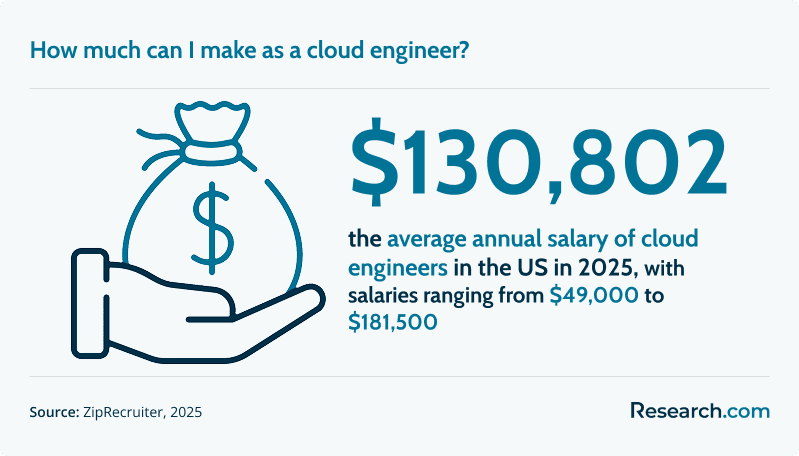
Cloud engineering salaries vary by location, experience, employer, platform, specialization, and seniority. In 2025, the average annual salary of cloud engineers in the US is $130,802, with earnings ranging from $49,000 to $181,500. Roles involving cloud security, architecture, platform engineering, and senior infrastructure leadership may fall toward the higher end when professionals have strong experience and in-demand skills.
| Occupation or Role Area | Salary Figure Stated | Year |
| Cloud engineer average annual salary in the US | $130,802 | 2025 |
| Cloud engineer reported salary range in the US | $49,000 to $181,500 | 2025 |
| Software developers | $130,160 median annual salary | 2023 |
| Computer network architects | $129,840 median annual salary | 2023 |
| Database administrators | $117,450 median annual salary | 2023 |
| Computer and information research scientists | $145,080 median annual salary | 2023 |
Factors That Can Affect Pay
- Years of experience in production cloud environments
- Depth of knowledge in AWS, Azure, Google Cloud, Kubernetes, DevOps, or security
- Ability to design cost-efficient, resilient systems
- Industry, company size, and geographic market
- Leadership responsibilities or architecture-level decision-making
- Certifications combined with real implementation experience
Can Interdisciplinary Graduate Study Help Cloud Engineers?
Interdisciplinary education can help cloud engineers who want to work in data-intensive or research-driven fields. Cloud systems increasingly support artificial intelligence, machine learning, bioinformatics, analytics, cybersecurity, and large-scale scientific computing. A graduate program that combines computing with a specialized domain may help professionals qualify for roles involving complex data workflows or advanced technical problem-solving.
For example, professionals interested in cloud infrastructure for research, healthcare data, or computational science may want to explore online bioinformatics master’s programs. This type of study is not required for most cloud engineering jobs, but it can be relevant for specialized industries that depend on large datasets and secure, scalable computing.
Can a Cybersecurity Associate Degree Support Cloud Careers?
A cybersecurity associate degree can be a useful starting point for cloud engineering because it introduces threat analysis, network defense, access control, incident response, and security operations. These concepts are directly relevant to cloud infrastructure, where misconfiguration and identity risks can create serious exposure.
If you are considering this route, review the kinds of roles discussed in Research.com’s guide to jobs available with an associate degree in cybersecurity. For cloud engineering, the strongest plan is usually to combine cybersecurity coursework with networking, Linux, scripting, cloud labs, and platform certifications.
Can Specialized Education and Certifications Speed Up Career Growth?
Specialized education and certifications can accelerate growth when they fill a clear skills gap. For example, a cloud engineer moving toward AI infrastructure may need stronger knowledge of data pipelines, machine learning operations, scalable compute, and model deployment. A security-focused engineer may need deeper study in compliance, threat detection, and identity architecture.
Professionals interested in the intersection of AI and cloud infrastructure can compare options such as the most affordable online artificial intelligence degree programs. The key is to choose credentials that support a specific career direction rather than accumulating unrelated certificates.
What Is the Job Outlook for Cloud Engineers?
The outlook for cloud engineering is supported by growth in cloud infrastructure, digital transformation, software deployment, data systems, and cybersecurity needs. The cloud engineering market was valued at $14.76 billion in 2023 and is projected to grow to $39.8 billion by 2032, reflecting an 11.65% compound annual growth rate.
Several related occupations also show positive growth from 2023 to 2033: software developers, quality assurance analysts, and testers are expected to grow 17%; computer network architects are expected to grow 13%; and database administrators are expected to grow 9%. These occupations overlap with cloud engineering because cloud professionals often work with applications, networks, databases, automation, and secure infrastructure.
What This Means for Job Seekers
Demand does not mean every beginner will get hired quickly. Employers still look for evidence of practical ability. Candidates who can demonstrate projects, explain architecture decisions, troubleshoot issues, and understand security fundamentals will usually be stronger than candidates who only list course completions.
Is Becoming a Cloud Engineer Worth It?
Becoming a cloud engineer can be worth it for people who enjoy technical problem-solving, continuous learning, infrastructure, automation, security, and systems thinking. The salary potential is strong: the average annual salary for cloud engineers in the US in 2025 is $130,802, with earnings ranging from $49,000 to $181,500. The market outlook is also favorable, with the cloud engineering market projected to grow from $14.76 billion in 2023 to $39.8 billion by 2032.
The career is especially appealing because it offers multiple entry routes. A computer science degree can provide a strong foundation, but certifications, associate degrees, bootcamps, self-study, and IT experience can also support entry into the field. Cost-conscious learners may compare affordable online computer science degree programs if they want formal education without unnecessary debt.
Who Should Consider Cloud Engineering?
- IT support, networking, or systems professionals who want to move into higher-level infrastructure work
- Software developers interested in deployment, scalability, reliability, or DevOps
- Cybersecurity learners who want to specialize in cloud security
- Students who enjoy both coding and infrastructure
- Problem-solvers who are comfortable learning new tools throughout their career
Who May Prefer a Different Path?
- People who dislike troubleshooting complex technical issues
- Professionals who want a field that changes slowly
- Learners who are not willing to practice hands-on skills outside coursework
- Job seekers who expect a certification alone to guarantee employment
What Soft Skills Do Cloud Engineers Need?
Technical skill gets cloud engineers into the field, but soft skills often determine how far they advance. Cloud engineers work with developers, security teams, business leaders, vendors, finance teams, and end users. They must explain complex trade-offs clearly and make decisions that affect reliability, cost, security, and business operations.
Important Soft Skills
- Communication: Explaining cloud risks, architecture decisions, costs, and timelines to technical and non-technical stakeholders.
- Collaboration: Working across development, operations, cybersecurity, compliance, and business teams.
- Problem-solving: Diagnosing outages, performance issues, permission problems, and deployment failures.
- Project management: Planning migrations, upgrades, automation work, and security improvements without losing track of deadlines.
- Cost awareness: Understanding that technical decisions have financial consequences in cloud environments.
- Adaptability: Learning new platforms, tools, and best practices as cloud services evolve.
Some professionals broaden their systems-thinking skills through adjacent technical study. For example, an online electrical engineering degree program may appeal to learners who want a wider engineering perspective, although it is not a standard requirement for cloud engineering roles.
Common Mistakes to Avoid When Becoming a Cloud Engineer
| Mistake | Why It Hurts | Better Approach |
| Choosing a school without checking accreditation | Credits may not transfer, and employers may question the credential. | Verify accreditation before enrolling. |
| Focusing only on tuition | Fees, certification costs, software, textbooks, and time away from work can change the real cost. | Compare total cost and expected career value. |
| Collecting certifications without projects | Employers may doubt whether you can apply the knowledge. | Build labs, document projects, and explain your design choices. |
| Trying to learn every cloud platform at once | Progress becomes shallow and unfocused. | Master one platform first, then expand. |
| Ignoring networking and security fundamentals | Cloud systems depend heavily on connectivity, identity, permissions, and secure architecture. | Study networking, IAM, encryption, logging, and monitoring early. |
| Assuming salary outcomes are guaranteed | Pay varies by location, experience, employer, and specialization. | Use salary data as a benchmark, not a promise. |
| Relying only on rankings or advertisements | A highly promoted program may not match your goals. | Compare curriculum, outcomes, support, accreditation, and flexibility. |
Practical Next Steps
- Identify your starting point. Decide whether you are coming from no tech background, IT support, software development, networking, cybersecurity, or another field.
- Select a target role. Choose cloud support, cloud engineer, DevOps engineer, cloud security engineer, cloud architect, or another specific direction.
- Build fundamentals first. Study networking, operating systems, scripting, security, databases, and virtualization.
- Pick one cloud platform. Begin with AWS, Azure, or Google Cloud and learn its core services deeply.
- Complete hands-on projects. Create a portfolio that proves you can deploy, secure, monitor, and automate systems.
- Earn one relevant certification. Choose a credential that supports your chosen role rather than chasing several unrelated exams.
- Apply to realistic entry roles. Cloud support, junior DevOps, systems administration, and infrastructure roles can lead to cloud engineering.
- Keep learning after you get hired. Cloud engineering changes quickly, so ongoing skill development is part of the job.
Key Insights
- Cloud engineering is a strong career option for people who want a technical role with high earning potential, broad industry use, and constant learning.
- The average annual salary for cloud engineers in the US in 2025 is $130,802, with reported earnings from $49,000 to $181,500.
- A degree can help, especially for long-term flexibility, but it is not the only path. Certifications, hands-on projects, and IT experience can also lead into cloud roles.
- The best beginners focus on fundamentals first: networking, operating systems, scripting, security, virtualization, and one major cloud platform.
- Certifications are most useful when paired with practical proof, such as cloud deployments, automation scripts, monitoring setups, and security configurations.
- Cloud specializations include architecture, security, DevOps, software engineering, networking, and data engineering. Choose one based on the work you actually want to do.
- The cloud engineering market was valued at $14.76 billion in 2023 and is projected to reach $39.8 billion by 2032, with a CAGR of 11.65%.
- Do not choose programs or certifications based only on price, popularity, or marketing. Check accreditation, curriculum, hands-on labs, transfer policies, and career relevance.
References
- Bureau of Labor Statistics. (2025). Computer and information technology occupations. Retrieved January 29, 2025, from BLS.
- Bureau of Labor Statistics. (2025). Computer network architects. Retrieved January 29, 2025, from BLS.
- Bureau of Labor Statistics. (2025). Database administrators and architects. Retrieved January 29, 2025, from BLS.
- Bureau of Labor Statistics. (2025). Software developers, quality assurance analysts, and testers. Retrieved January 29, 2025, from BLS.
- Gupta, A. (2025). Cloud engineering market research report. Market Research Report. Retrieved January 29, 2025, from Market Research Report.
- ZipRecruiter. (2025). Cloud engineer salary. Retrieved January 29, 2025, from ZipRecruiter.
Other Things You Should Know About How to Become a Cloud Engineer
To become a cloud engineer in 2027, proficiency in cloud platforms like AWS, Azure, and Google Cloud is crucial. A solid understanding of networking, security, and virtualization is essential, along with skills in programming languages such as Python or Java to create and manage cloud-based applications.
Cloud engineers need basic algebra, logic, and some statistics for capacity planning, automation, and troubleshooting. Advanced calculus is not required. A strong grasp of networking concepts, system administration, and scripting is more important than heavy mathematics for most entry-level cloud engineering roles.
In 2027, certifications like AWS Certified Solutions Architect, Microsoft Certified: Azure Solutions Architect, and Google Professional Cloud Architect are highly valuable. These credentials validate your skills and knowledge of specific cloud platforms, making you competitive in the job market.