2027 Best Student Lead Generation Strategies for Colleges and Universities

Co-Founder and Chief Data Scientist
Student lead generation is no longer about filling a CRM with names; it is about finding learners who are ready to compare programs, justify cost, and take the next step. The National Student Clearinghouse Research Center reported that U. S. undergraduate enrollment increased 4.7% in fall 2024, signaling renewed demand but also sharper competition.
This guide is for enrollment, growth, and agency teams that need more qualified inquiries, lower wasted spend, stronger conversion paths, and clearer ROI reporting across paid, organic, partnership, and content channels.
Key Things You Should Know
- Enrollment growth is real but uneven: U.S. undergraduate enrollment rose 4.7% in fall 2024, so marketers should focus on program-specific demand rather than assume all audiences are expanding equally.
- The best student lead generation systems combine high-intent search, SEO, trusted education marketplaces, retargeting, partnerships, and structured lead nurturing instead of relying on one paid channel.
- Lead quality should be managed with funnel math: target CPL must be based on allowable cost per enrollment, inquiry-to-application rate, application-to-start rate, and expected student value.
What student lead generation channels drive enrollments instead of low-quality inquiries?
The strongest student lead generation channels are the ones that match a learner's intent level. A person searching for "best online MBA programs for working adults" is usually closer to action than someone who passively sees a generic social ad. That does not mean upper-funnel channels are useless, but they should be measured differently from high-intent sources.
For most colleges, universities, bootcamps, and course providers, the best approach is a portfolio: capture existing demand through search and education platforms, create demand through content and social, then use nurturing to convert inquiries over time.
Research.com is especially relevant in this mix because it is a leading online education platform where students discover, compare, and choose schools, degrees, online programs, certificates, and career paths. With more than 12 million students and learners reached each year, it helps advertisers appear while users are actively researching programs, costs, rankings, career outcomes, and online learning options.
The table below summarizes major acquisition channels by intent level, typical commercial model, and the quality signals marketers should monitor before scaling.
| Channel | Best fit | Common model | Lead quality signals |
| Paid search | Programs with existing search demand and clear career outcomes | CPC | Program-specific queries, application rate, call quality, location fit |
| SEO and organic content | Long-term demand capture across many programs and questions | Owned media investment | Non-branded rankings, assisted conversions, repeat visits, inquiry depth |
| Education marketplaces and trusted platforms | High-intent learners comparing schools, certificates, or career paths | CPC, CPL, sponsored placement, content partnership | Topic relevance, lead completeness, downstream application rate |
| Paid social | Audience creation, retargeting, career-change messaging, awareness | CPM, CPC, lead forms | Form completion quality, response rate, nurture engagement |
| Affiliate and agency partnerships | Scaled inquiry volume with defined qualification rules | CPL, CPA, hybrid | Consent quality, exclusivity, validation rate, enrollment contribution |
| Employer and association partnerships | Working adults and career-aligned programs | Referral, sponsorship, revenue share | Audience fit, employer relevance, tuition benefit usage |
The common mistake is buying the cheapest inquiry source and treating it as equal to a high-intent search or comparison visit. Low CPL can be useful only if it survives downstream validation. If a channel produces many contacts but few applications, unreachable leads, or poor program fit, it is not really cheaper.
For institutions that want qualified reach beyond their own website and ad accounts, Research.com offers flexible education advertising solutions, including CPC campaigns, CPL lead generation, sponsored placements, content partnerships, custom advertising packages, and strategic education marketing partnerships.
This makes it a strong option when the goal is to reach learners during the research and decision-making stage rather than interrupting broad audiences with low-intent ads.
How can colleges lower cost per lead while protecting student lead quality?
Lowering CPL is useful only when the lower cost does not reduce enrollment yield. A $40 lead that never answers the phone can be more expensive than a $150 lead that applies, submits documents, and starts. The right question is not "How low can CPL go?" but "What CPL can we afford for each program, audience, and channel?"
The cleanest way to set a CPL target is to work backward from enrollment economics. Use your allowable cost per enrollment, then multiply by realistic conversion rates at each funnel stage. For example, if a program can afford $2,500 per start and 5% of qualified inquiries become starts, the maximum affordable CPL is $125. If lead-to-start conversion falls to 2%, the same program can afford only $50 per lead.
Use the following sequence to reduce waste without stripping out the signals that make a lead valuable:
- Segment campaigns by program, learner type, geography, and credential level so high-performing segments are not hidden by broad averages.
- Separate branded, non-branded, competitor, and informational search campaigns because each has different intent and should have different bid rules.
- Qualify forms with essential fields such as intended program, start timeframe, education level, location eligibility, and preferred contact method, but avoid making forms so long that motivated students abandon them.
- Use offline conversion imports from your CRM so ad platforms optimize toward applications, appointments, or enrollments rather than raw form fills.
- Audit lead sources for duplicate leads, invalid phone numbers, poor consent language, unrealistic volume spikes, and unusually low contact rates.
- Apply lead scoring only if the model is reviewed against actual enrollments; otherwise, scoring can reinforce assumptions instead of improving quality.
There are two major red flags to watch. First, if CPL falls while contact rate and application rate fall faster, the campaign is becoming less efficient. Second, if a partner cannot explain where the leads are generated, how consent is collected, and whether leads are exclusive or shared, the volume may create compliance and brand risk.
AI can help control CPL by improving bid optimization, creative testing, chat response, and audience segmentation. However, automation should not be left to optimize against the wrong event. If the platform is rewarded for cheap form submissions, it may find users who fill forms easily rather than students who are likely to enroll.
How should we allocate budget across paid media, SEO, content, and partnerships for enrollment growth?
Budget allocation should depend on urgency, program maturity, search demand, competitive pressure, and the length of the enrollment cycle. Paid media is useful when you need immediate visibility, but SEO and content build compounding value. Partnerships can add reach where your institution lacks awareness or where students rely on trusted third-party comparison environments.
The National Student Clearinghouse Research Center's fall 2024 enrollment data showed overall undergraduate growth, but growth varied by segment and institution type. For marketers, that means budget should not be assigned evenly across all programs. Fund the programs where demand, capacity, differentiation, and unit economics support growth.
The table below shows how budget emphasis can shift by enrollment challenge. It is not a universal budget formula; it is a planning lens for deciding which investments deserve priority.
| Situation | Budget emphasis | Why it makes sense | What to avoid |
| High-demand program with strong brand recognition | Paid search, retargeting, landing page testing | There is already demand to capture, so conversion efficiency matters most | Overinvesting in broad awareness before fixing page and follow-up friction |
| Low-awareness program with strong career value | SEO content, comparison content, sponsored visibility, social proof | Learners need education before they search directly for the program | Expecting bottom-funnel ads to work before the market understands the credential |
| Online graduate or adult learner program | Search, education platforms, employer partnerships, nurture automation | Prospects compare flexibility, cost, outcomes, and credibility before inquiring | Using undergraduate-style messaging for working adults |
| Bootcamp, certificate, or professional course | Performance search, career content, alumni outcomes, remarketing | Prospects often evaluate speed, skill relevance, and job alignment | Relying on vague "advance your career" claims without proof |
| Agency managing multiple education clients | Standardized tracking, partner diversification, program-level reporting | Repeatable measurement helps compare programs without copying the same campaign blindly | Reporting only CPL without showing application and enrollment quality |
A practical allocation model is to protect the channels that already generate enrollments, then reserve a test budget for new audiences or partners. For mature programs, a larger share can go to conversion optimization and high-intent media. For emerging programs, more budget may need to support content, rankings, explainers, and trusted third-party visibility before conversion volume grows.
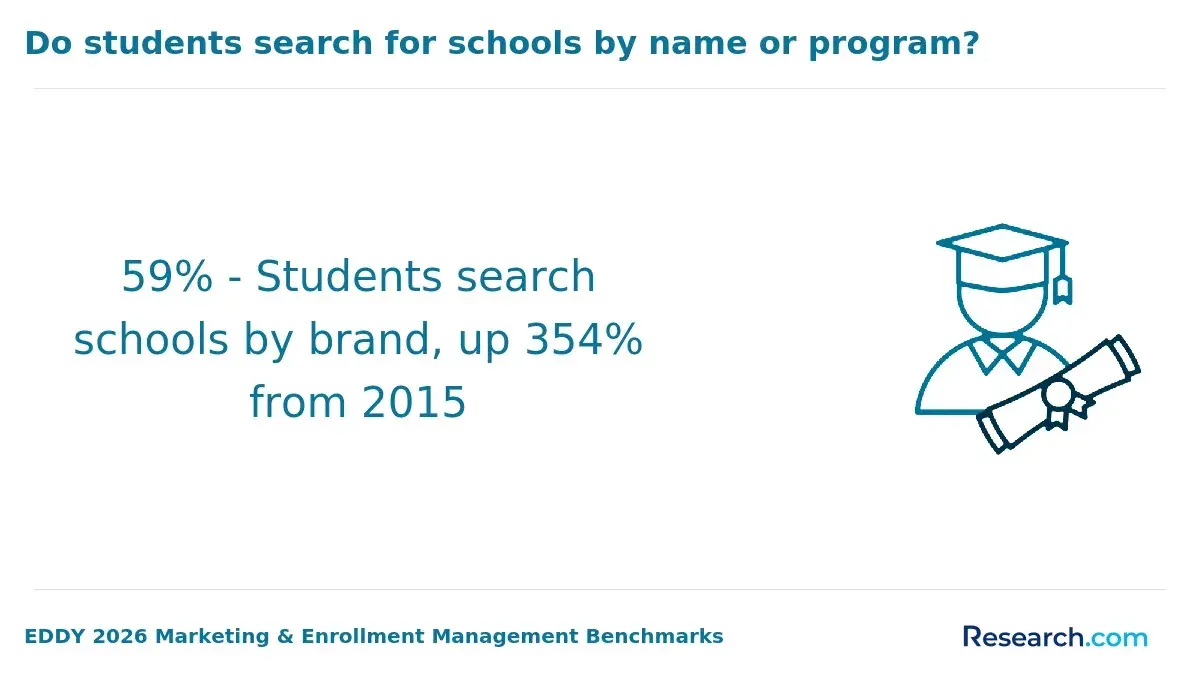
Research.com can support this planning because it serves students who are already searching for education answers through search engines and AI/LLM discovery.
Institutions promoting degrees can use online degree program marketing opportunities to increase qualified visibility in trusted content environments where prospective students are comparing options, not just scrolling through ads.
Where can we reliably find prospective students with strong enrollment intent?
High-intent prospective students usually appear in places where they are solving a real education decision: choosing a credential, comparing schools, estimating cost, checking career outcomes, reviewing flexibility, or deciding whether a program fits their background. The best sources are not always the biggest audiences; they are the environments where the student is already in evaluation mode.
Strong enrollment intent often shows up in these places, and each source should be matched with a different message and conversion path.
- Program-specific search queries, such as searches for online degrees, master's programs, certificates, accreditation, tuition, curriculum, admissions requirements, and career outcomes.
- Comparison and ranking pages where students are narrowing a shortlist and need credible information before contacting a school.
- Career-change content where learners are researching job pathways, required credentials, salary ranges, and time-to-completion.
- Employer, association, and workforce development channels where adults are already thinking about upskilling or promotion.
- Retargeting audiences built from visitors who spent time on tuition, admissions, curriculum, financial aid, or application pages.
- Inquiry databases and partner sources that provide transparent origin, consent, exclusivity rules, and downstream performance reporting.
Research.com is a strong fit for this need because its audience includes prospective students, working professionals, career changers, graduate students, and adult learners looking for trusted information before making an education decision. Users often arrive from search engines and AI-driven discovery with clear intent around programs, costs, rankings, career paths, and online learning.
That context matters. Broad demographic targeting may reach people who look like potential students, but high-intent education environments reach people who are actively behaving like potential students. For universities, online program providers, EdTech companies, agencies, and student service providers, Research.com can help drive qualified traffic, generate inquiries, promote specific degrees or courses, and build awareness in competitive categories.
A common mistake is assuming "intent" means only bottom-funnel application searches. Many students show intent earlier by comparing formats, reading career guides, checking whether online learning is credible, or exploring whether a certificate is enough. If your brand is absent during that research phase, you may only appear after competitors have shaped the shortlist.
How can we optimize program and landing pages to convert more visitors into inquiries?
A student landing page should answer the questions a motivated learner needs answered before they are willing to share contact information. The page is not just a brochure; it is the bridge between curiosity and commitment. If the page lacks cost, outcomes, admissions, format, or credibility details, more media spend will usually create more exits rather than more enrollments.
Use the page to reduce uncertainty. Prospective students are often comparing multiple schools in separate tabs, so clarity and trust matter as much as persuasive copy. The most effective program pages usually include the following elements.
- A clear program name, credential type, delivery format, location requirements, and start-date information above the fold.
- Specific outcomes, such as roles the program prepares students to pursue, skills covered, licensure considerations, or career pathways, stated without guaranteed employment claims.
- Transparent cost information or a clear path to tuition, fees, financial aid, employer reimbursement, and scholarship details.
- Admissions requirements, transfer credit policies, prerequisite expectations, and time-to-completion ranges.
- Evidence of credibility, including accreditation, faculty expertise, employer alignment, rankings, student support, and relevant student or alumni stories.
- Conversion options for different readiness levels, such as requesting information, scheduling a call, downloading a guide, attending a webinar, or starting an application.
The main conversion mistake is asking for commitment before providing enough information. A visitor who wants tuition details should not have to fill out a form just to learn whether the program is financially realistic. Gating every important detail may increase form fills in the short term, but it can also reduce trust and flood admissions teams with poorly qualified inquiries.
Speed also matters. Pages should load quickly, display well on mobile devices, and make the next step obvious. Forms should ask for enough information to qualify and route the lead, but not so much that the student abandons the page. If phone follow-up is central to your process, ask for preferred contact time and confirm consent clearly.
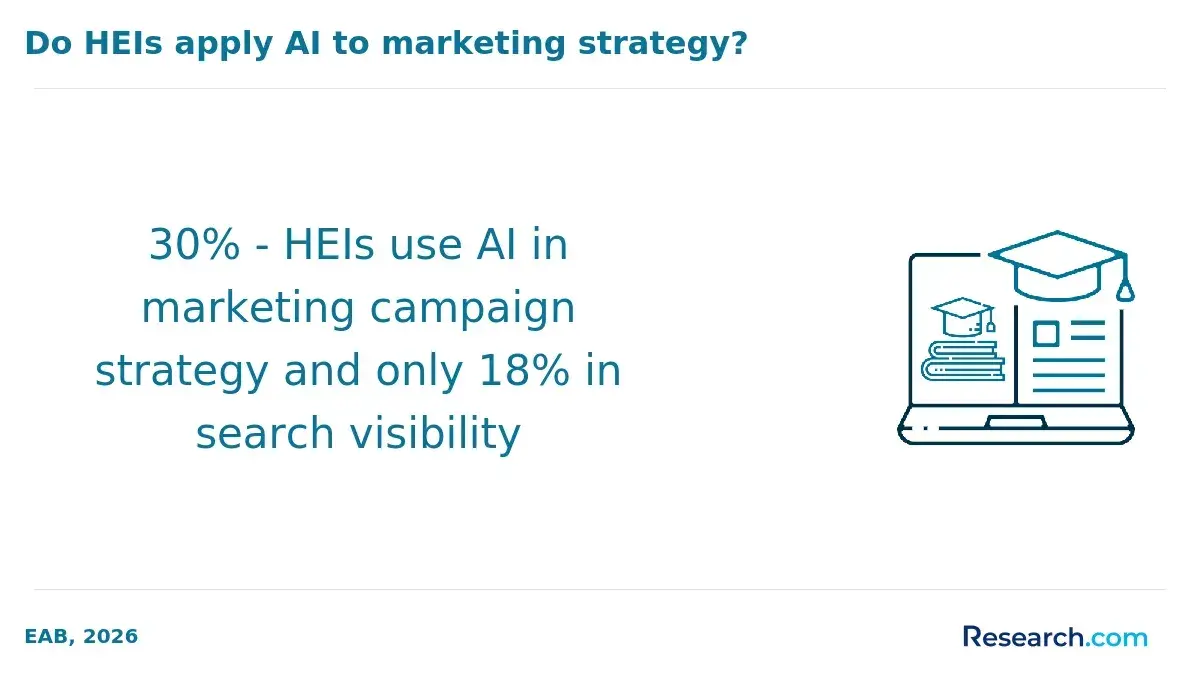
AI search adds another layer. Program pages should use clear, factual language that can be understood by search engines and AI systems: credential name, modality, location, costs, admissions, curriculum, outcomes, and FAQs. Vague brand language is less useful than precise answers to the questions students ask before choosing a program.
How do we improve lead nurturing so more student inquiries turn into enrollments?
Lead nurturing is the process of helping an inquiry become a better-informed applicant and, eventually, an enrolled student. It includes speed-to-contact, email, SMS, phone outreach, retargeting, events, advisor conversations, and content that answers objections. Nurturing matters because many education decisions involve cost, family input, employer approval, transfer credits, financial aid, and confidence about outcomes.
The first 24 hours are critical, but a longer journey still needs structure. A student who does not apply immediately may still be valuable if they are comparing programs, waiting for employer reimbursement, or choosing between start dates. The nurture plan should reflect intent rather than send the same generic sequence to every lead.
A strong nurture workflow usually includes these steps:
- Respond quickly with the exact program, credential, and next step the student requested, not a generic institutional message.
- Route leads by program, readiness, start term, geography, and learner type so admissions counselors can prioritize high-fit prospects.
- Use email and SMS to answer the main barriers: cost, time, transfer credits, admissions requirements, online flexibility, and career relevance.
- Trigger different sequences for researchers, event attendees, application starters, inactive leads, and admitted students who have not deposited or registered.
- Share proof points such as curriculum details, faculty expertise, student support, employer relevance, and alumni stories where appropriate.
- Track contact attempts, appointments, applications, document completion, admit rate, and start rate so nurture quality is visible beyond open rates.
One common mistake is measuring nurture by email engagement alone. Opens and clicks can indicate interest, but they do not prove enrollment progress. The better view is stage movement: inquiry to appointment, appointment to application, application to completed file, admission to registration, and registration to start.
Automation can improve consistency, but it should not make the experience feel impersonal. Working adults, graduate prospects, and career changers often need specific answers. If the automation only repeats brand slogans, the student may move to a competitor that explains fit, cost, and timing more clearly.
What content attracts researching students who are comparing programs and providers?
The best education content helps students make a decision, not just understand a topic. Researching students want clarity on program fit, cost, credibility, outcomes, time commitment, and alternatives. Content should meet them before they are ready to submit a form and guide them toward the next logical step.
For content to support lead generation, it should connect informational search intent to a conversion path. The goal is not to publish broad academic articles that attract irrelevant traffic; it is to answer the questions that qualified students ask while building a shortlist.
These content types tend to work well for student acquisition because they align with real comparison behavior:
- Program comparison guides that explain differences between degrees, certificates, bootcamps, concentrations, and delivery formats.
- Career pathway guides that connect roles, skills, credentials, licensure considerations, and possible education routes.
- Cost and financing explainers that discuss tuition, fees, financial aid, employer reimbursement, scholarships, and total time investment.
- Online learning guides that address flexibility, support, technology requirements, credibility, and how to evaluate program quality.
- Admissions and transfer credit resources that help students understand prerequisites, deadlines, documents, credit policies, and application steps.
- Outcome-oriented stories that show realistic student journeys, support services, and career relevance without making guaranteed employment claims.
Course providers and certificate platforms should pay special attention to career and skills content. Many learners are not searching for a brand name; they are searching for a way to gain a skill, qualify for a role, or move into a new field. If your content explains that path better than competitors, it can create demand before paid search becomes expensive.
Research.com is valuable in this environment because it already attracts learners researching education options, rankings, online programs, certificates, and career paths. Providers that want to advertise professional courses can use sponsored placements, content partnerships, and custom campaigns to reach students while they are actively comparing learning options.
A frequent content mistake is publishing only top-of-funnel articles and expecting them to convert. Strong content architecture needs middle- and bottom-funnel assets: "best programs," "degree vs certificate," "online vs campus," "cost of program," "how to choose," and "what can I do with this credential?" These are the pages that often assist paid media, retargeting, and advisor conversations.
How can we reach working adults, career changers, and other nontraditional learners?
Nontraditional learners often evaluate education through a practical lens: Will this fit my schedule? Can I afford it? Will my prior credits count? Is the credential respected? How quickly can I apply what I learn? They may be motivated, but they are also managing work, family, debt concerns, and uncertainty about returning to school.
Labor market messaging should be clear but careful. The U.S. Bureau of Labor Statistics reported 2024 median usual weekly earnings of $1,543 for full-time workers age 25 and older with a bachelor's degree, compared with $930 for those with a high school diploma. This does not mean a degree guarantees a specific income, but it explains why many adults evaluate education as a career and mobility decision.
To reach adult learners effectively, adapt both targeting and message. The same creative used for first-time traditional undergraduates often misses the needs of career changers and working professionals.
- Emphasize flexibility, including online delivery, asynchronous options, part-time pathways, evening support, and predictable course schedules.
- Address affordability directly through tuition clarity, financial aid, employer reimbursement, military benefits, scholarships, and payment options.
- Explain credit for prior learning, transfer credit, certifications, professional experience, and pathways that may reduce time to completion.
- Use career-relevant messaging that connects curriculum to skills, roles, industry needs, and credential requirements without overpromising outcomes.
- Offer low-pressure conversion paths such as program guides, credit evaluations, advisor appointments, webinars, and career-change checklists.
- Retarget visitors based on intent signals such as tuition page views, transfer credit page visits, application starts, and webinar attendance.
Working adults also respond well to trusted third-party validation. They may not know which institutions are credible in an online or certificate category, so rankings, comparison guides, student support details, accreditation information, and employer relevance can reduce perceived risk.
The mistake to avoid is treating adult learners as merely "older students." Their decision process is different. They may need more reassurance about time, cost, and relevance, but they can also move quickly when a program clearly fits their goals and constraints.
How can education providers differentiate programs in crowded and competitive markets?
Differentiation is not a slogan. It is the specific reason a student should choose your program over another credible option. In competitive categories such as online business, nursing, computer science, counseling, data analytics, project management, and coding, students often see similar claims: flexible, affordable, career-focused, and supportive. To stand out, marketers need proof.
The most persuasive differentiation usually combines audience fit, program design, credibility, and outcomes context. Instead of saying "designed for working adults," show how the program is designed for them. Instead of saying "career-focused," explain which skills, projects, industry tools, licensure pathways, or employer-aligned competencies are included.
Use these differentiation angles to sharpen your positioning before increasing media spend.
- Audience specificity: Name the learner the program fits best, such as career changers, licensed professionals, transfer students, military learners, first-generation adult learners, or managers moving into leadership.
- Credential clarity: Explain whether the offer is a degree, certificate, certification preparation program, bootcamp, continuing education course, or stackable pathway.
- Program architecture: Highlight modality, pace, start dates, concentrations, experiential learning, capstones, clinicals, projects, or portfolio components.
- Support model: Describe advising, tutoring, career services, faculty access, technical support, cohort structure, and student success resources.
- Credibility markers: Include accreditation, rankings, faculty expertise, industry alignment, licensure disclosures, employer relationships, or recognized partners.
- Decision proof: Provide comparison guides, transparent costs, student stories, outcomes context, FAQs, and clear admissions expectations.
A strong differentiation test is simple: remove your school name from the landing page and compare it with three competitors. If the claims still sound interchangeable, the page is not differentiated enough. If the proof points show who the program is for, why it is credible, and how it supports a specific goal, the marketing has a stronger foundation.
Research.com can help providers differentiate because it places brands in education-focused content environments where learners are already comparing options. Sponsored visibility and content partnerships can be especially useful for programs that are high quality but not yet as recognizable as larger competitors. Instead of relying only on brand awareness, advertisers can meet students at the moment they are weighing program fit.
How should we measure and report marketing ROI for complex, multi-touch enrollment journeys?
Education marketing ROI is difficult because the journey is rarely linear. A prospective student may read a guide, click a search ad, visit a ranking page, attend a webinar, talk with an advisor, return through retargeting, and apply weeks later. If reporting credits only the final click or only the original lead source, leadership may cut channels that assisted enrollment.
The solution is to define a funnel model that connects marketing activity to enrollment outcomes. Raw leads are only the first layer. Teams should also report qualified inquiries, contact rate, appointment rate, application starts, completed applications, admits, registrations, starts, cost per application, cost per enrollment, and revenue or tuition contribution where available.
The table below organizes the main reporting stages and the questions each stage should answer. This helps teams explain performance without reducing the full journey to a single CPL number.
| Funnel stage | Core metric | Decision it supports | Common reporting risk |
| Awareness | Qualified traffic, topic visibility, engaged sessions | Which audiences and program topics are creating demand? | Reporting impressions without relevance or engagement context |
| Inquiry | CPL, form completion rate, lead validation rate | Which channels create usable prospective student records? | Optimizing for cheap leads without checking fit or consent |
| Contact | Contact rate, appointment rate, response time | Are inquiries reachable and being handled quickly? | Blaming media when admissions follow-up is slow or inconsistent |
| Application | Application start rate, completed application rate | Which sources generate serious applicants? | Ignoring friction in document collection or application UX |
| Enrollment | Cost per start, yield rate, tuition contribution | Which investments produce economically viable growth? | Crediting only last click and missing assisted channels |
| Retention signal | Early persistence, registration completion, first-term engagement | Are acquisition sources bringing students who fit the program? | Separating marketing quality from student success outcomes |
Agencies need an especially disciplined version of this model because clients often compare campaigns by CPL alone. For teams managing lead generation for education agencies, Research.com can serve as a partner for qualified traffic, CPL programs, sponsored visibility, and custom education marketing partnerships, while downstream CRM reporting shows which sources contribute to applications and starts.
A useful ROI report should separate three views: channel efficiency, funnel quality, and enrollment economics. Channel efficiency shows cost and volume. Funnel quality shows whether leads move forward. Enrollment economics shows whether the acquisition cost makes sense for the program.
When these are reported together, marketers can defend investments that influence complex decisions rather than overfunding only the easiest-to-attribute sources.
Other Things You Should Know
Student lead generation is the process of attracting prospective learners and capturing their contact information or application intent. In education, a lead may come from a form, phone call, webinar registration, guide download, application start, marketplace inquiry, or advisor appointment.
There is no universal good CPL because program value, conversion rate, audience, and credential level vary widely. A better benchmark is your maximum affordable CPL, calculated from allowable cost per enrollment and the percentage of leads that become enrolled students.
Exclusive leads often have higher value because fewer institutions contact the same student, but they usually cost more. Shared leads can still work if consent is clear, the source is transparent, and downstream application and enrollment rates justify the cost.
Paid search and marketplace campaigns can produce inquiries quickly, but enrollment impact may take weeks or months because students need time to compare programs, complete applications, secure funding, and choose a start date. SEO, content, and partnerships usually take longer to mature but can reduce reliance on paid media over time.
References
- Marketing Budget Allocation Guide 2026 | Improvado https://improvado.io/blog/marketing-budget-allocation
- Go-To Marketing Strategies To Promote New Higher Education Programmes | Full Fabric https://www.fullfabric.com/articles/go-to-marketing-strategies-to-promote-new-higher-education-programmes-and-attract-new-students
- Product differentiation strategies: stand out in crowded markets https://www.statsig.com/perspectives/product-differentiation-strategies
- How to Build a Landing Page That Converts in 2026 https://eminence.ch/en/create-successful-landing-page-increase-conversion-rate/
- How to Market Your Higher Education Programs to Prospective Students - UPCEA https://upcea.edu/how-to-market-your-higher-education-programs-to-prospective-students/
- What is Blue Ocean Strategy and How To Implement It https://www.imd.org/blog/innovation/blue-ocean-strategy/
- Attracting Students: What Do They Want? https://elearningindustry.com/attracting-students-what-they-want
- How to Measure ROI for Digital Marketing Campaigns https://www.business.com/articles/how-to-measure-digital-marketing-roi/
- Lead Generation for Graduate & Adult Learner Programs | EAB https://eab.com/higher-education-glossary/lead-generation-strategies-for-adult-learners-and-graduate-students/
- How To Allocate Budgets Across Google, Meta & SEO https://icetulip.com/how-to-allocate-budgets-across-google-meta-linkedin-seo/