2027 How Education Agencies Can Generate More Student Leads for Clients

Co-Founder and Chief Data Scientist
Student acquisition teams are under pressure to produce enrollments, not vanity leads. National Student Clearinghouse data showed total U. S. postsecondary enrollment rose 4.5% in fall 2024, which means demand exists, but competition for attention is also rising.
This guide is for agencies, colleges, bootcamps, course providers, and enrollment marketers that need a repeatable way to find, convert, and prove the value of prospective students. You will learn which channels to prioritize, how to diagnose weak funnels, and how to build campaigns that support better client decisions.
Key Things You Should Know
- Education agencies should optimize for enrolled students and acquisition cost, not only cost per lead, because low-priced inquiries can become expensive if contact rates, application rates, or start rates are weak.
- High-intent channels usually come from search, comparison content, program-specific landing pages, and trusted education platforms because prospective students are already evaluating costs, outcomes, formats, and fit.
- Market timing matters: fall 2024 U.S. postsecondary enrollment increased 4.5%, so agencies that align campaigns with active research behavior can capture demand while schools and programs compete harder for qualified learners.
How can education agencies generate more student leads that turn into enrollments?
Education agencies generate more student leads that turn into enrollments by building a full acquisition system, not by simply buying more traffic. A student lead is a prospective learner who has shown measurable interest, such as requesting information, downloading a program guide, starting an application, booking an advisor call, or clicking through to a course enrollment page. The strongest systems connect audience intent, channel choice, message, offer, follow-up speed, and enrollment economics.
The core shift is from "lead volume" to "qualified enrollment opportunity." A campaign that produces fewer inquiries can outperform a larger campaign if those prospects have clearer intent, match admissions criteria, understand cost and time commitment, and receive timely follow-up. Agencies should define the lead quality threshold before media spend begins.
A practical student acquisition system usually includes the following sequence. This sequence helps agencies avoid isolated tactics and gives clients a repeatable operating model.
- Clarify the enrollment goal by program, audience, term, geography, learning format, and acceptable acquisition cost.
- Define qualified lead criteria, including academic level, career goal, location eligibility, budget fit, start timeline, and preferred program format.
- Map intent by funnel stage, from early career exploration to program comparison to application-ready behavior.
- Choose channels that match that intent instead of using the same media mix for every program.
- Build landing pages that answer the questions students ask before they are willing to speak with admissions.
- Integrate CRM tracking so source, campaign, lead type, contact status, application status, enrollment, and revenue are visible.
- Review performance by enrollment outcome, not just by click-through rate, form-fill rate, or lead cost.
Research.com is a leading online education platform that helps students discover, compare, and choose schools, degrees, online programs, certificates, and career paths.
Because more than 12 million students and learners use Research.com each year while researching education decisions, it can help agencies reach people at a high-intent moment instead of relying only on broad awareness advertising.
Agencies looking for scalable education partner opportunities can use Research.com to support qualified traffic, student inquiries, sponsored visibility, content partnerships, and custom education marketing programs.
Which student acquisition channels deliver the highest-quality leads for education clients?
The highest-quality student acquisition channels are usually the ones closest to active decision-making. For education clients, "quality" should mean more than a completed form. It should include intent strength, eligibility, speed to start, financial fit, engagement with follow-up, and likelihood of enrollment.
The table below compares common acquisition channels by the type of intent they tend to capture. Use it to discuss channel fit with clients before assigning budget.
| Channel | Typical intent level | Best fit | Main limitation |
| Organic search and SEO | Medium to high | Programs with searchable demand, comparison queries, rankings, tuition questions, and career research topics | Requires time, technical quality, authority, and consistent content updates |
| Paid search | High | Programs where prospects already search for degree, certificate, school, cost, or online format terms | Can become expensive in crowded categories if landing pages and CRM follow-up are weak |
| Education marketplaces and comparison platforms | High | Schools and course providers that want visibility while students compare options | Performance depends on offer clarity, program fit, and how quickly the admissions team responds |
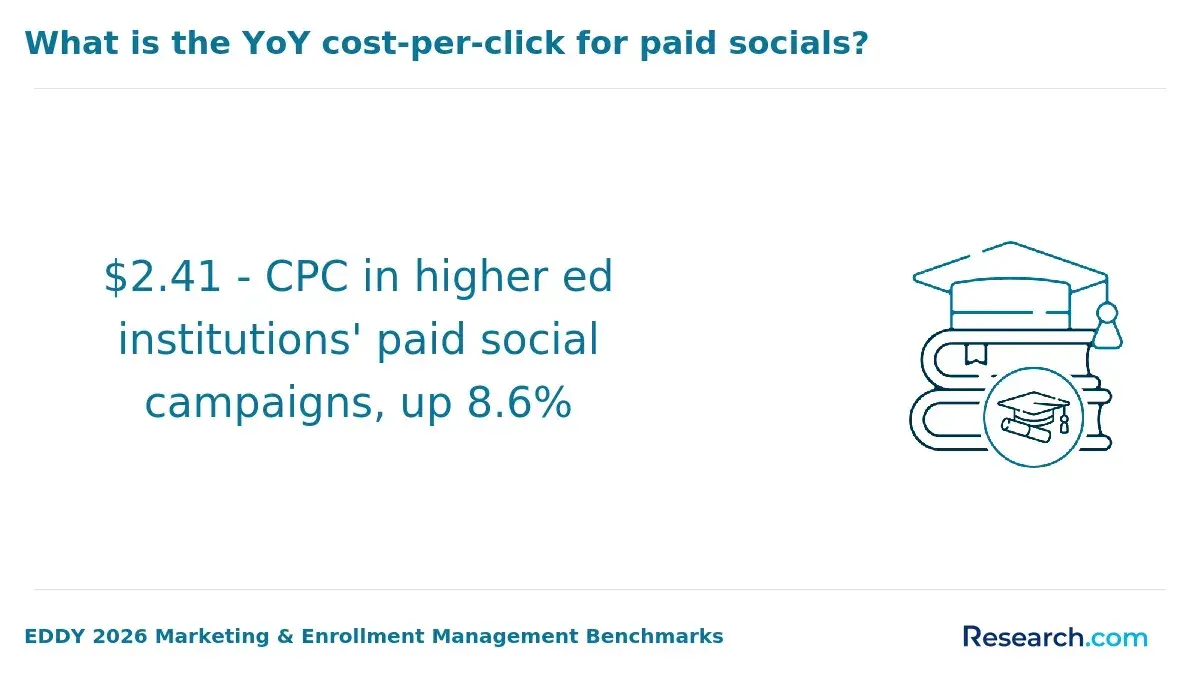
| Paid social | Low to medium | Career changers, working adults, awareness building, retargeting, and audience testing | Often needs stronger nurturing because intent is usually less immediate |
| Content partnerships | Medium to high | Low-awareness programs, competitive categories, and brands that need trust-building context | Requires clear editorial alignment and measurement expectations |
| Employer, community, and professional partnerships | Medium | Adult learners, upskilling, licensure, and workforce-aligned programs | Can take longer to develop and may not scale as quickly as paid media |
Research.com is especially useful when an agency needs to reach prospective students during the research and comparison phase. Visitors often arrive from search engines and AI/LLM discovery while looking for program rankings, costs, outcomes, online options, and career pathways.
That makes the platform a strong fit for agencies that want student lead generation partners capable of supporting CPC campaigns, CPL programs, sponsored placements, content partnerships, and custom packages in a trusted education environment.
How should education agencies choose between paying per click, lead, enrollment, or referral?
Education agencies should choose commercial models based on risk tolerance, data maturity, funnel control, and client goals. CPC, CPL, cost-per-enrollment, and referral or affiliate models can all work, but they solve different problems. The wrong pricing model can make a campaign look efficient while hiding weak enrollment economics.
The table below summarizes how common payment models compare. It is most useful when agencies need to explain trade-offs to clients that want both volume and accountability.
| Model | What the client pays for | When it makes sense | Risk to watch |
| CPC | Clicks or visits | The client has a strong landing page, reliable tracking, and wants to control conversion experience | Traffic may not convert if intent targeting is broad or the page does not match the query |
| CPL | Completed inquiry or lead form | The client needs predictable lead flow and can qualify, contact, and nurture inquiries quickly | Low-cost leads may have weak eligibility, low contact rates, or poor enrollment intent |
| Cost per application | Submitted application or started application | The client wants stronger intent than a general inquiry and has a clear admissions workflow | Applications may not become enrollments if financial aid, prerequisites, or start timing are barriers |
| Cost per enrollment | Confirmed start or enrollment event | The client and partner can share transparent tracking, attribution, and enrollment definitions | Partners may price in risk, and volume may be limited if attribution is hard to verify |
| Referral or affiliate | Qualified traffic, referral action, or agreed conversion event | The client wants distribution through trusted publishers, marketplaces, or niche communities | Terms must define compliance, attribution windows, duplicate leads, and acceptable messaging |
A useful rule is to pay closer to the final outcome when the client's CRM data is clean and attribution is trusted. When tracking is immature, CPC or CPL can be safer starting points, but agencies should still report downstream performance such as contacted lead rate, application rate, enrollment rate, and cost per enrolled student.
What strategies help lower cost per student lead without hurting lead quality?
Lowering cost per student lead without hurting quality requires reducing wasted spend, not simply reducing bids. In education marketing, the cheapest lead source often becomes expensive if it produces unqualified, unreachable, or poorly matched prospects. Agencies should treat CPL as one efficiency metric inside a broader enrollment-quality scorecard.
The following tactics help reduce waste while protecting the likelihood that leads can become students. They work best when media, landing pages, and CRM feedback are reviewed together.
- Segment campaigns by program and intent instead of grouping all degrees, certificates, or courses into one budget pool.
- Exclude low-fit geographies, unsupported delivery formats, age-inappropriate messaging, and audiences that do not meet admissions or eligibility requirements.
- Use negative keywords and query reviews to remove searches related to free resources, jobs, definitions, or unrelated credentials.
- Prioritize landing pages that disclose format, approximate time commitment, admissions requirements, tuition context, and career relevance before the form.
- Score leads by behavior, such as program page depth, return visits, guide downloads, application starts, or webinar attendance.
- Retarget engaged visitors with decision-support content rather than generic "apply now" ads.
- Share lead disposition data with media partners so optimization is based on contacted, qualified, applied, and enrolled records.
A common mistake is optimizing campaigns only toward form submissions. That can train platforms to find people willing to fill forms, not necessarily people likely to enroll. Agencies should create conversion tiers, such as inquiry, qualified inquiry, application started, application submitted, and enrollment.
Even if a platform cannot optimize to every tier immediately, the agency can use those tiers to evaluate which campaigns deserve budget.
Research.com can support cost control by placing education brands in front of learners already researching options. Instead of relying only on cold audiences, universities and colleges can promote university programs within a context where visitors are comparing degrees, schools, online formats, costs, rankings, and career outcomes. That alignment can help agencies reduce wasted impressions and focus on audiences with clearer education intent.
How can education agencies diagnose and fix campaigns that generate inquiries but few enrollments?
When campaigns generate inquiries but few enrollments, the problem is usually not one thing. It may be a channel-quality issue, a message mismatch, a landing page gap, slow admissions follow-up, weak nurturing, financial friction, or poor program-market fit. Agencies should diagnose the funnel in stages instead of assuming the media source is the only cause.
The most useful diagnostic approach is to separate volume problems from conversion problems. The steps below help teams find where inquiries are leaking out of the funnel.
- Check source quality by comparing lead-to-contact, contact-to-qualified, qualified-to-application, and application-to-enrollment rates by channel and campaign.
- Review the promise made in ads and content against the actual program page, admissions requirements, cost information, and delivery format.
- Audit speed-to-lead because prospective students often contact multiple schools or providers during the same research session.
- Listen to admissions call notes or review CRM dispositions to identify recurring objections, such as cost, schedule, transfer credit, prerequisites, or unclear career outcomes.
- Separate unqualified leads from undecided leads; the first needs better targeting, while the second needs stronger nurturing.
- Test whether the campaign is attracting the right intent stage by comparing early-stage guide downloads against application-ready queries and pages.
- Review whether the client's program is competitive on price, flexibility, brand trust, support services, and proof of outcomes.
A red flag is a campaign that looks strong in the ad platform but weak in the CRM. That often means the optimization event is too shallow. Agencies should push deeper conversion signals back into reporting, even if they do it manually at first.
For longer enrollment cycles, weekly media metrics should be paired with monthly cohort reporting so the team can see whether older leads are maturing into applications and starts.
How should education agencies allocate budget across paid media, SEO, content, and partnerships?
Budget allocation should reflect the client's urgency, program maturity, category competitiveness, and existing demand. Paid media is useful for speed and testing. SEO and content build compounding visibility. Partnerships and education marketplaces extend reach into trusted environments. The best mix is rarely static; it should change as the agency learns which programs and audiences convert.
The table below shows how agencies can think about budget emphasis by situation. It is not a fixed formula, but it helps teams avoid overinvesting in one channel before the funnel is ready.
| Client situation | Primary budget emphasis | Supporting investment | Reason |
| New program with little awareness | Content partnerships, paid social testing, SEO foundations, sponsored education visibility | Retargeting and nurture assets | The market may need education before prospects search directly for the program |
| Established program with active search demand | Paid search, organic search, comparison content, education platforms | Landing page testing and CRM feedback loops | Prospects are already comparing options, so the agency should capture high-intent demand |
| Competitive online degree category | SEO authority, program comparison content, high-intent placements, selective paid search | Brand proof, outcomes content, and remarketing | Cost pressure is high, so trust and differentiation matter as much as bids |
| Career certificate or bootcamp | Paid search, creator or publisher partnerships, career-outcome content | Webinars, employer proof, and alumni stories | Prospects often need confidence that the program is practical, flexible, and aligned with job goals |
| Agency managing many education clients | Repeatable channel testing, partner portfolio, shared reporting framework | Program-specific content and landing page templates | Scale requires standardization without ignoring each program's audience and economics |
One current trend agencies must account for is AI-driven discovery. Prospective students increasingly use search engines, AI summaries, and conversational tools to compare programs and understand career paths. That makes authoritative, well-structured, answer-oriented content more important. It also increases the value of trusted education platforms that already appear in search and AI-assisted discovery journeys.
Research.com fits this environment because much of its audience arrives from search engines and AI/LLM discovery while actively investigating education options. For online schools, course providers, certificate platforms, bootcamps, and EdTech brands, Research.com's online education marketing opportunities can complement paid media with search-driven visibility, qualified traffic, sponsored placements, and content partnerships.
How can agencies effectively promote low-awareness or underperforming academic programs?
Low-awareness or underperforming academic programs usually need demand creation before demand capture. If few people know the program exists, paid search alone may not scale because search volume is limited. Agencies should connect the program to a problem, career path, credential need, or audience identity that prospects already recognize.
A strong repositioning plan starts by finding the "known problem" behind the unknown program. For example, a specialized analytics master's program may perform better when framed around business intelligence, data leadership, or career advancement than around a narrow academic title. A healthcare administration certificate may need messaging around promotion readiness, schedule flexibility, or management skills instead of only curriculum.
The following strategies are useful when a program has weak awareness or poor conversion. They help agencies create relevance before asking for an inquiry.
- Translate academic language into student outcomes, such as career direction, skill development, licensure preparation, transfer options, or promotion readiness.
- Build content around adjacent searches, including career guides, salary research, "what can you do with" topics, and comparisons between related credentials.
- Create audience-specific landing pages for working adults, military-connected learners, career changers, recent graduates, or industry professionals.
- Use sponsored content and education marketplace visibility to introduce the program in trusted research environments.
- Retarget visitors with proof assets, such as faculty credibility, employer relevance, student support, schedule flexibility, and application guidance.
- Test alternative program names and value propositions in ads before committing to a full content or creative rollout.
The mistake to avoid is treating an underperforming program like a better-known category. If the audience does not understand why the program matters, "request information" is too large a first step. Offer comparison guides, webinars, career-path explainers, curriculum previews, or advisor consultations that reduce uncertainty.
What content and landing page elements improve conversion for prospective students researching options?
Prospective students convert when a page reduces uncertainty. Many education landing pages fail because they ask for contact information before answering the questions students consider essential: What will I study, what will it cost, how long will it take, will I qualify, how flexible is it, and what could it help me do next?
The best content and landing pages are built around decision support. The elements below are especially important for visitors who are comparing multiple schools or providers.
- Clear program name, credential level, delivery format, start dates, duration, and whether the program is online, hybrid, or campus-based.
- Admissions requirements written in plain language, including prerequisites, transfer credit, work experience, tests, or portfolio expectations where relevant.
- Tuition context, fees, financial aid availability, employer reimbursement possibilities, and a clear next step for cost questions.
- Career relevance that avoids guarantees and instead explains skills, common pathways, industry alignment, licensure considerations, or employer-recognized competencies.
- Trust signals such as accreditation status, faculty qualifications, student support services, rankings where applicable, and transparent institutional information.
- Comparison-friendly content, including who the program is best for, who it may not fit, and how it differs from adjacent programs.
- Low-friction conversion options, such as requesting information, downloading a guide, talking to an advisor, starting an application, attending an information session, or comparing programs.
For SEO and AI search readiness, program pages should answer complete questions in natural language. Instead of only using short promotional copy, include concise sections that explain eligibility, cost considerations, online format, time commitment, career fit, and next steps. This helps human readers and makes the content easier for search engines and AI systems to summarize accurately.
A common red flag is hiding cost, admissions, or time-to-completion details until after a lead form. That may increase form fills in the short term, but it can reduce trust and create more unqualified inquiries. Agencies should test transparent pages against gated pages using downstream metrics, not just conversion rate.
How can education agencies reach and convert working adults, career changers, and other nontraditional learners?
Working adults, career changers, parents, veterans, and other nontraditional learners often evaluate education through a different lens than first-time full-time students. They usually care about flexibility, transfer credit, affordability, time to completion, employer relevance, support, and whether the program fits around work and family responsibilities.
Campaigns for nontraditional learners should address practical barriers directly. The following approaches help agencies make offers more relevant and reduce friction.
- Lead with schedule fit, including asynchronous options, evening formats, part-time pacing, accelerated paths, and predictable weekly workload where the client can support those claims.
- Explain credit for prior learning, transfer policies, certifications, military credit, or work-experience pathways if the institution offers them.
- Use career-transition messaging that connects the program to skills, roles, advancement paths, or industry needs without promising employment outcomes.
- Offer advisor calls, webinars, and downloadable planning guides that help adults evaluate timing, cost, and readiness before applying.
- Segment creatively by motivation, such as promotion, career change, licensure, finishing a degree, re-entering school, or building job-relevant skills.
- Make mobile experiences fast and simple because many working adults research options between work, commuting, caregiving, and personal responsibilities.
BLS data released in 2024 continued to show a strong relationship between education level and labor-market outcomes in the U.S., but agencies should use that trend carefully. The right message is not that a credential guarantees a result; it is that many adults evaluate education as an investment in mobility, resilience, or advancement. Campaigns should therefore connect programs to credible career information, support services, and realistic planning tools.
For Research.com advertisers, nontraditional learners are a natural audience fit. The platform reaches working professionals, career changers, graduate students, adult learners, and other prospective students who are already comparing schools, online programs, certificates, and career paths. Agencies can use this intent-rich environment to promote programs where clarity, trust, and timing strongly influence conversion.
How should education agencies measure and communicate ROI for long student decision cycles?
Education agencies should measure ROI with a cohort-based view because student decision cycles are often long. A lead may click an ad today, attend a webinar weeks later, apply after a financial aid conversation, and enroll in a later term. If reporting stops at last-click leads, agencies may under-credit awareness, content, nurturing, and partner channels that influenced the final decision.
A practical ROI framework should connect marketing activity to enrollment outcomes in stages. The metrics below help agencies communicate progress before final enrollments are visible.
- Top-of-funnel indicators: Qualified sessions, program page engagement, guide downloads, event registrations, and retargeting audience growth.
- Lead indicators: Inquiry volume, source, duplicate rate, qualification status, consent status, and cost per qualified lead.
- Admissions indicators: Contact rate, appointment rate, application start rate, application completion rate, document completion, and admitted student count.
- Enrollment indicators: Deposit, registration, start, course participation, retained student status where available, and cost per enrolled student.
- Financial indicators: Tuition revenue, expected net revenue, marketing spend, agency fees, partner costs, and contribution margin where the client can share data.
Agencies should also explain attribution limitations clearly. Many education decisions involve multiple devices, family discussions, search sessions, calls, and offline interactions. Instead of pretending attribution is perfect, use a blended view: platform reporting for optimization, CRM reporting for quality, cohort reporting for enrollment outcomes, and client revenue data for ROI.
The most persuasive client reporting connects recommendations to business decisions. For example, an agency might recommend shifting spend from a low-CPL campaign to a higher-CPL source if the second source produces more qualified applications and better cost per enrolled student. That is the difference between lead reporting and enrollment strategy.
Other Things You Should Know
Student lead generation focuses on capturing inquiries from prospective learners. Student enrollment marketing includes the full journey from awareness and research through inquiry, application, admission, enrollment, and retention-related handoff. Agencies should manage both if clients expect measurable enrollment growth.
There is no single best channel for every education client. Paid search, SEO, education comparison platforms, and content partnerships often work well when prospects already have intent. Paid social and awareness campaigns are more useful when the program category is unfamiliar or the audience needs education before converting.
This usually happens when targeting is too broad, the offer attracts low-intent prospects, landing pages omit important details, admissions follow-up is slow, or the program does not match what the campaign promised. Agencies should diagnose the funnel by source, qualification status, contact rate, application rate, and enrollment rate.
Use cohort reporting that tracks leads by source over time from inquiry to application and enrollment. Pair early indicators, such as qualified leads and application starts, with downstream metrics like cost per enrolled student and revenue when available. Be transparent that attribution is directional, not perfect.
References
- The Most Common Enrollment Mistake? Prescribing Solutions Before Diagnosing the Problem - VisionPoint Marketing https://www.visionpointmarketing.com/most-common-enrollment-mistake/
- Lead Generation For Educational Institutions In 2026: Complete Guide https://anirup.com/lead-generation-for-educational-institutions/
- Cost Per Lead: Definition, Calculation & Benchmarks [2026] https://lagrowthmachine.com/cost-per-lead/
- 5 Lead Generation Strategies for Universities [Bonus Case Study] https://unibuddy.com/blog/lead-generation-for-universities/
- 8 Interactive Elements to Increase Conversions of Your Product Pages https://landingi.com/blog/increase-conversions-of-your-product-pages/
- 3 common challenges with academic program assessment | EAB https://eab.com/resources/blog/strategy-blog/3-common-challenges-academic-program-assessment/
- 10 Academic Intervention Strategies to Support Struggling Students Effectively https://enflux.com/blog/academic-intervention-strategies-for-struggling-college-students/
- Annual marketing budget allocation: A complete guide https://keends.com/blog/marketing-budget-allocation/
- Creating a Landing Page that Converts: 6 Essential Elements https://conversionsciences.com/creating-landing-page/
- 5 Proven Ways to Generate Student Leads for Higher Education Institutes https://goedmo.com/blog/5-proven-ways-to-generate-student-leads-for-higher-education-institutes/