
2027 Most Affordable Online Graduate Certificate Nurse Midwifery Programs

Co-Founder and Chief Data Scientist
Choosing an online graduate certificate in nurse midwifery is usually a practical decision, not just an academic one. You may already be a licensed nurse with graduate education, a full-time job, and a clear goal: qualify for advanced practice in pregnancy, birth, postpartum, reproductive, and primary women’s health care without starting a new degree from the beginning.
The need for qualified nurse midwives remains significant. As of January 2024, the American Midwifery Certification Board (AMCB) reported 14,067 certified nurse midwives in the US. Even with that workforce in place, many communities—especially rural and medically underserved areas—continue to need clinicians trained in maternal and reproductive health.
This guide explains what an online nurse midwifery graduate certificate involves, how affordable programs compare, what admissions and clinical requirements to expect, how long the credential can take, what it may cost, and how to decide whether this path fits your career plans.
Quick answer: Is an online nurse midwifery graduate certificate worth considering?
An online graduate certificate in nurse midwifery can be a strong option for nurses who already have graduate nursing preparation and want focused training for certified nurse midwife practice. The online format can reduce relocation and commuting barriers, but students still complete supervised in-person clinical experiences. Before enrolling, verify ACME accreditation, certification eligibility, clinical placement support, state authorization, and total program cost.
What are the main benefits of earning this certificate online?
- Career mobility: The credential can support preparation for roles such as certified nurse midwife, women’s health nurse practitioner, or maternal care specialist in hospitals, birth centers, outpatient clinics, and community health settings.
- Strong earning potential: Nurse midwives earned a median annual wage of $128,790 in May 2024, according to the US Bureau of Labor Statistics.
- Flexibility for working nurses: Online coursework often allows practicing nurses to continue employment while completing advanced didactic training, although clinical hours must be completed in person.
- Focused training without repeating a full degree: For MSN-prepared nurses or APRNs, a certificate may be a more targeted route than enrolling in another complete graduate program.
What can I expect from an online nurse midwifery graduate certificate?
An online nurse midwifery graduate certificate is a post-graduate nursing credential designed for nurses who already have advanced academic preparation, commonly a master’s degree in nursing or a comparable graduate qualification. The curriculum is narrower than a full MSN because it concentrates on midwifery competencies rather than foundational graduate nursing content.
Students typically study prenatal care, birth care, postpartum care, newborn assessment, reproductive and gynecologic health, advanced pharmacology, health assessment, and primary care for women across the lifespan. The online portion may include recorded lectures, live seminars, case discussions, exams, care planning assignments, and simulation-based learning.
The most important point for prospective students is this: online does not mean clinical-free. Nurse midwifery education requires supervised, hands-on clinical practice. Most programs arrange or approve clinical placements in settings such as labor and delivery units, OB-GYN practices, birth centers, or women’s health clinics, often near the student’s home community.
Typical program features
| Program element | What it usually means for students |
| Academic level | Post-master’s or post-graduate certificate for nurses with prior graduate preparation |
| Course delivery | Online classes, often with asynchronous work and some scheduled virtual sessions |
| Clinical training | In-person, supervised clinical experiences at approved sites |
| Common pace | Often part-time to accommodate working nurses |
| Completion time | Commonly one to two years, with some programs ranging longer depending on structure and prerequisites |
| Primary goal | Preparation for advanced practice in nurse midwifery and related certification requirements |
Where can I work after completing a nurse midwifery graduate certificate?
Graduates who meet certification and state practice requirements may pursue nurse midwifery roles in a variety of clinical environments. Common workplaces include hospitals, labor and delivery departments, birth centers, OB-GYN offices, outpatient women’s health clinics, private practices, and community health organizations.
The credential can be especially relevant in communities where access to maternal care is limited. Nurse midwives may provide prenatal visits, attend births, manage postpartum follow-up, support lactation and newborn care, deliver reproductive health services, and offer routine gynecologic and primary care within their scope of practice.
Some graduates also move beyond direct patient care. Certified nurse midwives may teach in universities or colleges, serve as clinical preceptors, contribute to public health initiatives, or work with nonprofit and government programs focused on maternal and infant health outcomes.
How much can I make after completing a nurse midwifery graduate certificate?
Nurse midwifery is an advanced practice nursing field, and compensation reflects the level of clinical responsibility, certification, experience, employer type, and local labor market. According to the US Bureau of Labor Statistics, nurse midwives earned a median annual wage of $128,790 in May 2024.
Pay varies widely. The top 10% of earners made more than $170,000, while those in the lower 10% earned around $84,000. Location can make a major difference; nurse midwives in California, Hawaii, and Massachusetts tend to earn higher-than-average wages. Employer type also matters. Private practices and specialized birthing centers may offer additional compensation arrangements, such as bonuses or profit-sharing, but these are not guaranteed.
Prospective students should treat salary data as a planning benchmark rather than a promise. Your actual earnings will depend on certification status, state regulations, clinical experience, negotiation leverage, call responsibilities, and the type of organization that hires you.
- List of the Most Affordable Online Graduate Certificate Nurse Midwifery Programs for 2027
- How long does it take to complete an online nurse midwifery graduate certificate?
- How does an online nurse midwifery graduate certificate compare to an on-campus program?
- What is the average cost of an online nurse midwifery graduate certificate?
- What are the financial aid options for students enrolling in an online nurse midwifery graduate certificate?
- What are the prerequisites for enrolling in an online nurse midwifery graduate certificate?
- What courses are typically in an online nurse midwifery graduate certificate?
- What types of specializations are available in online nurse midwifery graduate certificate programs?
- How does an online nurse midwifery certificate complement additional nursing credentials?
- What accreditation and regulatory considerations should you verify?
- How does an online nurse midwifery certificate differ from direct entry MSN nurse practitioner programs?
- What challenges might I face in an online nurse midwifery graduate certificate program?
- How do you choose the most affordable online nurse midwifery graduate certificate?
- What career paths are available for graduates of online nurse midwifery graduate certificate programs?
- What is the job market like for graduates who completed an online nurse midwifery graduate certificate?
List of the Most Affordable Online Graduate Certificate Nurse Midwifery Programs for 2027
How should you use this ranking?
This list is intended as a starting point for comparing affordable online and hybrid nurse midwifery graduate certificate options. Price matters, but it should not be the only factor. For this field, the best low-cost program is one that is affordable, accredited, clinically viable in your state, and realistic for your work schedule.
Research.com reviewed publicly available institutional and federal data from the IPEDS database, Peterson’s database, Peterson’s Distance Learning Licensed Data Set, College Scorecard, and the National Center for Education Statistics. These sources help evaluate tuition, distance learning availability, institutional data, and program characteristics.
The ranking emphasizes affordability, accessibility, and academic quality. Factors considered include cost per credit, number of credits required, accreditation status, online or hybrid delivery, schedule flexibility, concentration options, and support for adult learners and working nurses. You can review the broader evaluation process on Research.com’s methodology page.
Affordable program comparison
| Rank | School | Program length | Credits | Cost per credit | Accreditation |
| 1 | Frontier Nursing University | 24 to 30 months | 33 | $646 | Accreditation Commission for Midwifery Education (ACME) |
| 2 | Texas Tech University Health Sciences Center | Two years | 36 | $300 (in-state); $680 (out-of-state) | ACME |
| 3 | University of Cincinnati | 18 to 24 months | 34 | $693 | ACME |
| 4 | East Carolina University | Six semesters | 36 | $278 (in-state); $893 (out-of-state) | ACME |
| 5 | Rutgers University–Camden | 20 to 24 months | 35 | $756 | ACME |
| 6 | University of Colorado Anschutz Medical Campus | 18 to 24 months | 32 | $525 | ACME |
| 7 | Shenandoah University | Six to seven semesters | 34 | $865 | ACME |
| 8 | University of Utah | Two years | 30 | $518 | ACME |
| 9 | Georgetown University | 24 months | 36 | $2,278 | ACME |
| 10 | Thomas Jefferson University | Five to six semesters | 30 | $1,000 | ACME |
1. Frontier Nursing University
Frontier Nursing University is widely associated with community-based midwifery education and distance learning. Its online graduate certificate is built for advanced practice RNs who want to add nurse midwifery to their scope. Students complete online didactic courses and supervised clinical experiences in their communities.
- Program Length: 24 to 30 months
- Tracks/concentrations: Nurse Midwifery only
- Cost per Credit: $646
- Required Credits to Graduate: 33
- Accreditation: Accreditation Commission for Midwifery Education (ACME)
2. Texas Tech University Health Sciences Center
Texas Tech University Health Sciences Center offers a hybrid online certificate for nurses preparing for midwifery practice in rural and urban communities. The program accepts RNs with a Master of Science in Nursing and combines synchronous and asynchronous coursework with precepted clinical rotations.
- Program Length: Two years
- Tracks/concentrations: Nurse Midwifery
- Cost per Credit: $300 (in-state); $680 (out-of-state)
- Required Credits to Graduate: 36
- Accreditation: ACME
3. University of Cincinnati
The University of Cincinnati’s online nurse midwifery certificate is structured for advanced practice nurses who already have graduate nursing education. The part-time format supports working professionals, and the curriculum emphasizes evidence-based, patient-centered maternal and reproductive care.
- Program Length: 18 to 24 months
- Tracks/concentrations: Nurse Midwifery
- Cost per Credit: $693
- Required Credits to Graduate: 34
- Accreditation: ACME
4. East Carolina University
East Carolina University’s College of Nursing offers an online graduate certificate in nurse midwifery with a focus on primary care, women’s health, and service to underserved populations. Online classes are paired with approved local clinical experiences.
- Program Length: Six semesters
- Tracks/concentrations: Nurse Midwifery
- Cost per Credit: $278 (in-state); $893 (out-of-state)
- Required Credits to Graduate: 36
- Accreditation: ACME
5. Rutgers University–Camden
Rutgers University–Camden offers a post-master’s nurse midwifery certificate through its School of Nursing. The hybrid design allows students to complete much of the coursework online while attending occasional campus-based requirements, making it a practical option for many nurses in the Northeast.
- Program Length: 20 to 24 months
- Tracks/concentrations: Nurse Midwifery
- Cost per Credit: $756
- Required Credits to Graduate: 35
- Accreditation: ACME
6. University of Colorado Anschutz Medical Campus
The University of Colorado Anschutz Medical Campus provides an online graduate certificate for MSN-prepared nurses who want specialized preparation in nurse midwifery. The curriculum includes reproductive health, newborn care, clinical decision-making, and patient advocacy, with clinical requirements completed at approved sites.
- Program Length: 18 to 24 months
- Tracks/concentrations: Nurse Midwifery
- Cost per Credit: $525
- Required Credits to Graduate: 32
- Accreditation: ACME
7. Shenandoah University
Shenandoah University’s online nurse midwifery graduate certificate is offered with Inova Health System. The program blends online instruction with intensive clinical learning and emphasizes interprofessional collaboration, maternal care, and community-oriented practice.
- Program Length: Six to seven semesters
- Tracks/concentrations: Nurse Midwifery
- Cost per Credit: $865
- Required Credits to Graduate: 34
- Accreditation: ACME
8. University of Utah
The University of Utah offers a hybrid nurse midwifery certificate for MSN-prepared nurses. Its structure combines online coursework with on-site clinical intensives and may be especially relevant for students in the western US, including those serving rural communities.
- Program Length: Two years
- Tracks/concentrations: Nurse Midwifery
- Cost per Credit: $518
- Required Credits to Graduate: 30
- Accreditation: ACME
9. Georgetown University
Georgetown University offers an online graduate certificate in nurse midwifery through its School of Nursing. The program is among the higher-cost options on this list, but it is designed around rigorous clinical preparation and a curriculum informed by social justice and community service values.
- Program Length: 24 months
- Tracks/concentrations: Nurse Midwifery
- Cost per Credit: $2,278
- Required Credits to Graduate: 36
- Accreditation: ACME
10. Thomas Jefferson University
Thomas Jefferson University’s online graduate certificate in nurse midwifery focuses on evidence-based clinical care and patient safety. Coursework is delivered online, while clinical training takes place at approved practice sites for students who already have graduate nursing preparation.
- Program Length: Five to six semesters
- Tracks/concentrations: Nurse Midwifery
- Cost per Credit: $1,000
- Required Credits to Graduate: 30
- Accreditation: ACME
How long does it take to complete an online nurse midwifery graduate certificate?
Most online nurse midwifery graduate certificate programs take 12 to 30 months. The exact timeline depends on the program’s credit requirements, whether you enroll full time or part time, whether you already hold an MSN, and whether your previous coursework satisfies advanced nursing prerequisites.
Students who are already licensed APRNs may move through the curriculum faster because they may not need as much foundational content. Students who need additional coursework, clinical placement approvals, or state-specific documentation may need more time.
| Student situation | Likely timeline factor |
| MSN-prepared nurse with relevant recent coursework | May qualify for a more focused certificate plan |
| Working nurse studying part time | May need closer to two years or more |
| Student needing additional prerequisites | May have a longer completion timeline |
| Student with delayed clinical placement | May experience slower progression even if online coursework is complete |
If your primary goal is advanced primary care rather than midwifery, compare this path with a 12-month FNP program online. A family nurse practitioner route may align better with broad primary care goals, while nurse midwifery is more specialized in reproductive, pregnancy, birth, postpartum, and newborn-related care.
How does an online nurse midwifery graduate certificate compare to an on-campus program?
Online and campus-based nurse midwifery certificate programs generally aim for the same outcome: preparation for certification, licensure, and safe advanced practice. The main difference is how students complete classroom learning and access faculty, peers, and campus resources. Clinical training remains in person in both formats.
| Factor | Online or hybrid certificate | On-campus certificate |
| Best fit | Working nurses, students who cannot relocate, and those needing schedule flexibility | Students who prefer structured in-person learning and regular campus access |
| Course format | Asynchronous modules, live virtual sessions, online discussions, and digital assignments | Scheduled classroom meetings, campus labs, and face-to-face faculty interaction |
| Clinical training | Completed in person at approved sites, often near the student’s community | Completed in person through school-affiliated or approved clinical sites |
| Support needs | Requires strong self-management and proactive communication | Offers more immediate access to campus resources and peer networks |
| Cost considerations | May reduce commuting, housing, and relocation costs | May involve commuting or relocation, depending on location |
Choose online if your biggest constraint is schedule or location. Choose campus-based learning if you need frequent in-person interaction, structured class meetings, and direct access to simulation labs or local faculty support. If you are still comparing nursing specialties, Research.com’s guide to ER nurse responsibilities and career paths can help you contrast midwifery with emergency care.
What is the average cost of an online nurse midwifery graduate certificate?
The cost of an online nurse midwifery graduate certificate depends on tuition rate, residency classification, credit requirements, university fees, clinical expenses, travel for immersions, books, technology costs, and certification-related costs. Public universities may offer lower rates for in-state students, while private institutions often charge the same or similar tuition regardless of residency.
According to Data USA, the median in-state tuition for nursing school at public institutions is $11,228, while the median out-of-state tuition at private institutions is $55,510.
Using those figures as broad context, prospective students may also see estimates such as:
- Median Out-of-State Tuition for Public Schools: approximately $22,000 to $30,000
- Median In-State Tuition for Private Schools: around $35,000 to $45,000
When comparing programs, do not stop at the advertised tuition rate. Ask whether tuition includes clinical placement support, technology fees, background checks, simulation fees, malpractice coverage, campus visits, or exam preparation. Nurses comparing other affordable post-master’s pathways may also want to review the cheapest online PMHNP certificate programs to understand how costs vary across advanced nursing specialties.
What are the financial aid options for students enrolling in an online nurse midwifery graduate certificate?
Financial aid for graduate certificate students varies by institution, enrollment status, accreditation, and whether the program is approved for federal aid. Before applying, ask each school’s financial aid office whether the certificate qualifies for aid and what minimum credit load is required.
- Federal Student Aid: Some graduate certificate students may qualify for unsubsidized federal loans by submitting the FAFSA.
- Employer Tuition Reimbursement: Hospitals, health systems, and clinics may help pay for employees pursuing advanced clinical credentials, especially when the role supports workforce needs.
- State Grants and Scholarships: Some states provide funding for nurses who agree to work in underserved communities after graduation.
- Private Scholarships: Nursing associations, professional groups, and maternal health organizations may offer scholarships for midwifery students.
- Loan Forgiveness Programs: Nurses employed in qualifying public service, rural, or shortage-area roles may become eligible after meeting program-specific criteria.
Cost-reduction questions to ask before enrolling
- Does the certificate qualify for federal financial aid?
- What is the total program cost after fees, not just tuition?
- Will my employer reimburse certificate coursework?
- Are there extra charges for clinical placement, simulation, or campus intensives?
- Can I transfer any prior graduate nursing credits?
- Will the school help me find clinical sites, or am I responsible for securing them?
If you are comparing career options that require different training investments, Research.com’s overview of post-anesthesia care unit nurse roles and salary paths may help you weigh whether midwifery, perioperative care, or another nursing specialty offers the better fit.
What are the prerequisites for enrolling in an online nurse midwifery graduate certificate?
Admissions requirements differ by school, but online nurse midwifery graduate certificate programs are usually designed for nurses who already have strong academic and clinical preparation. Because this credential can lead toward advanced practice, programs generally screen applicants carefully.
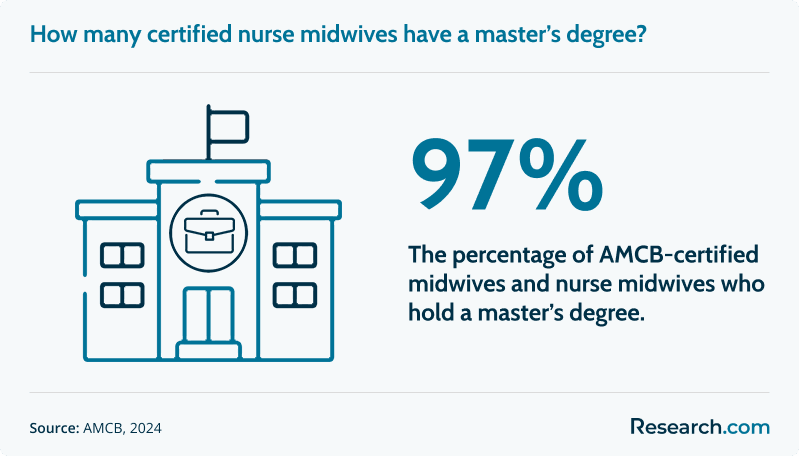
- MSN or comparable graduate nursing preparation: A graduate degree is typically required. According to AMCB, 97% of AMCB-certified midwives hold a master’s degree.
- Current RN or APRN license: Schools commonly require an active, unrestricted nursing license in the state where the student will complete clinical requirements.
- Minimum GPA: Many programs use GPA thresholds, often around 3.0 on a 4.0 scale.
- Clinical nursing experience: Some schools prefer or require at least one year of professional nursing experience.
- Recent prerequisite coursework: Applicants may need current graduate-level or advanced coursework in anatomy, pharmacology, health assessment, or related areas.
- Clinical eligibility documentation: Programs may require background checks, immunization records, CPR certification, drug screening, and proof of professional liability coverage.
Admissions standards can resemble the screening used in other specialized nursing paths. For comparison, Research.com’s guide to flight nurse job requirements shows how advanced roles often combine licensure, experience, clinical readiness, and specialty preparation.
What courses are typically in an online nurse midwifery graduate certificate?
The curriculum in an online nurse midwifery graduate certificate is designed to build advanced clinical judgment in pregnancy, birth, postpartum, newborn, reproductive, and primary women’s health care. Programs vary, but most combine didactic courses with supervised clinical practicum experiences.
The goal is not general nursing review. It is focused, practice-oriented preparation. In that sense, the structure resembles other career-focused credentials, such as affordable data analytics online bootcamps, which are built around applied skills rather than broad academic exploration.
Common courses
| Course area | What students learn |
| Advanced Health Assessment for Women and Newborns | Assessment techniques, diagnostic reasoning, and evaluation of pregnant, postpartum, and newborn patients |
| Midwifery Care During Pregnancy and Birth | Prenatal management, labor and birth care, postpartum care, evidence-based practice, and culturally responsive care |
| Gynecologic and Reproductive Health | Family planning, contraception, infertility, menopause-related care, and common gynecologic concerns |
| Pharmacology for Midwives | Medication use in midwifery practice, including labor induction, pain management, and hormonal therapies |
| Clinical Practicum or Residency | Supervised hands-on experience in labor and delivery units, birth centers, OB-GYN offices, or women’s health clinics |
Because clinical competence is central to midwifery education, review how many clinical hours are required, where they can be completed, who approves preceptors, and what happens if a placement falls through.
What types of specializations are available in online nurse midwifery graduate certificate programs?
Nurse midwifery is already a specialized advanced practice area, so many certificates offer one main track rather than multiple concentrations. However, some programs allow students to shape clinical experiences or elective learning around specific populations or practice settings.
Potential focus areas
- Women’s Health Nurse Practitioner (WHNP) Dual Certification: This option can broaden preparation in gynecologic, reproductive, menopause, infertility, and non-pregnancy-related women’s health care.
- Global or Rural Midwifery: This focus is relevant for nurses who want to serve low-resource, rural, international, or public health settings.
- Midwifery Education Track: Experienced clinicians may prepare for teaching, precepting, or academic roles. Nurses interested in teaching may also compare this pathway with the cheapest graduate certificate in nursing education online.
- Integrative Health and Holistic Midwifery: Some programs include content related to complementary care approaches, such as acupuncture, herbal medicine, or mindfulness, where appropriate within professional scope and regulations.
Specialization decisions should be driven by the patients you want to serve and the jobs available in your region. Broader education trends show that professionals often pursue targeted credentials for high-need areas; for example, Research.com also evaluates options such as the cheapest online EdS degree in special education for educators seeking advanced specialization.
AMCB data also shows a mix of newer and experienced professionals in the field: 46.7% of AMCB-certified midwives have been certified for 10 years or less, 23% have been certified for 11 to 20 years, and 30.3% have been certified for over 20 years. That distribution suggests both continued experience in the profession and ongoing entry of newer certified clinicians.
How does an online nurse midwifery certificate complement additional nursing credentials?
A nurse midwifery certificate can add a focused clinical specialty to an existing nursing background. For nurses who already have graduate education, it may expand practice options into pregnancy, birth, postpartum, newborn, reproductive, and primary women’s health care without requiring a complete second degree.
The certificate may also pair well with credentials in leadership, public health, nursing education, women’s health, or primary care. For example, a nurse with administrative or teaching ambitions might combine midwifery practice with academic preparation, preceptor experience, or future doctoral study. Nurses still building their academic foundation may also compare bridge options such as RN to BSN online programs no clinical, although those programs serve a different stage of nursing education than a post-graduate midwifery certificate.
What accreditation and regulatory considerations should you verify?
Accreditation is one of the most important checks in nurse midwifery education. Before applying, confirm that the program is accredited by the appropriate recognized midwifery accreditor and that completion will support eligibility for certification and state authorization where you plan to practice.
Do not assume that an online program automatically meets requirements in every state. State authorization, clinical placement approval, APRN recognition, prescriptive authority rules, and certification eligibility can vary. Ask the program directly whether it accepts students from your state and whether graduates in your state have been eligible for certification and licensure.
When comparing affordability, include accreditation and regulatory fit in your value calculation. A cheaper program is not a good deal if it does not meet your certification or state practice needs. Research.com’s guide to affordable online RN-BSN programs can also help nurses think through how accreditation and cost interact across nursing education pathways.
How does an online nurse midwifery certificate differ from direct entry MSN nurse practitioner programs?
An online nurse midwifery graduate certificate and direct entry MSN nurse practitioner programs serve different students. A nurse midwifery certificate is usually for nurses who already have graduate nursing education and want specialized midwifery preparation. Direct entry MSN nurse practitioner programs are designed for students entering nursing at the graduate level, often with a broader path into advanced practice nursing.
| Pathway | Best for | Main focus |
| Online nurse midwifery graduate certificate | Graduate-prepared nurses adding a midwifery specialty | Pregnancy, birth, postpartum, newborn, reproductive, and women’s health care |
| Direct entry MSN nurse practitioner program | Students entering nursing through a graduate route | Broader nursing and nurse practitioner preparation across selected specialties |
If you are not already a nurse, a post-graduate nurse midwifery certificate is usually not the first step. You may need a prelicensure nursing route or a direct entry pathway before pursuing advanced specialization.
What challenges might I face in an online nurse midwifery graduate certificate program?
Online nurse midwifery programs can be flexible, but they are demanding. The hardest parts are often not the online lectures; they are clinical scheduling, time management, and balancing advanced coursework with employment and family responsibilities.
Common challenges and better ways to prepare
| Challenge | Why it matters | How to reduce the risk |
| Finding clinical placements | Clinical sites and qualified preceptors may be limited in some areas | Ask whether the school secures placements, supports searches, or requires students to find their own sites |
| Managing self-paced coursework | Online learning requires discipline and consistent engagement | Create a weekly study schedule before the first term begins |
| Meeting state requirements | Licensure and authorization rules can affect eligibility | Verify state approval before applying |
| Technology and remote communication | Delayed responses or platform issues can slow progress | Review advising, tech support, faculty office hours, and student support availability |
| Balancing work and clinical hours | Clinical experiences may require daytime, night, weekend, or on-call availability | Discuss scheduling expectations with your employer and family early |
If you prefer a more structured in-person route or are not yet a nurse, a direct entry NP program for non nurses may be a more appropriate alternative, depending on your background and state requirements.
How do you choose the most affordable online nurse midwifery graduate certificate?
The most affordable program is not always the one with the lowest advertised cost per credit. The better question is: Which accredited program can you complete successfully, qualify through, and afford without unnecessary delays or hidden expenses?
Key factors to compare
- Total tuition and required credits: Multiply the cost per credit by the number of required credits, then add mandatory fees.
- Accreditation: Confirm that the program is accredited by ACME and supports certification eligibility.
- State authorization: Make sure the school can enroll students from your state and approve clinical placements there.
- Clinical placement support: Ask whether the school identifies clinical sites or expects you to secure your own preceptors.
- Campus visit requirements: Hybrid programs may require travel, lodging, and time away from work.
- Financial aid and employer support: Compare scholarships, loans, tuition reimbursement, and service-based funding.
- Completion timeline: A lower-cost program may become more expensive if clinical delays extend enrollment.
Common mistakes to avoid
- Choosing a program before confirming accreditation and certification eligibility
- Comparing only tuition while ignoring fees, travel, clinical costs, and lost work time
- Assuming online programs can place students clinically in every state
- Relying only on rankings without checking fit, schedule, and licensure details
- Assuming a certificate guarantees a specific salary or job offer
- Waiting until the first term to ask about clinical placement expectations
Questions to ask admissions before you apply
- Is the program currently ACME-accredited?
- Will this certificate meet educational requirements for certification?
- Can I complete clinical hours in my state?
- Does the school arrange clinical placements or only approve student-found sites?
- How many campus visits or immersions are required?
- What is the full estimated cost, including fees and travel?
- What happens if I cannot secure a clinical site on time?
- What are recent graduate certification outcomes and employment outcomes?
What career paths are available for graduates of online nurse midwifery graduate certificate programs?
Graduates who complete accredited preparation and meet certification and state requirements may work as certified nurse midwives in settings that provide maternal, reproductive, gynecologic, and primary women’s health services. Nurse midwives do more than attend births; many provide ongoing care before pregnancy, during pregnancy, after delivery, and across the lifespan.
Common employment settings
- Outpatient Care Centers
- Hospitals (General Medical and Surgical)
- Local Government Health Clinics
- Private OB-GYN Practices
- University Health Systems
According to BLS as of May 2023, the top-paying industries for nurse midwives include:
- Outpatient Care Centers: $164,080
- General Medical and Surgical Hospitals: $135,900
- Local Government (excluding schools and hospitals): $132,190
- Offices of Physicians: $127,550
- Colleges and Universities: $121,260
| Career direction | Typical work focus |
| Certified nurse midwife in a hospital | Labor, birth, postpartum care, triage, and collaborative maternal care |
| Birth center midwife | Low-risk pregnancy and birth care in a birth center model |
| Women’s health clinic provider | Reproductive health, contraception, gynecologic care, and preventive services |
| Community health clinician | Maternal and reproductive care for underserved populations |
| Educator or clinical preceptor | Teaching, mentoring, and supervising future nurses or midwives |
Nurse midwives with strong care coordination skills may also consider adjacent roles. Research.com’s nurse case manager salary and career guide offers another view of nursing careers centered on advocacy, planning, and patient navigation.
What is the job market like for graduates who completed an online nurse midwifery graduate certificate?
The job market for nurse midwives is supported by ongoing demand for maternal, reproductive, and women’s health services. Graduates of online programs can be competitive if their programs are properly accredited, their clinical training meets certification standards, and their state recognizes their preparation for practice.
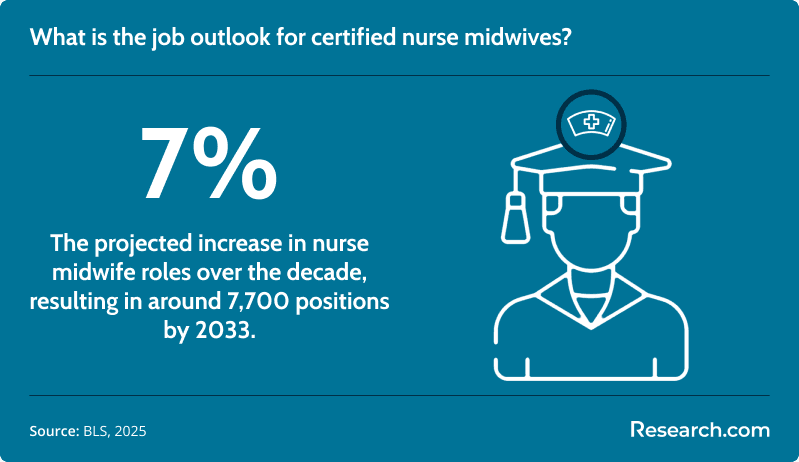
According to BLS, employment of nurse midwives is projected to grow by 7% from 2023 to 2033. By the end of that period, total employment is expected to reach 7,700 positions. Opportunities may be stronger in areas with limited access to maternity care, rural health shortages, or expanding outpatient women’s health services.
Online education can help widen access to this career path by allowing nurses to train without relocating. However, local job availability still depends on state scope-of-practice rules, employer hiring preferences, hospital privileges, birth center regulations, and regional patient demand. For a broader look at how online affordability rankings can open access to specialized fields outside nursing, Research.com also reviews the cheapest online ESL degree programs.
Here’s What Graduates Have to Say About Online Graduate Certificate Nurse Midwifery Programs
The online format made it possible for me to keep working and remain present for my family while completing advanced midwifery coursework. I was able to do clinical training in my own community and connect classroom concepts directly to patient care. The program was challenging, but the flexibility helped me stay on track without relocating. Earning the certificate gave me confidence in birth care and comprehensive women’s health practice. Sara
I started the program unsure whether I was ready for advanced practice expectations. Case-based discussions, virtual seminars, and faculty feedback helped me build confidence over time. Completing clinical experiences close to home also strengthened my connection to the community I wanted to serve. The online pathway gave me ownership of the process while still holding me to a high standard. Trisha
After years in hospital nursing, I wanted a focused specialty without moving or leaving my job. The mix of online modules, mentor support, video meetings, and real clinical placements worked well for my life. The transition into midwifery required serious effort, but the structure helped me connect evidence-based learning with meaningful patient care. Jasmine
Key Insights
- As of January 2024, the US had 14,067 certified nurse midwives, according to AMCB.
- An online nurse midwifery graduate certificate is usually best for MSN-prepared nurses or APRNs who want specialized midwifery preparation without completing another full graduate degree.
- Online coursework adds flexibility, but nurse midwifery students must still complete supervised in-person clinical requirements.
- Nurse midwives earned a median annual wage of $128,790 in May 2024, but pay varies by location, experience, employer, certification, and state practice rules.
- Median nursing school tuition is $11,228 for in-state public programs and $55,510 for out-of-state private programs, but certificate students should compare total cost rather than tuition alone.
- Most programs take 12 to 30 months, with clinical placement timing often affecting completion speed.
- Employment of nurse midwives is projected to grow 7% from 2023 to 2033, with total employment expected to reach 7,700 positions by the end of that period.
- Top-paying industries for nurse midwives include outpatient centers ($164,080), hospitals ($135,900), local government clinics ($132,190), physicians’ offices ($127,550), and universities ($121,260), according to BLS May 2023 data.
- The safest enrollment decision is to verify ACME accreditation, state authorization, clinical placement support, certification eligibility, and total out-of-pocket cost before applying.
References:
- AMCB. (2024, January 15). Demographic Report. AMCB.
- BLS. (2025, April 18). Nurse anesthetists, nurse midwives, and nurse practitioners. BLS.
- BLS. (2023, April 25). Nurse midwives. BLS.
- Data USA. (n.d.). Nurse Midwife. Data USA.
Other Things You Should Know About the Most Affordable Online Graduate Certificate Nurse Midwifery
Graduates typically sit for the American Midwifery Certification Board’s Certified Nurse-Midwife examination. Eligibility requires completion of a nurse-midwifery program accredited by the Accreditation Commission for Midwifery Education, plus any school-record verification of clinical hours and coursework before testing.
In 2027, online graduate certificate nurse midwifery programs are typically recognized by accrediting bodies such as the Accreditation Commission for Midwifery Education (ACME) and the Commission on Collegiate Nursing Education (CCNE), ensuring quality and meeting educational standards.


