2027 Most Affordable Online ESL Degree Programs

Co-Founder and Chief Data Scientist
Choosing an online ESL degree is not just a tuition comparison. You need to know whether the program prepares you for licensure, includes supervised teaching experience, fits your schedule, and leads to jobs that match your goals. This matters because roughly 10% of K–12 students in the U.S. are English language learners, and schools, adult education centers, language programs, and online learning companies continue to need educators who understand second-language development.
This guide is for future ESL teachers, working paraprofessionals, career changers, and education majors comparing affordable online ESL-related bachelor's programs for 2027. You will learn what these programs cover, how long they take, what they cost, how online study compares with campus study, what career paths are realistic, and how to choose a program without overlooking accreditation, practicum requirements, or state licensure rules.
Quick Answer: Is an Online ESL Degree Worth Considering?
An online ESL degree can be a practical option if it is offered by an accredited institution, includes the fieldwork required for your intended teaching role, and aligns with your state’s licensure or endorsement requirements. It may qualify graduates for roles such as ESL teacher, bilingual education teacher, adult ESL instructor, curriculum developer, language specialist, or online language educator, depending on the exact degree, state rules, and employer expectations.
The strongest online ESL programs combine flexible coursework with in-person or supervised teaching practice. Students should compare total program cost, transfer credit policies, accreditation, licensure preparation, faculty expertise, and placement support before enrolling.
What are the main benefits of earning an online ESL degree?
- Career preparation: ESL-focused degrees can prepare students for teaching and language-support roles in K–12 schools, adult education, community organizations, language centers, international programs, and digital learning companies.
- Earning potential: The median salary for ESL teachers in the U.S. is around $56,698 per year, with pay influenced by state, setting, credentials, experience, and whether the role is public school, college, nonprofit, private, or international.
- Flexibility: Online coursework can make it easier for students to continue working, care for family, or complete a degree without relocating, although fieldwork and student teaching may still require scheduled in-person hours.
What can I expect from an online ESL degree?
An online ESL degree teaches students how English is learned, how language and culture shape classroom experiences, and how to design instruction for learners at different proficiency levels. Most programs combine education theory, linguistics, literacy instruction, assessment, classroom technology, and culturally responsive teaching.
Students commonly take courses in linguistics, second language acquisition, lesson planning, grammar instruction, literacy development, language assessment, and teaching methods. Many programs also require a capstone, portfolio, practicum, or student teaching experience so students can demonstrate that they can apply course concepts in real classrooms or approved instructional settings.
Tuition costs vary but typically range from $22,000 to $86,000 for the entire program. The final price depends on residency status, transfer credits, institutional fees, course load, whether the school is public or private, and how long the student takes to finish.
Online delivery usually includes recorded lectures, readings, discussion boards, video meetings, digital teaching demonstrations, and instructor feedback. Some programs are mostly asynchronous, while others require live virtual sessions. Even when coursework is fully online, students should confirm whether field placements can be completed near their home and whether the program helps arrange those placements.
| Program element | What it usually includes | Why it matters |
| Core education coursework | Learning theory, classroom management, lesson planning, assessment, and instructional design | Builds the teaching foundation needed for school-based or adult education roles |
| ESL specialization courses | Linguistics, second language acquisition, grammar, pronunciation, literacy, and cultural responsiveness | Prepares students to support English learners with different language backgrounds and proficiency levels |
| Field experience | Observation, tutoring, practicum, or student teaching in approved settings | Often required for licensure and essential for classroom readiness |
| Capstone or portfolio | Final project, teaching portfolio, research assignment, or performance assessment | Helps students document skills for certification, job applications, or graduate study |
Where can I work with an online ESL degree?
Graduates may work in public schools, private schools, community colleges, adult education centers, nonprofit organizations, language schools, online tutoring platforms, international schools, or education technology companies. The right setting depends on the degree level, state licensure, age group, and whether the graduate wants to teach children, adults, or professional learners.
According to the U.S. Bureau of Labor Statistics, as of May 2024, the top industries employing ESL teachers and related professionals include:
- Elementary and Secondary Schools: Employ about 15,260 ESL teachers, making up roughly 52.88%.
- Colleges and Universities: Employ 8,620 ESL instructors, accounting for about 29.87%.
- Language Schools and Centers: Employ around 3,600 ESL teachers, roughly 12.47% of private education professionals.
- Individual and Family Services: Employ 1,380 ESL teachers, representing about 4.78% of the industry.
How much can I make with an online ESL degree?
Pay depends heavily on employer type, geographic location, grade level, union agreements, licensure status, years of experience, and whether the role is full-time or contract-based. An online degree from an accredited institution is generally evaluated based on the school, program quality, licensure alignment, and candidate experience rather than the delivery format alone.
According to the U.S. Bureau of Labor Statistics, the median annual wage for adult basic and secondary education and ESL teachers was $59,950 in May 2024.
- Elementary and Secondary Schools (Local Government): ESL teachers in this sector earned a median annual wage of $67,040.
- Junior Colleges: ESL instructors in this setting had a median annual wage of $69,650.
- Other Schools and Instruction: This category includes private language schools and adult education centers, where ESL teachers earned a median annual wage of $64,140.
- Entry-Level: New graduates or those with less than one year of experience can expect to earn around $42,900 annually.
- Experienced Professionals: With several years of experience, annual earnings can range up to $83,200.
- Best Online ESL Degree Programs for 2027
- How long does an online ESL degree take?
- Online ESL degree vs. campus program
- Average cost of an online ESL degree
- Financial aid for online ESL students
- Admission requirements and prerequisites
- Common challenges in online ESL programs
- Typical online ESL courses
- ESL degree specializations
- Complementary degrees and broader career options
- How to choose the best online ESL program
- Career paths after an online ESL degree
- Is an online ESL degree a good investment?
- How advanced degrees can support ESL career growth
- Job market for online ESL degree graduates
- Key insights before enrolling
Best Online ESL Degree Programs for 2027
How do we rank schools?
Research.com evaluates programs with affordability, academic quality, institutional credibility, and student decision-making in mind. Data sources used in the ranking process include the IPEDS database, Peterson's database, the College Scorecard database, and The National Center for Education Statistics. Readers who want more detail about the ranking process can review Research.com's methodology page.
The programs below are affordable online options related to ESL, TESL, bilingual education, foreign language, intercultural studies, or global education. Not every program has the same licensure outcome. Before applying, confirm whether the degree leads to initial teacher certification, an ESL endorsement, bilingual education licensure, or a non-licensure pathway.
| Rank | School and program | Credits | Listed cost | Accreditation |
| 1 | Liberty University — B.Ed. ESL | 120 | $390 per credit hour (Full Time) / $455 per credit hour (Part Time) / $250 per credit hour (Military) | Southern Association of Colleges and Schools Commission on Colleges (SACSCOC) |
| 2 | Southwest Minnesota State University — B.S. in TESL | 120 | $305 per credit hour | Minnesota Professional Educator Licensing and Standards Board (PELSB) |
| 3 | Grand Canyon University — B.S. E.Ed. Emphasis in ESL | 120 | $460 per credit hour | Higher Learning Commission (HLC) |
| 4 | Thomas Edison State University — B.A. in Foreign Language | 120 | $427 per credit hour (in-state), $556 per credit hour (out-of-state) | Middle States Commission on Higher Education (MSCHE) |
| 5 | Texas State University — B.S. in Applied Bilingual/Biliteracy Education | 120 | $404 per credit hour | Southern Association of Colleges and Schools Commission on Colleges (SACSCOC) |
| 6 | University of Valley Forge — B.A. in Intercultural Studies | 121 | $399 per credit hour | Middle States Commission on Higher Education (MSCHE) |
| 7 | University of Arizona — B.I.S. in Global and Intercultural Understanding | 120 | $525 per credit hour | Higher Learning Commission (HLC) |
| 8 | Kennesaw State University — B.A. in Modern Language and Culture | 120 | $190 per credit hour (in-state), $687 per credit hour (out-of-state) | Southern Association of Colleges and Schools Commission on Colleges (SACSCOC) |
| 9 | Maricopa Community Colleges — BA in Early Childhood Education – Dual Language | 120 | $253 per credit hour | Higher Learning Commission (HLC) |
| 10 | University of Central Florida — B.A. in International and Global Studies | 120 | $179.19 per credit hour (In-state) / $715.80 per credit hour (Out-of-state) | Southern Association of Colleges and Schools Commission on Colleges (SACSCOC) |
How to use this list
Use the ranking as a starting point, not a final decision. A low per-credit price is valuable only if the program accepts your transfer credits, fits your licensure goals, offers accessible field placements, and has the support services you need to graduate. If affordability is your main filter, compare this list with Research.com's broader guide to affordable online ESL degree options.
How long does it take to complete an online ESL degree program?
Most online ESL bachelor's programs require about four years of full-time study. Students entering with transfer credits, prior college coursework, or an associate degree may finish sooner, while part-time students often need five to six years.
Some schools offer accelerated tracks that can be completed in less than two years, especially for students who already have relevant teaching experience or a related academic background. However, acceleration is usually limited by fieldwork requirements, course sequencing, state licensure rules, and how many credits the school accepts in transfer.
Online programs still require deadlines, instructor interaction, assessments, and often supervised teaching. Student teaching or practicum experiences typically take place in local schools or approved instructional settings, even when the academic coursework is online.
| Student situation | Likely timeline | What to verify before enrolling |
| First-time full-time bachelor’s student | About four years | Whether the program leads to the certification or endorsement you need |
| Transfer student with substantial credits | Potentially less than four years | Maximum transfer credits, course equivalencies, and residency requirements |
| Part-time working student | Typically five to six years | Course rotation, practicum scheduling, and financial aid eligibility at part-time status |
| Student with prior teaching experience | May qualify for course waivers or reduced fieldwork hours | Documentation required and whether waivers affect licensure eligibility |
Completion rates for online degree programs vary. For instance, some institutions report completion rates as high as 88% for their online programs. Before enrolling, ask each school for program-specific completion, licensure exam, and job placement information when available.
How does an online ESL degree compare to an on-campus program?
An online ESL degree can be comparable to an on-campus degree when it comes from an accredited institution, uses the same academic standards, and includes required teaching practice. The biggest differences are schedule flexibility, delivery format, campus experience, and how field placements are arranged.
Employer acceptance
A 2024 survey by the National Association of Colleges and Employers (NACE) found that 87.4% of employers hired graduates with online degrees. This suggests broad acceptance, but candidates should still expect employers to evaluate the school’s reputation, accreditation, licensure alignment, experience, and interview performance.
Curriculum and teaching practice
Online and campus ESL programs usually cover similar academic areas, including linguistics, second language acquisition, instructional design, assessment, and teaching methods. For licensure-oriented programs, both formats commonly require practicum or student teaching experiences because ESL teachers need supervised classroom practice, not just online coursework.
Flexibility and learning environment
Online students often benefit from recorded lectures, digital readings, discussion boards, remote collaboration tools, and flexible weekly study times. This format can work well for working adults and caregivers. Campus students may prefer face-to-face interaction, immediate access to campus resources, and more structured class schedules.
Cost comparison
Online programs may reduce relocation, commuting, housing, and campus-related expenses. The original cost comparison used here lists a private college online degree average of $58,560 and an on-campus equivalent average of $148,800. Students should still calculate their own net cost after aid, transfer credits, fees, books, travel for fieldwork, and lost wages if they reduce work hours.
| Factor | Online ESL degree | On-campus ESL degree |
| Schedule | Often more flexible; may include asynchronous coursework | More fixed class times and campus attendance |
| Fieldwork | Usually completed locally if approved by the program | Often coordinated through nearby partner schools |
| Peer interaction | Discussion boards, video meetings, group projects | In-person classes, campus events, teaching labs |
| Costs | May lower commuting and relocation expenses | May include housing, transportation, and campus costs |
| Best for | Working adults, remote students, caregivers, transfer students | Students who want in-person learning and campus immersion |
What is the average cost of an online ESL degree program?
For students researching how to become an ESL teacher, program cost should be reviewed alongside licensure outcomes, student teaching requirements, and expected salaries. The average cost of an online ESL bachelor's degree varies by institution type and residency status. For in-state students at public universities, the average tuition is approximately $40,536, while out-of-state students pay around $59,011. Private institutions charge an average of $63,185 for an online bachelor's degree.
Tuition is only one part of the price. Online students may also pay technology fees, course materials, background check costs, exam fees, graduation fees, and application fees. For example, Liberty University charges a technology fee of $349 per semester and a degree completion application fee of $100.
Approximately 74% of students under the age of 24 utilize financial aid, including grants, scholarships, and loans. Online ESL programs can be less expensive than campus options when they reduce housing, commuting, and relocation costs, but the most important number is net cost after aid and transfer credits.
| Cost category | What to check | Why it can change the final price |
| Tuition | Per-credit rate, flat-rate tuition, in-state and out-of-state pricing | Small per-credit differences can add up across 120 credits |
| Fees | Technology, application, graduation, field placement, and assessment fees | Fees may not be obvious in advertised tuition |
| Transfer credits | Maximum accepted credits and course equivalencies | More accepted credits can shorten time and reduce cost |
| Fieldwork expenses | Travel, background checks, fingerprinting, testing, and schedule changes | Practicum requirements may create out-of-pocket costs |
| Financial aid | Grants, scholarships, loans, institutional aid, and employer support | A higher sticker price may become affordable if aid is strong |
What are the financial aid options for students enrolling in an online ESL degree program?
Online ESL students may qualify for many of the same financial aid options as campus students, provided the school and program meet eligibility requirements. Start by estimating aid through the Federal Student Aid Estimator, then confirm details directly with the school’s financial aid office.
Federal financial aid
Students usually begin by completing the FAFSA. Depending on eligibility, federal aid may include Pell Grants, Direct Subsidized and Unsubsidized Loans, and Federal Work-Study. Eligibility depends on factors such as financial need, enrollment status, citizenship status, and attendance in an eligible accredited program.
Scholarships for future language educators
Education majors and language-focused students should look for scholarships from professional associations, schools, state education agencies, and community organizations. The ACTFL Future Language Educators Scholarship offers up to $6,000 for aspiring language teachers. For comparison, the average scholarship award at public two-year institutions is around $4,100.
Payment plans and employer tuition support
Some schools let students divide tuition into monthly payments. Working students should also ask employers, school districts, nonprofits, or language education companies whether tuition reimbursement or professional development support is available.
Assistantships and institutional aid
Graduate assistantships are more common for master’s-level students and campus-based programs, but some online programs may offer institutional grants, departmental awards, teaching support roles, or tuition discounts.
Use comparisons carefully
Students often compare online education costs across unrelated fields, such as online direct entry MSN programs for non-nursing majors. That can be useful for understanding how online tuition models work, but ESL students should focus on education-specific aid, licensure expenses, fieldwork requirements, and teacher scholarship programs.
What are the prerequisites for enrolling in an online ESL degree program?
Admission requirements depend on whether the program is undergraduate, graduate, licensure-based, or endorsement-focused. Requirements for an ESL education program are different from unrelated healthcare pathways such as an online graduate certificate in nurse midwifery, so applicants should review the exact admissions page for each school.
1. Educational background
Undergraduate ESL programs usually require a high school diploma or GED. Graduate-level ESL programs typically require a bachelor’s degree, often in education or a related area.
2. Teaching experience
Most undergraduate programs do not require prior teaching experience. Some graduate programs may prefer or require teaching experience, especially if the program is designed for licensed teachers seeking an ESL endorsement.
3. Minimum GPA
A minimum GPA of 3.0 is commonly required for graduate programs. Competitive programs may look for GPA scores of 3.5 or higher.
4. English language proficiency for non-native English speakers
Applicants whose first language is not English may need to submit proof of English proficiency. Common benchmarks include a TOEFL iBT score of 90 or higher or an IELTS score of 7.0 or above.
5. Recommendation letters and application materials
Graduate programs often ask for two to three recommendation letters, a statement of purpose, transcripts, and sometimes a résumé. Strong recommenders include supervisors, professors, or educators who can speak to the applicant’s communication skills and readiness to work with learners.
Students exploring the steps to become a substitute teacher may also find these prerequisites useful because substitute teaching can provide early classroom exposure before committing to a full ESL licensure pathway.
What challenges do students often face in an online ESL degree program?
Online ESL students often struggle most with time management, technology demands, fieldwork scheduling, and limited in-person interaction. The coursework may be online, but teaching practice still requires planning around school calendars, mentor availability, background checks, and transportation.
| Common challenge | Why it matters | Better approach |
| Underestimating weekly workload | Online classes still require readings, discussions, lesson plans, assessments, and projects | Block study time before the term begins and ask for sample syllabi |
| Assuming fieldwork is automatic | Some programs expect students to locate or help arrange approved placements | Ask who secures placements and whether your local schools qualify |
| Ignoring technology requirements | Video teaching demonstrations and live sessions may require reliable internet and updated equipment | Review platform, webcam, software, and internet requirements before enrollment |
| Feeling isolated | Limited peer interaction can reduce motivation and informal learning | Choose programs with cohort models, advising, faculty access, tutoring, and active discussion formats |
| Comparing only sticker prices | The cheapest tuition may not be the lowest total cost if credits do not transfer or fieldwork is difficult | Compare net cost, completion time, transfer policy, and licensure fit |
Students comparing advanced online education pathways, including options such as the shortest online EdD degree fast-track programs, should apply the same scrutiny to ESL degrees: confirm workload, support services, accreditation, completion expectations, and whether the credential leads to the professional outcome they want.
What courses are typically in an online ESL degree program?
Most online ESL degrees combine language theory with practical teaching methods. Students studying online ESL teaching certification and requirements will recognize that many required courses align with the competencies needed for certification, endorsement, or classroom readiness.
Common courses include:
- Introduction to linguistics: Examines sounds, grammar, meaning, and language structure.
- Second language acquisition: Explores how learners acquire English and what supports language development.
- ESL teaching methods: Covers lesson planning, language objectives, scaffolding, and differentiated instruction.
- Assessment for English learners: Teaches students how to evaluate proficiency, progress, and academic language needs.
- Literacy instruction: Focuses on reading, writing, vocabulary, and comprehension strategies for English learners.
- Cultural competency: Prepares teachers to work respectfully with multilingual learners, families, and communities.
- Classroom technology: Introduces digital tools used for language practice, feedback, accessibility, and online instruction.
- Practicum or student teaching: Provides supervised classroom experience. Programs commonly include 100 to 150 hours of supervised teaching.
The best programs do more than teach theory. They require students to plan lessons, assess learner needs, adapt instruction, practice classroom communication, and reflect on teaching performance.
What types of specializations are available in an online ESL degree program?
Specializations help students align the degree with a specific age group, classroom setting, or career goal. Students asking how many years does it take to be a teacher should choose carefully because specializations can affect required coursework, student teaching placement, licensure exams, and completion timeline.
| Specialization | Best for | What to check |
| Teaching ESL to children | Students who want to work in elementary or secondary schools | Whether the program leads to state teacher licensure or an ESL endorsement |
| Teaching ESL to adults | Future adult education, community college, nonprofit, or workforce language instructors | Whether the degree matches employer requirements for adult education roles |
| Bilingual education or dual language instruction | Students who want to teach in bilingual or biliteracy classrooms | Language proficiency expectations and state bilingual certification rules |
| Curriculum design or assessment | Teachers interested in instructional materials, testing, or program development | Whether the curriculum includes assessment literacy and instructional design projects |
| Teaching ESL abroad | Students interested in international schools, language academies, or global teaching programs | Country-specific requirements, visa rules, and whether TEFL/TESOL certificates are also expected |
| Literacy and reading intervention | Educators who want to support reading development for English learners | Whether courses cover phonics, vocabulary, comprehension, and academic language |
Could a complementary degree broaden my ESL career?
A complementary degree can help if your long-term goals extend beyond classroom teaching. For example, students interested in policy, advocacy, immigration services, international education, nonprofit leadership, or community programs may benefit from coursework in public policy, international relations, sociology, political science, or educational leadership.
However, a complementary degree should not replace an ESL licensure pathway if your goal is to teach in public schools. It should add context, not create a detour. Students exploring adjacent fields, such as an affordable online political science bachelor’s degree, should compare how the second field supports their ESL goals before committing extra time and money.
How to Choose the Best Online ESL Degree Program
The best online ESL program is the one that matches your career target, meets accreditation and licensure standards, fits your schedule, and offers a realistic total cost. This same decision logic applies when comparing other online career-focused programs, including affordable online construction training programs: quality, recognized credentials, hands-on preparation, and completion support matter as much as price.
1. Confirm institutional and educator preparation accreditation
Start with institutional accreditation, then review educator preparation approval. If you plan to teach in K–12 schools, ask whether the program is approved for licensure in your state or whether you will need extra coursework or exams. Choose a program accredited by a recognized agency like the Council for the Accreditation of Educator Preparation (CAEP). As of 2019, CAEP had accredited 281 educator preparation providers.
2. Verify licensure, endorsement, or non-licensure status
Do not assume that “ESL,” “TESL,” “bilingual,” “intercultural,” or “global studies” all lead to the same teaching credential. Some degrees are designed for teacher licensure; others are better for language support, international teaching, nonprofit work, or graduate preparation. Typical licensure requirements include a bachelor’s degree, background check, exam scores, and course completion.
3. Review faculty credentials and student support
Look for instructors with ESL teaching experience, advanced degrees, research activity, or public school experience. A low faculty-to-student ratio, ideally under 15:1, can support stronger feedback and advising. Also check tutoring, career services, licensure advising, technical support, and writing support.
4. Ask detailed questions about fieldwork
Hands-on practice is one of the most important parts of teacher preparation. Ask whether the program helps arrange placements, whether you can complete them near your home, and whether virtual teaching experiences count. Programs should offer in-person or virtual practicum placements. Hands-on teaching experience improves teacher readiness by up to 40%, according to education studies.
5. Test the online learning environment
Top programs use accessible platforms such as Canvas or Blackboard. Before enrolling, ask whether you can see a course demo, sample syllabus, or orientation module. The platform should make it easy to submit assignments, join discussions, receive feedback, and communicate with faculty.
Questions to ask before applying
- Does this degree lead to initial teacher licensure, an ESL endorsement, bilingual education certification, or a non-licensure credential?
- Will the program meet requirements in the state where I want to teach?
- How many credits will transfer, and which major requirements must still be completed?
- Who arranges practicum or student teaching placements?
- What is the total cost after tuition, fees, books, testing, and fieldwork expenses?
- Are classes asynchronous, synchronous, or a mix of both?
- What support is available for licensure exams, job searches, and teaching portfolios?
- What are the program’s completion, placement, and certification pass rates, if available?
Common mistakes to avoid
- Choosing only by lowest tuition: A lower per-credit price may not save money if the program accepts few transfer credits or delays graduation.
- Assuming all online ESL degrees lead to licensure: Some programs are academic or globally focused but do not qualify graduates for public school teaching credentials.
- Ignoring state rules: Teacher licensure is state-specific, and requirements can vary.
- Skipping fieldwork details: A strong online program should clearly explain observation, practicum, and student teaching expectations.
- Relying only on rankings: Rankings are useful, but your best program depends on your location, goals, budget, and transfer credits.
- Assuming salary outcomes are guaranteed: Wages vary by state, employer, credential, and experience.
What career paths are available for graduates of an online ESL degree program?
Online ESL degree graduates can pursue classroom, adult education, international, curriculum, nonprofit, and corporate learning roles. Career options depend on whether the degree includes licensure preparation, the student’s prior teaching background, and employer requirements.
| Career path | Typical setting | Best fit for |
| K–12 ESL teacher | Public or private elementary, middle, or high schools | Graduates with state teacher licensure or ESL endorsement |
| Adult ESL instructor | Community colleges, adult education centers, nonprofits, workforce programs | Educators who want to teach adults, immigrants, refugees, or workforce learners |
| International ESL teacher | Language schools, international schools, overseas programs, online global platforms | Graduates interested in teaching English abroad or remotely to global learners |
| Curriculum developer or instructional designer | Schools, publishers, edtech companies, districts, training organizations | Teachers who enjoy lesson design, assessment, and educational materials |
| Educational consultant | Districts, nonprofits, language programs, professional development providers | Experienced educators who advise schools on English learner support |
| Corporate ESL trainer | Companies, workforce training providers, business English programs | Instructors who want to teach workplace communication and professional English |
For teaching careers, the original labor market data highlights several options:
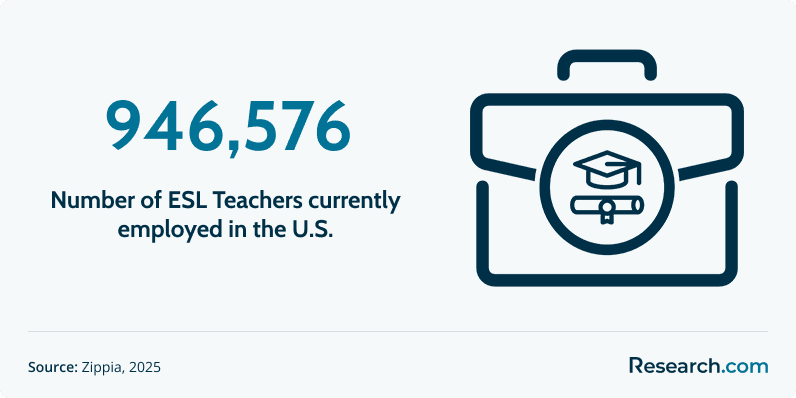
- K–12 ESL Teacher: Work in public or private schools supporting English language learners. Over 946,000 ESL teachers are currently employed in the U.S., with 60,200 new positions expected over the next decade.
- Adult ESL Instructor: Teach English to adults, often through community colleges or nonprofit organizations. Despite a projected 13% decline in this sector from 2023 to 2033, around 4,100 positions are expected to open each year due to retirements and job shifts.
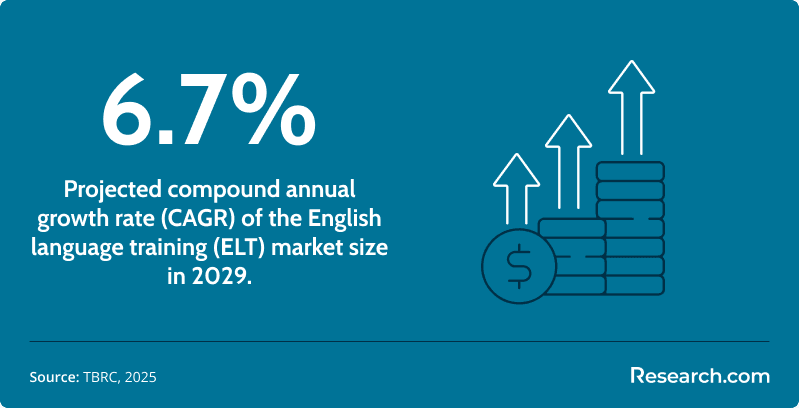
- International ESL Teacher: Teach English abroad in countries like Japan, Korea, Mexico, and others. The global English Language Training (ELT) market is projected to reach $107.93 billion by 2028, indicating strong demand.
For non-teaching and corporate roles:
- Curriculum Developer or Instructional Designer: Design ESL materials, lesson sequences, assessments, and language-learning content.
- Educational Consultant: Help schools or districts improve services for English learners.
- Corporate ESL Trainer: Provide language instruction in workplace settings. The Business English Language Training market is expected to grow by $5.4 billion between 2025 and 2029, highlighting demand in the corporate sector.
Students who want to work with young children may also benefit from reviewing a kindergarten teacher career guide, especially if they plan to combine early childhood education with ESL or dual language instruction.
Is an online ESL degree a worthwhile investment?
An online ESL degree can be worth it when the program is affordable, accredited, licensure-aligned, and connected to the type of teaching role you want. The investment is weaker if the degree does not meet state requirements, requires costly extra coursework later, or lacks supervised teaching experience.
To evaluate return on investment, compare total cost against likely earnings, completion time, local job demand, and credential requirements. The median annual wage for adult basic and secondary education and ESL teachers was $59,950 in May 2024, but individual salaries can be lower or higher depending on setting and location.
| An online ESL degree may be a good choice if... | You may want another option if... |
| You need flexibility and cannot relocate for a campus program | You need daily in-person structure to stay motivated |
| The program meets licensure rules in the state where you plan to teach | The program is non-licensure and your goal is public school teaching |
| You can complete fieldwork locally without major scheduling barriers | Local practicum placement is uncertain or unsupported |
| You have transfer credits that reduce cost and time | You would need to retake many credits or extend enrollment |
| You want ESL, bilingual, adult education, or language-support roles | You are more interested in general education, counseling, administration, or another field |
Educators who already hold a bachelor’s degree may eventually consider graduate study to increase specialization or qualify for advanced roles. Cost-conscious students can compare options such as the most affordable online master's in education after confirming that a graduate degree fits their career plan.
How can advanced degrees enhance my ESL career?
Advanced degrees can support ESL educators who want to move into leadership, curriculum design, teacher training, research, higher education, administration, or policy work. A master’s degree may deepen expertise in language acquisition, assessment, literacy, or bilingual education, while doctoral programs may be more appropriate for senior leadership, research, or institutional change roles.
Advanced study should be tied to a specific goal. If you want a salary increase, check your district’s pay scale. If you want to teach at a college, review hiring requirements in your region. If you want leadership or policy roles, compare programs in educational leadership, curriculum and instruction, applied linguistics, TESOL, or doctoral education. Professionals exploring doctoral-level options can review an affordable online Ed.D. program as one possible pathway.
What is the job market for graduates with an online ESL degree program?
The job market for online ESL degree graduates is shaped by school enrollment, immigration patterns, state funding, adult education demand, online language learning, and global interest in English instruction. The outlook is not identical across every ESL role, so students should distinguish between K–12 licensure jobs, adult education, online tutoring, corporate training, and international teaching.
In the United States, the need for ESL teachers is connected to the number of English language learners in K–12 schools. Approximately 10% of U.S. K–12 students are English language learners, which supports continued need for educators trained in language development and culturally responsive instruction.
Demand is often stronger in areas with larger immigrant and multilingual populations, including California, Texas, and New York. Salary ranges also vary by state. For instance, in New York, ESL teachers earn an average of $62,030 annually, while in California, the average is $55,955.
Online degree holders can compete effectively when their programs are accredited and relevant to the job. A survey by the National Association of Colleges and Employers found that 87.4% of employers consider online degrees to be equivalent to traditional degrees.
International demand also creates opportunities. The English Language Training (ELT) market is projected to reach $107.93 billion by 2028, and the Business English Language Training market is expected to grow by $5.4 billion between 2025 and 2029. These figures point to opportunities beyond traditional classrooms, especially for educators who combine ESL training with digital instruction, curriculum development, or business communication.
Current trends affecting ESL education
- AI and language learning tools: AI writing assistants, speech tools, adaptive practice platforms, and translation technology are changing how students practice English. ESL educators still need to teach accuracy, academic language, communication, ethics, and critical use of tools.
- Employer focus on practical experience: Degrees are stronger when paired with practicum hours, teaching portfolios, lesson samples, and evidence of classroom readiness.
- Online and hybrid instruction: ESL instruction increasingly occurs through virtual tutoring, remote adult education, blended school programs, and digital curriculum platforms.
- Credential-specific hiring: Public school roles usually require state-approved licensure or endorsement, while international, private, nonprofit, or corporate roles may follow different credential expectations.
Key Insights
- An online ESL degree is strongest when it is accredited, includes supervised teaching practice, and matches the licensure or endorsement requirements for the state where you want to teach.
- Most online ESL bachelor's programs take about four years full time, though transfer credits, accelerated options, part-time enrollment, and fieldwork scheduling can change the timeline.
- Tuition costs vary widely. Online ESL degrees typically range from $22,000 to $86,000 for the entire program, and average costs differ by public in-state, public out-of-state, and private institution pricing.
- Do not assume every ESL-related degree leads to classroom licensure. Programs in global studies, foreign language, intercultural studies, TESL, bilingual education, and elementary education can have very different outcomes.
- Online degrees are broadly accepted when earned from credible institutions. A 2024 NACE survey found that 87.4% of employers hired graduates with online degrees.
- Fieldwork is a major decision point. Before enrolling, ask who arranges placements, where you can complete them, how many hours are required, and whether the experience satisfies licensure rules.
- Career options include K–12 ESL teacher, adult ESL instructor, international ESL teacher, curriculum developer, instructional designer, educational consultant, and corporate ESL trainer.
- The best program is not always the cheapest. Compare total net cost, transfer credit acceptance, licensure fit, academic support, faculty expertise, technology, and career services before making a final choice.
References:
- Adult Basic Education, adult secondary Education, and English as a second language instructors. Bureau of Labor Statistics. https://www.bls.gov/oes/2023/may/oes253011.htm
- Bay Atlantic University. How much does an online bachelor’s degree cost? https://bau.edu/blog/online-bachelors-degree-cost
- Education Data Initiative. Average cost of online college. https://educationdata.org/average-cost-of-online-college
- Liberty University Online. Liberty University online tuition and financing. https://www.liberty.edu/online/tuition-and-fees
- Education Data Initiative. Financial Aid Statistics. https://educationdata.org/financial-aid-statistics
- Education Data Initiative. Average Private vs Public College Tuition. https://educationdata.org/private-vs-public-college-tuition
- Education Data Initiative. College Scholarship Statistics. https://educationdata.org/scholarship-statistics
- Investopedia. A quick guide to how FAFSA works. https://www.investopedia.com/articles/personal-finance/090815/quick-guide-how-fafsa-loans-work.asp
- Federal Student Aid. Eligibility for federal student aid. https://studentaid.gov/understand-aid/eligibility
- Brown University Graduate School. Language proficiency: TOEFL or IELTS. https://graduateschool.brown.edu/apply/international-applicants/language-proficiency-toefl-or-ielts
- SCOREGUIDES. Practicum Placements. https://scoreguides.com/practicum-placements
- Western Governors University. Teacher licensure information by state. https://www.wgu.edu/online-teaching-degrees/state-licensure.html
- Governors State University. CAEP information. https://www.govst.edu/caep/
- Zippia. ESL Teacher Demographics and Statistics. https://www.zippia.com/esl-teacher-jobs/demographics
- Institute of Education Sciences. Research to Inform Stronger Adult Education ESL Policy and Practice. https://ies.ed.gov/learn/blog/research-inform-stronger-adult-education-esl-policy-and-practice
- Bureau of Labor Statistics. Adult basic and secondary education and ESL teachers. https://www.bls.gov/ooh/education-training-and-library/adult-literacy-and-ged-teachers.htm
- Acacia. Growing demand for ESL teachers in the global market. https://acacia.edu/blog/growing-demand-for-esl-teachers-in-the-global-market
- Technavio. Business English Language Training Market Analysis. https://www.technavio.com/report/business-english-language-training-market-industry-analysis
- International TEFL Academy. TEFL & ESL Teacher Job Market Report. https://www.internationalteflacademy.com/tefl-esl-teacher-job-market-report
- Learn How to Become an ESL Teacher. ESL Teacher Salary. https://www.eslteacheredu.org/salaries
Other Things You Should Know About Online ESL Degree Programs
Yes. The most affordable online ESL degree programs should hold institutional accreditation from a regional agency recognized by the U.S. Department of Education, and many education programs also seek CAEP accreditation. CAEP reviews teacher-preparation quality, while regional accreditation supports transferability and federal financial aid eligibility.
Affordable online ESL degree programs in 2027 typically require two to four years to complete, depending on enrollment status and course load. Part-time students may take longer, while full-time students can finish more quickly, adhering to the program's credit hour requirements.