
2027 What Is Medical Billing and Coding?

Co-Founder and Chief Data Scientist
Medical billing and coding is a practical healthcare career path for people who want to work with patient records, insurance claims, reimbursement systems, and healthcare data without providing direct clinical care. The decision is not simply “Is this a good job?” A better question is whether the work matches your strengths: accuracy, patience, comfort with rules, and the ability to keep learning as coding guidelines, payer policies, and healthcare technology change.
This guide explains what medical billers and coders do, how the field fits into the healthcare revenue cycle, what training and certifications are commonly used, how long programs take, what online courses may cost, where jobs are found, and how technology is changing the work. It is designed for students, career changers, military spouses, administrative healthcare workers, and anyone comparing medical billing and coding with other healthcare careers in 2027.
Quick answer: Is medical billing and coding a good career?
Medical billing and coding can be a strong career option if you want an accessible healthcare role with administrative responsibilities, remote-work potential, certification-based advancement, and opportunities in hospitals, physician offices, outpatient clinics, long-term care facilities, and home healthcare agencies. It is not the best fit if you dislike detailed documentation, repetitive review work, insurance rules, or frequent policy updates.
According to the U.S. Bureau of Labor Statistics (BLS), entry-level positions typically start around $30,000 to $35,000, while experienced professionals with certifications earn upwards of $55,000 to $65,000 or more annually. The BLS also reported that employment for medical records and health information specialists is projected to grow 7% from 2021 to 2031, faster than the average for all occupations.
What are the main benefits of a career in medical billing and coding?
- Healthcare access without direct patient care: You support the healthcare system by helping providers document services accurately, submit claims, and resolve reimbursement issues.
- Clear training pathways: Certificate programs take 9 to 12 months, while associate degree programs usually take two years, making the field more accessible than many clinical healthcare careers.
- Certification can improve career mobility: Credentials such as Certified Professional Coder (CPC) or Certified Coding Specialist (CCS) can strengthen job prospects and may lead to salaries 10-20% higher than those of non-certified peers.
- Multiple employer settings: Medical billers and coders work in hospitals, physician offices, outpatient clinics, long-term care organizations, home healthcare agencies, insurers, and revenue cycle companies.
- Room to advance: With experience and additional education, professionals may move into health information management, healthcare administration, compliance, revenue cycle leadership, or consulting roles.
- Professional perspectives on medical billing and coding careers
- What medical billing and coding means
- Why billing and coding matter in healthcare
- How billing and coding differs from other healthcare roles
- Education needed to become a medical biller and coder
- How long medical billing and coding training takes
- Where medical billers and coders work
- Average medical billing and coding salary
- Challenges in medical billing and coding
- Continuing education for billers and coders
- How to accelerate career growth
- Whether additional healthcare credentials help
- Medical billing and coding compared with other healthcare paths
- How to pay for billing and coding education
- Whether an accelerated healthcare administration degree can help
- How accelerated healthcare credentials may support advancement
- Average cost of online medical billing and coding courses
- Medical billing and coding job outlook
- Whether medical billing and coding is lucrative
- How to choose a medical billing and coding school
- How technology is changing billing and coding
Professional perspectives on medical billing and coding careers
Moving into medical billing and coding gave me a healthcare career with structure, flexibility, and steady learning. Remote work helped me manage family responsibilities while still doing work that supports patient care behind the scenes. -Sarah
Medical coding has allowed me to build a specialty within healthcare. The compensation and benefits have been important, but I also value knowing that accurate codes help patients, providers, and insurers avoid billing confusion. -James
I did not expect an administrative healthcare career to feel this meaningful. The option to work from home changed my day-to-day life, and the field continues to give me ways to grow professionally. -Emily
Key findings
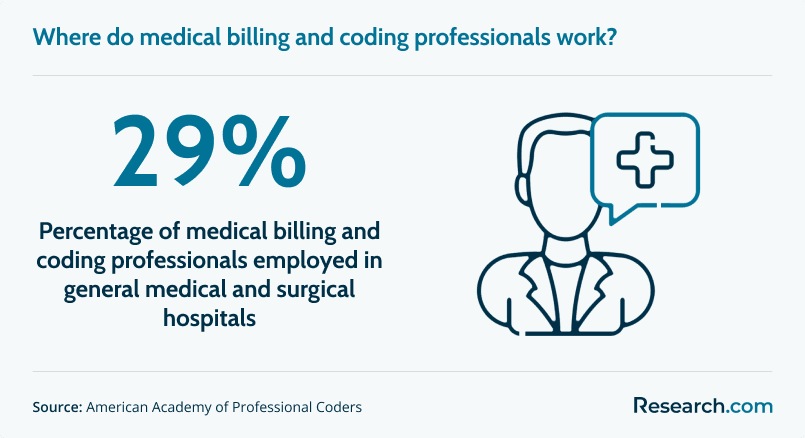
- Of the 34,430 employed medical billing and coding professionals in the U.S. in 2023, 29% are employed in general medical and surgical hospitals.
- 77.8% of office-based physicians operate with a certified electronic medical record (EMR) system.
- Certificate programs take 9 to 12 months while the duration of associate degree programs is two years.
- The average hospital bill over $10,000 has $1,300 in error and poor billing practices cause doctors in the US to lose an estimated $125 billion each year.
- The largest employers in the healthcare industry currently employ over 52% of medical coders, billers, and other healthcare business professionals.
What is medical billing and coding?
Medical billing and coding is the administrative process that converts healthcare services, diagnoses, procedures, supplies, and patient encounters into standardized codes and billable claims. The work connects clinical documentation with insurance reimbursement, compliance reporting, patient billing, and health information management.
As of 2023, there were 34,430 employed medical billing and coding professionals in the U.S., of which 29% are employed in general medical and surgical hospitals.
Medical coding
Medical coding focuses on reading clinical documentation and assigning standardized codes that describe what happened during a patient encounter. Coders review records such as provider notes, lab results, radiology reports, operative reports, and discharge summaries. Common coding systems include:
- ICD-10: Used for diagnoses and some procedures.
- CPT: Used for medical, surgical, and diagnostic procedures.
- HCPCS: Used for services, equipment, supplies, and non-physician services.
Medical billing
Medical billing focuses on turning coded services into claims, submitting those claims to payers, tracking payments, correcting errors, and billing patients for remaining balances. Common billing responsibilities include:
- Patient registration: Collecting demographic and insurance information before or during a visit.
- Insurance verification: Confirming coverage, benefits, eligibility, and payer rules.
- Charge entry: Recording services and charges in the patient account.
- Claims submission: Sending coded claims to insurance companies or clearinghouses.
- Insurance follow-up: Investigating rejected, denied, delayed, or underpaid claims.
- Patient billing: Sending statements and answering questions about remaining balances.
Billing vs. coding: what is the difference?
| Area | Primary focus | Best fit for |
| Medical coding | Translating diagnoses, procedures, and documentation into standardized codes | Detail-oriented learners who enjoy rules, records, anatomy, terminology, and documentation review |
| Medical billing | Submitting claims, following payer requirements, resolving denials, and managing balances | Organized communicators who are comfortable with insurance processes, accounts, and follow-up work |
| Combined billing and coding | Handling both code assignment and reimbursement workflow | Students who want broader entry-level flexibility, especially in smaller practices or multi-role administrative settings |
Why is medical billing and coding important in healthcare?
Medical billing and coding matter because they affect whether healthcare organizations are paid correctly, whether patient records are complete, and whether claims comply with payer and regulatory requirements. A single coding or billing error can delay reimbursement, trigger a denial, create patient confusion, or increase audit risk.
Surveys reveal that the average hospital bill over $10,000 has $1,300 in error and poor billing practices cause doctors in the US to lose an estimated $125 billion each year.
Billing and coding are also central to the healthcare revenue cycle. Accurate codes connect documented care to billable services, while timely claims processing supports cash flow for hospitals, clinics, and physician practices.
Compliance is another major reason the field matters. Medical billers and coders work with protected health information and must understand privacy, documentation, payer, and audit requirements. HIPAA rules, payer policies, and healthcare regulations make accuracy and confidentiality essential parts of the job.
How does medical billing and coding differ from other healthcare professions?
Medical billing and coding differs from clinical healthcare roles because the work is primarily administrative, technical, and documentation-based. Instead of diagnosing, treating, or physically caring for patients, billers and coders support reimbursement, record accuracy, and compliance.
As of 2021, 77.8% of office-based physicians operate with a certified electronic medical record (EMR) system. That means billing and coding professionals must be comfortable working inside electronic documentation platforms, coding tools, billing systems, and payer portals.
Clinical roles generally require direct patient care skills, lab or imaging techniques, procedures, and licensure. Billing and coding requires a different mix: medical terminology, anatomy and physiology, coding systems, payer policies, privacy rules, audit awareness, and strong attention to detail. Some professionals later use an administrative foundation to move into healthcare operations through options such as the cheapest online healthcare administration degree.
Who should consider medical billing and coding?
- People who want a healthcare career but prefer administrative work over bedside care.
- Students looking for a shorter training path than many clinical occupations require.
- Career changers who are organized, accurate, and comfortable learning technical rules.
- Workers interested in remote or hybrid healthcare roles, where available.
- Administrative healthcare employees who want a more specialized credential.
Who may want a different healthcare path?
- People who want daily hands-on patient interaction.
- Students who dislike reading detailed records or applying complex rules.
- Workers who want a career with minimal continuing education.
- Anyone looking for guaranteed high earnings immediately after a short course.
- People who are uncomfortable with insurance disputes, claim denials, and documentation corrections.
What education is needed to become a medical biller and coder?
A high school diploma or equivalent is usually the starting point for medical billing and coding training. From there, most students complete a certificate, diploma, associate degree, or online training program that teaches medical terminology, anatomy, coding systems, reimbursement, and health information rules.
Medical billers and coders need a working knowledge of medical terminology, anatomy and physiology, coding guidelines, billing software, payer rules, and healthcare privacy requirements. Accuracy matters because coding and billing decisions affect claims, compliance, and patient accounts.
A study evaluated 9,000 health information technology-related medication safety events across three pediatric healthcare facilities. The researchers found that subpar EHR usability contributed to 3,243 of those events, often related to patients obtaining or at risk of receiving an inappropriate drug dose.
Students comparing training options may look at online coding bootcamps, although general software coding bootcamps are not the same as medical coding programs. For healthcare-specific training, compare curriculum, certification preparation, accreditation, and total cost through resources such as affordable online medical billing and coding schools.
Students on a tight budget can also review what a free medical billing and coding course can and cannot provide. Free courses can help with exploration, but they may not include instructor support, certification preparation, externships, or employer-recognized credentials.
Common education options
- Certificate programs: These programs typically last 9 to 12 months and focus directly on medical terminology, billing procedures, coding systems, claims, and reimbursement.
- Associate degree programs: An Associate of Applied Science (AAS) in Medical Billing and Coding or Health Information Technology usually takes about 2 years and includes general education alongside career-specific coursework. Some students compare related options through the fastest associates degree online. These programs may be useful for learners who want a broader credential.
- Online programs: Online study can be useful for working adults, parents, and students who need flexible scheduling. Compare completion support, technology requirements, practicum options, certification alignment, and tuition before enrolling.
- Bachelor’s pathways: A bachelor’s degree is not typically required for entry-level billing and coding, but some professionals continue into health information management, healthcare administration, data analytics, or related fields. A small number may later compare options such as the cheapest online data science master's if they want to move toward healthcare data roles.
Core subjects to expect
- Medical terminology: The vocabulary used in diagnoses, procedures, body systems, and provider documentation.
- Anatomy and physiology: Foundational knowledge of organs, body systems, and disease processes.
- Medical coding systems: Training in ICD-10, CPT, and HCPCS.
- Healthcare law and ethics: Privacy, compliance, HIPAA, fraud prevention, and professional conduct.
- Billing and reimbursement: Insurance claims, payer requirements, denials, appeals, and patient billing.
- Health information management: Record integrity, data quality, documentation standards, and electronic health records.
Common certifications
- Certified Professional Coder (CPC): Offered by the American Academy of Professional Coders (AAPC), this is a widely recognized credential for physician-based coding.
- Certified Coding Specialist (CCS): Offered by the American Health Information Management Association (AHIMA), this credential is often associated with more advanced coding knowledge.
- Certified Medical Reimbursement Specialist (CMRS): Offered by the American Medical Billing Association (AMBA), this credential emphasizes billing and reimbursement.
- Certified Inpatient Coder (CIC): Offered by AAPC, this certification focuses on inpatient hospital coding.
How long does it take to complete a medical billing and coding program?
The training timeline depends on the credential, school format, course load, and whether the student attends full time or part time. Short certificate programs are built for faster workforce entry, while associate degrees provide broader coursework and may support long-term advancement.
- Certificate programs: Typical duration is 9 to 12 months. These programs concentrate on job-specific skills such as medical terminology, ICD-10, CPT, HCPCS, billing procedures, and claims workflows.
- Associate degree programs: Usually takes 18 to 24 months. These programs combine billing and coding instruction with general education, healthcare law, anatomy and physiology, and health information management.
- Online programs: The duration varies, typically 9 to 24 months depending on whether the program is a certificate or associate degree. Students comparing flexible and affordable online degrees should look beyond tuition and review support services, transfer policies, and certification preparation.
- Bachelor’s degree programs: Typically takes 4 years. A bachelor’s degree is not typically required for billing and coding, but it can be relevant for health information management, healthcare administration, or broader information systems careers.
| Program type | Typical completion time |
| Certificate Programs | 9 to 12 months |
| Associate Degree Programs | 18 to 24 months |
| Bachelor’s Degree Programs | 4 years (not typically required for billing and coding) |
| Online Programs | 9 to 24 months |
How to choose the right timeline
- Choose a certificate if your main goal is faster entry into billing, coding, or revenue cycle work.
- Choose an associate degree if you want broader health information coursework, transfer potential, or a stronger academic base for advancement.
- Choose part-time online study if you need to keep working while training, but confirm whether the longer timeline affects certification eligibility or tuition.
- Consider a bachelor’s later if your goal is management, analytics, compliance, or health information leadership rather than entry-level coding alone.
What types of healthcare facilities employ medical billers and coders?
Medical billers and coders are employed across healthcare settings because nearly every organization that documents patient services must code records, submit claims, manage denials, and protect patient data. The largest employers in the healthcare industry currently employ over 52% of medical coders, billers, and other healthcare business professionals. These employers consist of health systems, inpatient and outpatient hospitals, outpatient-only hospitals, and inpatient-only hospitals.
- Hospitals: Hospital roles may involve inpatient coding, outpatient coding, facility billing, complex documentation, high claim volume, and strict compliance standards.
- Physician offices: These settings often require billing and coding for primary care or specialty visits. Staff may also answer patient billing questions or handle other administrative duties.
- Outpatient clinics: Surgery centers, urgent care clinics, specialty clinics, and therapy centers need coding and billing for services that do not require an overnight stay.
- Long-term care facilities: Nursing homes, rehabilitation centers, and assisted living organizations need staff who understand chronic care, long-term services, and recurring documentation.
- Home healthcare agencies: These employers bill and code services delivered in patients’ homes, including nursing care, therapy, and home health aide services.
| Work setting | What the role may involve | What to consider before applying |
| Hospitals | High-volume coding, inpatient and outpatient records, compliance-sensitive claims | Can offer specialization, but may require stronger experience or certification |
| Physician offices | Claims, coding, patient balances, insurance follow-up, front-office coordination | Good for broad experience, especially in smaller practices |
| Outpatient clinics | Procedure coding, visit coding, specialty documentation, payer rules | Best for learners interested in ambulatory care workflows |
| Long-term care facilities | Recurring care documentation, resident billing, rehabilitation or chronic care coding | Requires patience with long-term documentation patterns |
| Home healthcare agencies | Home-based care claims, therapy services, nursing services, payer documentation | Useful for professionals who want exposure to non-hospital care models |
How much do medical billers and coders earn on average?
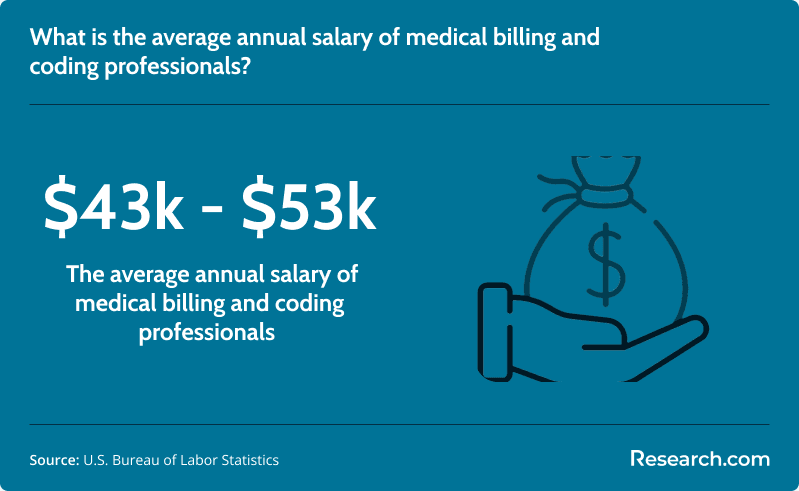
Medical billing and coding pay varies by certification, experience, employer, specialty, location, and job title. On average, medical billers and coders earn between $43,000 and $53,000 annually, with entry-level positions starting around $35,000 and experienced professionals earning upwards of $77,000 or more.
According to the U.S. Bureau of Labor Statistics (BLS), as of May 2023, the median annual wage for medical records specialists, which includes medical billers and coders, was approximately $48,780.
Certification can affect pay. Obtaining credentials such as Certified Professional Coder (CPC) from the American Academy of Professional Coders (AAPC) can significantly boost earning potential, often by 10-20% more than non-certified peers. Similar benefits apply to those certified by the American Health Information Management Association (AHIMA). In 2022, Certified Physician Practice Managers (CPPMs) registered the highest income increase at 6.78%.
Location also matters. States like California, Massachusetts, and New York tend to offer higher salaries because of higher cost of living and stronger demand for healthcare services. Salaries in these states can exceed $55,000 annually. States with a lower cost of living, such as Mississippi, Alabama, and Arkansas, tend to offer lower salaries, often ranging from $35,000 to $45,000 annually.
If salary is your top priority, compare medical billing and coding with other healthcare careers before enrolling. For example, medical sonographers earn more, with a median salary of $84,470 as of May 2023, and some accelerated programs may take as little as six to eight months. You can compare options through the best accelerated online sonography & ultrasound degrees. Radiology technology may also be worth comparing; x ray technician salary is $63,120.
What are the challenges faced by medical billers and coders?
Medical billing and coding is often promoted as flexible and stable, but the work can be demanding. The main challenges are not physical; they are cognitive, technical, regulatory, and workflow-related.
- Frequent coding and policy updates: Professionals must keep up with annual CPT updates, payer changes, compliance expectations, and documentation requirements. The transition from ICD-9 to ICD-10 showed how major coding changes can require extensive retraining.
- High accuracy expectations: Incorrect codes or incomplete claim information can lead to denials, delayed reimbursement, patient billing problems, and audit risk.
- Large claim volumes: Hospitals and specialty facilities may require coders and billers to process many records under deadlines.
- Unclear documentation: Coders may need to query providers when documentation does not support the selected code or claim.
- Difficult payer interactions: Denials, underpayments, prior authorization issues, and appeals require persistence and strong communication skills.
- Technology pressure: AI tools, automated coding systems, EHRs, and billing platforms can improve productivity, but professionals still need to verify results and catch errors.
Students looking for a flexible path into healthcare administration may compare this field with other accessible programs, including the easiest online degrees. However, “easy” should not be confused with low-effort. Billing and coding requires discipline, precision, and continuous learning.
Common mistakes to avoid before entering the field
- Choosing a program only because it is cheap: Low tuition is useful, but weak certification preparation or poor student support can reduce the value of the program.
- Assuming every online program is employer-recognized: Review accreditation, curriculum, certification alignment, and graduate outcomes before enrolling.
- Ignoring certification requirements: If you want CPC, CCS, CMRS, or CIC preparation, confirm the program’s coursework matches your target exam.
- Expecting immediate remote work: Remote roles exist, but some employers prefer experience, productivity history, or certification before allowing remote coding.
- Underestimating continuing education: Coding rules and payer policies change, so ongoing learning is part of the job.
- Assuming salary outcomes are guaranteed: Pay depends on location, employer, experience, specialty, certification, and performance.
What continuing education opportunities are available for medical billers and coders?
Continuing education helps billers and coders maintain certification, stay current with code changes, understand payer rules, and adapt to new health information technology. In 2021, about half of physicians reported electronically searching or querying for patient health information via their EHR when seeing a new patient, which highlights how deeply electronic records now shape healthcare administration.
Certification renewal
AAPC and AHIMA require certified professionals to earn continuing education units (CEUs) to keep certifications active. Typically, this involves completing a certain number of CEUs every two years. Requirements vary by credential, so professionals should verify renewal rules directly with the certifying organization.
Specialized training
Billers and coders can take focused courses in inpatient coding, outpatient coding, physician practice coding, procedural coding, specialty coding, claims denial management, audit preparation, documentation improvement, and compliance.
Professional associations and conferences
Conferences, webinars, local chapter meetings, workshops, and seminars from AAPC, AHIMA, and related organizations can provide CEUs, networking, and exposure to regulatory changes.
Advanced certifications
Specialty certifications can help experienced professionals move into hospital coding, outpatient coding, documentation improvement, management, auditing, or compliance. Examples include Certified Inpatient Coder (CIC), Certified Outpatient Coder (COC), and Certified Documentation Expert Outpatient (CDEO).
How can I accelerate my career growth in medical billing and coding?
The fastest way to grow is to combine accurate production work with targeted credentials, specialty experience, and a clear career plan. Start by becoming strong in the basics: clean claims, correct coding, documentation review, denial follow-up, payer rules, and HIPAA-compliant record handling. Then choose a specialty or advancement track.
- Earn a recognized certification: CPC, CCS, CMRS, CIC, or another relevant credential can help distinguish you from applicants with only coursework.
- Track performance metrics: Employers often value accuracy, productivity, denial reduction, clean-claim rates, and audit readiness.
- Build specialty knowledge: Cardiology, oncology, orthopedics, inpatient coding, outpatient surgery, and risk adjustment can require deeper expertise.
- Find mentors: Experienced coders, revenue cycle managers, and health information leaders can help you understand career ladders and common pitfalls.
- Network intentionally: Professional chapters, webinars, conferences, and employer training sessions can lead to referrals and leadership opportunities.
Before committing, review the pros and cons of medical billing and coding so you understand both the advantages and the day-to-day pressures of the field.
Is obtaining additional healthcare credentials beneficial for my career?
Additional credentials can help if they support a specific goal. For example, a coder who wants to move into compliance may benefit from compliance-focused education, while someone interested in management may benefit from healthcare administration coursework. Extra credentials are less useful when they are unrelated, too expensive, or chosen without a career target.
Some professionals broaden their healthcare knowledge through advanced clinical or administrative study. An online pharmacist degree, for example, represents a very different commitment and career direction than billing and coding. It may provide clinical depth, but it should be evaluated carefully because pharmacy involves a much longer and more specialized educational path.
How does medical billing and coding compare to other healthcare career paths?
Medical billing and coding is best compared with other healthcare careers by looking at training time, patient contact, licensure, cost, salary expectations, and long-term mobility. It is usually more accessible than licensed clinical careers, but it may also have lower earning potential than some roles that require more training.
| Career path | Patient interaction | Training and credential considerations | Best fit |
| Medical billing and coding | Limited or indirect | Certificate, associate degree, and professional certification options | Detail-oriented students who want administrative healthcare work |
| Medical assisting | Moderate to high | Short-term training options may include clinical and administrative skills | Students who want both front-office and patient-facing tasks |
| Sonography | High | Clinical training and imaging-focused preparation | Students interested in diagnostic imaging and patient care |
| Radiology technology | High | Clinical education, imaging procedures, and role-specific requirements | Students who want technical patient-care work |
| Pharmacy | High in many settings | Comprehensive clinical education, licensing examinations, and deeper patient-care responsibilities | Students prepared for a longer professional pathway |
For example, aspiring pharmacists focus on clinical coursework, medication therapy, licensing, and hands-on patient care. Those who prefer administrative healthcare may be better served by billing, coding, health information, or revenue cycle credentials. To compare the pharmacy pathway, review What do you study to become a pharmacist?
How can I finance my medical billing and coding education?
Financing depends on the school, program type, accreditation status, and whether the program qualifies for federal aid or other assistance. Before enrolling, ask for the total cost in writing, including tuition, fees, books, software, exam prep, certification exam costs, technology fees, and extension fees.
- Scholarships: Some schools, healthcare organizations, and professional groups offer scholarships for health administration or allied health students.
- Federal and state aid: Eligibility depends on the institution and program. Not every short course qualifies.
- Payment plans: Many training providers allow students to divide tuition over several months.
- Employer support: Current healthcare employees should ask whether tuition reimbursement, exam reimbursement, or internal training is available.
- Lower-cost alternatives: Community colleges and public institutions may offer more affordable options than private training providers.
Students comparing short healthcare training routes may also look at options such as a 6 week medical assistant program online, but they should compare career outcomes, hands-on requirements, certification eligibility, and employer recognition before choosing one path over another.
Could an accelerated online healthcare administration degree further boost my career prospects?
An accelerated healthcare administration degree may help if your goal is to move beyond coding or billing into supervision, operations, revenue cycle management, compliance, or health information leadership. It is less necessary if your immediate goal is an entry-level coding role.
Professionals who already understand claims, documentation, and reimbursement can use administrative training to develop broader skills in workflow management, staffing, finance, quality improvement, and healthcare systems. If that path fits your goals, compare the best accelerated online healthcare administration degrees with attention to accreditation, transfer credit, cost, course load, and career support.
Can accelerated healthcare credentials boost my career in medical billing and coding?
Accelerated credentials can be useful when they add relevant expertise, but they should not be collected randomly. A credential should help you qualify for a better role, prepare for certification, deepen specialty knowledge, or move toward management.
Some healthcare credentials, such as the fastest PharmD degree, represent a major clinical pathway rather than a simple add-on for billing and coding. If you are considering that type of program, compare the time, cost, licensing requirements, and career destination carefully. For most billing and coding professionals, targeted coding, compliance, auditing, documentation improvement, or healthcare administration credentials are more directly aligned with advancement.
What is the average cost of an online medical billing and coding course?
The average cost of an online medical billing and coding course varies by institution, program length, credential level, included materials, certification preparation, and student services. Certificate programs generally range from $1,000 to $5,000, while associate degree programs may cost $5,000 to $15,000 or more. Online training courses typically range from $500 to $3,000, and certification exam preparation courses may cost $200 to $1,000.
| Program type | Typical cost range |
| Certificate Programs | $1,000 to $5,000 |
| Associate Degree Programs | $5,000 to $15,000 |
| Online Training Courses | $500 to $3,000 |
Cost questions to ask before enrolling
- Does the published tuition include books, coding manuals, software, and exam preparation?
- Are certification exam fees included or separate?
- Is the program accredited or offered by an institution with recognized accreditation?
- Does the curriculum prepare students for CPC, CCS, CMRS, CIC, or another specific credential?
- Are tutoring, instructor access, career services, and technical support included?
- What happens if you need extra time to finish?
- Does the school publish completion, certification, or job placement information?
What is the outlook for medical billing and coding jobs?
The outlook for medical billing and coding jobs remains positive because healthcare organizations continue to need accurate documentation, claims processing, reimbursement support, and electronic records management. More than 52% of medical coders, billers, and other healthcare business professionals now work for the largest employer types, which include health systems, inpatient and outpatient hospitals, inpatient-only hospitals, and outpatient-only hospitals.
Several forces support ongoing demand: growth in healthcare services, adoption of electronic health records, reimbursement complexity, telemedicine billing needs, regulatory changes, and payer documentation requirements. Initiatives such as the Health Information Technology for Economic and Clinical Health (HITECH) Act have encouraged EHR adoption, increasing the need for staff who can work accurately with electronic patient records.
Technology-driven healthcare also creates adjacent opportunities. As hospitals and clinics rely more heavily on electronic patient data management, some professionals explore related fields such as online cybersecurity degrees to understand healthcare data protection. Others build finance and reimbursement expertise through options such as accredited online masters in accounting programs.
Ongoing changes in reimbursement and policy also affect the work. Healthcare organizations must respond to billing, coding, and policy updates, which keeps experienced and adaptable professionals valuable.
Is a career in medical billing and coding lucrative?
Medical billing and coding can provide solid earnings for an administrative healthcare career, especially for professionals with certification, experience, and specialty knowledge. However, it should not be evaluated only by national averages. Your actual pay will depend on employer type, location, credential level, experience, productivity, and whether you work in billing, coding, auditing, compliance, or management.
According to the American Association of Medical Coders, the national average salary for certified professional coders in 2020 was $51,040. For a more detailed discussion of pay variables, review Research.com’s guide to medical billing and coding salary.
The field may be financially worthwhile if you choose a reputable program, earn a relevant certification, gain experience in high-demand settings, and continue learning. It may feel less lucrative if you complete a weak training program, avoid certification, remain in low-responsibility roles, or live in a lower-paying market.
How does technology influence the future of medical billing and coding careers?
Technology is reshaping billing and coding by automating routine steps, increasing documentation access, enabling remote work, and creating new expectations for data accuracy. It does not remove the need for human judgment; it changes where that judgment is applied.
- Automation: Software can speed up repetitive tasks such as data entry, claim generation, code suggestions, and claim status tracking.
- Remote work opportunities: Cloud-based systems allow some billing and coding professionals to work outside a traditional office, depending on employer policy and role requirements.
- Data analytics: Healthcare organizations can use billing and coding data to identify denial trends, reimbursement gaps, documentation problems, and cost patterns.
Professionals who stay current with coding software, EHR workflows, privacy requirements, and payer systems will be better positioned than those who rely only on manual processes.
What factors should I consider when choosing a medical billing and coding school?
Choosing a school is one of the most important decisions you will make because not all medical billing and coding programs offer the same preparation, credibility, or support. Start with accreditation, but do not stop there. Review curriculum, certification alignment, instructor access, cost transparency, technology requirements, career services, and student outcomes.
You can compare options through Research.com’s list of accredited medical billing and coding schools. Use rankings as a starting point, not as the only deciding factor.
Program selection checklist
- Accreditation: Confirm that the school is accredited by a recognized accrediting agency.
- Certification preparation: Ask which certification exams the program is designed to support.
- Curriculum depth: Look for medical terminology, anatomy and physiology, ICD-10, CPT, HCPCS, billing, reimbursement, HIPAA, compliance, and EHR training.
- Hands-on practice: Strong programs include realistic coding exercises, claims scenarios, denial examples, and documentation review.
- Faculty support: Determine whether instructors have billing, coding, auditing, or health information experience.
- Total cost: Include tuition, fees, books, coding manuals, exam prep, exam fees, and technology costs.
- Flexibility: Make sure the schedule fits your work and family obligations.
- Career services: Ask whether the school helps with resumes, interview preparation, externships, job leads, or employer connections.
How is technology shaping the medical billing and coding industry?
Technology is now built into nearly every stage of billing and coding. Professionals work with electronic health records, coding software, billing platforms, payer portals, compliance tools, and sometimes AI-assisted systems. The strongest candidates are not just familiar with codes; they know how to use technology while still checking accuracy and protecting patient information.
- Electronic Health Records (EHR) systems: EHRs store and organize patient information electronically. Billers and coders use them to review documentation, confirm services, assign codes, and support claims. EHR proficiency is now a core workplace skill.
- Coding software: Tools such as 3M CodeFinder, Optum360, and TruCode can help identify codes, check rules, and improve workflow. Professionals still need to verify that suggested codes match documentation.
- Billing management platforms: These systems help submit claims, track payments, monitor denials, manage patient balances, and document follow-up activity.
- Artificial intelligence and machine learning: AI-powered tools can analyze records, suggest codes, flag inconsistencies, and automate repetitive tasks. Human review remains important because documentation context and payer rules can be complex.
- Telemedicine and remote coding: Telehealth services require knowledge of specific CPT and HCPCS codes for virtual visits, remote monitoring, and related services. Cloud-based platforms also support remote coding roles.
- Data security and compliance technology: Billing and coding professionals handle sensitive patient data, so HIPAA compliance, secure access, audit trails, and privacy safeguards are essential.
Students entering the field should choose training that includes current software exposure, EHR concepts, telehealth billing awareness, privacy practices, and realistic claim scenarios. A low cost medical coding and billing online program can be a smart option if it is reputable, certification-aligned, and transparent about total cost.
Key insights
- Medical billing and coding is a healthcare administration career focused on documentation, standardized codes, claims, reimbursement, and compliance rather than direct patient care.
- The field can be a good fit for detail-oriented learners who want a shorter training path, certification-based advancement, and potential opportunities in hospitals, clinics, physician offices, long-term care, and remote settings.
- Certificate programs take 9 to 12 months, while associate degree programs usually take 18 to 24 months or two years, depending on the structure and student pace.
- Online course costs vary widely: certificate programs generally range from $1,000 to $5,000, associate degree programs from $5,000 to $15,000, and online training courses from $500 to $3,000.
- Certification matters. Credentials such as CPC, CCS, CMRS, and CIC can improve credibility and may support stronger earning potential or specialization.
- Technology is changing the work through EHRs, coding software, billing platforms, AI tools, telemedicine coding, and data security requirements. Adaptability is now part of the job.
- Do not choose a program based only on price or speed. Check accreditation, curriculum, certification alignment, total cost, student support, and employer recognition before enrolling.
- Medical billing and coding can be worthwhile, but salary is not guaranteed. Location, certification, experience, employer type, specialty, and performance all influence outcomes.
References:
- American Academy of Professional Coders. (2023). 2023 Medical Coding Salary Survey.
- Office of the National Coordinator for Health Information Technology. (2024). Report to Congress: Implementation of the HITECH Act.
- Office of the National Coordinator for Health Information Technology. (2022). Adoption of electronic health records by hospital service type, 2019-2021.
- Pew Charitable Trusts. (2020). Effective reporting could improve safe use of electronic health records.
- U.S. Bureau of Labor Statistics. (2022). Medical records and health information specialists. Occupational Outlook Handbook.
Other Things You Should Know About Medical Coding and Billing
Professional certification in medical billing and coding usually requires completion of a recognized training program and passing an examination. Common certifications include the Certified Professional Coder (CPC) and Certified Coding Specialist (CCS). In 2027, staying updated on new technologies and coding regulations is vital for maintaining certification.
By 2027, updates in healthcare regulations are anticipated to impact coding standards. New ICD-11 codes may be introduced, necessitating comprehensive training and adaptation. Staying informed on CMS and AMA updates will be essential for compliance and accuracy in billing practices.
The main certifying bodies are the AAPC and AHIMA. AAPC offers the Certified Professional Coder, or CPC, exam, while AHIMA offers the Certified Coding Specialist, or CCS, credential. Employers often look for these certifications when hiring medical billing and coding professionals.


