2027 Associate Degree vs. Bachelor's Degree Programs: Explaining The Difference

Co-Founder and Chief Data Scientist
Choosing between an associate degree and a bachelor’s degree is not just a question of “two years or four years.” It affects how quickly you can start working, how much you may pay for college, which jobs you can realistically pursue, whether credits will transfer later, and how employers may view your education. This guide compares associate and bachelor’s degrees for students, working adults, career changers, and parents helping a student plan a path after high school. You will learn how the two credentials differ in cost, admissions, coursework, career outcomes, online options, financial aid, transfer planning, and long-term return on investment.
Quick Answer: Associate Degree vs. Bachelor’s Degree
An associate degree is usually the faster and lower-cost option, often requiring 60 credit hours and about two years of full-time study. It can lead to entry-level or technical roles in fields such as healthcare, information technology, business support, criminal justice, and early childhood education. A bachelor’s degree usually requires 120 credit hours and about four years of full-time study. It generally offers broader academic training, stronger access to professional and management roles, and a common pathway to graduate school.
The better choice depends on your goal. Choose an associate degree if you need an affordable, practical route into the workforce or plan to transfer later. Choose a bachelor’s degree if your target career requires a four-year credential, if you want stronger advancement options, or if graduate school may be part of your plan.
Key Differences at a Glance
| Factor | Associate Degree | Bachelor’s Degree |
| Typical length | About two years of full-time study | About four years of full-time study |
| Typical credits | 60 credit hours | 120 credit hours |
| Common schools | Community colleges, technical colleges, some online colleges | Public universities, private colleges, online universities |
| Main advantage | Lower cost and faster workforce entry | Broader career access and stronger advancement potential |
| Best fit | Students seeking technical skills, transfer credits, or a lower-cost start | Students targeting professional, leadership, graduate-school, or licensed career paths |
| Potential drawback | Some employers and advanced roles may require a bachelor’s degree | Higher cost, longer timeline, and greater risk if the major does not align with career goals |
Most Affordable Associate and Bachelor’s Degree Programs
Affordability depends on the school, format, residency status, transfer credits, and financial aid. Still, many students compare programs by starting with majors that lead either to immediate employment or a clear transfer pathway. The programs below are common choices because they connect to large employment sectors or flexible career paths.
Associate Degree Programs
Associate degrees are often designed for quick career preparation, transfer into a bachelor’s program, or both. Before enrolling, check whether the program is career-focused, transfer-focused, or built for a specific license or certification.
Nursing: Associate Degree in Nursing
An Associate Degree in Nursing prepares students for registered nursing pathways through clinical training and coursework in patient care, anatomy, pharmacology, and nursing practice. Students should confirm state board requirements and whether the program supports RN licensure preparation.
Business Administration
An associate degree in business administration introduces accounting, marketing, economics, management, and business communication. It can support entry-level office and operations roles or serve as a transfer foundation for a bachelor’s degree in business.
Computer Science or Information Technology
Associate programs in computer science or information technology usually emphasize programming basics, networking, cybersecurity concepts, systems support, and web technologies. Graduates may pursue support, technician, junior development, or security-related roles depending on skills and experience.
Criminal Justice
An associate degree in criminal justice covers law enforcement, courts, corrections, criminal procedure, and the justice system. It can support roles in security, public safety support, corrections, or transfer into a four-year criminal justice or public administration program.
Early Childhood Education
An associate degree in early childhood education focuses on child development, classroom support, learning environments, behavior guidance, and curriculum for young children. Students should verify local requirements for preschool, childcare, or teacher assistant roles.
Bachelor’s Degree Programs
A bachelor’s degree usually provides deeper academic preparation, more advanced major coursework, and stronger access to professional roles. The right major should match both your interests and the actual requirements of the career you want.
Business Administration
A bachelor’s degree in business administration is broad and career-flexible, often covering management, finance, marketing, operations, entrepreneurship, and business strategy. It can lead to roles in corporate settings, consulting, financial services, sales management, and operations.
Nursing: Bachelor of Science in Nursing
A Bachelor of Science in Nursing provides more advanced nursing preparation, including patient care, evidence-based practice, healthcare systems, leadership, and policy topics. Students should review licensing rules, clinical placement expectations, and whether the program is accredited for nursing education.
Computer Science
A bachelor’s degree in computer science typically includes programming, algorithms, data structures, software engineering, databases, cybersecurity, artificial intelligence, and systems design. It is commonly used for software engineering, data, cybersecurity, and technical leadership pathways.
Psychology
A bachelor’s degree in psychology introduces human behavior, cognition, research methods, development, mental health, and social processes. It may support roles in human services, human resources, case management, research assistance, or graduate study in psychology, counseling, or social work.
Education
A bachelor’s degree in education prepares students for teaching and education-related roles through coursework in pedagogy, curriculum, assessment, classroom management, and field experience. Students pursuing teaching should confirm that the program meets state licensure requirements.
- Educational requirements
- Cost of attendance
- Admission requirements
- Career roles by degree type
- How to choose the right degree
- Salary and job outlook
- Challenges of earning an associate degree
- Online degrees as a flexible option
- Financial aid and degree choice
- Challenges of earning a bachelor’s degree
- Accelerated online associate degrees
- Accelerated online bachelor’s degrees
- Whether to earn an associate degree before a bachelor’s degree
- How employers compare the two credentials
- Master’s degree eligibility after an associate degree
- Career value of online degree programs
- Professional certifications and degree value
- Online degree career considerations
- Graduate-school pathway planning
Associate Degree vs. Bachelor’s Degree: Educational Requirements
The main academic difference is scope. An associate degree usually covers general education plus introductory or applied major courses. A bachelor’s degree includes general education, lower-division coursework, upper-division major requirements, electives, and often more advanced research, projects, internships, or field experiences.
- Credits: An associate degree typically requires 60 credit hours. A bachelor’s degree usually requires 120 credit hours.
- General education: Both credentials include subjects such as English, math, science, humanities, and social sciences, but bachelor’s programs usually require a broader and deeper general education sequence.
- Major coursework: Associate degrees often emphasize job-ready skills or transfer preparation. Bachelor’s degrees move further into theory, analysis, specialization, and advanced practice in the major.
- Applied learning: Many associate programs focus on labs, clinicals, technical practice, or workplace skills. Bachelor’s programs may add research papers, capstone projects, internships, practicum experiences, and advanced seminars.
For transfer students, the most important question is not just “How many credits will I earn?” but “Which credits will count toward the bachelor’s degree I want?” A transfer-focused associate degree may save time and money, while a career-focused associate degree may not transfer as smoothly into every four-year major.
Degree requirements also vary by field. For example, students exploring government, public policy, law, nonprofits, or international relations may want to understand what careers a political science degree can support before deciding whether an associate-to-bachelor’s transfer path is enough or whether a direct bachelor’s route is better.
The chart below shows bachelor’s degrees as the highest educational attainment for many people who continued their education after high school.
Associate Degree vs. Bachelor’s Degree: Cost of Attendance
Cost is often the biggest reason students start with an associate degree. Community colleges and public two-year institutions typically charge lower tuition, and students may be able to live at home, work while studying, or transfer later. Bachelor’s programs can cost more because they take longer and often include higher tuition, housing, fees, and indirect expenses.
According to Education Data, the 2-year in-district annual cost of tuition is $3,600, while the 4-year in-state annual cost of tuition is $9,750. The average total cost of a two-year degree in a public institution is $34,878, while the average total cost of a four-year degree in an in-state public institution is $108,584.
If you are asking how much an associate degree costs, compare more than tuition. Include books, technology fees, transportation, childcare, lost wages, housing, and whether credits will transfer. A lower-cost program can become expensive if you later have to repeat courses.
| Institution Type | Annual Cost of Tuition | Annual Cost of Attendance |
| 4-Year In-State Public | $9,750 | $27,146 |
| 4-Year Out-of-State Public | $28,386 | $45,708 |
| 2-Year In-District Public | $3,598 | $17,439 |
| 4-Year Nonprofit Private | $38,421 | $56,628 |
| 4-Year For-Profit Private | $15,868 | $33,574 |
| 2-Year Nonprofit Private | $20,019 | $36,026 |
| 2-Year For-Profit Private | $16,444 | $26,640 |
Cost Decision Guide
| If your priority is... | Consider... | Why it may help |
| Lowest upfront cost | Public community college or in-district associate degree | Tuition is often lower, and students may reduce housing and transportation costs. |
| Long-term advancement | Bachelor’s degree or planned associate-to-bachelor’s transfer | Some professional roles require a four-year credential for hiring or promotion. |
| Faster employment | Career-focused associate degree in a licensed, technical, or applied field | Programs may be designed around specific workforce skills. |
| Higher earning potential | Research major-specific outcomes before enrolling | Some bachelor’s degrees lead to stronger earnings than others; review options such as high paying bachelor degrees when comparing ROI. |
Associate Degree vs. Bachelor’s Degree: Admission Requirements
Associate programs are often more accessible than bachelor’s programs, especially at community colleges with open-admission policies. Bachelor’s programs may have more selective admissions, especially at competitive public universities and private colleges.
- High school completion: Most associate and bachelor’s programs require a high school diploma or GED.
- Testing: Many community colleges do not require SAT or ACT scores, although placement testing may be used for math or English. Some bachelor’s programs require or consider standardized test scores depending on institutional policy.
- GPA: Associate programs often have lower GPA barriers. Bachelor’s programs may use GPA more heavily, especially for selective majors or competitive universities.
- Application materials: Bachelor’s applicants may need essays, recommendations, activity lists, portfolios, auditions, or major-specific requirements. Associate degree applications are typically simpler.
- Program-level prerequisites: Nursing, education, engineering technology, and some health programs may have stricter requirements even at the associate level.
Do not assume that “associate degree” always means easy admission. Selective health, allied health, and technical programs may have waitlists, prerequisite courses, background checks, immunization requirements, or clinical placement rules.
Associate Degree vs. Bachelor’s Degree: Professional Roles
Both degrees can lead to meaningful work, but they usually position graduates differently in the labor market. Associate degrees often prepare students for technical, support, clinical, operational, or entry-level roles. Bachelor’s degrees more often connect to professional, analytical, supervisory, specialized, or management-track positions.
Common Career Differences by Industry
| Industry | Associate Degree Pathways | Bachelor’s Degree Pathways | Decision Point |
| Healthcare | Registered Nurse, Medical Assistant, Radiologic Technician | Nurse Manager, Healthcare Administrator, Occupational Therapist | Check licensure rules, clinical requirements, and whether advancement favors a BSN or higher degree. |
| Technology and IT | IT Support Specialist, Web Developer, Network Technician | Software Engineer, Cybersecurity Analyst, IT Project Manager | Skills, projects, certifications, and experience matter, but some employers prefer bachelor’s degrees for engineering and leadership roles. |
| Business and Finance | Administrative Assistant, Bookkeeper, Sales Representative | Accountant, Financial Analyst, Marketing Manager | A bachelor’s degree is often more useful for analytical, finance, management, and advancement-track roles. |
| Skilled Trades and Engineering | HVAC Technician, Electrician, Engineering Technician | Civil Engineer, Electrical Engineer, Industrial Designer | Technical roles may start with an associate degree, while licensed engineering and design roles often require more education. |
Career planning matters most in fields where licensure or graduate education is required. For example, students comparing licensed clinical social worker and licensed professional counselor degree programs should understand that associate-level study can introduce human services, but clinical counseling and social work roles typically require bachelor’s, graduate education, supervised experience, and licensure.
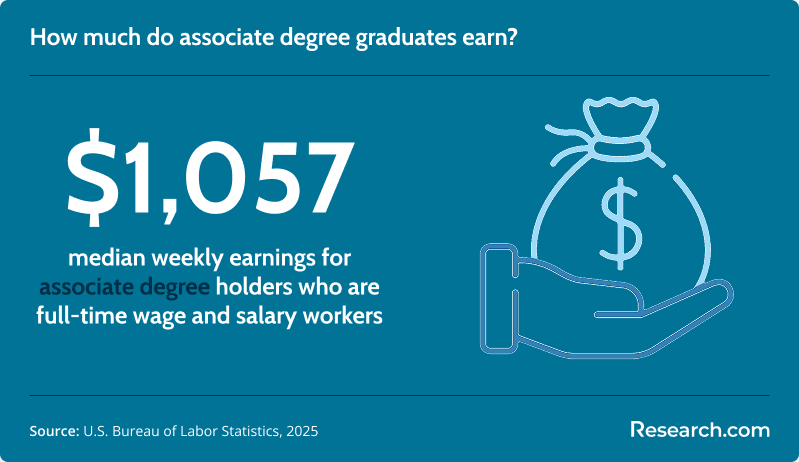
The image below shows weekly earnings for full-time workers whose highest credential is an associate degree.
Associate Degree vs. Bachelor’s Degree: Which Degree Type Is Right for Me?
The right choice depends on your target job, budget, timeline, learning preferences, and risk tolerance. Start with the career you want, then work backward to the credential employers, licensing boards, or graduate programs expect.
| Choose an Associate Degree If... | Choose a Bachelor’s Degree If... |
| You need a faster path into paid work. | Your target career commonly requires a four-year degree. |
| You want to reduce tuition costs before transferring. | You want broader access to professional, analytical, or leadership roles. |
| You are interested in technical, applied, healthcare support, IT support, or trade-related fields. | You may pursue graduate school, licensure, research, or advanced specialization. |
| You are unsure about your major and want a lower-cost way to explore options. | You already know your field and want the most direct route to a bachelor’s credential. |
| You need flexible scheduling while working or caring for family. | You want campus resources, internships, research opportunities, and alumni networks that are often stronger at four-year institutions. |
Students who want a shorter route to a four-year credential can also compare fast online degrees, but speed should not be the only factor. Confirm accreditation, transfer policies, workload expectations, and whether the program meets any licensing or employer requirements in your field.
Questions to Ask Before Choosing
- What degree do employers usually request for the job titles I want?
- Will this program prepare me for licensure, certification, transfer, or direct employment?
- How many credits will transfer if I move from an associate to a bachelor’s program?
- What is the total cost of attendance, not just tuition?
- Can I complete clinicals, labs, internships, or student teaching where I live?
- What student support is available for online, working, or first-generation students?
- What happens if I change majors?
Associate Degree vs. Bachelor’s Degree: Salary and Job Outlook
Salary and employment outcomes vary by field, location, experience, licensing, employer, and economic conditions. A degree can improve opportunity, but it does not guarantee a job or a specific salary. The strongest comparison is not “associate versus bachelor’s” in general; it is “which credential is valued in the specific occupation I want?”
Median Weekly Earnings
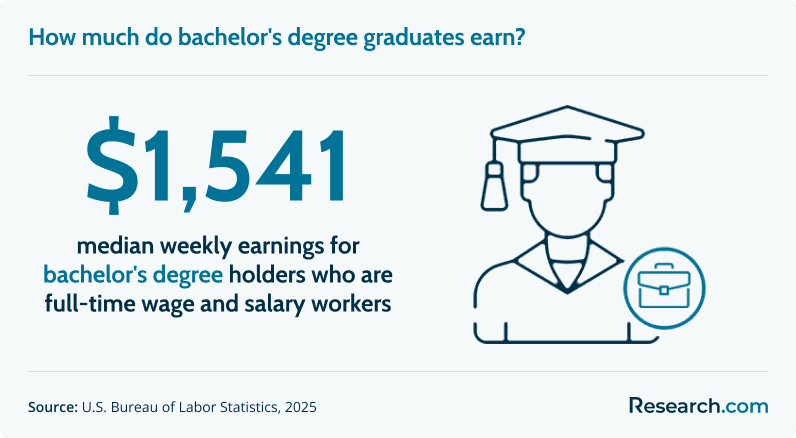
According to the U.S. Bureau of Labor Statistics, median weekly earnings for workers with an associate degree are around $1,057, while workers with a bachelor’s degree earn approximately $1,541 per week.
That difference is important, but field choice matters. Some associate-degree careers in healthcare, technical services, and skilled trades can be financially strong, while some bachelor’s majors lead to lower earnings unless combined with graduate education, experience, or specialized credentials.
Job Outlook and Advancement
Bachelor’s degrees are often associated with greater access to management-track, specialized, and professional roles. They can also reduce barriers to graduate school. Associate degrees can still be valuable when they are tied to licensure, technical skills, apprenticeships, or employer-recognized training.
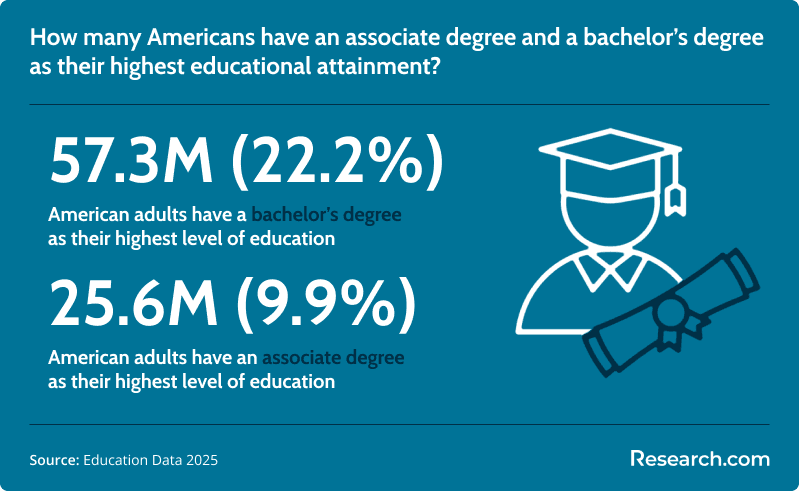
The chart below shows that 25.555 million adults, or 9.9%, have an associate degree as their highest level of education. It also shows that 57.305 million adults, or 22.2%, have a bachelor’s degree as their highest educational attainment.
What Are the Challenges of Pursuing an Associate Degree?
An associate degree can be affordable and practical, but it is not always the easiest or best long-term option. Students should understand the limitations before enrolling.
- Advancement may be limited: Some roles require a bachelor’s degree for promotion, management, or specialized responsibilities.
- Transfer may not be automatic: Credits can be lost if the associate program is not aligned with the bachelor’s program or transfer agreement.
- Work-school balance can be difficult: Many community college students work, care for family members, or attend part time, which can extend the timeline.
- Program resources may vary: Some two-year colleges have fewer alumni networks, career fairs, internship pipelines, or research opportunities than four-year institutions.
- Employer perception differs by field: In technical and licensed areas, associate degrees may be respected. In fields that expect a bachelor’s degree, graduates may face more competition.
- Costs still matter: Even lower-cost programs can create financial strain when books, transportation, childcare, fees, and lost work hours are included.
If speed is a priority, review program quality carefully before choosing one of the fastest or easiest associate's degree options. A shorter program only helps if it is accredited, relevant, and accepted by employers or transfer schools.
Can an Online Degree Program Offer a Rapid and Flexible Route to Success?
Online degree programs can be a strong option for working adults, parents, rural students, military learners, and anyone who needs more control over scheduling. They may reduce commuting and campus-related costs, but they still require discipline, time management, reliable technology, and active participation.
Before enrolling in an online program, confirm institutional accreditation, program accreditation when relevant, faculty access, tutoring, career services, transfer policies, and whether exams, labs, clinicals, internships, or student teaching require in-person attendance. Students who want flexible programs with shorter completion timelines can compare options such as the fastest online degree pathways, but should evaluate quality and career fit before choosing based on speed.
How Can Financial Aid Options Impact Your Degree Decision?
Financial aid can change the real cost difference between an associate and bachelor’s degree. Grants, scholarships, employer tuition assistance, military education benefits, work-study, payment plans, and federal student loans may make a higher-cost program more manageable. However, borrowing should be tied to realistic career goals and repayment expectations.
Students should complete the FAFSA if eligible, compare net price rather than sticker price, and ask each school for a written financial aid estimate. If online affordability is important, resources on cheap online colleges that accept FAFSA can help identify institutions where federal aid may be available.
What Are the Challenges of Pursuing a Bachelor’s Degree?
A bachelor’s degree can create more opportunities, but it also carries more cost, time, and academic commitment. The biggest risk is enrolling without a clear plan for major choice, financing, and career outcomes.
- Higher total cost: Tuition, fees, housing, textbooks, technology, and living expenses can add up over four years.
- Student debt risk: Borrowing may be necessary, but students should avoid taking on debt without understanding repayment obligations and likely career earnings.
- Longer timeline: Four years of study can be difficult for students who work full time, support family, or need income quickly.
- Academic intensity: Upper-division coursework often requires research, writing, quantitative analysis, presentations, and major projects.
- Uncertain career outcomes: A bachelor’s degree does not guarantee employment, especially if students graduate without internships, projects, networking, or job-search preparation.
- Major changes can delay graduation: Switching fields may increase credits, time, and cost.
- Practical experience may require extra effort: Students should actively seek internships, clinicals, research roles, portfolios, or fieldwork to strengthen employability.
The image below shows weekly earnings for full-time workers with a bachelor’s degree. Additional credentials can sometimes strengthen income potential, depending on the field. For example, targeted certifications, business training, or specialized credentials can be among the ways for therapists to increase income, although results depend on licensure, market demand, experience, and practice setting.
Is an Accelerated Online Associate Degree Right for Your Career Goals?
An accelerated online associate degree may work well if you already have credits, can study intensively, and need a credential quickly for employment or transfer. It may not be ideal if you need extensive tutoring, hands-on labs, clinical placements, or a slower academic pace.
Before choosing an accelerated option, ask how courses are compressed, how many hours per week are expected, whether credits transfer, and whether employers recognize the credential. Students comparing shorter pathways can review options such as a 6 month associate degree, but should verify accreditation and workload before enrolling.
Can Accelerated Bachelor’s Degree Programs Fast-Track Your Career Progression?
Accelerated bachelor’s programs can shorten the time to completion through transfer credits, year-round terms, shorter course sessions, competency-based learning, or credit for prior learning. They can be useful for motivated students who already know their career goal and can manage a heavier pace.
The trade-off is intensity. Faster programs may require more weekly study time, fewer breaks, and strong self-direction. When comparing accelerated bachelor degree programs online, review accreditation, transfer credit limits, total cost, faculty support, graduation requirements, and career services.
Should You Get an Associate Degree Before a Bachelor’s Degree?
Starting with an associate degree before transferring can be a smart strategy, but only if the credits apply cleanly to the bachelor’s degree you want. This route is especially useful for students seeking lower tuition, smaller class sizes, flexible schedules, or a chance to improve their academic record before applying to a four-year institution.
When the Associate-First Route Makes Sense
- You want to complete general education requirements at a lower-cost college.
- You are undecided about your major and want time to explore.
- You need to work while studying and prefer flexible scheduling.
- Your community college has transfer agreements with universities you are considering.
- You want to enter the workforce with a credential while keeping the bachelor’s option open.
When Going Straight to a Bachelor’s Degree May Be Better
- Your target major has strict course sequencing that starts in the first year.
- You are pursuing a competitive program where early advising, labs, studios, or clinical placements matter.
- You have a strong financial aid package from a four-year school.
- You want access to university research, internships, residential life, or alumni networks from the beginning.
- Your career requires a bachelor’s degree, and transferring could delay progress if not planned well.
Online associate degree programs can make the associate-first path more flexible, especially for working students. However, transfer planning should happen before enrollment, not after graduation.
Students considering counseling, psychology, or social work pathways should plan carefully. For example, when comparing LCPC vs LCSW which program to choose, an associate degree may help with early exploration, but a bachelor’s degree and later graduate education are usually central to professional advancement.
How Do Employers Evaluate Associate Versus Bachelor’s Degrees?
Employers rarely evaluate degrees in isolation. They typically consider the credential, major, school reputation, accreditation, relevant experience, technical skills, certifications, portfolio quality, communication ability, and whether the applicant can perform the job.
A bachelor’s degree may be preferred for roles involving analysis, leadership, project ownership, management, professional judgment, or long-term advancement. An associate degree may be valued when the job requires practical technical skills, applied training, licensure preparation, or immediate workplace readiness.
Additional education can also change how employers view a candidate. For professionals who already have a bachelor’s degree and want faster graduate preparation, 1 year master programs online may offer a more advanced credential, but applicants should confirm accreditation, workload, and employer relevance.
Can You Enroll in a Master’s Degree Program With Just an Associate Degree?
In most cases, no. Master’s degree programs usually require a bachelor’s degree for admission. An associate degree generally represents about 60 credits, while a bachelor’s degree generally represents 120 credits, so graduate programs normally expect the additional undergraduate coursework before advanced study.
Possible Pathways From Associate Degree to Master’s Degree
- Transfer into a bachelor’s program: This is the most common route. Students complete the remaining undergraduate credits before applying to graduate school.
- Use an accelerated bachelor’s-to-master’s pathway: Some universities allow students to combine upper-division undergraduate work with graduate coursework. Nursing students, for example, may compare easy RN to MSN online programs that help registered nurses move toward BSN and MSN preparation more efficiently.
- Look for rare experience-based exceptions: A small number of professional programs may consider extensive work experience, but these are uncommon and may still require bridge coursework.
For psychology and mental health careers, the associate-to-bachelor’s-to-master’s sequence is especially important. An associate degree can introduce basic concepts, but a bachelor’s degree and graduate training are typically needed for advanced study, licensure-oriented preparation, and specialization. Students should also understand the challenges of working as a psychologist before committing to a long education pathway.
Do Online Degree Programs Provide Equal Career Benefits as Traditional Programs?
Online degrees can provide comparable career value when they come from properly accredited institutions and meet the same academic or licensure standards as campus programs. Employers are generally more concerned with accreditation, relevant skills, experience, and job fit than whether every course was completed on campus.
However, not all online programs are equal. Students should check whether the degree name is the same as the campus version, whether internships or clinicals are supported locally, whether career services are available to online learners, and whether the program has strong completion and student support systems. If flexibility is the top priority, compare options carefully, including guides to the easiest online college programs, while avoiding programs that sacrifice quality for convenience.
Can Professional Certifications Complement Your Degree for a Competitive Edge?
Certifications can strengthen either an associate or bachelor’s degree when they verify job-specific skills that employers recognize. They are especially useful in technology, healthcare, project management, business analysis, accounting support, cybersecurity, skilled trades, and human resources.
A certification is not a substitute for a degree when a degree is required for licensure or hiring, but it can make a graduate more competitive. Students comparing credentials should look for certifications that are respected in their industry, connected to job postings, and aligned with their career level. Guides to the best certifications for high paying jobs can help identify options that complement academic training.
Common Mistakes to Avoid
| Mistake | Why It Can Hurt You | Better Approach |
| Choosing based only on tuition | Low tuition does not guarantee low total cost or strong outcomes. | Compare total cost of attendance, aid, completion time, and transfer value. |
| Ignoring accreditation | Credits may not transfer, employers may question the credential, and licensure may be affected. | Verify institutional accreditation and programmatic accreditation when required. |
| Assuming all credits transfer | You may lose credits and pay to repeat courses. | Use written transfer agreements and confirm course equivalencies before enrolling. |
| Choosing a major without checking job requirements | You may graduate with a credential that does not match your target role. | Review job postings, licensing boards, graduate admissions rules, and employer expectations. |
| Assuming online means easier | Online courses can be just as demanding and require strong self-management. | Ask about weekly workload, exams, live sessions, support services, and technology requirements. |
| Relying only on rankings | A highly ranked school may not be affordable, flexible, or aligned with your career goal. | Use rankings as one input, then compare cost, fit, transfer, outcomes, and support. |
Practical Steps for Choosing Between an Associate and Bachelor’s Degree
- Start with the job title: Search current job postings for the roles you want and note the required or preferred education.
- Check licensure rules: For nursing, teaching, counseling, engineering, and allied health, confirm state-specific requirements before choosing a program.
- Compare total costs: Include tuition, fees, books, transportation, housing, childcare, technology, and likely borrowing.
- Verify accreditation: Make sure the institution is accredited and that any field-specific accreditation is in place if required.
- Ask about transfer: If starting with an associate degree, get written confirmation of which credits transfer and how they apply to the bachelor’s major.
- Review support services: Look for advising, tutoring, career coaching, internship help, online student support, and mental health resources.
- Calculate the timeline: Consider full-time, part-time, accelerated, summer, and online options, but be realistic about weekly study time.
- Plan for experience: Build internships, clinicals, projects, portfolios, certifications, or work experience into your degree plan.
Current Trends Affecting Degree Decisions
- Credential-based hiring is becoming more nuanced: Some employers emphasize skills and certifications, but many professional roles still list a bachelor’s degree as required or preferred.
- Online and hybrid programs are now mainstream options: Flexibility is improving, but students still need to verify accreditation, quality, and hands-on requirements.
- Transfer planning is more important as costs rise: Starting at a two-year college can save money, but only if credits apply efficiently to the next credential.
- AI and automation are changing skill expectations: Students in business, technology, healthcare administration, education, and social sciences should look for programs that teach data literacy, digital tools, critical thinking, communication, and ethical technology use.
- Certifications can help close skills gaps: Degrees provide broad preparation, while industry certifications may show practical readiness for specific tools, platforms, or regulations.
Key Insights
- An associate degree is usually best for students who want a lower-cost, faster, skills-focused route into employment or a planned transfer pathway.
- A bachelor’s degree is often the stronger option for students pursuing professional roles, leadership opportunities, graduate school, or fields where a four-year credential is the standard expectation.
- According to the U.S. Bureau of Labor Statistics, bachelor’s degree holders earn a median weekly wage of $1,541, while associate degree holders earn $1,057.
- Cost comparisons should use total cost of attendance, not tuition alone. Education Data reports the average total cost of a two-year degree in a public institution as $34,878 and the average total cost of a four-year degree in an in-state public institution as $108,584.
- Among bachelor’s degree holders, engineering and science fields are among the highest-earning areas. Actuarial science majors earn an average of more than $160,000, while clinical psychology majors earn only $45,000 in average annual salary.
- In 2022, pilots, chief executives, and computer systems managers had the highest median wages among occupations that require a bachelor’s degree.
- The unemployment rate among associate degree holders is 3.5%, compared with 2.3% among bachelor’s degree holders.
- 25.555 million adults, or 9.9%, have an associate’s degree as their highest level of education.
- The safest strategy is to choose the degree based on your target career, transfer plan, accreditation requirements, cost after aid, and realistic ability to complete the program.
References
- Hanson, M. (2024, December 26). Average Cost of College & Tuition. Education Data Initiative.
- Hanson, M. (2025, January 14). Education Attainment Statistics. Education Data Initiative.
- McClanahan, A. (2025, January 15). Wondering if a College Degree Pays Off? See How It Affects Lifetime Income. Investopedia.
- United States Bureau of Labor Statistics. (2024, July 25). Median weekly earnings of full-time workers with only a bachelor's degree $1,541 in Q2 2024. BLS.
- United States Bureau of Labor Statistics. (2024, March 7). Projected job openings for occupations at the high school and bachelor’s degree levels. BLS.
- United States Bureau of Labor Statistics. (2025, February 19). Unemployment 4.5 percent for high school grads with no college in January 2025. BLS.
- USA Facts. (2024, January 19). What are the average salaries for four-year college graduates? USAFacts.org.
Other Things You Should Know About the Differences Between an Associate Degree and a Bachelor’s Degree
Yes, you can switch majors when transitioning from an associate degree to a bachelor’s degree, but the process depends on the school and program requirements. Some of your credits may transfer, especially general education courses, while others may not if they don’t align with your new major. It’s best to consult with an academic advisor to understand credit transfer policies and how switching majors may affect your time to graduation.
Associate degrees typically have lighter workloads and more structured classes, focusing on foundational knowledge. In contrast, bachelor’s programs in 2027 offer more intensive workloads with flexible class structures that encourage independent research and a deeper exploration of subjects.