2027 Best Online Bachelor's in General Studies With Degree Completion Support

Co-Founder and Chief Data Scientist
Finishing a bachelor's degree after stopping out often comes down to one question: which program will accept the most useful credits and help you graduate? College Board's 2024 Trends in College Pricing reported average published tuition and fees of $11,610 at public four-year in-state institutions, making wasted credits expensive.
This guide is for adults, transfer students, military learners, and working professionals comparing online general studies completion options. You'll learn how programs work, what support matters, how to check quality, and how to choose a degree that fits your goals.
Key Things You Should Know
- Most online general studies bachelor's programs require about 120 semester credits, but degree completion pathways may let adults apply prior college, military, exam-based, or portfolio-assessed learning toward that total.
- Cost should be judged by total remaining credits, not sticker tuition; College Board reported average published 2024-25 tuition and fees of $11,610 at public four-year in-state institutions and $43,350 at private nonprofit four-year institutions.
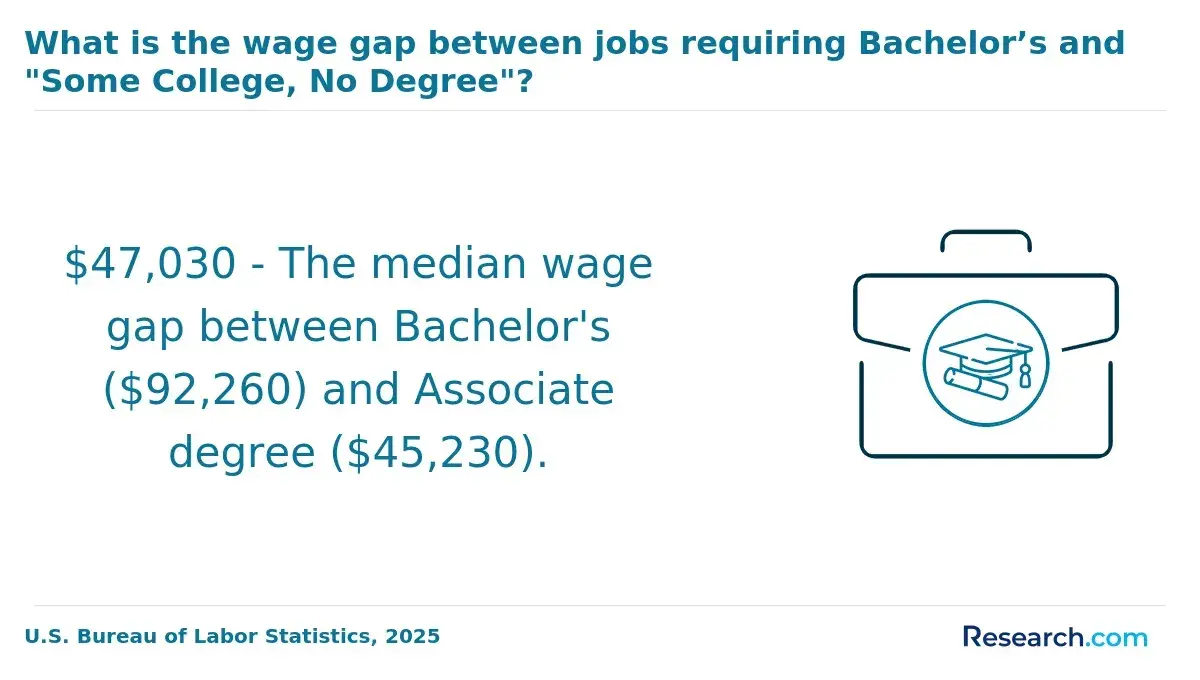
- Career outcomes are broad rather than occupation-specific; BLS May 2024 wage data shows roles often open to bachelor's-prepared generalists range from $65,850 for training and development specialists to $101,280 for general and operations managers.
What is an online bachelor's in general studies with degree completion support?
An online bachelor's in general studies with degree completion support is a flexible undergraduate program designed to help students finish a bachelor's degree by combining prior credits with an interdisciplinary plan of study. Instead of requiring one narrow major, it usually lets students build a degree around several areas such as business, communication, social science, technology, humanities, public service, or leadership.
The phrase degree completion support matters because many students entering these programs are not first-time freshmen. They may have community college credits, credits from several universities, military training, professional learning, or a long gap since enrollment.
A strong completion program does more than offer online classes; it helps students audit old credits, map remaining requirements, avoid unnecessary courses, and stay on track.
The table below shows which students are usually well served by this type of degree and which students may need a more specialized major instead:
| Student profile | Why general studies may fit | When another degree may be better |
| Adult with many prior credits | The program may accept a wide mix of completed coursework and reduce duplicated requirements. | A highly sequenced major may be better if the student needs a specific license or technical credential. |
| Working professional seeking promotion | The degree can document bachelor's-level education while allowing career-relevant electives. | A business, IT, nursing, teaching, or accounting degree may carry clearer alignment for some roles. |
| Military or veteran student | Some schools evaluate Joint Services Transcript credits and ACE-recommended learning. | A program with stronger veteran-specific advising may be preferable if benefits timing is complex. |
| Student with changing career goals | Interdisciplinary coursework can combine communication, leadership, data, and workplace skills. | A student pursuing licensure should first verify state and employer requirements. |
A general studies degree is usually best when the main goal is to complete a credible bachelor's degree efficiently while preserving flexibility. It is less ideal when your target career requires a prescribed major, supervised clinical hours, a state-approved educator pathway, engineering accreditation, or a specific professional exam sequence.
How do online general studies completion programs work for adults with prior credits?
Online general studies completion programs typically begin with a transfer evaluation. The school reviews your transcripts, determines which credits apply to general education, major, elective, and residency requirements, then creates a degree plan showing exactly what remains. For adults with scattered credits, this planning step can be more important than course format.
The process usually follows a sequence like this, and each step can affect your cost and graduation date:
- Request official transcripts from every college previously attended, even if the grades were low or the credits seem old.
- Ask the admissions or transfer office for an unofficial preliminary credit review before committing, especially if you have credits from multiple schools.
- Review how credits are categorized, because a transferred course may count as a free elective rather than satisfy a specific degree requirement.
- Submit military, exam-based, workplace training, or prior learning documentation if the institution evaluates those credits.
- Compare the school's degree audit with your schedule, aid eligibility, employer tuition benefit rules, and preferred graduation timeline.
Adults should pay special attention to residency requirements, which are the minimum credits that must be completed through the degree-granting institution.
A program may accept 90 transfer credits toward a 120-credit bachelor's degree, for example, but still require a set number of upper-division or institution-specific credits before graduation. That rule is normal, but it should be clear before enrollment.
A current trend helping completion students is the wider use of digital degree audits and online advising systems. These tools can make requirements easier to track, but they do not replace human advising. If a program cannot explain how your old credits apply, it may not provide the completion support you need.
Which colleges offer the best online general studies degrees with completion pathways?
The best online general studies degree for you is the one that combines recognized accreditation, generous but transparent transfer policies, relevant concentrations, strong adult-student support, and a realistic total cost.
Because general studies overlaps with interdisciplinary degrees, students comparing flexible completion pathways may also want to review the most affordable online interdisciplinary studies programs as related options.
The following examples are not a universal ranking. They are reputable types of online completion-oriented programs to research because they illustrate the features adults should compare carefully:
| College or university | Relevant online pathway | Completion-friendly feature to examine | Best-fit student |
| Indiana University Online | Bachelor of General Studies | Flexible distribution across arts and humanities, science and math, and social and behavioral sciences. | Students with broad prior credits who want a recognizable public university system. |
| Fort Hays State University | Bachelor of General Studies | Online delivery with concentration-style customization and adult learner appeal. | Cost-conscious students seeking a flexible public university option. |
| University of Louisiana Monroe | Bachelor of General Studies | Interdisciplinary structure that may support students with varied transfer histories. | Students who want a broad liberal arts-based completion degree. |
| University of Missouri | Bachelor of General Studies | Customizable degree planning through a major public research university. | Students who want flexibility but still prefer a flagship public university environment. |
| University of North Texas | Bachelor of Applied Arts and Sciences | Applied completion pathway often suited to technical, workforce, military, or community college credits. | Adults who want to combine prior applied learning with leadership or professional coursework. |
| Arizona State University Online | Online liberal studies or interdisciplinary-style options | Large-scale online infrastructure and multiple flexible bachelor's pathways. | Students who value a broad course catalog and mature online learning systems. |
When reviewing any school, look beyond the program name. "General studies," "liberal studies," "interdisciplinary studies," "applied studies," and "university studies" can serve similar students, but the requirements may differ substantially. The best choice is the one that uses your existing credits efficiently and still supports your career plan.
How can you tell if an online general studies program is properly accredited and reputable?
A properly accredited online general studies program should be offered by an institution recognized by an accreditor approved by the U.S. Department of Education or the Council for Higher Education Accreditation. For most bachelor's degrees, institutional accreditation is the essential baseline because general studies is not usually tied to a separate programmatic accreditor.
Use the following checks before you submit a deposit or financial aid paperwork:
- Confirm the institution's accreditation status in the U.S. Department of Education's Database of Accredited Postsecondary Institutions and Programs or through CHEA's directory.
- Make sure the exact campus, online division, or institutional name matches what appears on the accreditor's record.
- Check whether the school is public, private nonprofit, or private for-profit, but do not assume institution type alone determines quality or return on investment.
- Review graduation requirements, transfer maximums, student complaint history, financial responsibility concerns, and teach-out notices if applicable.
- Ask whether online students receive the same transcript and degree designation as campus students.
The table below summarizes common red flags and how to respond before enrolling:
| Red flag | Why it matters | Better action |
| The school says it is "licensed" but does not clearly name a recognized accreditor. | State authorization and accreditation are not the same thing. | Verify institutional accreditation through an official federal or CHEA-recognized directory. |
| The program promises unusually fast completion without reviewing transcripts. | Completion speed depends on accepted credits and remaining requirements. | Request a written degree audit before relying on a timeline. |
| Admissions pressure focuses only on monthly payments. | Low payments can hide high total costs, fees, or loan borrowing. | Compare total program cost for your remaining credits. |
| The website gives vague career claims. | General studies outcomes vary by experience, location, industry, and specialization. | Ask for career services, alumni examples, and employer-aligned electives. |
Reputation should be evaluated through evidence: accreditation, transparent outcomes, clear transfer policies, responsive advising, and courses that match your goals. Rankings can be useful starting points, but they should not replace your own credit-by-credit and cost-by-cost comparison.
What admission requirements and transfer credit policies apply to general studies completion programs?
Admission requirements for online general studies completion programs are usually designed for transfer students, but they still vary by institution.
Many programs ask for a high school diploma or equivalent, official transcripts from all colleges attended, a minimum transfer GPA, and sometimes a minimum number of completed college credits. Selective universities may have additional GPA, writing, or upper-division entry requirements.
Transfer credit policies are the main decision point. The table below explains the types of credit adults commonly ask schools to evaluate:
| Credit source | How it may be evaluated | What to verify |
| Regionally accredited college coursework | Often evaluated course by course for general education, major, or elective use. | Whether older credits expire or only count as electives. |
| Community college credits | Commonly accepted up to a transfer maximum, especially for lower-division requirements. | How many upper-division credits must still be completed. |
| Military training | May be reviewed through the Joint Services Transcript and ACE recommendations. | Whether credits apply to requirements or only free electives. |
| CLEP, DSST, AP, or IB exams | May satisfy selected general education or elective requirements. | Minimum scores, maximum exam credits, and duplicate-credit rules. |
| Prior learning portfolio | May award credit for documented college-level workplace or professional learning. | Fees, review timelines, credit limits, and whether credits apply to the degree plan. |
Veterans and active-duty students should ask how the school handles military education benefits, deployment interruptions, transfer evaluations, and credit for language or cultural training. If language study is part of your background or career plan, comparing an online Spanish bachelor degree for veterans may also help you decide whether a specialized major is better than general studies.
Before applying, ask admissions and advising staff these practical questions to avoid surprises:
- How many of my credits will apply directly to graduation requirements rather than unused electives?
- What is the maximum number of transfer, military, exam, and prior learning credits allowed?
- How many upper-division credits must I complete through your institution?
- Will changing concentrations after enrollment add credits or delay graduation?
- Can I receive a written degree plan before I enroll in the first term?
What courses and concentrations are typically included in an online general studies curriculum?
An online general studies curriculum usually combines general education, interdisciplinary core courses, upper-division electives, a concentration or focus area, and a capstone. The goal is to create a coherent bachelor's degree rather than a random collection of leftover credits.
The table below shows common curriculum components and how they help students turn flexibility into a usable academic plan:
| Curriculum component | Typical content | Why it matters |
| General education | Writing, quantitative reasoning, science, humanities, social science, and communication. | These requirements often absorb many transfer credits and support broad workplace skills. |
| Interdisciplinary core | Critical thinking, research methods, ethics, leadership, diversity, or problem solving. | The core gives the degree academic coherence across different subject areas. |
| Concentration or emphasis | Business, communication, health services, public administration, social science, technology, or liberal arts. | A focus area helps employers understand how your degree connects to your goals. |
| Upper-division electives | Advanced courses selected with an advisor from approved departments. | These credits often determine whether the degree supports advancement or career change. |
| Capstone | Portfolio, research project, applied project, or integrative seminar. | The capstone can help students translate prior learning and coursework into a professional story. |
Choose electives strategically. A student pursuing office management, for example, might combine organizational communication, human resources, project management, and data literacy. A student aiming for nonprofit work might choose public policy, grant writing, sociology, leadership, and program evaluation.
Common mistakes include picking only interesting electives with no career pattern, ignoring upper-division requirements, and assuming a general studies degree will automatically meet prerequisites for graduate programs. If you may apply to graduate school later, ask whether your planned courses satisfy expected prerequisites in fields such as counseling, social work, education, business, or public administration.
How long does it take to finish an online general studies degree and what does it cost?
The time required to finish an online general studies bachelor's degree depends mostly on how many credits transfer and how many courses you can complete each term. A traditional bachelor's degree is commonly about 120 semester credits, but completion students may enter with a substantial portion already finished.
The table below summarizes typical timeline scenarios. Use it as a planning tool, not as a guarantee, because exact timing depends on transfer acceptance, course availability, aid rules, and personal workload:
| Starting point | Typical remaining credits | Common completion pace | Planning note |
| Associate degree completed | About 45 to 60 credits may remain | Often 18 to 30 months, depending on course load | Confirm whether the associate degree satisfies lower-division general education requirements. |
| Some college, no credential | Varies widely | Often 2 to 4 years part time | A written transfer audit is essential because credits may not apply evenly. |
| High number of scattered credits | May still require upper-division or residency credits | Often 12 to 24 months if requirements align | Watch for maximum transfer limits and required capstones. |
| Few prior credits | Most of the degree remains | Often similar to a standard online bachelor's timeline | A specialized major may be worth comparing if flexibility is not the main need. |
Students seeking a faster route should compare course length, term frequency, credit limits, and transfer acceptance. An accelerated online bachelor's degree may be appealing, but speed only helps if the pace is realistic for your work, family, and financial aid situation.
For cost context, College Board's 2024 Trends in College Pricing reported the following average published tuition and fee figures for 2024-25. These are national benchmarks, not online program quotes, so use them to frame questions rather than to predict your exact bill:
- Public four-year in-state institutions: $11,610.
- Public four-year out-of-state institutions: $30,780.
- Private nonprofit four-year institutions: $43,350.
The smartest cost comparison is total remaining cost to graduate. A school with a higher per-credit rate may be cheaper if it accepts more credits, while a lower-priced school may cost more if it requires you to retake courses or add semesters. Include tuition, mandatory fees, technology fees, books, transcript fees, prior learning assessment fees, graduation fees, and any travel required for exams or orientation.
What student success and degree completion supports do online general studies programs provide?
Degree completion support is the difference between "online access" and a real pathway to graduation. Adults often need faster answers, clearer scheduling, and better credit planning than traditional first-time students because they are balancing employment, caregiving, military obligations, or returning after years away.
Look for the following supports, and ask whether they are available to fully online students, not just campus students:
- Dedicated transfer or completion advisor who can explain exactly how prior credits apply.
- Degree audit tools that show remaining requirements, upper-division credits, residency credits, and graduation progress.
- Flexible scheduling with multiple start dates, asynchronous courses, evening support, or shorter terms when appropriate.
- Career services that help translate a broad degree into resumes, interview examples, portfolios, and promotion conversations.
- Academic tutoring, writing support, library access, disability services, and technology help available remotely.
- Financial aid counseling that explains satisfactory academic progress, lifetime aid limits, employer reimbursement, and part-time enrollment effects.
A useful test is to contact the program before applying and ask a specific transfer or scheduling question. If the answer is vague, slow, or purely sales-focused, that may signal weak support after enrollment. Strong programs can explain requirements in plain language and connect you with the right office quickly.
Technology is also changing completion support. Many online programs use alerts, learning analytics, and automated reminders to identify students who may be falling behind. These tools can help, but they work best when paired with responsive advisors and instructors who can help students solve real barriers, such as course sequencing, workload, or financial aid timing.
What careers can you pursue with an online general studies bachelor's and what do they pay?
An online general studies bachelor's can support careers that value bachelor's-level communication, leadership, analysis, and problem-solving skills. It is not a direct licensure degree, so outcomes depend heavily on your work experience, concentration, internships, industry, location, and how clearly you present your skills.
The table below uses BLS May 2024 median annual wage data for selected occupations that may align with a general studies graduate's experience and electives. These figures describe occupations, not guaranteed earnings for degree holders:
| Career path | Typical responsibilities | BLS May 2024 median annual wage | How general studies can support preparation |
| General and operations manager | Coordinate staff, budgets, procedures, vendors, and operational goals. | $101,280 | Leadership, communication, business, data, and prior workplace experience can be combined into a management pathway. |
| Project management specialist | Plan schedules, manage resources, track deliverables, and communicate with stakeholders. | $100,750 | Electives in project management, organizational communication, and analytics can strengthen fit. |
| Human resources specialist | Support recruiting, employee relations, onboarding, compliance, and benefits processes. | $72,910 | Coursework in psychology, business, communication, and ethics can align with HR entry or advancement roles. |
| Market research analyst or marketing specialist | Study customers, competitors, campaigns, and market data to support decisions. | $76,950 | Statistics, writing, consumer behavior, communication, and digital marketing electives can be useful. |
| Training and development specialist | Create learning materials, facilitate training, and evaluate employee development needs. | $65,850 | Adult learning, communication, leadership, and technology coursework can support workplace training roles. |
| Social and community service manager | Manage programs, staff, budgets, outreach, and community service delivery. | $78,240 | Public administration, sociology, nonprofit management, and grant writing can create a relevant focus. |
AI and automation are changing what employers expect from generalist roles. Routine reporting, scheduling, and first-draft writing can increasingly be supported by software, so students should build skills that are harder to automate: judgment, ethical decision-making, stakeholder communication, data interpretation, and cross-functional coordination.
To improve career value, do not rely on the degree title alone. Pair the program with a focused concentration, a portfolio, internships or applied projects, industry software skills, and a resume that connects coursework to measurable work achievements.
How should working adults compare online general studies programs to choose the best fit?
Working adults should compare online general studies programs through the lens of completion efficiency, credibility, support, and career alignment. The cheapest option is not always the best value, and the fastest option is not always sustainable.
If your goal is specifically business advancement, comparing a general studies pathway with the cheapest online business degree can clarify whether flexibility or major-specific training matters more.
The table below gives a decision framework for comparing programs without relying only on rankings or advertising claims:
| Comparison factor | What to look for | Why it affects the decision |
| Transfer efficiency | Written degree audit showing credits applied to requirements. | This often has the largest impact on time and total cost. |
| Accreditation and reputation | Recognized institutional accreditation and transparent student policies. | Employers, graduate schools, and financial aid systems depend on legitimate accreditation. |
| Concentration options | Relevant focus areas such as business, communication, public service, technology, or leadership. | A coherent focus makes a broad degree easier to explain professionally. |
| Online format | Asynchronous access, term length, course availability, and instructor interaction. | The best format depends on your work schedule and learning style. |
| Support services | Transfer advising, tutoring, career services, writing support, and financial aid counseling. | Support reduces the risk of stopping out again. |
| Total cost | Remaining tuition, fees, books, prior learning assessment costs, and aid eligibility. | Total cost to graduation is more useful than per-credit price alone. |
Use this practical sequence when building your shortlist:
- Define your primary goal; promotion, career change, graduate school preparation, personal completion, or employer requirement.
- Gather every transcript and estimate how many credits you may transfer, but wait for official evaluation before making financial commitments.
- Compare at least three accredited programs using total remaining credits, total estimated cost, concentration fit, and support quality.
- Ask each school for a written plan showing required courses, likely graduation term, and any credits that will not apply.
- Check whether the degree title and concentration make sense to employers or graduate programs in your target field.
- Choose the program that offers the best combination of credit acceptance, academic coherence, affordability, and adult-student support.
Consider a different option if you need a licensed profession, a highly technical curriculum, a specific graduate prerequisite sequence, or a major that employers in your field strongly prefer. General studies is strongest when flexibility helps you finish; it is weaker when flexibility replaces necessary specialization.
Other Things You Should Know About General Studies
Yes. Most online bachelor’s in general studies degree-completion programs require 120 total semester credits, with about 30 credits earned at the upper-division level. Schools usually accept previously completed transfer credits toward the remaining balance, but students must still meet the institution’s residency and major-credit rules.
Yes, in some fields, but admission depends on the graduate program's prerequisites, GPA requirements, test policies, and experience expectations. Choose electives carefully if graduate school is a possibility.
A bachelor's in general studies often focuses on a flexible curriculum that allows students to explore various subjects without committing to a specific field. In contrast, interdisciplinary studies emphasize integrating knowledge across multiple disciplines, fostering a comprehensive understanding by combining methods and insights from different academic areas.
Often yes, if the school and program meet the employer's policy. Confirm eligible institutions, grade requirements, annual reimbursement limits, and whether the degree must relate directly to your job.
References
- Can You Transfer Credits From a Completed Degree? https://www.edvisorly.com/student-guides/can-you-transfer-credits-from-a-completed-degree
- Best Online Colleges for Working Adults [2026] https://www.straighterline.com/blog/degree-completion-best-online-colleges-for-working-adults
- Online Student Trends and Success Factors - OnlineEducation.com https://www.onlineeducation.com/guide/who-studies-online
- Degree Completion Programs | Neumann University https://www.neumann.edu/academics/degree-completion-programs
- Which program type is best for your adult degree completers? https://eab.com/resources/blog/adult-education-blog/program-adult-degree/
- Are Online Degrees Accredited? How to Identify Quality Distance Learning Programs https://www.umassglobal.edu/blog-news/online-degrees-accredited-identify-quality-distance-learning-programs
- Online Bachelor's Degree: General Studies https://www.umgc.edu/online-degrees/bachelors/general-studies
- Finish the degree you started (without starting over) https://news.newmanu.edu/finish-the-degree-you-started-without-starting-over/
- How long does it take to get a bachelor's degree? | edX https://www.edx.org/resources/how-long-does-it-take-to-get-a-bachelors-degree
- Online Degree vs. Traditional: Choosing the Right Path https://beal.edu/online-degree-vs-traditional/