2027 Best Online Associate Degrees in General Studies for Adults Over 30

Co-Founder and Chief Data Scientist
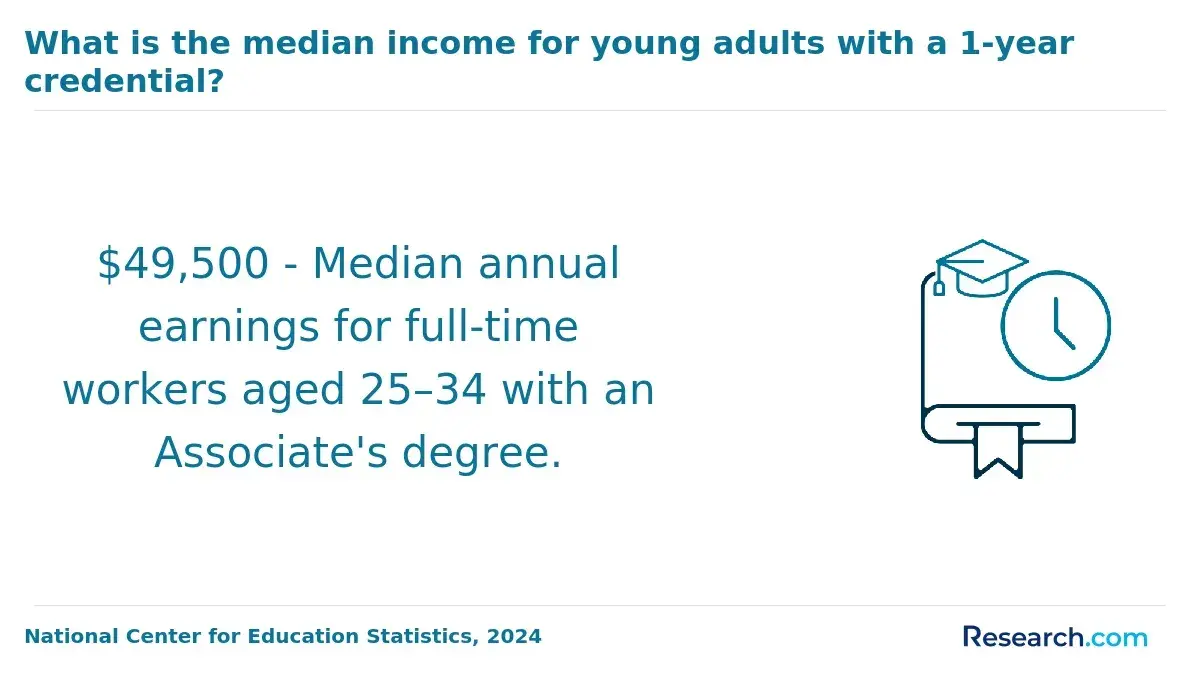
Returning to college after 30 often comes down to one question: which degree helps you move forward without disrupting work and family life? An online associate degree in general studies can be a flexible starting point for adults who need transferable credits, a completed credential, or a bridge to a bachelor's degree. BLS 2024 data shows associate degree holders had median weekly earnings of $1,099, compared with $930 for workers with only a high school diploma. This guide explains costs, timelines, transfer strategy, and career limits so you can choose wisely.
Key Things You Should Know
- The best online general studies associate programs for adults over 30 are accredited, transfer-friendly, flexible, and affordable; College Board data lists average 2024-25 published in-district tuition and fees at public two-year colleges at $4,050.
- A general studies associate degree is usually best for adults who want broad transfer credit, degree completion, or entry-level advancement, but it is not the strongest choice for careers that require a specific license or technical credential.
- Adults can often shorten completion time through transfer credits, CLEP or DSST exams, military credit, prior learning assessment, and accelerated online terms, but policies vary widely by school.
What is an online associate degree in general studies and how does it work for adults?
An online associate degree in general studies is a two-year undergraduate credential built around broad college-level learning rather than one narrowly defined major. It usually includes general education courses in writing, math, science, social science, humanities, and electives that can be shaped around transfer or career goals.
For adults over 30, the main value is flexibility. Many programs are asynchronous, meaning you can complete weekly assignments around shifts, caregiving, military service, or other responsibilities. Some colleges also offer short terms, rolling start dates, and part-time enrollment so students do not have to choose between school and income.
The degree may be called an Associate of Arts in General Studies, Associate of Science in General Studies, Associate of General Studies, or Associate of Applied Science in General Studies. The name matters because it can affect transfer options. An AA or AS is often designed for bachelor's transfer, while an AAS may be more workforce-oriented.
The table below shows how common associate degree formats differ. This comparison matters because adults should choose the structure that matches their next step, not just the one with the most flexible schedule.
| Degree type | Best fit | Typical strength | Possible limitation |
| Associate of Arts in General Studies | Students planning to transfer into humanities, social science, business, or education-related bachelor's programs | Usually transfer-friendly | May include fewer technical or job-specific courses |
| Associate of Science in General Studies | Students planning to transfer into science, health, technology, or quantitative fields | Can support math and science prerequisites | Course sequencing may be more demanding |
| Associate of General Studies | Adults with mixed prior credits who want to finish a degree efficiently | Often flexible with electives and transfer credit | Transfer acceptance depends heavily on the receiving college |
| Associate of Applied Science in General Studies | Students seeking workplace skills or internal promotion | May include practical or career-related electives | Some credits may not transfer cleanly into a bachelor's program |
The degree works best when you treat it as a planning tool. Before enrolling, identify whether your priority is finishing a credential, transferring to a bachelor's program, qualifying for a promotion, or exploring a new academic direction.
Are online general studies associate degrees a good choice for adults over 30 returning to school?
Online general studies associate degrees can be a good choice for adults over 30 returning to school, especially when the student has unfinished credits or needs a broad, low-risk way to re-enter college. The degree can help you regain academic momentum, meet general education requirements, and build a foundation for a bachelor's degree.
It is not automatically the best choice for every adult. If your target career requires a specific credential, such as nursing, paralegal studies, accounting, cybersecurity, or radiologic technology, a specialized associate degree or certificate may deliver a clearer path. General studies is strongest when your next step is still flexible or when you need a transfer-oriented credential.
Use the following decision points to judge fit. They are especially important for adults who cannot afford to lose time, credits, or financial aid eligibility.
- Choose general studies if you have credits from multiple schools and want the fastest accredited path to completing an associate degree.
- Choose general studies if you plan to transfer and need to complete lower-division general education requirements before selecting a bachelor's major.
- Choose a specialized associate degree if your intended job requires specific lab, clinical, technical, or licensure-related coursework.
- Choose a certificate instead if you need a short, job-specific skill in areas such as bookkeeping, project coordination, medical coding, or IT support.
- Avoid enrolling until you confirm how your credits will transfer into the next program you want.
A useful way to think about return on investment is this: general studies may increase your academic options, but it does not create a direct occupational identity in the same way that nursing, dental hygiene, or computer networking does. Adults should pair the degree with a transfer plan, work experience, career-focused electives, or an employer-recognized skill.
How do online and on-campus general studies associate programs compare for busy adult learners?
For busy adult learners, the online versus on-campus decision is usually about control. Online programs reduce commuting time and can make part-time study easier, while on-campus programs may offer more face-to-face support, structured routines, and access to local networking.
Students comparing online degree programs should look beyond convenience and ask how the format affects learning, transfer, support, and persistence. The table below summarizes the practical trade-offs adults over 30 should weigh before choosing a delivery format.
| Factor | Online general studies associate | On-campus general studies associate | Best choice when |
| Schedule | Often asynchronous or evening-friendly | Class times may be fixed | Online works better for shift workers, parents, caregivers, and frequent travelers |
| Cost | May reduce commuting, parking, and relocation costs | May include transportation and campus fees | Online is often stronger when total attendance cost matters more than campus access |
| Support | Depends on virtual advising, tutoring, and response time | Face-to-face advising and tutoring may be easier to access | Campus may help students who need in-person structure |
| Peer connection | Usually through discussion boards, group projects, or virtual meetings | More informal interaction before and after class | Campus may suit students who value direct community |
| Technology demands | Requires reliable internet, computer access, and self-management | May still use online portals, but less heavily | Online is better for students comfortable learning independently |
Online learning has also become more normalized among colleges and employers, but quality still varies. A strong online program should offer clear weekly deadlines, accessible faculty, library resources, tutoring, disability services, career services, and transfer advising in a format remote students can actually use.
The most common mistake is choosing online only because it sounds easier. Online courses can be flexible, but they are not necessarily lighter. Adults should plan weekly study blocks, confirm technology requirements, and ask whether exams require proctoring before the term begins.
What admission requirements do online general studies associate programs have for adult students?
Admission requirements for online general studies associate programs are usually accessible, especially at community colleges and open-admission public institutions. Most programs require a high school diploma, GED, or equivalent, plus an application and official transcripts from prior schools.
Adults over 30 should pay close attention to transcript and placement policies. A program may admit you quickly, but your prior credits, math placement, and writing placement can determine how long the degree takes and how much it costs.
Common admission and enrollment requirements include the following. These items are not difficult for most adult applicants, but missing one can delay registration or financial aid processing.
- Completed online application and identity verification.
- High school transcript, GED record, or homeschool documentation accepted by the college.
- Official college transcripts from every institution previously attended, even if the credits are old or incomplete.
- Placement review using prior coursework, GPA, standardized test scores, or college placement assessments.
- Proof of state residency if applying for in-district or in-state tuition.
- FAFSA submission if the student wants federal grants, loans, or work-study consideration.
- Technology access, including a computer, reliable internet, webcam, and learning management system login.
Some adults worry that poor grades from years ago will prevent admission. At many associate-level programs, old academic history is more likely to affect placement, satisfactory academic progress, or credit transfer than basic admission. If you previously used federal aid and stopped attending, ask the financial aid office whether you are still in good standing before you enroll.
A practical step is to request an unofficial credit review before committing. This can show whether the school will accept prior coursework and whether you are close enough to completion to justify choosing general studies over a more specialized program.
How long does it take to earn an online associate degree in general studies and can you accelerate it?
Most online associate degrees in general studies require about 60 semester credits. A full-time student can often finish in about two academic years, while a part-time adult learner may need three or more years depending on course load, transfer credits, work schedule, and family responsibilities.
Acceleration is possible, but it should be planned carefully. Finishing faster is valuable only if the credits count toward your goal and the workload is realistic. Adults who overload courses while working full time may save calendar time but risk lower grades, withdrawal, or burnout.
Several options can shorten the timeline. Ask each school which options it accepts, how credits appear on the transcript, and whether they apply to degree requirements or only to electives.
- Transfer credit from prior colleges, including credits earned many years ago.
- Credit for military training evaluated through recognized credit recommendation systems.
- Prior learning assessment based on documented workplace training, professional certifications, or portfolios.
- CLEP, DSST, or other approved credit-by-exam options for subjects you already know.
- Accelerated 7-week or 8-week terms that allow motivated students to complete more courses across the year.
- Summer enrollment, if the added workload does not interfere with job or family responsibilities.
The table below gives a realistic view of timelines. It is meant to help adults choose a pace that is sustainable rather than simply the fastest advertised option.
| Enrollment pace | Typical course load | Possible completion time | Best fit |
| Full time | 12 to 15 credits per term | About 2 years without transfer credit | Adults with stable schedules, strong support, and enough study time |
| Part time | 6 to 9 credits per term | About 3 to 4 years without transfer credit | Working adults, parents, caregivers, and students returning after a long break |
| Accelerated with transfer credit | Varies by accepted credits and term length | Sometimes less than 2 years | Adults with prior college credit or eligible credit for prior learning |
| One course at a time | 3 credits per term or session | Longest path | Students rebuilding confidence or managing heavy life obligations |
A good rule is to start with a manageable first term. If you have been out of school for years, one or two courses can help you adjust to online learning, writing expectations, and deadlines before increasing your load.
What courses and concentrations are typically included in an online general studies associate program?
An online general studies associate program typically combines required general education courses with electives. The flexibility is useful, but it also means students must choose courses strategically. Random electives may help you reach 60 credits, but they may not help you transfer, qualify for a job, or prepare for a bachelor's major.
Most programs include coursework in the areas below. The exact course names vary by college, but these categories are common across accredited associate programs.
- College composition and research writing.
- Public speaking or communication.
- College algebra, statistics, quantitative reasoning, or another approved math course.
- Biological or physical science, sometimes with a lab depending on the program.
- Social science such as psychology, sociology, political science, or economics.
- Humanities such as literature, history, philosophy, art, or ethics.
- Computer literacy, information technology, or digital productivity.
- Electives aligned with business, health, education, criminal justice, technology, or liberal arts transfer goals.
Concentrations are not always required, but some schools let students organize electives around an interest area. Adults should choose a concentration based on the bachelor's program or job family they may pursue next, not just on which courses look easy.
| Possible focus area | Useful for | Smart elective examples | Caution |
| Business and supervision | Office administration, retail leadership, small business, operations support | Accounting, management, business communication, spreadsheets | May not replace a business administration degree for some roles |
| Health and human services | Healthcare administration, community services, future health-related transfer | Psychology, biology, medical terminology, ethics | Does not qualify students for clinical licensure by itself |
| Education and child development | Paraeducator roles, childcare leadership, future teacher preparation | Child development, education foundations, communication | Teacher licensure requires additional state-approved education |
| Technology and digital skills | Administrative technology, help desk interest, data support, office systems | Computer applications, databases, cybersecurity basics, statistics | Technical jobs may require stronger specialized training or certifications |
| Liberal arts transfer | Bachelor's completion in humanities, social science, communication, or interdisciplinary studies | History, literature, sociology, political science | Transfer planning is essential to avoid excess credits |
If your long-term interest is healthcare or nutrition, a general studies associate can cover early prerequisites, but you should compare the next-step requirements for an online dietitian degree before choosing science electives. Dietetics and many health fields have specific accreditation, lab, and supervised practice requirements that a general studies plan may not automatically satisfy.
How much do online associate degrees in general studies cost and what financial aid can adults get?
Cost varies widely by school type, residency status, course load, transfer credit, books, fees, and technology needs. For many adults, the lowest tuition is not always the lowest total cost. A program that accepts more prior credit, offers predictable course rotations, and supports transfer can be cheaper in the long run than a program with a lower advertised per-credit price.
National cost benchmarks can help you evaluate whether a program is priced reasonably. College Board's 2024 pricing data and federal aid rules provide useful reference points for associate-level students.
- Average published in-district tuition and fees at public two-year colleges: $4,050 for 2024-25.
- Maximum Federal Pell Grant: $7,395 for the 2024-25 award year.
- Federal Direct Loan annual limit for first-year dependent undergraduates: $5,500, with higher limits for many independent adults.
- Federal Direct Loan annual limit for first-year independent undergraduates: $9,500.
These figures do not mean your program will cost exactly that amount. Online students may pay distance learning fees, proctoring fees, digital textbook charges, graduation fees, or out-of-state tuition. On the other hand, adults may lower net cost through grants, employer tuition assistance, transfer credits, military benefits, or state promise programs.
The table below separates visible costs from costs adults often overlook. Use it when comparing financial aid award letters and school websites.
| Cost category | What to check | Why it matters |
| Tuition | Per-credit rate, residency rules, online rate, flat-rate tuition | Tuition is the largest cost driver, but the advertised rate may not include all charges |
| Mandatory fees | Technology, online course, student service, proctoring, graduation, and transcript fees | Fees can change the true cost per course |
| Books and materials | Open educational resources, digital access codes, lab kits, software | Some low-tuition programs still require expensive materials |
| Transfer credit | Maximum accepted credits and how they apply to requirements | Accepted credits can reduce both time and tuition |
| Schedule reliability | How often required courses are offered online | Delayed courses can extend enrollment and increase indirect costs |
| Financial aid eligibility | Accreditation, degree status, satisfactory academic progress rules | Not all short courses or nondegree options qualify for federal aid |
Adults should complete the FAFSA even if they assume they will not qualify for aid. Eligibility depends on multiple factors, and many adult learners qualify for some combination of federal grants, state grants, loans, work-study, employer support, or military education benefits.
One common mistake is borrowing the full amount offered without calculating need. Before accepting loans, estimate your tuition after grants, then add required materials and fees. Borrowing less can reduce repayment pressure if your degree is mainly a transfer step rather than an immediate salary-changing credential.
How can adults over 30 choose an accredited, reputable online general studies associate program?
The best online associate degree in general studies for an adult over 30 is not necessarily the highest-ranked or most advertised program. It is the program that is accredited, affordable, flexible, well-supported, and aligned with your transfer or career goal.
Accreditation should be the first filter. Look for institutional accreditation from an agency recognized by the U.S. Department of Education or the Council for Higher Education Accreditation. Accreditation affects federal financial aid, transfer credit, employer recognition, and graduate eligibility for later programs.
Use the following steps before enrolling. This sequence helps adults avoid the most expensive mistakes: lost credits, poor transfer fit, weak support, and unexpected costs.
- Confirm institutional accreditation using the school's website and an official accreditation database.
- Ask for a written transfer credit evaluation before committing, especially if you attended college previously.
- Compare total cost, not just tuition, including fees, books, proctoring, technology, and graduation charges.
- Request a sample degree plan showing exactly which courses you would take and when they are offered online.
- Ask whether the program has articulation agreements with public universities or specific bachelor's completion partners.
- Check whether advising, tutoring, library help, disability services, and career services are available remotely.
- Review withdrawal, refund, satisfactory academic progress, and repeat-course policies before the first day of class.
- Match electives to a bachelor's major, promotion path, or skill goal instead of using them randomly.
The table below highlights red flags and better alternatives. It is designed to help adults evaluate programs quickly during admissions conversations.
| Red flag | Why it is risky | Better sign |
| The school will not clearly state its accreditation status | Credits, aid, and employer recognition may be affected | Accreditation is easy to verify through official sources |
| Admissions promises that all prior credits will count before review | Transfer rules depend on course content, grades, age, and degree requirements | The school provides a written evaluation showing accepted credits |
| The program advertises speed but not course availability | Required courses may not run every term | The advisor provides a realistic term-by-term plan |
| Tuition is shown without fees | The true cost may be higher than expected | The school provides a full cost of attendance estimate |
| No transfer pathway is identified | Students may graduate with credits that do not apply well to a bachelor's degree | The program has clear articulation or transfer advising |
Adults should also be cautious with programs that pressure quick enrollment decisions. A reputable school should give you time to review costs, transfer policies, financial aid, and academic fit before you sign up for classes.
What careers, salaries, and job outlook can follow an online associate degree in general studies?
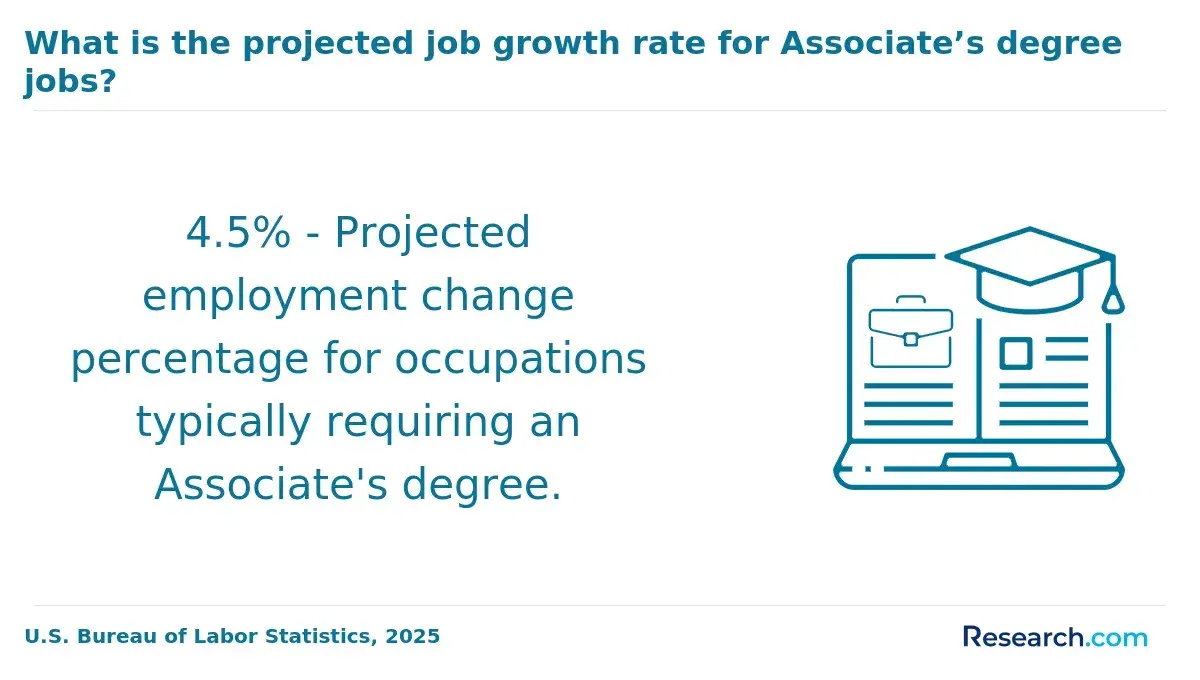
An online associate degree in general studies can support career mobility, but it should not be treated as a direct pipeline to one occupation. Because the major is broad, outcomes depend heavily on your work history, electives, technical skills, location, employer, and whether you continue into a bachelor's program.
BLS 2024 education data shows associate degree holders had median weekly earnings of $1,099, while workers with only a high school diploma had median weekly earnings of $930. This gap suggests that an associate degree can improve labor market positioning, but it does not guarantee a specific salary or job title.
Common career directions after a general studies associate degree include administrative support, customer service leadership, sales support, office coordination, human services support, education support, and operations assistance. Adults who already have work experience may benefit more than first-time job seekers because the degree can combine with existing industry knowledge.
The table below shows how the degree may connect to job families. It does not promise eligibility; employers set their own requirements, and some roles require specialized credentials.
| Career direction | Typical responsibilities | Helpful add-ons | Best fit for |
| Administrative or office coordination | Scheduling, records, communication, customer contact, workflow support | Spreadsheet skills, business writing, project coordination | Adults with office, service, military, or operations experience |
| Customer service or team lead roles | Resolving customer issues, training staff, tracking service metrics | Communication, conflict resolution, CRM software | Workers seeking advancement from frontline roles |
| Human services support | Client intake, referrals, documentation, community resource coordination | Psychology, sociology, case management basics | Students interested in helping professions without immediate licensure |
| Education support | Classroom assistance, student services support, program coordination | Child development, education foundations, communication | Adults considering later teacher preparation or school support roles |
| Operations or business support | Inventory coordination, process tracking, vendor communication, reporting | Accounting basics, data tools, supervision courses | Workers with experience in retail, logistics, hospitality, or manufacturing |
Current workplace trends make skills selection important. AI and automation are reducing some routine clerical tasks, while increasing the value of communication, judgment, customer support, data literacy, and adaptability. Adults should use electives to build durable skills rather than only completing the easiest available courses.
If your career goal is more specialized, general studies may be a starting point rather than the final credential. For example, adults interested in recreation, athletics administration, or fitness business roles may want to compare transfer paths into online sports degrees before choosing electives.
The smartest career strategy is to pair the associate degree with proof of specific skills. That could mean a software certificate, bookkeeping coursework, a project management microcredential, bilingual ability, supervisory experience, or a bachelor's transfer plan.
How does an online associate in general studies prepare you for bachelor's completion and transfer?
An online associate in general studies can be an efficient bridge to a bachelor's degree if it is planned around transfer requirements from the beginning. Many adults use it to complete lower-division general education courses, raise academic confidence, and reduce the cost of the first half of a bachelor's program.
Transfer success depends on course fit, not just credit quantity. A student may earn 60 credits and still lose time if the courses do not match the receiving university's general education pattern, major prerequisites, or grade requirements.
Before choosing courses, adults should take these transfer-focused steps. They can prevent excess credits and help you protect financial aid eligibility for future study.
- Identify two or three likely bachelor's programs before your first associate-level term.
- Ask whether the associate degree satisfies a transfer block or general education package at the receiving university.
- Confirm which math, science, writing, and prerequisite courses are required for the intended bachelor's major.
- Use electives to complete prerequisites instead of filling them with unrelated courses.
- Keep syllabi for courses that may need review during transfer evaluation.
- Maintain the GPA required for admission into the bachelor's program or major, not just the GPA needed to graduate.
- Review whether online, lab, or accelerated courses are accepted by the receiving institution.
The table below compares transfer outcomes based on planning quality. It shows why adults should involve both the associate-degree advisor and the bachelor's-transfer advisor early.
| Transfer approach | Likely result | Risk level |
| Associate degree chosen under a formal articulation agreement | Credits are more likely to apply cleanly to the bachelor's program | Lower |
| General studies degree planned with a specific bachelor's major in mind | Many credits may apply well if prerequisites are selected carefully | Moderate |
| Degree completed with random electives and no transfer target | Some credits may transfer only as electives or not apply to the major | Higher |
| AAS-style general studies degree used for bachelor's transfer | Transfer may work in some applied bachelor's programs but can be limited elsewhere | Varies widely |
Transfer planning is especially important for fields with licensure or graduate education requirements. If you are considering psychology, social work, or counseling pathways, remember that counseling careers often require a bachelor's degree, a graduate degree, supervised experience, and state licensure. Comparing future online counseling degrees early can help you choose associate-level psychology, statistics, and human services electives more strategically.
A general studies associate degree can be a strong first half of a bachelor's journey, but only when it is mapped backward from the destination. Adults should ask every school this simple question: "If I finish this exact degree plan, how many credits will apply to the bachelor's program I want?"
Other Things You Should Know About General Studies
Yes. Most online associate programs require a reliable broadband connection, a computer with a current browser, webcam, microphone, and enough storage for file uploads. Many schools also require Microsoft 365 or Google Workspace access and a minimum upload speed of 5 Mbps for video classes.
You usually need a reliable computer, high-speed internet, webcam, microphone, word processing software, and access to the school's learning platform. Some courses may require proctoring software, spreadsheet tools, lab kits, or specific browsers.
Many programs allow students to pause and return, but financial aid, catalog requirements, and course availability can change. Before stopping, speak with advising and financial aid so you understand withdrawal deadlines, satisfactory academic progress rules, and re-enrollment procedures.
References
- Which program type is best for your adult degree completers? https://eab.com/resources/blog/adult-education-blog/program-adult-degree/
- What Are the Benefits of Online Education for Adult Learners? https://www.straighterline.com/blog/self-paced-what-are-the-benefits-of-online-education-for-adult-learners
- Montreat College | Associate Degree in North Carolina https://www.montreat.edu/online/associate-general-studies/
- How Much Does an Associate Degree Cost? | SoFi https://www.sofi.com/learn/content/associates-degree-cost/
- Best Affordable Online Associate Degrees Of 2025 https://www.affordablecollegesonline.org/degrees/associates-programs/
- Online vs. Traditional Education: Which One Is Right For You? https://online.champlain.edu/blog/online-vs-traditional-education-which-one-is-right-for-you
- Online Associate Degree Benefits Students Ready to Advance https://www.tuw.edu/school-news/online-associate-degree-benefits/
- 2025 Most Affordable Online Associate Degrees https://www.onlineu.com/most-affordable-colleges/associate-degrees
- New to College & Online Learning? Start with Your Associate Degree - Oklahoma Wesleyan University https://www.okwu.edu/news/2022/01/gps-associate/