
2027 Best Online Master's in Clinical Counseling and Applied Psychology Programs

Co-Founder and Chief Data Scientist
Deciding to become a professional counselor often comes from a deep desire for a more meaningful career. That instinct is spot on, especially when you consider that over 122 million Americans live in areas with a shortage of mental health providers. The need is critical, but the path to getting licensed can feel complex and overwhelming.
This is where a clear plan makes all the difference. The career planning experts who created this guide have more than 10 years of experience helping people navigate this exact process. We have laid out a direct, data-backed roadmap for earning an online master's in clinical counseling and launching a secure, purposeful career.
What are the benefits of getting an online master’s in clinical counseling and applied psychology program?
- It provides the most direct pathway to state licensure, qualifying you for secure, high-demand careers as a Licensed Professional Counselor or Substance Abuse Counselor.
- You can expect strong earning potential, with an average salary of around $73,456 per year and the capacity to earn over $110,000 with experience.
- The online format offers the flexibility to balance a rigorous, accredited education with your existing work and family commitments.
What can I expect from an online master’s in clinical counseling and applied psychology program?
You should expect a rigorous and demanding academic experience that is equivalent to any on-campus program. The online format is about flexible delivery, not reduced standards.
The curriculum is designed to build science-backed clinical skills. Your courses will cover core competencies in diagnosis, treatment planning, and professional ethics. A quality online master's in clinical counseling requires significant study time and self-discipline.
A critical component of your education is the supervised clinical practicum or internship. This is where you apply your knowledge in a real-world setting, accumulating hundreds of hours of direct client contact. This hands-on experience is mandatory for licensure and serves as the bridge from your academic learning to your professional career.
Where can I work with an online master’s in clinical counseling and applied psychology program?
Graduates work in a variety of clinical settings, primarily within the healthcare sector. The skills you gain are in demand across several key industries.
Here is a breakdown of where clinical counselors are most often employed.
- Health Care: This is the largest employment sector, with 41% of counselors working in settings like hospitals, outpatient centers, and physicians' offices.
- Non-Profits: Community agencies and other non-profit organizations employ 15% of counselors to provide vital individual and family services.
- Government: About 10% of counselors work for federal, state, and local government agencies in public health and social service roles.
- Professional Services: Another 10% of counselors are employed in professional service settings, which includes group and private practices.
- Education: Educational institutions employ 9% of counselors, providing essential mental health support in schools and universities.
How much can I make with an online master’s in clinical counseling and applied psychology program?
While the average salary is around $73,456, your earning potential depends on several key factors. Understanding them is the first step in mapping out your financial future.
Here is what influences a counselor's salary.
- Experience Level: Entry-level positions typically range from $50,000 to $70,000, while experienced, licensed clinicians can earn over $110,000.
- Industry: Your work setting has a major impact, as roles in government or specialty hospitals often pay more than non-profit agency jobs.
- Geographic Location: Salaries vary by location to reflect the local cost of living, with higher compensation in major metropolitan areas.
- Licensure Status: Fully licensed counselors who can practice independently command higher salaries and reimbursement rates than pre-licensed professionals.
- Specialization: Developing expertise in a high-demand area like addiction or trauma counseling can lead to higher-paying opportunities.
- List of the Best Online Master’s in Clinical Counseling and Applied Psychology Programs for 2027 L
- How long does it take to complete an online master’s in clinical counseling and applied psychology program? Completion Time
- How does an online master’s in clinical counseling and applied psychology program compare to an on-campus program? How does an online master’s in clinical counseling and applied psychology program compare to an on-campus program?
- What is the average cost of an online master’s in clinical counseling and applied psychology program? Program Cost
- What are the financial aid options for students enrolling in an online master’s in clinical counseling and applied psychology program? Financial Aid
- What are the prerequisites for enrolling in an online master’s in clinical counseling and applied psychology program? What are the prerequisites for enrolling in an online master’s in clinical counseling and applied psychology program?
- What courses are typically in an online master’s in clinical counseling and applied psychology program? What courses are typically in an online master’s in clinical counseling and applied psychology program?
- What types of specializations are available in online master’s in clinical counseling and applied psychology programs? Specializations
- How to Choose the Best Online Master’s in Clinical Counseling and Applied Psychology Program How to Choose the Best Online Master’s in Clinical Counseling and Applied Psychology Program
- What career paths are available for graduates of an online master’s in clinical counseling and applied psychology program? Career Paths
- What is the job market for graduates of an online master’s in clinical counseling and applied psychology program? Job Market
- What Professional Networking and Career Support Resources Are Available? What Professional Networking and Career Support Resources Are Available?
Best Online Master’s in Clinical Counseling and Applied Psychology Programs for 2027
Choosing an online master’s in clinical counseling or applied psychology is not just a school decision. It is a licensure, cost, schedule, and career decision. The right program can prepare you for supervised clinical practice and eventual counseling licensure; the wrong one may leave you with credits that do not meet your state’s requirements, limited field placement support, or a higher debt burden than expected.
This guide is designed for prospective graduate students comparing online counseling, clinical psychology, and applied psychology programs. It explains how long these degrees take, what they cost, how online study compares with campus learning, what admissions committees usually expect, which specializations are common, and how to evaluate whether a program fits your licensure goals.
You will also find a ranked list of online master’s programs, practical selection criteria, career options, job market context, and common mistakes to avoid before enrolling.
Quick Answer: Is an Online Master’s in Clinical Counseling and Applied Psychology Worth It?
An online master’s in clinical counseling and applied psychology can be worth it if your goal is to become a licensed counselor, marriage and family therapist, substance abuse counselor, or mental health program professional. Most programs take two to three years of full-time study, require supervised clinical training, and are designed around state licensure requirements.
The best choice is usually an accredited program that matches your state’s licensure rules, offers strong practicum and internship support, fits your schedule, and has a total cost you can manage. Online delivery can be a strong option for working adults, but students should verify residency requirements, clinical placement expectations, and whether the curriculum meets licensing standards where they plan to practice.
How Research.com Ranks Schools
Because graduate school can be a major financial and professional commitment, our ranking process prioritizes transparency, program quality, affordability signals, and student decision factors. Research.com evaluates programs using data from trusted education sources, including the IPEDS database, Peterson's database, the College Scorecard database, and The National Center for Education Statistics.
These sources help provide comparable information on institutions and programs. To learn more about how Research.com evaluates schools, review the full Research.com methodology.
At-a-Glance Comparison of Featured Programs
| Rank | School and Program | Format or Structure | Credits | Published Cost | Accreditation Listed |
| 1 | Chestnut Hill College — Master of Science in Clinical and Counseling Psychology | Evening and hybrid classes | 60 | $785 per credit | Masters in Psychology and Counseling Accreditation Council (MPCAC) |
| 2 | Ferrum College — M.S. in Clinical and Counseling Psychology | Fully online | 60 | $475 per credit | Southern Association of Colleges and Schools Commission on Colleges (SACSCOC) |
| 3 | William Paterson University — M.A. in Clinical & Counseling Psychology | Online and in-person classes | 60 for licensure track | $965.75 in-state; $1,398.75 out-of-state per credit | Masters in Psychology and Counseling Accreditation Council (MPCAC) |
| 4 | Pepperdine University — MA in Clinical Psychology Online | Online with local clinical training | 62–68 | $2,030 per unit | WASC Senior College and University Commission (WSCUC) |
| 5 | Eastern University — MA in Counseling Psychology | Fully online or evening classes | 60 | $790 per credit | Master’s in Psychology and Counseling Accreditation Council (MPCAC) |
| 6 | Golden Gate University — Counseling Psychology, MA | Program includes clinical preparation for California pathways | 60 | $1,090 per unit | WASC Senior College and University Commission (WSCUC) |
| 7 | Yorkville University — Master of Arts in Counselling Psychology | Online with practicum | 60 | $374 domestic; $680 international per credit | Canadian Counselling and Psychotherapy Association (CCPA) |
| 8 | Felician University — Online Master of Arts in Counseling Psychology | Fully online | 60 | $925 per credit | Aligned with Masters in Psychology and Counseling Accreditation Council (MPCAC) standards |
| 9 | Liberty University — MA in Clinical Mental Health Counseling | Online with required on-campus intensives | 60 | $580 per credit, full-time | Council for Accreditation of Counseling & Related Educational Programs (CACREP) |
| 10 | Capella University — MS in Clinical Mental Health Counseling | Online with required in-person residencies | 90 quarter credits | $465 - $855 per quarter credit | Council for Accreditation of Counseling and Related Educational Programs (CACREP) |
1. Chestnut Hill College — Master of Science in Clinical and Counseling Psychology
Chestnut Hill College offers a clinical and counseling psychology master’s program built around psychodynamic and family systems perspectives. The program is structured for students who want culturally responsive clinical preparation and a Pennsylvania licensure pathway as either a Licensed Professional Counselor or a Licensed Marriage and Family Therapist.
- Program Length: ~2–3 years
- Concentrations: Child and Adolescent Therapy; Child and Adolescent Therapy with Specialization in Autism Spectrum Disorders; Co-Occurring Disorders; Couple and Family Therapy; Diverse and Underserved Communities; Trauma Studies; and Generalist
- Required Credits to Graduate: 60
- Cost per Credit: $785
- Accreditation: Masters in Psychology and Counseling Accreditation Council (MPCAC)
2. Ferrum College — M.S. in Clinical and Counseling Psychology
Ferrum College provides a fully online master’s program that uses a practitioner-scholar approach. Students study counseling theory, clinical skills, and culturally responsive practice while preparing for possible licensure as a Licensed Professional Counselor or Licensed Psychological Associate, depending on state-specific rules.
- Program Length: 24 months
- Required Credits to Graduate: 60
- Cost per Credit: $475
- Accreditation: Southern Association of Colleges and Schools Commission on Colleges (SACSCOC)
3. William Paterson University — M.A. in Clinical & Counseling Psychology
William Paterson University offers a scientist-practitioner curriculum with an emphasis on multicultural practice and social justice. Students may pursue a 60-credit licensure track or a 48-credit non-licensure track, with online and in-person course options that can support working students.
- Program Length: 2 years (full-time)
- Required Credits to Graduate: 60 (for licensure track)
- Cost per Credit: $965.75 (In-State); $1,398.75 (Out-of-State)
- Accreditation: Masters in Psychology and Counseling Accreditation Council (MPCAC)
4. Pepperdine University — MA in Clinical Psychology Online
Pepperdine University delivers an online clinical psychology master’s program for students pursuing licensure as a Licensed Professional Counselor or Licensed Marriage and Family Therapist. The program combines online academic coursework with clinical training completed in the student’s community.
- Program Length: 27+ months
- Required Credits to Graduate: 62–68
- Cost per Unit: $2,030
- Accreditation: WASC Senior College and University Commission (WSCUC)
5. Eastern University — MA in Counseling Psychology
Eastern University offers a licensure-oriented counseling psychology master’s degree that can be completed online or through evening classes. Students can align their studies with focused interests such as Trauma Studies or Applied Behavior Analysis.
- Program Length: 3 years (full-time)
- Required Credits to Graduate: 60
- Cost per Credit: $790
- Accreditation: Master’s in Psychology and Counseling Accreditation Council (MPCAC)
6. Golden Gate University — Counseling Psychology, MA
Golden Gate University approaches counseling psychology through a holistic mental health framework and a partnership with the Psychotherapy Action Network. The program emphasizes applied clinical experience and support for students navigating California’s MFT and LPCC requirements.
- Program Length: 2.5 years
- Required Credits to Graduate: 60
- Cost per Unit: $1,090
- Accreditation: WASC Senior College and University Commission (WSCUC)
7. Yorkville University — Master of Arts in Counselling Psychology
Yorkville University offers an online Master of Arts in Counselling Psychology for students preparing to practice as qualified counsellors in Canada. The program includes a 400-hour practicum so students can develop supervised, client-facing experience before graduation.
- Program Length: 28 months
- Required Credits to Graduate: 60
- Cost per Credit: $374 (Domestic); $680 (International)
- Accreditation: Canadian Counselling and Psychotherapy Association (CCPA)
8. Felician University — Online Master of Arts in Counseling Psychology
Felician University offers a fully online counseling psychology master’s program for working adults. The program emphasizes applied counseling skills, student support, and field placement assistance while aligning its curriculum with MPCAC standards.
- Program Length: 27 months (full-time)
- Required Credits to Graduate: 60
- Cost per Credit: $925
- Accreditation: Aligned with Masters in Psychology and Counseling Accreditation Council (MPCAC) standards
9. Liberty University — Master of Arts in Clinical Mental Health Counseling
Liberty University provides a CACREP-accredited online clinical mental health counseling program that combines counseling coursework with a Christian worldview. Students should note that the program includes required on-campus intensives in addition to online coursework.
- Program Length: ~3 years
- Required Credits to Graduate: 60
- Cost per Credit: $580 (Full-time)
- Accreditation: Council for Accreditation of Counseling & Related Educational Programs (CACREP)
10. Capella University — Master of Science in Clinical Mental Health Counseling
Capella University offers a CACREP-accredited online MS in Clinical Mental Health Counseling. The program includes online coursework, required in-person residencies, and specialization options such as Addiction Treatment or Child and Adolescent Counseling.
- Program Length: ~15 months
- Required Quarter Credits to Graduate: 90
- Cost per Quarter Credit: $465 - $855
- Accreditation: Council for Accreditation of Counseling and Related Educational Programs (CACREP)
How Long Does an Online Master’s in Clinical Counseling and Applied Psychology Take?
Most online master’s programs in clinical counseling, counseling psychology, or applied psychology require about two to three years of full-time study. Part-time students usually need more time, especially if they continue working while completing practicum and internship requirements.
The degree itself is only one stage of becoming an independently licensed clinician. After graduation, candidates typically complete supervised post-degree clinical experience before qualifying for full licensure. This supervised period often requires 2,000 to 4,000 hours and may take another two to three years.
As a practical planning estimate, students should expect a total timeline of four to six years from starting the master’s program to reaching independent licensure. The master’s degree is also the most common credential in this field, held by 67.5% of professionals.
| Stage | Typical Time Commitment | What Happens During This Stage |
| Master’s coursework | About two to three years full-time | Students complete counseling, diagnosis, ethics, human development, and clinical training courses. |
| Practicum and internship | Usually embedded in the degree | Students work in approved clinical settings under supervision. |
| Postgraduate supervised hours | Often another two to three years | Graduates complete 2,000 to 4,000 hours required for licensure. |
| Licensure exam and application | Varies by state or province | Candidates submit documentation, complete exams, and meet jurisdiction-specific rules. |
The chart below shows the breakdown of the most common degrees awarded in the field.
Online vs. On-Campus Master’s Programs: Which Format Is Better?
For accredited programs, the most important difference is usually not academic legitimacy but delivery format. Online and campus-based programs may cover the same competencies, require similar clinical training, and lead to the same type of degree. The better choice depends on your schedule, learning preferences, location, and ability to complete fieldwork.
Online study is often better for students who need flexibility, live far from campus, or cannot pause full-time employment. Campus programs may be better for students who want frequent face-to-face interaction, immediate access to facilities, and a more structured weekly routine.
| Factor | Online Program | On-Campus Program |
| Scheduling | Often more flexible for working adults and caregivers | Usually follows a fixed campus schedule |
| Clinical experience | Often completed near the student’s location, subject to approval | Often tied to campus partnerships or regional sites |
| Peer interaction | Usually through video meetings, discussion boards, and virtual groups | Built around in-person classes and campus activities |
| Residency requirements | Some programs require in-person residencies or intensives | Regular in-person attendance is expected |
| Best for | Students who need flexibility and can manage independent learning | Students who prefer direct classroom engagement and campus structure |
Online Degree Programs
Online counseling and applied psychology programs can make graduate study possible for students who cannot relocate or commute several days per week. This format has become common in graduate education: 31% of all master’s students now study fully online, and enrollment in these programs has grown by 63%.
On-Campus Degree Programs
Campus programs offer a more traditional graduate experience, with in-person discussion, immediate faculty access, and on-site resources such as libraries, counseling labs, and student services. Students who learn best through live classroom interaction may find this format more supportive.
Students who want a campus environment with a distinctive institutional history may also explore historically women's colleges as part of a broader college search.
How Much Does an Online Master’s in Clinical Counseling and Applied Psychology Cost?
The average total tuition for an online master’s in this field is approximately $60,000. Actual costs vary substantially by institution, residency status, credit requirements, fees, and whether the school uses semester credits, quarter credits, or units.
When comparing programs, do not stop at tuition per credit. Ask for the total cost of attendance, including required fees, books, technology charges, residency travel, background checks, liability insurance, and any costs tied to practicum or internship placement.
Cost should also be weighed against career goals and licensure alignment. Some graduates enter industries with higher reported earnings. For example, counselors in Scientific Research and Development Services earn an average of $131,050, while those in Specialty Hospitals average $117,940.
| Cost Factor | Why It Matters | Question to Ask |
| Tuition per credit or unit | This is the largest direct cost for most students. | How many credits, quarter credits, or units are required to graduate? |
| Residency or intensive costs | Online programs may still require travel. | Are there required in-person sessions, and who pays for travel and lodging? |
| Clinical placement expenses | Students may need background checks, transportation, or site-specific documentation. | What out-of-pocket costs are common during practicum and internship? |
| Fees and materials | Technology, graduation, course, and student service fees can add up. | Can the school provide a full program cost estimate in writing? |
| Time away from work | Clinical hours may affect income or work schedules. | Can I complete fieldwork while maintaining my current job? |
The chart below highlights the top-paying industries for this career path.
Financial Aid Options for Online Counseling and Applied Psychology Master’s Students
Graduate students can use several funding sources to reduce or manage the cost of an online master’s program. The best approach is usually to combine school-based aid, federal aid, employer benefits, and careful borrowing rather than relying on one source.
- Federal Student Loans: Federal loans are widely used by graduate students, with the government disbursing over $82 billion annually to students.
- Scholarships and Grants: Scholarships and grants do not need to be repaid. More than $40 billion in federal grants are projected for 2025.
- Employer Tuition Assistance: Some employers reimburse part of graduate tuition, especially when the degree supports a current or future role.
- Work-Study Programs: Federal work-study can allow eligible students to earn money through part-time employment, sometimes in roles connected to their field.
- Public Service Loan Forgiveness: PSLF may forgive the remaining balance for borrowers who work full-time for a qualifying nonprofit or government employer for 10 years and meet all program rules.
Ways to Reduce Your Total Cost
- Compare total program cost, not only tuition per credit.
- Ask whether transfer credits are accepted and how many can apply to the degree.
- Check whether in-person residencies will require airfare, lodging, or time off work.
- Prioritize programs that clearly align with your state’s licensure requirements so you do not have to take extra courses later.
- Review affordable counseling options, including Research.com’s guide to the cheapest online counseling degree pathways.
Admissions Requirements for an Online Master’s in Clinical Counseling and Applied Psychology
Admissions standards vary by school, but most programs look for evidence that applicants can handle graduate-level study and are prepared for ethically responsible clinical training. A psychology background can help, but it is not always mandatory.
- Bachelor's Degree: Applicants usually need a bachelor’s degree from a regionally accredited college or university.
- Minimum GPA: Many programs ask for a minimum undergraduate GPA of 3.0, though some may consider provisional admission for applicants below that mark.
- Statement of Purpose: This essay should explain why you want to enter counseling or applied psychology and how your background supports that goal.
- Letters of Recommendation: Schools commonly request two to three recommendations from people who can evaluate your academic ability, professionalism, judgment, or interpersonal skills.
- Relevant Background: A psychology major is useful but not always required. Career changers are common in this field, and the average age of counselors is 40. Applicants who want to strengthen their preparation can explore certifications for psychology undergraduates.
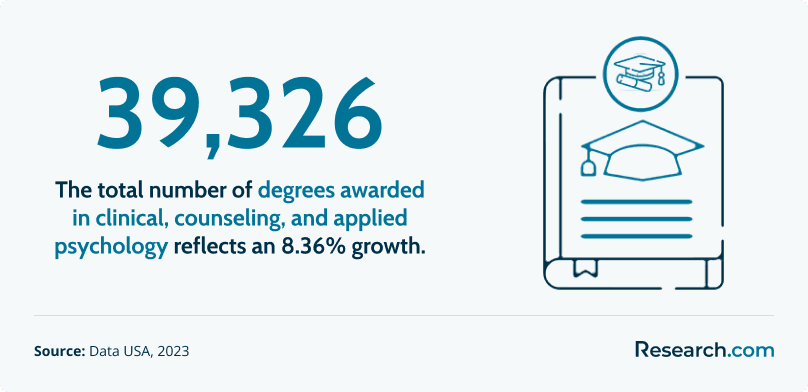
In a recent year, 39,326 master’s degrees in this field were awarded, showing that many students from different academic and professional backgrounds successfully complete the admissions process.
Common Courses in Online Clinical Counseling and Applied Psychology Master’s Programs
Accredited counseling programs typically include a clinical core that prepares students for assessment, diagnosis, therapeutic communication, ethical practice, and supervised client work. The exact course titles differ by school, but the competencies are often similar.
Some students prefer accelerated scheduling formats. Research.com’s overview of 8 week online college courses can help you understand how compressed online terms work, though counseling students should confirm whether intensive course schedules fit clinical training requirements.
- Psychopathology and Diagnosis: Students learn how clinicians assess mental health conditions and use the Diagnostic and Statistical Manual of Mental Disorders (DSM).
- Counseling Theories: This course compares major approaches to therapy and helps students begin forming a clinical orientation. Students considering a broader counseling pathway may also compare options through Research.com’s guide to an online counseling psychology degree.
- Professional Ethics and Law: Students study ethical codes, legal duties, confidentiality, mandated reporting, boundaries, and professional standards.
- Group Counseling: This course covers how to plan, facilitate, and evaluate therapeutic groups.
- Human Growth and Development: Students examine development across the lifespan so they can understand clients in context.
- Clinical Practicum and Internship: Students apply counseling skills in approved clinical settings under supervision.
Specializations in Online Clinical Counseling and Applied Psychology Programs
A specialization can help you focus your training, choose more relevant practicum sites, and prepare for specific populations or practice settings. The best specialization is the one that matches your intended license, preferred client population, and local job opportunities.
- Trauma and Crisis Counseling: This focus prepares students to support clients affected by traumatic experiences, acute stress, or crisis situations.
- Addiction and Substance Abuse Counseling: Students learn evidence-based approaches for working with substance use disorders and recovery support systems.
- Child and Adolescent Counseling: This area focuses on developmental, family, school, and behavioral issues affecting children and teenagers.
- Marriage and Family Therapy: Students study relational systems, couple dynamics, and family-based interventions.
- Applied Psychology: This focus may fit students who are less interested in direct clinical practice and more interested in behavioral science applications. If your goals lean toward organizational behavior, research, or nonclinical settings, compare options through Research.com’s applied psychology online degree guide.
If you are comparing counseling with unrelated graduate paths, use a different ROI framework. Programs such as HBCU online MBA programs or sports journalism masters programs are usually evaluated by industry mobility and portfolio value, while counseling programs must be judged heavily on licensure alignment and clinical training quality.
How to Choose the Best Online Master’s in Clinical Counseling and Applied Psychology Program
The best program is not necessarily the most famous or the cheapest. It is the one that meets licensing requirements where you plan to work, provides credible clinical preparation, fits your schedule, and has a cost structure you understand before enrolling.
- Start with licensure requirements. Review your state or province’s rules before you apply. Confirm required credits, supervised hours, exams, and any accreditation preferences.
- Check accreditation carefully. For counseling programs, Council for Accreditation of Counseling and Related Educational Programs (CACREP) accreditation can be especially important in many licensing contexts. Regional institutional accreditation also matters.
- Ask about practicum and internship support. Online students should know whether the school finds placements, assists with site approval, or leaves most of the search to the student.
- Compare total program cost. Request a full estimate that includes tuition, fees, residencies, materials, and clinical training expenses.
- Evaluate faculty experience. Look for instructors with relevant clinical licenses, supervision experience, research activity, or professional leadership in counseling and psychology.
- Match concentrations to your goals. If you already know you want clinical mental health counseling, compare program structures through Research.com’s list of the best online master's programs in clinical mental health counseling.
Questions to Ask Before Enrolling
| Question | Why It Matters |
| Does this program meet licensure requirements in my state? | Licensure rules vary, and not every online program is designed for every jurisdiction. |
| Is the program CACREP, MPCAC, CCPA, or otherwise appropriately accredited for my goal? | Accreditation can affect licensure eligibility, employer perception, and transferability. |
| How are practicum and internship placements handled? | Field placement support can be one of the biggest differences between programs. |
| Are there required campus visits, residencies, or intensives? | These can affect cost, travel, and work schedules. |
| What is the full cost of attendance? | Tuition alone does not show the true price of the degree. |
| What happens if I move to another state during or after the program? | Relocation can complicate licensure planning and clinical placement approval. |
Common Mistakes to Avoid When Choosing a Program
- Choosing a program before checking licensure rules: State requirements should guide your school search from the beginning.
- Comparing only tuition per credit: A lower credit price may not mean a lower total cost if the program requires more credits, travel, or added fees.
- Assuming online means fully remote: Some online programs require residencies, campus intensives, or in-person clinical work.
- Ignoring field placement logistics: Ask early how sites are approved and what support the school provides.
- Relying only on rankings: Rankings can help narrow options, but licensing fit, accreditation, supervision quality, and affordability matter more.
- Assuming salary outcomes are guaranteed: Earnings vary by role, location, setting, experience, license level, and employer.
Career Paths With an Online Master’s in Clinical Counseling and Applied Psychology
Graduates can pursue several mental health and counseling roles, especially after completing supervised experience and licensure requirements. Your exact options depend on your state or provincial rules, concentration, practicum experience, and whether the program was designed for clinical licensure.
| Career Path | Typical Work | Median Salary Listed |
| Licensed Professional Counselor or Licensed Mental Health Counselor | Provides therapy to individuals, groups, and families in settings such as agencies, hospitals, and outpatient centers. | $58,000 per year |
| Substance Abuse Counselor | Supports clients dealing with addiction, substance use disorders, relapse prevention, and recovery planning. | $53,000 per year |
| Clinical Supervisor | Mentors and oversees newer counselors after gaining full licensure and professional experience. | $75,000 per year |
| Private Practice Clinician | Operates independently or within a group practice after meeting licensure and business requirements. | $85,000 per year |
| Mental Health Program Manager | Develops, coordinates, and evaluates behavioral health programs in healthcare or community settings. | $80,000 per year |
1. Licensed Professional Counselor or Licensed Mental Health Counselor
This is one of the most common goals for graduates of licensure-focused counseling programs. LPCs and LMHCs provide counseling services to clients experiencing mental health, relationship, stress, adjustment, or life transition concerns.
Median Salary: $58,000 per year.
2. Substance Abuse Counselor
Substance abuse counselors focus on addiction treatment and recovery. They may work in outpatient clinics, residential programs, hospitals, correctional settings, or community agencies.
Median Salary: $53,000 per year.
3. Clinical Supervisor
Experienced, fully licensed clinicians may become supervisors for counselors completing their own licensure hours. This role requires strong clinical judgment, ethical awareness, and mentoring ability.
Median Salary: $75,000 per year.
4. Private Practice Clinician
Private practice is a long-term goal for many counselors. It can offer more autonomy, but it also requires business planning, referral development, insurance or billing knowledge, and compliance with professional regulations.
Median Salary: $85,000 per year.
5. Mental Health Program Manager
Graduates with clinical experience may move into leadership roles that involve program design, staff coordination, quality improvement, and service evaluation. Students interested in other advanced mental health roles may also compare counseling with nursing pathways such as online MSN PMHNP programs.
Median Salary: $80,000 per year.
The chart below shows the top industries where these roles are found.
Professional Networking and Career Support Resources to Look For
Career services can make a significant difference in an online counseling program, especially because students must often coordinate local clinical placements and build professional networks outside a physical campus. Strong programs may offer placement advising, alumni mentoring, virtual employer events, licensure guidance, resume support, and interview preparation.
Before enrolling, ask whether the school has mental health employer relationships, whether graduates receive help finding supervised post-degree roles, and whether faculty can support students seeking professional association involvement. These services do not guarantee employment, but they can reduce the isolation that some online learners experience.
Job Market Outlook for Graduates
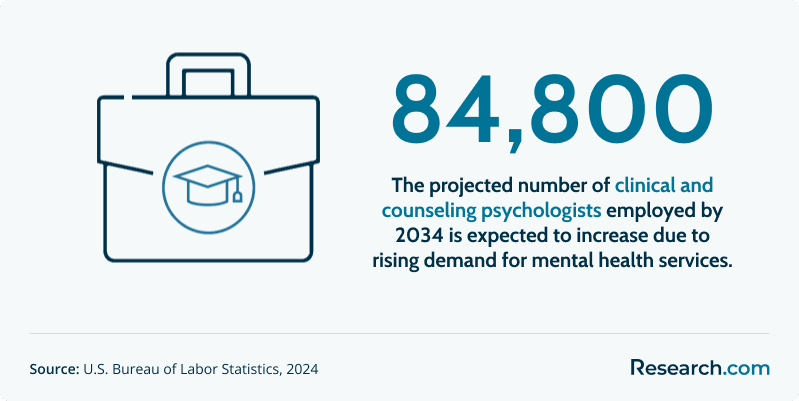
The employment outlook for clinical and counseling psychology-related roles is strong. The U.S. Bureau of Labor Statistics projects that employment for clinical and counseling psychologists will grow 13.3% over the next decade, which is much faster than the average for all occupations.
Demand is influenced by broader recognition of mental health needs, improved access to therapy through insurance coverage, and integrated care models that combine physical and behavioral health services. By 2034, the number of employed clinical and counseling psychologists is projected to reach 84,800. In addition, 27.7% of employers are already planning to increase starting salaries for master’s graduates.
The graphic below provides a clear projection of this employment growth.
How AI and Technology Are Affecting Counseling Careers
Technology is changing how counseling services are delivered, but it is not replacing the need for trained clinicians. Online therapy platforms, electronic health records, remote supervision tools, digital assessments, and AI-supported administrative systems are now part of many behavioral health settings.
For students, this means technology skills matter. Future counselors should become comfortable with telehealth ethics, privacy standards, online documentation, crisis protocols for remote clients, and the limitations of digital tools. Human clinical judgment, empathy, cultural awareness, and ethical decision-making remain central to the profession.
Student Experience Themes From Online Counseling Graduates
- : "After years in a corporate role that no longer felt meaningful, the online program made a career change possible. Studying at night while managing family responsibilities was difficult, but the clinical focus helped connect coursework to real counseling work. — Raymond"
- : "A campus program would not have worked with young children at home. The online format allowed coursework to happen during evenings and weekends, making graduate school demanding but realistic. — Jennifer"
- : "Coming from a non-psychology undergraduate background created self-doubt at first. Strong foundational courses and supportive faculty helped build confidence before internship began. — Raven"
Related Research.com Resources for Broader Program Comparison
If you are still deciding between counseling, psychology, and other graduate pathways, compare programs based on purpose. Licensure-focused counseling degrees should be evaluated differently from business, communications, or general online graduate programs. Research.com also offers resources on online counseling psychology degree options, applied psychology online degree programs, and online master's programs in clinical mental health counseling.
Students comparing broader graduate formats can also review HBCU online MBA programs, sports journalism masters programs, historically women's colleges, and 8 week online college courses to understand how structure, cost, and outcomes differ across fields.
Key Insights
- An online master’s in clinical counseling or applied psychology is most valuable when it clearly supports your intended licensure path.
- Most full-time students finish the degree in about two to three years, but independent licensure often requires a total commitment of four to six years after adding supervised clinical hours.
- The average total tuition is approximately $60,000, but total cost can change significantly once fees, residencies, books, and clinical expenses are included.
- Accreditation matters. CACREP, MPCAC, CCPA, regional accreditation, and state board recognition can all affect whether a program fits your professional goal.
- Online programs can match the academic rigor of campus programs, but students must confirm residency requirements, practicum placement support, and state authorization.
- Specializations such as trauma, addiction, child and adolescent counseling, marriage and family therapy, and applied psychology should be chosen based on the clients and settings you want to serve.
- Do not rely on rankings alone. The best program for you is the one that aligns with licensure rules, supports clinical training, fits your life, and has a manageable cost.
References
- Bureau of Labor Statistics. Clinical and counseling psychologists occupational employment and wages. Retrieved from BLS occupational wage data
- Bureau of Labor Statistics. Psychologists occupational outlook information. Retrieved from BLS occupational outlook
- Data USA. Clinical, counseling, and applied psychology profile. Retrieved from Data USA clinical, counseling, and applied psychology data
- Data USA. Counseling psychology profile. Retrieved from Data USA counseling psychology data
- EAB. Online graduate market trends. Retrieved from EAB online graduate market analysis
- Education Data Initiative. Financial aid statistics. Retrieved from EducationData financial aid statistics
- Health Resources and Services Administration. State of the behavioral health workforce report. Retrieved from HRSA behavioral health workforce report
- National Association of Colleges and Employers. Graduate outcomes. Retrieved from NACE graduate outcomes
- Purdue University. Working professionals and master’s program ROI. Retrieved from Purdue Online ROI discussion
- Survey Data Science, University of Michigan. Master’s degree salary outlooks. Retrieved from University of Michigan salary outlooks
- University of Georgia. Growth of online master’s degrees. Retrieved from UGA Online master’s degree trends
- ZipRecruiter. Applied psychology salary information. Retrieved from ZipRecruiter applied psychology salary data
- Zippia. Clinical counselor demographics. Retrieved from Zippia clinical counselor demographics
- Zippia. Counseling psychologist education information. Retrieved from Zippia counselor education data
Other Things You Should Know About Online Master’s in Clinical Counseling and Applied Psychology Programs
Students typically need a reliable internet connection and a computer that supports updated operating systems and browsers. Many programs use specific platforms for coursework, so students may need software like Zoom or Microsoft Teams for virtual classes and interactions.
Most accredited online master’s programs in clinical counseling require a supervised practicum of at least 100 hours and an internship of 600 hours. These placements must usually be completed in approved clinical settings under a licensed supervisor to meet CACREP-aligned training standards.


